

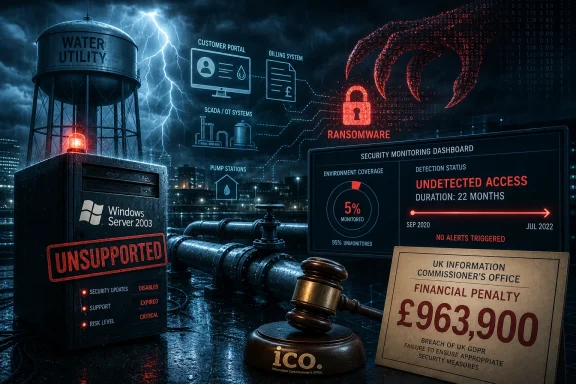
South Staffordshire Plc, parent of South Staffs Water, has been fined £963,900 by the UK Information Commissioner’s Office on May 11, 2026, after a Cl0p ransomware intrusion first begun in September 2020 went undetected until July 2022 and exposed data on 633,887 people. The headline number is not the most interesting part of the case. The real story is that a critical infrastructure operator was not beaten by a zero-day miracle or cinematic sabotage, but by the familiar compound interest of weak monitoring, old software, poor patching, and excess privilege.
The fine lands in a sector already struggling with public trust. Water companies do not compete for customers in the ordinary consumer sense; most households cannot switch provider because they dislike the security posture of the one assigned to their region. That makes this case less like a conventional corporate breach and more like a civic failure with invoices attached.
The attack was detected in July 2022, but the postmortem timeline pushed the initial compromise back to September 2020. In cyber terms, that is not a dwell time; it is a residency. An intruder with nearly two years inside a network has time to map systems, escalate privileges, identify valuable stores of data, and decide when public extortion will cause the most pain.
That chronology matters because it punctures the comforting story companies often tell after ransomware incidents. The stock phrase is that an organization “took immediate action” after becoming aware of an attack. That may be true in the narrow incident-response sense, but it does not answer the harder question: why did awareness arrive so late?
The ICO’s findings suggest a company that lacked the visibility to know what was happening inside its own environment. According to the regulator, only around 5 percent of South Staffordshire’s IT estate was being monitored. That statistic is devastating because it converts the breach from an unlucky ambush into a predictable result.
The company was reportedly alerted by performance issues, not by a mature detection pipeline. That distinction should make every administrator wince. If the first meaningful signal of compromise is that systems feel sluggish, the attacker has already won the reconnaissance phase, the access phase, and probably most of the data-theft phase too.
The ICO’s list of failings reads like the agenda for a security fundamentals workshop: insufficient access controls, inadequate logging, unsupported software, poor vulnerability management, and weak scanning practice. None of those is exotic. None requires a breakthrough in cryptography or a nation-state budget to understand.
The privilege-escalation point is particularly important. The regulator said the attacker was able to escalate to administrator rights after gaining an initial foothold. That is the moment a breach changes character, because admin access turns a local compromise into an enterprise problem.
Unsupported software made the picture worse. The presence of Windows Server 2003 in a modern environment is not merely embarrassing; it is a governance signal. There are sometimes hard operational reasons for keeping ancient systems alive, especially in utilities and industrial environments, but those reasons do not remove the obligation to isolate, monitor, compensate, and plan an exit.
The problem is not that old systems exist. The problem is pretending that unsupported systems can be treated as ordinary nodes on an ordinary network. Once a server is no longer receiving mainstream security fixes, the organization has chosen a different risk model whether it admits it or not.
That model demands compensating controls: segmentation, strict access paths, application allow-listing, enhanced monitoring, documented ownership, and a funded replacement plan. Without those, “legacy” becomes a euphemism for unmanaged exposure. The ICO’s decision makes clear that regulators are less interested in whether an old platform was convenient than whether the organization took appropriate steps to control the risks it created.
This is where many WindowsForum readers will recognize the uncomfortable reality behind the enforcement language. Legacy infrastructure is rarely kept alive by one bad decision. It survives through a chain of small postponements, each individually defensible, until the accumulated result is indefensible.
If only a small fraction of assets are producing useful telemetry, the defender’s view of the network is less a map than a keyhole. Attackers thrive in those gaps. They do not need to evade every alert if most systems are silent by design or neglect.
For Windows environments, this is not theoretical. Event logs, Active Directory changes, endpoint telemetry, authentication patterns, PowerShell execution, lateral movement, and anomalous admin activity are the raw material of detection. If those signals are not collected, retained, correlated, and reviewed, the organization is relying on luck dressed up as incident response.
The regulator’s phrasing also cuts against a common excuse: that monitoring is an enhancement rather than a baseline. For companies holding large volumes of personal data, and especially those operating critical national infrastructure, the ICO is treating proactive security as a legal expectation. That should focus boardrooms more effectively than another internal slide deck about “cyber maturity.”
That last point deserves attention because it shows why breach accounting by row count is inadequate. A spreadsheet entry can be more than a name and address. It can reveal vulnerability, medical dependency, household circumstances, or a need for extra assistance during supply interruptions.
Utilities hold unusually intimate data because their services are embedded in daily life. A water company may know where people live, how they pay, whether they are struggling with bills, and whether they need priority support. Customers do not provide that information because they admire the provider’s privacy policy; they provide it because the service is essential.
The leak was reportedly massive, exceeding 4 TB of company files. Volume is not always the same as sensitivity, but at that scale the distinction becomes academic for victims. Once a trove is published online, the company’s loss of control becomes everyone else’s long-tail risk.
This is the uncomfortable convergence facing utilities. The public expects physical resilience, regulatory compliance, affordability, customer service, and digital convenience all at once. Attackers do not care which budget line owns the weak point.
For defenders, the old distinction between IT and OT can become a dangerous comfort blanket. Even if the operational environment is segmented, poorly defended enterprise systems can still expose staff data, customer data, supplier data, network documentation, and credentials. Those are not side issues; they are the connective tissue of the organization.
The ICO’s intervention also shows that data protection law is now one of the more practical enforcement paths for cyber failures. Regulators may not need to prove that a pump was endangered to act. They can look at whether personal data was processed securely, whether known risks were managed, and whether reasonable controls were in place.
Still, the financial penalty should not be mistaken for the total cost. Incident response, legal support, customer communication, monitoring services, remediation work, executive time, insurance friction, staff anxiety, and reputational harm all sit outside the headline number. So does the cost borne by affected customers and employees who must live with leaked data long after the press cycle moves on.
South Staffordshire’s public response followed the expected pattern. The company apologized for the worry caused, said it took immediate action to contain the incident and support those affected, and said it has invested significantly in cybersecurity resilience, governance, and monitoring. That may all be true, and post-incident investment is better than denial.
But the regulator’s case is built around the period before discovery, not merely the response after it. Cybersecurity culture is revealed less by the emergency meeting than by the neglected scan, the unmonitored subnet, the unpatched critical system, and the unsupported server nobody has budgeted to replace.
The South Staffordshire case is harder to fit into that template. The ICO’s criticism focused on established, widely understood controls. That is regulator-speak for: this was not obscure.
This does not mean every breach is negligence or that defenders can stop every intrusion. Modern networks are large, hybrid, and full of dependencies. Ransomware crews have professional tooling, stolen credentials, access brokers, and a ruthless sense of timing.
But regulators are drawing a sharper distinction between being breached and being unprepared. An organization can suffer an intrusion despite reasonable controls. It is much harder to defend nearly two years of undetected access, minimal monitoring coverage, unsupported software, and inadequate vulnerability management.
Active Directory remains a recurring pressure point. Once attackers gain privileged access in a Windows domain, they can often move from opportunistic intrusion to strategic control. Least privilege, tiered administration, credential hygiene, and monitoring of privileged actions are not boutique practices; they are the line between containment and sprawl.
Vulnerability management is another area where process matters more than slogans. Running scans is not enough if findings are not triaged, assigned, remediated, and verified. Internal scanning matters because internet-facing exposure is only one part of the attack surface; once inside, attackers exploit whatever the internal network presents.
The same is true of logging. Collecting telemetry without review is archival theater. A security team needs coverage, retention, alerting logic, escalation paths, and the authority to demand fixes when signals point to systemic weakness.
This is why Ian Hulme’s comment for the ICO cuts through the technical language. Customers do not choose their water company. That lack of choice raises the duty of care rather than lowering it.
The same argument applies beyond water. Energy networks, transport systems, healthcare providers, councils, and outsourced public-service contractors all collect data under conditions where the individual has limited practical ability to opt out. The more compulsory the relationship, the less credible it is for the organization to behave as if data security were a discretionary investment.
This is also why cybersecurity should not be treated as an IT department problem. If a board approves years of underinvestment, tolerates unsupported systems, or accepts weak visibility because remediation is inconvenient, then the breach is not merely technical. It is managerial.
That shift favors organizations that can prove their work. Asset inventories, patch records, risk exceptions, segmentation diagrams, incident response exercises, log-retention policies, and vulnerability remediation metrics are not paperwork for its own sake. They are the documentary trail that shows whether security governance existed before the breach.
For smaller operators and strained utilities, this is daunting. Cybersecurity costs money, skilled staff are scarce, and legacy estates are not modernized by wishful thinking. But the South Staffordshire decision suggests that pleading complexity will not be enough where basic controls are absent.
The practical lesson is not that every organization must buy every security product. It is that every organization holding sensitive data must know what it runs, know what it exposes, know what it logs, and know who can administer it. Those are not luxury controls; they are the foundation on which everything else rests.
Source: The Register Water company's leaky security earns near-£1M fine
The fine lands in a sector already struggling with public trust. Water companies do not compete for customers in the ordinary consumer sense; most households cannot switch provider because they dislike the security posture of the one assigned to their region. That makes this case less like a conventional corporate breach and more like a civic failure with invoices attached.
 The Breach Was Old Before Anyone Knew It Existed
The attack was detected in July 2022, but the postmortem timeline pushed the initial compromise back to September 2020. In cyber terms, that is not a dwell time; it is a residency. An intruder with nearly two years inside a network has time to map systems, escalate privileges, identify valuable stores of data, and decide when public extortion will cause the most pain.That chronology matters because it punctures the comforting story companies often tell after ransomware incidents. The stock phrase is that an organization “took immediate action” after becoming aware of an attack. That may be true in the narrow incident-response sense, but it does not answer the harder question: why did awareness arrive so late?
The ICO’s findings suggest a company that lacked the visibility to know what was happening inside its own environment. According to the regulator, only around 5 percent of South Staffordshire’s IT estate was being monitored. That statistic is devastating because it converts the breach from an unlucky ambush into a predictable result.
The company was reportedly alerted by performance issues, not by a mature detection pipeline. That distinction should make every administrator wince. If the first meaningful signal of compromise is that systems feel sluggish, the attacker has already won the reconnaissance phase, the access phase, and probably most of the data-theft phase too.
Cl0p Did Not Need Magic When the Basics Were Missing
Cl0p has never needed much help becoming notorious. The group has been tied to high-impact data theft campaigns, extortion leaks, and a professionalized ransomware economy that treats stolen documents as leverage rather than collateral damage. But the South Staffordshire case is a reminder that the villain’s brand can distract from the victim’s security hygiene.The ICO’s list of failings reads like the agenda for a security fundamentals workshop: insufficient access controls, inadequate logging, unsupported software, poor vulnerability management, and weak scanning practice. None of those is exotic. None requires a breakthrough in cryptography or a nation-state budget to understand.
The privilege-escalation point is particularly important. The regulator said the attacker was able to escalate to administrator rights after gaining an initial foothold. That is the moment a breach changes character, because admin access turns a local compromise into an enterprise problem.
Unsupported software made the picture worse. The presence of Windows Server 2003 in a modern environment is not merely embarrassing; it is a governance signal. There are sometimes hard operational reasons for keeping ancient systems alive, especially in utilities and industrial environments, but those reasons do not remove the obligation to isolate, monitor, compensate, and plan an exit.
Windows Server 2003 Is Not a Legacy System, It Is a Warning Light
Every sysadmin has met the box nobody wants to touch. It runs a billing connector, an obscure reporting tool, a vendor package whose supplier vanished, or a plant-side application that “just works” until the day it doesn’t. Windows Server 2003 is the patron saint of that bargain.The problem is not that old systems exist. The problem is pretending that unsupported systems can be treated as ordinary nodes on an ordinary network. Once a server is no longer receiving mainstream security fixes, the organization has chosen a different risk model whether it admits it or not.
That model demands compensating controls: segmentation, strict access paths, application allow-listing, enhanced monitoring, documented ownership, and a funded replacement plan. Without those, “legacy” becomes a euphemism for unmanaged exposure. The ICO’s decision makes clear that regulators are less interested in whether an old platform was convenient than whether the organization took appropriate steps to control the risks it created.
This is where many WindowsForum readers will recognize the uncomfortable reality behind the enforcement language. Legacy infrastructure is rarely kept alive by one bad decision. It survives through a chain of small postponements, each individually defensible, until the accumulated result is indefensible.
Monitoring Five Percent of the Estate Is an Invitation to Be Surprised
Security monitoring is often sold as a dashboard problem. Buy the platform, connect the logs, tune the alerts, and a wall of glowing rectangles will eventually reveal the truth. The South Staffordshire case shows the more prosaic reality: monitoring that does not cover the environment cannot protect the environment.If only a small fraction of assets are producing useful telemetry, the defender’s view of the network is less a map than a keyhole. Attackers thrive in those gaps. They do not need to evade every alert if most systems are silent by design or neglect.
For Windows environments, this is not theoretical. Event logs, Active Directory changes, endpoint telemetry, authentication patterns, PowerShell execution, lateral movement, and anomalous admin activity are the raw material of detection. If those signals are not collected, retained, correlated, and reviewed, the organization is relying on luck dressed up as incident response.
The regulator’s phrasing also cuts against a common excuse: that monitoring is an enhancement rather than a baseline. For companies holding large volumes of personal data, and especially those operating critical national infrastructure, the ICO is treating proactive security as a legal expectation. That should focus boardrooms more effectively than another internal slide deck about “cyber maturity.”
The Data Was Not Abstract, and Neither Was the Harm
The breach affected 633,887 people, according to the ICO. The exposed material included personally identifiable information, customer online-service usernames and passwords, bank account numbers and sort codes, and HR data including National Insurance numbers. For a limited group on the Priority Services Register, the stolen data could have allowed inferences about disability.That last point deserves attention because it shows why breach accounting by row count is inadequate. A spreadsheet entry can be more than a name and address. It can reveal vulnerability, medical dependency, household circumstances, or a need for extra assistance during supply interruptions.
Utilities hold unusually intimate data because their services are embedded in daily life. A water company may know where people live, how they pay, whether they are struggling with bills, and whether they need priority support. Customers do not provide that information because they admire the provider’s privacy policy; they provide it because the service is essential.
The leak was reportedly massive, exceeding 4 TB of company files. Volume is not always the same as sensitivity, but at that scale the distinction becomes academic for victims. Once a trove is published online, the company’s loss of control becomes everyone else’s long-tail risk.
Critical Infrastructure Is a Data Protection Problem Too
When people talk about cyber risk in water, they often imagine pumps, treatment systems, and operational technology. That concern is legitimate, but the South Staffordshire fine is a reminder that critical infrastructure also fails through ordinary corporate IT. Billing systems, HR files, customer portals, and help-desk credentials may not open valves, but they can still become the route into a crisis.This is the uncomfortable convergence facing utilities. The public expects physical resilience, regulatory compliance, affordability, customer service, and digital convenience all at once. Attackers do not care which budget line owns the weak point.
For defenders, the old distinction between IT and OT can become a dangerous comfort blanket. Even if the operational environment is segmented, poorly defended enterprise systems can still expose staff data, customer data, supplier data, network documentation, and credentials. Those are not side issues; they are the connective tissue of the organization.
The ICO’s intervention also shows that data protection law is now one of the more practical enforcement paths for cyber failures. Regulators may not need to prove that a pump was endangered to act. They can look at whether personal data was processed securely, whether known risks were managed, and whether reasonable controls were in place.
The Fine Is Smaller Than the Lesson
A penalty of £963,900 is serious, but it is not existential for a utility group. The original proposed amount was larger, and the ICO reduced the fine by 40 percent after considering the company’s representations, including its agreement with the findings and early admission of wrongdoing. That reduction is important because it shows the enforcement model is not simply punitive; cooperation and remediation can matter.Still, the financial penalty should not be mistaken for the total cost. Incident response, legal support, customer communication, monitoring services, remediation work, executive time, insurance friction, staff anxiety, and reputational harm all sit outside the headline number. So does the cost borne by affected customers and employees who must live with leaked data long after the press cycle moves on.
South Staffordshire’s public response followed the expected pattern. The company apologized for the worry caused, said it took immediate action to contain the incident and support those affected, and said it has invested significantly in cybersecurity resilience, governance, and monitoring. That may all be true, and post-incident investment is better than denial.
But the regulator’s case is built around the period before discovery, not merely the response after it. Cybersecurity culture is revealed less by the emergency meeting than by the neglected scan, the unmonitored subnet, the unpatched critical system, and the unsupported server nobody has budgeted to replace.
Regulators Are Losing Patience With “Sophisticated Attack” Excuses
The phrase “sophisticated cyberattack” has become one of the most overused lines in breach communications. Sometimes it is accurate. Often it functions as a reputational airbag, implying that no reasonable organization could have resisted the attacker.The South Staffordshire case is harder to fit into that template. The ICO’s criticism focused on established, widely understood controls. That is regulator-speak for: this was not obscure.
This does not mean every breach is negligence or that defenders can stop every intrusion. Modern networks are large, hybrid, and full of dependencies. Ransomware crews have professional tooling, stolen credentials, access brokers, and a ruthless sense of timing.
But regulators are drawing a sharper distinction between being breached and being unprepared. An organization can suffer an intrusion despite reasonable controls. It is much harder to defend nearly two years of undetected access, minimal monitoring coverage, unsupported software, and inadequate vulnerability management.
For Windows Admins, the Case Reads Like a Checklist Written in Red Ink
The details that matter here are familiar to Windows administrators because they are the things that often lose priority when budgets are tight and uptime is king. Patch cycles slip because maintenance windows are politically expensive. Legacy servers remain because vendors are slow or departments resist change. Logging projects stall because storage, licensing, and staffing costs are easy to cut until the day logs are needed.Active Directory remains a recurring pressure point. Once attackers gain privileged access in a Windows domain, they can often move from opportunistic intrusion to strategic control. Least privilege, tiered administration, credential hygiene, and monitoring of privileged actions are not boutique practices; they are the line between containment and sprawl.
Vulnerability management is another area where process matters more than slogans. Running scans is not enough if findings are not triaged, assigned, remediated, and verified. Internal scanning matters because internet-facing exposure is only one part of the attack surface; once inside, attackers exploit whatever the internal network presents.
The same is true of logging. Collecting telemetry without review is archival theater. A security team needs coverage, retention, alerting logic, escalation paths, and the authority to demand fixes when signals point to systemic weakness.
The Water Sector’s Trust Problem Now Includes Cyber Hygiene
UK water companies have spent years under public pressure over sewage discharges, infrastructure investment, dividends, debt, and bills. Cybersecurity adds another dimension to that trust deficit. The public may not understand privilege escalation or unsupported operating systems, but it understands being forced to hand over personal data to a monopoly provider that then loses control of it.This is why Ian Hulme’s comment for the ICO cuts through the technical language. Customers do not choose their water company. That lack of choice raises the duty of care rather than lowering it.
The same argument applies beyond water. Energy networks, transport systems, healthcare providers, councils, and outsourced public-service contractors all collect data under conditions where the individual has limited practical ability to opt out. The more compulsory the relationship, the less credible it is for the organization to behave as if data security were a discretionary investment.
This is also why cybersecurity should not be treated as an IT department problem. If a board approves years of underinvestment, tolerates unsupported systems, or accepts weak visibility because remediation is inconvenient, then the breach is not merely technical. It is managerial.
The Coming Fight Is Over Evidence, Not Intentions
The next phase of cybersecurity enforcement will be shaped by evidence. Regulators are not going to be satisfied with statements that an organization takes security seriously. They will ask what was monitored, what was patched, what was unsupported, what risks were known, who owned them, and how long they remained unresolved.That shift favors organizations that can prove their work. Asset inventories, patch records, risk exceptions, segmentation diagrams, incident response exercises, log-retention policies, and vulnerability remediation metrics are not paperwork for its own sake. They are the documentary trail that shows whether security governance existed before the breach.
For smaller operators and strained utilities, this is daunting. Cybersecurity costs money, skilled staff are scarce, and legacy estates are not modernized by wishful thinking. But the South Staffordshire decision suggests that pleading complexity will not be enough where basic controls are absent.
The practical lesson is not that every organization must buy every security product. It is that every organization holding sensitive data must know what it runs, know what it exposes, know what it logs, and know who can administer it. Those are not luxury controls; they are the foundation on which everything else rests.
South Staffordshire’s Fine Turns a Breach Report Into a Boardroom Memo
The case leaves behind a set of lessons that are concrete enough to survive beyond the news cycle. They are not glamorous, but that is precisely the point. Mature security is often the boring work that prevents exciting headlines.- Organizations cannot defend systems they do not inventory, monitor, or understand.
- Unsupported Windows servers require compensating controls and a funded retirement plan, not quiet acceptance.
- Privileged access must be constrained, monitored, and treated as a primary breach risk.
- Vulnerability scanning only matters when findings lead to tracked remediation.
- Critical infrastructure operators face a higher trust obligation because customers often cannot choose another provider.
- Post-breach cooperation may reduce a fine, but it does not erase years of preventable exposure.
Source: The Register Water company's leaky security earns near-£1M fine
