

South Oxfordshire and Vale of White Horse District Councils moved from a long-running outsourced IT model to an in-house Microsoft cloud environment in 2025, with Node4 helping migrate Microsoft 365, devices, Teams telephony, and 14 legacy servers into Azure ahead of a September contract deadline. The project matters because it is not merely another public-sector cloud case study. It is a useful snapshot of where local government IT is heading: away from monolithic outsourcing contracts and toward smaller internal teams that use cloud platforms, automation, and selective specialist partners to regain control.
The headline is Azure migration. The larger story is sovereignty of operation. South & Vale did not bring IT back in-house because the cloud made infrastructure magically simple; it did so because the old model made change politically and contractually expensive.
For nearly a decade, South & Vale operated under a fully outsourced managed services contract. That arrangement gave the councils a working IT service, but it also wrapped everyday technical decisions in the process machinery of a multi-party contract. According to Simon Turner, the councils’ IT and digital services manager, even relatively ordinary changes became negotiations because several partners and other councils sat inside the same contract model.
That is the uncomfortable truth behind many public-sector outsourcing deals. They are often sold as a way to reduce operational burden, but over time they can turn IT into a queue. The provider may be competent, the contract may be legally sound, and the service may be stable — yet the organisation still loses the ability to move at the speed of its own requirements.
South & Vale’s decision to rebuild its own IT capability before the September 30, 2025 contract end date was therefore not a nostalgic return to server-hugging. It was a bet that the councils needed internal authority over architecture, priorities, security posture, and service evolution. Cloud infrastructure only makes that bet possible if the operating model changes with it.
This is why the Node4 role is significant. The councils did not simply swap one outsourcing provider for another. They used a specialist partner to do the hard migration work, establish the Microsoft foundation, and fill capability gaps while preserving the strategic control that had been missing from the previous arrangement.
That model made sense when the biggest challenge was keeping commodity systems running. It fits less well when councils are expected to digitise citizen services, manage hybrid work, secure distributed endpoints, and prepare for AI-assisted productivity tools. The technology stack changes faster than the governance structure around it.
Turner’s criticism was not that the old provider failed to perform any one task. It was that the system was insufficiently flexible for modern council needs. When change requires consensus across councils and suppliers, the pace of technology becomes a problem rather than an advantage.
The lesson for IT leaders is blunt: if every architectural decision requires contract archaeology, the organisation has already lost agility. The cloud will not fix that by itself. A badly governed cloud estate can be just as slow, opaque, and expensive as an outsourced data centre.
That is where many migration projects become dangerous. Organisations can underestimate the dependencies accumulated over years of managed service operation: device ownership, network assumptions, server locations, telephony routing, database administration, application access, identity configuration, and undocumented operational habits. The contract ends on a date; the technical entanglement does not politely end with it.
Node4’s work began with the Microsoft 365 tenant because identity and collaboration are now the centre of gravity in a Microsoft estate. Reviewing security, governance, and compliance was not administrative tidying. It was the foundation for everything else: device enrolment, Teams telephony, data access, and future AI governance.
The councils then had to deal with 800 laptops tied to the previous provider’s network. Those devices needed intellectual property removed, images rebuilt, and management shifted into the new environment. In practical terms, that is where abstract strategy becomes a logistics problem involving people, schedules, helpdesk capacity, and a tolerance for very little downtime.
South & Vale chose the latter. Node4 built the Windows 11 package and the Intune Autopilot platform used to onboard, rebuild, and reimage the laptop estate in a standardised way. The councils say 800 laptops were rebuilt in four weeks, a pace that would be difficult to imagine under a heavily bespoke, manually managed desktop model.
Autopilot is not magic, and sysadmins know it can be unforgiving when application packaging, network access, identity, drivers, and enrolment policies are poorly prepared. But when it works, it shifts endpoint deployment from artisanal rebuilds to repeatable provisioning. That is exactly the kind of operational muscle a smaller in-house team needs.
The Windows 11 move also hints at a deeper shift. The device is no longer treated as a semi-permanent local artefact lovingly maintained by an external provider. It becomes a managed endpoint in a cloud-governed fleet, replaceable, policy-driven, and easier to recover.
For councils, this is not a cosmetic change. Telephony still matters because residents call about planning, waste, benefits, environmental services, and local issues that are not always neatly handled by web forms. A failed voice migration is visible immediately and politically uncomfortable.
Putting calling inside Teams aligns communications with the collaboration environment employees already use. It also reduces the fragmentation between telephony, user identity, endpoint policy, and support operations. That consolidation is attractive, but it also makes Microsoft 365 governance more consequential.
The risk is platform concentration. When identity, collaboration, calling, endpoint management, analytics, and eventually AI all sit in the Microsoft orbit, the organisation gains integration but also deepens dependency. South & Vale’s choice is rational, especially given its long Microsoft 365 history, but it places a premium on internal competence and strong partner oversight.
This is the reality behind many local government cloud stories. The future may be SaaS, analytics, and AI, but the present still includes line-of-business applications with specific hosting requirements, database dependencies, and service expectations. Azure becomes the landing zone not because every workload is instantly cloud-native, but because the organisation needs somewhere controlled and supportable to put systems that cannot yet be retired.
A successful migration into Azure is therefore only the first chapter. Once workloads are stable, councils can begin asking harder questions. Which applications should be modernised? Which should be replaced? Which data sets should feed reporting platforms? Which systems are too expensive or risky to keep in their current form?
The danger is declaring victory at the moment of relocation. A server running in Azure is not automatically modern. It is simply under a different operational and commercial model, and the next gains come from rationalisation, automation, resilience design, and data strategy.
That kind of timeline sounds neat in a case study, but the more revealing detail is that Turner spent the prior two years building the in-house IT team and preparing the foundations. The migration itself may have had a dramatic final stretch, but the capability shift was slow, deliberate, and organisational.
This is the part other councils should pay attention to. Bringing IT in-house is not a procurement slogan. It requires recruiting or developing people who can own architecture, supplier management, security decisions, service delivery, and the messy reality of applications. Without that internal spine, cloud migration can become just another dependency shift.
The lack of reported downtime or outages is impressive, but it should not be read as evidence that such migrations are easy. It is evidence that preparation matters. The visible cutover is the smallest part of the work.
That is not hypocrisy; it is the modern operating model. Very few local authorities can justify full-time specialists for every database, cloud, telephony, endpoint, security, and analytics requirement. The smarter question is not whether partners are involved, but whether they are used to increase institutional control or substitute for it.
The database administration example is instructive. During the project, Turner identified two business-critical databases that had been managed by the previous provider and would otherwise lose coverage. Node4’s data services team took on the DBA role, giving the councils access to specialist maintenance without hiring a full-time resource.
That is the sweet spot for partner use: targeted expertise around defined operational needs. It avoids the sprawl of a fully outsourced model while recognising that small public-sector IT teams cannot be staffed like global enterprises.
AI tools such as Copilot are only as safe and useful as the permissions, data hygiene, retention policies, and information architecture beneath them. If a council’s files, Teams, SharePoint sites, and legacy repositories are poorly governed, AI will not fix the mess. It may simply expose it faster.
Power BI presents a similar challenge from a different angle. Local authorities sit on valuable operational data, but turning it into reliable insight requires more than dashboards. It requires agreed definitions, trustworthy sources, access controls, and a culture that can distinguish useful measurement from performative reporting.
South & Vale’s migration gives it a better platform for that work. It does not guarantee success. The next phase will be less about moving systems and more about deciding how information should flow through the organisation.
But simplicity purchased through inflexibility eventually becomes expensive. If a council cannot adapt its technology stack without renegotiating across multiple parties, it is effectively paying an agility tax. That tax shows up as delayed projects, frustrated staff, weaker experimentation, and an inability to respond quickly when policy or service needs change.
Cloud platforms have not eliminated outsourcing. If anything, they have created a richer market for managed cloud, security, data, and modern workplace services. What they have changed is the shape of dependency. Councils can now retain architectural control while buying specialist help in narrower, more accountable slices.
That is a healthier model, provided the public body has enough internal capability to remain an intelligent customer. Without that, the language changes but the dependency remains.
Source: Comms Business Node4 supports South & Vale Councils’ Microsoft Azure migration - Comms Business
The headline is Azure migration. The larger story is sovereignty of operation. South & Vale did not bring IT back in-house because the cloud made infrastructure magically simple; it did so because the old model made change politically and contractually expensive.
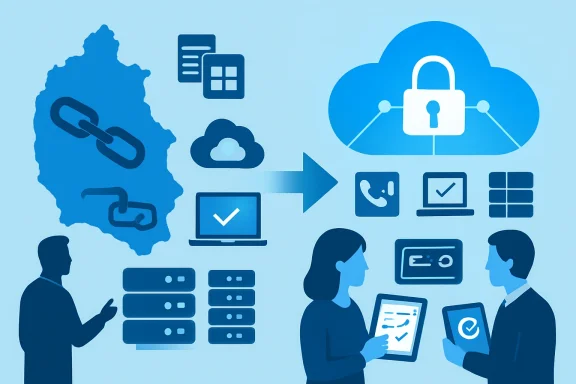 The Cloud Win Was Really a Governance Win
For nearly a decade, South & Vale operated under a fully outsourced managed services contract. That arrangement gave the councils a working IT service, but it also wrapped everyday technical decisions in the process machinery of a multi-party contract. According to Simon Turner, the councils’ IT and digital services manager, even relatively ordinary changes became negotiations because several partners and other councils sat inside the same contract model.That is the uncomfortable truth behind many public-sector outsourcing deals. They are often sold as a way to reduce operational burden, but over time they can turn IT into a queue. The provider may be competent, the contract may be legally sound, and the service may be stable — yet the organisation still loses the ability to move at the speed of its own requirements.
South & Vale’s decision to rebuild its own IT capability before the September 30, 2025 contract end date was therefore not a nostalgic return to server-hugging. It was a bet that the councils needed internal authority over architecture, priorities, security posture, and service evolution. Cloud infrastructure only makes that bet possible if the operating model changes with it.
This is why the Node4 role is significant. The councils did not simply swap one outsourcing provider for another. They used a specialist partner to do the hard migration work, establish the Microsoft foundation, and fill capability gaps while preserving the strategic control that had been missing from the previous arrangement.
Legacy Outsourcing Failed the Pace Test
The phrase “legacy IT” tends to conjure racks of ageing servers and dusty applications. In South & Vale’s case, the more important legacy may have been contractual. The councils had deployed Microsoft 365 as far back as 2015, but the surrounding operating model still reflected an older era in which public bodies bought IT as a large, bundled service.That model made sense when the biggest challenge was keeping commodity systems running. It fits less well when councils are expected to digitise citizen services, manage hybrid work, secure distributed endpoints, and prepare for AI-assisted productivity tools. The technology stack changes faster than the governance structure around it.
Turner’s criticism was not that the old provider failed to perform any one task. It was that the system was insufficiently flexible for modern council needs. When change requires consensus across councils and suppliers, the pace of technology becomes a problem rather than an advantage.
The lesson for IT leaders is blunt: if every architectural decision requires contract archaeology, the organisation has already lost agility. The cloud will not fix that by itself. A badly governed cloud estate can be just as slow, opaque, and expensive as an outsourced data centre.
Node4’s Real Deliverable Was an Exit Ramp
The South & Vale project had the usual ingredients of a Microsoft modernisation programme: tenant review, device migration, Windows 11 deployment, Intune Autopilot, Teams Calling, server migration into Azure, and future work around Copilot and Power BI. But the binding thread was exit management. The councils had to leave an incumbent provider cleanly without breaking public services.That is where many migration projects become dangerous. Organisations can underestimate the dependencies accumulated over years of managed service operation: device ownership, network assumptions, server locations, telephony routing, database administration, application access, identity configuration, and undocumented operational habits. The contract ends on a date; the technical entanglement does not politely end with it.
Node4’s work began with the Microsoft 365 tenant because identity and collaboration are now the centre of gravity in a Microsoft estate. Reviewing security, governance, and compliance was not administrative tidying. It was the foundation for everything else: device enrolment, Teams telephony, data access, and future AI governance.
The councils then had to deal with 800 laptops tied to the previous provider’s network. Those devices needed intellectual property removed, images rebuilt, and management shifted into the new environment. In practical terms, that is where abstract strategy becomes a logistics problem involving people, schedules, helpdesk capacity, and a tolerance for very little downtime.
Windows 11 Became the Forcing Function
The migration also gave South & Vale a natural point to move from Windows 10 to Windows 11. That timing matters. Microsoft’s Windows 10 support deadline has already forced organisations to decide whether endpoint modernisation is a chore to postpone or an opportunity to reset device management.South & Vale chose the latter. Node4 built the Windows 11 package and the Intune Autopilot platform used to onboard, rebuild, and reimage the laptop estate in a standardised way. The councils say 800 laptops were rebuilt in four weeks, a pace that would be difficult to imagine under a heavily bespoke, manually managed desktop model.
Autopilot is not magic, and sysadmins know it can be unforgiving when application packaging, network access, identity, drivers, and enrolment policies are poorly prepared. But when it works, it shifts endpoint deployment from artisanal rebuilds to repeatable provisioning. That is exactly the kind of operational muscle a smaller in-house team needs.
The Windows 11 move also hints at a deeper shift. The device is no longer treated as a semi-permanent local artefact lovingly maintained by an external provider. It becomes a managed endpoint in a cloud-governed fleet, replaceable, policy-driven, and easier to recover.
Teams Calling Shows the Platform Strategy Taking Shape
Telephony is often where cloud transformation projects reveal whether they are genuine platform moves or just infrastructure relocations. South & Vale replaced its legacy telephony platform with Teams Calling, integrated with the contact centre and supported by Node4’s Direct Routing platform. The deployment now supports 790 users with hunt groups, voicemail, and PSTN connectivity.For councils, this is not a cosmetic change. Telephony still matters because residents call about planning, waste, benefits, environmental services, and local issues that are not always neatly handled by web forms. A failed voice migration is visible immediately and politically uncomfortable.
Putting calling inside Teams aligns communications with the collaboration environment employees already use. It also reduces the fragmentation between telephony, user identity, endpoint policy, and support operations. That consolidation is attractive, but it also makes Microsoft 365 governance more consequential.
The risk is platform concentration. When identity, collaboration, calling, endpoint management, analytics, and eventually AI all sit in the Microsoft orbit, the organisation gains integration but also deepens dependency. South & Vale’s choice is rational, especially given its long Microsoft 365 history, but it places a premium on internal competence and strong partner oversight.
Fourteen Servers Carried the Highest Stakes
The least glamorous part of the project may have been the most important: migrating 14 legacy servers from the old provider’s data centres into Azure. Turner described this as the biggest and most crucial piece of work because those servers held data for some of the councils’ most important applications. If the server migration failed, the consequences would not be abstract.This is the reality behind many local government cloud stories. The future may be SaaS, analytics, and AI, but the present still includes line-of-business applications with specific hosting requirements, database dependencies, and service expectations. Azure becomes the landing zone not because every workload is instantly cloud-native, but because the organisation needs somewhere controlled and supportable to put systems that cannot yet be retired.
A successful migration into Azure is therefore only the first chapter. Once workloads are stable, councils can begin asking harder questions. Which applications should be modernised? Which should be replaced? Which data sets should feed reporting platforms? Which systems are too expensive or risky to keep in their current form?
The danger is declaring victory at the moment of relocation. A server running in Azure is not automatically modern. It is simply under a different operational and commercial model, and the next gains come from rationalisation, automation, resilience design, and data strategy.
The Deadline Was Beaten Because the Programme Started Two Years Earlier
South & Vale’s contract with its previous provider ended on September 30, 2025, but the councils wanted to be off the old platforms by the end of July. They beat that internal target: by the end of June, users were reportedly no longer logging in to the old systems, and in July the legacy environment was switched off.That kind of timeline sounds neat in a case study, but the more revealing detail is that Turner spent the prior two years building the in-house IT team and preparing the foundations. The migration itself may have had a dramatic final stretch, but the capability shift was slow, deliberate, and organisational.
This is the part other councils should pay attention to. Bringing IT in-house is not a procurement slogan. It requires recruiting or developing people who can own architecture, supplier management, security decisions, service delivery, and the messy reality of applications. Without that internal spine, cloud migration can become just another dependency shift.
The lack of reported downtime or outages is impressive, but it should not be read as evidence that such migrations are easy. It is evidence that preparation matters. The visible cutover is the smallest part of the work.
The New Model Still Depends on Partners
There is a tendency in public-sector IT debates to frame the choice as outsourcing versus insourcing. South & Vale’s project shows why that binary is outdated. The councils brought strategic control back in-house, but they still relied on Node4 for Microsoft expertise, migration execution, telephony, Azure work, and later database administration services.That is not hypocrisy; it is the modern operating model. Very few local authorities can justify full-time specialists for every database, cloud, telephony, endpoint, security, and analytics requirement. The smarter question is not whether partners are involved, but whether they are used to increase institutional control or substitute for it.
The database administration example is instructive. During the project, Turner identified two business-critical databases that had been managed by the previous provider and would otherwise lose coverage. Node4’s data services team took on the DBA role, giving the councils access to specialist maintenance without hiring a full-time resource.
That is the sweet spot for partner use: targeted expertise around defined operational needs. It avoids the sprawl of a fully outsourced model while recognising that small public-sector IT teams cannot be staffed like global enterprises.
Copilot and Power BI Raise the Governance Bar
The councils are already discussing the potential use of Copilot and Power BI, with Node4 helping shape governance and safe deployment. That future-facing element is not just a nice add-on. It explains why control of the Microsoft tenant, data estate, and endpoint environment mattered in the first place.AI tools such as Copilot are only as safe and useful as the permissions, data hygiene, retention policies, and information architecture beneath them. If a council’s files, Teams, SharePoint sites, and legacy repositories are poorly governed, AI will not fix the mess. It may simply expose it faster.
Power BI presents a similar challenge from a different angle. Local authorities sit on valuable operational data, but turning it into reliable insight requires more than dashboards. It requires agreed definitions, trustworthy sources, access controls, and a culture that can distinguish useful measurement from performative reporting.
South & Vale’s migration gives it a better platform for that work. It does not guarantee success. The next phase will be less about moving systems and more about deciding how information should flow through the organisation.
Local Government Is Learning to Avoid the Mega-Contract Trap
The South & Vale story lands at a moment when councils are under pressure from every direction. They need to digitise services, defend against cyber threats, support hybrid work, handle resident expectations, meet accessibility obligations, and do it all under tight financial conditions. The old mega-contract promised simplicity: hand the problem to someone else.But simplicity purchased through inflexibility eventually becomes expensive. If a council cannot adapt its technology stack without renegotiating across multiple parties, it is effectively paying an agility tax. That tax shows up as delayed projects, frustrated staff, weaker experimentation, and an inability to respond quickly when policy or service needs change.
Cloud platforms have not eliminated outsourcing. If anything, they have created a richer market for managed cloud, security, data, and modern workplace services. What they have changed is the shape of dependency. Councils can now retain architectural control while buying specialist help in narrower, more accountable slices.
That is a healthier model, provided the public body has enough internal capability to remain an intelligent customer. Without that, the language changes but the dependency remains.
The South & Vale Playbook Is Smaller Than a Mega-Deal and Harder to Fake
The most concrete lesson from this migration is that public-sector cloud success is operational, not theatrical. The press-release numbers matter because they show execution, but the durable value sits in control, repeatability, and readiness for the next wave of change.- South & Vale used the end of a managed services contract as a trigger to redesign its IT operating model, not merely to change suppliers.
- Node4 reviewed and secured the Microsoft 365 tenant before the wider migration, making identity and governance the base layer of the programme.
- The councils rebuilt 800 laptops in four weeks by combining the Windows 11 move with Intune Autopilot and standardised provisioning.
- Teams Calling replaced legacy telephony for 790 users and tied voice services more closely to the Microsoft collaboration environment.
- Fourteen legacy servers were moved into Azure, protecting critical application data while giving the councils a more controlled platform for future modernisation.
- The next phase, including Copilot, Power BI, and database administration, will test whether the new model can turn migration success into sustained digital capability.
Source: Comms Business Node4 supports South & Vale Councils’ Microsoft Azure migration - Comms Business
