

SpaceX reportedly showed investors a slim, handset-like artificial-intelligence device before its June 2026 public listing, but Elon Musk denied the July 1 report as “utterly false,” leaving the alleged prototype somewhere between serious product roadmap, investor theater, and Silicon Valley rumor fuel. The uncertainty is the point. In 2026, the most important consumer-AI hardware story is not whether Musk has an iPhone-thin gadget in a drawer. It is that every large AI company now seems to believe the smartphone is both indispensable and insufficient.
That tension explains why a thin SpaceXAI device, even an unconfirmed one, matters to WindowsForum readers. We are watching a new platform war form around the same old questions: who owns the operating system, who controls the network, who mediates identity, and who gets between the user and the model. If the report is wrong, it still reveals what investors now expect from AI giants. If it is right, SpaceX is no longer just building rockets, satellites, and models; it is inching toward the most dangerous territory in technology, the pocket.
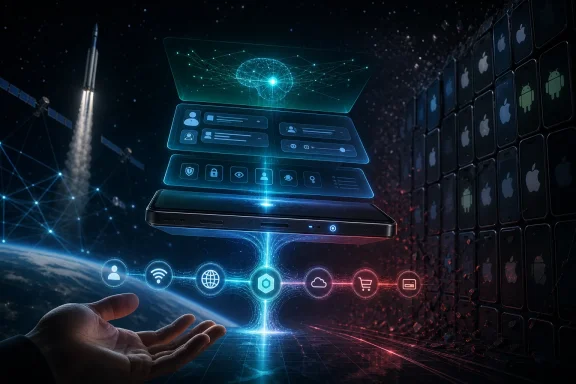
The reported device sounds almost comically optimized for headlines: slimmer than an iPhone, powered by a Qualcomm Snapdragon chip, running a proprietary operating system, and built to integrate technology from xAI, now folded into the wider SpaceX orbit. That description is thin on practical detail and heavy on platform ambition. It does not say whether the object is a phone, a companion device, a satellite terminal, a wearable-adjacent slab, or a concept model meant to make investors imagine all of the above.
But the rumor landed because SpaceX has spent 2026 becoming a very different company in public view. Its merger with xAI, its relationship with X, and its reported acquisition of Cursor all point toward a company trying to own more than infrastructure. The pitch is not merely “we launch things”; it is “we control the stack from physical networks to frontier models to developer tools.”
That is why Musk’s denial does not settle the matter culturally, even if it may settle the specific report. A company can deny a particular prototype while still pursuing the strategic logic that would make such a prototype plausible. Tech history is full of product concepts that are simultaneously nonexistent, premature, misleadingly described, or already being tested under another name.
The phrase “slimmer than an iPhone” also does more work than it should. It borrows Apple’s design language as a yardstick of seriousness. Nobody says a device is slimmer than a random Android phone; they say it is slimmer than an iPhone because the iPhone remains the default symbol for a finished consumer object.
SpaceX, if it is exploring such a device, would be attempting to skip the long apprenticeship that consumer electronics usually demands. Hardware is not just a bill of materials and a chipset. It is thermal behavior, battery trade-offs, radios, antennas, repair channels, developer relations, retail trust, regulatory approvals, and the boring discipline of shipping a million units without turning early adopters into unpaid QA.
That explanation has been hard to make. The first wave of AI-native hardware promised a more ambient, less app-driven relationship with computing, but the market has been ruthless about latency, reliability, and everyday utility. A product that can summarize an email, answer a question, or identify an object is not automatically a new platform if a phone can do the same thing with fewer compromises.
This is where the SpaceX angle becomes interesting. SpaceX is not just another model company trying to build a shiny voice assistant. It owns Starlink, has ambitions in direct-to-cell connectivity, and has a brand associated with physical infrastructure rather than software demos. If there is a coherent reason for SpaceX to contemplate a device, it is that hardware could become the user-facing endpoint for a network-and-AI bundle.
That is also why the “is it a phone?” debate may be too narrow. A SpaceXAI device might not need to compete with the iPhone feature-for-feature on day one. It could aim at a different wedge: satellite-connected AI access, field communications, developer tooling, enterprise operations, robotics control, or a dedicated agent device for users who live inside Musk’s expanding ecosystem.
Still, the smartphone wall remains. The moment a handset-like object needs messaging, photos, maps, authentication, payments, app compatibility, and cellular fallback, it becomes trapped in the gravitational field of iOS and Android. Many companies have learned that you can launch hardware against Apple; far fewer have learned how to make people change their daily computing rituals.
That ambition fits Musk’s recent consolidation moves. X offers identity, distribution, media, messaging, and payments ambitions. xAI supplies models and the Grok brand. Cursor brings developer mindshare and coding workflows. SpaceX supplies connectivity, capital markets spectacle, and a mythology of engineering scale. A proprietary device OS would be the missing retail surface for that stack.
The temptation is obvious. Apple and Google sit between AI companies and mobile users. They control default assistants, background permissions, payments, app review, device APIs, notification rules, and increasingly the on-device AI layer. If AI agents become the main interface to computing, model companies do not want to rent that interface from Cupertino or Mountain View.
Microsoft understands this better than most. Windows has spent decades as the neutral-ish platform on which other companies build, only to watch mobile shift the center of gravity elsewhere. Copilot+ PCs, NPUs, Recall controversies, Windows on Arm, and Microsoft’s OpenAI partnership all reflect the same anxiety: the next interface layer may not be the desktop, the browser, or the app launcher, but the assistant that sees, remembers, and acts.
A SpaceXAI device would be another sign that AI companies are unwilling to remain features inside existing platforms. The old software hierarchy put operating systems at the bottom, apps above them, and services above that. The new hierarchy is messier: the model wants to be the shell, the memory layer, the search engine, the automation broker, and the help desk.
This does not mean Qualcomm is secretly powering a finished SpaceX phone. Snapdragon chips appear in many prototypes because they are practical choices for companies experimenting with mobile form factors. Development boards, reference designs, modem integration, and Android-adjacent software ecosystems make Qualcomm a natural place to start, even when the eventual product changes direction.
For Windows users, the Qualcomm angle has another resonance. Microsoft’s push around Windows on Arm and Copilot+ PCs depends on the same broad industry belief: more AI workloads will move closer to the user, not because the cloud disappears, but because latency, privacy, battery life, and cost force a hybrid model. The endpoint matters again.
That is the deeper shift behind all this hardware speculation. After a decade of telling users that everything important lives in the cloud, AI companies are rediscovering the edge. Cameras, microphones, local context, personal files, calendars, codebases, and biometric identity all live near the user. A model that wants to act for you needs privileged access to those things.
Apple’s advantage is that it already has that access. Microsoft’s advantage is that it still owns the work machine. Google’s advantage is that it owns Android and search habits. SpaceX’s advantage, if it has one, is neither a mature OS nor a consumer hardware channel, but a network and an unusually consolidated corporate empire.
That is why “slimmer than an iPhone” is a seductive but shallow metric. Thinness can signal engineering competence, but it can also signal misplaced priorities. A thinner device may have less battery, worse thermals, weaker antennas, limited durability, or a smaller surface for meaningful interaction. In AI hardware, responsiveness may matter far more than profile.
The industry’s obsession with thinness also collides with the demands of always-available AI. Continuous listening, image recognition, local inference, secure memory, and network handoff are power-hungry behaviors. If the device depends heavily on cloud inference, the network becomes the experience. If it depends heavily on local inference, heat and battery become the constraints.
Apple has spent years balancing those trade-offs in public. It has been cautious, sometimes painfully so, about turning AI into a brand-defining product category. That caution has frustrated users who wanted Apple Intelligence to arrive as a spectacular leap. But it also reflects a truth that AI startups sometimes rediscover late: shipping a trusted assistant on personal hardware is harder than demoing one.
A SpaceXAI device would not merely compete with Apple’s industrial design. It would compete with Apple’s permission structure. Users tolerate deep access from an iPhone because the iPhone has become a social and personal institution. A new AI gadget asking for similar access starts from a much colder place.
Companies going public do not simply sell their current revenue. They sell a map of adjacent markets they might conquer. For SpaceX, rockets and Starlink are already enormous businesses, but the public-market premium comes from convincing investors that the company can expand into AI infrastructure, consumer services, enterprise tools, and maybe personal devices.
A prototype can serve that story without ever becoming a product. It can show optionality. It can suggest that the company has an answer to Apple and OpenAI. It can make a spreadsheet cell labeled “consumer AI hardware” feel less speculative. In a market hungry for the next platform, even a noncommittal object can become a narrative asset.
This is not unique to Musk. The tech industry has repeatedly used hardware demos to embody strategies that are otherwise too abstract. A headset makes the metaverse visible. A robotaxi makes autonomy tangible. A pocket AI device makes agentic computing feel like something one can hold.
The risk is that investor theater and product development can become hard to separate. Engineers may build prototypes because leadership wants a story. Leadership may tell the story because engineers built a prototype. Investors may treat the story as evidence of strategy. By the time the public hears about it, the device has acquired a reality that may exceed its technical maturity.
The operating system is being renegotiated around AI. Microsoft wants Copilot to become a durable interface across Windows, Microsoft 365, Azure, and developer tools. Apple wants AI to enhance the iPhone without surrendering the user relationship to cloud model providers. Google wants Gemini to strengthen Android and search rather than cannibalize them. OpenAI wants hardware and software surfaces that are not dependent on other companies’ app-store policies.
SpaceX, if it is even experimenting here, would be entering a fight where the product is not a gadget but the default agent. Whoever owns that agent may influence what software users open, what cloud services they buy, what code they write, what news they see, and what devices they trust. That is why the OS claim is more important than the thickness claim.
On the PC, this contest will show up as pressure on permissions and integration. AI assistants will want access to files, browser sessions, screenshots, microphones, cameras, calendars, terminals, IDEs, and corporate data. IT administrators will want audit logs, policy controls, local processing options, retention limits, and clear boundaries between personal and work contexts.
The rise of AI hardware will not reduce those concerns. It may multiply them. A dedicated AI device connected to a user’s accounts could become a second endpoint that enterprise IT has to inventory, secure, restrict, or ban. The bring-your-own-device headache becomes more complicated when the device’s primary purpose is to observe, summarize, and act.
A satellite-connected AI endpoint could be useful in places where phones work poorly, laptops are inconvenient, and conventional enterprise devices are too general-purpose. It might guide repairs, translate procedures, document inspections, summarize telemetry, or connect workers to remote experts. That would be less glamorous than an iPhone killer, but more believable as a wedge.
This is where SpaceX’s infrastructure could matter. Starlink gives the company a distribution story that most AI hardware startups lack. A device that pairs naturally with satellite connectivity, field kits, or mission-critical services could avoid direct consumer comparison long enough to mature.
But enterprise buyers are not easily dazzled by thin prototypes. They ask about device management, identity providers, compliance, encryption, support life cycles, repairability, procurement, data residency, and failure modes. They want boring answers. Musk-led companies tend to excel at audacious engineering and struggle, at times, with the institutional patience that enterprise IT demands.
If SpaceXAI hardware ever becomes real, its success may depend less on whether it charms gadget reviewers and more on whether it can satisfy administrators. The future of AI devices will not be decided only by keynote applause. It will be decided in procurement meetings, security reviews, and pilot deployments where “cool” is not a control objective.
If an AI agent becomes the user’s first stop, the app grid becomes less important. The agent can choose the service, compose the message, book the reservation, summarize the thread, generate the code, or invoke the workflow. That has enormous implications for developers, advertising, search, payments, and platform fees.
Apple’s defense is to make the agent part of the system rather than an external layer. That is why Apple’s AI strategy, however slow it may appear, is structurally conservative. It tries to preserve the iPhone as the trusted broker while selectively handing tasks to models. The company wants AI to make iOS more valuable, not make iOS invisible.
A SpaceXAI device would represent the opposite instinct: build a new surface around the model and the network, then pull users into that world. OpenAI’s hardware ambitions, with Jony Ive involved, point in a similar direction. Meta’s smart glasses push reflects another variant: do not beat the smartphone as a phone, but surround it with devices that capture attention and context before the phone does.
The question for Apple is not whether it can out-design SpaceX. It probably can. The question is whether the center of consumer computing remains a phone screen full of apps, or shifts toward agents that live across devices and choose interfaces dynamically.
That leaves us with a familiar modern ambiguity. The specific SpaceX device may not exist. It may exist only as an internal exploration. It may have been misdescribed by sources. It may be one of many prototypes that large companies routinely build and discard. Or it may be real enough to show behind closed doors but nowhere near real enough to sell.
Journalistically, the right stance is neither gullibility nor dismissal. The report belongs in the category of strategically plausible, factually disputed, and commercially uncertain. That is a frustrating category for readers who want clean answers, but it is often where the early signals of a platform shift appear.
For Windows users, the lesson is to watch where the defaults move. If AI becomes a system-level interface, then the old boundaries between device, OS, browser, search engine, cloud account, and assistant will blur. That will affect everything from software development to endpoint security to personal privacy.
The SpaceX rumor, true or false, is a flare from that larger battlefield. It says the smartphone incumbents are no longer the only companies allowed to imagine personal computing hardware. It says AI companies are not satisfied being apps. And it says the next device war may be fought as much over agency and context as over screens and chips.
That tension explains why a thin SpaceXAI device, even an unconfirmed one, matters to WindowsForum readers. We are watching a new platform war form around the same old questions: who owns the operating system, who controls the network, who mediates identity, and who gets between the user and the model. If the report is wrong, it still reveals what investors now expect from AI giants. If it is right, SpaceX is no longer just building rockets, satellites, and models; it is inching toward the most dangerous territory in technology, the pocket.
 The Rumor Works Because the Strategy Already Exists
The reported device sounds almost comically optimized for headlines: slimmer than an iPhone, powered by a Qualcomm Snapdragon chip, running a proprietary operating system, and built to integrate technology from xAI, now folded into the wider SpaceX orbit. That description is thin on practical detail and heavy on platform ambition. It does not say whether the object is a phone, a companion device, a satellite terminal, a wearable-adjacent slab, or a concept model meant to make investors imagine all of the above.But the rumor landed because SpaceX has spent 2026 becoming a very different company in public view. Its merger with xAI, its relationship with X, and its reported acquisition of Cursor all point toward a company trying to own more than infrastructure. The pitch is not merely “we launch things”; it is “we control the stack from physical networks to frontier models to developer tools.”
That is why Musk’s denial does not settle the matter culturally, even if it may settle the specific report. A company can deny a particular prototype while still pursuing the strategic logic that would make such a prototype plausible. Tech history is full of product concepts that are simultaneously nonexistent, premature, misleadingly described, or already being tested under another name.
The phrase “slimmer than an iPhone” also does more work than it should. It borrows Apple’s design language as a yardstick of seriousness. Nobody says a device is slimmer than a random Android phone; they say it is slimmer than an iPhone because the iPhone remains the default symbol for a finished consumer object.
SpaceX, if it is exploring such a device, would be attempting to skip the long apprenticeship that consumer electronics usually demands. Hardware is not just a bill of materials and a chipset. It is thermal behavior, battery trade-offs, radios, antennas, repair channels, developer relations, retail trust, regulatory approvals, and the boring discipline of shipping a million units without turning early adopters into unpaid QA.
AI Hardware Keeps Running Into the Smartphone Wall
The broader AI-device boom has been awkward for a simple reason: phones already exist. They have screens, microphones, cameras, neural processors, app stores, payment systems, secure enclaves, location services, Bluetooth, ultra-wideband, mobile radios, emergency alerts, and users who carry them everywhere. Any dedicated AI gadget starts by explaining why it deserves to be another object in the pocket.That explanation has been hard to make. The first wave of AI-native hardware promised a more ambient, less app-driven relationship with computing, but the market has been ruthless about latency, reliability, and everyday utility. A product that can summarize an email, answer a question, or identify an object is not automatically a new platform if a phone can do the same thing with fewer compromises.
This is where the SpaceX angle becomes interesting. SpaceX is not just another model company trying to build a shiny voice assistant. It owns Starlink, has ambitions in direct-to-cell connectivity, and has a brand associated with physical infrastructure rather than software demos. If there is a coherent reason for SpaceX to contemplate a device, it is that hardware could become the user-facing endpoint for a network-and-AI bundle.
That is also why the “is it a phone?” debate may be too narrow. A SpaceXAI device might not need to compete with the iPhone feature-for-feature on day one. It could aim at a different wedge: satellite-connected AI access, field communications, developer tooling, enterprise operations, robotics control, or a dedicated agent device for users who live inside Musk’s expanding ecosystem.
Still, the smartphone wall remains. The moment a handset-like object needs messaging, photos, maps, authentication, payments, app compatibility, and cellular fallback, it becomes trapped in the gravitational field of iOS and Android. Many companies have learned that you can launch hardware against Apple; far fewer have learned how to make people change their daily computing rituals.
Musk’s Stack Is Becoming the Product
The most consequential part of the report is not the thickness comparison. It is the alleged proprietary operating system. In consumer technology, an OS is a declaration of independence. It says a company does not merely want to appear as an app icon inside somebody else’s store; it wants to define the rules of interaction.That ambition fits Musk’s recent consolidation moves. X offers identity, distribution, media, messaging, and payments ambitions. xAI supplies models and the Grok brand. Cursor brings developer mindshare and coding workflows. SpaceX supplies connectivity, capital markets spectacle, and a mythology of engineering scale. A proprietary device OS would be the missing retail surface for that stack.
The temptation is obvious. Apple and Google sit between AI companies and mobile users. They control default assistants, background permissions, payments, app review, device APIs, notification rules, and increasingly the on-device AI layer. If AI agents become the main interface to computing, model companies do not want to rent that interface from Cupertino or Mountain View.
Microsoft understands this better than most. Windows has spent decades as the neutral-ish platform on which other companies build, only to watch mobile shift the center of gravity elsewhere. Copilot+ PCs, NPUs, Recall controversies, Windows on Arm, and Microsoft’s OpenAI partnership all reflect the same anxiety: the next interface layer may not be the desktop, the browser, or the app launcher, but the assistant that sees, remembers, and acts.
A SpaceXAI device would be another sign that AI companies are unwilling to remain features inside existing platforms. The old software hierarchy put operating systems at the bottom, apps above them, and services above that. The new hierarchy is messier: the model wants to be the shell, the memory layer, the search engine, the automation broker, and the help desk.
Qualcomm Is the Quietly Plausible Part
The reported Snapdragon detail is easy to overlook, but it is one of the more plausible elements. Qualcomm has spent years trying to turn Arm-based computing from a mobile story into a PC and edge-AI story. A thin AI device with a proprietary OS would almost certainly need an efficient system-on-chip with strong connectivity, decent local inference capability, and a mature hardware ecosystem.This does not mean Qualcomm is secretly powering a finished SpaceX phone. Snapdragon chips appear in many prototypes because they are practical choices for companies experimenting with mobile form factors. Development boards, reference designs, modem integration, and Android-adjacent software ecosystems make Qualcomm a natural place to start, even when the eventual product changes direction.
For Windows users, the Qualcomm angle has another resonance. Microsoft’s push around Windows on Arm and Copilot+ PCs depends on the same broad industry belief: more AI workloads will move closer to the user, not because the cloud disappears, but because latency, privacy, battery life, and cost force a hybrid model. The endpoint matters again.
That is the deeper shift behind all this hardware speculation. After a decade of telling users that everything important lives in the cloud, AI companies are rediscovering the edge. Cameras, microphones, local context, personal files, calendars, codebases, and biometric identity all live near the user. A model that wants to act for you needs privileged access to those things.
Apple’s advantage is that it already has that access. Microsoft’s advantage is that it still owns the work machine. Google’s advantage is that it owns Android and search habits. SpaceX’s advantage, if it has one, is neither a mature OS nor a consumer hardware channel, but a network and an unusually consolidated corporate empire.
The iPhone Comparison Is a Trap
Every would-be device challenger eventually gets measured against Apple because Apple made hardware feel inevitable. But the iPhone is not just thin glass. It is a supply chain, a developer economy, a services machine, a camera platform, a security model, a retail operation, and a decade-plus of accumulated user trust.That is why “slimmer than an iPhone” is a seductive but shallow metric. Thinness can signal engineering competence, but it can also signal misplaced priorities. A thinner device may have less battery, worse thermals, weaker antennas, limited durability, or a smaller surface for meaningful interaction. In AI hardware, responsiveness may matter far more than profile.
The industry’s obsession with thinness also collides with the demands of always-available AI. Continuous listening, image recognition, local inference, secure memory, and network handoff are power-hungry behaviors. If the device depends heavily on cloud inference, the network becomes the experience. If it depends heavily on local inference, heat and battery become the constraints.
Apple has spent years balancing those trade-offs in public. It has been cautious, sometimes painfully so, about turning AI into a brand-defining product category. That caution has frustrated users who wanted Apple Intelligence to arrive as a spectacular leap. But it also reflects a truth that AI startups sometimes rediscover late: shipping a trusted assistant on personal hardware is harder than demoing one.
A SpaceXAI device would not merely compete with Apple’s industrial design. It would compete with Apple’s permission structure. Users tolerate deep access from an iPhone because the iPhone has become a social and personal institution. A new AI gadget asking for similar access starts from a much colder place.
Investor Theater Has Become a Product Category
The timing of the report matters. The alleged prototype was shown to investors and stakeholders ahead of SpaceX’s public listing, according to reporting summarized by multiple outlets. That does not automatically make the device fake, but it does place it in the peculiar genre of pre-IPO imagination management.Companies going public do not simply sell their current revenue. They sell a map of adjacent markets they might conquer. For SpaceX, rockets and Starlink are already enormous businesses, but the public-market premium comes from convincing investors that the company can expand into AI infrastructure, consumer services, enterprise tools, and maybe personal devices.
A prototype can serve that story without ever becoming a product. It can show optionality. It can suggest that the company has an answer to Apple and OpenAI. It can make a spreadsheet cell labeled “consumer AI hardware” feel less speculative. In a market hungry for the next platform, even a noncommittal object can become a narrative asset.
This is not unique to Musk. The tech industry has repeatedly used hardware demos to embody strategies that are otherwise too abstract. A headset makes the metaverse visible. A robotaxi makes autonomy tangible. A pocket AI device makes agentic computing feel like something one can hold.
The risk is that investor theater and product development can become hard to separate. Engineers may build prototypes because leadership wants a story. Leadership may tell the story because engineers built a prototype. Investors may treat the story as evidence of strategy. By the time the public hears about it, the device has acquired a reality that may exceed its technical maturity.
Windows Users Should Watch the OS, Not the Gadget
For WindowsForum readers, the immediate temptation is to file this under “Musk may build a phone” and move on. That would miss the more relevant lesson. The alleged device is another symptom of the same platform pressure that is reshaping Windows, Android, iOS, and macOS.The operating system is being renegotiated around AI. Microsoft wants Copilot to become a durable interface across Windows, Microsoft 365, Azure, and developer tools. Apple wants AI to enhance the iPhone without surrendering the user relationship to cloud model providers. Google wants Gemini to strengthen Android and search rather than cannibalize them. OpenAI wants hardware and software surfaces that are not dependent on other companies’ app-store policies.
SpaceX, if it is even experimenting here, would be entering a fight where the product is not a gadget but the default agent. Whoever owns that agent may influence what software users open, what cloud services they buy, what code they write, what news they see, and what devices they trust. That is why the OS claim is more important than the thickness claim.
On the PC, this contest will show up as pressure on permissions and integration. AI assistants will want access to files, browser sessions, screenshots, microphones, cameras, calendars, terminals, IDEs, and corporate data. IT administrators will want audit logs, policy controls, local processing options, retention limits, and clear boundaries between personal and work contexts.
The rise of AI hardware will not reduce those concerns. It may multiply them. A dedicated AI device connected to a user’s accounts could become a second endpoint that enterprise IT has to inventory, secure, restrict, or ban. The bring-your-own-device headache becomes more complicated when the device’s primary purpose is to observe, summarize, and act.
The Enterprise Version Is Less Glamorous and More Important
Consumer coverage naturally gravitates toward the iPhone comparison, but the first serious markets for AI-native devices may be enterprise, industrial, and field operations. SpaceX’s own world suggests why. Technicians, engineers, emergency responders, logistics teams, military customers, energy crews, and remote workers all face situations where connectivity, hands-light interaction, and fast access to domain knowledge can matter more than app-store abundance.A satellite-connected AI endpoint could be useful in places where phones work poorly, laptops are inconvenient, and conventional enterprise devices are too general-purpose. It might guide repairs, translate procedures, document inspections, summarize telemetry, or connect workers to remote experts. That would be less glamorous than an iPhone killer, but more believable as a wedge.
This is where SpaceX’s infrastructure could matter. Starlink gives the company a distribution story that most AI hardware startups lack. A device that pairs naturally with satellite connectivity, field kits, or mission-critical services could avoid direct consumer comparison long enough to mature.
But enterprise buyers are not easily dazzled by thin prototypes. They ask about device management, identity providers, compliance, encryption, support life cycles, repairability, procurement, data residency, and failure modes. They want boring answers. Musk-led companies tend to excel at audacious engineering and struggle, at times, with the institutional patience that enterprise IT demands.
If SpaceXAI hardware ever becomes real, its success may depend less on whether it charms gadget reviewers and more on whether it can satisfy administrators. The future of AI devices will not be decided only by keynote applause. It will be decided in procurement meetings, security reviews, and pilot deployments where “cool” is not a control objective.
Apple’s Real Exposure Is Interface Control
AppleInsider and 9to5Mac framed the report through the obvious Apple lens, and that is fair. Any handset-like AI device inevitably invites comparison with the iPhone. But Apple’s vulnerability is not that someone might make a thinner rectangle. It is that AI threatens to move user attention away from apps, which are the organizing principle of iOS.If an AI agent becomes the user’s first stop, the app grid becomes less important. The agent can choose the service, compose the message, book the reservation, summarize the thread, generate the code, or invoke the workflow. That has enormous implications for developers, advertising, search, payments, and platform fees.
Apple’s defense is to make the agent part of the system rather than an external layer. That is why Apple’s AI strategy, however slow it may appear, is structurally conservative. It tries to preserve the iPhone as the trusted broker while selectively handing tasks to models. The company wants AI to make iOS more valuable, not make iOS invisible.
A SpaceXAI device would represent the opposite instinct: build a new surface around the model and the network, then pull users into that world. OpenAI’s hardware ambitions, with Jony Ive involved, point in a similar direction. Meta’s smart glasses push reflects another variant: do not beat the smartphone as a phone, but surround it with devices that capture attention and context before the phone does.
The question for Apple is not whether it can out-design SpaceX. It probably can. The question is whether the center of consumer computing remains a phone screen full of apps, or shifts toward agents that live across devices and choose interfaces dynamically.
Denial Does Not Kill the Platform War
Musk’s “utterly false” denial is important and should be taken seriously as a denial of the report as framed. The problem is that the surrounding market signals remain intact. AI companies are hunting for dedicated surfaces. Platform owners are defending their defaults. Chipmakers are pitching edge inference. Investors are rewarding vertical integration stories.That leaves us with a familiar modern ambiguity. The specific SpaceX device may not exist. It may exist only as an internal exploration. It may have been misdescribed by sources. It may be one of many prototypes that large companies routinely build and discard. Or it may be real enough to show behind closed doors but nowhere near real enough to sell.
Journalistically, the right stance is neither gullibility nor dismissal. The report belongs in the category of strategically plausible, factually disputed, and commercially uncertain. That is a frustrating category for readers who want clean answers, but it is often where the early signals of a platform shift appear.
For Windows users, the lesson is to watch where the defaults move. If AI becomes a system-level interface, then the old boundaries between device, OS, browser, search engine, cloud account, and assistant will blur. That will affect everything from software development to endpoint security to personal privacy.
The SpaceX rumor, true or false, is a flare from that larger battlefield. It says the smartphone incumbents are no longer the only companies allowed to imagine personal computing hardware. It says AI companies are not satisfied being apps. And it says the next device war may be fought as much over agency and context as over screens and chips.
The Pocket-Sized SpaceX Story Leaves a Larger Trail
The practical reading is narrower than the hype and broader than the denial. A single alleged prototype does not mean SpaceX is about to dethrone Apple, but it does fit a year in which Musk’s companies have been reorganized around AI, connectivity, and distribution. The concrete takeaways are less about a mystery slab and more about the platform incentives now driving the market.- SpaceX’s reported AI hardware prototype remains disputed, and Musk has publicly denied the report rather than confirmed a product roadmap.
- The alleged design details matter because they point toward a proprietary operating system, edge-capable mobile silicon, and deep integration with SpaceXAI rather than a simple accessory.
- A SpaceX device would make more strategic sense as part of a network-and-AI stack than as a conventional iPhone clone.
- Apple’s real risk is not a thinner competing rectangle, but a shift from app-centric computing to agent-centric computing.
- Enterprise IT should treat AI-native devices as future endpoints that may require governance, inventory, and policy controls.
- The larger platform war is moving toward whoever controls the default assistant, the user’s context, and the permissions to act.
References
- Primary source: AppleInsider
Published: Wed, 01 Jul 2026 21:14:16 GMT
Loading…
appleinsider.com - Independent coverage: 9to5Mac
Published: 2026-07-01T18:20:31.376683
Loading…
9to5mac.com - Related coverage: macrumors.com
Loading…
www.macrumors.com - Related coverage: techcrunch.com
Loading…
techcrunch.com - Related coverage: digitaltrends.com
Loading…
www.digitaltrends.com - Related coverage: technobezz.com
Loading…
www.technobezz.com
- Related coverage: thenextweb.com
Loading…
thenextweb.com - Related coverage: investing.com
Loading…
www.investing.com - Related coverage: phonearena.com
Loading…
www.phonearena.com - Related coverage: aiweekly.co
Loading…
aiweekly.co - Related coverage: forbes.com
Loading…
www.forbes.com - Related coverage: axios.com
Loading…
www.axios.com - Related coverage: lemonde.fr
Loading…
www.lemonde.fr - Related coverage: wsws.org
- Related coverage: content.spacex.com
- Related coverage: phys.org
Loading…
phys.org