

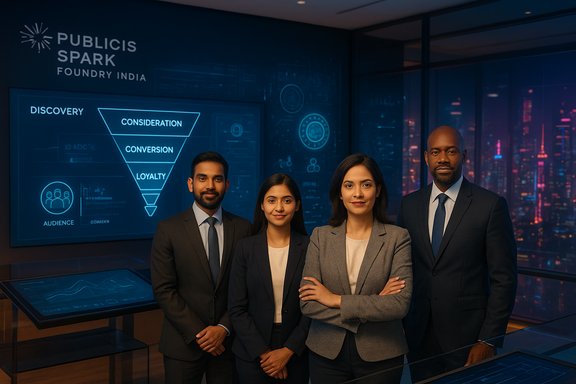
Publicis Media’s India arm has launched Spark Foundry India — a full-funnel, AI- and data-powered media agency — and tapped Niti Kumar, a seasoned agency and media leader, as its CEO in a move that reshapes the group’s India-era operating map and doubles down on a single objective: delivering measurable growth across the entire marketing funnel from discovery to conversion and loyalty.
Publicis Media has been restructuring and expanding its agency architecture globally for several years, positioning Spark Foundry as a growth-focused media brand inside the Groupe that combines creative investment, analytics, and tech-led media services. The Spark Foundry identity has been used internationally in multiple iterations as Publicis consolidated legacy brands and scaled a “startup spirit with a powerhouse soul” approach. In India, Publicis Media’s network — which includes Zenith, Starcom, Performics and now Spark Foundry India — is explicitly leaning into integrated, data-first media offers. That strategic tilt is framed against a market context in which digital now accounts for a majority share of media spend and where billings concentration remains highly skewed toward a small number of global holding groups. Independent market tallies show WPP Media leading with a dominant share, followed by IPG and Publicis, underlining how competitive the Indian market has become. Publicis Media’s formal launch of Spark Foundry India, and the related leadership reshuffle, is therefore both defensive and offensive: defensive in protecting client relationships and talent inside a larger group; offensive in creating a sharper, full-funnel proposition that markets now demand.
However, turning these promises into repeatable outcomes requires mature data infrastructure, disciplined measurement design, and transparent governance — capabilities that only a handful of agencies and tech partners currently execute well at scale. The launch signals Publicis’ intent to marry its existing capabilities with a brand that can be explicitly sold as “full-funnel, AI-enabled.”
Publicis’ broader reshuffle (with Ravi Bhaya, Jai Lala and Rathi Gangappa operating in connected roles) creates a leadership structure that is intentionally matrixed: local agency focus combined with centralized data, CRM and influence capabilities. That design aims to reduce duplication while enabling specialist practices to scale across clients.
But the proof will be in execution. Delivering consistent, auditable outcomes requires more than promises of AI and data; it demands robust measurement frameworks, strict data governance, transparent reporting, and a culture that rewards integrated, client-centric outcomes over internal reorg optics. In a concentrated, hyper-competitive market where regulatory scrutiny is rising, Spark Foundry India’s success will hinge on turning capability into verifiable client results — fast.
For clients, the opportunity is real: a new integrated agency model that could simplify execution and measurement. For Publicis, the risk is equally real: the market will quickly separate marketing statements from demonstrable growth. The next 12–18 months will show whether Spark Foundry India can convert a strategic intent into a practical, repeatable advantage in India’s fast-moving media ecosystem.
Source: Storyboard18 Publicis Media launches Spark Foundry India, a full-funnel media agency, Niti Kumar appointed as CEO
 Background
Publicis Media has been restructuring and expanding its agency architecture globally for several years, positioning Spark Foundry as a growth-focused media brand inside the Groupe that combines creative investment, analytics, and tech-led media services. The Spark Foundry identity has been used internationally in multiple iterations as Publicis consolidated legacy brands and scaled a “startup spirit with a powerhouse soul” approach. In India, Publicis Media’s network — which includes Zenith, Starcom, Performics and now Spark Foundry India — is explicitly leaning into integrated, data-first media offers. That strategic tilt is framed against a market context in which digital now accounts for a majority share of media spend and where billings concentration remains highly skewed toward a small number of global holding groups. Independent market tallies show WPP Media leading with a dominant share, followed by IPG and Publicis, underlining how competitive the Indian market has become. Publicis Media’s formal launch of Spark Foundry India, and the related leadership reshuffle, is therefore both defensive and offensive: defensive in protecting client relationships and talent inside a larger group; offensive in creating a sharper, full-funnel proposition that markets now demand.What was announced
- Spark Foundry India will operate as Publicis Media’s full-funnel media agency in India, focusing on brand building, performance marketing, and commerce with AI and data at its core.
- Niti Kumar — previously in leadership roles within the Publicis ecosystem and with a deep marketing and media operations background — has been appointed Chief Executive Officer of Spark Foundry India. She will lead the new agency’s growth and positioning.
- Ravi Bhaya is moving into an elevated role as Chief Growth Officer at Publicis Media India to accelerate network-wide growth and client transformation initiatives.
- Jai Lala and Rathi Gangappa will retain leadership of Zenith and Starcom respectively, with expanded mandates under a “Publicis Connected Media” structure that sponsors Connected CRM and Connected Influence capabilities. All four leaders will report to Lalatendu Das, CEO, Publicis Media South Asia.
Why this matters: the strategic logic
A full-funnel demand from brands
Brands increasingly expect agencies to move beyond silos — creative, media, performance, and commerce — and offer seamless solutions that drive outcomes across the funnel. Spark Foundry India is being positioned specifically to address that demand by combining:- Brand building and upper-funnel reach through audience and contextual strategies.
- Mid-funnel engagement driven by data-led personalization and creative testing.
- Lower-funnel performance and commerce tactics that measure incremental sales and lifetime value.
Leveraging AI and data at scale
Publicis Media’s public positioning for the new agency emphasizes AI- and data-powered models. That aligns with the network’s broader investments in proprietary data assets and programmatic/analytics stacks. For clients, the promise is twofold: faster, more granular optimization and the ability to measure the business impact of creative and media decisions in near-real time.However, turning these promises into repeatable outcomes requires mature data infrastructure, disciplined measurement design, and transparent governance — capabilities that only a handful of agencies and tech partners currently execute well at scale. The launch signals Publicis’ intent to marry its existing capabilities with a brand that can be explicitly sold as “full-funnel, AI-enabled.”
Talent and leadership: Niti Kumar’s role
Niti Kumar’s elevation to CEO is significant because the launch leans on a leader who knows both media operations and client-side marketing. Her prior roles — including executive positions inside agency brands tied to the Publicis ecosystem and experience across content, digital and performance functions — give her credibility to lead an integrated media proposition.Publicis’ broader reshuffle (with Ravi Bhaya, Jai Lala and Rathi Gangappa operating in connected roles) creates a leadership structure that is intentionally matrixed: local agency focus combined with centralized data, CRM and influence capabilities. That design aims to reduce duplication while enabling specialist practices to scale across clients.
Market context and why timing matters
Digital-first growth and concentrated billings
Independent industry research shows the Indian media market is now concentrated among a few large holding groups and digital ad spend has grown rapidly — digital accounted for around 52% of agency billings in the most recent COMvergence survey. The top three agency groups (led by WPP Media) continue to capture the lion’s share of billings, making scale and cross-capability integration critical competitive assets. For Publicis, launching Spark Foundry India is a bet on winning more integrated briefs and on converting a digital-first market into full-funnel revenue.Client demands: measurement, commerce, and outcomes
Marketing procurement has shifted: procurement and CMOs now demand measurable ROI, clear attribution pathways, and cross-channel accountability. Agencies that can show improved return on ad spend (ROAS), lower customer acquisition costs (CAC), and measurable uplifts in brand metrics have a distinct commercial advantage. Spark Foundry’s explicit “discovery-to-loyalty” promise is a direct response to that briefing language.Regulatory backdrop: data, privacy, and AI
India’s Digital Personal Data Protection framework (the DPDP Act of 2023) and subsequent draft rules and guidance remain a moving target for marketers and technology vendors. The law creates new obligations around consent, data fiduciary responsibilities, breach reporting, and cross-border processing. The rules under the Act have been under consultation and partial notification; companies deploying advanced data and AI solutions must factor compliance and governance into any full-funnel offering. In practice this means extra work on consent flows, data minimization, retention policies, and breach readiness.Strengths of the Spark Foundry India proposition
- Integrated full-funnel product: The agency is explicitly designed to bridge brand and performance, which clients increasingly request. This reduces handoffs and the attribution friction that often plagues multi-agency setups.
- Leadership continuity and experience: Appointing a senior operator like Niti Kumar reduces the risk of a “vanity launch” and gives immediate operational credibility to clients and partners.
- Group-level leverage: Publicis Media’s global and regional tools, data assets, and tech partnerships can be deployed to scale campaigns quickly across markets — a selling point for multinational clients.
- Clear go-to-market message: Positioning Spark Foundry India around AI, data, and commerce is timely and attractive to clients trying to monetize digital and e-commerce ecosystems.
Risks, unknowns, and practical challenges
1. Claims vs. capability: productization gaps
Many holding companies promise full-funnel and AI-driven answers. The difficult part is productizing those capabilities into repeatable offerings that deliver consistent outcomes across clients and categories. Publicis must show, quickly and demonstrably, that Spark Foundry India has:- Unified measurement frameworks that tie marketing inputs to business metrics.
- Clean, consent-based consumer data flows that are auditable.
- Repeatable creative-test methodologies that feed AI optimization without degrading brand equity.
2. Talent and culture friction
Mergers, carve-outs and new launches often create cultural and staffing tension. Integrating teams from different legacy agencies, aligning incentives across brand and performance teams, and retaining top talent are real execution risks. Leadership continuity helps; but culture shifts are operationally heavy and require sustained investment.3. Client conflicts and account structuring
A consolidated full-funnel agency may face conflicts with existing Publicis brands (and with cross-holding group relationships) over client ownership, billings, and fee models. The group will need strict governance to avoid client churn triggered by perceived overlaps or opaque account structures.4. Measurement, attribution and transparency
Attribution remains an industry-level challenge — especially when the agency sells both media and measurement solutions. Independent verification, transparent data partners, and third-party auditing are prerequisites for long-term trust. The industry’s sensitivity to walled-garden metrics means Spark Foundry must design measurement systems that are understandable and verifiable by clients and independent auditors.5. Regulatory and privacy enforcement
While India’s DPDP Act is on the books, the rules’ phased notification and enforcement timeline introduces uncertainty. Agencies that rely on cross-border data flows or heavy profiling must build compliance-first architectures now; retrofitting later will be costly. Further, new rules on AI use and transparency (both global and local) are likely to influence permissible tactics for targeting and measurement.What clients should ask today
- How will Spark Foundry India operationalize consent and data governance across owned, rented and third-party datasets?
- What are the concrete KPIs and measurement frameworks used to attribute upper-funnel spend to sales or LTV?
- Which proprietary or third-party AI/optimization tools will be applied, and how are those models validated for bias and performance drift?
- How will conflicts of interest between sister agencies be managed, and what client protections are in place?
- Can the agency produce case studies with verifiable, audited outcomes across different categories?
Competitive implications
Spark Foundry India will intensify competition in a market where scale, data capability, and commerce integrations are table stakes. Competitors are likely to respond in three ways:- Double down on their own full-funnel product suites and proprietary tools.
- Re-bundle services with creative and commerce partners to preserve client billings.
- Offer second-opinion or independent measurement services to clients wary of single-vendor accountability.
Quick-read: What this means for the Indian media landscape
- Publicis is sharpening its go-to-market with a branded, integrated full-funnel agency that aims to capture both brand and performance dollars.
- Market-level dynamics (rising digital share, concentration of billings among a few groups) make integrated propositions commercially attractive.
- Regulatory shifts around data protection and AI will shape how aggressively agencies can deploy certain personalization and data-driven tactics.
Conclusion — sober optimism, with caveats
The launch of Spark Foundry India and the appointment of Niti Kumar mark a decisive move by Publicis Media to present a clearer, full-funnel alternative to clients in India. The strategic logic is sound: brands want outcome-first, tightly measured media solutions that connect creative, media, and commerce. Publicis has the global pedigree and local scale to pursue this space.But the proof will be in execution. Delivering consistent, auditable outcomes requires more than promises of AI and data; it demands robust measurement frameworks, strict data governance, transparent reporting, and a culture that rewards integrated, client-centric outcomes over internal reorg optics. In a concentrated, hyper-competitive market where regulatory scrutiny is rising, Spark Foundry India’s success will hinge on turning capability into verifiable client results — fast.
For clients, the opportunity is real: a new integrated agency model that could simplify execution and measurement. For Publicis, the risk is equally real: the market will quickly separate marketing statements from demonstrable growth. The next 12–18 months will show whether Spark Foundry India can convert a strategic intent into a practical, repeatable advantage in India’s fast-moving media ecosystem.
Source: Storyboard18 Publicis Media launches Spark Foundry India, a full-funnel media agency, Niti Kumar appointed as CEO
