

Spark’s latest Microsoft Copilot rollout is more than a productivity story. It is a case study in how a large, operationally complex business can use AI to shave minutes off thousands of interactions, then compound those gains across customer service, engineering, software delivery, and network operations. The headline number — roughly 1.5 to 2 minutes saved per call — matters, but the more consequential change is structural: Spark is redesigning work so that people and AI can share the load in a more coordinated way. That makes this announcement less about one tool and more about a new operating model.
Spark is one of New Zealand’s biggest enterprises, and that scale matters because large organisations do not suffer from one dramatic inefficiency so much as hundreds of small ones. A customer query may move across multiple systems, multiple teams, and multiple approval paths before it is fully resolved. In a contact-centre environment, those delays are amplified because the work is time-sensitive, high-volume, and closely tied to customer satisfaction.
That is why the company’s Microsoft partnership, announced in 2025, was strategically significant. Microsoft said the deal included New Zealand’s largest-ever public cloud partnership and a major Copilot deployment, signalling that Spark was not merely experimenting with AI but preparing to rebuild parts of its digital backbone around it. The current results suggest that the partnership has moved from ambition to execution.
The broader industry context is just as important. Microsoft has spent the past two years pushing a narrative that the next phase of AI adoption is not simple chatbots or isolated copilots, but Frontier Firms — organisations that redesign workflows around human-agent collaboration. Microsoft’s own materials describe this as moving beyond faster task completion toward AI that can carry out defined parts of the work itself, then hand off to humans for judgement and oversight.
Spark’s experience is a useful real-world test of that thesis. The company is not claiming that AI has replaced expertise. Instead, it is showing what happens when AI is embedded into the messy middle of enterprise operations: fewer transfers, fewer repeated questions, faster handoffs, and less time spent hunting for the right information. That is where many digital-transformation projects either succeed or stall.
The company’s emphasis on end-to-end process mapping is also telling. Rather than asking where AI can be added, Spark appears to have asked where work gets stuck. That distinction is important because AI is often overused as a layer on top of broken processes, when the real value comes from simplifying the process first and then automating the most repetitive parts.
Spark’s Copilot deployment appears designed to reduce that burden. By training the tool on technical and procedural knowledge, the company is effectively turning institutional know-how into a more accessible layer for frontline staff. That is a significant shift because it reduces dependency on informal memory and personal expertise.
Key implications include:
In practice, customer care environments are ideal early targets for AI because they contain repeatable patterns, high call volumes, and relatively clear outcomes. A well-designed assistant can summarize a conversation, surface relevant policies, and suggest next steps without forcing the agent to start from scratch every time. This is where AI can produce visible customer-facing value without requiring a full organisational overhaul.
Spark’s approach appears to be built around three layers of assistance:
The reported savings of 1.5 to 2 minutes per call may sound modest, but in high-volume environments the economics are significant. Even a small reduction in average handling time can free up major capacity across a large team. It also improves employee experience because advisors spend less time wrestling with systems and more time resolving the actual issue.
The article’s figures suggest the scale is already meaningful. Spark says AI assistants are handling about 20,000 internal queries each month, reducing questions sent back to operational teams by around 60 per cent. That is not just a productivity gain; it is a reallocation of effort away from internal back-and-forth and toward higher-value work.
That has several knock-on effects:
The same pattern is visible in business customer product setup, where Spark says automation has reduced process time by around 60 per cent. That indicates the company is finding value not only in customer-facing support but also in the workflows that sit behind revenue generation and service provisioning. Those are often the places where enterprise AI has the greatest ROI.
This is also where enterprise AI differs sharply from consumer AI. A consumer might accept a wrong suggestion from a digital assistant and move on. In a telecommunications business, the consequences can include incorrect billing guidance, poor customer outcomes, or operational mistakes that ripple across systems. That means trust architecture is as important as model capability.
That distinction should reassure enterprise buyers who worry about hallucinations, compliance, and accountability. It also explains why organisations often see better results when they narrow the AI’s role to clearly bounded tasks rather than trying to automate everything at once.
Important governance themes include:
Network operations is another compelling frontier. Spark says AI is helping detect potential faults earlier and recommend remediation steps, which suggests a move toward more proactive operations management. In telecoms, earlier detection is valuable because small issues can become service disruptions quickly. Reducing mean time to detect and mean time to repair is one of the clearest ways AI can create infrastructure value.
That is strategically significant because it broadens AI’s value beyond the front office. The same platform can improve service quality, engineering velocity, and operational resilience if the underlying data and process design are sound.
The likely benefits are:
This is where Microsoft’s “Frontier Firm” language becomes more than branding. The idea is that the organisation becomes a hybrid environment where humans define the goal, agents complete bounded tasks, and people review the outcome. Microsoft has argued in multiple recent posts that this is the model that allows AI to scale meaningfully across the enterprise.
Spark’s framing suggests a future where AI might:
The energy-management angle is also interesting because it shows AI can affect both cost and sustainability. For a large distributed business, site-level optimisation could be a meaningful lever if demand patterns are predictable enough for automation to help.
For Microsoft, Spark is another showcase customer in a market where proof points matter. The company is building a narrative that Copilot is not just an employee productivity layer but a platform for enterprise transformation. The more examples it can point to where major companies achieve tangible gains, the more credible that narrative becomes. Spark’s New Zealand footprint gives Microsoft a regional reference case with global relevance.
That creates a competitive divide between organisations that merely adopt AI and those that redesign around it. In industries with thin margins and high service expectations, that divide may become decisive.
Potential market takeaways include:
The biggest opportunity is scale. Once the pattern is proven in one workflow, it can often be adapted to adjacent workflows with relatively little reinvention. That creates the possibility of compounding returns over time rather than one-off productivity gains.
There is also an organisational risk. Teams may become too dependent on AI-guided workflows and lose some fluency in manual problem-solving. That can be manageable if training and oversight remain strong, but it is a real concern in fast-moving environments.
If Spark can safely move from assisted work to partially executed work, it will enter a more advanced phase of enterprise AI adoption. That would put the company among the more credible examples of what Microsoft is calling a Frontier Firm, where humans and agents collaborate across routine and complex tasks alike.
The watchpoints are straightforward, even if the execution is not.
Spark’s AI journey suggests a broader truth for enterprise technology in 2026: the winners will not be the companies that simply add Copilot to existing processes, but the ones that rethink how work flows from start to finish. If Spark continues on this path, it may become one of the clearest examples in the region of how responsible AI, disciplined governance, and workflow redesign can combine to produce real business impact.
Source: Microsoft Source 2-minute savings per call is just the beginning: Spark transforms workflows with Microsoft Copilot - Source Asia
 Background
Spark is one of New Zealand’s biggest enterprises, and that scale matters because large organisations do not suffer from one dramatic inefficiency so much as hundreds of small ones. A customer query may move across multiple systems, multiple teams, and multiple approval paths before it is fully resolved. In a contact-centre environment, those delays are amplified because the work is time-sensitive, high-volume, and closely tied to customer satisfaction.That is why the company’s Microsoft partnership, announced in 2025, was strategically significant. Microsoft said the deal included New Zealand’s largest-ever public cloud partnership and a major Copilot deployment, signalling that Spark was not merely experimenting with AI but preparing to rebuild parts of its digital backbone around it. The current results suggest that the partnership has moved from ambition to execution.
The broader industry context is just as important. Microsoft has spent the past two years pushing a narrative that the next phase of AI adoption is not simple chatbots or isolated copilots, but Frontier Firms — organisations that redesign workflows around human-agent collaboration. Microsoft’s own materials describe this as moving beyond faster task completion toward AI that can carry out defined parts of the work itself, then hand off to humans for judgement and oversight.
Spark’s experience is a useful real-world test of that thesis. The company is not claiming that AI has replaced expertise. Instead, it is showing what happens when AI is embedded into the messy middle of enterprise operations: fewer transfers, fewer repeated questions, faster handoffs, and less time spent hunting for the right information. That is where many digital-transformation projects either succeed or stall.
Why the Spark Story Matters
The most interesting part of Spark’s story is not the technology itself, but the logic of the workflow redesign. Automating summaries and surfacing the right information at the right time can appear incremental on paper, yet at enterprise scale those small gains multiply quickly. When a contact centre handles thousands of interactions a day, a two-minute reduction per call is not a marginal tweak; it is a major operational reset.The company’s emphasis on end-to-end process mapping is also telling. Rather than asking where AI can be added, Spark appears to have asked where work gets stuck. That distinction is important because AI is often overused as a layer on top of broken processes, when the real value comes from simplifying the process first and then automating the most repetitive parts.
The hidden cost of friction
Every organisation has friction, but in a service-heavy business friction is expensive. Advisors may need to switch between systems, validate account data, check product rules, and hand off to operations teams before they can close a case. Each handoff is small in isolation, but together they create delay, inconsistency, and cognitive load.Spark’s Copilot deployment appears designed to reduce that burden. By training the tool on technical and procedural knowledge, the company is effectively turning institutional know-how into a more accessible layer for frontline staff. That is a significant shift because it reduces dependency on informal memory and personal expertise.
Key implications include:
- Faster first-contact resolution for customers.
- Lower dependency on back-office teams for routine questions.
- More consistent answers across large advisor teams.
- Reduced rework caused by incomplete information.
- Better use of expert staff on exceptions rather than basics.
Contact Centres as the First Battleground
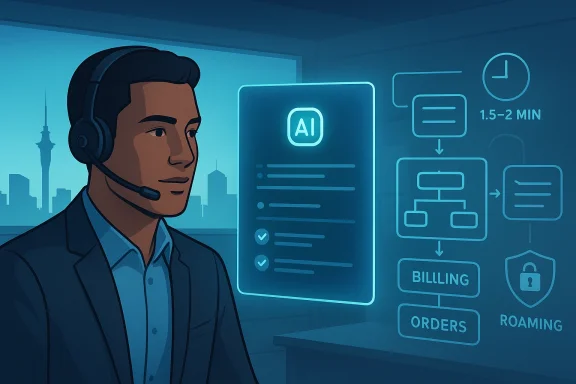
Spark’s contact centres are the most visible place where Copilot is already making a measurable difference. The company says the tools are supporting more than 350 frontline advisors, bringing together information from across systems and providing real-time guidance across billing, orders, and roaming. That matters because these are the kinds of customer questions where speed and accuracy are equally important.In practice, customer care environments are ideal early targets for AI because they contain repeatable patterns, high call volumes, and relatively clear outcomes. A well-designed assistant can summarize a conversation, surface relevant policies, and suggest next steps without forcing the agent to start from scratch every time. This is where AI can produce visible customer-facing value without requiring a full organisational overhaul.
From information retrieval to guided action
The step change is that Copilot is not just helping advisors find answers. It is helping them navigate the workflow itself. That distinction matters because customer service failures often come from process complexity rather than lack of goodwill.Spark’s approach appears to be built around three layers of assistance:
- Summarisation of the interaction so far.
- Context retrieval from customer, product, and service systems.
- Procedural guidance that suggests what should happen next.
The reported savings of 1.5 to 2 minutes per call may sound modest, but in high-volume environments the economics are significant. Even a small reduction in average handling time can free up major capacity across a large team. It also improves employee experience because advisors spend less time wrestling with systems and more time resolving the actual issue.
The Operational Multiplier Effect
The deeper story is that Spark is not deploying AI in only one department. It is creating a repeatable pattern that can be extended into product setup, software engineering, and network operations. That is what makes the initiative strategically important. The company is turning Copilot from a point solution into an operational multiplier.The article’s figures suggest the scale is already meaningful. Spark says AI assistants are handling about 20,000 internal queries each month, reducing questions sent back to operational teams by around 60 per cent. That is not just a productivity gain; it is a reallocation of effort away from internal back-and-forth and toward higher-value work.
Internal support becomes self-service
The reduction in internal queries is especially notable because internal support often hides substantial inefficiency. Teams that answer repeated procedural questions can become a bottleneck, even when they are highly skilled. By teaching Copilot to answer routine questions, Spark is effectively industrialising a chunk of institutional knowledge.That has several knock-on effects:
- Operations teams spend less time on repetitive guidance.
- Frontline staff get faster answers.
- Knowledge becomes more broadly available.
- Onboarding new employees becomes easier.
- Service quality becomes less dependent on who happens to be on shift.
The same pattern is visible in business customer product setup, where Spark says automation has reduced process time by around 60 per cent. That indicates the company is finding value not only in customer-facing support but also in the workflows that sit behind revenue generation and service provisioning. Those are often the places where enterprise AI has the greatest ROI.
Why Governance Matters
Spark’s insistence on governance, privacy, and accountability is not a side note. It is one of the most important parts of the story. Any AI system that touches customer information, operational decision-making, or technical guidance needs clear controls, or it risks becoming a source of error rather than efficiency. Spark says human oversight is built in and that people, not AI, remain responsible for final decisions. That is the right posture.This is also where enterprise AI differs sharply from consumer AI. A consumer might accept a wrong suggestion from a digital assistant and move on. In a telecommunications business, the consequences can include incorrect billing guidance, poor customer outcomes, or operational mistakes that ripple across systems. That means trust architecture is as important as model capability.
Human-in-the-loop is not optional
The best enterprise deployments do not treat human oversight as a fallback. They treat it as a core design principle. Spark’s approach reflects that philosophy by positioning AI as decision support, process acceleration, and knowledge amplification — not autonomous authority.That distinction should reassure enterprise buyers who worry about hallucinations, compliance, and accountability. It also explains why organisations often see better results when they narrow the AI’s role to clearly bounded tasks rather than trying to automate everything at once.
Important governance themes include:
- Defined responsibility for final decisions.
- Privacy controls around customer and operational data.
- Process transparency so teams understand what AI is doing.
- Human review for exceptions and escalations.
- Clear boundaries between recommendation and execution.
Software Development and Network Operations
Spark’s use of Copilot is not confined to customer service. The company says it is using AI in software development to draft test cases, assist with migrations, and validate changes before they are merged. That matters because development teams are usually measured not only on speed but also on quality, and those two goals can conflict. AI that reduces repetitive coding or testing overhead can improve throughput while preserving standards if it is used carefully.Network operations is another compelling frontier. Spark says AI is helping detect potential faults earlier and recommend remediation steps, which suggests a move toward more proactive operations management. In telecoms, earlier detection is valuable because small issues can become service disruptions quickly. Reducing mean time to detect and mean time to repair is one of the clearest ways AI can create infrastructure value.
From support work to technical resilience
These use cases show that Spark is trying to move from assisted work to augmented systems. In engineering, Copilot is not just speeding up typing. It is helping validate, test, and maintain technical consistency. In network operations, it is supporting earlier intervention, which may lower outage risk and improve service continuity.That is strategically significant because it broadens AI’s value beyond the front office. The same platform can improve service quality, engineering velocity, and operational resilience if the underlying data and process design are sound.
The likely benefits are:
- Shorter development cycles without sacrificing controls.
- Better test coverage through faster test-case drafting.
- Reduced deployment friction during migrations.
- Earlier issue detection in network systems.
- More consistent remediation playbooks for operators.
The Move Toward Agentic AI
Spark’s future direction is perhaps the most ambitious part of the story. The company says it is exploring how AI can adjust energy usage across sites in response to real-time demand, and how Copilot and other Microsoft Azure AI tools can carry out defined steps in a workflow before handing off for human approval. That is a move toward agentic AI — systems that do more than recommend and instead help execute.This is where Microsoft’s “Frontier Firm” language becomes more than branding. The idea is that the organisation becomes a hybrid environment where humans define the goal, agents complete bounded tasks, and people review the outcome. Microsoft has argued in multiple recent posts that this is the model that allows AI to scale meaningfully across the enterprise.
What changes when AI can do parts of the work
The distinction between suggestion and execution is crucial. A tool that drafts a response or finds a policy is useful. A tool that can complete defined steps in a workflow is more transformative because it affects throughput, queue depth, and process consistency.Spark’s framing suggests a future where AI might:
- Gather required data.
- Prepare a draft action or recommendation.
- Execute pre-approved steps.
- Escalate only when human judgment is required.
- Log the process for oversight and compliance.
The energy-management angle is also interesting because it shows AI can affect both cost and sustainability. For a large distributed business, site-level optimisation could be a meaningful lever if demand patterns are predictable enough for automation to help.
Competitive and Market Implications
Spark’s deployment should be read in the context of a much larger competitive race among telecoms and enterprise technology providers. AI is increasingly becoming a differentiator not because firms can say they use it, but because they can demonstrate measurable operational change. That puts pressure on competitors to move beyond pilot projects and into workflow redesign.For Microsoft, Spark is another showcase customer in a market where proof points matter. The company is building a narrative that Copilot is not just an employee productivity layer but a platform for enterprise transformation. The more examples it can point to where major companies achieve tangible gains, the more credible that narrative becomes. Spark’s New Zealand footprint gives Microsoft a regional reference case with global relevance.
Lessons for rivals
Other telecoms and large service businesses should notice two things. First, the strongest results are coming from use cases close to real operational pain, not abstract innovation labs. Second, the benefits depend on connecting AI to actual systems of work, not just giving staff a smarter search box.That creates a competitive divide between organisations that merely adopt AI and those that redesign around it. In industries with thin margins and high service expectations, that divide may become decisive.
Potential market takeaways include:
- AI is moving from experiment to infrastructure.
- Process redesign is becoming more important than model choice.
- Human oversight remains a key trust differentiator.
- Operational ROI is now a central selling point.
- Industry-specific deployment matters more than generic adoption.
Strengths and Opportunities
Spark’s rollout has several obvious strengths, and those strengths explain why the initiative is likely to keep expanding. The company has chosen practical use cases, tied AI to measurable outcomes, and built governance into the design from the start. That combination is more durable than flashy experimentation because it is rooted in the realities of running a complex business.The biggest opportunity is scale. Once the pattern is proven in one workflow, it can often be adapted to adjacent workflows with relatively little reinvention. That creates the possibility of compounding returns over time rather than one-off productivity gains.
- Clear operational pain points were identified before deployment.
- Measurable time savings give the project visible ROI.
- Human oversight reduces the risk of unsafe automation.
- Cross-functional applicability extends the value beyond contact centres.
- Knowledge capture makes expertise easier to share.
- Better consistency can improve customer and employee experience.
- Energy optimisation opens a sustainability angle as well as a cost angle.
Risks and Concerns
Even strong AI deployments carry risk, and Spark’s approach is no exception. The more deeply AI is embedded into operational systems, the more important it becomes to control data quality, permissions, and model behaviour. If the underlying information is incomplete or inconsistent, AI can accelerate errors just as easily as it accelerates good decisions.There is also an organisational risk. Teams may become too dependent on AI-guided workflows and lose some fluency in manual problem-solving. That can be manageable if training and oversight remain strong, but it is a real concern in fast-moving environments.
- Hallucinated or incorrect guidance could mislead staff.
- Data fragmentation may limit the reliability of AI outputs.
- Over-automation could weaken human expertise over time.
- Governance overhead may slow future deployments.
- Change fatigue could reduce adoption if rollout is too broad.
- Hidden bias may affect recommendations in subtle ways.
- Integration complexity could become the real bottleneck.
Looking Ahead
Spark’s next phase will likely determine whether this becomes a notable efficiency program or a true operating-model shift. The company has already demonstrated that AI can reduce friction in high-volume service environments and improve internal knowledge access. The harder challenge now is to extend those gains into more autonomous but still well-governed workflows.If Spark can safely move from assisted work to partially executed work, it will enter a more advanced phase of enterprise AI adoption. That would put the company among the more credible examples of what Microsoft is calling a Frontier Firm, where humans and agents collaborate across routine and complex tasks alike.
The watchpoints are straightforward, even if the execution is not.
- Expansion into new workflows beyond customer care and development.
- Evidence of sustained ROI over multiple quarters.
- New agentic use cases with clear human approval gates.
- Integration with energy and sustainability systems.
- Employee adoption rates and satisfaction with AI-assisted work.
Spark’s AI journey suggests a broader truth for enterprise technology in 2026: the winners will not be the companies that simply add Copilot to existing processes, but the ones that rethink how work flows from start to finish. If Spark continues on this path, it may become one of the clearest examples in the region of how responsible AI, disciplined governance, and workflow redesign can combine to produce real business impact.
Source: Microsoft Source 2-minute savings per call is just the beginning: Spark transforms workflows with Microsoft Copilot - Source Asia
