

Spinx’s move to unify its data across systems with LevelShift and Microsoft Fabric is a textbook example of how a modern, cloud-first data foundation can turn fragmented operational data into timely, actionable insight—and lay the groundwork for AI-driven business processes.
Spinx, a South Carolina convenience and fuel retail operator, confronted a familiar problem: multiple transactional systems (Oracle, SQL Server, third‑party platforms), manual data handling, and limited visibility into promotion and item‑level performance. LevelShift—recently rebranded from PreludeSys and positioned as a Microsoft Fabric partner—helped Spinx consolidate those silos into a single data lake, modernize reporting, and bring real‑time analytics to operational teams. Microsoft Fabric is presented as a unified data platform that combines ingestion, storage (OneLake), compute, governance, and BI in a single SaaS experience. Fabric’s Data Factory capability advertises connectivity to a very large set of sources—“over 170 data sources”—which is central to the Spinx story because it enabled out‑of‑the‑box integrations from on‑prem and cloud systems into the lake. That claim is documented in Microsoft’s Fabric Data Factory materials and is corroborated by partner integrations built for Fabric. LevelShift’s value proposition in the engagement combined domain expertise (retail and field operations) with deep Fabric implementation skills: they embed with customer teams, run migrations and data strategy, and also use Fabric internally so delivery teams bring practical, operational knowledge to clients. This consultative model appears central to Spinx selecting LevelShift as a partner.
Source: Microsoft Spinx unified its data across systems with LevelShift and Microsoft Fabric | Microsoft Customer Stories
 Background / Overview
Spinx, a South Carolina convenience and fuel retail operator, confronted a familiar problem: multiple transactional systems (Oracle, SQL Server, third‑party platforms), manual data handling, and limited visibility into promotion and item‑level performance. LevelShift—recently rebranded from PreludeSys and positioned as a Microsoft Fabric partner—helped Spinx consolidate those silos into a single data lake, modernize reporting, and bring real‑time analytics to operational teams. Microsoft Fabric is presented as a unified data platform that combines ingestion, storage (OneLake), compute, governance, and BI in a single SaaS experience. Fabric’s Data Factory capability advertises connectivity to a very large set of sources—“over 170 data sources”—which is central to the Spinx story because it enabled out‑of‑the‑box integrations from on‑prem and cloud systems into the lake. That claim is documented in Microsoft’s Fabric Data Factory materials and is corroborated by partner integrations built for Fabric. LevelShift’s value proposition in the engagement combined domain expertise (retail and field operations) with deep Fabric implementation skills: they embed with customer teams, run migrations and data strategy, and also use Fabric internally so delivery teams bring practical, operational knowledge to clients. This consultative model appears central to Spinx selecting LevelShift as a partner. What Spinx actually did: implementation highlights
1. Built a tenant‑level OneLake foundation
Spinx consolidated operational and transactional sources into a single logical lake (OneLake). This removed the multiple manual extraction and reconciliation steps used to a governed, discoverable surface where analytics and operational queries run against the same curated data. OneLake’s “zero‑copy” sharing and mirroring patterns let teams expose curated artifacts to BI and machine learning without duplicating terabytes of data.2. Used Fabric Data Factory to connect and modernize pipelines
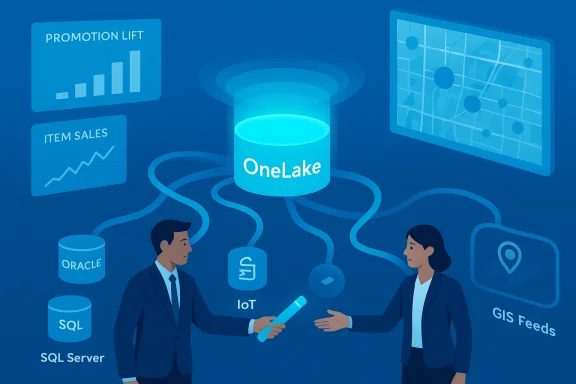
The team used Fabric’s Data Factory pipelines to ingest, transform and orchestrate data from:- Oracle and SQL Server production systems,
- third‑party retail and ticketing platforms,
- IoT streams (car wash telemetry and site devices),
- GIS APIs and demographic overlays.
3. Real‑time analytics and operations integration
Spinx moved from batch-only reporting to near‑or critical operational signals: promotion effectiveness, item‑level sales, and site‑level diagnostics for IoT‑enabled hardware. Fabric’s Real‑Time Intelligence and indexed event stores (eventhouses/eventstreams) are designed to support these low‑latency operational dashboards and alerting patterns. This enables faster diagnosis of site issues and more detailed promotion analysis that protects margins.4. Semantic models and analytic layer for promotion optimization
Once the lake and pipelines were in place, LevelShift and Spinx focused on semantic modeling and curated datasets so analysts and business users could run consistent reports and feed ML models. The medallion/semantic approach (bronze/silver/gold layers) enforces data quality and lineage, making ML and Copilot‑style experiences more reliable.5. GIS and analytics for strategic expansion
Geospatial APIs were woven into the data estate to enable smarter site selection using demographic overlays and location intelligence—an example of how operational telemetry and external datasets become decision inputs once they live in a governed lake.Why the stack and partner model mattered
- Breadth of connectors and out‑of‑the‑box integrations: Fabric’s Data Factory supports a large catalogue of connectors, which reduces custom integration engineering. Microsoft documents this as connectivity to over 170 sources; partners and ISVs (for example, Delphix / Perforce) also position their solutions around the same connector footprint. That breadth is what made a fast migration feasible for Spinx.
- OneLake as a single logical data lake: Moving authoritative data and curated artifacts into OneLake enabled governed sharing across workloads (analytics, ML, Copilot experiences) without creating multiple competing copies.
- Partner delivery and domain expertise: LevelShift’s model—embedding resources, applying vertical accelerators (retail), and combining implementation with advisory strategy—accelerated the program and reduced friction between IT, analytics and business stakeholders. LevelShift’s public materials highlight their Fabric certifications and focus on retail accelerators.
- AI‑readiness and RAG/Copilot future paths: With a governed lake and semantic models, Spinx can now build Retrieval‑Augmented Generation (RAG) or Copilot experiences grounded in vetted data, reducing hallucination risk and making AI outputs auditable.
Verifying key technical claims (what we checked and why)
- Claim: “Fabric connects over 170 data sources”
- Verified directly from Microsoft’s Fabric Data Factory documentation stating Data Factory connects to over 170 data sources.
- Independently corroborated by third‑party vendor materials (Delphix / Perforce) that explicitly reference Fabric and a 170+ connector footprint when discussing native integrations and masking for Fabric pipelines. That alignment is important because ISVs position their integrations based on Microsoft’s supported connectors.
- Claim: LevelShift is a Microsoft partner and uses Fabric internally
- Verified on LevelShift’s partner and services pages where they describe being a Microsoft Solutions Partner and a featured Fabric partner with Fabric‑focused offerings and events participation. LevelShift’s press materials and event listings further support their partner positioning and Fabric engagement.
- Claim: Spinx migrated Oracle/SQL Server and third‑party data into Fabric
- Verified directly in Microsoft’s customer story for Spinx, which names Oracle, SQL Server and third‑party platforms as the sources unified into the Fabric data lake.
Data plane and pipelines
- Fabric Data Factory acts as the ingestion and orchestration surface. It pulls from transactional systems (Oracle, SQL Server), SaaS APIs, and custom connectors.
- Mirroring can replicate operational databases into OneLake in analytics‑ready formats (Delta/Parquet), reducing the need for heavy ETL. Mirroring plus OneLake shortcuts avoids needless data duplication while preserving lineage and governance.
Storage and semantics
- OneLake stores raw and curated data. Data teams apply transformations (dbt or Fabric transformations) to build semantic layers and medallion pipelines. These gold datasets feed Power BI, Copilot, and ML pipelines.
Real‑time & operational layer
- Fabric’s Real‑Time Intelligence (RTI) supports event ingestion, time‑series indexing, and low‑latency dashboards. For retail operations, this enables:
- Promotion response monitoring,
- Site hardware health signals (car washes, kiosks),
- Quick diagnostic workflows for field technicians.
Governance, security, and compliance
- Microsoft Purview (or the Fabric governance plane) provides catalog, classification, and policy enforcement. Partners and ISVs (e.g., Delphix) provide masking and compliance tooling to embed privacy controls into pipelines, an especially relevant consideration for retail customer data and payment telemetry.
Strengths and practical benefits (what the architecture delivers)
- Faster integration with less custom coding: The large connector library reduces custom work and shortens migration time.
- Single source of truth: OneLake semantic artifacts eliminate inconsistent figures across finance, operations and merchandising.
- Operational agility: Near‑real‑time insights let operations act faster—diagnose site issues and measure promotion lift quickly.
- Foundation for trustworthy AI: With governed, curated datasets, retrieval‑based AI experiences are more reliable.
- Repeatable partner delivery: LevelShift’s vertical accelerators and Fabric playbooks accelerate adoption and reduce risk for other retailers.
Risks, limitations, and what to watch out for
- Vendor coupling and portability
- Consolidating ingestion, storage, compute and governance into Fabric is efficient, but it increases coupling to Microsoft’s managed services. Future migrations away from Fabric (or transferring workloads between clouds) will be more complex and could carry nontrivial migration costs.
- Cost modeling and operational expense
- Cloud services trade upfront capex for ongoing opex. For high-volume mirroring, frequent matching and near‑real‑time processing, compute and storage can grow rapidly. Organizations should model ingestion cadence, mirror frequency, and query patterns to estimate long‑term costs. Independent guidance recommends PoC cost modeling and runbook preparation.
- Data residency and sovereignty
- Centralizing data on a cloud tenant requires clarity on residency and legal obligations—especially if data crosses jurisdictional boundaries. This is a standard compliance concern but must be surfaced early in project governance.
- Operational discipline and data quality
- Fabric reduces technical friction, but business value depends on data modeling discipline, semantic governance, and monitoring (data health dashboards, duplicate/consistency checks). Automated pipelines without adequate validation can surface garbage faster.
- Security for agents and Copilot experiences
- As organizations unlock RAG and Copilot experiences, agent credentials, service principals and token management become new attack surfaces. Zero Trust controls, least privilege and continuous monitoring are essential. Historical industry reporting highlights risks of insufficient governance around autonomous agents.
- Overpromising from vendor narratives
- Case studies are useful for architecture pattern discovery but often omit detailed cost, SLA or scale metrics. Where claims are operational (e.g., percent reductions in work hours), independent verification or internal benchmarking is required before extrapolating results.
Practical checklist for teams planning a similar migration
- Inventory all source systems and classify by sensitivity, update cadence, and schema complexity.
- Run a representative PoC that includes:
- Ingesting realistic volumes,
- Mirroring near‑real‑time updates,
- Running expected BI and ML queries.
- Validate connector coverage (confirm specific connector names and authentication modes) rather than relying on high‑level counts.
- Establish semantic models and a medallion pipeline early to prevent ad‑hoc dataset sprawl.
- Integrate governance: Purview classifications, Entra access control, and audit logging from day one.
- Perform cost modeling for ingestion, storage, compute and continuous processing.
- Prepare an operational runbook for monitoring, alerting, and incident response specific to Fabric workloads.
- If you will use RAG/Copilot, define grounding, retraining cadences, and human‑in‑the‑loop checks for production outputs.
What the Spinx story means for retail and similar industries
Retailers and field‑operations businesses live or die by timely decisions and tight margins. The Spinx engagement shows a practical path from fragmented systems to:- comprehensive promotion analytics,
- better operational diagnostics (IoT),
- and a foundation for personalized, AI‑assisted customer experiences.
Final assessment and takeaway
Spinx’s migration is a compelling example of pragmatic data modernization: it pairs technology (Microsoft Fabric) with partner execution (LevelShift) and produces operational benefits that matter to the business—faster insight into promotions, better site diagnostics, and a path to AI. The central technical claim that enabled this migration—Fabric’s connectivity to a wide range of sources (over 170)—is documented by Microsoft and corroborated by partner integrations and ISV materials, making the architectural choice defensible for organizations with heterogeneous data estates. That said, success is not automatic. Organizations must plan for governance, cost modeling, security hardening, and long‑term operational ownership. Partners that embed into an organization and bring domain expertise—like LevelShift claims to do—can materially shorten the time to value, but teams should insist on measurable PoCs, clear SLAs, and runbooks that show how to operate the platform at scale. Spinx’s story is a practical template for retail and operational businesses: unify, govern, operationalize, and then iterate toward AI‑enabled workflows. The technical building blocks exist; the differentiator is disciplined implementation and governance—exactly the fields where a seasoned partner can make the difference.Source: Microsoft Spinx unified its data across systems with LevelShift and Microsoft Fabric | Microsoft Customer Stories
