

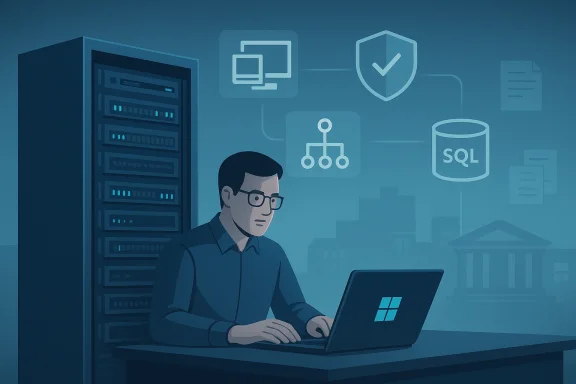
SPMB’s opening for an IT Specialist in Cedar Rapids is a useful reminder that many law firms now depend on in-house technology talent, not just outside vendors. The ad is straightforward, but the skill set it asks for is telling: this is not an entry-level help desk role, and it is not limited to one platform or one narrow function. It blends Windows Server, SQL Server, Active Directory, networking, cybersecurity basics, and Hyper-V into a single position, which suggests a lean IT team that needs someone capable of wearing multiple hats.
The posting from Simmons Perrine Moyer Bergman PLC, commonly referred to as SPMB, appears on The Gazette’s classifieds ecosystem and mirrors the version syndicated through Corridor Careers. It calls for a B.A. in Computer Science or related field plus two years of experience working in an IT Department, a combination that usually signals a mid-level role rather than a trainee position. The ad also provides a direct application path to Ben Sass, which is typical for smaller professional-services employers that want to keep hiring tightly managed.
The practical meaning of the listing is broader than a single vacancy. It reflects how regional firms in legal, accounting, consulting, and other professional sectors have become increasingly dependent on internal systems administration. In a firm environment, downtime is expensive, security expectations are high, and support needs can range from user provisioning to database maintenance and virtualization. That makes this sort of role more strategic than it may first appear.
The job is also notable because it sits in Cedar Rapids, one of Iowa’s most durable business hubs. SPMB’s own corporate profile shows it as a full-service law firm with offices in Cedar Rapids and Coralville, which implies a distributed environment with shared infrastructure, remote access needs, and multi-office support concerns. In that context, the position likely has both day-to-day operational responsibilities and some degree of project work.
What stands out most is the toolchain. Active Directory, Windows Server, and Hyper-V point to an on-prem or hybrid Microsoft-centered stack, while SQL Server and data analysis indicate responsibilities that may extend into line-of-business applications and reporting. The addition of cybersecurity basics matters too, because law firms handle sensitive client information and cannot treat security as an afterthought.
For job seekers, the listing is also a clue about the expected profile of the hiring manager’s ideal candidate. Two years of IT Department experience suggests the firm wants someone who can contribute immediately, while the degree requirement implies a preference for structured technical training. Put simply, SPMB appears to want practical competence more than raw potential.
A Microsoft-centric stack is common in law firms because it supports predictable identity management and familiar desktop workflows. Active Directory remains central in many such environments, especially when local permissions, group-based access, and policy enforcement are critical. When paired with Windows Server and Hyper-V, the picture becomes one of a relatively mature but still operationally active infrastructure layer.
The mention of SQL Server is especially revealing because legal firms frequently rely on applications with database components, whether for document management, billing, case workflow, or reporting. A person in this role may not be writing production code, but they may need to understand queries, backups, restores, service dependencies, and performance issues well enough to keep business systems functioning.
Cybersecurity basics is a phrase that sounds modest but often translates into practical responsibilities such as endpoint hygiene, phishing awareness, access reviews, and patch discipline. In a law firm, those tasks are not optional niceties; they are part of the firm’s duty to protect client data and preserve trust. Even an IT generalist can become a key part of a security posture if the team is small.
That has upside and downside. The upside is exposure to a wide range of technologies, which can accelerate skill growth. The downside is that the employee must be comfortable context-switching throughout the day and cannot rely on a deep bench of nearby specialists.
Compared with a standard desktop support job, this listing has more infrastructure depth. Compared with a server admin post, it has more user-facing pressure. That in-between nature can be attractive to candidates who want variety, but it can also be taxing if the firm expects one person to cover too many layers without enough backup.
The geography matters because technology hiring in smaller metro areas often rewards candidates who can handle responsibility without expecting the layered specialization found in a giant corporate campus. Employers in these markets tend to value stability, responsiveness, and the ability to solve problems with limited overhead. This job seems designed for exactly that kind of environment.
It also means the role may come with a strong expectation of trust. When a firm puts systems, access control, and internal support in the hands of a small IT team, reliability becomes part of the job description even when it is not stated explicitly. In a law firm, trust is itself an IT competency.
The degree requirement, meanwhile, suggests SPMB wants a person who can combine hands-on work with conceptual understanding. A candidate with equivalent experience might still be competitive, but the ad clearly prioritizes formal education. That can be especially important in a firm environment, where documentation, procedure, and judgment matter alongside technical skill.
The enterprise value is obvious: reduced downtime, steadier administration, and better coordination across the environment. The career value is just as important: exposure to servers, networking, virtualization, and user support in a real production setting. Those experiences can be highly transferable across industries.
It can also sharpen judgment. Knowing when to fix something immediately, when to escalate, and when to document for later is one of the quiet skills that make small-team IT work effective. In a legal office, that judgment is especially important because mistakes can have operational or compliance consequences.
SPMB’s posting also fits a larger trend in which professional firms are increasingly unwilling to accept fragile IT coverage. Even smaller workplaces now depend on encrypted data, cloud-connected services, identity systems, and virtual infrastructure. That raises the bar for internal IT roles and makes the posted skill set feel less like a wish list and more like a minimum operating baseline.
This is why generalist specialization has become such a valuable profile: broad enough to operate across domains, deep enough to handle meaningful infrastructure tasks. In the current market, that combination is often more employable than a narrow title alone.
For the wider Cedar Rapids market, the posting is another sign that strong infrastructure talent remains valuable outside the software sector. Local employers still need people who understand Microsoft environments, security hygiene, and business continuity. As more firms digitize their workflows, demand for these profiles should stay resilient.
Source: thegazette.com SPMB has opportunities for IT Specialist
 Overview
The posting from Simmons Perrine Moyer Bergman PLC, commonly referred to as SPMB, appears on The Gazette’s classifieds ecosystem and mirrors the version syndicated through Corridor Careers. It calls for a B.A. in Computer Science or related field plus two years of experience working in an IT Department, a combination that usually signals a mid-level role rather than a trainee position. The ad also provides a direct application path to Ben Sass, which is typical for smaller professional-services employers that want to keep hiring tightly managed.The practical meaning of the listing is broader than a single vacancy. It reflects how regional firms in legal, accounting, consulting, and other professional sectors have become increasingly dependent on internal systems administration. In a firm environment, downtime is expensive, security expectations are high, and support needs can range from user provisioning to database maintenance and virtualization. That makes this sort of role more strategic than it may first appear.
The job is also notable because it sits in Cedar Rapids, one of Iowa’s most durable business hubs. SPMB’s own corporate profile shows it as a full-service law firm with offices in Cedar Rapids and Coralville, which implies a distributed environment with shared infrastructure, remote access needs, and multi-office support concerns. In that context, the position likely has both day-to-day operational responsibilities and some degree of project work.
What stands out most is the toolchain. Active Directory, Windows Server, and Hyper-V point to an on-prem or hybrid Microsoft-centered stack, while SQL Server and data analysis indicate responsibilities that may extend into line-of-business applications and reporting. The addition of cybersecurity basics matters too, because law firms handle sensitive client information and cannot treat security as an afterthought.
Why This Job Listing Matters
This kind of posting is a strong indicator of where enterprise IT demand is heading outside major tech companies. Organizations that are not technology-first still need dependable systems management, but they usually want one person who can bridge multiple domains. That means the market increasingly rewards candidates who are part administrator, part analyst, and part support specialist.For job seekers, the listing is also a clue about the expected profile of the hiring manager’s ideal candidate. Two years of IT Department experience suggests the firm wants someone who can contribute immediately, while the degree requirement implies a preference for structured technical training. Put simply, SPMB appears to want practical competence more than raw potential.
The shape of a modern law-firm IT role
Law firms often run a mix of file services, document management platforms, office productivity suites, printer and endpoint management, identity services, and legacy line-of-business software. That means the person filling this role may spend part of the day troubleshooting user issues and part of the day maintaining infrastructure. The posting’s skill list reflects that reality.- Windows Server knowledge points to directory services, file shares, patching, and server upkeep.
- SQL Server suggests database support, maintenance, or application back-end troubleshooting.
- Active Directory implies account lifecycle management, access control, and group policy work.
- Networking covers connectivity, segmentation, printers, VPNs, and office infrastructure.
- Hyper-V indicates virtual machine administration or support for virtualized workloads.
SPMB’s Technology Environment
SPMB’s public profile describes the firm as a full-service law practice with Cedar Rapids and Coralville offices. That setup alone suggests the IT team must manage user identity, shared storage, connectivity between offices, and secure access to case-related documents. Even without a detailed technical architecture statement from the company, the hiring requirements reveal a lot about the likely environment.A Microsoft-centric stack is common in law firms because it supports predictable identity management and familiar desktop workflows. Active Directory remains central in many such environments, especially when local permissions, group-based access, and policy enforcement are critical. When paired with Windows Server and Hyper-V, the picture becomes one of a relatively mature but still operationally active infrastructure layer.
What the stack implies operationally
There are several possible interpretations of the skills list, and the most likely one is a hybrid of internal and vendor-managed systems. The candidate may be asked to support servers, monitor service health, and manage daily user requests, while also coordinating with outside providers for specialized applications. That mix is typical in a small or mid-sized professional firm, where efficiency matters as much as technical depth.The mention of SQL Server is especially revealing because legal firms frequently rely on applications with database components, whether for document management, billing, case workflow, or reporting. A person in this role may not be writing production code, but they may need to understand queries, backups, restores, service dependencies, and performance issues well enough to keep business systems functioning.
Required Skills, Decoded
The posted requirements look simple, but each item carries operational weight. Windows Server and Active Directory are the backbone of many business networks, and familiarity with both usually means the job will involve more than password resets or basic desktop support. The inclusion of troubleshooting and configuring OS also suggests a hands-on support environment where the candidate will need to diagnose both hardware and software issues quickly.Cybersecurity basics is a phrase that sounds modest but often translates into practical responsibilities such as endpoint hygiene, phishing awareness, access reviews, and patch discipline. In a law firm, those tasks are not optional niceties; they are part of the firm’s duty to protect client data and preserve trust. Even an IT generalist can become a key part of a security posture if the team is small.
Breaking down the software list
The software and system list in the posting effectively maps to a small enterprise administrator’s daily toolbox. It is broad enough to require adaptability, but specific enough to exclude true beginners. That’s a meaningful distinction for applicants deciding whether to apply.- Windows Server: server administration, file services, updates, service health.
- Windows SQL Server: database support, backup awareness, basic optimization.
- Active Directory: authentication, group policy, account provisioning, permissions.
- Networking: switches, connectivity, office networking, VPN basics.
- Data analysis: reporting, spreadsheet reasoning, operational insight.
- Cybersecurity basics: endpoint safety, awareness, policy enforcement.
- Hyper-V: virtualization, VM management, capacity awareness.
How This Compares With Similar Roles
This opening fits a pattern seen across many mid-market employers in 2025 and 2026: fewer specialized roles, more blended responsibilities. In a larger organization, server administration, database administration, security operations, and help desk support might each be separate jobs. In a firm like SPMB, those duties can converge into one position or a very small team.That has upside and downside. The upside is exposure to a wide range of technologies, which can accelerate skill growth. The downside is that the employee must be comfortable context-switching throughout the day and cannot rely on a deep bench of nearby specialists.
Consumer-style support versus enterprise support
Although the internal users are employees rather than consumers, the service expectations often resemble high-touch customer support. Lawyers and staff need fast answers, minimal downtime, and confident handling of sensitive issues. That means the role likely demands polished communication as well as technical fluency.Compared with a standard desktop support job, this listing has more infrastructure depth. Compared with a server admin post, it has more user-facing pressure. That in-between nature can be attractive to candidates who want variety, but it can also be taxing if the firm expects one person to cover too many layers without enough backup.
- It is broader than a pure help desk role.
- It is less specialized than a dedicated systems engineer role.
- It likely involves direct interaction with attorneys and staff.
- It may require balancing urgent support tickets with maintenance work.
- It could include after-hours work during outages or upgrades.
Why Cedar Rapids Is a Good Fit
Cedar Rapids is a strong setting for this kind of job because it combines a regional business base with enough scale to support serious professional services firms. SPMB’s office location and the Gazette’s local classifieds reach both reinforce that this is a real local employer hiring in a market where reputation and reliability matter. The firm’s Cedar Rapids identity is also consistent with a need for dependable, in-person or hybrid technical support.The geography matters because technology hiring in smaller metro areas often rewards candidates who can handle responsibility without expecting the layered specialization found in a giant corporate campus. Employers in these markets tend to value stability, responsiveness, and the ability to solve problems with limited overhead. This job seems designed for exactly that kind of environment.
Local employer, local accountability
For an IT professional, a local law-firm role can offer more visibility than a comparable corporate assignment. The worker may build direct relationships with leadership and influence how systems are run rather than merely following tickets in a queue. That can be professionally satisfying, especially for someone who wants to see the business impact of technical decisions.It also means the role may come with a strong expectation of trust. When a firm puts systems, access control, and internal support in the hands of a small IT team, reliability becomes part of the job description even when it is not stated explicitly. In a law firm, trust is itself an IT competency.
What Candidates Should Read Between the Lines
The phrase “two years of experience working in an IT Department” is doing a lot of work here. It narrows the field to applicants who have already lived through tickets, maintenance windows, user escalations, and the awkward realities of keeping business systems available. It also implies the company is not looking for someone to learn the basics from scratch.The degree requirement, meanwhile, suggests SPMB wants a person who can combine hands-on work with conceptual understanding. A candidate with equivalent experience might still be competitive, but the ad clearly prioritizes formal education. That can be especially important in a firm environment, where documentation, procedure, and judgment matter alongside technical skill.
How applicants should position themselves
People applying to a role like this should present themselves as operational problem-solvers, not just technology enthusiasts. The strongest applications will likely show evidence of managing AD objects, supporting server environments, working with virtualization, or resolving network-related incidents. Even experience with backup routines, patching cycles, or SQL-backed applications would be relevant.- Emphasize practical experience over buzzwords.
- Show examples of troubleshooting under pressure.
- Highlight any exposure to law, finance, healthcare, or other regulated environments.
- Mention collaboration with non-technical users.
- Demonstrate comfort with multiple systems and competing priorities.
Enterprise vs. Career-Building Value
For the employer, the position is about continuity, access control, and service quality. For the applicant, it may be a chance to move from reactive support into a broader systems role. That makes the job potentially valuable as a stepping stone, especially for someone who wants to deepen Microsoft infrastructure skills in a business setting.The enterprise value is obvious: reduced downtime, steadier administration, and better coordination across the environment. The career value is just as important: exposure to servers, networking, virtualization, and user support in a real production setting. Those experiences can be highly transferable across industries.
What the job can teach
A role like this can help an IT professional build confidence in areas that employers routinely test during interviews. If the workload includes infrastructure support, the employee may learn how to diagnose issues methodically, communicate clearly with end users, and balance incident response with preventive maintenance. That combination is often what distinguishes a technician from a systems professional.It can also sharpen judgment. Knowing when to fix something immediately, when to escalate, and when to document for later is one of the quiet skills that make small-team IT work effective. In a legal office, that judgment is especially important because mistakes can have operational or compliance consequences.
- Infrastructure troubleshooting
- Identity and access management
- Virtual machine administration
- End-user support and communication
- Basic security awareness
- Cross-functional coordination
The Broader Hiring Picture
The Gazette classifieds remain a significant local employment channel, and the fact that this opening appears there underscores how regional recruiting still works in 2026. Local employers use familiar outlets because they want visibility among people already living and working in the area. For a Cedar Rapids firm, that likely means finding someone who can be on-site, close enough to respond quickly, and rooted in the same market.SPMB’s posting also fits a larger trend in which professional firms are increasingly unwilling to accept fragile IT coverage. Even smaller workplaces now depend on encrypted data, cloud-connected services, identity systems, and virtual infrastructure. That raises the bar for internal IT roles and makes the posted skill set feel less like a wish list and more like a minimum operating baseline.
Why this kind of position stays in demand
The demand for small-team IT specialists persists because business technology rarely gets simpler. Applications multiply, security requirements rise, and users expect systems to work flawlessly regardless of office size. A well-rounded administrator can absorb that complexity far better than a narrowly trained support technician.This is why generalist specialization has become such a valuable profile: broad enough to operate across domains, deep enough to handle meaningful infrastructure tasks. In the current market, that combination is often more employable than a narrow title alone.
Strengths and Opportunities
The posting has several strengths that may appeal to experienced candidates and to observers tracking the local IT labor market. It is specific enough to signal real responsibilities, but broad enough to offer range and growth. For the right person, it could become a stable, visible, and technically varied role inside a respected professional-services environment.- Clear Microsoft stack focus, which makes the environment legible to applicants.
- Exposure to Windows Server, SQL Server, and Hyper-V.
- A chance to work in a law firm where IT supports mission-critical operations.
- Direct interaction with internal users, which can build communication skills.
- Potential for broad responsibility rather than repetitive task ownership.
- Strong résumé value for candidates seeking hybrid infrastructure experience.
- Local Cedar Rapids setting, which may reduce relocation barriers.
Risks and Concerns
The same broad scope that makes the role attractive can also create pressure if expectations are not carefully managed. A small firm can ask a lot from one IT professional, especially when users need rapid support and systems must remain available during business hours. If there is insufficient staffing or vendor support, the job could become reactive and stressful.- The role may combine help desk, systems admin, and security duties.
- Broad responsibilities can lead to scope creep if priorities are not controlled.
- A two-year experience requirement may still be demanding for the actual workload.
- Small teams can mean limited backup during vacations or outages.
- The mention of cybersecurity basics may understate real security expectations.
- Database and virtualization support could require knowledge beyond the wording of the ad.
- Legal-sector environments can be high-pressure when deadlines or filings are involved.
Looking Ahead
If SPMB fills this role successfully, the firm may strengthen the reliability of its internal systems while improving response time for staff. That can have a meaningful ripple effect across the business, because legal professionals tend to notice IT quality most when it is absent. A capable specialist can quietly raise the standard of the whole workplace.For the wider Cedar Rapids market, the posting is another sign that strong infrastructure talent remains valuable outside the software sector. Local employers still need people who understand Microsoft environments, security hygiene, and business continuity. As more firms digitize their workflows, demand for these profiles should stay resilient.
Key things to watch
- Whether the firm hires a generalist or a more infrastructure-focused specialist.
- Whether the position evolves toward cloud administration or stays on-premises.
- How much emphasis the firm places on security and compliance.
- Whether the role becomes a stepping stone to broader IT leadership.
- Whether similar openings appear from other Cedar Rapids professional firms.
Source: thegazette.com SPMB has opportunities for IT Specialist
