

Valve’s Steam platform is poised for a busy, consequential 2026: a long‑planned technical cleanup has become a hard deadline for legacy Windows users, Steam Input and controller support are getting broader and deeper, and Valve’s hardware roadmap — a new Steam Controller, a Steam Machine console, and Steam Frame — is set to reshape how players access the Steam library across PC, living room, and handheld form factors.
Steam’s desktop client has been the connective tissue of the PC gaming ecosystem for two decades, balancing backward compatibility with new features. That balance has, until now, included maintaining a Windows client that could run on 32‑bit editions of the OS — a choice that increasingly conflicts with modern drivers, libraries, and security practices.
Valve has announced a firm retirement of 32‑bit Windows support for Steam: beginning January 1, 2026, Steam will stop shipping updates and providing official support to systems running 32‑bit Windows. Valve’s own telemetry indicates that only a tiny fraction of users remain on 32‑bit Windows — the company cites ~0.01% — whichs a pragmatic consolidation rather than a mass migration.
This technical pivot is more than housekeeping. Moving the Steam client ecosystem to a 64‑bit baseline changes what Valve can build, how it integrates with drivers and anti‑cheat systems, and how the platform supports new hardware. It algineering overhead created by maintaining parallel 32‑ and 64‑bit toolchains. Expect the immediate result to be more reliable capture/recording, fewer driver‑related regressions, and a cleaner path for future feature work.
Why this matters in practice:
More importantly for 2026, Valve is reintroducing the Steam Controller concept as a modernized gamepad that borrows the Steam Deck’s input toolkit: dual square touchpads beneath the analog sticks, accurate gyro aiming, capacitive grip sensing, magnetic thumbsticks, and a dedicated low‑latency radio accessory (the “Puck”) that provides a magnetic dock and a wireless puck/dongle combo. Early coverage and hands‑on impressions point to a controller that tries to solve the old Steam Controller’s weaknesses while preserving its core strengths: deep configurability and desktop‑style pointing.
Key benefits Valve aims to deliver:
Interpretation and caution: performance claims like “6x Steam Deck” typically come from vendor marketing materials and should be treated as directional rather than precise. Real‑world performance depends heavily on thermal budgets, resolution/refresh targets (e.g., 4K 60 FPS vs. 1080p), and workload. Independent benchmarks will be required once review units arrive. Until then, consider the Steam Machine a credible effort to deliver a premium SteamOS living‑room box — but verify numbers against third‑party testing when it mam]
Strengths:
Conclusion
2026 will be a year when Steam stops carrying an old legacy weight and starts operating with clearer engineering assumptions and a more unified hardware vision. For most users, the change will be seamless and beneficial. For the small slice of legacy users and the broader ecosystem of peripheral and anti‑cheat vendors, the change is a scheduling challenge with real technical implications. Valve is giving the community a runway — but not forever. Plan, test, and validate now so you’re ready for the Steam of 2026.
Source: bgr.com 4 Big Changes Coming To Steam In 2026 - BGR
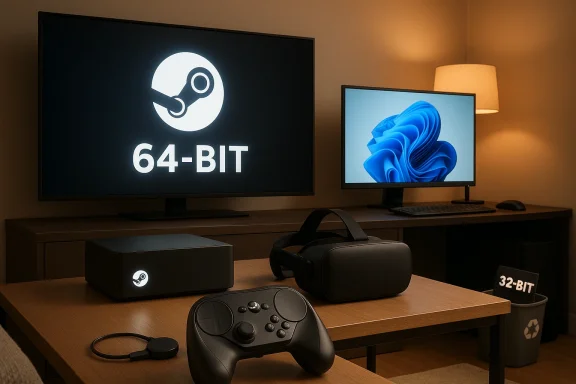 Background: why 2026 feels like a turning point for Steam
Steam’s desktop client has been the connective tissue of the PC gaming ecosystem for two decades, balancing backward compatibility with new features. That balance has, until now, included maintaining a Windows client that could run on 32‑bit editions of the OS — a choice that increasingly conflicts with modern drivers, libraries, and security practices.Valve has announced a firm retirement of 32‑bit Windows support for Steam: beginning January 1, 2026, Steam will stop shipping updates and providing official support to systems running 32‑bit Windows. Valve’s own telemetry indicates that only a tiny fraction of users remain on 32‑bit Windows — the company cites ~0.01% — whichs a pragmatic consolidation rather than a mass migration.
This technical pivot is more than housekeeping. Moving the Steam client ecosystem to a 64‑bit baseline changes what Valve can build, how it integrates with drivers and anti‑cheat systems, and how the platform supports new hardware. It algineering overhead created by maintaining parallel 32‑ and 64‑bit toolchains. Expect the immediate result to be more reliable capture/recording, fewer driver‑related regressions, and a cleaner path for future feature work.
What’s changing in 2026 — the four big shifts
1) Steam’s Windows client: 64‑bit becomes the standard (and 32‑bit support ends Jan 1, 2026)
Valve has transitioned the Steam desktop client to run natively as a 64‑bit application on supported Windows editions (Windows 10 x64 and Windows 11). The company will continue to ship a legacy 32‑bit build only to machines that need it — but updates and official support for that legacy branch stop after January 1, 2026. This is the clearest, most consequential single change: it places a hard date on the end of a legacy compatibility era.Why this matters in practice:
- Memory and reliability: a native 64‑bit process removes the ~4 GB address space ceiling and reduces memory fragmentation for large library caches and in‑client browser components.
- Driver and middleware compatibility: modern capture, anti‑cheat, and peripheral drivers increasingly target 64‑bit only, making the single‑architecture approach necessary.
- Security and future features: 64‑bit enables more modern mitigations and simplifies the adoption of new platform libraries.
- If you run Windows 10/11 64‑bit: no action needed — the update is automatic.
- If you run Windows 10 32‑bit and your CPU supports x64: plan a clean 64‑bit install to continue receiving updates after January 1, 2026.
- If you operate specialized kiosks, embedded systems, or retro rigs on 32‑bit Windows: treat continued Steam functionality without updates as a temporary and increasingly risky stopgap.
2) Steam Input and controller ecosystem: parity, polish, and new hardware
Steam Input — Valve’s powerful remapping and compatibility layer — is gaies which, combined with Valve’s new hardware, change the controller story for PC gaming. Recent client updates promoted new gyro modes to defaults, added toggles for relative roll/pitch mapping in gyro‑to‑joystick translation, and improved configurator stability. Steam Input also added explicit USB support for Nintendo’s latest controllers (referred to in coverage as Switch 2 hardware), and GameCube adapter support in Wii‑U mode including rumble.More importantly for 2026, Valve is reintroducing the Steam Controller concept as a modernized gamepad that borrows the Steam Deck’s input toolkit: dual square touchpads beneath the analog sticks, accurate gyro aiming, capacitive grip sensing, magnetic thumbsticks, and a dedicated low‑latency radio accessory (the “Puck”) that provides a magnetic dock and a wireless puck/dongle combo. Early coverage and hands‑on impressions point to a controller that tries to solve the old Steam Controller’s weaknesses while preserving its core strengths: deep configurability and desktop‑style pointing.
Key benefits Valve aims to deliver:
- Universal mapping: full Steam Input parity so every Steam title can be remapped, including mouse emulation via trackpads.
- Precise gyro + touchpad combo: the touchpads provide a higher‑precision cursor option while sticks remain available for analog play.
- Flexible connectivity: USB‑C wired, Bluetooth, or Valve’s low‑latency puck radio for a living‑room experience.
- Power user features: capacitive Grip Sense to avoid accidental gyro activation, and advanced haptics for richer feedback.
3) Valve’s new hardware family: Steam Machine and Steam Frame enter the picture
Valve’s 2026 hardware roadmap — as covered in recent reporting and early specs released to the press — includes a more powerful “Steam Machine” console, a VR headset called “Steam Frame,” and the aforementioned Steam Controller. The Steam Machine is described as a compact, SteamOS‑based console designed for the living room, with hardware claims suggesting substantial performance gains over the Steam Deck (Tom’s Guide and others cite a claim of “around six times more powerful” than the Deck). The machine touts modern connectivity (Wi‑Fi 6E, Bluetooth, Ethernet), a semi‑custom RDNA‑class GPU, and replaceable storage options.Interpretation and caution: performance claims like “6x Steam Deck” typically come from vendor marketing materials and should be treated as directional rather than precise. Real‑world performance depends heavily on thermal budgets, resolution/refresh targets (e.g., 4K 60 FPS vs. 1080p), and workload. Independent benchmarks will be required once review units arrive. Until then, consider the Steam Machine a credible effort to deliver a premium SteamOS living‑room box — but verify numbers against third‑party testing when it mam]
4) Media, recording, and UI fixes enable creators and streamers
Bundled with the 64‑bit migration were a set of practical fixes for recording and the in‑client experience. Valve addressed issues exporting HEVC/H.265 recordings on certain NVIDIA RTX 50xx GPUs, clipboard copying problems when exporting screenshots or clips, and Big Picture/Remote Play stability issues. Friends & Chat received inline reporting improvements to make it easier to report abusive messages. These are the kind of quality‑of‑life fixes creators rely on, and the 64‑bit foundation makes it easier for Valve to stabilize and extend these features.Technical analysis: the upside and the tradeoffs
The strategic upside for Valve and users
- Engineering velocity: dropping 32‑bit maintenance frees engineering cycles and reduces QA matrix complexity; faster iteration on features that require 64‑bit-only libraries becomes feasible.
- Stronger driver interactions: anti‑cheat vendors, capture providers, and peripheral makers can assume a uniform client architecture, simplifying integration testing.
- Improved stability and UX: more addressable memory and modern system libraries reduce crashes related to memory pressure and permit richer in‑client experiences (bigger previews, more simultaneous overlays).
- Hardware ecosystem coherence: the new Steam Controller and Steam Machine create an integrated hardware stack where Valve can ship optimized default mappings and experiences from Day One.
The risks, unknowns, and short‑term costs
- Legacy systems and preservationists: retro computing and archival communities that rely on 32‑bit Windows as a platform will need to assess alternatives. While 32‑bit games run fine on 64‑bit Windows, some very old peripheral drivers or tooling may not.
- Anti‑cheat and enterprise edge cases: some anti‑cheat or DRM solutions involve kernel components whose updates must be validated against the new client; mismatches could cause regressions that affect online play.
- Initial driver/peripheral friction: whenever a platform tightens its assumptions (64‑bit only), there is a risk of regressions for niche or older hardware until vendors finish updates.
- Marketing claims vs. reality (hardware): Valve’s performance claims for the Steam Machine and feature lists for the Steam Controller should be verified through independent testing; marketing numbers can be optimistic and often assume favorable conditions.
Deep dive: the new Steam Controller — design, ergonomics, and what it means for PC play
Design choices and why they matter
Valve’s 2026 controller iteration is clearly informed by lessons learned from both the original Steam Controller and the Steam Deck:- Dual square touchpads beneath the sticks recreate the Deck’s precision for aiming and pointer tasks while preserving analog sticks for standard movement. This hybrid approach aims to satisfy both precision‑hungry FPS players and users who prefer analog movement.
- Capacitive Grip Sense and contextual gyro activation aim to eliminate a major annoyance: accidental gyro input. By activating gyro only when a grip is detected or when a dedicated button is held, Valve reduces false positives and improves aiming reliability.
- Magnetic Puck provides a novel ecosystem play: it acts as both a dock/charger and a low‑latency USB transmitter, offering parity with the Deck’s wireless responsiveness while supporting Bluetooth and wired USB‑C options.
- High‑precision gyro and advanced haptics target competitive play and immersion alike, while magnetic thumbsticks and modularity suggest aftermarket servicing or swap‑out parts.
Practical impact on gameplay
- FPS and third‑person shooters: gyro combined with touchpad fine control can yield tighter aim than sticks alone, especially for small corrective movements that analog sticks struggle with.
- Strategy, UI‑heavy, and point‑and‑click games: the touchpads enable a cursorlike experience without a mouse, useful for living‑room play or big‑screen scenarios.
- Accessibility and custom profiles: Steam Input’s deep remapping allows one profile to adapt across genres — from hot‑key heavy MMOs to twin‑stick shooters.
What to test when the controller ships
- Latency across connection modes (puck, Bluetooth, wired).
- Gyro activation behavior with Grip Sense in real matches and across invert/look settings.
- Trackpad-to-mouse mapping fidelity at different acceleration curves.
- Battery life with the puck attached vs. wireless.
- Steam Input profile sync across Deck and PC — does Valve deliver true parity?
What Valve’s moves mean for developers, publishers, and peripheral makers
- Developers: add the Steam 64‑bit client to QA matrices and validate anti‑cheat and capture paths sooner rather than later. If you ship controller presets, test them on the new Steam Controller hardware and with Steam Input’s updated gyro defaults.
- Publishers: consider whether streaming/remote play bundles, Big Picture promotions, or controller presets should be updated to reflect Valve’s hardware push.
- Peripheral vendors: confirm driver compatibility with the 64‑bit client and test the puck radio profile and Bluetooth interplay. For vendors of legacy adapters (e.g., GameCube adapters), the recent rumble fixes are welcome but signal that Valve expects modernized support scenarios.
Recommended steps for different audiences
- PC gamers (general): confirm your Windows install is 64‑bit; no immediate action is necessary unless you still run 32‑bit Windows.
- Content creators and streamers: install the latest client, verify HEVC exports and clipboard flows with your GPU, and test your capture pipeline on the new 64‑bit client.
- Retro gamers and preservers: audit any 32‑bit‑only tooling or drivers you rely on and prepare alternate workflows. Keep a tested image or VM strategy that isolates legacy needs.
- IT and enterprise operators: inventory endpoints for 32‑bit Windows and schedule migrations. Test third‑party anti‑cheat or capture solutions against the 64‑bit client in a staged rollout.
Final assessment: incremental modernization with big practical consequences
Valve’s 2026 Steam roadmap is a mix of infrastructure modernization and product bets. The 64‑bit migration and the Jan 1, 2026 cutoff for 32‑bit Windows are pragmatic, largely unavoidable steps that unlock a cleaner engineering future and reduce legacy drag. The Steam Input updates and the reimagined Steam Controller, together with hardware like the Steam Machine and Steam Frame, are riskier bets: they can deliver a more coherent Steam ecosystem across form factors, but they hinge on execution — latency, mapping fidelity, ergonomics, and price.Strengths:
- Technical clarity: a single architecture simplifies development and supports modern features.
- Hardware consistency: Valve’s renewed control over the hardware stack makes it easier to ship polished defaults and unified experiences.
- Input flexibility: the hybrid touchpad + gyro + stick approach may finally deliver a mainstream controller that covers both precision pointing and traditional analog play.
- Edge‑case disruption: niche users and legacy hardware may face friction, and anti‑cheat/driver vendors must keep pace to avoid regressions.
- Marketing vs. reality: performance claims for new hardware require independent validation; buyers and admins should wait for benchmarks and hands‑on reviews before committing to large purchases.
Conclusion
2026 will be a year when Steam stops carrying an old legacy weight and starts operating with clearer engineering assumptions and a more unified hardware vision. For most users, the change will be seamless and beneficial. For the small slice of legacy users and the broader ecosystem of peripheral and anti‑cheat vendors, the change is a scheduling challenge with real technical implications. Valve is giving the community a runway — but not forever. Plan, test, and validate now so you’re ready for the Steam of 2026.
Source: bgr.com 4 Big Changes Coming To Steam In 2026 - BGR
