

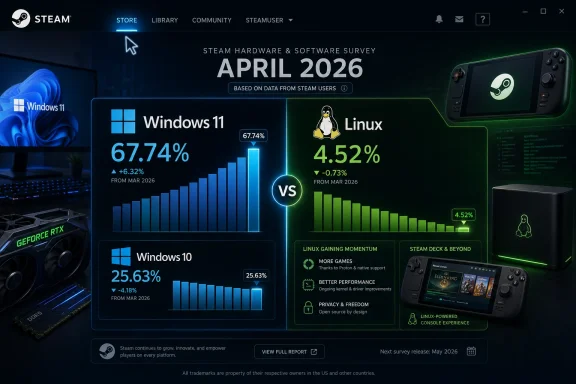
Valve’s April 2026 Steam Hardware & Software Survey shows Windows 11 rising to 67.74 percent of surveyed Steam users, while Linux fell back to 4.52 percent after briefly clearing the 5 percent mark in March. The numbers do not prove that Linux gaming is fading, nor do they prove that Windows 11 has suddenly become beloved. They do show something more durable: PC gaming remains a Windows-first market even as Valve’s Linux project becomes technically impressive enough to matter. For Microsoft, the Steam survey is less a victory lap than a reminder that inertia, compatibility, and habit still beat ideology at scale.
The most interesting thing about Windows 11’s continued rise on Steam is how unsurprising it has become. After years of complaints about hardware requirements, telemetry, Start menu changes, forced account flows, and advertising experiments, the gaming audience is still moving where the ecosystem pulls it. Steam users are not a perfect proxy for all PC users, but they are a useful proxy for the enthusiast class Microsoft is often accused of alienating.
In April, Windows 11 gained 0.89 percentage points from March, landing at 67.74 percent. Windows 10 also gained slightly, moving to 25.63 percent, while Windows overall sat at 93.47 percent. That combination matters because it tells us the Linux decline was not simply Windows 11 swallowing everything in sight; the broader Windows platform regained share too.
The headline temptation is to frame this as a Windows-versus-Linux horse race. That is emotionally satisfying and analytically thin. The better reading is that Steam’s operating-system numbers are a snapshot of where people actually play, and where people actually play is still overwhelmingly the platform with the least friction.
Windows 11 does not have to be adored to dominate. It only has to be good enough, preinstalled enough, driver-supported enough, and compatible enough with the games people already own. That has been the Windows story for decades, and Steam’s April data suggests the story is still intact.
But symbolic milestones are not the same as stable plateaus. Linux dropping to 4.52 percent in April does not erase the long-term improvement, but it does expose how volatile Steam’s monthly survey can be. A swing of less than one percentage point looks small until the base is only around five percent; then it becomes a major narrative event.
That volatility should cool both camps. Linux advocates should resist declaring every spike a revolution. Windows loyalists should resist treating every pullback as proof that Linux gaming was a mirage. The trend line over years matters more than the month-to-month drama.
Valve’s survey is opt-in and sampling-based, not a census. It is useful precisely because it is large and recurring, but it is still a survey. When niche segments move sharply, the first interpretation should be caution, not triumphalism.
That is both the strength and limitation of Linux gaming’s recent rise. Steam Deck users are Linux users in the survey, but many are not Linux converts in the cultural sense. They bought a handheld that runs Steam well, not necessarily a philosophy of open computing.
This distinction matters because it explains why Linux share can grow without producing a visible mass migration from Windows desktops. A Steam Deck owner may still have a Windows 11 gaming PC. A Bazzite or ChimeraOS experimenter may still dual-boot. A handheld gamer may spend months in SteamOS and then return to Windows for a game with unfriendly anti-cheat.
Linux has become credible as a gaming appliance. It is still fighting to become the default gaming desktop.
For single-player titles and many indie games, that bargain is often invisible. Install, launch, play. For multiplayer games with kernel-level anti-cheat, proprietary launchers, invasive DRM, or vendor-specific utilities, the bargain can collapse quickly.
That is where Windows 11 keeps its advantage. It may be heavier, messier, and more commercially intrusive, but it remains the expected target. GPU vendors validate drivers for it. Peripheral makers ship control panels for it. Anti-cheat vendors prioritize it. Publishers test against it because the market tells them to.
Linux users can rightly argue that this is a self-reinforcing cycle rather than a technical inevitability. They are correct. But markets are full of self-reinforcing cycles, and this one has been compounding since the 1990s.
That creates an awkward reality for Microsoft. Windows 11 is winning the migration, but it is not winning a clean emotional mandate. Some users upgrade because new PCs ship with it. Some upgrade because newer CPUs and laptops are optimized around it. Some upgrade because support deadlines and software assumptions leave them little choice.
For gamers, the operating system is often a means rather than a destination. If Windows 10 runs the library, supports the GPU, and avoids surprises, it remains attractive. If Windows 11 does the same on newer hardware, it becomes the path of least resistance.
The Steam data therefore does not say “everyone loves Windows 11.” It says Windows 11 is becoming the default place where PC gaming happens, while Windows 10 still has enough trust and installed base to slow the coronation.
A gamer can buy a graphics card, download a driver, install Steam, plug in a headset, launch Discord, run a hardware monitor, and expect the whole pile to cooperate. Not perfectly, but predictably enough. That predictability is the product.
Linux has made enormous progress here, especially with AMD graphics, Mesa, Proton, Gamescope, and the work Valve has funded around SteamOS. But the further a user drifts from the curated Steam Deck-like experience, the more the old desktop Linux trade-offs return. Distribution choice, kernel versions, compositor behavior, proprietary Nvidia edge cases, audio routing, and device utilities can still turn “it works” into “it works after I learn three new things.”
Enthusiasts often underestimate how expensive that learning curve feels to everyone else. A Windows annoyance is resented; a Linux troubleshooting session is often interpreted as proof that the experiment failed. That asymmetry is unfair, but it is real.
That middle matters because it is where operating systems become invisible. Users with mainstream GPUs, mainstream memory configurations, and mainstream monitors are not trying to prove a point. They are trying to keep a library running across years of sales, patches, and driver updates.
The RTX 3060’s continued prominence is especially telling. It is not the newest card, but it is widely deployed, capable enough, and heavily represented in the kind of systems that define Steam’s center of gravity. That is exactly the world Windows is built to own.
Linux can win enthusiasts at the edges and appliances in the handheld market. Windows still owns the middle, and the middle is where volume lives.
That distinction is crucial. SteamOS gives Valve bargaining power. Proton gives Valve strategic insulation. The Steam Deck proves that a Linux-first commercial gaming device can be successful without asking users to install a distribution or read a wiki.
Even if Linux never reaches 20 percent of Steam users, Valve benefits from having a credible alternative. Microsoft cannot easily squeeze Steam through Windows policy, store preferences, or platform-level friction if Valve can point to a working escape hatch. The existence of that hatch changes the negotiation.
This is why the Linux pullback should not be read as a strategic defeat. Valve has already changed the industry’s assumptions. Before Proton and the Deck, Linux gaming was often a punchline. Now it is a platform strategy.
The April data is meaningful because it aligns with a broader reality: Windows 11 is steadily becoming the dominant gaming OS on Steam. Linux’s decline is meaningful because it reminds us that the March spike was not yet a new floor. Both can be true without either becoming a morality play.
The survey also compresses different kinds of machines into one table. A Windows 11 desktop with a high-end GPU, a Steam Deck, a Linux handheld, a MacBook running casual titles, and an aging Windows 10 laptop can all show up in the same operating-system category view. That makes the top-line number easy to quote and harder to interpret.
For IT pros, the lesson is familiar. Metrics matter, but methodology matters too. A dashboard can show direction; it cannot explain everything underneath it.
Windows wins that contest by accumulation. It is not always elegant, and Windows 11 has given critics plenty of ammunition. But the platform’s flaws are often priced into user expectations. Gamers complain, adapt, click through, disable what they can, and keep playing.
Linux wins when it removes friction so completely that the user forgets the platform changed. Steam Deck is the model. The user presses a button, resumes a game, and never thinks about Wine prefixes, shader caches, or compositor paths. That is the version of Linux gaming that scares Microsoft.
Desktop Linux becomes compelling when it behaves less like an alternative operating system and more like a better appliance. That may offend purists, but it is how mainstream adoption usually works. People do not adopt platforms because they are theoretically superior; they adopt them when the old platform annoys them and the new one feels safe.
The danger for Microsoft is that it mistakes dominance for permission. Gamers have tolerated Windows because it runs games. They have not granted Microsoft an unlimited mandate to turn the desktop into a billboard, a data funnel, or a coercive cloud terminal. Every unwanted prompt and every settings regression gives Valve’s alternative a little more emotional oxygen.
This is where the Linux number matters even below 5 percent. It represents the visible edge of user willingness to leave. More importantly, it represents proof that leaving no longer means giving up the PC gaming library.
If Microsoft wants Windows 11 to remain the default enthusiast gaming platform, the path is not complicated. It needs to keep performance predictable, respect local control, avoid breaking workflows, and stop treating the operating system as a growth surface for every other Microsoft business. The bar is not perfection. The bar is trust.
But Linux’s improved position changes the calculation at the margin. A few years ago, Linux compatibility could be dismissed as charity or niche goodwill. Now, with Steam Deck and Proton in the picture, it can mean access to a meaningful handheld audience and better long-term portability.
The key friction point remains anti-cheat. If a multiplayer title cannot run on SteamOS because its anti-cheat stack refuses the environment, the Linux gaming story hits a wall. That wall is not purely technical; it is a risk decision made by publishers and vendors.
The April survey does not force developers to rethink their priorities overnight. It does suggest that Linux compatibility is no longer a curiosity. It is part of the platform planning conversation, especially for games that want to thrive on handheld PCs.
That is why SteamOS has influence beyond its market share. It showed that PC games could live inside a console-like shell without surrendering the openness of the PC model. Suspend and resume, controller-first navigation, shader pre-caching, and a storefront-native interface all matter more when the device is held in two hands.
Windows 11 can run on handheld PCs, but running is not the same as belonging. Microsoft has been working to make Windows more viable in this form factor, yet it still carries the legacy of a desktop OS being squeezed into a console-like role. Valve built from the opposite direction: it made Linux disappear behind Steam.
If handhelds keep growing, the operating-system contest becomes less about desktop market share and more about experience design. That is a contest Microsoft can win only if it is willing to make Windows less Windows-like in the places where Windows gets in the way.
All of those readings contain some truth. None is sufficient. The mature interpretation is that Windows remains structurally dominant, Linux is structurally more credible than it used to be, and Steam’s audience is moving through a hardware-and-software transition that will take years rather than months.
For WindowsForum readers, the practical lessons are more concrete than the culture-war framing suggests.
Source: Notebookcheck Windows 11 continues to grow among Steam users as Linux pulls back
 Windows 11 Wins the Room Without Winning the Argument
The most interesting thing about Windows 11’s continued rise on Steam is how unsurprising it has become. After years of complaints about hardware requirements, telemetry, Start menu changes, forced account flows, and advertising experiments, the gaming audience is still moving where the ecosystem pulls it. Steam users are not a perfect proxy for all PC users, but they are a useful proxy for the enthusiast class Microsoft is often accused of alienating.In April, Windows 11 gained 0.89 percentage points from March, landing at 67.74 percent. Windows 10 also gained slightly, moving to 25.63 percent, while Windows overall sat at 93.47 percent. That combination matters because it tells us the Linux decline was not simply Windows 11 swallowing everything in sight; the broader Windows platform regained share too.
The headline temptation is to frame this as a Windows-versus-Linux horse race. That is emotionally satisfying and analytically thin. The better reading is that Steam’s operating-system numbers are a snapshot of where people actually play, and where people actually play is still overwhelmingly the platform with the least friction.
Windows 11 does not have to be adored to dominate. It only has to be good enough, preinstalled enough, driver-supported enough, and compatible enough with the games people already own. That has been the Windows story for decades, and Steam’s April data suggests the story is still intact.
The 5 Percent Linux Moment Was Real, But It Was Also Fragile
Linux crossing 5 percent on Steam in March was a symbolic milestone because Linux gaming spent so many years trapped in the realm of caveats. Proton changed that. The Steam Deck changed that even more. For the first time, a Linux-based gaming system was not just a hobbyist setup; it was a mass-market consumer device sold by the company that runs the largest PC gaming storefront.But symbolic milestones are not the same as stable plateaus. Linux dropping to 4.52 percent in April does not erase the long-term improvement, but it does expose how volatile Steam’s monthly survey can be. A swing of less than one percentage point looks small until the base is only around five percent; then it becomes a major narrative event.
That volatility should cool both camps. Linux advocates should resist declaring every spike a revolution. Windows loyalists should resist treating every pullback as proof that Linux gaming was a mirage. The trend line over years matters more than the month-to-month drama.
Valve’s survey is opt-in and sampling-based, not a census. It is useful precisely because it is large and recurring, but it is still a survey. When niche segments move sharply, the first interpretation should be caution, not triumphalism.
Steam Deck Changed the Ceiling, Not the Floor
The real Linux gaming story is not that desktop Linux is suddenly replacing Windows on custom gaming towers. It is that Valve created a Linux device compelling enough that millions of users stopped thinking about Linux at all. SteamOS on the Deck works because it hides the operating system beneath a console-like experience.That is both the strength and limitation of Linux gaming’s recent rise. Steam Deck users are Linux users in the survey, but many are not Linux converts in the cultural sense. They bought a handheld that runs Steam well, not necessarily a philosophy of open computing.
This distinction matters because it explains why Linux share can grow without producing a visible mass migration from Windows desktops. A Steam Deck owner may still have a Windows 11 gaming PC. A Bazzite or ChimeraOS experimenter may still dual-boot. A handheld gamer may spend months in SteamOS and then return to Windows for a game with unfriendly anti-cheat.
Linux has become credible as a gaming appliance. It is still fighting to become the default gaming desktop.
Compatibility Is Still the Tax Linux Pays
The Linux gaming argument has improved so dramatically that it is easy to forget how much of it still depends on translation. Proton is a remarkable achievement, but it is also an admission that the Windows software catalog remains the center of gravity. Most Linux gaming progress comes from making Windows games behave as if Windows were present.For single-player titles and many indie games, that bargain is often invisible. Install, launch, play. For multiplayer games with kernel-level anti-cheat, proprietary launchers, invasive DRM, or vendor-specific utilities, the bargain can collapse quickly.
That is where Windows 11 keeps its advantage. It may be heavier, messier, and more commercially intrusive, but it remains the expected target. GPU vendors validate drivers for it. Peripheral makers ship control panels for it. Anti-cheat vendors prioritize it. Publishers test against it because the market tells them to.
Linux users can rightly argue that this is a self-reinforcing cycle rather than a technical inevitability. They are correct. But markets are full of self-reinforcing cycles, and this one has been compounding since the 1990s.
Windows 10’s Afterlife Keeps Windows 11 Honest
The April survey also shows Windows 10 refusing to vanish. Its Steam share rose slightly to 25.63 percent, which is striking in a year when Microsoft has been pushing the industry beyond Windows 10’s mainstream life. On paper, Windows 11 should be the clean successor. In practice, many gamers still see Windows 10 as the known-good build.That creates an awkward reality for Microsoft. Windows 11 is winning the migration, but it is not winning a clean emotional mandate. Some users upgrade because new PCs ship with it. Some upgrade because newer CPUs and laptops are optimized around it. Some upgrade because support deadlines and software assumptions leave them little choice.
For gamers, the operating system is often a means rather than a destination. If Windows 10 runs the library, supports the GPU, and avoids surprises, it remains attractive. If Windows 11 does the same on newer hardware, it becomes the path of least resistance.
The Steam data therefore does not say “everyone loves Windows 11.” It says Windows 11 is becoming the default place where PC gaming happens, while Windows 10 still has enough trust and installed base to slow the coronation.
Microsoft’s Real Advantage Is the Boring Stuff
The PC gaming discourse tends to focus on visible operating-system features: menus, overlays, AI assistants, game bars, store integrations, and handheld modes. Those matter, but they are not why Windows dominates Steam. Windows dominates because the boring substrate works for the largest number of people.A gamer can buy a graphics card, download a driver, install Steam, plug in a headset, launch Discord, run a hardware monitor, and expect the whole pile to cooperate. Not perfectly, but predictably enough. That predictability is the product.
Linux has made enormous progress here, especially with AMD graphics, Mesa, Proton, Gamescope, and the work Valve has funded around SteamOS. But the further a user drifts from the curated Steam Deck-like experience, the more the old desktop Linux trade-offs return. Distribution choice, kernel versions, compositor behavior, proprietary Nvidia edge cases, audio routing, and device utilities can still turn “it works” into “it works after I learn three new things.”
Enthusiasts often underestimate how expensive that learning curve feels to everyone else. A Windows annoyance is resented; a Linux troubleshooting session is often interpreted as proof that the experiment failed. That asymmetry is unfair, but it is real.
Hardware Trends Make Windows Stickier
Notebookcheck’s summary of the April survey also points to the hardware baseline of the Steam audience: 16GB of RAM remains the largest segment, while 32GB continues to grow; Nvidia’s RTX 3060 remains the most common GPU; and 8GB of VRAM is still a mainstream sweet spot. These are not exotic Linux workstation specs. They are the familiar middle of the PC gaming market.That middle matters because it is where operating systems become invisible. Users with mainstream GPUs, mainstream memory configurations, and mainstream monitors are not trying to prove a point. They are trying to keep a library running across years of sales, patches, and driver updates.
The RTX 3060’s continued prominence is especially telling. It is not the newest card, but it is widely deployed, capable enough, and heavily represented in the kind of systems that define Steam’s center of gravity. That is exactly the world Windows is built to own.
Linux can win enthusiasts at the edges and appliances in the handheld market. Windows still owns the middle, and the middle is where volume lives.
Valve Is Building Leverage, Not Just Market Share
The mistake is to measure Valve’s Linux effort only by Steam survey percentage. If Linux is at 4.52 percent instead of 5.33 percent, has Valve failed? Obviously not. Valve’s objective is not merely to make Linux popular; it is to make Steam less dependent on Microsoft’s choices.That distinction is crucial. SteamOS gives Valve bargaining power. Proton gives Valve strategic insulation. The Steam Deck proves that a Linux-first commercial gaming device can be successful without asking users to install a distribution or read a wiki.
Even if Linux never reaches 20 percent of Steam users, Valve benefits from having a credible alternative. Microsoft cannot easily squeeze Steam through Windows policy, store preferences, or platform-level friction if Valve can point to a working escape hatch. The existence of that hatch changes the negotiation.
This is why the Linux pullback should not be read as a strategic defeat. Valve has already changed the industry’s assumptions. Before Proton and the Deck, Linux gaming was often a punchline. Now it is a platform strategy.
The Survey Is a Thermometer, Not the Weather
Steam’s monthly survey is useful because it gives the PC gaming community a shared scoreboard. But scoreboards invite overinterpretation. One month of operating-system movement can reflect sampling, regional participation, device mix, internet café behavior, handheld usage, or simple randomness.The April data is meaningful because it aligns with a broader reality: Windows 11 is steadily becoming the dominant gaming OS on Steam. Linux’s decline is meaningful because it reminds us that the March spike was not yet a new floor. Both can be true without either becoming a morality play.
The survey also compresses different kinds of machines into one table. A Windows 11 desktop with a high-end GPU, a Steam Deck, a Linux handheld, a MacBook running casual titles, and an aging Windows 10 laptop can all show up in the same operating-system category view. That makes the top-line number easy to quote and harder to interpret.
For IT pros, the lesson is familiar. Metrics matter, but methodology matters too. A dashboard can show direction; it cannot explain everything underneath it.
The Consumer OS War Is Now a Friction War
The old operating-system debate was about features and philosophy. The modern one is about friction. Which platform gets you into the game fastest? Which one breaks less often after updates? Which one supports your controller, capture card, headset, RGB software, anti-cheat stack, and social apps with the least ceremony?Windows wins that contest by accumulation. It is not always elegant, and Windows 11 has given critics plenty of ammunition. But the platform’s flaws are often priced into user expectations. Gamers complain, adapt, click through, disable what they can, and keep playing.
Linux wins when it removes friction so completely that the user forgets the platform changed. Steam Deck is the model. The user presses a button, resumes a game, and never thinks about Wine prefixes, shader caches, or compositor paths. That is the version of Linux gaming that scares Microsoft.
Desktop Linux becomes compelling when it behaves less like an alternative operating system and more like a better appliance. That may offend purists, but it is how mainstream adoption usually works. People do not adopt platforms because they are theoretically superior; they adopt them when the old platform annoys them and the new one feels safe.
Windows 11’s Growth Carries a Warning for Microsoft
Microsoft should be pleased by the Steam numbers, but not smug. Windows 11’s growth among gamers is partly a function of replacement cycles and platform gravity. Those are powerful forces, but they are not the same as loyalty.The danger for Microsoft is that it mistakes dominance for permission. Gamers have tolerated Windows because it runs games. They have not granted Microsoft an unlimited mandate to turn the desktop into a billboard, a data funnel, or a coercive cloud terminal. Every unwanted prompt and every settings regression gives Valve’s alternative a little more emotional oxygen.
This is where the Linux number matters even below 5 percent. It represents the visible edge of user willingness to leave. More importantly, it represents proof that leaving no longer means giving up the PC gaming library.
If Microsoft wants Windows 11 to remain the default enthusiast gaming platform, the path is not complicated. It needs to keep performance predictable, respect local control, avoid breaking workflows, and stop treating the operating system as a growth surface for every other Microsoft business. The bar is not perfection. The bar is trust.
Developers Still Follow the Money, but the Money Is Watching Linux
Game developers and publishers are pragmatic. They optimize for the platforms that sell copies, reduce support costs, and keep players online. Windows therefore remains the default PC target because it is where the overwhelming majority of Steam users are.But Linux’s improved position changes the calculation at the margin. A few years ago, Linux compatibility could be dismissed as charity or niche goodwill. Now, with Steam Deck and Proton in the picture, it can mean access to a meaningful handheld audience and better long-term portability.
The key friction point remains anti-cheat. If a multiplayer title cannot run on SteamOS because its anti-cheat stack refuses the environment, the Linux gaming story hits a wall. That wall is not purely technical; it is a risk decision made by publishers and vendors.
The April survey does not force developers to rethink their priorities overnight. It does suggest that Linux compatibility is no longer a curiosity. It is part of the platform planning conversation, especially for games that want to thrive on handheld PCs.
Handheld PCs Are the Wild Card Microsoft Cannot Ignore
The Windows-versus-Linux gaming question looks different on a handheld. On a desktop, Windows’ complexity is tolerable because keyboards, mice, large monitors, and decades of habits absorb it. On a handheld, every desktop assumption becomes more painful.That is why SteamOS has influence beyond its market share. It showed that PC games could live inside a console-like shell without surrendering the openness of the PC model. Suspend and resume, controller-first navigation, shader pre-caching, and a storefront-native interface all matter more when the device is held in two hands.
Windows 11 can run on handheld PCs, but running is not the same as belonging. Microsoft has been working to make Windows more viable in this form factor, yet it still carries the legacy of a desktop OS being squeezed into a console-like role. Valve built from the opposite direction: it made Linux disappear behind Steam.
If handhelds keep growing, the operating-system contest becomes less about desktop market share and more about experience design. That is a contest Microsoft can win only if it is willing to make Windows less Windows-like in the places where Windows gets in the way.
April’s Numbers Say Less About Defeat Than Discipline
The April survey gives every camp something to misuse. Windows fans can say Linux fell back. Linux fans can say the long-term trend remains up. Windows 11 critics can say the migration is coerced by hardware and support cycles. Microsoft can say its newest OS is now the clear Steam default.All of those readings contain some truth. None is sufficient. The mature interpretation is that Windows remains structurally dominant, Linux is structurally more credible than it used to be, and Steam’s audience is moving through a hardware-and-software transition that will take years rather than months.
For WindowsForum readers, the practical lessons are more concrete than the culture-war framing suggests.
- Windows 11 is now the dominant Steam operating system by a wide margin, and its lead is still expanding.
- Linux’s April pullback does not erase the Steam Deck and Proton-driven gains that made Linux gaming newly credible.
- Windows 10 remains a substantial part of the Steam base, which means the gaming migration to Windows 11 is still incomplete.
- Developers will continue to prioritize Windows, but Linux compatibility now has commercial relevance rather than novelty value.
- The next major battleground is likely to be handheld and living-room PC experiences, where Windows’ desktop inheritance is more of a liability.
Source: Notebookcheck Windows 11 continues to grow among Steam users as Linux pulls back
