

SteamOS’s recent desktop head‑to‑head with Windows 11 shows Linux isn’t just “good enough” for gaming anymore — on the right hardware and with the right stack it can match or even slightly exceed Windows at native 4K Ultra in several modern AAA titles. ETA Prime’s all‑AMD desktop tests, summarized by NotebookCheck and discussed in community analysis, put SteamOS and Windows 11 within a few percent of each other in games such as Cyberpunk 2077, Marvel’s Spider‑Man 2 and Borderlands 4 — while Windows still pulls ahead in titles like Forza Horizon 5 and Red Dead Redemption 2.
The SteamOS vs Windows 11 debate has shifted from academic to practical in the last two years. Valve’s SteamOS stack (Proton, Mesa drivers, tuned kernel patches and a focused compositor) started as a handheld‑first solution for the Steam Deck, but Valve has expanded SteamOS to support other AMD handhelds and put effort into driver and runtime improvements that also benefit desktop installs. That work, combined with major Mesa and Proton updates, narrowed the long‑standing compatibility and performance gap between Linux and Windows for many single‑player AAA games. At the same time, the Linux gaming ecosystem is uneven: hardware vendor support varies, some anti‑cheat systems and multiplayer services still lack robust Linux support, and performance remains title‑ and driver‑version dependent. The practical outcome for many enthusiasts in 2026 is a pragmatic dual approach: SteamOS (or a SteamOS‑style image) for single‑player and handheld‑style efficiency, with Windows 11 available for anti‑cheat‑protected multiplayer and Windows‑centric workflows.
For builders and readers planning changes: test your must‑play titles, prefer AMD hardware if you aim to push Linux parity today, and keep a fallback Windows partition for anti‑cheat or Windows‑only experiences. The landscape will continue to shift quickly; driver and Proton releases can change the story overnight, so treat every benchmark as a snapshot — useful, actionable, but never the final word.
Source: PC Guide SteamOS keeps up with Windows in latest PC gaming benchmarks, including Cyberpunk 2077 at 4K Ultra
 Background / Overview
The SteamOS vs Windows 11 debate has shifted from academic to practical in the last two years. Valve’s SteamOS stack (Proton, Mesa drivers, tuned kernel patches and a focused compositor) started as a handheld‑first solution for the Steam Deck, but Valve has expanded SteamOS to support other AMD handhelds and put effort into driver and runtime improvements that also benefit desktop installs. That work, combined with major Mesa and Proton updates, narrowed the long‑standing compatibility and performance gap between Linux and Windows for many single‑player AAA games. At the same time, the Linux gaming ecosystem is uneven: hardware vendor support varies, some anti‑cheat systems and multiplayer services still lack robust Linux support, and performance remains title‑ and driver‑version dependent. The practical outcome for many enthusiasts in 2026 is a pragmatic dual approach: SteamOS (or a SteamOS‑style image) for single‑player and handheld‑style efficiency, with Windows 11 available for anti‑cheat‑protected multiplayer and Windows‑centric workflows.The test: what ETA Prime ran and why it matters
System configuration (the all‑AMD rig)
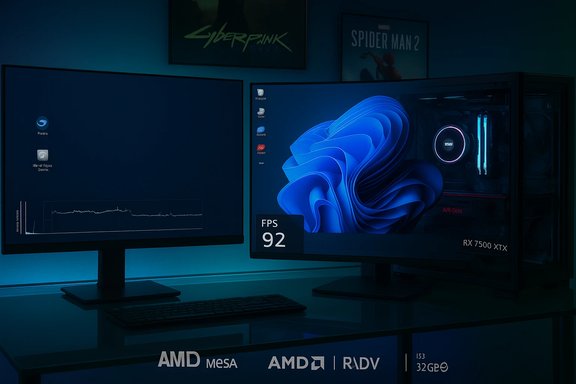
ETA Prime built an intentionally all‑AMD desktop to reduce cross‑vendor driver variability: an AMD Ryzen 7 9800X3D CPU paired with an AMD Radeon RX 7900 XTX GPU and 32 GB of DDR5 memory. He installed SteamOS (stable channel) on one NVMe and Windows 11 Pro on another, tuning BIOS power curves to keep the hardware baseline consistent between OSes. That hardware choice is significant: the AMD open‑driver ecosystem (Mesa + RADV) is mature and widely tuned for Linux, which removes one major source of variance some community tests identify.Software stack snapshot
The SteamOS build used for these tests was the stable SteamOS 3.7.x channel current in late 2025 (the 3.7.17 stable release was part of Valve’s November 2025 updates). On the Windows side ETA Prime used a current Windows 11 Pro build with vendor Radeon drivers installed. Freezing driver and Proton/Mesa versions is essential for reproducibility — those components change frequently and materially affect results.The games and settings tested
ETA Prime tested a selection of demanding AAA titles at native 4K Ultra (and 4K Extreme in one case) with FidelityFX Super Resolution (FSR) used in some titles where noted. The headline results (averages) for the representative set were reported as:- Cyberpunk 2077 — 4K Ultra (no FSR): SteamOS 85 FPS, Windows 11 84 FPS.
- Forza Horizon 5 — 4K Extreme (no FSR): SteamOS 157 FPS, Windows 11 191 FPS (Windows ~21.6% faster in this run).
- Marvel’s Spider‑Man 2 — 4K Very High (FSR Quality): SteamOS 111 FPS, Windows 11 103 FPS.
- Borderlands 4 — 4K Ultra (FSR Quality): SteamOS 69 FPS, Windows 11 74 FPS.
- Red Dead Redemption II — 4K Ultra (FSR Quality): SteamOS 88 FPS, Windows 11 96 FPS.
Why SteamOS can match or beat Windows in some cases
1. Lean OS and fewer background tasks
SteamOS is designed as a gaming‑first environment. On a desktop install that’s been tuned for performance, it boots to a minimal compositor and runs far fewer background services than a full Windows 11 desktop configured with typical background apps and telemetry. That lower OS overhead reduces CPU wakeups and scheduler noise, improving tight frame‑timing in shader‑heavy scenes. Community analysis and reviewer writeups repeatedly call this out as a repeatable benefit in handheld and purpose‑built gaming Linux images.2. Shader compilation, caching and Proton maturity
Modern AAA engines compile many shader permutations at runtime. How a platform’s driver/runtime handles on‑the‑fly shader compiling and caching can make a big difference to perceived smoothness. Valve’s Proton, combined with Mesa’s shader cache strategies and RADV driver improvements, reduces blocking shader compiles in many scenarios and thus cuts down on micro‑stutters that can appear on Windows in similar scenes. Proton’s ongoing development (and Valve’s work with shader cache delivery) makes this an actionable advantage for SteamOS in shader‑heavy titles.3. AMD’s strong open‑source driver investment
AMD’s open approach to Linux — with active contributions to Mesa and closer collaboration with Valve and the community — has left the AMD stack (RADV + Mesa) particularly well‑tuned for Linux, especially on RDNA3 hardware. Recent Mesa releases and RADV optimizations continue to improve performance and ray‑tracing behavior on AMD cards, narrowing or erasing the historical Windows advantage in many scenarios. This hardware/driver alignment helps explain why an all‑AMD rig is a good candidate for parity.Where Windows still leads — and why that matters
DirectX, publisher tuning and vendor driver work
Windows remains the default development and testing target for many studios, especially those that leverage DirectX‑only features or optimizations tied to vendor SDKs. Publishers with a Microsoft lineage — or titles that use DirectX‑specific code paths — often see better Windows performance because the Windows drivers and game code are the primary focus during QA and optimization. Forza Horizon 5’s significant advantage in ETA Prime’s run is an example where publisher/engine tuning may have tipped the balance in Windows’ favor.Ray tracing and NVIDIA’s proprietary stack
When real‑time ray tracing or vendor‑specific features (e.g., DLSS Frame Generation variants) are central to the experience, Windows + NVIDIA still often hold an edge because of feature parity and proprietary driver capabilities that are not always matched on Linux. Nvidia’s Linux support has improved but remains more closed than AMD’s Mesa approach, and some driver features are Windows‑first. That makes Windows the safer choice for those who demand the absolute highest RT fidelity or NVIDIA‑specific extras.Anti‑cheat and multiplayer blockers
Anti‑cheat remains the single biggest practical blocker to a full SteamOS switch for many gamers. While Proton and Valve have worked with major anti‑cheat vendors (notably making Easy Anti‑Cheat workable on Proton for titles whose developers enable Linux support), many publishers and studios still restrict Linux support or explicitly forbid Proton environments on official servers. The status of anti‑cheat is improving but inconsistent; technical feasibility does not equal widespread adoption. Until anti‑cheat middleware and publisher policies catch up, competitive multiplayer and some online titles will require Windows.Practical caveats: reproducibility, driver volatility and test sensitivity
- Tests are snapshots. Small changes in Mesa, Proton, the Linux kernel, or Windows driver builds can swing outcomes significantly. Benchmarks frozen to a specific software stack are reproducible only for that snapshot.
- Scene selection and measurement method matter. Micro‑stutter, 1% lows and frame‑time consistency can be more important than peak averages; a game that “wins” on average FPS may still feel worse if frame‑time spikes are present. Community and lab tests differ in capture method, so interpret single‑creator videos as directional evidence rather than lab‑grade proof.
- Hardware: AMD favors Linux here. The all‑AMD rig used in ETA Prime’s test reduced cross‑vendor variability and exploited the strengths of the Mesa/RADV stack. Results could look different on Intel‑ or Nvidia‑centric builds.
What this means for builders, enthusiasts and WindowsForum readers
When to consider SteamOS (or a SteamOS‑style image)
- You primarily play single‑player AAA titles or games with good Proton compatibility.
- You value battery life and frame‑time consistency on handhelds or thermally constrained devices.
- You run an AMD GPU and appreciate open‑source driver tooling and reproducibility.
- You’re comfortable troubleshooting drivers, kernel updates, and occasional regressions.
When to keep Windows 11 (or dual‑boot)
- You play competitive multiplayer titles that require anti‑cheat middleware not guaranteed on Linux.
- You need vendor‑specific utilities (overclocking suites, RGB/OEM apps) or Windows‑exclusive features.
- You rely on ray tracing features or NVIDIA‑only features that haven’t reached parity in Linux drivers.
- You want the broadest plug‑and‑play compatibility across stores and apps.
A recommended approach for most users
- Identify the games that are non‑negotiable for you (especially online titles).
- Test those games under ProtonDB and check recent community notes and compatibility tags.
- If your must‑play titles are single‑player or Proton‑friendly, create a dual‑boot plan: SteamOS as your primary gaming partition and Windows for required titles.
- Freeze driver and Proton versions for benchmarking and reproducible testing; track upstream changes that could alter behavior.
Strengths, trade‑offs and risks — a critical appraisal
Strengths
- Performance parity is real in many cases. On current AMD hardware and with tuned stacks, SteamOS can match Windows at native 4K Ultra for several high‑profile titles. ETA Prime’s desktop experiment is one of many indicators showing that parity is no longer theoretical.
- Open drivers and Proton improvements reduce friction. Mesa and RADV, plus Valve’s Proton advances, have materially improved the Linux experience for gamers and reduced the “translation tax.”
- Lean stack advantages for handhelds and thermally constrained devices. Lower background overhead and tuned governors yield better battery life and steadier frame‑times on many devices.
Trade‑offs and risks
- Anti‑cheat fragmentation. Even with Proton improvements and selective EAC/BattlEye support, publisher policies and server rules still limit playable multiplayer on Linux. This isn’t a purely technical problem — it’s an ecosystem and policy issue that can only be resolved through wider developer adoption.
- Driver and kernel volatility. Frequent updates mean regressions can appear (and be fixed) quickly; users who prize stability must be ready to rollback or freeze stacks. Community distributions and curated images (like Bazzite) help, but they’re not a complete substitute for vendor‑backed stability.
- Hardware dependency. Results skew toward AMD in many public tests because of the open‑source driver model. Intel and Nvidia configurations can behave differently; testing on your exact hardware is essential.
Unverifiable or tentative claims
- Claims framed as permanent platform superiority (e.g., “Linux is now faster than Windows across the board”) remain unverifiable and overstated. The observed parity is real for specific hardware and software snapshots; it is not a universal truth. Any sweeping statement about global parity should be treated as provisional and will need repeated cross‑vendor, cross‑driver laboratory replication to be trustworthy.
The near future: what to watch
- Proton and Mesa releases (each has potential to flip performance deltas). Keep an eye on Proton major versions and Mesa 25.x/26.x improvements.
- Vendor and publisher anti‑cheat policies. EAC and BattlEye technical support for Linux exists, but developer adoption remains uneven; watch for more studios enabling Linux server compatibility.
- Valve’s SteamOS expansion and OEM support. Valve’s SteamOS 3.7 series broadened support beyond the Deck, and OEM devices shipping with SteamOS (or ‘Powered by SteamOS’ branding) can shift the bar for mainstream acceptance.
Conclusion
ETA Prime’s all‑AMD desktop experiments — and the subsequent coverage and analysis — mark an important inflection point: SteamOS is no longer merely “playable” for modern AAA titles on desktop hardware; with the right hardware and a frozen, tuned software stack it can compete with Windows 11 at native 4K Ultra in several demanding games. That reality does not make Windows obsolete — DirectX, publisher tuning, NVIDIA‑centric features, and anti‑cheat requirements still give Windows clear advantages in many scenarios. The practical takeaway for most enthusiasts is choice: SteamOS is now a viable, competitive option for single‑player and handheld‑style gaming, while Windows remains necessary for certain multiplayer and feature‑critical titles.For builders and readers planning changes: test your must‑play titles, prefer AMD hardware if you aim to push Linux parity today, and keep a fallback Windows partition for anti‑cheat or Windows‑only experiences. The landscape will continue to shift quickly; driver and Proton releases can change the story overnight, so treat every benchmark as a snapshot — useful, actionable, but never the final word.
Source: PC Guide SteamOS keeps up with Windows in latest PC gaming benchmarks, including Cyberpunk 2077 at 4K Ultra
