Background
For Stellantis, this Microsoft deal is not an isolated announcement so much as the latest step in a broader effort to turn one of the world’s largest automakers into a software-defined enterprise. Over the last year and a half, the company has repeatedly signaled that AI is now embedded in its product strategy, manufacturing thinking, and enterprise tooling. Stellantis has already worked with Mistral AI on in-car assistants and broader enterprise adoption, and it has leaned into AI-enabled simulation, digital development, and connected-car platforms across its business.
That matters because the automotive sector is in the middle of a structural shift. Traditional OEMs once competed primarily on powertrains, dealer networks, and manufacturing scale. Today, they also compete on software cadence, cloud data architecture, cybersecurity, and the ability to personalize the ownership experience after the sale. In that environment, partnerships with large AI vendors are becoming a shorthand for ambition, but they also expose automakers to new technical and organizational complexity.
Stellantis has not been shy about technology partnerships more generally. Its recent moves around autonomous driving, product development, warehouse optimization, and data analytics show a company trying to assemble a stack of capabilities from external specialists rather than build everything in-house. That approach can accelerate transformation, but it also creates dependency on outside platforms, vendor roadmaps, and integration quality.
Microsoft, for its part, has spent the last several years turning Copilot, Azure AI, and enterprise security tools into a default modernization layer for large organizations. The Stellantis relationship fits a recognizable Microsoft pattern: pair with a major industrial brand, broaden AI adoption from pilot programs to enterprise workflows, and then extend that foundation into targeted customer and operational use cases. The automaker becomes a reference case, while Microsoft deepens its footprint in manufacturing and mobility.
Why this announcement matters now
The timing is revealing. Stellantis has been under pressure to sharpen execution, improve profitability, and simplify an increasingly sprawling portfolio of brands, platforms, and regional strategies. AI can help with those goals, but only if it reduces friction in operations rather than adding another layer of experimentation. That is the central tension in this deal: a bold promise of acceleration versus the hard work of implementation.
Stellantis’ own public statements over the past year underscore this direction. The company has said it wants to move beyond experimentation toward broader deployment of AI across the value chain, while also investing in software architecture and connected features. Microsoft’s enterprise AI products, meanwhile, have evolved to emphasize governance, workflow integration, and secure scale, which makes them attractive to regulated industries like automotive.
Overview
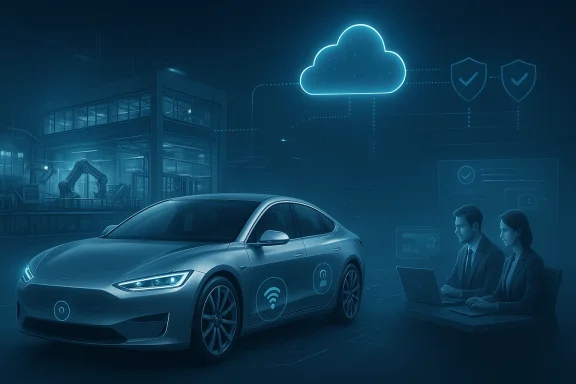
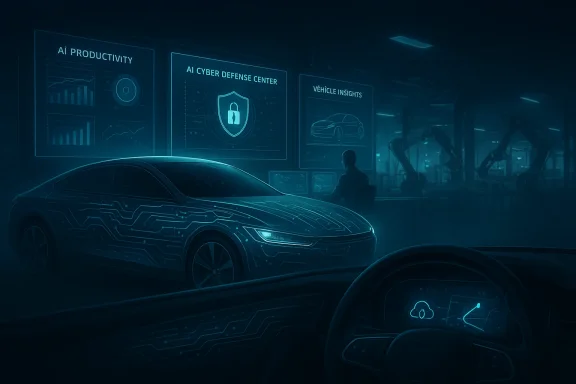
At the center of the Stellantis-Microsoft partnership is a simple but powerful idea: AI should touch nearly every layer of the automaker. That includes employee productivity through Copilot, software and product development support, cyber defense, manufacturing analytics, and customer-facing vehicle guidance. Stellantis said the companies plan to co-develop more than 100 AI initiatives, a number that is more symbolic than literal, but still signals breadth and ambition.
The most immediate benefit is likely to be internal. Stellantis employees already have access to Microsoft Copilot, and the company says at least 20,000 employees are using Microsoft 365 Copilot, while training is underway to help workers integrate AI into daily tasks. That kind of deployment is often where ROI begins, because knowledge workers can automate routine drafting, search, synthesis, and summarization tasks long before the car itself changes.
A second cluster of use cases sits in security and operations. Stellantis says Microsoft will help build an AI-driven global cyber defense center to oversee IT systems, vehicles, and manufacturing sites. That is an especially important area for automotive companies because their attack surface now includes factories, logistics systems, cloud services, connected vehicles, and customer applications. A single cyber platform that correlates those signals could be valuable, but only if it is tuned to the realities of automotive operations.
Then there is the consumer-facing dimension. Stellantis described possible vehicle features such as maintenance recommendations and route suggestions delivered by AI agents. Those features matter because they move AI from the back office into the ownership experience. If done well, they could make the car feel more helpful, more predictive, and more connected to the driver’s daily life. If done poorly, they could feel intrusive, gimmicky, or just inaccurate.
The broader strategic message
This deal also sends a message to the market: Stellantis wants to be seen not just as a carmaker, but as a technology orchestrator. In practical terms, that means stitching together cloud, AI, software, and data into a coherent operating model. In symbolic terms, it says the company is willing to use big-name partners to compress the time it takes to modernize.
- Employee AI is being treated as a baseline capability.
- Cybersecurity is now a strategic AI use case, not just an IT function.
- Product development is becoming more data-driven and software-led.
- Customer engagement is shifting toward intelligent, context-aware services.
- Manufacturing and logistics remain likely beneficiaries even when not named directly.
- Platform thinking is replacing isolated pilots and one-off demos.
The Enterprise Productivity Play
The first and most visible layer of the partnership is employee productivity. Microsoft Copilot has become the default entry point for many firms that want to show they are “using AI,” and Stellantis appears to be following that playbook at scale. That is sensible, because the early gains in AI adoption usually come from reducing the cost of routine cognitive work, not from reinventing the vehicle overnight.
For an automaker, that can mean faster document drafting, more efficient meeting summarization, quicker information retrieval, and better cross-team coordination. A company as large and geographically dispersed as Stellantis can use AI to reduce the time spent looking for answers buried in emails, documents, and knowledge bases. When that works, it can improve decision velocity in ways that are hard to capture in a single headline but meaningful in daily operations.
What Copilot changes inside a car company
AI productivity tools are most effective when they are paired with process redesign. If employees simply use Copilot to produce more drafts of the same old work, the benefit is limited. If managers rethink workflows so that AI handles the repetitive first pass and humans focus on judgment, exception handling, and relationship work, the effect can be much larger.
That is why training matters. Stellantis says employees are being trained on how to integrate AI into their daily workflows, which suggests the company understands that adoption is not just about licenses. It is about behavior change, governance, and a willingness to let some tasks be reallocated to software.
- Faster drafting can reduce administrative drag.
- Better search can make corporate knowledge more usable.
- Workflow automation can cut repetitive coordination.
- Analyst support can improve synthesis across departments.
- Training programs can raise AI literacy and reduce misuse.
- Governance can prevent shadow AI adoption from becoming a liability.
Why enterprises care more than consumers think
To outside observers, Copilot may look like just another chatbot. Inside a company like Stellantis, though, it can become a common interface layer across hundreds of processes. That makes it useful in ways that are less flashy but more important: status updates, policy questions, first drafts, knowledge retrieval, and internal planning. That is where enterprise AI earns trust.
Microsoft has been positioning Copilot as a secure enterprise environment with controls around data use and compliance, which is likely a key reason Stellantis can justify broader rollout. In industries where IP, engineering data, and supplier relationships matter, the security story is just as important as the model quality.
Cybersecurity as a Business Strategy
If there is one part of the Stellantis-Microsoft alliance that feels especially consequential, it is the plan for an AI-driven global cyber defense center. That reflects a reality many automakers are still catching up to: cybersecurity is no longer a narrow compliance function. It is now central to operational continuity, product integrity, and brand trust.
Automotive companies must protect corporate IT, supplier data, manufacturing systems, dealer systems, connected services, and vehicle software stacks. Each of those domains has its own threat model, and each can become a target for fraud, ransomware, intellectual property theft, or service disruption. AI can help correlate signals faster than human analysts alone, but it can also generate alert fatigue if poorly tuned.
Why vehicle cybersecurity is different
Vehicle cybersecurity is especially hard because it merges traditional enterprise risk with embedded systems risk. A compromise in a backend identity system may affect customer accounts, while a compromise in a manufacturing environment may affect production uptime. A vehicle-side vulnerability may have reputational consequences long before it has direct financial ones.
That is why the proposed cyber defense center matters. Stellantis is effectively saying it wants one intelligence layer watching IT systems, vehicles, and manufacturing sites together. That holistic view could uncover patterns that siloed security teams miss, especially if the company is trying to defend a global network of software, plants, and connected services.
The promise and the problem
The promise is a faster response loop, better prioritization, and more efficient triage. The problem is that AI-driven security only works when the data foundation is solid and the operating model is disciplined. If data quality is poor, the model will surface noisy conclusions. If escalation paths are unclear, analysts will still be stuck in manual review.
- Unified visibility can reduce blind spots.
- Correlated telemetry can improve detection speed.
- Automation can reduce analyst burnout.
- Threat hunting can become more proactive.
- Incident response can be better coordinated across domains.
- Governance will be essential to prevent overreliance on automation.
This is one area where Stellantis is likely to be judged not by rhetoric but by outcomes. Cybersecurity is unforgiving; if the new center reduces dwell time and improves containment, it will be a meaningful win. If it becomes another dashboard without operational authority, it will fade into the background.
Customer-Facing AI in the Vehicle
One of the most interesting parts of the deal is the possibility of AI-driven maintenance recommendations and route suggestions appearing directly in Stellantis vehicles. That is where AI shifts from office tool to product feature, and where the customer’s perception of the brand can change in real time. It also raises the bar considerably, because vehicle-grade AI has to be dependable in a way that an email assistant does not.
For drivers, the appeal is easy to understand. An AI system that warns about maintenance before a failure occurs, suggests more efficient routes, or explains service needs in plain language can reduce friction and improve confidence. In a connected vehicle, that kind of intelligence can make the ownership experience feel more personalized and more modern.
From infotainment to intelligent assistance
The automotive industry has been talking about “smart cockpit” systems for years, but many implementations have stopped at voice commands and app ecosystems. AI agents offer a deeper possibility: systems that infer intent, adapt to context, and act more like assistants than menus. That is the kind of shift Stellantis seems to want.
Still, the leap from concept to customer value is substantial. Drivers do not want constant interruptions, vague recommendations, or models that hallucinate vehicle status. They want clarity, accuracy, and convenience. If the AI is not trustworthy, it will quickly become annoying.
What customers may gain
- Predictive maintenance that helps prevent breakdowns.
- Route optimization based on traffic, range, and preferences.
- Simpler explanations of vehicle alerts and service needs.
- More personalized experiences across the ownership lifecycle.
- Better service scheduling through integrated recommendations.
- Potentially higher resale confidence if maintenance is better documented.
The customer-facing angle also opens a broader strategic question: how much AI should live in the vehicle versus in the cloud? That tradeoff affects latency, privacy, resilience, and update frequency. It also determines how much control Stellantis keeps over the user experience versus how much gets delegated to Microsoft infrastructure.
Manufacturing and Operations
Even though the announcement emphasizes employee tools and vehicle insights, the operational implications for manufacturing may be just as important. Automakers are increasingly using AI in supply chain planning, warehouse management, defect analysis, and production analytics. Stellantis has already said it has used AI in warehouse management and data analytics, so the Microsoft partnership looks like a scale-up rather than a first experiment.
That matters because manufacturing is where incremental efficiency gains can quickly add up. If AI can help anticipate disruptions, optimize inventory, reduce downtime, and improve quality control, the business impact can be substantial. In a high-volume, global manufacturing environment, small improvements in decision quality can translate into real financial leverage.
Why factories are fertile ground for AI
Factories generate large volumes of structured and semi-structured data: machine telemetry, quality measurements, supply signals, maintenance logs, and workflow events. That makes them a natural environment for AI systems that detect anomalies, recommend interventions, and prioritize attention. It also makes them a good place to test whether AI can move from pilot to production.
Microsoft’s industrial cloud and enterprise AI stack are built around exactly that kind of use case. The Stellantis deal is therefore not just about productivity software; it is about applying enterprise AI to physical operations. That is a harder problem than email drafting, but potentially much more valuable.
The manufacturing ROI checklist
To make the partnership real on the shop floor, Stellantis will need to prove several things:
- AI insights must be timely enough to matter.
- Recommendations must be specific enough to act on.
- Systems must fit into existing plant workflows.
- Operators must trust the outputs.
- Measurable productivity gains must follow.
Without those elements, AI in manufacturing becomes another pilot project that never escapes the demonstration phase. With them, it can become a durable source of competitive advantage.
Competitive Context
Stellantis is not alone in pursuing automotive AI partnerships. Its peers are also blending cloud, software, and mobility platforms in pursuit of smarter factories and better customer experiences. Ford has emphasized organizational change and digital discipline, while other automakers are racing to define what a software-defined vehicle should actually deliver to customers. The race is no longer just about electric vehicles or autonomous driving; it is also about who can operationalize AI most effectively.
The timing of Stellantis’ Microsoft move also sits alongside its broader use of other AI partners. The company has collaborated with Palantir on data consolidation and analysis, and it has deepened work with Mistral AI on customer experience and vehicle development. That multi-partner approach suggests Stellantis wants flexibility, not dependence on a single AI stack. It also means the company is building an ecosystem rather than a monogamous technology relationship.
Why Microsoft is the right kind of partner
Microsoft brings three qualities that matter to industrial firms. First, it has an established enterprise footprint, so employee adoption can start quickly. Second, it has cloud and security credibility, which matters when the use case expands from productivity to defense and manufacturing. Third, it has a growing agentic AI story that can be tailored to workflows across departments.
That gives Microsoft an edge over vendors that can demo AI but struggle with enterprise deployment. It also gives Stellantis a partner whose tools are already familiar to many workers, which lowers training friction. The danger, of course, is that familiarity can mask the complexity of integration.
Competitive implications for rivals
- Ford will be watched for its own AI and software execution.
- General Motors continues to face the challenge of scaling digital experiences across brands.
- Volkswagen Group and other global OEMs must balance software ambition with execution discipline.
- Tesla remains the benchmark for vertically integrated software, even if its model is different.
- Chinese automakers continue to pressure legacy players on digital speed and feature velocity.
- Suppliers and tier-one vendors may increasingly be pulled into AI-integrated workflows.
In that context, Stellantis is trying to avoid becoming a follower in the AI narrative. The question is whether it can turn broad partnership language into a repeatable operational advantage. That is the real competitive test.
The Data and Governance Challenge
The more AI spreads across an automaker, the more important data governance becomes. A system that touches employees, customers, vehicles, and factory operations cannot be treated as a casual experiment. It needs access controls, auditability, model oversight, and clear lines about which decisions remain human-led.
This is especially important because automotive data is sensitive in multiple ways. It can reveal customer behavior, engineering performance, supplier relationships, proprietary design information, and cybersecurity posture. A poorly governed AI rollout can expose the company to regulatory, legal, and reputational risks even if the technology works well in a narrow sense.
The hidden cost of enterprise AI
Many companies underestimate the operational burden that comes with scaling AI. The hard part is not buying licenses or building demos. The hard part is creating reliable data pipelines, ensuring role-based access, documenting outputs, training staff, and monitoring outcomes for drift or misuse.
Microsoft’s enterprise pitch emphasizes security and compliance, which is why it continues to win large-scale deals. But the customer still owns the governance layer. Stellantis will need to decide how much autonomy its AI tools get, how they are tested, and how exceptions are handled when the model is wrong.
Governance priorities Stellantis will likely need
- Data classification across corporate, customer, and vehicle systems.
- Access controls to keep sensitive data from being overexposed.
- Human review for high-stakes recommendations.
- Audit trails for AI-generated decisions and suggestions.
- Model monitoring to detect drift and quality issues.
- Clear accountability when AI outputs cause operational problems.
This is where the partnership could become a blueprint—or a cautionary tale. AI governance is often the difference between a useful deployment and a widely criticized one. Enterprise scale magnifies both the benefits and the mistakes.
Strengths and Opportunities
The Stellantis-Microsoft partnership has real upside because it combines a practical enterprise platform with a company that has already started to normalize AI internally. The automaker is not waiting for a future AI era; it is trying to operationalize one now. If the implementation is disciplined, the payoff could span productivity, security, customer experience, and manufacturing.
- Broad scope creates multiple paths to ROI.
- Microsoft familiarity should help employee adoption.
- Cybersecurity integration addresses a growing automotive risk.
- Vehicle insights can improve ownership experience.
- Manufacturing applications could deliver measurable efficiency gains.
- Training programs support sustainable adoption.
- Multi-partner strategy may reduce overdependence on a single vendor.
The biggest opportunity is perhaps cultural. If Stellantis can make AI a normal part of how teams work, not just a headline feature, it could gain speed in ways competitors will struggle to match. That would be a meaningful advantage in an industry where execution often matters more than slogans.
Risks and Concerns
The same breadth that makes the partnership appealing also creates risk. Enterprise AI projects often fail not because the technology is weak, but because implementation is fragmented, governance is inconsistent, or expectations outpace reality. Stellantis will need to avoid turning “100 initiatives” into a scattershot portfolio with no clear hierarchy.
- Pilot sprawl could dilute resources.
- Vendor dependency may limit strategic flexibility.
- Hallucinated outputs could damage trust in customer tools.
- Security overconfidence could create blind spots.
- Data integration issues may slow adoption.
- Employee resistance could weaken ROI.
- Regulatory scrutiny could increase as AI reaches the vehicle and the factory.
There is also the reputational risk of overpromising. The auto industry has seen too many technology announcements that sounded transformative and later proved incremental. Stellantis will need visible, customer-relevant wins to convince skeptics that this is more than a branding exercise. The market will not award points for ambition alone.
Looking Ahead
The most important thing to watch is not whether Stellantis and Microsoft can produce a large number of AI projects, but whether they can prioritize the right ones and scale them responsibly. The first wave will likely center on productivity, cybersecurity, and internal workflow automation, because those are the fastest areas to show value. The harder, but more interesting, phase will be customer-facing intelligence and vehicle-integrated assistance.
If Stellantis gets this right, the partnership could become a model for how legacy manufacturers absorb AI without losing operational discipline. If it gets it wrong, it may join the long list of corporate AI announcements that sounded larger than their real-world effect. The difference will come down to execution, governance, and whether the technology improves decisions at the points that matter most.
What to watch next:
- Which of the 100 AI initiatives reach production first
- How quickly employee productivity gains become measurable
- Whether the cyber defense center reduces incident response time
- How vehicle-side AI is tested for safety and reliability
- Whether customers actually use maintenance and route suggestions
- How Stellantis balances Microsoft with other AI partners
- Whether new features produce clear business or quality metrics
Stellantis is signaling that AI is now part of how it intends to compete, not just how it intends to communicate. That is the right strategic instinct in 2026, when the winners in manufacturing will increasingly be the companies that can connect software, data, and hardware into one operating system. The challenge is that in automotive, strategy only matters if it survives contact with production, regulation, and the driver’s daily reality.
References
- Stellantis, Microsoft announce partnership centered on AI tech Detroit Free Press