

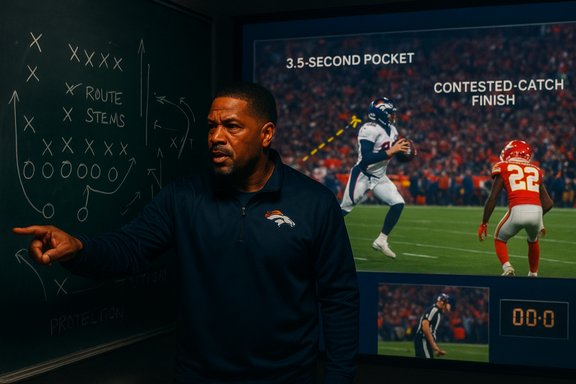
Steve Atwater’s film-room breakdown of Troy Franklin’s fourth‑quarter catch against the Kansas City Chiefs distills a high‑leverage NFL moment into teachable steps, showing how a single contested catch — paired with disciplined clock management and field‑position play — set up Wil Lutz’s game‑winning field goal and sealed a 22–19 Broncos victory. The Broncos’ Between the Lines segment, released Nov. 18, 2025 and hosted by Hall of Famer Atwater, frames Franklin’s reception as a micro‑lesson in route design, catch technique, and situational awareness; Atwater uses slow‑motion replays and schematic overlays to make the football details accessible to coaches and fans alike.
The on‑field facts are straightforward and verifiable: Denver defeated Kansas City 22–19 in Week 11, Wil Lutz converted five field goals including a 35‑yard game‑winner as time expired, and Bo Nix delivered the 32‑yard pass to Troy Franklin that put the Broncos into Chiefs’ territory for the final field‑goal attempt. Those game facts are reported across multiple independent outlets — Reuters, the Associated Press, and local Denver coverage — which list the final score, Lutz’s five field goals, and Nix’s 32‑yard completion to Franklin on the decisive drive. Atwater’s Between the Lines clip (published by the Broncos) does not attempt to reframe the play as an isolated miracle. Instead, the segment situates Franklin’s catch inside the drive’s context: earlier third‑down conversions, protection rules that bought the quarterback time, and a route stem engineered to put a linebacker in conflict — all of which are visible on the tape and emphasized during Atwater’s walk‑through. The team video pairs close camera angles with tactical narration, making the teachable elements explicit for viewers.
Source: Denver Broncos Steve Atwater breaks down Franklin's big 4th-quarter catch vs. Chiefs | Between the Lines
 Background / Overview
The on‑field facts are straightforward and verifiable: Denver defeated Kansas City 22–19 in Week 11, Wil Lutz converted five field goals including a 35‑yard game‑winner as time expired, and Bo Nix delivered the 32‑yard pass to Troy Franklin that put the Broncos into Chiefs’ territory for the final field‑goal attempt. Those game facts are reported across multiple independent outlets — Reuters, the Associated Press, and local Denver coverage — which list the final score, Lutz’s five field goals, and Nix’s 32‑yard completion to Franklin on the decisive drive. Atwater’s Between the Lines clip (published by the Broncos) does not attempt to reframe the play as an isolated miracle. Instead, the segment situates Franklin’s catch inside the drive’s context: earlier third‑down conversions, protection rules that bought the quarterback time, and a route stem engineered to put a linebacker in conflict — all of which are visible on the tape and emphasized during Atwater’s walk‑through. The team video pairs close camera angles with tactical narration, making the teachable elements explicit for viewers. What Atwater Shows — Play Anatomy and Teaching Points
Steve Atwater’s strengths as a film‑room presenter lie in his ability to isolate repeatable mechanics and to translate subtle technique into short, actionable items. The Between the Lines breakdown on Franklin’s reception focuses on three primary teaching points: pre‑snap alignment and protection, route stem and leverage, and contested‑catch fundamentals.Pre‑snap alignment and protection clarity
Atwater freezes the pre‑snap picture to show protection rules and pass‑rush windows. The tape illustrates how a simplified protection plan created a roughly 3–3.5 second clean pocket — enough time for the timing route to develop and for Bo Nix to deliver a precise outside‑shoulder throw. Film‑room commentaries routinely stress that this pocket window is the single most important enabling condition for a timing concept like the one executed on Denver’s drive.Route stem and leverage over pure speed
The route itself is not pure vertical speed; it’s a designed stem that forces a linebacker into a split decision — respect the underneath route or honor the vertical void. Atwater points out the leverage created by that stem: it narrows the catch window for defenders and expands the YAC corridor if the receiver wins the catch point. This idea — engineering leverage rather than relying on separation speed — is a repeatable schematic principle Atwater isolates for coaches.Contested‑catch fundamentals and finish
Atwater slows the tape at the catch point to highlight hands, body positioning, and the immediate transition to yards after catch. The film‑room replay shows Franklin securing the ball under pressure and turning upfield decisively, converting a medium‑gain pass into a field‑flipping play. The clip stresses familiar but crucial fundamentals: secure the ball at the highest point possible, use the body to create a shield, and finish through contact to maximize forward progress.Why the Catch Mattered — Game Context and Impact
The tactical value of Franklin’s catch goes beyond raw yardage. It came with under a minute left, after the Broncos had earlier converted a long third‑down to avoid a disaster deep in their own territory. That 32‑yard completion moved the ball to the Chiefs’ 15 and allowed Denver to bleed clock and set up a low‑variance kick by Lutz. The kick itself — Lutz’s fifth of the day — restored a pattern of efficient field‑position play that had defined Denver’s late‑game management in that contest. Independent recaps and wire stories confirm the play’s role as the decisive moment that produced the winning field‑goal opportunity. From a probability perspective, the catch changed the Broncos’ expected points and win probability materially in a short window. That’s the precise value coaches try to manufacture late in one‑score games: flip field position, avoid takeaways, and present special teams with a clean, makeable distance. Atwater’s clip is pedagogically effective because it shows not just the catch but the conditions that made the catch lead to a win.Strengths of Atwater’s Breakdown
- Clarity of teaching cues. Atwater picks a manageable number of teachable elements and demonstrates them visually; the clip is short, focused, and practical for position groups and film rooms.
- Emphasis on fundamentals. The segment returns to hand placement, pad level, and finishing mechanics — the “boring” details that consistently win plays in tight‑space football.
- Contextual framing. Rather than glorifying the highlight, the clip situates the reception within the drive and the game flow, which reduces the risk of viewers misreading a single moment as systemic dominance.
- Production quality for fan education. The Broncos’ Between the Lines package uses overlays and multiple angles to make coordination and timing visually intuitive for non‑coaches, increasing the clip’s outreach value.
Risks, Fragilities, and What the Clip Doesn’t Prove
The Between the Lines format is intentionally selective: it teaches from success. That editorial selection introduces well‑known fragilities that Atwater himself and independent analysts caution against.- Small‑sample risk. Highlights show what worked; they do not prove consistency. Single plays have outsized narrative impact but limited statistical power. To claim a trend from one or two tight‑game wins would be methodologically unsound. Atwater’s clip is valuable as instruction, not as proof of season‑long performance.
- Dependence on protection. Timing concepts require reliable interior protection. If protection degrades — due to pressure, blitzes, or assignment errors — the concept collapses into turnovers or negative plays. The clip’s success is contingent on those preconditions.
- Highlight bias and editorial selection. Cameras and production choices can overemphasize a single defender’s error or a receiver’s exceptional effort while omitting nearby errors that nearly negated the play earlier in the drive. Viewers should cross‑check game logs and play‑by‑play to avoid overfitting.
- Opponent context. Tactical successes are sensitive to opponent tendencies and roster health; what works against one defense (or in a single game) might not translate universally. Independent recaps of the Broncos‑Chiefs game note missed extra points, blocked kicks, or defensive plays that also influenced the outcome — details that modulate how impactful a single catch really was in isolation.
How Coaches and Analysts Should Use the Clip — A Practical Checklist
Atwater’s video is most valuable when used as a blueprint for practice and evaluation. The following is a pragmatic, coachable approach to turning the highlight into repeatable outcomes:- Watch full‑speed once to capture game context (down, distance, clock and score).
- Replay from multiple camera angles and freeze at pre‑snap to confirm alignment and protection rules.
- Slow the tape to contact speed at the catch point and evaluate hand placement, body positioning, and finishing technique.
- Chart responsibility correctness: did the defender or offensive blocker miss an assignment, or was the play defeated by execution?
- Cross‑reference the clip with play‑by‑play and drive charts to measure downstream impact (time of possession, expected points added).
- Convert the film lessons into locked practice drills (protection clarity reps, contested‑catch progression, sprint‑out‑to‑throw timing windows).
Cross‑Verifying Critical Game Facts
For readers who demand factual verification, the key load‑bearing claims in the film-room narrative line up with independent reporting:- Final score and game outcome: Broncos 22, Chiefs 19. This is confirmed in Reuters and AP wire reporting, as well as local Denver coverage.
- Wil Lutz’s five field goals and a 35‑yard game‑winner as time expired: reported by Reuters, AP, and Denver‑area outlets.
- The decisive 32‑yard pass to Troy Franklin on the final drive (Bo Nix to Franklin) that set up the field‑goal opportunity: explicitly called out in AP, Fox Sports/Associated Press distribution, and team recaps.
- Game momentum plays cited in Atwater’s clip (third‑down conversions, pressure windows): corroborated by game recaps and tactical writeups that highlight Denver’s late third‑down resilience.
The Broader Narrative: What This Says About Denver’s Team Identity
Atwater’s breakdown reinforces a theme visible in Denver’s Week 11 performance: a reliance on disciplined situational football, clean execution in short‑time windows, and special teams reliability. Journalistic coverage of the game places emphasis on the Broncos’ win streak, Bo Nix’s efficient management of the clock, and Wil Lutz’s reliability — themes consistent with the film clip’s message that small execution details created a game‑deciding opportunity. That said, broader roster health, penalty counts, and run‑game sustainment remain relevant. Independent game coverage points out Denver’s penalty yardage and occasional offensive stagnation; those are structural variables that define whether the kinds of third‑down conversions and teachable catches Atwater highlights will be repeatable over a full season. Use the film lesson as a positive indicator, not as proof of systemic invulnerability.SEO‑Friendly Takeaways for Fans and Analysts
- The clip offers route stem and leverage teaching points that apply to the modern passing game.
- Coaches should prioritize protection clarity and contested‑catch drills when translating film‑room lessons into practice plans.
- For stat‑minded analysts, pair Atwater’s qualitative takeaways with pressure‑rate and third‑down analytics to measure sustainability.
- For fans searching keywords: “Troy Franklin catch analysis,” “Bo Nix game‑winning drive vs Chiefs,” and “Steve Atwater Between the Lines breakdown,” the Broncos’ team video is a concise, high‑production resource that outlines the teachable mechanics behind the highlight.
Conclusion
Steve Atwater’s breakdown of Troy Franklin’s fourth‑quarter catch is a model of modern team film production: short, technically focused, visually clear, and framed around teachable fundamentals. The clip’s central claims — that a designed route stem, a reliable protection window, and crisp contested‑catch technique combined to flip field position and enable a game‑winning field goal — are supported by the game’s play‑by‑play and by independent reporting of Denver’s 22–19 win. Atwater’s segment is most useful as a practical coaching vignette: it gives position groups concrete drills and attention points. The viewer should, however, resist converting a single highlight into a season‑long conclusion. Use the clip as a template — film plus data — for extracting repeatable process improvements: lock protection rules, rehearse contested‑catch finishes, and bank situational clock management. Those are the measurable habits that turn one high‑leverage catch into a reliable edge across a full campaign.Source: Denver Broncos Steve Atwater breaks down Franklin's big 4th-quarter catch vs. Chiefs | Between the Lines
