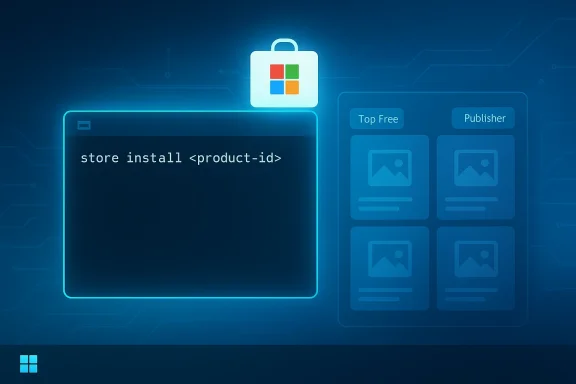
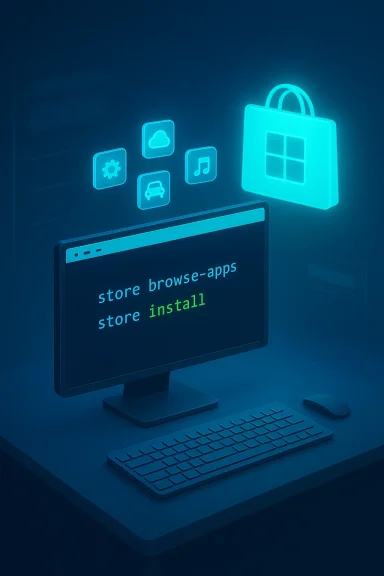
Microsoft has quietly added a first‑party command‑line client for the Microsoft Store to Windows 11: a built‑in Store CLI surfaced as the store command that lets you browse, search, install and update Store content from the terminal without opening the GUI. This is a small change on the surface, but it matters — especially to power users, IT pros and administrators who want faster, scriptable access to Store‑hosted apps. Microsoft documents the feature as part of an updated developer blog post announcing enhanced Store tooling, and hands‑on reporting shows the CLI arriving in Preview on recent Windows 11 builds.
The Windows ecosystem already offered several command‑line touchpoints for apps: the Windows Package Manager (winget) for broader package management, and the Microsoft Store Developer CLI (msstore) for publishers and CI workflows. The new built‑in Store CLI is distinct — it’s a Store‑centric client that talks to the Microsoft Store catalog and the Store client on the device, focusing on discovery and lifecycle actions for Store packages. Early coverage and community testing describture shipped with some Windows 11 builds rather than a separately installed tool.
At the same time, the decision not to fold these features directly into winget speaks to functional separation: winget remains a general package manager and automation engine, while the Store CLI is a Store client optimized to reflect Sering. That separation is defensible — the two tools have different trust, entitlement and distribution models — but it introduces a modest maintenance and integration burden for teams that now must th tools in provisioning flows.
The Store CLI makes the Microsoft Store more accessible to terminal users — that’s progress. The next step is for Microsoft to pair the CLI with clear enterprise guidance, robust logging and lifecycle parity so administrators can trust it in large‑scale deployments. Until then, experiment cautiously, log everything, and prefer deterministic Product IDs over name‑based installs when you need reliability.
Source: Thurrott.com Windows 11 Has a Microsoft Store CLI Now
 Background
The Windows ecosystem already offered several command‑line touchpoints for apps: the Windows Package Manager (winget) for broader package management, and the Microsoft Store Developer CLI (msstore) for publishers and CI workflows. The new built‑in Store CLI is distinct — it’s a Store‑centric client that talks to the Microsoft Store catalog and the Store client on the device, focusing on discovery and lifecycle actions for Store packages. Early coverage and community testing describture shipped with some Windows 11 builds rather than a separately installed tool. Why a Store CLI now?
Microsoft’s stated rationale is straightforward: give developers and users “a new way to discover and install Store apps, without needing the GUI.” Command‑line workflows are faster for many tasks and easier to automate, and a Store‑specific CLI fills a gap winget doesn’t fully cover: canonical Store discovery, price metadata and curated store listings. The Windows Developer Blog highlights browse and filter capabilities that mirror the Store UI while returning compact, CLI‑friendly output.What the Store CLI does today
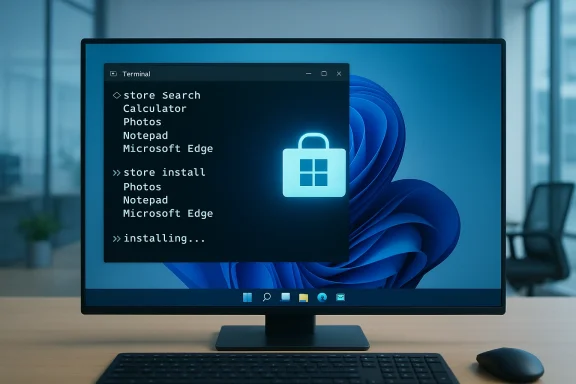
The Store CLI exposes a set of discovery and lifecycle commands that align closely with typical Store UI actions. Hands‑on reports and Microsoft’s blog show the primary capabilities:- Browse the Store cataists (e.g., curated or top charts) via store browse-apps and store browse-games. (blogs.windows.com)
- Search the Store catalog with filters for market, language and listing type via store search. The output includes the Store product identifier and other Store metadata.
- Install Store apps by product ID or name with store install. Installations begin without opening the full Store GUI and surface installed apps in Start once complete.
- Update individual Store apps via store update and check/update all Store apps via store updates. Several testers confid triggering works, though progress feedback in the terminal is minimal.
How it compares to winget and msstore
The arrival of another Store‑related CLI naturally raises the question: why not just extend winget? The practical distinctions are clpt builders.- Scope: Store CLI is Store‑first — it queries the Microsoft Store catalog and surfaces the canonical Store entry for each listing. winget is a general package manager that aggregates manifests and repositories, often returning multiple manpackaging variants for the same product.
- Discovery: Store CLI returns Store ordering, price metadata, and curated lists (top charts, categories) identical to the Store UI; winget does not provide Store charts or price metadata.
- Publishing: msstore (Microsoft Store Developer CLI) is for publishers — packaging,tion in Partner Center — and is separate from the end‑user built‑in store client. The built‑in Store CLI is consumption‑focused, not a publishing tool.
- Automation and enterprise readiness: winget today has the richer enterprise feature set (export/import manifests, policies, enterprise deployment considerations). The Store CLI currently appears Preview‑grade with limited documentation for enterprise integration. That makes winget the better choice for full provisioning pipelines, while the Store CLI is better for Store‑accurate, Store‑only operations.
Early observations and behavior quirks
Community testing and writer hands‑on checks reveal several practical behaviors you should know before adopting the Store CLI in scripts or workflows.Installation and progress reporting
Installs triggered by store install typically start downloads and completeull Store GUI. However, terminal feedback is sparse: many testers report no progress bars and sometimes no terminal completion message, while the system’s Start menu and Store installed list will reflect completed installs. Scripts that assume synchronous, verbose progress may misinterpret the command’s state without additional verification.Paid items and entitI can list paid items and show pricing metadata, but it cannot process purchases inline. If you attempt to install a paid app without owning entitlements, the CLI fails and instructs you to complete the purchase via the Store GUI first. That behavior preserves Store licensing flows but breaks fully unattended purchase/install automation.
Uninstall and lifecycle gaps
In many early builds the Store CLI focuses on discovery, install and updates; a supand is often missing or inconsistent. That means the CLI is not (yet) a complete lifecycle tool for Store packages — other tools (Settings, Store GUI or PowerShell/Appx commands) are still needed for uninstallation in many cases.Availability and consistency
The Store CLI appears automatically on some Windows 11 installs and not on others — availability may vary by Windows build, channel, or region. Microsoft has published the CLI announcement as part of updated Store/developer tooling, but first‑class, versioned documentation for tited at this time. Enterprises should treat the CLI as Preview until Microsoft clarifies release channels and versioning.Security, privacy and governance considerations
Introducing a terminal client for the Store adds new angles for security teams and compliance officers lements remain enforced by the Store. The CLI delegates licensing checks to the Store’s entitlement system, so it cannot bypass paid entitlements or family/organizational purchase controls. That preserves the integrity of licensing but means automation must respect entitlement checks and fail gracefully when required purchases are missing.- Auditabiresent appear limited. There’s no publicly documented centralized audit trail or enterprise logging specific to the Store CLI; until Microsoft publishes integrated logging or telemetry hooks, treat CLI operations as UI installs from an auditing perspective. Enterprises that require immutable install logs will need to supplement CLI usage with local logging wrappers or system event collestalls need robust verification. Because terminal progress is minimal, automation should verify outcomes via store installed, check Get‑AppxPackage (for UWP/MSIX packages), and optionally validate file presence or registry entries. Add retries, timeouts and explicit status checks rather than assuming completion once the command returns.
Practical he Store CLI safely in scripts
If you want to experiment with the Store CLI in lab or production scripts, follow these concrete steps to reduce risk and improve reliability.- Verify presence and run fallback logic.
- Check for the CLI before using it: run
store --here. If absent, fall back to winget or an alternate provisioning path. This prevents brittle scripts on varied Windows builds. - Use product IDs for deterministic installs.
- Use
store searchorstore showto obtain the Store Product ID (a stable identifier) and callstore install <ProductID>ty. This mirrors best practices used for winget manifests. - Validate installation explicitly.
- After
store install, verify the app withstore installedand check system installers (e.g.,Get‑AppxPackagefor MSIX/UWP). Add a retry loop with reasonable timeouts; the CLI’s sparse output makes implic - Handle paid apps and entitlements separately.
- If
store searchshows a price, block automated install attempts unless entitlements are pre‑provisioned through enterprise licensing. Attempting to script purchases is not supported — the CLI will fail and rrchase completion. - Combine tools for full provisioning.
- Use a hybrid approach: winget for wide package coverage, MSI/EXE vendors, and enterprise manifests; store CLI for Store exclusives, curated lists and Store‑accurate entries. This is the most pragmatic path until the Store CLI matches winget’s enterprise features.
- Build logging and observability.
- Wrap
storecommands in a logging function that timestamps outputs, records exit codes, and collectsGet‑AppxPackage/file Ship these logs to centralized telemetry for compliance and troubleshooting.
Example workflows and command snippets
Below are a few representative examples that show how the Store CLI might be used in everyday workflows. Each example assumes the store command is present on the device.- Search for a Store app and install by Product ID:
- store search brave
(look for the Product ID in the results, then) - store install XP8C9QZMS2PC1T
This will trigger a Store install for Braveilable in your region and entitlements allow it. - Browse top free productivity apps:
- store browse-apps top-free --categoryhis returns a compact, Store‑ordered list you can consume directly in scripts or logs.
- Update all installed Store apps:
sestore updatesto check for updates across installed Store apps and trigger installs. Follow up withstore installedto validate updated versions. Keep in mind terminal progress may be minimal, so verify via installed package queries. - Combine winget and store in a provisioning script (pseudo):
- Ensure
storeis available; otherwise use winget fallback. - winget install --silent 7zip
- store install <ProductID_for_Store_only_app>
- Verify both installs via appropriate checks.
Strengths and who benefits most
The built‑in Store CLI brings meaningful benefits for specific user groups:- **Power users and devee terminal and want faster Store discovery and installs without GUI friction. The browse and search filters offer a way to replicate Store browsing in a compact, scriptable format.
- IT pros and single‑machine automation tasks where a handful of Store apps musteloper or test machines — the CLI makes those installs less fiddly and faster than clicking through the Store.
- Troubleshooters who need quick device audits:
store installedand `store showlity into store‑installed packages and metadata useful for debugging.
Limitations and risks — what Microsoft still needs to fix or clarify
The Store CLI as shipped in Preview has clear gaps that limit enterge‑scale automation:- No documented enterprise integration. How the CLI integrates with Intune, offline licensing, or enterprise purchase entitlements is unclear. Microsoft needs to pubd APIs for enterprise workflows.
- Sparse progress and exit reporting. Scripts need robust exit codes and progress signals; right now, the terminal output is too minimal for confident automation without extra verification steps.
- Uninstall and full lifecycle coverage. Many builds lack a supported uninstall command, making the CLI a partiarprises expect install, update and uninstall parity with other management tools.
- Availability inconsistency. The CLI’s presence depending on Windows build/channel complicates rollouts; Microsoft should publish versioning, release channels and backcompat guarantees.
The bigger picture: what this says about Microsoft’s app strategy
The Store CLI reflects a pragmatic approach: Microsoft is doubling down on the Store as a canonical content source while recognizing that many users and admins prefer terminal workflows. By giving the Store a native CLI, Microsoft acknowledges that the Store’s role is larger than a simple GUI front end and that some Store‑speci lists, paid entitlements, extensions) deserve a dedicated command‑line surface.At the same time, the decision not to fold these features directly into winget speaks to functional separation: winget remains a general package manager and automation engine, while the Store CLI is a Store client optimized to reflect Sering. That separation is defensible — the two tools have different trust, entitlement and distribution models — but it introduces a modest maintenance and integration burden for teams that now must th tools in provisioning flows.
Recommendations for IT teams and power users
- s Preview for now. Use it for lab work, single‑machine provisioning and targeted scripts where Store accuracy matters. Avoid relying on it for fleet provisioning until Microsoft publishes enterprise docs and logging.
- Adopt a hybrid provisioning strategy. Continue using winget for broad package installs and automation; call store for Store exclusives or when you need canonical Store entries and price metadata.
- Harden scripts. Always check for CLI presence, use Product IDs, validate results explicitly, and log every action. Add retry logic and fallbacks to guard against entitlements and staged rollouts.
- Watch Microsoft documentation and release notes. Because the Store CLI is rolling out in Preview, monitor official Microsoft channels for versioning, enterprise features, and any audit/logging support that’s added. Microsoft has posted the initial announcement in its developer blog; expect formal docs to follow.
Conclusion
The built‑in Microsoft Store CLI is a welcome addition for an, scriptable access to Store content. It fills a clear niche — Store‑accurate discovery and installs — that winget does not fully cover, and it offers practical value for power users and small‑scale automation. But it’s not a replacement for winget or a full enterprise management solution yet. Expect growing pains: minimal progress reporting, licensing and purchase constraints, lifecycle gaps and uncertainuilds. For now, the smart path is a hybrid approach: use winget for broad automation and the Store CLI where canonical Store listings or curated Store browsing matter, while keeping a close eye on Microsoft’s documentation updates and enterprise feature announcements.The Store CLI makes the Microsoft Store more accessible to terminal users — that’s progress. The next step is for Microsoft to pair the CLI with clear enterprise guidance, robust logging and lifecycle parity so administrators can trust it in large‑scale deployments. Until then, experiment cautiously, log everything, and prefer deterministic Product IDs over name‑based installs when you need reliability.
Source: Thurrott.com Windows 11 Has a Microsoft Store CLI Now