

Strategy’s partner pitch — “Partner with us to build AI‑ready data foundations for world class organizations” — is more than marketing copy; it’s a strategic pivot that threads together three converging market forces: decades of business‑intelligence pedigree, the enterprise rush to operationalize generative AI, and a renewed commercial emphasis on partner‑led delivery and governance. (strategy.com)
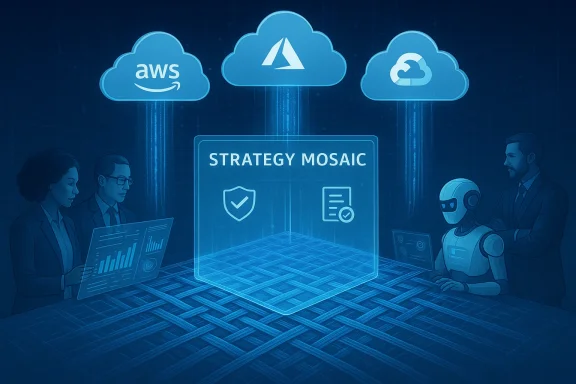
Strategy — the company formerly known as MicroStrategy — presents its partner program as an ecosystem engineered to deliver “AI‑ready” data foundations that support analytics, applications, and AI agents across clouds. The company traces its lineage to the late 1980s and now positions a portfolio that includes Strategy One (its analytics suite) and Strategy Mosaic™, which the vendor calls an AI‑powered Universal Intelligence Layer designed to connect disparate data sources without heavy upfront data movement. (strategy.com)
At the same time, Strategy has publicly rebranded from MicroStrategy and signalled a broader corporate strategy that includes significant cryptocurrency treasury activity. That rebranding and corporate repositioning have been widely reported and formalized through press announcements. The rebrand does not change the company’s BI product ambitions, but it does add a layer of financial and governance context partners must factor into long‑term engagements.
Cross‑checking those vendor claims with independent coverage and product announcements shows congruence rather than contradiction. Strategy’s own press release announcing Mosaic’s general availability outlines the same capabilities; trade reporting on Strategy World and press summaries corroborate the product positioning and emphasis on governance and cloud portability. That dual confirmation reduces the likelihood that Mosaic is merely aspirational marketing.
But the vendor is also different in 2025 than it was in 2019: a public rebrand and an unusually prominent corporate treasury strategy add a new dimension to supplier risk that deserves explicit evaluation. The pragmatic partner will treat Strategy as a promising strategic supplier — and will protect their practice through careful technical validation, contractual clarity, and an outcome‑first GTM that turns Mosaic’s governance and retrieval claims into measurable business impact. (strategy.com)
Source: Strategy https://www.strategy.com/software/partners/
 Background
Strategy — the company formerly known as MicroStrategy — presents its partner program as an ecosystem engineered to deliver “AI‑ready” data foundations that support analytics, applications, and AI agents across clouds. The company traces its lineage to the late 1980s and now positions a portfolio that includes Strategy One (its analytics suite) and Strategy Mosaic™, which the vendor calls an AI‑powered Universal Intelligence Layer designed to connect disparate data sources without heavy upfront data movement. (strategy.com)At the same time, Strategy has publicly rebranded from MicroStrategy and signalled a broader corporate strategy that includes significant cryptocurrency treasury activity. That rebranding and corporate repositioning have been widely reported and formalized through press announcements. The rebrand does not change the company’s BI product ambitions, but it does add a layer of financial and governance context partners must factor into long‑term engagements.
Overview: What Strategy’s partner program promises
Strategy’s partner page lays out three core value props for potential partners and customers: enablement, go‑to‑market support, and technical compatibility across major cloud providers. The program highlights:- Enablement & Training: partner portal access, certifications, and quarterly updates aimed at accelerating product knowledge and certifications. (strategy.com)
- Sales & Marketing Support: co‑selling motions, event collaborations, and joint marketing campaigns to accelerate pipeline. (strategy.com)
- Pipeline & Deal Registration: referral margins, co‑sell discounts, and structured deal registration to protect partner economics. (strategy.com)
Why partners matter now: market context and timing
Two market trends make Strategy’s partner pitch timely and relevant:- Enterprises are transitioning from GenAI exploration to production. This transition is not primarily about model choice; it’s about data grounding, governance, and operationalization — the plumbing that makes LLMs reliable in regulated workflows. Partners who can deliver governed data fabrics, retrieval‑augmented pipelines, and auditable model access win sustained enterprise engagements.
- Hyperscaler ecosystems (Microsoft, AWS, Google) emphasize partner networks as the primary delivery model for complex, industry‑specific AI systems. Successful patterns combine a unified data plane, model routing or choice, and partner delivery to move pilots into production. Vendors such as Strategy are positioning their semantic and governance layers as glue for these partner deliveries.
Strategy Mosaic™: technical claims and independent verification
Strategy positions Mosaic as an "AI‑powered Universal Intelligence Layer" that sits on top of existing databases and data warehouses to provide:- A unified semantic layer that maps business logic, metrics, and governance across sources.
- Connectors to hundreds of data sources and the ability to avoid wholesale data movement by providing curated access patterns.
- Grounding primitives for LLMs and copilot‑style agents so they can retrieve auditable, trusted answers rather than hallucinations.
Cross‑checking those vendor claims with independent coverage and product announcements shows congruence rather than contradiction. Strategy’s own press release announcing Mosaic’s general availability outlines the same capabilities; trade reporting on Strategy World and press summaries corroborate the product positioning and emphasis on governance and cloud portability. That dual confirmation reduces the likelihood that Mosaic is merely aspirational marketing.
What’s compelling: strengths partners should lean into
- Legacy credibility in semantic modeling. Strategy (formerly MicroStrategy) has decades of experience in semantic layers and enterprise reporting; that history is valuable when selling into conservative enterprise IT organizations that equate history with resilience and maturity. The company’s founding in 1989 and subsequent product evolution are publicly documented.
- Cloud and platform flexibility. Mosaic and Strategy One are marketed as compatible with major clouds and with data platforms like Snowflake and Databricks. For partners dealing with hybrid estates, this reduces vendor lock‑in concerns and simplifies integration patterns. (strategy.com)
- Partner economics and co‑sell mechanics. Strategy advertises concrete partner incentives — from training to deal registration and margins — which can improve partner willingness to invest in go‑to‑market activities versus ad‑hoc, low‑commitment relationships. (strategy.com)
- AI grounding and governance messaging. Mosaic’s emphasis on providing auditable retrieval for LLMs aligns with enterprise risk concerns about hallucinations and regulatory exposure. This positions partners to sell “safer” generative AI, which remains an important procurement differentiator.
- Marketing momentum via Strategy World and partner awards. Visible events and award ecosystems provide partners with co‑marketing opportunities and proof points to accelerate enterprise trust. Strategy’s event programming is a practical mechanism for pipeline development. (strategy.com)
What to watch out for: risks and friction points
No vendor pitch is without caveats. Partners should weigh the following real considerations before deep investments:- Corporate and financial signal noise. Strategy’s rebrand from MicroStrategy and its prominent Bitcoin treasury strategy are material context for prospective partners. A company that diverts executive attention or capital toward aggressive cryptocurrency accumulation introduces governance and strategic risk that could affect product investment, support SLAs, or long‑term roadmap commitments. Treat rebranding and treasury posture as a factor in vendor health assessments.
- Product maturity vs. marketing cadence. New offerings that claim to be “universal” or “agent‑ready” often ship in phases. While press releases and demonstrations may show capability, full enterprise readiness — including hardened connectors, comprehensive policy engines, and scale testing — sometimes trails initial announcements. Request explicit milestones, reference architectures, and production reference customers before committing to major implementations.
- Integration complexity with existing MLOps and data platforms. A semantic layer that promises to reduce data movement may still require substantial engineering to build retrieval indexes, tune vectorization and embedding strategies, and maintain lineage across rapid schema drift. Partners must budget for ongoing data engineering and MLOps labor rather than treating the semantic layer as a one‑time lift.
- Agent sprawl and lifetime governance. When organizations enable many copilots or domain agents, governance complexity multiplies: shadow agents, inconsistent policies, and sprawl can create compliance and security risk. Partners must build lifecycle management, discovery, and decommission playbooks into proposals.
- Vendor concentration and single‑vendor dependency. Even if Strategy positions Mosaic as cloud‑agnostic, partners must assess the depth of integration with each cloud and the extent of lock‑in in connectors, metadata formats, and SDKs. Build migration and portability scenarios into statements of work. (strategy.com)
How partners should evaluate Strategy: a practical checklist
Partners considering either joining Strategy’s program or delivering Mosaic‑based solutions should perform a disciplined technical and commercial assessment. Here’s a compact, prioritized checklist to use in RFPs and discovery:- Ask for production references that match your target industry and scale. Verify runbooks, incident histories, and time‑to‑value metrics.
- Validate connector coverage for the customer estate: confirm supported sources, ingestion patterns, streaming vs. batch, and any third‑party adapter gaps.
- Request detailed governance capabilities: policy enforcement points, masking/tokenization, role‑based lineage, and audit trails for retrievals used by LLMs.
- Evaluate MLOps friendliness: can Mosaic output be integrated into existing retriever/reader stacks? Are embedding flows standardized?
- Define operational SLAs and support models: response times, escalation paths, and co‑managed support during the first 90–180 days of go‑live.
- Confirm partner economics and co‑sell rules: margins, lead protection, and dispute resolution for competitive deals. (strategy.com)
Go‑to‑market motion: how to craft winning propositions with Strategy
To turn Strategy’s technology and partner benefits into closed deals, partners should consider three complementary GTM approaches:- Verticalized solutionization: build pre‑packaged solutions that combine Mosaic governance templates with industry logic (e.g., claims triage for insurers, supply‑chain reconciliation for manufacturing). These productized packages reduce proof‑of‑concept fatigue and align with buyer procurement patterns.
- Outcome‑first pilots: sell short, measurable sprints focused on a single high‑value workflow (order‑to‑cash exceptions, contract review, nurse scheduling). Quantify time saved and error reduction; these outcomes create executive sponsors and defensible expansion paths.
- Co‑sell and consumption acceleration: leverage Strategy’s co‑sell programs and cloud partner alliances to reduce procurement friction and qualify deals where hyperscaler incentives lower customer TCO. Ensure joint account plans and executive briefing decks are ready. (strategy.com)
Engineering delivery patterns: reference architecture and operational playbooks
Successful partner deliveries will repeat a small set of architectural and operational patterns. Adopt the following as delivery standards:- Start with a small, production‑grade dataset and index it for retrieval; iterate the embedding and retrieval tuning rather than indexing everything at once.
- Use a layered security model where Mosaic enforces policy at both the dataset and retrieval level, and where downstream LLM access is routed through a control plane for audit and redaction.
- Implement observability for both data lineage and agent behavior. Instrument retrieval success rates, hallucination incidents, and data‑drift metrics.
- Build a human‑in‑the‑loop escalation path; no agent should be allowed to autonomously perform high‑risk actions without human signoff.
- Define agent lifecycle management: creation, versioning, testing, deployment, monitoring, and retirement — all governed and discoverable.
Commercial and contractual advice partners should insist on
When negotiating partner agreements or SOWs with Strategy, include explicit provisions for:- Roadmap commitments for features critical to your delivery (specific connectors, governance APIs).
- Escalation and support credits tied to measurable downtime or priority defect SLAs during go‑live windows.
- IP and reuse rights for accelerators and jointly developed artifacts — clarify who owns pre‑built connectors and configuration recipes.
- Financial clarity on margins, referral fees, and direct‑sale carve‑outs to avoid future disputes. (strategy.com)
Competitive landscape and partner positioning
Strategy competes in an ecosystem where several dynamics shape partner value:- Vendors offering universal semantic layers or data fabrics (both commercial and open‑source) are proliferating; partners must be able to justify mosaic‑specific differentiators such as prebuilt semantic catalogs, native governance controls, or reference vertical content.
- Hyperscalers are building semantic and governance primitives into their stacks (Fabric/OneLake, Foundry, AWS Clean Rooms equivalents). Partners should design for portability and avoid over‑optimizing for a single vendor’s proprietary control plane.
- Independent software vendors and systems integrators with deep data engineering benches are attractive consolidation targets; partners should be realistic about capability gaps they must fill internally or via subcontracts.
Final assessment: is joining Strategy’s partner ecosystem the right move?
For many partners — especially those with data engineering strength and vertical domain expertise — Strategy’s partner program represents a pragmatic opportunity. The vendor offers:- A modern semantic layer narrative that maps to enterprise pain points (governance, grounded LLMs), backed by a product that has been publicly launched and described in technical terms.
- Concrete partner incentives and event platforms that can accelerate pipeline. (strategy.com)
Recommended next steps for partners (executive checklist)
- Conduct a 30‑day technical trial focused on a single high‑value use case.
- Request production references and perform a reference check with similar vertical customers.
- Map a 6–12 month co‑sell plan with joint KPIs and executive sponsors.
- Negotiate contractual guardrails: roadmap commitments, SLAs, IP terms, and exit clauses.
- Build a 90‑day onboarding playbook that includes partner enablement, proof‑of‑value metrics, and a post‑pilot scale roadmap. (strategy.com)
Conclusion
Strategy’s partner proposition combines decades of semantic‑layer experience with a modern, AI‑first narrative that addresses the most pressing enterprise barrier to useful generative AI: trusted, governed access to the right data. For partners with the right mix of data engineering, industry IP, and commercial discipline, the offering looks like an opportunity to sell differentiated, outcome‑oriented engagements today.But the vendor is also different in 2025 than it was in 2019: a public rebrand and an unusually prominent corporate treasury strategy add a new dimension to supplier risk that deserves explicit evaluation. The pragmatic partner will treat Strategy as a promising strategic supplier — and will protect their practice through careful technical validation, contractual clarity, and an outcome‑first GTM that turns Mosaic’s governance and retrieval claims into measurable business impact. (strategy.com)
Source: Strategy https://www.strategy.com/software/partners/
