

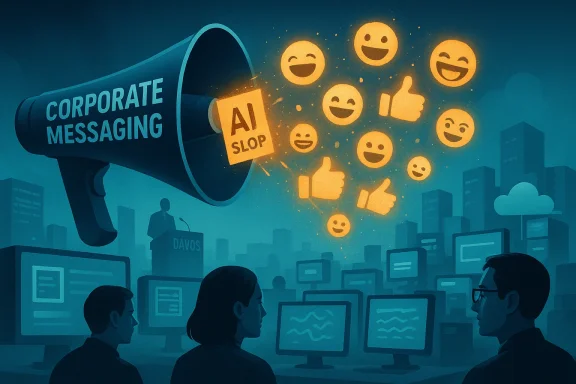
It is a peculiar moment when a Microsoft chief executive can turn a throwaway critique into a broader commentary on how Silicon Valley handles public scrutiny. Satya Nadella’s recent plea to move beyond the language of “AI slop” and his Davos-era warnings about bubbles, social permission, and adoption have collided with a much older communications lesson: trying to tamp down a meme often makes it louder. That is the Streisand effect in action, and in 2026 it has become one of the most useful lenses for understanding the reputational risk around artificial intelligence. The irony is that the more executives try to reframe the debate with polished language, the more ordinary users suspect they are being asked to ignore their own eyes.
The immediate controversy is not really about one LinkedIn post or one World Economic Forum interview. It is about the widening gap between how the AI industry describes itself and how many users experience it. Nadella’s comments about needing a new equilibrium in how people think about AI, alongside his assertion that the technology must prove it can spread benefits beyond tech firms, were intended as a sophisticated defense of the sector. Instead, they landed in a media environment primed to hear corporate euphemism, not nuance.
That tension matters because Microsoft has staked an enormous amount of strategic credibility on Copilot, Azure OpenAI, and the broader AI transformation narrative. The company has spent years positioning AI as a productivity layer rather than a novelty feature, and Nadella himself has repeatedly framed the technology as a platform shift. But the market is now more skeptical, more crowded, and more allergic to grand claims that do not quickly translate into visible value. That is why a phrase like “AI slop” is not just a meme; it is a shorthand for a real skepticism about quality, utility, and trust.
The Streisand effect is a useful comparison because the dynamic is so familiar. When powerful people ask the public to stop paying attention to a label, a criticism, or an awkward truth, the label usually becomes more memorable. Britannica defines the Streisand effect as an attempt to suppress or redirect attention that instead attracts more of it, and the public often responds with renewed curiosity or even mockery. In other words, the fix can become the story.
For Microsoft, that creates a problem with two faces. One is technical: AI still has to justify itself in real workflows, not just in demos. The other is cultural: if executives sound as though they are trying to persuade users to stop noticing bad outputs, hallucinations, or generic content, they risk making critics louder, not quieter. That is why this debate has escaped the narrow world of enterprise software and entered the broader culture war over AI legitimacy.
That pitch worked best when the product category felt magical. Chatbots wrote emails, summarized documents, and generated images on demand. But the honeymoon phase ended quickly once users encountered repetitive prose, wrong answers, awkward images, and content that felt mass-produced rather than intelligent. The phrase AI slop emerged as a popular shorthand for the sense that generative systems were flooding the internet with low-value output dressed up as innovation. It is not a formal technical term, but it captures an emotion the industry has struggled to dismiss.
Microsoft has responded by insisting that AI should be judged by impact, not aesthetics. That is a defensible position, especially in enterprise environments where time saved, errors reduced, and tasks automated can be measured. The company has also tried to broaden the frame from novelty to infrastructure, arguing that the real story is adoption across sectors like healthcare, education, and coding. Yet when the public hears executives argue that the debate should move “beyond” slop, it can sound less like strategic clarity and more like a request for indulgence.
The Davos setting amplified that impression. The World Economic Forum is designed for elite consensus, not for street-level persuasion, and comments made there are almost guaranteed to escape the room and be translated for a wider audience. That is especially true in an era when every corporate stage statement is clipped, reposted, and contextualized by journalists, rivals, and critics. Once that happens, the message ceases to belong to the executive and becomes public property.
The deeper issue is that language is now part of the product experience. Users do not separate interface quality, model quality, and corporate messaging. If a company sounds defensive, users infer that the underlying product may be fragile. That is why public relations missteps in AI are so easy to magnify and so hard to walk back.
Nadella’s comments fit that pattern because they were not a direct rebuttal of quality concerns. They were a rhetorical attempt to change the terms of debate, asking audiences to think in terms of theory of mind, social permission, and broader adoption. Those are real strategic concepts, but they are also the sort of abstractions that can feel disconnected from the average user who has just encountered bland AI output or an obviously wrong answer. That mismatch is where the backlash grows.
This is why a defensive phrase from a CEO can become a cultural marker. It is not merely that people disagree with the claim. It is that the claim sounds like a demand that the audience participate in a kind of collective disbelief. That rarely works in a networked public sphere.
The company also has a second problem: it is no longer speaking only to enterprise buyers. By pushing AI into consumer software, browser experiences, and operating system-level features, Microsoft has broadened the audience that judges the product. Enterprises may tolerate rough edges if the ROI story is solid. Consumers, by contrast, are far less forgiving when a feature feels like clutter or coercion.
On the consumer side, however, the bar is emotional as well as functional. People want technology that feels helpful, trustworthy, and unobtrusive. If the product looks like marketing dressed as usefulness, the reaction is often ridicule rather than loyalty.
A few things follow from that split:
Executives often respond by insisting on nuance. They say the models are improving, that use cases are expanding, and that the right measure is not whether every output is perfect but whether the system moves the work forward. Those claims may be true, but they do not erase the public’s growing sensitivity to how much synthetic content is being injected into everything from search to social feeds.
For Microsoft, this means every awkward Copilot demo, every generic summary, and every user complaint becomes more than a product issue. It becomes evidence in a much larger trial about whether AI is truly mature or just well-funded. The phrase “AI slop” survives because it speaks to that larger doubt, not merely to content quality.
Nadella’s remarks about bubbles, broad benefits, and social permission were intended to show seriousness. But the setting also invited comparison to a familiar pattern: corporate elites explaining why a technology should be embraced faster, even as ordinary users remain unconvinced. In that sense, Davos can make a chief executive seem more exposed, not more authoritative.
That mismatch is why a Davos comment can become meme material. It is also why tech leaders increasingly need to think like broadcasters, not just boardroom speakers. What sounds careful in a conference hall may sound evasive once clipped and reposted.
The difficulty is that the bubble debate has two layers. One is financial, centered on valuation, capital expenditure, and return on investment. The other is cultural, centered on whether the public sees AI as useful or merely intrusive. The two are linked, because a product that feels noisy and underwhelming makes it easier to believe the economics are overheated.
But adoption is not the same as enthusiasm. Companies can deploy a tool because they feel pressured to experiment, not because they love it. That distinction matters, and it is why executives should be careful about overstating consensus when what they really have is momentum.
This is where the criticism around “AI slop” and the criticism around mandatory AI-style integration overlap. If the market thinks a company is forcing a feature into workflows before it has earned trust, then even useful functionality can feel like overreach. The user’s reaction is not to ask whether the model is impressive. It is to ask whether the company respects choice.
That is why Microsoft needs a softer public posture than its current hype cycle often permits. Productivity should feel earned, not imposed. If it does not, the company risks turning an efficiency story into a culture-war story.
There is also a timing issue. When trust is already thin, any attempt to manage perception can look manipulative. The audience is not waiting to be educated; it is waiting to be convinced by something concrete. Without that, the messaging becomes a liability.
That approach is less glamorous, but it is far more credible. It replaces rhetorical polish with operational proof, which is exactly what a skeptical market needs.
The broader industry faces the same test. If AI becomes more reliable, less intrusive, and more obviously useful, the “slop” critique will lose some of its power. If it does not, then every attempt to talk critics out of the phrase will only keep it alive longer.
Source: IT Pro Satya Nadella needs to remember the Streisand effect for 'AI slop'
 Overview
The immediate controversy is not really about one LinkedIn post or one World Economic Forum interview. It is about the widening gap between how the AI industry describes itself and how many users experience it. Nadella’s comments about needing a new equilibrium in how people think about AI, alongside his assertion that the technology must prove it can spread benefits beyond tech firms, were intended as a sophisticated defense of the sector. Instead, they landed in a media environment primed to hear corporate euphemism, not nuance.That tension matters because Microsoft has staked an enormous amount of strategic credibility on Copilot, Azure OpenAI, and the broader AI transformation narrative. The company has spent years positioning AI as a productivity layer rather than a novelty feature, and Nadella himself has repeatedly framed the technology as a platform shift. But the market is now more skeptical, more crowded, and more allergic to grand claims that do not quickly translate into visible value. That is why a phrase like “AI slop” is not just a meme; it is a shorthand for a real skepticism about quality, utility, and trust.
The Streisand effect is a useful comparison because the dynamic is so familiar. When powerful people ask the public to stop paying attention to a label, a criticism, or an awkward truth, the label usually becomes more memorable. Britannica defines the Streisand effect as an attempt to suppress or redirect attention that instead attracts more of it, and the public often responds with renewed curiosity or even mockery. In other words, the fix can become the story.
For Microsoft, that creates a problem with two faces. One is technical: AI still has to justify itself in real workflows, not just in demos. The other is cultural: if executives sound as though they are trying to persuade users to stop noticing bad outputs, hallucinations, or generic content, they risk making critics louder, not quieter. That is why this debate has escaped the narrow world of enterprise software and entered the broader culture war over AI legitimacy.
Background
To understand why this became such fertile ground for backlash, you have to go back to the way the generative AI boom was marketed. For years, companies promised that large language models would unlock a new era of productivity, creativity, and efficiency. Microsoft was among the most aggressive in tying that promise to its own ecosystem, wrapping Copilot into Windows, Office, GitHub, and cloud services while presenting AI as an obvious step forward rather than a tentative experiment.That pitch worked best when the product category felt magical. Chatbots wrote emails, summarized documents, and generated images on demand. But the honeymoon phase ended quickly once users encountered repetitive prose, wrong answers, awkward images, and content that felt mass-produced rather than intelligent. The phrase AI slop emerged as a popular shorthand for the sense that generative systems were flooding the internet with low-value output dressed up as innovation. It is not a formal technical term, but it captures an emotion the industry has struggled to dismiss.
Microsoft has responded by insisting that AI should be judged by impact, not aesthetics. That is a defensible position, especially in enterprise environments where time saved, errors reduced, and tasks automated can be measured. The company has also tried to broaden the frame from novelty to infrastructure, arguing that the real story is adoption across sectors like healthcare, education, and coding. Yet when the public hears executives argue that the debate should move “beyond” slop, it can sound less like strategic clarity and more like a request for indulgence.
The Davos setting amplified that impression. The World Economic Forum is designed for elite consensus, not for street-level persuasion, and comments made there are almost guaranteed to escape the room and be translated for a wider audience. That is especially true in an era when every corporate stage statement is clipped, reposted, and contextualized by journalists, rivals, and critics. Once that happens, the message ceases to belong to the executive and becomes public property.
Why the language matters
Nadella’s choice of wording is a case study in how not to resist a cultural label. “Slop” is an insult because it compresses a long technical critique into one vivid image: noisy, low-grade, mass-produced output. When a CEO tells people to move past the insult, he is not actually neutralizing it. He is often reaffirming that the insult struck a nerve in the first place.The deeper issue is that language is now part of the product experience. Users do not separate interface quality, model quality, and corporate messaging. If a company sounds defensive, users infer that the underlying product may be fragile. That is why public relations missteps in AI are so easy to magnify and so hard to walk back.
The Streisand Effect in 2026
The Streisand effect is older than social media, but the modern internet has made it much more potent. One person’s complaint can become a viral joke within minutes, and an executive’s attempt to redirect criticism can be reframed as proof that the criticism landed. Britannica’s definition is simple enough: suppression or deflection creates attention instead of reducing it. In the age of AI, that dynamic is especially dangerous because the public already suspects that corporations want to control the narrative.Nadella’s comments fit that pattern because they were not a direct rebuttal of quality concerns. They were a rhetorical attempt to change the terms of debate, asking audiences to think in terms of theory of mind, social permission, and broader adoption. Those are real strategic concepts, but they are also the sort of abstractions that can feel disconnected from the average user who has just encountered bland AI output or an obviously wrong answer. That mismatch is where the backlash grows.
When framing becomes fuel
Public relations usually fails when it asks people to ignore what they already see. In AI, the mismatch is unusually stark because the evidence is visible in everyday life: weird summaries, synthetic images, robotic customer service, and generic marketing text. Those failures are easy to screenshot, easy to share, and easy to turn into jokes.This is why a defensive phrase from a CEO can become a cultural marker. It is not merely that people disagree with the claim. It is that the claim sounds like a demand that the audience participate in a kind of collective disbelief. That rarely works in a networked public sphere.
- The more visible the criticism, the harder it is to bury.
- The more polished the denial, the more performative it can sound.
- The more elite the venue, the more detached the message can feel.
- The more users distrust AI output, the less patience they have for euphemism.
- The more executives talk about adoption, the more people ask adoption of what, exactly?
Microsoft’s AI Brand Problem
Microsoft’s challenge is that it has become both one of AI’s biggest promoters and one of its most exposed corporate champions. The company needs the market to believe that Copilot and related services are transformative, but it also must defend the everyday quality of those products. That is a difficult balancing act when critics can point to visible inconsistencies between the marketing narrative and the user experience.The company also has a second problem: it is no longer speaking only to enterprise buyers. By pushing AI into consumer software, browser experiences, and operating system-level features, Microsoft has broadened the audience that judges the product. Enterprises may tolerate rough edges if the ROI story is solid. Consumers, by contrast, are far less forgiving when a feature feels like clutter or coercion.
Enterprise versus consumer perception
In enterprise settings, AI is usually sold as a labor-saving tool. That means buyers focus on throughput, compliance, support burden, and workflow integration. If a model produces imperfect output but saves enough time, it can still be valuable.On the consumer side, however, the bar is emotional as well as functional. People want technology that feels helpful, trustworthy, and unobtrusive. If the product looks like marketing dressed as usefulness, the reaction is often ridicule rather than loyalty.
A few things follow from that split:
- Enterprises evaluate AI through procurement and productivity.
- Consumers evaluate AI through annoyance and trust.
- Enterprises can tolerate a pilot; consumers can abandon a feature instantly.
- Enterprises read roadmap promises; consumers remember bad experiences.
- Enterprises may forgive a miss if support improves; consumers often do not.
Why “AI Slop” Sticks
The reason the phrase has so much staying power is that it names a feeling many users already had but had not quite articulated. “AI slop” captures low-value output, high-volume generation, and the sense that the internet is being flooded with content nobody requested. It is blunt, memorable, and emotionally efficient. That makes it difficult for corporate communications to neutralize.Executives often respond by insisting on nuance. They say the models are improving, that use cases are expanding, and that the right measure is not whether every output is perfect but whether the system moves the work forward. Those claims may be true, but they do not erase the public’s growing sensitivity to how much synthetic content is being injected into everything from search to social feeds.
The reputational asymmetry
There is also an asymmetry at work. A single bad example can do more damage than a hundred good ones can repair, especially when critics are already suspicious. That is a classic trust problem, and it is one of the hardest to fix because the burden of proof keeps rising.For Microsoft, this means every awkward Copilot demo, every generic summary, and every user complaint becomes more than a product issue. It becomes evidence in a much larger trial about whether AI is truly mature or just well-funded. The phrase “AI slop” survives because it speaks to that larger doubt, not merely to content quality.
The Davos Factor
Davos is a powerful symbol because it is both prestigious and alienating. When CEOs speak there, they are addressing peers, policymakers, investors, and a global media ecosystem that knows exactly how to translate elite language into popular skepticism. That makes it the wrong place to sound as though public criticism can be managed with abstractions.Nadella’s remarks about bubbles, broad benefits, and social permission were intended to show seriousness. But the setting also invited comparison to a familiar pattern: corporate elites explaining why a technology should be embraced faster, even as ordinary users remain unconvinced. In that sense, Davos can make a chief executive seem more exposed, not more authoritative.
Elite consensus versus public skepticism
The World Economic Forum thrives on strategic optimism. Its stage is built for conversations about structural change, economic growth, and global cooperation. Yet the public outside that room is more interested in whether AI produces durable value or just more noise.That mismatch is why a Davos comment can become meme material. It is also why tech leaders increasingly need to think like broadcasters, not just boardroom speakers. What sounds careful in a conference hall may sound evasive once clipped and reposted.
- Davos rewards confidence.
- The internet rewards sharp contradiction.
- The public rewards visible usefulness.
- Critics reward overreach.
- Memes reward a single phrase that says too much and too little at once.
The Bubble Debate Is Real
Nadella is not wrong to say AI can become a bubble if the benefits stay concentrated among tech companies. That is a serious argument, and one echoed by many observers: if the infrastructure spending grows faster than the practical payoff, the economics start to look fragile. In that sense, his caution at Davos was analytically sensible even if the messaging was awkward.The difficulty is that the bubble debate has two layers. One is financial, centered on valuation, capital expenditure, and return on investment. The other is cultural, centered on whether the public sees AI as useful or merely intrusive. The two are linked, because a product that feels noisy and underwhelming makes it easier to believe the economics are overheated.
Adoption as a shield
Microsoft’s response has been to emphasize adoption across sectors and geographies. That is a rational defensive move because real usage can blunt accusations of speculation. If AI truly transforms medicine, logistics, coding, and public services, the bubble narrative weakens.But adoption is not the same as enthusiasm. Companies can deploy a tool because they feel pressured to experiment, not because they love it. That distinction matters, and it is why executives should be careful about overstating consensus when what they really have is momentum.
Copilot, Coercion, and Trust
One of the subtler reputational hazards for Microsoft is that Copilot is no longer just a feature; it is increasingly a brand behavior. When users feel that AI is being inserted everywhere, whether they want it or not, the experience can start to resemble coercion rather than assistance. That is a dangerous perception for a company selling productivity.This is where the criticism around “AI slop” and the criticism around mandatory AI-style integration overlap. If the market thinks a company is forcing a feature into workflows before it has earned trust, then even useful functionality can feel like overreach. The user’s reaction is not to ask whether the model is impressive. It is to ask whether the company respects choice.
Productivity, but on whose terms?
The most persuasive AI products are the ones that disappear into the work. They save time quietly, they reduce friction, and they let users keep control. When the tool becomes the center of attention, the product loses some of its practical magic.That is why Microsoft needs a softer public posture than its current hype cycle often permits. Productivity should feel earned, not imposed. If it does not, the company risks turning an efficiency story into a culture-war story.
The Public Relations Lesson
The article’s central warning is simple: do not fan the flames. That sounds obvious, but corporate AI communications have a habit of doing precisely that by overexplaining away criticism instead of confronting it with humility. In public relations, defensiveness often reads as guilt or at least insecurity.There is also a timing issue. When trust is already thin, any attempt to manage perception can look manipulative. The audience is not waiting to be educated; it is waiting to be convinced by something concrete. Without that, the messaging becomes a liability.
What good messaging would look like
A better response would start with acknowledgment rather than correction. It would accept that some AI output is mediocre, some workflows remain fragile, and some users have good reasons to be skeptical. From there, the company could describe how it is reducing error rates, improving utility, and giving users more control.That approach is less glamorous, but it is far more credible. It replaces rhetorical polish with operational proof, which is exactly what a skeptical market needs.
- Acknowledge the criticism before reframing it.
- Show product improvement, not just strategic vision.
- Explain how users retain control.
- Use concrete examples rather than abstract theory.
- Treat skepticism as a signal, not an obstacle.
Strengths and Opportunities
Microsoft still has real advantages here, and they are not trivial. It has distribution, capital, enterprise relationships, and an unmatched ability to place AI inside familiar workflows. If it can combine those assets with clearer product discipline, it can still shape the category rather than merely defend it.- Distribution scale through Windows, Office, Azure, and GitHub.
- Enterprise trust that makes pilot adoption easier than for smaller rivals.
- Deep integration opportunities across productivity software and cloud services.
- Strong developer ecosystem that can normalize AI-assisted workflows.
- Financial capacity to keep improving models, infrastructure, and support.
- Brand familiarity that lowers the barrier to experimentation.
- Policy influence that can help frame responsible deployment.
Risks and Concerns
The risks are equally real, and some are structural. The more Microsoft sells AI as essential, the more it must answer for quality, ethics, energy use, and user fatigue. If it cannot do that convincingly, the backlash will not remain confined to a single meme or a single executive quote.- Trust erosion if users keep encountering weak or inaccurate outputs.
- Backlash fatigue if AI is promoted too aggressively across products.
- Consumer resentment if features feel forced rather than helpful.
- Enterprise skepticism if pilots do not convert into measurable gains.
- Reputational spillover from public jokes, memes, and media criticism.
- Energy and infrastructure criticism if growth looks socially costly.
- Bubble narratives if spending outruns visible real-world value.
Looking Ahead
The next phase of this story will be shaped less by one speech and more by whether Microsoft can make AI feel boringly useful. That means better product quality, fewer overhyped claims, and a messaging style that sounds confident without sounding defensive. The company does not need to win every cultural argument. It does need to stop creating fresh ones.The broader industry faces the same test. If AI becomes more reliable, less intrusive, and more obviously useful, the “slop” critique will lose some of its power. If it does not, then every attempt to talk critics out of the phrase will only keep it alive longer.
- Watch for more direct product metrics, not just vision statements.
- Watch whether Copilot becomes easier to opt into, or easier to ignore.
- Watch how Microsoft frames energy, compute, and social permission in future speeches.
- Watch whether enterprise case studies translate into consumer trust.
- Watch whether rivals lean into quality rhetoric to contrast themselves with “slop.”
Source: IT Pro Satya Nadella needs to remember the Streisand effect for 'AI slop'
Last edited:
