

Todd C. Miller has quietly done something almost unimaginable in modern software: for more than three decades he has been the principal — in practice, the solitary — steward of one of Unix and Linux’s most essential utilities, sudo. Now he is asking for help. His public appeal for sponsorship to keep sudo maintained exposes not only a human plea for support but a structural problem in the open source ecosystem: critical infrastructure run on tenuous human goodwill, vulnerable to single points of failure. This is not an abstract risk. It is a clear and present challenge to system security, supply-chain integrity, and the sustainability of the Linux stack that underpins cloud platforms, enterprises, and embedded devices worldwide.
Sudo is the command-line gatekeeper that lets ordinary accounts run commands with elevated privileges when configured to do so. It is a simple interface with outsized responsibility: controlling privileged execution and generating audit trails for administrative actions. Over the years, sudo’s C codebase and design have become a keystone of system administration practice on Linux and many BSDs.
Todd C. Miller has been the visible maintainer of sudo for decades, publicly associated with the project since the early 1990s. His stewardship has spanned operating systems and generations of administrators; his stewardship has also made sudo a product of painstaking, unpaid labor interwoven with the rhythms of a life lived alongside professional work. In early 2026 he posted that he seeks a sponsor to sustain continued development and maintenance of sudo — an appeal that crystallizes the problem for many other low-level, high-impact projects: the people who keep them safe and usable are rarely funded at a scale that matches the software’s importance.
This matters because the cost of neglect is high. Privilege-management bugs are attractive to attackers, and maintenance slippage can uncover or reintroduce vulnerabilities that let local users or attackers escalate privileges. Even well-tested utilities harbor historical bugs; memory-safety issues are a recurring theme, prompting efforts to rebuild key utilities in memory-safe languages. At the same time, major Linux distributors are already experimenting with, and in some cases shipping, Rust-based replacements aimed at reducing memory-safety risk. Those transitions — helpful and sensible — are not immediate fix-alls. They introduce migration costs, compatibility issues, and their own maintenance needs.
Two forces have made this situation acute:
Other mechanisms exist today:
Key features of the proposed Tux Talent Academy (TTA):
This is not charity. It is risk management, procurement, and workforce development rolled into one: companies that depend on open source are already paying the cost when maintenance fails. It is far cheaper — and more ethical — to invest predictably in maintainers’ time and training than to scramble reactively when vulnerabilities surface or supply chains are subverted.
A practical next step: OSPOs, university CS departments, and industry foundations should convene a pilot — modest in scope, rigorous in governance — to test the academy model with a few critical projects. If that pilot demonstrates improved patch cadence, better handovers, and employer commitments to maintainers’ time, it will have done its job. If it fails, iterate. The alternative — relying on goodwill and ad-hoc donations while the rest of the world depends on your software — is untenable.
The Tux Talent Academy is a practical, culturally sensitive way to bridge that gap. It would not replace existing programs; it would organize and professionalize the pipeline that turns contributors into trusted maintainers and connects them with employers who will sponsor their time. If Linux’s stewardship is to survive the retirement, burnout, or life changes of its founding generation, it will be because institutions stepped in to make maintainership a viable, respected career — not because individuals keep carrying the entire burden on their own.
A resilient Linux ecosystem will be one that recognizes the human side of code and invests accordingly. The alternative is to gamble critical systems on the hope that devotion alone can be the infrastructure of record. That gamble is one we have already seen go wrong. It’s time to design better.
Source: theregister.com Linux mid-life crisis: A Tux-led transformation chance
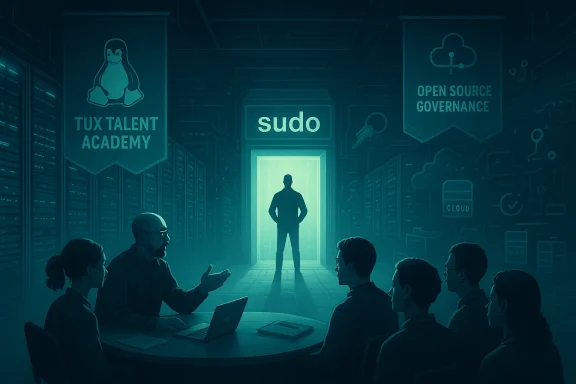 Background: sudo, its steward, and why this matters
Sudo is the command-line gatekeeper that lets ordinary accounts run commands with elevated privileges when configured to do so. It is a simple interface with outsized responsibility: controlling privileged execution and generating audit trails for administrative actions. Over the years, sudo’s C codebase and design have become a keystone of system administration practice on Linux and many BSDs.Todd C. Miller has been the visible maintainer of sudo for decades, publicly associated with the project since the early 1990s. His stewardship has spanned operating systems and generations of administrators; his stewardship has also made sudo a product of painstaking, unpaid labor interwoven with the rhythms of a life lived alongside professional work. In early 2026 he posted that he seeks a sponsor to sustain continued development and maintenance of sudo — an appeal that crystallizes the problem for many other low-level, high-impact projects: the people who keep them safe and usable are rarely funded at a scale that matches the software’s importance.
This matters because the cost of neglect is high. Privilege-management bugs are attractive to attackers, and maintenance slippage can uncover or reintroduce vulnerabilities that let local users or attackers escalate privileges. Even well-tested utilities harbor historical bugs; memory-safety issues are a recurring theme, prompting efforts to rebuild key utilities in memory-safe languages. At the same time, major Linux distributors are already experimenting with, and in some cases shipping, Rust-based replacements aimed at reducing memory-safety risk. Those transitions — helpful and sensible — are not immediate fix-alls. They introduce migration costs, compatibility issues, and their own maintenance needs.
The single-maintainer problem: why one person shouldn’t hold the keys
There are several interlocking dimensions to the risk posed by single-maintainer stewardship:- Single point of failure: When one person is the central gatekeeper for critical code, their health, employment, or life choices directly affect global users.
- Tacit knowledge and handover risk: The codebase contains institutional memory; handing that off to unknown parties is risky, especially after high-profile supply-chain compromises.
- Time and financial limits: Volunteer maintenance competes with paid work and family obligations; that limits how much defensive hardening, auditing, and proactive development a maintainer can do.
- Attractiveness of attack: Projects with limited oversight are tempting targets for sophisticated social engineering or supply-chain attacks.
The ecosystem has changed — and that amplifies the problem
When Linux and its user-space utilities were young, many projects were hobbyist efforts, created and maintained by people who treated the work as a labor of love. That was sustainable when usage was limited and the stakes were lower. Over the last three decades, Linux has gone from the scrappy fringes to the center of enterprise computing, cloud infrastructure, telecom, automotive, and consumer devices. That maturity matters because the scale of reliance has multiplied orders of magnitude while the maintenance model for many components has not.Two forces have made this situation acute:
- Scale of dependence: Linux-based systems now run critical infrastructure and billions of devices. Bugs or backdoors at the system-level can have global reach.
- Complexity of the supply chain: Modern builds depend on layers of packages; the attack surface has expanded as supply chains grew richer but less transparently governed.
What has been tried: precedents in funding and protection
The industry has learned, sometimes painfully, that reactive responses to crises work but are incomplete. After Heartbleed (the catastrophic 2014 OpenSSL bug), the Linux Foundation convened the Core Infrastructure Initiative to fund critical projects. That initiative, backed by major vendors, funded developers and audits for projects like OpenSSL and set a precedent: when the community and industry collectively recognize criticality, pooled funding and formal support can follow.Other mechanisms exist today:
- Corporate sponsorship and OSPOs: Many companies now run Open Source Program Offices (OSPOs) and sponsor work that aligns with their strategic needs. OSPOs can underwrite employee time, audits, and training.
- Foundations and pooled grants: Organizations such as the OpenSSF, Linux Foundation projects, and others coordinate funding and security work for shared components.
- Direct patronage: Platforms like GitHub Sponsors, Open Collective, and Patreon let individuals and companies fund specific maintainers. These are helpful but often insufficient for full-time work.
- Training and internship pipelines: Programs such as Google Summer of Code and Outreachy bring newcomers into open source and create mentor/mentee relationships that can lead to fuller commitment.
The Tux Talent Academy: a focused proposal
The Register’s editorial concept of a “Tux Talent Academy” offers a practical blueprint: a distributed, open, credentialing and matchmaking program that deliberately cultivates the people who will inherit and maintain core utilities. The academy would not just be a training program; it would be a cultural and institutional bridge between academia, industry, and open source communities.Key features of the proposed Tux Talent Academy (TTA):
- Distributed and hybrid governance: A lightweight constitution combining a steering board of trusted maintainers, representatives from OSPOs, academic partners, and independent security experts.
- Active scouting and mentorship: A faculty network that identifies emerging contributors with the temperament to work on sustaining infrastructure, and pairs them with veteran maintainers for long-term mentorship.
- Career-backed credentials: Graduates receive a recognized credential (not a degree) that signals to employers the candidate is ready to maintain core software reliably, and that their employers can justify allocating paid time to their stewardship.
- Employer matchmaking and time-banking: The academy would broker commitments from employers to allocate paid work time (e.g., X days per quarter) to alumni for maintenance work, backed by contracts or memorandum-of-understanding that protect the maintainer’s time.
- Security and governance training: Focused modules on secure release practices, reproducible builds, key management, code review, and exposure to supply-chain threat modeling.
- Funding and sponsorship facilitation: Acting as a clearing house for pooled corporate funds, grants, and philanthropic support — making it simpler for companies to sponsor a cohort or a project.
How TTA would complement existing programs
TTA would not replace Outreachy, GSoC, OSPOs, or the OpenSSF. Instead, it would sit alongside them and target a specific gap: converting promising contributors into sustainable, trusted maintainers of core utilities.- Outreachy and GSoC provide recruiting and early-career contribution opportunities. TTA would accept mid-career and junior developers who have already shown interest and aptitude and provide the deep, project-level mentorship required to become maintainers.
- OSPOs would be natural funding and employer partners, providing the paid time that makes maintenance work possible.
- Foundations like the OpenSSF could help validate security training and provide grant frameworks for cohort sponsorship.
Practical implementation: five pragmatic steps
- Launch a pilot cohort: Convene a small group of maintainers (including volunteers like Todd Miller) to mentor 8–12 early-career engineers on a six-month curriculum focused on a few target projects (e.g., sudo, coreutils, packaging tools).
- Secure employer time commitments: Recruit a set of founding employer partners willing to allocate part-time paid hours for alumni maintenance work, in exchange for influence on curriculum and early access to trained maintainers.
- Create a governance charter: Build a light, transparent constitution covering code-of-conduct, handover expectations, and criteria for credentialing graduates.
- Establish a pooled fund and sponsorship tiers: Offer sponsorship options from small donors to enterprise patrons; funds would directly pay stipends, audits, travel, and a small operations budget.
- Measure and iterate: Define success metrics (number of sustained maintainers, reduction in time-to-patch for security issues, employer retention of alumni) and iterate curriculum and partnerships annually.
Risks, pitfalls, and the politics of credibility
The TTA idea is attractive, but it is not a magic bullet. Several real hazards could derail it:- Capture and mission drift: Powerful sponsors might attempt to shape the curriculum and credentialing to create a funnel for corporate hiring rather than community stewardship. Governance safeguards are essential.
- Credential inflation: If employers treat TTA certification as a replacement for demonstrated contribution history, the program could be gamed. The credential must require real, tracked contributions.
- False security: Training is not equivalent to accountability. The academy must require demonstrable security practices, transparent audits, and public code review logs.
- Scaling trust: If the program scales without careful vetting, it risks creating a second class of poorly prepared maintainers. A rigorous apprenticeship model is the antidote.
- Sociocultural resistance: Open source communities sometimes resist formal institutions. TTA must be community-led in spirit and operate as an enabling institution, not a gatekeeper.
Funding models and incentives that work
A sustainable TTA needs a blend of revenue and incentives. Consider a mixed model:- Corporate sponsorships: Tiered sponsorships in exchange for advisory seats or reporting on outcomes (not direct control). OSPOs can be conveners.
- Grant funding: Seek foundation grants for initial cohorts and for security audits tied to measurable outcomes.
- Employer apprenticeship contracts: Employers sign time-bank agreements, funding alumni time in exchange for staffing guarantees.
- Donations and micro-patronage: Facilitate small donations via existing platforms to support small maintenance bounties and travel bursaries.
- Paid specialized training: Offer optional, paid training for corporate engineers (distinct from the core academy) to generate revenue while spreading best practices.
Governance, trust, and the social contract
For TTA to avoid the pitfalls that plague other initiatives, governance must be designed to preserve trust:- Community-majority steering: Ensure maintainers and independent community representatives hold a majority of seats on advisory boards.
- Transparent reporting: Publish cohort outcomes, funds allocation, and audit results to the public.
- Open curriculum and code-of-practice: Make training materials public, and require alumni to undertake public, documented handovers when assuming maintenance roles.
- Rotation and succession planning: Embed formal succession planning into maintainer onboarding so no one individual remains an unplanned single point of failure.
What success looks like
If done well, the Tux Talent Academy would deliver measurable improvements:- Faster patch turnaround for critical utilities.
- More maintainers with proven, auditable competency in security and release governance.
- Employer willingness to commit paid time and resources to maintenance work.
- Fewer emergency, ad-hoc responses to supply-chain incidents because maintainership is part of organizational planning.
- A cultural shift where core utilities are treated as funded, professional infrastructure rather than as discretionary volunteer projects.
A call for realistic solidarity
Sudo’s situation is a narrow window onto a broader landscape. The appeal from a single steward — a man who has spent decades quietly ensuring millions of systems can safely run administrative commands — should prompt a sober question: if not now, when will we treat essential open source as we treat other public goods that require sustained investment?This is not charity. It is risk management, procurement, and workforce development rolled into one: companies that depend on open source are already paying the cost when maintenance fails. It is far cheaper — and more ethical — to invest predictably in maintainers’ time and training than to scramble reactively when vulnerabilities surface or supply chains are subverted.
A practical next step: OSPOs, university CS departments, and industry foundations should convene a pilot — modest in scope, rigorous in governance — to test the academy model with a few critical projects. If that pilot demonstrates improved patch cadence, better handovers, and employer commitments to maintainers’ time, it will have done its job. If it fails, iterate. The alternative — relying on goodwill and ad-hoc donations while the rest of the world depends on your software — is untenable.
Conclusion
Open source succeeded because it harnessed the passion and talent of distributed communities. That model still works for innovation and exploration. But sustaining global critical infrastructure requires a different set of tools: predictable funding, career pathways, governance, and security practices. Todd C. Miller’s public request for sponsorship is not a plea for personal charity so much as a spotlight on this structural mismatch.The Tux Talent Academy is a practical, culturally sensitive way to bridge that gap. It would not replace existing programs; it would organize and professionalize the pipeline that turns contributors into trusted maintainers and connects them with employers who will sponsor their time. If Linux’s stewardship is to survive the retirement, burnout, or life changes of its founding generation, it will be because institutions stepped in to make maintainership a viable, respected career — not because individuals keep carrying the entire burden on their own.
A resilient Linux ecosystem will be one that recognizes the human side of code and invests accordingly. The alternative is to gamble critical systems on the hope that devotion alone can be the infrastructure of record. That gamble is one we have already seen go wrong. It’s time to design better.
Source: theregister.com Linux mid-life crisis: A Tux-led transformation chance
