

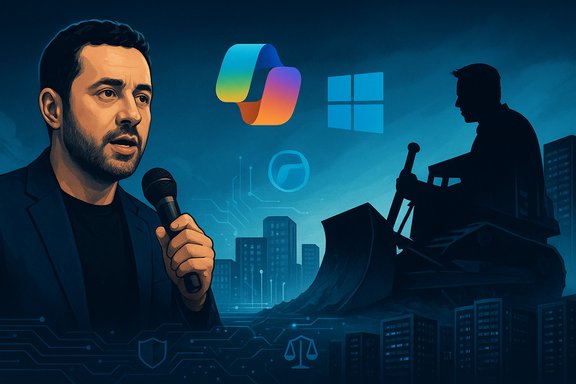
Mustafa Suleyman’s offhand praise of Elon Musk as a “bulldozer” with “superhuman capabilities to bend reality to his will” landed as more than celebrity name‑checking; it crystallized a strategic worldview from the executive now running Microsoft’s consumer AI organization — one that treats raw execution, infrastructure scale, and reputational muscle as central levers in the modern AI race.
Mustafa Suleyman’s comments were made in a wide‑ranging interview broadcast and published through Bloomberg’s Weekend/Mishal Husain program and quickly picked up and paraphrased across major outlets. In that conversation he sketched short portraits of three of AI’s best‑known leaders: Sam Altman (described as “courageous” for a massive data‑center push), Demis Hassabis (the research polymath), and Elon Musk (the “bulldozer” whose audacity and execution are uncanny). Those turns of phrase were simple but strategic: they both name-check individual capacity and implicitly map how Microsoft sees competitive dynamics in compute, governance and productization. Suleyman’s professional profile matters in this conversation. A co‑founder of DeepMind and the former leader of Inflection AI, he joined Microsoft to lead a newly consolidated consumer‑AI organization. That seat of influence — charged with shaping Copilot experiences across Windows, Office and consumer services — makes his public framing a signal as much as an appraisal.
Readers should treat the pithy praise and colorful metaphors as strategic flashing lights rather than technical blueprints. The more consequential story is not the celebrity compliment itself, but the structural contest it summarizes: who controls compute, how platform defaults are set, and whether governance will keep pace with the engineering feats that Suleyman admires. Those are the real issues that will shape Windows, Copilot, and the broader AI ecosystem in the years ahead.
Source: Windows Central https://www.windowscentral.com/arti...can-bend-reality-yes-they-actually-said-this/
 Background
Mustafa Suleyman’s comments were made in a wide‑ranging interview broadcast and published through Bloomberg’s Weekend/Mishal Husain program and quickly picked up and paraphrased across major outlets. In that conversation he sketched short portraits of three of AI’s best‑known leaders: Sam Altman (described as “courageous” for a massive data‑center push), Demis Hassabis (the research polymath), and Elon Musk (the “bulldozer” whose audacity and execution are uncanny). Those turns of phrase were simple but strategic: they both name-check individual capacity and implicitly map how Microsoft sees competitive dynamics in compute, governance and productization. Suleyman’s professional profile matters in this conversation. A co‑founder of DeepMind and the former leader of Inflection AI, he joined Microsoft to lead a newly consolidated consumer‑AI organization. That seat of influence — charged with shaping Copilot experiences across Windows, Office and consumer services — makes his public framing a signal as much as an appraisal.What Suleyman actually said — and why wording matters
The lines that ran through the headlines
When asked to describe Elon Musk in a single word, Suleyman replied “bulldozer” and then unpacked the metaphor: Musk “has superhuman capabilities to bend reality to his will” and “mostly manages to pull off what appears to be impossible,” while also having “a different kind of set of values” and being “very unfiltered.” The same interview labeled Sam Altman “courageous” for an aggressive infrastructure buildout and called Demis Hassabis “a great scientist” and a polymath. Those short portraits were widely reported and echoed across business and tech coverage.Why the metaphor is consequential
Words matter in public tech leadership. “Bulldozer” is flattering and worrying at once: it praises executional audacity while implying an actor who can reshape markets or norms without deference to slow consensus or incremental governance. In the context of AI — where computing footprint, data access and product defaults have real regulatory and social consequences — describing a peer this way is not merely admiration; it’s a framing of competitive risk and of the kind of actor Microsoft sees as both a competitor and a force that can reorder the playing field.Verification: cross‑checking the record
Multiple independent outlets carried the same direct quotation from Suleyman, attributing it to his Bloomberg interview, which establishes the central factual claim: Suleyman made the remarks and they were publicly reported. Fortune, Benzinga and other mainstream outlets ran consistent excerpts of the same phrasing, while the original audio/podcast rollout tied to Bloomberg provides the interview context. That cross‑coverage confirms the quote’s provenance. Where reporting gets messy — and where careful verification matters — is in the background statistics and ancillary claims that often get appended to these human portraits. For example, multiple tech outlets have used Suleyman’s comments as a springboard to restate widely reported figures about OpenAI’s revenue trajectory and its capital‑intensive infrastructure plans. Reporting from CNBC, Reuters and The Information converges around an OpenAI annual revenue run‑rate in the low‑double‑digit billions for 2025, with firms citing $10–$13 billion ARR depending on timing and the metric used. Those revenue figures have independent corroboration in multiple disclosures and reporting cycles. By contrast, one number that circulated in secondary coverage — an assertion that OpenAI “spends up to $1.4 billion on computing” — does not line up with the broader public record and appears to be a likely misinterpretation or misplacement of another financial fact. Microsoft’s SEC and earnings disclosures do reveal that Microsoft has deployed very large sums toward OpenAI and that a remaining commitment figure of roughly $1.4 billion shows up in some financial summaries, but that $1.4 billion is an accounting/commitment remainder in Microsoft’s funding of OpenAI — not an annual compute bill for OpenAI’s operations. Independent reporting and industry analysis indicate OpenAI’s compute commitments and projected infrastructure spending run into the tens of billions and, by some estimates and long‑range plans, into the many hundreds of billions or trillions over a multi‑year horizon. Where public filings and reputable outlets diverge or use different conventions, the prudent reader should treat any single intermediate figure (like a $1.4B compute claim) as likely misattributed unless traced to a primary disclosure.The strategic context: infrastructure, partnerships, and the "compute race"
Compute as leverage
Suleyman’s praise for Altman’s data‑center expansion and his characterization of Musk as an executional force point to a simple industry truth: compute capacity equals strategic optionality. Companies that secure hyperscale GPU and accelerator capacity — as well as the power, networking and physical real‑estate that go with it — can train larger models, iterate faster, offer lower‑latency services and negotiate from a position of strength in commercial and geopolitical deals. Microsoft’s own posture is to both partner (notably with OpenAI historically) and to build self‑sufficient capacity where necessary. Sullivan’s commentary read as a public recognition of this reality.Partnerships, diversification, and the cost of scale
OpenAI’s public and reported private commitments to multiple hardware and infrastructure partners show a strategic pivot from single‑vendor dependency to diversification — an approach the industry broadly favors when an outcome is as capital‑intensive and supply‑chain sensitive as modern AI. These moves create a new kind of vendor relationship where cloud suppliers, silicon firms and data‑center operators exchange multi‑year contracts and bespoke hardware for guaranteed demand; the economics of that exchange are central to competitive dynamics. Suleyman’s remarks implicitly recognize the same variable set: leadership, capital, and the ability to marshal operational muscle at scale.What this means for Microsoft, Windows and Copilot
Perception and product posture
Suleyman sits at the intersection of product evangelism and safety governance inside Microsoft. His framing — celebrate engineering audacity, but insist on governance — maps directly onto Microsoft’s product posture for Windows and Copilot: ship useful, auditable features that scale, but do so with safety defaults, explicit user controls, and accountability surfaces. The public friction around messaging such as “Windows is evolving into an agentic OS” shows how sensitive the conversation is, and Suleyman’s tone both defends and escalates the debate.Practical implications for Windows users and IT
- Microsoft will continue integrating Copilot across Windows and Microsoft 365, raising stakes for enterprise governance and update planning.
- Expect greater emphasis on opt‑in persona and memory controls, on‑device inference for privacy‑sensitive workloads, and a Copilot+ hardware tier that targets richer local inference through NPUs.
- Enterprises and IT teams should insist on SLAs, model lineage disclosure, audit logs, and predictable rollback semantics before deploying agentic features at scale.
The reputational upside and governance risk of celebrating "bulldozers"
Upside: catalytic progress
Actors described as “bulldozers” can accelerate technology adoption. They take moonshots, invest through uncertainty, and create new market categories (automotive electrification, reusable rockets, and mass adoption of generative AI are cited examples). Recognizing their capability is pragmatic: they change what is possible and create downstream opportunities for ecosystems and partners who can interoperate or adopt quickly. Suleyman’s compliment was accurate in that sense: bold execution changes industry trajectories.Downside: governance, norm erosion and externalities
Admiring bulldozer‑style actors without anchoring the praise to robust governance invites three risks:- Norm erosion: rapid execution can outpace regulatory and safety guardrails, leaving product defaults, data‑handling norms, and harm‑mitigation practices underdeveloped.
- Externalities overlooked: when a company controls enormous compute and distribution channels, market power can entrench and create systemic dependencies that are costly to unwind.
- Cultural mismatch: public alignment with the “get it done” style risks alienating stakeholders who prioritize transparency, auditability and careful change management — especially enterprise IT and regulators.
Clearing up numbers: revenue and spending — nuance over soundbites
Multiple reputable outlets report OpenAI’s 2025 annualized revenue in the range of $10–$13 billion, driven by subscriptions, enterprise products and API monetization. Those figures come from company disclosures and financial reporting covered by CNBC, Reuters and The Information. At the same time, OpenAI’s capital commitments for infrastructure are vast and long‑running; public estimates and analyst work suggest multi‑decade infrastructure costs that dwarf any single‑year compute bill and may run into the tens or hundreds of billions depending on scope and timeframe. Treat single‑figure claims about “compute spending” with caution unless they are anchored to primary financial statements or direct vendor contract disclosures. The $1.4 billion figure that appears in some re‑reported writeups is likely a conflation or misplacement of a different Microsoft/OpenAI commitment number rather than a standalone annual compute bill at scale.How reporters and readers should handle executive soundbites
- Verify the primary source: listen to or read the original interview transcript where possible.
- Distinguish metaphor from metric: “superhuman” and “bulldozer” are evaluative metaphors; treat them as framing rather than hard claims.
- Trace numbers to primary documents: financial and compute commitments are often complex (multi‑vendor, multi‑year) and can be mis‑summarized in secondary coverage.
- Watch for strategic signaling: an exec’s phrasing can telegraph corporate intent (e.g., race for compute, preference for regulations, appetite for partnerships).
Practical takeaways for WindowsForum readers
- Expect Microsoft to keep pursuing an AI‑first Windows experience that will emphasize integrated Copilot features and a clearer Copilot+ hardware tier. Validate any agentic or persistent assistant features in a test profile before rolling them out for end users.
- Enterprises should demand reproducible performance benchmarks and attestation for on‑device NPU claims (advertised TOPS metrics are not the same as real‑world Copilot throughput). Require audit logs and role‑based controls for agents that can access corporate systems.
- Individual users and enthusiasts should press vendors for clear defaults: opt‑in memory, visible provenance for generated content, and easy toggles to restore a classic, non‑agentic desktop experience.
Risks that deserve public attention
- Systemic dependency: concentrated compute and vendor relationships create single‑points of failure with macroeconomic implications.
- Regulatory lag: speed of deployment can exceed the ability of policymakers to set practical, enforceable rules; public‑interest guardrails need acceleration.
- Misplaced hero worship: elevating “execution” without parallel emphasis on transparency and auditability risks normalizing shortcuts that later produce social harms.
Conclusion
The headlines about Mustafa Suleyman calling Elon Musk a “bulldozer” are accurate and reflect more than personal opinion; they reveal how a leading corporate AI executive conceptualizes power and risk in the industry today. That framing—celebrating audacity while simultaneously arguing for governance—captures Microsoft’s current posture: compete on infrastructure and product, but do so with an explicit commitment to safety, auditability and regulation.Readers should treat the pithy praise and colorful metaphors as strategic flashing lights rather than technical blueprints. The more consequential story is not the celebrity compliment itself, but the structural contest it summarizes: who controls compute, how platform defaults are set, and whether governance will keep pace with the engineering feats that Suleyman admires. Those are the real issues that will shape Windows, Copilot, and the broader AI ecosystem in the years ahead.
Source: Windows Central https://www.windowscentral.com/arti...can-bend-reality-yes-they-actually-said-this/
