
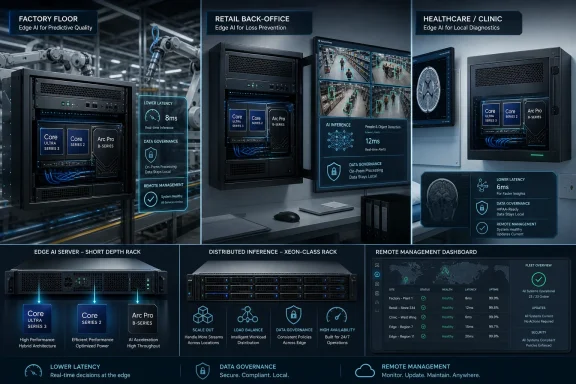
Supermicro announced on June 23, 2026, that it is expanding its edge AI systems portfolio with Intel-powered platforms using Core Ultra Series 3 processors, Core Series 2 processors, Arc Pro B-series GPUs, and Xeon-class systems for distributed inference workloads. The announcement is not just another server-vendor product refresh. It is a signal that the AI hardware race is moving away from a single obsession with hyperscale GPU racks and toward the messier places where Windows shops, factories, stores, clinics, campuses, and telecom rooms actually run infrastructure. The edge is becoming the next battleground because latency, bandwidth, privacy, and control all get worse when every decision has to make a round trip to a cloud region.
The last two years of AI infrastructure news have been dominated by giant clusters, liquid cooling, scarce accelerators, and trillion-parameter model economics. Supermicro has been a beneficiary of that boom, especially as enterprises and cloud providers rushed to turn AI demand into physical systems. But the company’s Intel edge expansion points to a more pragmatic phase: the deployment problem after the demo.
The pitch is straightforward. If AI is going to inspect products on a factory line, summarize camera feeds in a retail location, triage medical images near the point of care, or coordinate robotics in a warehouse, it cannot always depend on a cloud endpoint. Some decisions need to happen close to the sensor, close to the user, and close to the failure domain.
That is where Supermicro’s announcement matters. Edge AI is not a single box category; it is a spectrum that runs from compact embedded systems to short-depth rackmount servers to ruggedized nodes with discrete GPU options. Supermicro is trying to make that spectrum feel less bespoke and more like a catalog that IT buyers can standardize around.
For WindowsForum readers, the important part is not the marketing phrase AI at the edge. It is the fact that the hardware stack is starting to look like something administrators already understand: x86 CPUs, integrated NPUs, discrete GPUs when needed, remote manageability, rack compatibility, and familiar operating environments.
That matters at the edge. A branch office, hospital closet, municipal traffic cabinet, or manufacturing cell does not necessarily need an eight-GPU monster. It may need a compact machine that can run inference, ingest video, handle networking, enforce security policies, and keep working without a team of accelerator specialists nearby.
The inclusion of Core Ultra Series 3 processors and Core Series 2 processors suggests Supermicro is aiming below the classic server tier as well as above it. These are not just miniature data-center machines; they are systems designed for environments where power, thermals, footprint, and maintenance windows are part of the buying decision.
Intel’s integrated AI accelerators also change the economics for smaller deployments. An NPU will not replace a powerful discrete GPU for every inference workload, but it can offload smaller models and background AI tasks without turning every edge node into a power-hungry workstation. For many IT departments, that difference is the line between a pilot and a fleet rollout.
Arc Pro gives Supermicro another rung on the ladder. That is strategically useful because edge AI buying rarely happens in one clean step. Customers may begin with CPU-only inference, move to NPU-assisted workloads, and then discover that video analytics, computer vision, or local model serving requires more parallel compute.
The risk is software maturity. Nvidia’s CUDA ecosystem remains a gravitational force, and many AI developers still assume Nvidia first unless told otherwise. Intel has been working hard on open tooling, drivers, and framework support, but in the field, “supported” and “pleasant to operate at scale” are not always the same thing.
That makes Supermicro’s job more than mechanical integration. It has to give customers confidence that Intel-based edge AI systems are not science projects. The hardware announcement is only the front door; the real test will be deployment recipes, validated workloads, driver stability, and lifecycle support.
Video streams, machine telemetry, patient information, point-of-sale data, and industrial signals can be expensive or legally complicated to ship into centralized infrastructure. Even when the cloud is allowed, it may not be desirable. Local inference lets organizations filter, summarize, classify, and act without turning every camera and sensor into a permanent upstream data pipe.
This is where edge AI overlaps with security and compliance in ways that traditional server refreshes do not. An edge node is not merely compute; it is a policy enforcement point. It decides what data is retained, what is discarded, what is anonymized, and what is escalated.
For administrators, that cuts both ways. Local AI can reduce exposure by keeping sensitive data nearby, but it also creates more endpoints that need patching, monitoring, physical security, and identity integration. The edge shrinks the distance between data and decision, but it expands the surface area of the infrastructure estate.
Edge deployments are messy. One customer needs short-depth rackmount systems for a telecom closet. Another needs rugged systems with wide temperature tolerance. A retailer may care about camera ingestion and low noise. A manufacturer may care about PCIe expansion, serial connectivity, and predictable replacement parts.
The company’s Data Center Building Block Solutions branding can sound like corporate wallpaper, but the underlying idea is practical. Supermicro wants to mix boards, chassis, cooling, accelerators, networking, and management features quickly enough to track silicon roadmaps without waiting years for a vertically integrated appliance cycle.
That speed is valuable in AI because the workload target keeps moving. Models are shrinking, quantization is improving, multimodal inference is spreading, and customers are still discovering what should run locally. A rigid hardware portfolio would age badly in that environment.
Windows-centric environments should pay attention because many edge use cases sit beside Microsoft infrastructure even when the AI stack itself is mixed. Endpoint management, identity, logging, compliance reporting, and application integration often flow through Microsoft tools. The hardware may be sold as edge AI, but it will live in the same operational universe as Windows Server, Azure Arc, Intune-managed endpoints, Active Directory, Entra ID, Defender, and familiar monitoring platforms.
That does not mean every Supermicro edge AI system will run Windows, nor should it. Many AI and computer-vision workloads are still Linux-first. But the buying committee and the operations team will often be the same people who manage Windows fleets, and they will demand the same things they expect elsewhere: predictable updates, remote access, inventory visibility, and a clean support path when something breaks at 2 a.m.
The lesson is simple. Edge AI cannot be treated as a developer toy once it reaches production. It becomes infrastructure, and infrastructure eventually lands on the desk of sysadmins.
Supermicro’s expanded Intel portfolio gives customers more compute choices, but compute choice is not the same as operational readiness. A ten-site pilot can be managed by heroic effort. A thousand-site deployment cannot.
This is where IT teams should be skeptical in a productive way. Ask whether the system can be managed remotely using existing tooling. Ask how firmware updates are handled. Ask whether the AI software stack is validated on the exact hardware configuration being purchased. Ask what happens when an NPU driver, GPU runtime, OS patch, and model update collide.
The edge is unforgiving because the physical environment is often outside the comfort zone of the data center. Systems may sit in dusty rooms, shallow racks, retail back offices, roadside cabinets, or factory floors. The best AI model in the world is not useful if the node running it is unreachable, unpatched, or thermally throttled into irrelevance.
A local AI agent that can adjust industrial equipment, reroute logistics, flag security incidents, or prioritize network traffic could reduce latency and make systems more responsive. But the closer an AI system gets to the physical world, the less tolerance there is for vague behavior. A chatbot can be wrong and annoying; an edge agent tied to operational technology can be wrong and expensive.
That is why hardware announcements need to be matched by governance architecture. Local inference should not mean local anarchy. Enterprises will need audit trails, policy boundaries, human approval paths, rollback mechanisms, and clear separation between recommendation and actuation.
Intel’s CPU-centered pitch may help here because edge AI systems are rarely pure accelerator workloads. They need orchestration, networking, security, and traditional application logic. In that sense, the CPU remains the control plane even when specialized accelerators do the math.
This is not vendor indecision; it is the shape of demand. Training clusters, enterprise inference racks, telecom edge nodes, branch-office appliances, and developer workstations are all being pulled into the AI story, but they do not need the same silicon. A company that can assemble around multiple roadmaps has a better chance of meeting buyers where they are.
For Intel, that creates an opening even in a market where Nvidia remains the AI accelerator default. Intel does not have to win every high-end model-training deal to matter. It needs to make AI a native capability of the enterprise compute base, especially in places where a discrete GPU is optional rather than mandatory.
For Supermicro, the opportunity is to become the integrator of that complexity. Customers do not want to assemble edge AI systems from scattered parts and hope the drivers behave. They want hardware configurations that are boring in the best enterprise sense: documented, repeatable, serviceable, and available.
That is a healthier phase than the early AI boom, when the answer to every infrastructure question seemed to be “buy more GPUs.” GPUs still matter enormously, and they will continue to dominate high-end AI compute. But enterprise AI will not be one giant cluster any more than enterprise computing became one giant mainframe again after virtualization took off.
The industry is rediscovering locality. Data has gravity. Latency has consequences. Regulations have borders. Physical operations have failure modes. Edge AI exists because centralized intelligence is not always enough.
The open question is whether vendors can make this complexity manageable. Supermicro can ship varied hardware quickly, and Intel can offer a familiar platform story, but customers still need integrated software, manageability, and security practices that scale beyond pilots.
Supermicro’s Intel expansion is a step toward that boring future. It gives buyers more ways to match compute to workload without immediately jumping to expensive accelerator-heavy systems. It also reinforces the idea that AI infrastructure can be built from familiar enterprise primitives rather than exotic one-off appliances.
Still, the industry should resist pretending that hardware variety alone solves the edge problem. If anything, variety increases the need for discipline. Every new CPU generation, NPU block, GPU option, and chassis format is another variable that has to be tested, secured, and supported.
That is where WindowsForum’s audience should keep its eye. The story is not just that Supermicro has more Intel-powered edge systems. The story is that AI is moving into the operational layer where sysadmins, security engineers, and infrastructure architects will decide whether the technology becomes durable or just another expensive pilot.
 Supermicro Is Selling the Edge as the Place AI Becomes Operational
The last two years of AI infrastructure news have been dominated by giant clusters, liquid cooling, scarce accelerators, and trillion-parameter model economics. Supermicro has been a beneficiary of that boom, especially as enterprises and cloud providers rushed to turn AI demand into physical systems. But the company’s Intel edge expansion points to a more pragmatic phase: the deployment problem after the demo.The pitch is straightforward. If AI is going to inspect products on a factory line, summarize camera feeds in a retail location, triage medical images near the point of care, or coordinate robotics in a warehouse, it cannot always depend on a cloud endpoint. Some decisions need to happen close to the sensor, close to the user, and close to the failure domain.
That is where Supermicro’s announcement matters. Edge AI is not a single box category; it is a spectrum that runs from compact embedded systems to short-depth rackmount servers to ruggedized nodes with discrete GPU options. Supermicro is trying to make that spectrum feel less bespoke and more like a catalog that IT buyers can standardize around.
For WindowsForum readers, the important part is not the marketing phrase AI at the edge. It is the fact that the hardware stack is starting to look like something administrators already understand: x86 CPUs, integrated NPUs, discrete GPUs when needed, remote manageability, rack compatibility, and familiar operating environments.
Intel’s Role Is Less Flashy Than Nvidia’s, but More Native to the Enterprise
Intel is not the company most people associate with the current AI hardware gold rush. Nvidia owns the high-end training conversation, and AMD has become a credible challenger in large accelerator deployments. Intel’s opening is different: it wants to make AI execution look like an extension of the CPU-centered enterprise platform rather than a completely new island of infrastructure.That matters at the edge. A branch office, hospital closet, municipal traffic cabinet, or manufacturing cell does not necessarily need an eight-GPU monster. It may need a compact machine that can run inference, ingest video, handle networking, enforce security policies, and keep working without a team of accelerator specialists nearby.
The inclusion of Core Ultra Series 3 processors and Core Series 2 processors suggests Supermicro is aiming below the classic server tier as well as above it. These are not just miniature data-center machines; they are systems designed for environments where power, thermals, footprint, and maintenance windows are part of the buying decision.
Intel’s integrated AI accelerators also change the economics for smaller deployments. An NPU will not replace a powerful discrete GPU for every inference workload, but it can offload smaller models and background AI tasks without turning every edge node into a power-hungry workstation. For many IT departments, that difference is the line between a pilot and a fleet rollout.
Arc Pro Gives Supermicro a Midrange AI Lever
The addition of Intel Arc Pro B-series GPU support is the most interesting part of the announcement because it fills the awkward middle of the edge AI market. Integrated AI is useful, but some workloads still need discrete graphics and accelerator resources. A full data-center GPU, meanwhile, can be too expensive, too hot, or simply too much hardware for the job.Arc Pro gives Supermicro another rung on the ladder. That is strategically useful because edge AI buying rarely happens in one clean step. Customers may begin with CPU-only inference, move to NPU-assisted workloads, and then discover that video analytics, computer vision, or local model serving requires more parallel compute.
The risk is software maturity. Nvidia’s CUDA ecosystem remains a gravitational force, and many AI developers still assume Nvidia first unless told otherwise. Intel has been working hard on open tooling, drivers, and framework support, but in the field, “supported” and “pleasant to operate at scale” are not always the same thing.
That makes Supermicro’s job more than mechanical integration. It has to give customers confidence that Intel-based edge AI systems are not science projects. The hardware announcement is only the front door; the real test will be deployment recipes, validated workloads, driver stability, and lifecycle support.
The Edge AI Pitch Is Really a Data-Governance Pitch
The public AI conversation tends to treat edge deployment as a latency story. That is true, but incomplete. The more durable reason enterprises care about edge AI is that moving raw data is often harder than processing it locally.Video streams, machine telemetry, patient information, point-of-sale data, and industrial signals can be expensive or legally complicated to ship into centralized infrastructure. Even when the cloud is allowed, it may not be desirable. Local inference lets organizations filter, summarize, classify, and act without turning every camera and sensor into a permanent upstream data pipe.
This is where edge AI overlaps with security and compliance in ways that traditional server refreshes do not. An edge node is not merely compute; it is a policy enforcement point. It decides what data is retained, what is discarded, what is anonymized, and what is escalated.
For administrators, that cuts both ways. Local AI can reduce exposure by keeping sensitive data nearby, but it also creates more endpoints that need patching, monitoring, physical security, and identity integration. The edge shrinks the distance between data and decision, but it expands the surface area of the infrastructure estate.
Supermicro’s Building-Block Model Fits the Messiness of the Edge
Supermicro’s long-running advantage has been its willingness to build many variations of a system rather than force the market into a small number of polished SKUs. That approach can look inelegant compared with vendors that sell tightly packaged platforms. At the edge, inelegance can be an advantage.Edge deployments are messy. One customer needs short-depth rackmount systems for a telecom closet. Another needs rugged systems with wide temperature tolerance. A retailer may care about camera ingestion and low noise. A manufacturer may care about PCIe expansion, serial connectivity, and predictable replacement parts.
The company’s Data Center Building Block Solutions branding can sound like corporate wallpaper, but the underlying idea is practical. Supermicro wants to mix boards, chassis, cooling, accelerators, networking, and management features quickly enough to track silicon roadmaps without waiting years for a vertically integrated appliance cycle.
That speed is valuable in AI because the workload target keeps moving. Models are shrinking, quantization is improving, multimodal inference is spreading, and customers are still discovering what should run locally. A rigid hardware portfolio would age badly in that environment.
Windows Shops Should Read This as an Infrastructure Signal, Not a Stock Blurb
The Investing.com framing naturally places the announcement in a market-news context, and Supermicro’s revenue growth has made the company a closely watched AI infrastructure name. But for IT professionals, the more useful reading is operational rather than financial. This is another sign that AI hardware is becoming a standard procurement category, not a one-off executive experiment.Windows-centric environments should pay attention because many edge use cases sit beside Microsoft infrastructure even when the AI stack itself is mixed. Endpoint management, identity, logging, compliance reporting, and application integration often flow through Microsoft tools. The hardware may be sold as edge AI, but it will live in the same operational universe as Windows Server, Azure Arc, Intune-managed endpoints, Active Directory, Entra ID, Defender, and familiar monitoring platforms.
That does not mean every Supermicro edge AI system will run Windows, nor should it. Many AI and computer-vision workloads are still Linux-first. But the buying committee and the operations team will often be the same people who manage Windows fleets, and they will demand the same things they expect elsewhere: predictable updates, remote access, inventory visibility, and a clean support path when something breaks at 2 a.m.
The lesson is simple. Edge AI cannot be treated as a developer toy once it reaches production. It becomes infrastructure, and infrastructure eventually lands on the desk of sysadmins.
The Practical Barrier Is Not Compute; It Is Fleet Management
The hardware industry likes to talk about TOPS, cores, memory bandwidth, and GPU options because those are easy to compare. Edge AI rollouts fail for less glamorous reasons. They fail because no one knows who owns the box, how it gets updated, where logs go, how models are versioned, and what happens when a deployment loses connectivity.Supermicro’s expanded Intel portfolio gives customers more compute choices, but compute choice is not the same as operational readiness. A ten-site pilot can be managed by heroic effort. A thousand-site deployment cannot.
This is where IT teams should be skeptical in a productive way. Ask whether the system can be managed remotely using existing tooling. Ask how firmware updates are handled. Ask whether the AI software stack is validated on the exact hardware configuration being purchased. Ask what happens when an NPU driver, GPU runtime, OS patch, and model update collide.
The edge is unforgiving because the physical environment is often outside the comfort zone of the data center. Systems may sit in dusty rooms, shallow racks, retail back offices, roadside cabinets, or factory floors. The best AI model in the world is not useful if the node running it is unreachable, unpatched, or thermally throttled into irrelevance.
Agentic AI Makes the Edge More Tempting—and More Dangerous
Supermicro and Intel are both leaning into the industry’s current favorite phrase: agentic AI. The idea is that AI systems will not merely classify inputs but take actions, call tools, coordinate workflows, and make decisions across distributed environments. At the edge, that vision is both powerful and risky.A local AI agent that can adjust industrial equipment, reroute logistics, flag security incidents, or prioritize network traffic could reduce latency and make systems more responsive. But the closer an AI system gets to the physical world, the less tolerance there is for vague behavior. A chatbot can be wrong and annoying; an edge agent tied to operational technology can be wrong and expensive.
That is why hardware announcements need to be matched by governance architecture. Local inference should not mean local anarchy. Enterprises will need audit trails, policy boundaries, human approval paths, rollback mechanisms, and clear separation between recommendation and actuation.
Intel’s CPU-centered pitch may help here because edge AI systems are rarely pure accelerator workloads. They need orchestration, networking, security, and traditional application logic. In that sense, the CPU remains the control plane even when specialized accelerators do the math.
Supermicro’s Intel Expansion Also Shows the AI Market Is Fragmenting
The AI infrastructure market is not converging on one perfect system. It is fragmenting by workload, location, budget, power envelope, and data sensitivity. Supermicro’s recent activity across Intel, AMD, Arm, and Nvidia ecosystems reflects that fragmentation.This is not vendor indecision; it is the shape of demand. Training clusters, enterprise inference racks, telecom edge nodes, branch-office appliances, and developer workstations are all being pulled into the AI story, but they do not need the same silicon. A company that can assemble around multiple roadmaps has a better chance of meeting buyers where they are.
For Intel, that creates an opening even in a market where Nvidia remains the AI accelerator default. Intel does not have to win every high-end model-training deal to matter. It needs to make AI a native capability of the enterprise compute base, especially in places where a discrete GPU is optional rather than mandatory.
For Supermicro, the opportunity is to become the integrator of that complexity. Customers do not want to assemble edge AI systems from scattered parts and hope the drivers behave. They want hardware configurations that are boring in the best enterprise sense: documented, repeatable, serviceable, and available.
The Webinar Date Matters Less Than the Direction of Travel
Supermicro and Intel plan to discuss the expanded portfolio in a joint webinar on June 25, but the announcement already tells us where the companies think the market is heading. Edge AI is moving from slideware to product segmentation. The number of SKUs, chassis types, and accelerator options is growing because customers are starting to ask for deployment-specific answers.That is a healthier phase than the early AI boom, when the answer to every infrastructure question seemed to be “buy more GPUs.” GPUs still matter enormously, and they will continue to dominate high-end AI compute. But enterprise AI will not be one giant cluster any more than enterprise computing became one giant mainframe again after virtualization took off.
The industry is rediscovering locality. Data has gravity. Latency has consequences. Regulations have borders. Physical operations have failure modes. Edge AI exists because centralized intelligence is not always enough.
The open question is whether vendors can make this complexity manageable. Supermicro can ship varied hardware quickly, and Intel can offer a familiar platform story, but customers still need integrated software, manageability, and security practices that scale beyond pilots.
The Real Winners Will Make Edge AI Boring
The most successful edge AI platforms will not be the ones that sound most futuristic. They will be the ones that disappear into normal operations. That means administrators can patch them, security teams can audit them, developers can deploy models to them, and finance teams can understand why they are cheaper than hauling every byte back to a cloud region.Supermicro’s Intel expansion is a step toward that boring future. It gives buyers more ways to match compute to workload without immediately jumping to expensive accelerator-heavy systems. It also reinforces the idea that AI infrastructure can be built from familiar enterprise primitives rather than exotic one-off appliances.
Still, the industry should resist pretending that hardware variety alone solves the edge problem. If anything, variety increases the need for discipline. Every new CPU generation, NPU block, GPU option, and chassis format is another variable that has to be tested, secured, and supported.
That is where WindowsForum’s audience should keep its eye. The story is not just that Supermicro has more Intel-powered edge systems. The story is that AI is moving into the operational layer where sysadmins, security engineers, and infrastructure architects will decide whether the technology becomes durable or just another expensive pilot.
The Edge AI Checklist Gets Shorter but Sharper
Supermicro’s announcement gives IT buyers more credible hardware paths, but it also narrows the questions that matter. The market is past the point where “does it run AI?” is a sufficient evaluation. The better question is whether it can run the right AI workload, in the right place, with the right controls, for long enough to justify becoming part of the production estate.- Supermicro’s June 23 expansion adds Intel Core Ultra Series 3, Core Series 2, Arc Pro B-series GPU, and broader Intel-powered edge options to its AI portfolio.
- The announcement reflects a shift from centralized AI experimentation toward distributed inference in factories, branches, telecom sites, retail locations, and other real-world environments.
- Intel’s advantage at the edge is familiarity, platform integration, and CPU-centered orchestration rather than raw dominance in high-end AI training.
- Arc Pro support gives Supermicro a middle tier between integrated NPUs and heavier discrete accelerator deployments.
- IT teams should evaluate manageability, patching, model lifecycle, physical environment, and security controls before treating edge AI hardware as production-ready.
- The most important edge AI deployments will be the ones that make local inference operationally boring, not the ones with the loudest performance claims.
References
- Primary source: investing.com
Published: Tue, 23 Jun 2026 13:50:57 GMT
Loading…
www.investing.com - Related coverage: newsroom.intel.com
Loading…
newsroom.intel.com - Related coverage: ir.supermicro.com
Loading…
ir.supermicro.com - Related coverage: za.investing.com
Loading…
za.investing.com - Related coverage: supermicro.com
Loading…
www.supermicro.com - Related coverage: stocktitan.net
Loading…
www.stocktitan.net
- Related coverage: prnewswire.com
Loading…
www.prnewswire.com - Related coverage: techradar.com
Intel expands Xeon 6 lineup with 288-core Clearwater Forest Xeon 6+ targeting AI workloads in 5G networks | TechRadar
288-core design targets efficiency gains across telecom and data centerswww.techradar.com - Related coverage: tomshardware.com
Intel Xeon 6+ ‘Clearwater Forest’ puts 18A in the data center with up to 288 cores, 576 MB of L3 cache — new Xeon 6990E+ is 30% faster per thread than 192-core AMD Epyc 9965, says Intel | Tom's Hardware
Intel’s dense Xeon 6+ design marks the first time 18A is being deployed in the data center.www.tomshardware.com - Related coverage: builders.intel.com
Loading…
builders.intel.com - Related coverage: intel.co.id
Loading…
www.intel.co.id