
Microsoft announced new Surface Laptop 8 and Surface Pro 12 models on June 16, 2026, through a device blog post and press briefings rather than a public launch event, extending a year in which six Surface PCs arrived in fragmented announcements. The hardware itself looks unusually ambitious. The way Microsoft introduced it made the lineup feel smaller than it is.
That disconnect matters because Surface has never been just another Windows PC brand. It has been Microsoft’s argument about what Windows hardware should become next. In 2026, that argument is finally interesting again — Arm laptops, AI workstations, privacy-focused business machines, and a new mini PC — but Microsoft has chosen to deliver it with the emotional force of a procurement notice.
The strange thing about Microsoft’s 2026 Surface rollout is not that the company skipped a keynote. Companies skip keynotes all the time when the products are dull, the roadmap is messy, or the news is too thin to justify stage lighting. The strange thing is that this year’s Surface hardware is not thin.
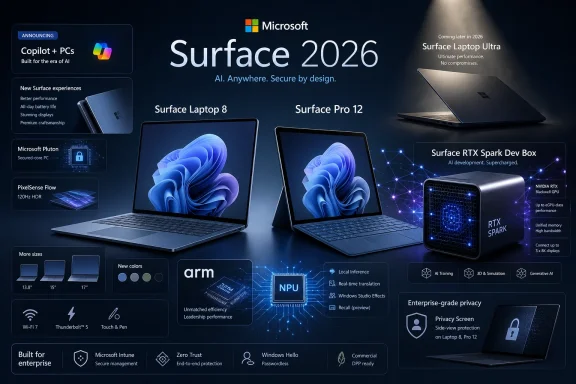
By the middle of June, Microsoft had announced a broad refresh spanning mainstream laptops, detachable tablets, business-focused Intel machines, consumer Snapdragon models, a high-end Surface Laptop Ultra, and a Surface RTX Spark Dev Box. That is not a quiet maintenance year. That is the kind of portfolio reset that, in earlier Surface eras, would have been framed as a manifesto.
Instead, the announcements arrived in fragments: a business refresh here, a Computex-timed workstation reveal there, a consumer Snapdragon update later. Each individual disclosure made sense in isolation. Together, they produced the impression that Microsoft had forgotten the difference between launching products and merely making them available.
Surface used to understand theater. The original Surface was not introduced as a spec sheet; it was introduced as Microsoft’s first serious attempt to challenge the PC industry from inside the PC industry. The kickstand, the keyboard cover, the magnesium shell, and the Panos Panay cadence were all part of the pitch. The hardware mattered because the story made clear why the hardware existed.
In 2026, Microsoft has hardware that deserves a story again. It just has not told one.
That would be survivable if the launch narrative did the sorting for buyers. It did not. The result is a lineup that may be strategically coherent inside Microsoft but lands publicly as a spreadsheet of SKUs.
The confusion is especially unfortunate because the underlying segmentation is not irrational. Intel-based Surface Pro and Surface Laptop models give enterprises a familiar compatibility and management path. Snapdragon X2 models advance Microsoft’s Windows-on-Arm ambitions for consumers and mobile professionals. Surface Laptop Ultra and Surface RTX Spark Dev Box aim at developers and creators who need local AI horsepower rather than just cloud prompts and Copilot demos.
Those distinctions are meaningful. They also require explanation. Microsoft cannot spend years telling the market that AI PCs, NPUs, Arm efficiency, local inference, enterprise security, and premium industrial design are transformative, then assume buyers will assemble the product logic from disconnected launch posts.
The old Surface events, for all their occasional excess, gave Microsoft a chance to impose order on complexity. They explained why a detachable mattered, why a hinge mattered, why a new chip mattered, or why a slightly odd device category deserved to exist. A press release can announce a machine. It rarely teaches people how to think about it.
That is not a minor repositioning. Surface has long lived in premium territory, but premium pricing depends on a buyer understanding the premium. If the launch message is scattered, the price increase becomes the story before the product can make its case.
The Surface Pro problem is especially old and especially stubborn. For years, Microsoft sold the idea of a tablet that could replace a laptop while often pricing the keyboard as an accessory rather than as part of the core experience. Including a keyboard with Surface Pro 12 orders, even for a limited window, is a tacit admission that the market has always treated the keyboard as essential.
That move is welcome, but it also exposes the awkwardness of the pricing strategy. If a Surface Pro is effectively incomplete without a keyboard, then the honest price of the computer is the tablet plus the keyboard. If Microsoft now bundles one to ease the transition to higher prices, it is solving a perception problem partly of its own making.
A keynote would not magically make expensive computers cheap. But it would give Microsoft a place to argue for the cost. Better displays, faster chips, improved haptics, stronger cameras, longer battery life, AI compute, privacy hardware, and premium materials all sound better when woven into a product thesis than when scattered across launch copy.
That is why this year’s quiet rollout feels like a missed opportunity. The PC market is in one of its most interesting transitions in a decade. Arm-based Windows machines are no longer a novelty. Local AI acceleration is becoming a purchasing argument. Enterprise buyers are being asked to care about privacy screens, neural processors, battery life under sustained workloads, and whether x86 compatibility is still the default assumption for every employee.
Surface is the obvious vehicle for Microsoft to make that transition legible. It can say, “Here is what an Arm-first Windows laptop looks like.” It can say, “Here is what a mobile AI workstation looks like when Microsoft and NVIDIA build around Windows.” It can say, “Here is how business PCs evolve when cameras, displays, privacy, and manageability matter as much as CPU generation.”
Instead, Microsoft appears to have ceded much of the storytelling to OEM partners, chip vendors, and the tech press. That may be efficient. It is not leadership.
The irony is that the hardware partners are exactly why Microsoft should have made more noise. Qualcomm’s Snapdragon X2 chips, Intel’s latest Core Ultra parts, and NVIDIA’s RTX Spark effort each point toward a different future for Windows PCs. Surface could have been the stage where Microsoft reconciled those futures into a single Windows narrative.
Without that stage, the portfolio looks less like a strategy and more like parallel experiments.
That is a big conceptual shift. Windows on Arm has spent years fighting the perception that it is the compatibility-compromised, performance-constrained cousin of “real” Windows laptops. The Snapdragon X era improved the conversation, but it still largely framed Arm around efficiency, standby time, and Copilot+ features.
Surface Laptop Ultra changes the frame. It suggests that Arm can be part of a serious workstation-class Windows future, particularly when paired with NVIDIA’s AI and graphics stack. That is not just a Surface story; it is a Windows platform story.
A machine like that needs context because it will not be for everyone. It will likely be expensive, specialized, and partly dependent on how well developer tools, creative applications, AI frameworks, drivers, and Windows-on-Arm compatibility continue to mature. Those caveats are not reasons to bury the product. They are reasons to explain it carefully.
The risk is that Surface Laptop Ultra becomes a curiosity rather than a category marker. Microsoft has been here before. Surface Studio was beloved by a certain kind of creative professional and admired by many more, but it never became the gravitational center of Windows creativity that it might have been. Surface Laptop Ultra could suffer a similar fate if Microsoft treats it as a product page instead of a platform argument.
The privacy screen feature in the Surface Laptop 8 for Business is a perfect example of a practical innovation that deserves a louder introduction. It is not as glamorous as a new AI chip, but it addresses an actual workplace problem: people use laptops in planes, cafés, trains, shared offices, conference centers, and public spaces. Privacy is not an abstract compliance term when the person next to you can read your spreadsheet.
That kind of feature also shows how the Surface brand can matter beyond raw performance. OEMs can compete on price, ports, display sizes, and configuration breadth. Microsoft’s own hardware should compete by defining the experience it thinks Windows users should expect.
The business angle also complicates the complaint about press-release launches. Enterprise buyers do not need fog machines. They need predictable availability, lifecycle support, serviceability information, security assurances, and procurement clarity. Microsoft could reasonably argue that staged consumer theatrics are less important than getting devices into the right commercial channels.
But this is not an either-or choice. A company the size of Microsoft can brief enterprise customers and still present a coherent public story. In fact, it must, because business users are still humans. IT departments may buy the machines, but employees judge them every day.
Surface should be the product line that turns those abstractions into felt advantages. Faster image generation is a demo. Better video calls, longer unplugged performance, quieter fans, private on-device processing, instant search, developer workflows, and real-time accessibility features are arguments. Microsoft needs more of the latter.
This matters because AI PC skepticism is not irrational. Many Windows users have watched Microsoft add AI branding to features that feel unfinished, intrusive, or irrelevant to their daily work. They have also watched the company struggle with trust-sensitive features, most notably the troubled rollout and revision of Recall.
A stronger Surface launch could have drawn a line between slogan and utility. It could have shown which tasks run locally, which require the cloud, what privacy protections exist, how business policies control AI features, and why a buyer should care about an AI-capable chip beyond future-proofing. Those are not footnotes. They are the heart of the value proposition.
Instead, Microsoft risks letting AI hardware become another premium checkbox. That is dangerous in a year when Surface prices are moving upward. If buyers see the AI PC label as marketing garnish, the higher price becomes harder to defend.
Microsoft today is a different company. It is more disciplined, more cloud-centered, more enterprise-focused, and less inclined to let hardware theatrics define its public identity. The Surface team itself has gone through leadership changes, restructuring, and a broader recalibration of Microsoft’s device ambitions.
So perhaps the quiet Surface year is not an accident. Perhaps Microsoft is signaling that Surface is no longer meant to be a cultural moment. It is meant to be a premium reference line inside a broader Windows, Copilot, Azure, and developer ecosystem.
There is logic in that. Hardware is expensive, margins are difficult, and Microsoft’s real leverage comes from platforms and services. A Surface keynote can generate buzz, but it does not necessarily move enterprise refresh cycles or developer adoption on its own.
Still, abandoning the stage entirely creates its own cost. Microsoft does not have to resurrect the Panay era to recognize that hardware needs narrative. Apple understands this. NVIDIA understands this. Qualcomm and Intel understand this. Even when the products are incremental, the story tells customers what to value.
Microsoft’s mistake is not failing to be theatrical. It is failing to be explanatory.
That means Surface cannot win merely by being good. It has to be meaningful. It has to show the rest of the ecosystem where Microsoft believes Windows hardware should go.
The 2026 lineup has the ingredients for that. The Snapdragon Surface models could define the mainstream premium Arm PC. The Intel business models could show how enterprise Windows laptops evolve without abandoning compatibility. The Surface Laptop Ultra could make Windows on Arm feel serious for creators and AI developers. The Surface RTX Spark Dev Box could give local AI development a tangible Windows home.
Put together, that is a strong ecosystem message: Windows is not betting on one chip architecture, one device shape, or one AI workload. It is trying to span thin-and-light mobility, enterprise reliability, local development, and premium creative work. That is a better story than “new Surface devices are now available.”
The problem is that Microsoft made the audience do the assembly. Enthusiasts who follow every leak and product post can connect the dots. Most buyers cannot, and many IT decision-makers will only see higher prices and another round of model-name ambiguity.
Surface should reduce Windows complexity. This year, Microsoft let Surface inherit it.
The Surface Pro remains one of the most distinctive Windows form factors, but it competes against cheaper tablets, convertibles, and excellent ultrabooks. The Surface Laptop remains one of the cleanest Windows laptop designs, but it competes in a market full of strong premium clamshells. The Surface Laptop Ultra may be technically fascinating, but it will need to convince buyers that a specialized Arm-and-NVIDIA workstation is more than an early-adopter trophy.
The included keyboard promotion helps with the Surface Pro 12, but it is not a strategy. The real question is whether Microsoft can make the entire package feel worth the new baseline. That means performance that is not just benchmark-deep, battery life that holds up under real work, displays that justify premium pricing, software that is polished rather than promotional, and AI features that users would miss if they disappeared.
It also means fewer self-inflicted wounds. Naming should be simpler. Availability should be clearer. Consumer and business distinctions should be obvious. Accessory pricing should not make buyers feel nickel-and-dimed after they have already crossed the four-figure threshold.
Surface has always asked customers to pay for Microsoft’s ideal version of the PC. In 2026, Microsoft needs to make that ideal easier to see.
The concrete lessons are straightforward:
That disconnect matters because Surface has never been just another Windows PC brand. It has been Microsoft’s argument about what Windows hardware should become next. In 2026, that argument is finally interesting again — Arm laptops, AI workstations, privacy-focused business machines, and a new mini PC — but Microsoft has chosen to deliver it with the emotional force of a procurement notice.
 Microsoft Built a Surface Year and Then Hid the Calendar
The strange thing about Microsoft’s 2026 Surface rollout is not that the company skipped a keynote. Companies skip keynotes all the time when the products are dull, the roadmap is messy, or the news is too thin to justify stage lighting. The strange thing is that this year’s Surface hardware is not thin.By the middle of June, Microsoft had announced a broad refresh spanning mainstream laptops, detachable tablets, business-focused Intel machines, consumer Snapdragon models, a high-end Surface Laptop Ultra, and a Surface RTX Spark Dev Box. That is not a quiet maintenance year. That is the kind of portfolio reset that, in earlier Surface eras, would have been framed as a manifesto.
Instead, the announcements arrived in fragments: a business refresh here, a Computex-timed workstation reveal there, a consumer Snapdragon update later. Each individual disclosure made sense in isolation. Together, they produced the impression that Microsoft had forgotten the difference between launching products and merely making them available.
Surface used to understand theater. The original Surface was not introduced as a spec sheet; it was introduced as Microsoft’s first serious attempt to challenge the PC industry from inside the PC industry. The kickstand, the keyboard cover, the magnesium shell, and the Panos Panay cadence were all part of the pitch. The hardware mattered because the story made clear why the hardware existed.
In 2026, Microsoft has hardware that deserves a story again. It just has not told one.
The Names Make the Portfolio Feel More Confusing Than It Is
The naming problem is not cosmetic. Surface Pro 12 sounds, to normal humans, like it ought to be a twelve-inch device, a twelfth-generation product, or somehow both. Surface Laptop 8 is easier to parse, but it now sits alongside Surface Laptop for Business models, Snapdragon consumer versions, Intel business versions, and the much more exotic Surface Laptop Ultra.That would be survivable if the launch narrative did the sorting for buyers. It did not. The result is a lineup that may be strategically coherent inside Microsoft but lands publicly as a spreadsheet of SKUs.
The confusion is especially unfortunate because the underlying segmentation is not irrational. Intel-based Surface Pro and Surface Laptop models give enterprises a familiar compatibility and management path. Snapdragon X2 models advance Microsoft’s Windows-on-Arm ambitions for consumers and mobile professionals. Surface Laptop Ultra and Surface RTX Spark Dev Box aim at developers and creators who need local AI horsepower rather than just cloud prompts and Copilot demos.
Those distinctions are meaningful. They also require explanation. Microsoft cannot spend years telling the market that AI PCs, NPUs, Arm efficiency, local inference, enterprise security, and premium industrial design are transformative, then assume buyers will assemble the product logic from disconnected launch posts.
The old Surface events, for all their occasional excess, gave Microsoft a chance to impose order on complexity. They explained why a detachable mattered, why a hinge mattered, why a new chip mattered, or why a slightly odd device category deserved to exist. A press release can announce a machine. It rarely teaches people how to think about it.
Sticker Shock Needs a Stage More Than Specs Do
The most commercially dangerous part of this Surface cycle is not the lack of spectacle. It is the price. Reports around the new Surface Pro 12 and Surface Laptop 8 point to starting prices at least $500 higher than the prior-generation devices, with Microsoft softening the blow in some cases by bundling a keyboard or offering accessory promotions.That is not a minor repositioning. Surface has long lived in premium territory, but premium pricing depends on a buyer understanding the premium. If the launch message is scattered, the price increase becomes the story before the product can make its case.
The Surface Pro problem is especially old and especially stubborn. For years, Microsoft sold the idea of a tablet that could replace a laptop while often pricing the keyboard as an accessory rather than as part of the core experience. Including a keyboard with Surface Pro 12 orders, even for a limited window, is a tacit admission that the market has always treated the keyboard as essential.
That move is welcome, but it also exposes the awkwardness of the pricing strategy. If a Surface Pro is effectively incomplete without a keyboard, then the honest price of the computer is the tablet plus the keyboard. If Microsoft now bundles one to ease the transition to higher prices, it is solving a perception problem partly of its own making.
A keynote would not magically make expensive computers cheap. But it would give Microsoft a place to argue for the cost. Better displays, faster chips, improved haptics, stronger cameras, longer battery life, AI compute, privacy hardware, and premium materials all sound better when woven into a product thesis than when scattered across launch copy.
Surface Is Supposed to Lead Windows, Not Merely Ship Windows
Surface occupies an odd place in Microsoft’s empire. It is not the largest Windows PC business, and it does not need to be. Its role is to make the Windows ecosystem look more intentional than the average laptop aisle.That is why this year’s quiet rollout feels like a missed opportunity. The PC market is in one of its most interesting transitions in a decade. Arm-based Windows machines are no longer a novelty. Local AI acceleration is becoming a purchasing argument. Enterprise buyers are being asked to care about privacy screens, neural processors, battery life under sustained workloads, and whether x86 compatibility is still the default assumption for every employee.
Surface is the obvious vehicle for Microsoft to make that transition legible. It can say, “Here is what an Arm-first Windows laptop looks like.” It can say, “Here is what a mobile AI workstation looks like when Microsoft and NVIDIA build around Windows.” It can say, “Here is how business PCs evolve when cameras, displays, privacy, and manageability matter as much as CPU generation.”
Instead, Microsoft appears to have ceded much of the storytelling to OEM partners, chip vendors, and the tech press. That may be efficient. It is not leadership.
The irony is that the hardware partners are exactly why Microsoft should have made more noise. Qualcomm’s Snapdragon X2 chips, Intel’s latest Core Ultra parts, and NVIDIA’s RTX Spark effort each point toward a different future for Windows PCs. Surface could have been the stage where Microsoft reconciled those futures into a single Windows narrative.
Without that stage, the portfolio looks less like a strategy and more like parallel experiments.
The Surface Laptop Ultra Deserved Better Than a Cameo
The Surface Laptop Ultra may be the most revealing product in the 2026 lineup because it stretches the Surface brand in a way Microsoft has rarely attempted. A high-performance Arm-based laptop with NVIDIA RTX Spark silicon, large memory configurations, a mini-LED display, and a pitch aimed at local AI development is not a routine Surface refresh. It is a declaration that Windows on Arm is no longer confined to thin-and-light battery life arguments.That is a big conceptual shift. Windows on Arm has spent years fighting the perception that it is the compatibility-compromised, performance-constrained cousin of “real” Windows laptops. The Snapdragon X era improved the conversation, but it still largely framed Arm around efficiency, standby time, and Copilot+ features.
Surface Laptop Ultra changes the frame. It suggests that Arm can be part of a serious workstation-class Windows future, particularly when paired with NVIDIA’s AI and graphics stack. That is not just a Surface story; it is a Windows platform story.
A machine like that needs context because it will not be for everyone. It will likely be expensive, specialized, and partly dependent on how well developer tools, creative applications, AI frameworks, drivers, and Windows-on-Arm compatibility continue to mature. Those caveats are not reasons to bury the product. They are reasons to explain it carefully.
The risk is that Surface Laptop Ultra becomes a curiosity rather than a category marker. Microsoft has been here before. Surface Studio was beloved by a certain kind of creative professional and admired by many more, but it never became the gravitational center of Windows creativity that it might have been. Surface Laptop Ultra could suffer a similar fate if Microsoft treats it as a product page instead of a platform argument.
Business Surface Machines Are Quietly Becoming the Most Interesting Ones
For enthusiasts, consumer Surface devices get most of the attention. For Microsoft, business Surface devices may be the more important story. The Surface Laptop 8 for Business and Surface Pro 12 for Business reportedly bring Intel’s latest Core Ultra Series 3 chips, display upgrades, haptic improvements, and enterprise-focused options that speak directly to the realities of managed fleets.The privacy screen feature in the Surface Laptop 8 for Business is a perfect example of a practical innovation that deserves a louder introduction. It is not as glamorous as a new AI chip, but it addresses an actual workplace problem: people use laptops in planes, cafés, trains, shared offices, conference centers, and public spaces. Privacy is not an abstract compliance term when the person next to you can read your spreadsheet.
That kind of feature also shows how the Surface brand can matter beyond raw performance. OEMs can compete on price, ports, display sizes, and configuration breadth. Microsoft’s own hardware should compete by defining the experience it thinks Windows users should expect.
The business angle also complicates the complaint about press-release launches. Enterprise buyers do not need fog machines. They need predictable availability, lifecycle support, serviceability information, security assurances, and procurement clarity. Microsoft could reasonably argue that staged consumer theatrics are less important than getting devices into the right commercial channels.
But this is not an either-or choice. A company the size of Microsoft can brief enterprise customers and still present a coherent public story. In fact, it must, because business users are still humans. IT departments may buy the machines, but employees judge them every day.
The AI PC Pitch Still Needs a Human Translation
The 2026 Surface lineup exists inside Microsoft’s larger AI PC campaign, and that campaign still has a translation problem. The industry is comfortable saying “NPU,” “TOPS,” “local inference,” and “Copilot+ PC.” Many buyers are not.Surface should be the product line that turns those abstractions into felt advantages. Faster image generation is a demo. Better video calls, longer unplugged performance, quieter fans, private on-device processing, instant search, developer workflows, and real-time accessibility features are arguments. Microsoft needs more of the latter.
This matters because AI PC skepticism is not irrational. Many Windows users have watched Microsoft add AI branding to features that feel unfinished, intrusive, or irrelevant to their daily work. They have also watched the company struggle with trust-sensitive features, most notably the troubled rollout and revision of Recall.
A stronger Surface launch could have drawn a line between slogan and utility. It could have shown which tasks run locally, which require the cloud, what privacy protections exist, how business policies control AI features, and why a buyer should care about an AI-capable chip beyond future-proofing. Those are not footnotes. They are the heart of the value proposition.
Instead, Microsoft risks letting AI hardware become another premium checkbox. That is dangerous in a year when Surface prices are moving upward. If buyers see the AI PC label as marketing garnish, the higher price becomes harder to defend.
Press Releases Cannot Recreate the Panay Era, and Maybe That Is the Point
It is tempting to blame all of this on the absence of the old Surface showmanship. Panos Panay’s Surface events were sometimes overwrought, but they made devices feel consequential. Hinges had narrative arcs. Keyboards had emotional stakes. Magnesium had soul.Microsoft today is a different company. It is more disciplined, more cloud-centered, more enterprise-focused, and less inclined to let hardware theatrics define its public identity. The Surface team itself has gone through leadership changes, restructuring, and a broader recalibration of Microsoft’s device ambitions.
So perhaps the quiet Surface year is not an accident. Perhaps Microsoft is signaling that Surface is no longer meant to be a cultural moment. It is meant to be a premium reference line inside a broader Windows, Copilot, Azure, and developer ecosystem.
There is logic in that. Hardware is expensive, margins are difficult, and Microsoft’s real leverage comes from platforms and services. A Surface keynote can generate buzz, but it does not necessarily move enterprise refresh cycles or developer adoption on its own.
Still, abandoning the stage entirely creates its own cost. Microsoft does not have to resurrect the Panay era to recognize that hardware needs narrative. Apple understands this. NVIDIA understands this. Qualcomm and Intel understand this. Even when the products are incremental, the story tells customers what to value.
Microsoft’s mistake is not failing to be theatrical. It is failing to be explanatory.
The Windows Ecosystem Needed a Reference Moment
The broader Windows PC market is crowded with competent machines. Dell, HP, Lenovo, ASUS, Acer, Samsung, and others can all build excellent laptops. Some will undercut Surface on price. Some will beat it on ports, displays, repairability, GPUs, keyboards, or corporate fleet options.That means Surface cannot win merely by being good. It has to be meaningful. It has to show the rest of the ecosystem where Microsoft believes Windows hardware should go.
The 2026 lineup has the ingredients for that. The Snapdragon Surface models could define the mainstream premium Arm PC. The Intel business models could show how enterprise Windows laptops evolve without abandoning compatibility. The Surface Laptop Ultra could make Windows on Arm feel serious for creators and AI developers. The Surface RTX Spark Dev Box could give local AI development a tangible Windows home.
Put together, that is a strong ecosystem message: Windows is not betting on one chip architecture, one device shape, or one AI workload. It is trying to span thin-and-light mobility, enterprise reliability, local development, and premium creative work. That is a better story than “new Surface devices are now available.”
The problem is that Microsoft made the audience do the assembly. Enthusiasts who follow every leak and product post can connect the dots. Most buyers cannot, and many IT decision-makers will only see higher prices and another round of model-name ambiguity.
Surface should reduce Windows complexity. This year, Microsoft let Surface inherit it.
The Price Increase Changes the Burden of Proof
Premium hardware can survive high prices when the product is clear, desirable, and differentiated. It struggles when the buyer has to squint. Surface now faces that burden across much of the lineup.The Surface Pro remains one of the most distinctive Windows form factors, but it competes against cheaper tablets, convertibles, and excellent ultrabooks. The Surface Laptop remains one of the cleanest Windows laptop designs, but it competes in a market full of strong premium clamshells. The Surface Laptop Ultra may be technically fascinating, but it will need to convince buyers that a specialized Arm-and-NVIDIA workstation is more than an early-adopter trophy.
The included keyboard promotion helps with the Surface Pro 12, but it is not a strategy. The real question is whether Microsoft can make the entire package feel worth the new baseline. That means performance that is not just benchmark-deep, battery life that holds up under real work, displays that justify premium pricing, software that is polished rather than promotional, and AI features that users would miss if they disappeared.
It also means fewer self-inflicted wounds. Naming should be simpler. Availability should be clearer. Consumer and business distinctions should be obvious. Accessory pricing should not make buyers feel nickel-and-dimed after they have already crossed the four-figure threshold.
Surface has always asked customers to pay for Microsoft’s ideal version of the PC. In 2026, Microsoft needs to make that ideal easier to see.
Redmond’s Best Surface Story Is Hiding in Plain Sight
The most frustrating part of this rollout is that the story is not weak. It is hidden. Microsoft has assembled its most interesting Surface slate in years and then treated it like a sequence of inventory updates.The concrete lessons are straightforward:
- Microsoft announced a unusually broad Surface lineup in the first half of 2026, including mainstream laptops, detachable PCs, business models, a high-end Arm workstation, and a developer-focused mini PC.
- The Surface Laptop 8 and Surface Pro 12 announcements landed without the kind of public event or stream that once helped Microsoft explain why Surface hardware mattered.
- Higher starting prices make the communication problem more serious, because buyers need a clearer reason to accept the new premium.
- The Surface Pro keyboard bundle is welcome, but it also highlights how awkward the device’s historical accessory pricing has been.
- The Surface Laptop Ultra and Surface RTX Spark Dev Box could become important Windows-on-Arm and local-AI reference machines if Microsoft gives them a stronger platform narrative.
- Surface’s real job is not merely to ship Microsoft-branded PCs, but to make the next phase of Windows hardware understandable.
References
- Primary source: Windows Central
Published: 2026-06-21T13:00:32.932992
Loading…
www.windowscentral.com - Related coverage: techradar.com
Microsoft reveals new Surface Pro and Surface Laptop with big graphics upgrades from Snapdragon X2 CPUs — but they're seriously pricey | TechRadar
Around an up to 50% boost in graphics performancewww.techradar.com - Related coverage: tomsguide.com
Latest Microsoft Surface devices are more expensive — but there’s some good news | Tom's Guide
The consumer versions of the Microsoft Surface Laptop 8 and Surface Pro 12 are now available for $600 and $500 more than 2024's models.www.tomsguide.com - Official source: microsoft.com
Loading…
www.microsoft.com - Related coverage: gizmochina.com
Loading…
www.gizmochina.com - Related coverage: tomshardware.com
Microsoft debuts Surface Pro and Surface Laptop with new jade green color and Qualcomm Snapdragon X2 chips — refreshed devices start at $1,499 with 16GB of RAM | Tom's Hardware
The Laptop features Microsoft's new haptic touchpad.www.tomshardware.com
- Official source: blogs.windows.com
Introducing the next Surface Pro and Surface Laptop, built for performance and flexibility
For more than 13 years, Surface has been shaped by the people who use it. Architects sketch buildings, developers train models, students build startups and field engineers solve problems that rarely make headlines. We didn't intend to design for onblogs.windows.com - Related coverage: notebookcheck.net
Detailed leak reveals new Surface Laptop 8 (Snapdragon X2): Full specs, colors, release date - Notebookcheck News
A detailed new leak has revealed that Microsoft is set to launch the ARM-based Surface Laptop 8 on June 16, 2026. Featuring Qualcomm's Snapdragon X2 Elite and Plus chips, the new models offer up to 80 TOPS of AI performance, a new "Jade" color option, and an anticipated OLED... www.notebookcheck.net
- Related coverage: notebookcheck.com
Microsoft zeigt Surface Laptop Ultra, mit super hellem Mini-LED-Display und Nvidia RTX Spark
Nach der RTX Spark Präsentation durch Jensen Huang auf der Computex 2026 haben sich einige Hersteller mit ersten Informationen und Bildern zu ihren darauf basierenden Laptops und Mini-PCs an die 0ffentlichkeit gewagt. Auch Microsoft mischt mit einem Surface Laptop Ultra beim neuen Nvidia... www.notebookcheck.com
- Related coverage: pcworld.com
The Surface Laptop Ultra's killer feature? A cleaner, quieter Windows
Microsoft showed off two new RTX Spark devices at its developers conference this week. I only had eyes for their operating system. www.pcworld.com
- Related coverage: axios.com
Microsoft debuts Nvidia-powered Microsoft Surface Ultra laptop
Microsoft is trying again to redefine the PC for the AI era.www.axios.com
- Related coverage: download.intel.com
Microsoft Announces New 8th Gen Intel Core-Powered Surface Pro 6 and Surface Laptop 2 | Intel Newsroom
PDF documentdownload.intel.com
- Official source: news.microsoft.com
</rdf:Alt> </dc:title> <dc:description> <rdf:Alt> <rdf:li xml:lang="x-default"/> </rdf:Alt> </dc:description> <dc:creator> <rdf:Seq> <rdf:li>Joseph
</rdf:Alt> </dc:description> <dc:creator> <rdf:Seq> <rdf:li>Joseph Galbraith (MBO Partners, Inc.)news.microsoft.com