

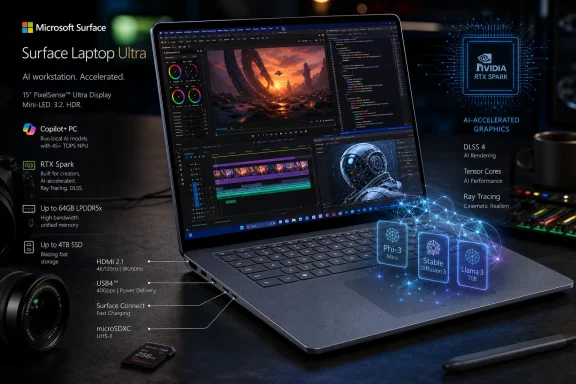
Microsoft announced the Surface Laptop Ultra globally on June 1, 2026, positioning the 15-inch Windows laptop as its most powerful Surface yet, with a mini-LED PixelSense Ultra display, NVIDIA RTX Spark silicon, up to 128GB of unified memory, and a repairable SSD design. The launch is not just another premium Surface refresh. It is Microsoft’s clearest attempt yet to make the Windows laptop feel like a first-class workstation for local AI, creator software, and GPU-heavy development. The gamble is that “AI PC” no longer means a modest NPU tucked beside a familiar processor, but a machine built around serious local compute.
For more than a decade, Surface has been Microsoft’s argument about what Windows hardware should look like. Sometimes that meant kickstands, detachable keyboards, pen-first tablets, or ultrathin laptops with unusually tall screens. But the Surface line has often stopped short of raw performance leadership, leaving gaming laptops, mobile workstations, and Apple’s MacBook Pro to define the top end.
Surface Laptop Ultra changes the tone. Microsoft is no longer pitching elegance as a substitute for horsepower. The machine is still thin, still light for its class, and still recognizably Surface, but the center of gravity has shifted toward sustained GPU compute, local AI models, and creator workflows that previously made Surface feel like the wrong tool.
That matters because the Windows PC market has spent the last two years drowning in AI branding while giving buyers little reason to believe the hardware category had fundamentally changed. Copilot+ PCs brought NPUs and better efficiency, but the experience often depended on whether Windows and third-party apps actually used the silicon. Surface Laptop Ultra is a more aggressive proposition: instead of asking whether a laptop has an NPU, it asks whether the machine can run meaningful workloads locally without immediately retreating to the cloud.
The answer, at least on paper, is yes. Microsoft says the new NVIDIA chip delivers up to one petaflop of AI compute, and the company is pairing that claim with up to 128GB of unified memory. Those numbers are not aimed at people checking email in Outlook. They are aimed at developers, model tinkerers, video editors, 3D artists, game builders, and enterprise teams wondering whether “local AI” can be more than a demo.
That phrasing is marketing, but the hardware direction is real. For years, Windows performance laptops have usually meant an Intel or AMD CPU paired with a discrete NVIDIA GPU. Surface Laptop Ultra moves toward a more integrated model, closer in spirit to Apple Silicon machines where CPU, GPU, and memory architecture are treated as one platform rather than a pile of parts.
The unified-memory approach is especially important for AI workloads. A machine with 128GB of unified memory is not automatically a datacenter in a backpack, but it changes what developers and creators can do locally. Larger models, bigger media projects, and heavier datasets become more plausible without round-tripping everything through a cloud endpoint.
That is the subtle strategic move here. Microsoft does not want Windows AI development to mean “write locally, run somewhere else.” It wants the PC itself to become a credible place for experimentation, inference, testing, and creative iteration. That is a much stronger pitch to professionals than another promise that a chatbot shortcut key will transform productivity.
The mini-LED decision is important because Microsoft is clearly chasing creators who might otherwise default to a MacBook Pro. For video editors, photographers, motion designers, and game artists, display quality is not cosmetic. It changes how confidently they can judge exposure, color, and contrast on the same machine where they cut, grade, render, and review.
The touchscreen also keeps Surface from becoming a pure MacBook clone. Apple still does not offer touch on the Mac, and Microsoft continues to treat direct manipulation as part of the Windows laptop identity. Whether that matters depends on the user, but for pen-adjacent creative workflows, UI testing, and certain design apps, touch is not a gimmick.
The more interesting point is that Microsoft appears to understand that a professional AI laptop cannot look like a developer board with a keyboard attached. If Surface Laptop Ultra is going to sell the idea of local AI and creator-class Windows hardware, the panel has to be good enough that people want to do the final work on it. Specs alone do not make a workstation desirable.
The full-size SD card reader is the clearest signal. This is a machine that wants to live near cameras, field recorders, production sets, and studios. HDMI means conference rooms, client reviews, and external displays without rummaging through a bag. USB-A means older peripherals and enterprise hardware still exist, no matter how many spec sheets pretend otherwise.
This is where Surface Laptop Ultra feels unusually pragmatic. Microsoft has often tried to make Surface represent a cleaner future than the PC market actually inhabits. With this device, the company seems more willing to admit that professional users carry messy workflows. They plug into things. They inherit devices. They move files from cameras. They do not want a $3,000-class laptop that needs a hub before it can begin behaving like a tool.
The headphone jack also deserves more respect than it usually gets. Low-latency audio monitoring, quick troubleshooting, and compatibility with existing equipment still matter. Wireless audio is convenient; wired audio is dependable. Professional machines need both instincts.
Surface has a complicated history here. The brand has produced beautiful machines that sometimes felt constrained by their thinness, fan behavior, or processor choices. A high-end NVIDIA-powered Surface cannot afford to be a burst-performance showcase that throttles when asked to compile code, render footage, run a model, and drive an external monitor at the same time.
The new thermal system is therefore a statement of intent. Microsoft knows that if Surface Laptop Ultra ships as a hot, loud, throttled status object, the professional audience will not forgive it. Engineers and creators are tolerant of fan noise when it buys them consistent throughput. They are much less tolerant of premium laptops that advertise workstation ambition and then behave like fashion devices under load.
Battery life remains the harder claim to judge. Microsoft says the laptop delivers all-day battery life and maintains performance while running on battery power, but final results will depend on workloads, software maturity, display brightness, and how aggressively Windows manages the NVIDIA silicon. AI compute and HDR displays are not free. The real test will be whether the machine can feel powerful unplugged without draining itself into irrelevance.
That does not mean cloud AI goes away. Microsoft is careful to frame local compute as complementary to frontier-scale cloud models. The local machine is for speed, privacy, iteration, lower latency, and cost control. The cloud remains the place for the largest models and collaborative services.
This hybrid model is probably the future Windows actually gets. Enterprises are not going to run every sensitive workflow through consumer-facing AI services, but they also are not going to abandon centralized governance, logging, and managed cloud infrastructure. A powerful local AI laptop gives IT another tier: some workloads stay on the device, some escalate to approved cloud services, and some never leave the company’s managed environment.
For developers, the appeal is more immediate. Local model testing, AI-assisted coding, image generation experiments, synthetic data workflows, and GPU-accelerated app features all become easier when the laptop itself has serious headroom. The Surface Laptop Ultra is not just a device for using AI apps. It is a device for building them.
That is not a bad thing. The Windows ecosystem has needed a credible first-party answer to the MacBook Pro for years. Gaming laptops can outperform Apple machines in certain workloads, and mobile workstations can be configured into monsters, but they often sacrifice battery life, acoustic comfort, portability, or design cohesion. Surface Laptop Ultra tries to occupy the more difficult middle ground: polished enough for executives and creators, powerful enough for developers and artists.
The challenge is software. Apple’s advantage is not merely that its silicon is efficient; it is that developers have spent years optimizing professional apps for a smaller, more predictable target. Windows has broader hardware diversity, which is both a strength and a burden. If RTX Spark becomes a real platform across multiple OEMs, Microsoft and NVIDIA have a chance to create a meaningful optimization target. If it remains a boutique configuration, the software story becomes harder.
CUDA support and RTX branding help. NVIDIA’s developer ecosystem is one of the strongest assets in computing, especially for AI, rendering, simulation, and creative acceleration. If Microsoft can wrap that ecosystem in a Surface design that users actually want to carry, it has a stronger MacBook Pro counterargument than Windows-on-Arm machines have traditionally offered.
For individual users, a replaceable SSD means longevity and flexibility. Storage needs grow, especially for video, code repositories, datasets, virtual machines, and local AI models. A machine that can adapt after purchase is easier to justify at a premium price.
For enterprises, serviceability is about fleet economics. Downtime costs money. Devices that can be repaired, redeployed, and kept in service reduce friction for IT departments. A high-end Surface that acknowledges this reality is more credible than one that treats the entire machine as sealed luxury.
This also fits the broader sustainability story companies increasingly have to tell. Repairability does not automatically make a device green, and Microsoft should not get a free pass for simply allowing some components to be replaced. But a professional laptop designed to stay useful longer is better aligned with how businesses now think about procurement, compliance, and lifecycle management.
FCC authorization language also matters. Microsoft’s own product page notes that shipment is conditioned on successful equipment authorization. That is normal for pre-release hardware, but it reinforces that this is an announcement before broad user testing. Early claims should be treated as claims until reviewers and customers put the machine through real workloads.
The most interesting uncertainty is how Windows will expose this hardware advantage. If the experience is simply “fast GPU in a nice laptop,” that is useful but not transformative. If Windows, developer tools, creative apps, Copilot features, and enterprise management frameworks start treating local AI compute as a first-class resource, Surface Laptop Ultra becomes more than a spec-sheet flex.
That is the bar Microsoft has set for itself. It has spent years telling users that AI will reshape Windows. Now it is shipping hardware that suggests the old PC architecture was not enough for that promise. The software has to catch up quickly.
The most concrete points are already visible:
Microsoft’s most powerful Surface is therefore less a finish line than a challenge to the rest of the Windows ecosystem. If RTX Spark laptops become common, if developers optimize for them, and if Windows turns local AI compute into something users can feel every day, the Surface Laptop Ultra may be remembered as the moment the AI PC grew up. If not, it will be another beautiful Surface that showed the future slightly before the future was ready to run on battery power.
 Microsoft Finally Builds the Surface It Used to Only Hint At
For more than a decade, Surface has been Microsoft’s argument about what Windows hardware should look like. Sometimes that meant kickstands, detachable keyboards, pen-first tablets, or ultrathin laptops with unusually tall screens. But the Surface line has often stopped short of raw performance leadership, leaving gaming laptops, mobile workstations, and Apple’s MacBook Pro to define the top end.Surface Laptop Ultra changes the tone. Microsoft is no longer pitching elegance as a substitute for horsepower. The machine is still thin, still light for its class, and still recognizably Surface, but the center of gravity has shifted toward sustained GPU compute, local AI models, and creator workflows that previously made Surface feel like the wrong tool.
That matters because the Windows PC market has spent the last two years drowning in AI branding while giving buyers little reason to believe the hardware category had fundamentally changed. Copilot+ PCs brought NPUs and better efficiency, but the experience often depended on whether Windows and third-party apps actually used the silicon. Surface Laptop Ultra is a more aggressive proposition: instead of asking whether a laptop has an NPU, it asks whether the machine can run meaningful workloads locally without immediately retreating to the cloud.
The answer, at least on paper, is yes. Microsoft says the new NVIDIA chip delivers up to one petaflop of AI compute, and the company is pairing that claim with up to 128GB of unified memory. Those numbers are not aimed at people checking email in Outlook. They are aimed at developers, model tinkerers, video editors, 3D artists, game builders, and enterprise teams wondering whether “local AI” can be more than a demo.
NVIDIA Gives Surface a Different Kind of Brain
The most consequential part of Surface Laptop Ultra is not the display, the finish, or the bigger haptic touchpad. It is the NVIDIA RTX Spark chip inside. Microsoft describes it as a new NVIDIA processor that combines an efficient CPU with an RTX GPU, uniting local AI agents, creation, and gaming in a single platform.That phrasing is marketing, but the hardware direction is real. For years, Windows performance laptops have usually meant an Intel or AMD CPU paired with a discrete NVIDIA GPU. Surface Laptop Ultra moves toward a more integrated model, closer in spirit to Apple Silicon machines where CPU, GPU, and memory architecture are treated as one platform rather than a pile of parts.
The unified-memory approach is especially important for AI workloads. A machine with 128GB of unified memory is not automatically a datacenter in a backpack, but it changes what developers and creators can do locally. Larger models, bigger media projects, and heavier datasets become more plausible without round-tripping everything through a cloud endpoint.
That is the subtle strategic move here. Microsoft does not want Windows AI development to mean “write locally, run somewhere else.” It wants the PC itself to become a credible place for experimentation, inference, testing, and creative iteration. That is a much stronger pitch to professionals than another promise that a chatbot shortcut key will transform productivity.
The Display Is Not Just Decoration This Time
Surface displays have long been among the line’s most defensible strengths, and the Surface Laptop Ultra continues that tradition with a 15-inch mini-LED PixelSense Ultra touchscreen. The 3:2 aspect ratio remains a productivity win, giving users more vertical room than a typical 16:9 laptop panel. The 262 PPI density and claimed 2000-nit peak HDR brightness put the display in territory meant for serious visual work, not merely spreadsheet comfort.The mini-LED decision is important because Microsoft is clearly chasing creators who might otherwise default to a MacBook Pro. For video editors, photographers, motion designers, and game artists, display quality is not cosmetic. It changes how confidently they can judge exposure, color, and contrast on the same machine where they cut, grade, render, and review.
The touchscreen also keeps Surface from becoming a pure MacBook clone. Apple still does not offer touch on the Mac, and Microsoft continues to treat direct manipulation as part of the Windows laptop identity. Whether that matters depends on the user, but for pen-adjacent creative workflows, UI testing, and certain design apps, touch is not a gimmick.
The more interesting point is that Microsoft appears to understand that a professional AI laptop cannot look like a developer board with a keyboard attached. If Surface Laptop Ultra is going to sell the idea of local AI and creator-class Windows hardware, the panel has to be good enough that people want to do the final work on it. Specs alone do not make a workstation desirable.
The Return of Ports Is an Admission, Not a Regression
The Surface Laptop Ultra’s port selection reads almost like a quiet apology for years of dongle dependency. Microsoft lists USB-C, USB-A, HDMI, a headphone jack, and a full-size SD card reader. For a device aimed at creators and professionals, that is not nostalgia. It is basic ergonomics.The full-size SD card reader is the clearest signal. This is a machine that wants to live near cameras, field recorders, production sets, and studios. HDMI means conference rooms, client reviews, and external displays without rummaging through a bag. USB-A means older peripherals and enterprise hardware still exist, no matter how many spec sheets pretend otherwise.
This is where Surface Laptop Ultra feels unusually pragmatic. Microsoft has often tried to make Surface represent a cleaner future than the PC market actually inhabits. With this device, the company seems more willing to admit that professional users carry messy workflows. They plug into things. They inherit devices. They move files from cameras. They do not want a $3,000-class laptop that needs a hub before it can begin behaving like a tool.
The headphone jack also deserves more respect than it usually gets. Low-latency audio monitoring, quick troubleshooting, and compatibility with existing equipment still matter. Wireless audio is convenient; wired audio is dependable. Professional machines need both instincts.
Thermal Capacity Is Where the Marketing Meets Physics
Microsoft says Surface Laptop Ultra has up to 2.5 times the thermal capacity of the 15-inch Surface Laptop 7th Edition. That claim may be less flashy than “one petaflop,” but it is arguably more important. Performance laptops are not judged by peak numbers alone; they are judged by what they can sustain after the first benchmark run has stopped flattering the silicon.Surface has a complicated history here. The brand has produced beautiful machines that sometimes felt constrained by their thinness, fan behavior, or processor choices. A high-end NVIDIA-powered Surface cannot afford to be a burst-performance showcase that throttles when asked to compile code, render footage, run a model, and drive an external monitor at the same time.
The new thermal system is therefore a statement of intent. Microsoft knows that if Surface Laptop Ultra ships as a hot, loud, throttled status object, the professional audience will not forgive it. Engineers and creators are tolerant of fan noise when it buys them consistent throughput. They are much less tolerant of premium laptops that advertise workstation ambition and then behave like fashion devices under load.
Battery life remains the harder claim to judge. Microsoft says the laptop delivers all-day battery life and maintains performance while running on battery power, but final results will depend on workloads, software maturity, display brightness, and how aggressively Windows manages the NVIDIA silicon. AI compute and HDR displays are not free. The real test will be whether the machine can feel powerful unplugged without draining itself into irrelevance.
Local AI Is the Real Product Microsoft Is Selling
The phrase “AI PC” has been stretched almost beyond usefulness. For some vendors, it means a keyboard key. For others, it means an NPU that accelerates a handful of effects. Microsoft’s Surface Laptop Ultra makes a more coherent argument: local AI becomes interesting when the machine has enough GPU compute and memory to run substantial tasks without defaulting to the cloud.That does not mean cloud AI goes away. Microsoft is careful to frame local compute as complementary to frontier-scale cloud models. The local machine is for speed, privacy, iteration, lower latency, and cost control. The cloud remains the place for the largest models and collaborative services.
This hybrid model is probably the future Windows actually gets. Enterprises are not going to run every sensitive workflow through consumer-facing AI services, but they also are not going to abandon centralized governance, logging, and managed cloud infrastructure. A powerful local AI laptop gives IT another tier: some workloads stay on the device, some escalate to approved cloud services, and some never leave the company’s managed environment.
For developers, the appeal is more immediate. Local model testing, AI-assisted coding, image generation experiments, synthetic data workflows, and GPU-accelerated app features all become easier when the laptop itself has serious headroom. The Surface Laptop Ultra is not just a device for using AI apps. It is a device for building them.
Microsoft Is Chasing the MacBook Pro Without Saying the Quiet Part Too Loudly
The comparison is unavoidable. A premium 15-inch creator laptop with a dense high-brightness display, unified memory, strong local AI performance, and a tightly integrated processor platform is clearly walking into MacBook Pro territory. Microsoft can describe Surface Laptop Ultra as a new category for “world makers,” but buyers will compare it to Apple’s best laptops anyway.That is not a bad thing. The Windows ecosystem has needed a credible first-party answer to the MacBook Pro for years. Gaming laptops can outperform Apple machines in certain workloads, and mobile workstations can be configured into monsters, but they often sacrifice battery life, acoustic comfort, portability, or design cohesion. Surface Laptop Ultra tries to occupy the more difficult middle ground: polished enough for executives and creators, powerful enough for developers and artists.
The challenge is software. Apple’s advantage is not merely that its silicon is efficient; it is that developers have spent years optimizing professional apps for a smaller, more predictable target. Windows has broader hardware diversity, which is both a strength and a burden. If RTX Spark becomes a real platform across multiple OEMs, Microsoft and NVIDIA have a chance to create a meaningful optimization target. If it remains a boutique configuration, the software story becomes harder.
CUDA support and RTX branding help. NVIDIA’s developer ecosystem is one of the strongest assets in computing, especially for AI, rendering, simulation, and creative acceleration. If Microsoft can wrap that ecosystem in a Surface design that users actually want to carry, it has a stronger MacBook Pro counterargument than Windows-on-Arm machines have traditionally offered.
Repairability Becomes Part of the Professional Pitch
The replaceable SSD is not the most glamorous specification, but it may be one of the most important for IT buyers. Microsoft says the Surface Laptop Ultra is designed with serviceability in mind, including internal wayfinding, repair guides, and replacement parts availability. That is a notable shift for a product family often criticized in earlier years for difficult repairs.For individual users, a replaceable SSD means longevity and flexibility. Storage needs grow, especially for video, code repositories, datasets, virtual machines, and local AI models. A machine that can adapt after purchase is easier to justify at a premium price.
For enterprises, serviceability is about fleet economics. Downtime costs money. Devices that can be repaired, redeployed, and kept in service reduce friction for IT departments. A high-end Surface that acknowledges this reality is more credible than one that treats the entire machine as sealed luxury.
This also fits the broader sustainability story companies increasingly have to tell. Repairability does not automatically make a device green, and Microsoft should not get a free pass for simply allowing some components to be replaced. But a professional laptop designed to stay useful longer is better aligned with how businesses now think about procurement, compliance, and lifecycle management.
The Missing Details Will Decide Whether This Is a Breakthrough or a Showcase
The launch gives us enough to understand Microsoft’s ambition, but not enough to fully judge the product. Pricing, exact configurations, availability by region, battery test details, real-world performance, fan noise, Linux compatibility, driver maturity, and app optimization will determine whether Surface Laptop Ultra becomes a category-defining machine or a fascinating halo product.FCC authorization language also matters. Microsoft’s own product page notes that shipment is conditioned on successful equipment authorization. That is normal for pre-release hardware, but it reinforces that this is an announcement before broad user testing. Early claims should be treated as claims until reviewers and customers put the machine through real workloads.
The most interesting uncertainty is how Windows will expose this hardware advantage. If the experience is simply “fast GPU in a nice laptop,” that is useful but not transformative. If Windows, developer tools, creative apps, Copilot features, and enterprise management frameworks start treating local AI compute as a first-class resource, Surface Laptop Ultra becomes more than a spec-sheet flex.
That is the bar Microsoft has set for itself. It has spent years telling users that AI will reshape Windows. Now it is shipping hardware that suggests the old PC architecture was not enough for that promise. The software has to catch up quickly.
The Surface Bet Now Lives or Dies in Real Workloads
Surface Laptop Ultra is the sort of product that makes sense only if buyers believe the next few years of computing will be more local, more GPU-heavy, and more AI-assisted than the last few. It is not a mainstream laptop with a fancy name. It is a wager that professionals will pay for local capability before the software ecosystem fully proves the return.The most concrete points are already visible:
- Microsoft has moved Surface into a higher-performance class with NVIDIA RTX Spark silicon and up to one petaflop of claimed AI compute.
- The 15-inch mini-LED PixelSense Ultra display, 3:2 aspect ratio, and 2000-nit peak HDR brightness are aimed at creators, not casual laptop buyers.
- The return of practical ports, including HDMI and a full-size SD card reader, acknowledges how professional workflows actually function.
- The 2.5x thermal-capacity claim is central because sustained performance will matter more than peak benchmark numbers.
- Up to 128GB of unified memory makes local AI experimentation and larger creative workloads more plausible on a Windows laptop.
- The replaceable SSD and serviceability language suggest Microsoft is paying closer attention to enterprise lifecycle concerns.
Microsoft’s most powerful Surface is therefore less a finish line than a challenge to the rest of the Windows ecosystem. If RTX Spark laptops become common, if developers optimize for them, and if Windows turns local AI compute into something users can feel every day, the Surface Laptop Ultra may be remembered as the moment the AI PC grew up. If not, it will be another beautiful Surface that showed the future slightly before the future was ready to run on battery power.
References
- Primary source: TelecomTalk
Published: Mon, 01 Jun 2026 11:22:55 GMT
Loading…
telecomtalk.info - Related coverage: tomshardware.com
Loading…
www.tomshardware.com - Official source: microsoft.com
Loading…
www.microsoft.com - Related coverage: gizmochina.com

Microsoft announces Surface Laptop Ultra with NVIDIA RTX Spark and its brightest display yet
Microsoft Surface Laptop Ultra launches with 2000-nit display, NVIDIA RTX Spark, 128GB RAM, and big Windows 11 upgrades. www.gizmochina.com
- Related coverage: windowscentral.com
Microsoft and NVIDIA’s Surface Laptop Ultra pushes Windows on Arm into high‑performance territory
Microsoft and NVIDIA unveil the Surface Laptop Ultra, a 128GB RAM beast with Blackwell graphics and a mini-LED display that redefines performance for Windows on Arm. www.windowscentral.com
- Related coverage: windowslatest.com

Microsoft builds its ultimate MacBook Pro rival with the NVIDIA powered Surface Laptop Ultra
Microsoft launches the Surface Laptop Ultra with an NVIDIA RTX Spark chip and 128GB unified memory to challenge Apple MacBook Pro dominance. www.windowslatest.com
- Related coverage: axios.com

Microsoft debuts Nvidia-powered Microsoft Surface Ultra laptop
Microsoft is trying again to redefine the PC for the AI era.www.axios.com
- Related coverage: windowsreport.com
Loading…
windowsreport.com - Official source: news.microsoft.com
Loading…
news.microsoft.com - Related coverage: fonearena.com
Loading…
www.fonearena.com