

Microsoft announced the Surface Laptop Ultra at Computex 2026 in Taipei on June 1, positioning it as a fall-shipping 15-inch Windows laptop built around Nvidia’s new RTX Spark superchip for local AI workloads. The headline is not that Surface is getting faster; Surface has been getting faster in predictable increments for more than a decade. The real story is that Microsoft is letting Nvidia define the most ambitious Windows PC of the AI era, and doing it in a form factor that looks less like a workstation and more like a premium laptop.
That makes Surface Laptop Ultra more than another halo device. It is a test of whether the “AI PC” can finally mean something beyond a Copilot key, a neural processing unit badge, and a few webcam tricks. If Microsoft and Nvidia are right, the next serious Windows machine is not merely cloud-connected; it is a local inference box with a keyboard.
Surface began life as Microsoft’s argument about what Windows hardware should be. The first devices were not always loved, and they were not always commercially elegant, but they gave OEMs a shove: touch mattered, kickstands were not absurd, detachable keyboards could be better, and premium Windows hardware did not have to be a beige compromise.
Surface Laptop Ultra feels like a different kind of shove. This time Microsoft is not correcting the industrial design of Windows PCs. It is trying to redefine the performance center of gravity.
The reported configuration is deliberately extravagant: Nvidia RTX Spark silicon, a Blackwell-class GPU block, a 20-core Arm CPU, up to 128GB of unified memory, and roughly one petaflop of FP4 AI performance. Those numbers require interpretation, because AI marketing has become a swamp of precision formats, sparsity assumptions, and workload-specific boasts. Still, even with the usual caveats, this is not a normal laptop spec sheet.
The important phrase is unified memory. A traditional performance laptop typically separates system RAM from GPU VRAM, forcing developers and creative applications to live inside a split memory budget. A machine with 128GB of coherent memory shared across CPU and GPU changes the shape of local AI development, especially for large models that are memory-bound before they are compute-bound.
That is why Microsoft’s “portable AI supercomputer” language, while overcaffeinated, is not entirely nonsense. The Surface Laptop Ultra is not going to replace a cloud training cluster, and it is not going to make every developer a frontier-model lab. But it could make a class of AI work feel local, iterative, and private in a way that today’s mainstream laptops do not.
RTX Spark changes that dynamic. It is not just “a GPU in a laptop.” It is Nvidia presenting a complete compute platform for Windows machines, one that combines Arm CPU cores, Blackwell GPU technology, tensor acceleration, and unified memory into a single design philosophy.
That matters because Microsoft has spent years trying to escape the gravitational pull of the classic x86 upgrade cycle. Windows on Arm has improved, but its public identity remains tangled in app compatibility, performance skepticism, and the long shadow of failed attempts. Qualcomm’s Snapdragon X generation gave Microsoft its best consumer-facing Arm moment in years, but Nvidia brings something different: not just battery life and thinness, but developer heat.
Nvidia’s pitch is simple and dangerous for the rest of the PC industry. If AI workloads are the new premium workload, and if those workloads care about GPU architecture, memory bandwidth, tensor performance, and software libraries, then Nvidia can claim the high ground. The company does not need to own every Windows PC. It only needs to own the machines that define what “serious” local AI computing looks like.
That is why the Surface branding matters. Microsoft could have left RTX Spark to Dell, HP, Lenovo, Asus, MSI, Acer, and Gigabyte. Instead, Surface is reportedly in the first wave. Microsoft is lending its own hardware badge to Nvidia’s claim that the future Windows PC is not an Intel notebook with a better NPU, but a different class of machine altogether.
The more durable specification is the 128GB memory ceiling. Local AI has an appetite that ordinary laptops cannot satisfy. Many users have discovered that the bottleneck is not whether a model can technically run, but whether it runs fast enough, with a useful context window, while leaving the rest of the machine usable.
That is the distinction between a demo and a tool. A small model running locally on a thin laptop can be impressive for five minutes. A larger model running locally with enough memory to support real coding, document analysis, media workflows, and agentic automation is a different proposition.
Surface Laptop Ultra’s likely audience is not the average Word-and-browser customer. It is the developer fine-tuning a workflow, the researcher testing model behavior, the video professional using AI-assisted editing, the architect generating design variants, the security analyst processing sensitive data, and the enterprise team that wants AI capability without shipping every prompt to a cloud service.
Those users do not merely need “AI features.” They need local capacity. That is the argument Microsoft and Nvidia are making, and it is more persuasive than another round of animated Copilot demos.
The Surface Laptop Ultra is a reaction to that problem. It says, implicitly, that the AI PC cannot be sold only as a slightly smarter ultrabook. It has to become a machine that can run workloads people currently associate with cloud GPUs, lab desktops, or rented inference endpoints.
That shift makes the device easier to understand and harder to mainstream. A petaflop-class AI laptop with 128GB of memory will not be cheap, and Microsoft has not announced pricing. The company’s silence is its own signal. This is almost certainly a halo machine, not a volume play.
But halo machines shape expectations. The original MacBook Pro did not represent every Mac buyer, and Nvidia’s top-end GPUs do not represent every Steam user. They still define the aspirational edge of a platform. Surface Laptop Ultra may play the same role for Windows AI hardware.
If it succeeds, “AI PC” stops being a compliance label and starts describing a tiered market. At the bottom are everyday machines with NPUs for system features and battery-friendly acceleration. In the middle are creator laptops with discrete GPUs and local AI tools. At the top are unified-memory AI workstations pretending, with varying degrees of success, to be portable computers.
Dell, HP, Lenovo, Asus, MSI, Acer, and Gigabyte are not bit players. If RTX Spark machines arrive across laptops and compact desktops this fall, the Surface model becomes the cleanest expression of a broader platform shift rather than a one-off science project. Microsoft gets to say Windows is ready for personal AI hardware. Nvidia gets a Windows ecosystem for its local AI ambitions. OEMs get a new premium tier to sell into a PC market that still needs reasons to upgrade.
There is an echo here of the Ultrabook era, when Intel used hardware requirements and marketing pressure to drag Windows laptops toward thinner, better, more premium designs. The difference is that Nvidia’s lever is not thinness. It is local compute.
That changes the politics. Intel and AMD both have AI roadmaps. Qualcomm has an Arm-based Windows pitch centered on efficiency. Microsoft is now standing onstage with Nvidia for a device that points in a different direction: not merely “the laptop lasts longer,” but “the laptop can do work that used to live somewhere else.”
This is why enterprise buyers will watch closely, even if they do not buy version one. The question is not whether every employee needs a Surface Laptop Ultra. They do not. The question is whether certain high-value roles can justify a local AI workstation that travels.
This is where Nvidia’s software ecosystem could matter as much as its silicon. Developers working in AI already live in a world of CUDA, containers, Python environments, model runtimes, acceleration libraries, and hardware-specific tuning. If Nvidia can make RTX Spark feel like a first-class local AI target on Windows, it could pull the professional audience toward Arm for reasons that have nothing to do with battery-life charts.
That would be a major reversal. Windows on Arm has often been sold as a consumer convenience: thinner, quieter, longer-lasting. Surface Laptop Ultra would sell Arm as a workstation decision. That is a much more interesting argument.
The risk is fragmentation. Windows developers already have to think about x86, x64, Arm64, discrete GPUs, integrated GPUs, NPUs, DirectML, CUDA, ONNX Runtime, Copilot Runtime, and a growing set of model-serving layers. Adding a premium Nvidia Arm Windows class could energize the market, but it could also make software support more complicated.
Microsoft’s job is to make the complexity disappear. Historically, that has been easier said than done.
Apple’s advantage has been integration. The CPU, GPU, neural engine, memory system, operating system, developer tools, and industrial design all tell one story. Microsoft’s Windows ecosystem is messier, but also broader. It can absorb Nvidia, AMD, Intel, Qualcomm, and dozens of OEM designs. That flexibility is Windows’ strength and its tax.
Surface Laptop Ultra appears designed to answer Apple on Apple’s strongest terrain: premium mobile hardware with a large unified memory pool and creator-friendly performance. But Microsoft’s answer is not to copy the MacBook Pro exactly. It is to put Nvidia’s AI stack at the center and aim directly at people who care about local inference.
That could be smart. Apple is formidable in creative workflows and increasingly credible in local AI experimentation, but Nvidia remains the default language of modern AI development. If a buyer’s world revolves around CUDA-accelerated tooling, model deployment paths, and GPU-centric development habits, an Nvidia-based Windows machine has a native appeal Apple cannot easily duplicate.
The irony is that Microsoft’s most Mac-like Surface may be the one that succeeds by being least like a Mac internally.
“All-day battery life” is especially slippery. A laptop can have all-day battery life while writing email and browsing the web, then burn through its charge rapidly under sustained local inference or rendering. That does not make the claim false, but it does make it incomplete.
Thermals may be the harder problem. A chip that looks spectacular in a compact desktop can behave very differently in a thin 15-inch chassis. Sustained performance is what separates a workstation from a benchmark theater. If Surface Laptop Ultra throttles aggressively under real AI loads, the marketing story will sour quickly among the people most likely to pay for it.
Pricing will determine whether this is a niche developer jewel or a credible fleet device for specialized enterprise roles. Nvidia’s DGX Spark desktop-class systems have already taught buyers that personal AI supercomputing is not a bargain-bin category. A Surface version with a premium display, battery, chassis, and Microsoft branding is unlikely to arrive gently.
That does not doom it. Professional machines can be expensive if they save time, protect data, or replace cloud spending. But Microsoft will need to explain the value in operational terms, not just superlatives.
Local AI does not magically solve governance. A model running on a laptop can still leak data through bad workflows, insecure plugins, careless logging, poisoned inputs, or unmanaged output. IT departments will still need policy, auditing, endpoint protection, model provenance, and data-loss controls.
But the locality changes the conversation. Cloud AI centralizes compute and can simplify governance at scale, but it also creates dependency, latency, cost, and data-residency concerns. Local AI moves some of the risk and capability to the endpoint. That is both attractive and alarming.
Windows is already the enterprise endpoint battleground. If AI agents begin acting on files, apps, browser sessions, command lines, and enterprise data, the endpoint becomes even more important. Microsoft’s security story around Surface Laptop Ultra must therefore extend beyond “it runs models locally.” It has to address what those models are allowed to touch, how actions are mediated, and how administrators can prove what happened.
That is where Windows management tooling could become a differentiator. A powerful AI laptop without governance is a toy for enthusiasts. A powerful AI laptop with policy hooks, identity integration, endpoint controls, and auditable local inference could become a new class of professional device.
For RTX Spark, the strongest path runs through the existing Nvidia ecosystem. If CUDA-oriented workloads, popular model runners, container workflows, AI coding tools, image and video generation pipelines, and inference frameworks behave predictably on Surface Laptop Ultra, the device has a plausible early audience. If setup is brittle, drivers lag, or Windows-specific oddities pile up, the machine becomes an expensive curiosity.
The Windows developer experience is better than its reputation in many areas, especially with WSL, modern terminal tooling, package managers, and improved virtualization. But AI development can be unforgiving. A missing library, unsupported wheel, driver mismatch, or memory allocation quirk can turn a premium machine into a troubleshooting weekend.
Microsoft and Nvidia must make the first-run experience boring. That means clean installers, clear documentation, stable drivers, supported runtimes, and realistic sample workflows. The buyer who spends workstation money should not have to become a forum archaeologist to run common models locally.
WindowsForum readers know this pattern well. Hardware potential is easy to announce. Driver maturity is earned over months.
Gaming performance is an open question. Blackwell GPU cores and Nvidia branding invite gaming assumptions, but an AI-focused integrated superchip is not necessarily equivalent to a conventional high-wattage GeForce laptop GPU. Drivers, memory architecture, power limits, and graphics configurations will determine where it lands.
Creative performance may be more central. Video editing, 3D rendering, AI-assisted upscaling, image generation, local transcription, audio cleanup, and design iteration are workloads where GPU acceleration and memory capacity can produce obvious user value. These are the tasks that can make a machine feel magical without requiring the buyer to understand model parameter counts.
The bragging-rights crowd will exist, of course. Every halo laptop attracts buyers who want the fastest, strangest, most future-proof machine on the table. Microsoft will not mind. Enthusiasts often subsidize the early phase of a platform shift.
But Surface Laptop Ultra’s real consumer challenge is narrative. Microsoft has to explain why a user should buy this instead of a MacBook Pro, a traditional RTX gaming laptop, a Snapdragon ultrabook, or a compact desktop plus a cheaper laptop. The answer cannot be “AI” alone. It has to be which AI work, done where, with what advantage.
That category creates opportunity. PC makers have spent years trying to lift average selling prices with premium materials, OLED panels, gaming GPUs, creator branding, and enterprise security features. AI workstations give them another story to tell, one with obvious resonance in boardrooms and developer teams.
It also creates confusion. Buyers will have to parse NPU TOPS, GPU tensor performance, FP4 claims, unified memory capacity, model-size support, Copilot features, CUDA compatibility, and battery life. The PC market is already bad at simple naming. An AI hardware arms race could make it worse.
Microsoft should be careful here. If every OEM slaps “AI supercomputer” on machines with wildly different sustained performance and software readiness, the term will decay quickly. The company has already seen how “AI PC” can become background noise when buyers cannot connect it to concrete outcomes.
Surface Laptop Ultra can help by serving as a benchmark for what the top of the category should mean. But Microsoft will need restraint from its partners and clarity from Nvidia. Otherwise, the launch becomes another spec fog.
It also gives competitors time to respond. Intel and AMD will not concede the AI PC narrative. Qualcomm will continue pressing the efficiency and Arm-native Windows story. Apple will keep improving local AI capabilities across Mac hardware. Cloud providers will argue that serious AI still belongs in scalable infrastructure, not on individual endpoints.
That competition is healthy, but it raises the bar. Surface Laptop Ultra cannot arrive as a beautiful machine with unfinished software. The first wave of buyers will be technically sophisticated, vocal, and unforgiving. They will test local LLMs, image models, developer stacks, battery drain, fan noise, thermals, virtualization, external monitor behavior, sleep reliability, and every driver edge case they can find.
If Microsoft delivers, it gets a new Surface legend. If it stumbles, the story becomes familiar: brilliant hardware idea, compromised by the realities of Windows platform complexity.
The stakes are higher because the AI PC market is still forming. Early impressions will shape whether buyers see local AI hardware as essential, premature, or simply overpriced.
That makes Surface Laptop Ultra more than another halo device. It is a test of whether the “AI PC” can finally mean something beyond a Copilot key, a neural processing unit badge, and a few webcam tricks. If Microsoft and Nvidia are right, the next serious Windows machine is not merely cloud-connected; it is a local inference box with a keyboard.
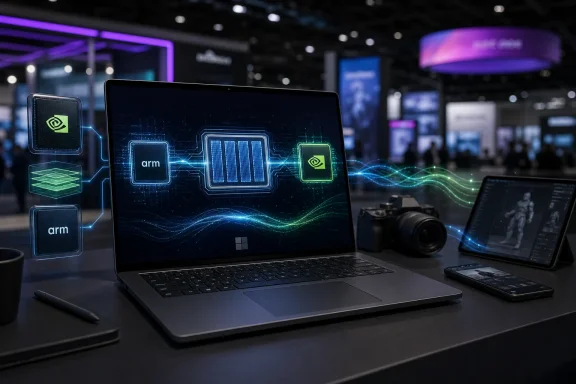 Microsoft’s Most Interesting Surface Is Also Its Least Traditional One
Surface began life as Microsoft’s argument about what Windows hardware should be. The first devices were not always loved, and they were not always commercially elegant, but they gave OEMs a shove: touch mattered, kickstands were not absurd, detachable keyboards could be better, and premium Windows hardware did not have to be a beige compromise.Surface Laptop Ultra feels like a different kind of shove. This time Microsoft is not correcting the industrial design of Windows PCs. It is trying to redefine the performance center of gravity.
The reported configuration is deliberately extravagant: Nvidia RTX Spark silicon, a Blackwell-class GPU block, a 20-core Arm CPU, up to 128GB of unified memory, and roughly one petaflop of FP4 AI performance. Those numbers require interpretation, because AI marketing has become a swamp of precision formats, sparsity assumptions, and workload-specific boasts. Still, even with the usual caveats, this is not a normal laptop spec sheet.
The important phrase is unified memory. A traditional performance laptop typically separates system RAM from GPU VRAM, forcing developers and creative applications to live inside a split memory budget. A machine with 128GB of coherent memory shared across CPU and GPU changes the shape of local AI development, especially for large models that are memory-bound before they are compute-bound.
That is why Microsoft’s “portable AI supercomputer” language, while overcaffeinated, is not entirely nonsense. The Surface Laptop Ultra is not going to replace a cloud training cluster, and it is not going to make every developer a frontier-model lab. But it could make a class of AI work feel local, iterative, and private in a way that today’s mainstream laptops do not.
Nvidia Has Found a New Door Into Windows
For decades, Nvidia’s role in Windows PCs has been obvious: the GPU vendor for games, workstations, rendering, CUDA acceleration, and, more recently, AI. The CPU belonged to someone else. Intel defined the mainstream PC. AMD fought its way into the same lane. Qualcomm tried to make Windows on Arm matter. Nvidia mostly lived beside the processor, not inside the definition of the PC itself.RTX Spark changes that dynamic. It is not just “a GPU in a laptop.” It is Nvidia presenting a complete compute platform for Windows machines, one that combines Arm CPU cores, Blackwell GPU technology, tensor acceleration, and unified memory into a single design philosophy.
That matters because Microsoft has spent years trying to escape the gravitational pull of the classic x86 upgrade cycle. Windows on Arm has improved, but its public identity remains tangled in app compatibility, performance skepticism, and the long shadow of failed attempts. Qualcomm’s Snapdragon X generation gave Microsoft its best consumer-facing Arm moment in years, but Nvidia brings something different: not just battery life and thinness, but developer heat.
Nvidia’s pitch is simple and dangerous for the rest of the PC industry. If AI workloads are the new premium workload, and if those workloads care about GPU architecture, memory bandwidth, tensor performance, and software libraries, then Nvidia can claim the high ground. The company does not need to own every Windows PC. It only needs to own the machines that define what “serious” local AI computing looks like.
That is why the Surface branding matters. Microsoft could have left RTX Spark to Dell, HP, Lenovo, Asus, MSI, Acer, and Gigabyte. Instead, Surface is reportedly in the first wave. Microsoft is lending its own hardware badge to Nvidia’s claim that the future Windows PC is not an Intel notebook with a better NPU, but a different class of machine altogether.
The Petaflop Number Is Real Marketing, But the Memory Story Is Real Engineering
“One petaflop” is the kind of number that makes readers either sit up or roll their eyes. Both reactions are justified. The figure refers to AI performance under particular low-precision conditions, not a universal promise that every workload suddenly runs like a data-center benchmark.The more durable specification is the 128GB memory ceiling. Local AI has an appetite that ordinary laptops cannot satisfy. Many users have discovered that the bottleneck is not whether a model can technically run, but whether it runs fast enough, with a useful context window, while leaving the rest of the machine usable.
That is the distinction between a demo and a tool. A small model running locally on a thin laptop can be impressive for five minutes. A larger model running locally with enough memory to support real coding, document analysis, media workflows, and agentic automation is a different proposition.
Surface Laptop Ultra’s likely audience is not the average Word-and-browser customer. It is the developer fine-tuning a workflow, the researcher testing model behavior, the video professional using AI-assisted editing, the architect generating design variants, the security analyst processing sensitive data, and the enterprise team that wants AI capability without shipping every prompt to a cloud service.
Those users do not merely need “AI features.” They need local capacity. That is the argument Microsoft and Nvidia are making, and it is more persuasive than another round of animated Copilot demos.
The AI PC Has Been Waiting for a Workload That Justifies the Name
The first wave of AI PCs was strangely underwhelming. The hardware vendors were not wrong that NPUs mattered, and Microsoft was not wrong that Windows needed a local AI story. But much of the initial pitch collapsed into background blur, live captions, image effects, and assistant integrations that did not require a new category of computer in the buyer’s mind.The Surface Laptop Ultra is a reaction to that problem. It says, implicitly, that the AI PC cannot be sold only as a slightly smarter ultrabook. It has to become a machine that can run workloads people currently associate with cloud GPUs, lab desktops, or rented inference endpoints.
That shift makes the device easier to understand and harder to mainstream. A petaflop-class AI laptop with 128GB of memory will not be cheap, and Microsoft has not announced pricing. The company’s silence is its own signal. This is almost certainly a halo machine, not a volume play.
But halo machines shape expectations. The original MacBook Pro did not represent every Mac buyer, and Nvidia’s top-end GPUs do not represent every Steam user. They still define the aspirational edge of a platform. Surface Laptop Ultra may play the same role for Windows AI hardware.
If it succeeds, “AI PC” stops being a compliance label and starts describing a tiered market. At the bottom are everyday machines with NPUs for system features and battery-friendly acceleration. In the middle are creator laptops with discrete GPUs and local AI tools. At the top are unified-memory AI workstations pretending, with varying degrees of success, to be portable computers.
Surface Is Becoming a Reference Design Again
Microsoft does not need Surface Laptop Ultra to sell in huge numbers for it to matter. Surface has often functioned as a reference design with a price tag, a public statement of where Microsoft wants OEMs to go. The RTX Spark partner list suggests that is exactly the role this launch is meant to play.Dell, HP, Lenovo, Asus, MSI, Acer, and Gigabyte are not bit players. If RTX Spark machines arrive across laptops and compact desktops this fall, the Surface model becomes the cleanest expression of a broader platform shift rather than a one-off science project. Microsoft gets to say Windows is ready for personal AI hardware. Nvidia gets a Windows ecosystem for its local AI ambitions. OEMs get a new premium tier to sell into a PC market that still needs reasons to upgrade.
There is an echo here of the Ultrabook era, when Intel used hardware requirements and marketing pressure to drag Windows laptops toward thinner, better, more premium designs. The difference is that Nvidia’s lever is not thinness. It is local compute.
That changes the politics. Intel and AMD both have AI roadmaps. Qualcomm has an Arm-based Windows pitch centered on efficiency. Microsoft is now standing onstage with Nvidia for a device that points in a different direction: not merely “the laptop lasts longer,” but “the laptop can do work that used to live somewhere else.”
This is why enterprise buyers will watch closely, even if they do not buy version one. The question is not whether every employee needs a Surface Laptop Ultra. They do not. The question is whether certain high-value roles can justify a local AI workstation that travels.
Windows on Arm Gets a Strange but Powerful New Advocate
If Surface Laptop Ultra uses Nvidia’s Arm-based Grace CPU cores as expected, it lands in the long, uneven story of Windows on Arm. That story has improved substantially, but it remains haunted by three letters: x86. Compatibility is better than it used to be, emulation is better than it used to be, and native Arm64 applications are more common than they used to be. “Better than it used to be,” however, is not the same as invisible.This is where Nvidia’s software ecosystem could matter as much as its silicon. Developers working in AI already live in a world of CUDA, containers, Python environments, model runtimes, acceleration libraries, and hardware-specific tuning. If Nvidia can make RTX Spark feel like a first-class local AI target on Windows, it could pull the professional audience toward Arm for reasons that have nothing to do with battery-life charts.
That would be a major reversal. Windows on Arm has often been sold as a consumer convenience: thinner, quieter, longer-lasting. Surface Laptop Ultra would sell Arm as a workstation decision. That is a much more interesting argument.
The risk is fragmentation. Windows developers already have to think about x86, x64, Arm64, discrete GPUs, integrated GPUs, NPUs, DirectML, CUDA, ONNX Runtime, Copilot Runtime, and a growing set of model-serving layers. Adding a premium Nvidia Arm Windows class could energize the market, but it could also make software support more complicated.
Microsoft’s job is to make the complexity disappear. Historically, that has been easier said than done.
The Mac Comparison Is Unavoidable, and Microsoft Knows It
The Mashable SEA report frames Surface Laptop Ultra’s local model capacity as comparable to a Mac mini with 128GB of memory. That comparison is telling, because Apple has spent the Apple Silicon era teaching buyers that unified memory is not a minor implementation detail. It is central to what the machine can do.Apple’s advantage has been integration. The CPU, GPU, neural engine, memory system, operating system, developer tools, and industrial design all tell one story. Microsoft’s Windows ecosystem is messier, but also broader. It can absorb Nvidia, AMD, Intel, Qualcomm, and dozens of OEM designs. That flexibility is Windows’ strength and its tax.
Surface Laptop Ultra appears designed to answer Apple on Apple’s strongest terrain: premium mobile hardware with a large unified memory pool and creator-friendly performance. But Microsoft’s answer is not to copy the MacBook Pro exactly. It is to put Nvidia’s AI stack at the center and aim directly at people who care about local inference.
That could be smart. Apple is formidable in creative workflows and increasingly credible in local AI experimentation, but Nvidia remains the default language of modern AI development. If a buyer’s world revolves around CUDA-accelerated tooling, model deployment paths, and GPU-centric development habits, an Nvidia-based Windows machine has a native appeal Apple cannot easily duplicate.
The irony is that Microsoft’s most Mac-like Surface may be the one that succeeds by being least like a Mac internally.
The Missing Specs Are Not Footnotes
For all the excitement, the unknowns are large. Microsoft has not disclosed pricing. Full battery-life details are missing. Thermal behavior is unproven. Storage configurations, memory bandwidth behavior under sustained load, repairability, enterprise manageability, Linux or container workflows, driver maturity, and app compatibility all matter more than the launch adjectives.“All-day battery life” is especially slippery. A laptop can have all-day battery life while writing email and browsing the web, then burn through its charge rapidly under sustained local inference or rendering. That does not make the claim false, but it does make it incomplete.
Thermals may be the harder problem. A chip that looks spectacular in a compact desktop can behave very differently in a thin 15-inch chassis. Sustained performance is what separates a workstation from a benchmark theater. If Surface Laptop Ultra throttles aggressively under real AI loads, the marketing story will sour quickly among the people most likely to pay for it.
Pricing will determine whether this is a niche developer jewel or a credible fleet device for specialized enterprise roles. Nvidia’s DGX Spark desktop-class systems have already taught buyers that personal AI supercomputing is not a bargain-bin category. A Surface version with a premium display, battery, chassis, and Microsoft branding is unlikely to arrive gently.
That does not doom it. Professional machines can be expensive if they save time, protect data, or replace cloud spending. But Microsoft will need to explain the value in operational terms, not just superlatives.
Local AI Is Also a Security and Governance Argument
The most interesting enterprise pitch for Surface Laptop Ultra may not be speed. It may be control. Running models locally can reduce the need to send sensitive prompts, documents, code, logs, or customer data to external services. For regulated industries, that is not a philosophical point; it is a procurement argument.Local AI does not magically solve governance. A model running on a laptop can still leak data through bad workflows, insecure plugins, careless logging, poisoned inputs, or unmanaged output. IT departments will still need policy, auditing, endpoint protection, model provenance, and data-loss controls.
But the locality changes the conversation. Cloud AI centralizes compute and can simplify governance at scale, but it also creates dependency, latency, cost, and data-residency concerns. Local AI moves some of the risk and capability to the endpoint. That is both attractive and alarming.
Windows is already the enterprise endpoint battleground. If AI agents begin acting on files, apps, browser sessions, command lines, and enterprise data, the endpoint becomes even more important. Microsoft’s security story around Surface Laptop Ultra must therefore extend beyond “it runs models locally.” It has to address what those models are allowed to touch, how actions are mediated, and how administrators can prove what happened.
That is where Windows management tooling could become a differentiator. A powerful AI laptop without governance is a toy for enthusiasts. A powerful AI laptop with policy hooks, identity integration, endpoint controls, and auditable local inference could become a new class of professional device.
Developers Will Decide Whether This Is a Workstation or a Curiosity
Hardware launches often assume software will arrive because the silicon is impressive. That assumption is dangerous. Developers adopt platforms when the platform reduces friction, reaches users, and improves their work.For RTX Spark, the strongest path runs through the existing Nvidia ecosystem. If CUDA-oriented workloads, popular model runners, container workflows, AI coding tools, image and video generation pipelines, and inference frameworks behave predictably on Surface Laptop Ultra, the device has a plausible early audience. If setup is brittle, drivers lag, or Windows-specific oddities pile up, the machine becomes an expensive curiosity.
The Windows developer experience is better than its reputation in many areas, especially with WSL, modern terminal tooling, package managers, and improved virtualization. But AI development can be unforgiving. A missing library, unsupported wheel, driver mismatch, or memory allocation quirk can turn a premium machine into a troubleshooting weekend.
Microsoft and Nvidia must make the first-run experience boring. That means clean installers, clear documentation, stable drivers, supported runtimes, and realistic sample workflows. The buyer who spends workstation money should not have to become a forum archaeologist to run common models locally.
WindowsForum readers know this pattern well. Hardware potential is easy to announce. Driver maturity is earned over months.
The Consumer Story Is Gaming, Creation, and Bragging Rights
Although Microsoft is talking about world makers and AI workers, Surface Laptop Ultra will inevitably be judged as a normal laptop too. It has a 15-inch form factor, a mini-LED display, lots of ports, an oversized touchpad, and a sub-4.5-pound target. That is premium laptop territory, not just lab equipment.Gaming performance is an open question. Blackwell GPU cores and Nvidia branding invite gaming assumptions, but an AI-focused integrated superchip is not necessarily equivalent to a conventional high-wattage GeForce laptop GPU. Drivers, memory architecture, power limits, and graphics configurations will determine where it lands.
Creative performance may be more central. Video editing, 3D rendering, AI-assisted upscaling, image generation, local transcription, audio cleanup, and design iteration are workloads where GPU acceleration and memory capacity can produce obvious user value. These are the tasks that can make a machine feel magical without requiring the buyer to understand model parameter counts.
The bragging-rights crowd will exist, of course. Every halo laptop attracts buyers who want the fastest, strangest, most future-proof machine on the table. Microsoft will not mind. Enthusiasts often subsidize the early phase of a platform shift.
But Surface Laptop Ultra’s real consumer challenge is narrative. Microsoft has to explain why a user should buy this instead of a MacBook Pro, a traditional RTX gaming laptop, a Snapdragon ultrabook, or a compact desktop plus a cheaper laptop. The answer cannot be “AI” alone. It has to be which AI work, done where, with what advantage.
OEMs Get a New Premium Tier, but Also a New Headache
The broader RTX Spark partner wave may be more important than the Surface model itself. If every major Windows PC maker ships Spark devices this fall, Microsoft and Nvidia are not launching a laptop; they are launching a category.That category creates opportunity. PC makers have spent years trying to lift average selling prices with premium materials, OLED panels, gaming GPUs, creator branding, and enterprise security features. AI workstations give them another story to tell, one with obvious resonance in boardrooms and developer teams.
It also creates confusion. Buyers will have to parse NPU TOPS, GPU tensor performance, FP4 claims, unified memory capacity, model-size support, Copilot features, CUDA compatibility, and battery life. The PC market is already bad at simple naming. An AI hardware arms race could make it worse.
Microsoft should be careful here. If every OEM slaps “AI supercomputer” on machines with wildly different sustained performance and software readiness, the term will decay quickly. The company has already seen how “AI PC” can become background noise when buyers cannot connect it to concrete outcomes.
Surface Laptop Ultra can help by serving as a benchmark for what the top of the category should mean. But Microsoft will need restraint from its partners and clarity from Nvidia. Otherwise, the launch becomes another spec fog.
The Fall Window Sets Up a High-Stakes Windows Season
A fall arrival gives Microsoft and Nvidia several months to turn an announcement into a platform. That timing matters. It allows developer tools, Windows updates, OEM designs, and enterprise messaging to converge before holiday buying and year-end procurement cycles.It also gives competitors time to respond. Intel and AMD will not concede the AI PC narrative. Qualcomm will continue pressing the efficiency and Arm-native Windows story. Apple will keep improving local AI capabilities across Mac hardware. Cloud providers will argue that serious AI still belongs in scalable infrastructure, not on individual endpoints.
That competition is healthy, but it raises the bar. Surface Laptop Ultra cannot arrive as a beautiful machine with unfinished software. The first wave of buyers will be technically sophisticated, vocal, and unforgiving. They will test local LLMs, image models, developer stacks, battery drain, fan noise, thermals, virtualization, external monitor behavior, sleep reliability, and every driver edge case they can find.
If Microsoft delivers, it gets a new Surface legend. If it stumbles, the story becomes familiar: brilliant hardware idea, compromised by the realities of Windows platform complexity.
The stakes are higher because the AI PC market is still forming. Early impressions will shape whether buyers see local AI hardware as essential, premature, or simply overpriced.
The Surface Ultra Bet Comes Down to Five Concrete Tests
The launch language is big, but the verdict will come from practical details. Surface Laptop Ultra will be judged less by whether it sounds like the future and more by whether it behaves like a tool people can trust.- Microsoft needs to prove that RTX Spark’s local AI performance holds up under sustained real workloads, not just short demonstrations and precision-specific peak numbers.
- Nvidia needs to make the Windows software stack feel as dependable as its data-center reputation suggests, especially for developers using common AI frameworks and model runners.
- The 128GB unified-memory option must translate into visibly better local model, creative, and engineering workflows than conventional premium laptops can offer.
- Battery life and thermals must be honest enough that buyers understand the difference between everyday laptop use and workstation-class AI operation.
- Enterprise adoption will depend on management, security, and governance features as much as raw performance.
- Pricing will decide whether Surface Laptop Ultra is a rare halo machine or the first believable member of a new professional Windows category.
References
- Primary source: Mashable SEA
Published: Mon, 01 Jun 2026 09:21:09 GMT
Loading…
sea.mashable.com - Related coverage: axios.com
Loading…
www.axios.com - Related coverage: nvidia.com

NVIDIA RTX Spark — Slim Laptops & Small Desktops
The fusion of NVIDIA AI and RTX graphics.www.nvidia.com - Related coverage: gizmochina.com

Microsoft announces Surface Laptop Ultra with NVIDIA RTX Spark and its brightest display yet
Microsoft Surface Laptop Ultra launches with 2000-nit display, NVIDIA RTX Spark, 128GB RAM, and big Windows 11 upgrades. www.gizmochina.com
- Related coverage: investor.nvidia.com

NVIDIA and Microsoft Reinvent Windows PCs for the Age of Personal AI
RTX Spark — a 1-Petaflop Superchip, the Full CUDA and RTX Ecosystem, and Windows-Native Agents — a New Beginning for Personal Computers News Summary: NVIDIA RTX Spark powers the world’s first Windows PCs purpose-built for personal agents, featuring 1 petaflop of AI performance, industry-leading...investor.nvidia.com
- Related coverage: windowscentral.com
Microsoft and NVIDIA’s Surface Laptop Ultra pushes Windows on Arm into high‑performance territory
Microsoft and NVIDIA unveil the Surface Laptop Ultra, a 128GB RAM beast with Blackwell graphics and a mini-LED display that redefines performance for Windows on Arm. www.windowscentral.com
- Related coverage: tomshardware.com

Nvidia unveils RTX Spark Superchip for laptops and desktop PCs at Computex 2026 – new platform promises to turn Windows into an agentic AI OS with Arm CPU, Blackwell GPU, and 128GB unified memory
Over 30 laptops and 10 desktops coming this fall with "the most efficent platform ever built"www.tomshardware.com
- Related coverage: windowslatest.com

Microsoft builds its ultimate MacBook Pro rival with the NVIDIA powered Surface Laptop Ultra
Microsoft launches the Surface Laptop Ultra with an NVIDIA RTX Spark chip and 128GB unified memory to challenge Apple MacBook Pro dominance. www.windowslatest.com
- Related coverage: nvidia.cn

- Related coverage: flopper.io
Loading…
flopper.io - Related coverage: 91mobiles.com
Loading…
www.91mobiles.com - Related coverage: dataconomy.com
Loading…
dataconomy.com - Related coverage: docs.nvidia.com
Loading…
docs.nvidia.com - Related coverage: techradar.com
Loading…
www.techradar.com - Related coverage: pcgamer.com
Loading…
www.pcgamer.com - Related coverage: tdsynnex.com
Loading…
www.tdsynnex.com - Related coverage: intuitionlabs.ai
Loading…
intuitionlabs.ai