

Microsoft’s latest Surface Q&A makes one point unusually clear: the company still sees its premium hardware line less as a conventional PC business and more as a way to prove where Windows can go next. That strategy now centers on Windows on Arm, local AI computing, and NVIDIA’s new RTX Spark platform—but the video also surfaced a more emotional issue for long-time fans: the enduring demand for a standalone Surface Studio monitor.
The discussion, featuring Microsoft EVP of Windows + Devices Pavan Davuluri and Surface CVP Brett Ostrum, looks back at a busy Surface year while offering carefully measured hints about the months ahead. The most concrete news remains the arrival of the Surface Laptop Ultra and the Surface RTX Spark Dev Box, both due later this year. Yet Ostrum also teased that Microsoft has “a few more surprises” planned before the end of the year.
That phrasing is deliberately broad, and Surface watchers should resist treating it as confirmation of a new monitor, tablet, or revived product category. Still, Microsoft’s decision to directly address requests for a Surface Studio display and the long-cancelled Surface Mini shows that the company understands exactly which gaps matter to its enthusiast audience.
For Windows users, the Q&A is important not because it delivers a surprise product announcement, but because it reveals the role Microsoft wants Surface to play in the next stage of the PC market.
Surface has never operated quite like a typical laptop manufacturer. Microsoft sells Surface PCs, tablets, accessories, and enterprise hardware, but the division has historically carried another responsibility: demonstrating Windows capabilities before the wider PC ecosystem fully adopts them.
Ostrum framed that mission as central to Surface’s future. The business will continue validating meaningful platform advances through its own hardware, much as Surface helped establish the relevance of touch, pen input, detachable keyboards, premium cameras, and Windows Hello biometric sign-in on Windows PCs.
That framing matters because it explains several decisions that can otherwise seem inconsistent. Surface is not necessarily designed to compete across every price band, every screen size, or every form factor at once. Instead, it tends to focus on devices that make a larger argument about Windows.
In past years, those arguments included:
That is the strategic rationale behind RTX Spark.
Those benefits remain important. The newly refreshed Surface Pro and Surface Laptop families continue to make the case for Snapdragon X2-based Windows PCs in mainstream premium categories. Surface Pro remains Microsoft’s adaptable 2-in-1 flagship, while Surface Laptop continues to represent the traditional clamshell experience.
But the category has reached a more complicated stage.
That is where the Surface Laptop Ultra becomes significant.
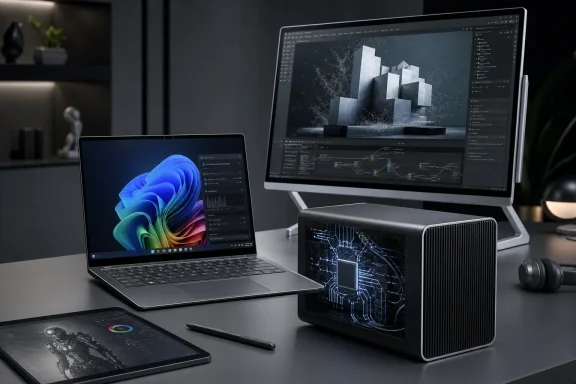
Rather than positioning an Arm-based Surface purely as an ultraportable notebook, Microsoft is preparing a machine built for sustained performance. The device is designed around NVIDIA RTX Spark silicon, combining an Arm CPU with a powerful RTX-class GPU and unified memory architecture.
Microsoft’s stated specifications are striking:
Surface fans have often wanted:
A compelling spec sheet is not the same as a successful workstation-class laptop. Real-world battery endurance, fan noise, driver maturity, application compatibility, heat management, and software stability will matter more than peak AI-compute claims. The same applies to pricing. A device carrying mini-LED, high-capacity unified memory, RTX-class graphics, and a sophisticated thermal solution is unlikely to be inexpensive.
Microsoft is pursuing a premium segment where users may accept a high price, but only if performance and reliability justify it.
This compact desktop is built for developers who need persistent local AI compute without relying entirely on expensive cloud services. It is intended for model experimentation, fine-tuning, inference, coding workflows, and agentic development that can run for extended periods.
Microsoft has positioned the Dev Box as a purpose-built system rather than a generic mini PC. It includes a developer-oriented Windows 11 setup with tools and settings configured for technical work, including Windows Subsystem for Linux support, GPU passthrough, CUDA support, PowerShell 7, Visual Studio Code, Git, Python, Node.js, and other developer-focused defaults.
Historically, the Surface brand was closely associated with portable computing: tablets, convertibles, laptops, compact notebooks, and mobile accessories. The RTX Spark Dev Box shifts the brand toward desk-bound compute infrastructure for AI development.
That does not mean Microsoft is abandoning consumer devices. Instead, it suggests that Surface is becoming more explicitly segmented:
There is a risk, however, that the portfolio becomes confusing. Surface branding has already spanned tablets, laptops, studios, hubs, headphones, earbuds, keyboards, docks, business products, and now AI developer hardware. Clear naming, clear target audiences, and disciplined product positioning will be essential.
The word Ultra helps distinguish the upcoming laptop from the regular Surface Laptop, but it also raises expectations. Buyers will expect a truly different class of performance, not merely a slightly upgraded configuration.
When asked about a standalone Surface Studio display, Ostrum acknowledged that the Surface Studio screen was the most beautiful display Microsoft has ever shipped. The answer was notably complimentary, but it stopped short of confirming any new monitor.
That distinction is crucial.
Still, the acknowledgment is meaningful because Microsoft could have offered a generic answer about evaluating customer feedback. Instead, Ostrum specifically highlighted the appeal of the Surface Studio screen.
That validates what many designers, photographers, illustrators, video editors, and Windows enthusiasts have argued for years: Surface Studio’s display experience deserved a life beyond the all-in-one PC.
The market has no shortage of displays. Buyers can choose from affordable office monitors, high-refresh-rate gaming panels, professional reference displays, ultrawide screens, portable displays, and premium OLED options. Yet a Microsoft-designed display could offer a distinctive combination of hardware, color management, Windows integration, camera capabilities, docking features, and creative input.
A well-executed Surface Studio monitor might include:
Premium monitors are difficult to build because buyers compare specifications relentlessly. Microsoft would need to compete with established display makers on panel quality, refresh rate, brightness, color coverage, connectivity, warranty support, and price. A Surface-branded monitor that costs substantially more than rivals would need clear, practical advantages—not simply attractive industrial design.
There is also the question of touch. Touchscreen monitors remain relatively uncommon on desktop setups, partly because traditional desk ergonomics can make extended touch interaction uncomfortable. Microsoft would need to make touch and pen features valuable enough to justify their inclusion without forcing every buyer to pay for capabilities they will rarely use.
A Surface Studio monitor could be an exceptional product, but it would need to avoid becoming a costly niche accessory with limited reach.
Davuluri’s comment that Microsoft may have a few units “laying around somewhere” was clearly playful. Ostrum followed with the standard reminder that Microsoft does not discuss future Surface roadmaps.
No revival was announced. No compact Surface tablet was confirmed. But the fact that Surface Mini remains a community reference more than a decade after its cancellation says something important about the Surface brand.
That concept has new relevance today.
Modern Windows hardware is more power-efficient than it was during the original Surface Mini era. Pen input is more refined, compact tablets are more capable, and users have grown accustomed to using multiple devices for different contexts. A truly small Windows tablet could appeal to students, field workers, medical professionals, travelers, note-takers, and users who want a flexible digital notebook.
Yet the business case remains difficult.
A compact Windows device must deal with interface scaling, application layouts, keyboard limitations, pricing pressure, and the reality that smartphones and larger tablets already satisfy many portable use cases. Microsoft has also spent years consolidating its Surface portfolio around more defensible categories.
A Surface Mini revival would need a sharply defined purpose. It could not simply be a smaller Surface Pro. It would need a compelling software story, likely centered on pen, AI assistance, communication, note capture, and highly portable Windows workflows.
Possible interpretations range from new accessories and regional availability details to additional RTX Spark devices, refreshed business systems, a monitor, or something entirely unexpected. At this stage, none of those possibilities should be treated as confirmed.
For a period, Surface risked appearing strategically scattered. Product lines evolved, some form factors disappeared, and the relationship between Surface hardware, Windows AI features, and Microsoft’s wider ecosystem was not always obvious.
Now the direction is more coherent.
Local AI processing is not automatically useful simply because a device has a large number attached to an AI-performance metric. But developers, researchers, creators, and enterprises increasingly have reasons to run models locally: privacy, latency, offline resilience, predictable cost, and direct control over sensitive data.
A Windows platform that can support those workflows effectively has real potential.
If Microsoft can use Surface to demonstrate compelling implementations of new chips, AI capabilities, security features, and device experiences, then PC partners can adapt those lessons across more price points and form factors. That is how Surface can influence Windows without trying to become a conventional high-volume PC vendor.
The arrival of RTX Spark systems from multiple manufacturers is critical to this model. Microsoft’s hardware can lead, while the wider ecosystem supplies scale, choice, and market competition.
The Surface Laptop Ultra will be judged on whether it can run real workloads reliably, not whether it can post impressive theoretical AI figures.
Microsoft and its partners must continue improving native Arm software, emulation performance, GPU acceleration, driver support, and developer documentation. Any friction in these areas could slow adoption among exactly the users the device is designed to attract.
The regular Surface Laptop also needs to remain attractive. If the Ultra is dramatically better in essential areas such as ports, display quality, storage serviceability, and thermal design, buyers may wonder why those features are absent from more affordable Surface models.
Microsoft must make the distinction clear: the Ultra should be more capable, not simply the only Surface Laptop configured the way enthusiasts have wanted all along.
The product would need excellent panel quality, meaningful Windows integration, robust connectivity, strong warranty support, and a coherent ecosystem of accessories. It should also work brilliantly with non-Surface devices. A display is a long-term purchase, and buyers will expect flexibility across laptops, desktops, consoles, cameras, and future hardware.
The Surface Studio legacy gives Microsoft a powerful design foundation. It also creates a high bar.
That means Windows on Arm is no longer just about thin, quiet laptops. It is becoming part of a wider effort to support serious local AI computing, demanding development work, and premium creative workflows. The Surface Laptop Ultra and Surface RTX Spark Dev Box are the first major expressions of that effort.
At the same time, Microsoft has not forgotten the passionate community that wants more than another laptop refresh. The Surface Studio monitor request remains alive because it reflects an unmet need: a beautifully engineered Windows display with Microsoft’s own design priorities behind it. The Surface Mini request endures because compact, pen-first computing still has an appeal that mainstream product categories do not fully satisfy.
For now, the real story is not what Microsoft might announce next. It is that Surface once again has a visible mission: make the difficult parts of Windows’ future tangible, then challenge the rest of the PC industry to follow.
The discussion, featuring Microsoft EVP of Windows + Devices Pavan Davuluri and Surface CVP Brett Ostrum, looks back at a busy Surface year while offering carefully measured hints about the months ahead. The most concrete news remains the arrival of the Surface Laptop Ultra and the Surface RTX Spark Dev Box, both due later this year. Yet Ostrum also teased that Microsoft has “a few more surprises” planned before the end of the year.
That phrasing is deliberately broad, and Surface watchers should resist treating it as confirmation of a new monitor, tablet, or revived product category. Still, Microsoft’s decision to directly address requests for a Surface Studio display and the long-cancelled Surface Mini shows that the company understands exactly which gaps matter to its enthusiast audience.
For Windows users, the Q&A is important not because it delivers a surprise product announcement, but because it reveals the role Microsoft wants Surface to play in the next stage of the PC market.
 Surface Is Still Microsoft’s Hardware Laboratory
Surface has never operated quite like a typical laptop manufacturer. Microsoft sells Surface PCs, tablets, accessories, and enterprise hardware, but the division has historically carried another responsibility: demonstrating Windows capabilities before the wider PC ecosystem fully adopts them.Ostrum framed that mission as central to Surface’s future. The business will continue validating meaningful platform advances through its own hardware, much as Surface helped establish the relevance of touch, pen input, detachable keyboards, premium cameras, and Windows Hello biometric sign-in on Windows PCs.
That framing matters because it explains several decisions that can otherwise seem inconsistent. Surface is not necessarily designed to compete across every price band, every screen size, or every form factor at once. Instead, it tends to focus on devices that make a larger argument about Windows.
In past years, those arguments included:
- Windows tablets can support real productivity work
- Pen input belongs on premium PCs
- 2-in-1 devices can replace traditional notebooks for many users
- Facial recognition can be a practical everyday sign-in method
- Premium Windows hardware can match the industrial design ambitions of Apple
- AI-assisted Windows experiences should run locally, not only in the cloud
That is the strategic rationale behind RTX Spark.
Windows on Arm Moves Into a More Demanding Phase
For several years, the Windows on Arm story was primarily associated with mobility. Devices built around Arm-based processors promised long battery life, quieter operation, instant-on behavior, integrated connectivity, and efficient performance in lightweight laptops and tablets.Those benefits remain important. The newly refreshed Surface Pro and Surface Laptop families continue to make the case for Snapdragon X2-based Windows PCs in mainstream premium categories. Surface Pro remains Microsoft’s adaptable 2-in-1 flagship, while Surface Laptop continues to represent the traditional clamshell experience.
But the category has reached a more complicated stage.
From Efficiency to Capability
Windows on Arm cannot rely forever on battery-life claims and elegant hardware alone. For the platform to become genuinely mainstream, it needs to satisfy users who work with serious desktop applications, complicated multitasking environments, development tools, creative software, advanced peripherals, and specialized workflows.That is where the Surface Laptop Ultra becomes significant.
Rather than positioning an Arm-based Surface purely as an ultraportable notebook, Microsoft is preparing a machine built for sustained performance. The device is designed around NVIDIA RTX Spark silicon, combining an Arm CPU with a powerful RTX-class GPU and unified memory architecture.
Microsoft’s stated specifications are striking:
- Up to 128GB of unified memory
- Up to one petaflop of AI compute
- A 15-inch mini-LED PixelSense Ultra display
- Up to 2,000 nits of peak HDR brightness
- A more substantial thermal design for sustained workloads
- USB-C, USB-A, HDMI, full-size SD card reader, and headphone jack
- A large haptic touchpad
- A user-serviceable SSD design
Why the Surface Laptop Ultra Matters
The Surface Laptop Ultra may be Microsoft’s clearest attempt yet to create a high-end Windows notebook that is both a halo product and a platform demonstration. It tackles several long-running criticisms of Surface hardware in a single move.Surface fans have often wanted:
- A more powerful traditional laptop without the compromise of an experimental convertible hinge
- More ports without a collection of adapters
- Better sustained GPU performance
- A larger, more capable display
- Greater memory capacity for professional work
- A Surface device explicitly built for creators and developers
A compelling spec sheet is not the same as a successful workstation-class laptop. Real-world battery endurance, fan noise, driver maturity, application compatibility, heat management, and software stability will matter more than peak AI-compute claims. The same applies to pricing. A device carrying mini-LED, high-capacity unified memory, RTX-class graphics, and a sophisticated thermal solution is unlikely to be inexpensive.
Microsoft is pursuing a premium segment where users may accept a high price, but only if performance and reliability justify it.
RTX Spark Is About More Than One Surface Laptop
The Surface Laptop Ultra is the more visible consumer-facing expression of RTX Spark, but Microsoft’s broader strategy is easier to understand through the Surface RTX Spark Dev Box.This compact desktop is built for developers who need persistent local AI compute without relying entirely on expensive cloud services. It is intended for model experimentation, fine-tuning, inference, coding workflows, and agentic development that can run for extended periods.
Microsoft has positioned the Dev Box as a purpose-built system rather than a generic mini PC. It includes a developer-oriented Windows 11 setup with tools and settings configured for technical work, including Windows Subsystem for Linux support, GPU passthrough, CUDA support, PowerShell 7, Visual Studio Code, Git, Python, Node.js, and other developer-focused defaults.
A Different Kind of Surface Expansion
The Dev Box represents a notable change in Surface’s identity.Historically, the Surface brand was closely associated with portable computing: tablets, convertibles, laptops, compact notebooks, and mobile accessories. The RTX Spark Dev Box shifts the brand toward desk-bound compute infrastructure for AI development.
That does not mean Microsoft is abandoning consumer devices. Instead, it suggests that Surface is becoming more explicitly segmented:
- Surface Pro for adaptable, portable 2-in-1 computing
- Surface Laptop for mainstream premium notebook buyers
- Surface Laptop Ultra for high-performance mobile creators and developers
- Surface RTX Spark Dev Box for local AI development and sustained desktop workloads
There is a risk, however, that the portfolio becomes confusing. Surface branding has already spanned tablets, laptops, studios, hubs, headphones, earbuds, keyboards, docks, business products, and now AI developer hardware. Clear naming, clear target audiences, and disciplined product positioning will be essential.
The word Ultra helps distinguish the upcoming laptop from the regular Surface Laptop, but it also raises expectations. Buyers will expect a truly different class of performance, not merely a slightly upgraded configuration.
The Surface Studio Monitor Question Refuses to Go Away
The most intriguing part of the Q&A may be the brief exchange about Surface peripherals.When asked about a standalone Surface Studio display, Ostrum acknowledged that the Surface Studio screen was the most beautiful display Microsoft has ever shipped. The answer was notably complimentary, but it stopped short of confirming any new monitor.
That distinction is crucial.
Recognition Is Not a Product Roadmap
Microsoft executives often avoid discussing unannounced hardware, and Ostrum’s response followed that pattern. Praising the Surface Studio display is not evidence that a standalone monitor is imminent. The abrupt transition to the next question may fuel speculation, but it should not be mistaken for a teaser.Still, the acknowledgment is meaningful because Microsoft could have offered a generic answer about evaluating customer feedback. Instead, Ostrum specifically highlighted the appeal of the Surface Studio screen.
That validates what many designers, photographers, illustrators, video editors, and Windows enthusiasts have argued for years: Surface Studio’s display experience deserved a life beyond the all-in-one PC.
Why a Surface Studio Monitor Would Make Sense
A modern standalone Surface Studio monitor could occupy a compelling position in the Windows ecosystem.The market has no shortage of displays. Buyers can choose from affordable office monitors, high-refresh-rate gaming panels, professional reference displays, ultrawide screens, portable displays, and premium OLED options. Yet a Microsoft-designed display could offer a distinctive combination of hardware, color management, Windows integration, camera capabilities, docking features, and creative input.
A well-executed Surface Studio monitor might include:
- A high-resolution touchscreen
- Premium color calibration
- Pen support for Surface Slim Pen workflows
- A large 3:2 or similarly productivity-friendly aspect ratio
- Advanced HDR support
- A high-quality webcam with Windows Hello
- USB-C and Thunderbolt-class connectivity
- Integrated USB hub functionality
- Docking support for Surface Laptop and Surface Pro devices
- Adjustable ergonomic positioning
- Premium speakers and microphones
- A modernized dial or haptic accessory ecosystem
The Risks of Re-Entering the Monitor Market
The challenge is not imagining the product. The challenge is shipping it at a sustainable price and scale.Premium monitors are difficult to build because buyers compare specifications relentlessly. Microsoft would need to compete with established display makers on panel quality, refresh rate, brightness, color coverage, connectivity, warranty support, and price. A Surface-branded monitor that costs substantially more than rivals would need clear, practical advantages—not simply attractive industrial design.
There is also the question of touch. Touchscreen monitors remain relatively uncommon on desktop setups, partly because traditional desk ergonomics can make extended touch interaction uncomfortable. Microsoft would need to make touch and pen features valuable enough to justify their inclusion without forcing every buyer to pay for capabilities they will rarely use.
A Surface Studio monitor could be an exceptional product, but it would need to avoid becoming a costly niche accessory with limited reach.
The Surface Mini Still Represents an Unresolved Idea
The Q&A also revisited the legendary Surface Mini, a compact Windows tablet that was reportedly close to launch before being cancelled in 2014.Davuluri’s comment that Microsoft may have a few units “laying around somewhere” was clearly playful. Ostrum followed with the standard reminder that Microsoft does not discuss future Surface roadmaps.
No revival was announced. No compact Surface tablet was confirmed. But the fact that Surface Mini remains a community reference more than a decade after its cancellation says something important about the Surface brand.
Why the Surface Mini Still Has Appeal
The Surface Mini represents a version of the Windows device market that never fully materialized: a small, highly portable tablet optimized for note-taking, reading, sketching, and lightweight productivity.That concept has new relevance today.
Modern Windows hardware is more power-efficient than it was during the original Surface Mini era. Pen input is more refined, compact tablets are more capable, and users have grown accustomed to using multiple devices for different contexts. A truly small Windows tablet could appeal to students, field workers, medical professionals, travelers, note-takers, and users who want a flexible digital notebook.
Yet the business case remains difficult.
A compact Windows device must deal with interface scaling, application layouts, keyboard limitations, pricing pressure, and the reality that smartphones and larger tablets already satisfy many portable use cases. Microsoft has also spent years consolidating its Surface portfolio around more defensible categories.
A Surface Mini revival would need a sharply defined purpose. It could not simply be a smaller Surface Pro. It would need a compelling software story, likely centered on pen, AI assistance, communication, note capture, and highly portable Windows workflows.
More Surprises, But Expectations Need Discipline
Ostrum’s promise of “a few more surprises” before the end of the year is likely to trigger intense speculation. That is inevitable whenever Surface leaders discuss future hardware in public.Possible interpretations range from new accessories and regional availability details to additional RTX Spark devices, refreshed business systems, a monitor, or something entirely unexpected. At this stage, none of those possibilities should be treated as confirmed.
What Microsoft Has Actually Signaled
Microsoft has clearly signaled several things:- Surface Laptop Ultra is still coming later this year.
It is positioned as a high-performance Windows on Arm laptop for demanding professional workloads. - Surface RTX Spark Dev Box is also planned for later this year.
It expands Surface into local AI development hardware. - Surface will continue validating emerging Windows platforms.
Windows on Arm and RTX Spark are currently central to that mission. - Microsoft is listening to requests for a standalone Surface Studio monitor.
Listening is not the same as announcing a product. - Surface Mini remains a known fan request, not a confirmed roadmap item.
The discussion was nostalgic rather than predictive.
The Strength of Microsoft’s New Surface Direction
The strongest aspect of Microsoft’s current approach is its renewed sense of purpose.For a period, Surface risked appearing strategically scattered. Product lines evolved, some form factors disappeared, and the relationship between Surface hardware, Windows AI features, and Microsoft’s wider ecosystem was not always obvious.
Now the direction is more coherent.
A Portfolio Built Around Windows’ Next Technical Challenges
Microsoft is using Surface to address three major Windows challenges:- Can Windows on Arm serve more than everyday productivity users?
- Can local AI workloads become useful without constant cloud dependence?
- Can Windows PCs deliver premium, tightly integrated hardware experiences for technical professionals?
Local AI processing is not automatically useful simply because a device has a large number attached to an AI-performance metric. But developers, researchers, creators, and enterprises increasingly have reasons to run models locally: privacy, latency, offline resilience, predictable cost, and direct control over sensitive data.
A Windows platform that can support those workflows effectively has real potential.
Surface Can Lead Without Owning Every Category
Ostrum’s comments also reinforce an important principle: Surface does not need to dominate PC unit sales to matter.If Microsoft can use Surface to demonstrate compelling implementations of new chips, AI capabilities, security features, and device experiences, then PC partners can adapt those lessons across more price points and form factors. That is how Surface can influence Windows without trying to become a conventional high-volume PC vendor.
The arrival of RTX Spark systems from multiple manufacturers is critical to this model. Microsoft’s hardware can lead, while the wider ecosystem supplies scale, choice, and market competition.
The Challenges Microsoft Cannot Ignore
Ambition alone will not guarantee success. The biggest risks for Microsoft’s Surface future are practical.App Compatibility and Driver Confidence
Windows on Arm has improved, but high-end professional users have little tolerance for uncertainty. Developers and creators rely on specialized tools, plug-ins, peripherals, drivers, codecs, virtual machines, enterprise software, and workflows that may not behave identically across architectures.The Surface Laptop Ultra will be judged on whether it can run real workloads reliably, not whether it can post impressive theoretical AI figures.
Microsoft and its partners must continue improving native Arm software, emulation performance, GPU acceleration, driver support, and developer documentation. Any friction in these areas could slow adoption among exactly the users the device is designed to attract.
Pricing and Product Separation
A powerful Surface Laptop Ultra could become a desirable flagship, but it must avoid colliding awkwardly with gaming laptops, mobile workstations, MacBook Pro systems, and premium creator notebooks from established Windows manufacturers.The regular Surface Laptop also needs to remain attractive. If the Ultra is dramatically better in essential areas such as ports, display quality, storage serviceability, and thermal design, buyers may wonder why those features are absent from more affordable Surface models.
Microsoft must make the distinction clear: the Ultra should be more capable, not simply the only Surface Laptop configured the way enthusiasts have wanted all along.
The Monitor Opportunity Must Be Treated Seriously
If Microsoft eventually launches a Surface Studio monitor, it cannot be a nostalgia project.The product would need excellent panel quality, meaningful Windows integration, robust connectivity, strong warranty support, and a coherent ecosystem of accessories. It should also work brilliantly with non-Surface devices. A display is a long-term purchase, and buyers will expect flexibility across laptops, desktops, consoles, cameras, and future hardware.
The Surface Studio legacy gives Microsoft a powerful design foundation. It also creates a high bar.
A More Focused Future for Surface
Microsoft’s new Surface Q&A offers a more coherent view of the brand than a single product launch could. The future is not centered on a speculative Surface Mini revival or a confirmed standalone Surface Studio monitor. It is centered on Surface acting as the proving ground for the next generation of Windows hardware.That means Windows on Arm is no longer just about thin, quiet laptops. It is becoming part of a wider effort to support serious local AI computing, demanding development work, and premium creative workflows. The Surface Laptop Ultra and Surface RTX Spark Dev Box are the first major expressions of that effort.
At the same time, Microsoft has not forgotten the passionate community that wants more than another laptop refresh. The Surface Studio monitor request remains alive because it reflects an unmet need: a beautifully engineered Windows display with Microsoft’s own design priorities behind it. The Surface Mini request endures because compact, pen-first computing still has an appeal that mainstream product categories do not fully satisfy.
For now, the real story is not what Microsoft might announce next. It is that Surface once again has a visible mission: make the difficult parts of Windows’ future tangible, then challenge the rest of the PC industry to follow.
References
- Primary source: Windows Central
Published: 2026-07-24T17:34:03+00:00
"We've got a few more surprises coming" Microsoft talks what's next for Surface and the people's desire for a Surface Studio monitor in new video | Windows Central
A new Inside Windows Q&A video has been released that dives into the year so far for Surface, what's next, and whether or not we might see some new peripherals soon.www.windowscentral.com - Official source: microsoft.com
Surface Laptop Ultra: The new performance Surface Laptop | Microsoft Surface
Discover the new Surface Laptop Ultra. Built for world makers and creative pros who require cutting-edge AI performance, power, and portability.www.microsoft.com - Official source: news.microsoft.com
微软推出新一代 Surface Pro 与 Surface Laptop,兼顾性能与灵活性 - Source Asia
 news.microsoft.com
- Official source: cdn-dynmedia-1.microsoft.com
msft-echo-Surface-Laptop-for-Business-13.8-15-inch-fact-sheet
PDF documentcdn-dynmedia-1.microsoft.com
- Official source: blogs.windows.com
Building the next generation of devices for developers: Surface RTX Spark Dev Box
Software developers are some of the most ambitious makers we serve. They push devices harder, ask more of their tools and expect their environment to help define the pace of modern software creation. Development today means longer runninblogs.windows.com