

Microsoft announced the Surface Laptop Ultra on May 31, 2026, ahead of Computex in Taipei, positioning the 15-inch Windows 11 machine as its first Surface built around NVIDIA’s new RTX Spark platform with Blackwell graphics, unified memory, CUDA support, and local AI workloads in mind. The device is not merely another premium Surface with a faster chip; it is Microsoft’s most direct attempt yet to give Windows a MacBook Pro-class flagship with a coherent silicon story. The interesting part is not that Microsoft wants to compete with Apple. It is that Microsoft appears to have decided it cannot do that with Intel, AMD, or Qualcomm alone.
For years, Surface has lived with an identity problem. It was aspirational enough to appear in coffee shops and developer demos, but rarely dominant enough to define the upper end of Windows laptops. Microsoft could set design trends, but Apple set the performance-per-watt narrative.
The Surface Laptop Ultra is an admission that the old playbook has run out of runway. A nice chassis, a clean Windows image, and a good keyboard are no longer sufficient when the buyer at the top of the market is asking whether a laptop can cut video, compile code, run models locally, survive a full workday, and stay quiet while doing it.
Microsoft’s pitch is unusually explicit. The company describes creators, developers, and AI builders dealing with “massive scenes, long compile cycles, local models and datasets,” and says the machine was built to meet that work “without flinching.” That is not the language of a lifestyle laptop. It is the language of a workstation trying very hard not to look like one.
The result is a Surface that sounds less like a Surface Laptop Studio successor and more like a declaration that Windows needs its own reference-class mobile workstation. Microsoft has spent the Copilot+ era talking about AI PCs as a category. Surface Laptop Ultra is the first time the company has made that category feel like it might have a serious high-end anchor.
That matters because Windows laptops have historically been a federation of parts. The CPU came from one vendor, the GPU from another, the memory pool was split, the drivers were layered, and the software story depended on how well everyone had behaved that month. Apple’s advantage with the MacBook Pro was never just raw speed; it was that the CPU, GPU, memory, media engines, battery behavior, thermals, and developer framework all looked like one argument.
RTX Spark is NVIDIA’s attempt to make a similar argument for Windows, but with CUDA at the center. Microsoft’s Surface Laptop Ultra is the showcase device for that argument, offering a Blackwell RTX GPU, up to 128GB of unified memory, and full CUDA support. That last phrase is doing a lot of work.
CUDA remains one of NVIDIA’s strongest moats. For AI developers, scientific workloads, 3D rendering pipelines, and many local model workflows, “runs on CUDA” still means “runs where the tools already are.” Apple has Metal, and Apple Silicon is formidable, but the developer gravity around NVIDIA remains enormous.
The catch is that RTX Spark’s success will depend on whether NVIDIA and Microsoft can make the entire Windows experience feel integrated rather than merely powerful. A spec sheet can promise one petaflop of AI compute and local 120-billion-parameter models. A laptop that earns trust has to wake reliably, manage memory intelligently, handle drivers cleanly, and not turn a creative workflow into a thermal negotiation.
The MacBook Pro has become the benchmark because it solved the thing Windows vendors kept treating as optional: consistency. Apple’s machines are not always the fastest in every benchmark and not always the best value, but they are predictable. They offer a clear line from software to silicon to battery life to thermals, and that clarity has become a product feature.
Surface Laptop Ultra attacks that from a different angle. Instead of saying Windows can match Apple by becoming Apple, Microsoft is saying Windows can win by being the best host for NVIDIA’s accelerated computing ecosystem. That is a much more credible argument than simply claiming a thinner chassis or a brighter display.
It is also a risky one. Apple owns its silicon roadmap, its operating system, its laptop design, and its developer frameworks. Microsoft owns Windows and Surface, but NVIDIA owns the most important new ingredient in this machine. If RTX Spark works, Microsoft gets a MacBook Pro-class story almost overnight. If it stumbles, Surface becomes the premium wrapper around someone else’s first-generation experiment.
That dependency is not new for Windows. The platform has always thrived by absorbing partner hardware. What is new is that Microsoft is trying to use a partner’s silicon not just as a component, but as the defining feature of its flagship laptop.
Traditional Windows laptops with discrete GPUs divide system memory and video memory. That model works fine for many games and conventional creator workloads, but it becomes awkward when data sets grow, scenes swell, and AI models need large contiguous pools of memory. Unified memory lets the CPU and GPU access a shared pool, reducing some of the gymnastics required to move data back and forth.
Apple has used unified memory as one of the pillars of Apple Silicon. NVIDIA is now bringing a similar concept into the Windows performance conversation, but with a CUDA-centric twist. That could matter enormously for developers who want to run inference locally, test agents, fine-tune models at the edge, or work with heavy media and 3D assets without immediately reaching for cloud compute.
Still, unified memory is not magic. Bandwidth, latency, allocation behavior, thermals, software support, and pricing will determine whether Surface Laptop Ultra feels like a breakthrough or just an impressive demo machine. A 128GB unified memory configuration will almost certainly be expensive, and the buyers who need it will be the same buyers least impressed by marketing shorthand.
The more interesting question is whether Microsoft will offer enough lower configurations to make the machine broadly desirable without diluting the point of the product. If the base model feels compromised, the Ultra name becomes branding. If the high-end model is priced into mobile workstation territory, Microsoft will need enterprise, developer, and creator buyers to believe this is more than a halo device.
Surface Laptop Ultra could change that. If it delivers credible CUDA performance in a portable machine with a large unified memory pool, it becomes something Microsoft has not really had before: a first-party Windows laptop that can serve as a local AI development box without sounding like a compromise.
That is a strategic shift. Microsoft is trying to make Windows feel like the natural home for developers building AI agents and local model workflows, not merely the endpoint where cloud-backed Copilot features appear. The company’s broader AI strategy depends heavily on Azure, but developers do not live entirely in the cloud. They prototype locally, debug locally, test models locally, and often want to avoid sending sensitive data off-device until the workflow demands it.
NVIDIA benefits just as much. The company already dominates data-center AI acceleration, but RTX Spark gives it a way to push the same ecosystem down into personal computing. If the developer’s laptop, desktop, workstation, and cloud instance all speak NVIDIA fluently, the lock-in becomes less a contract and more a habit.
That is why this machine matters beyond Surface fans. It is a test of whether the Windows laptop can again become the most obvious computer for builders, not just the most compatible one.
The Surface Laptop Ultra reverses that posture. Microsoft says the ports creators need were “picked on purpose,” and that line is worth taking seriously. An SD card slot matters to photographers and videographers. HDMI matters in conference rooms, studios, classrooms, and production setups. USB-A still matters because the real world remains full of equipment that refuses to die on schedule.
This is another way Microsoft is chasing the MacBook Pro rather than the MacBook Air. Apple itself had to walk back the USB-C-only maximalism of the 2016 MacBook Pro era, restoring HDMI, MagSafe, and SD in later models because professional users were right all along. Microsoft appears to have learned that lesson without pretending it invented the answer.
The haptic touchpad, described as the largest ever placed on a Surface, is part of the same argument. Trackpads, ports, displays, and cooling are not side dishes in a professional laptop. They are the places where a premium device either earns its price every day or gradually becomes resented.
Microsoft also emphasizes repairability alongside performance and durability. That is a welcome phrase, but one that deserves skepticism until the hardware is in teardown hands. Surface devices have improved over time, but the line’s reputation was shaped by years of elegant machines that were difficult or impractical to service. If Surface Laptop Ultra genuinely balances high performance, thin design, and repairability, that would be a meaningful break from old Surface habits.
RTX Spark changes the emphasis. This is not Arm as a lightweight alternative to x86. This is Arm as the CPU half of a workstation-class NVIDIA platform. That is a much more aggressive claim, and it puts pressure on Windows to behave like a mature Arm operating system across professional software, drivers, peripherals, development tools, and games.
The risks are obvious. Windows on Arm has made progress, but compatibility remains a lived concern for buyers who depend on niche tools, old plug-ins, hardware utilities, anti-cheat systems, device drivers, and enterprise software that was written for a different era. Emulation can be impressive and still not be the same as native reliability.
For Microsoft, Surface Laptop Ultra is therefore a confidence play. The company is not merely asking users to trust a new Surface. It is asking the most demanding users to trust Windows on Arm with workloads where failure is expensive, embarrassing, or both.
That makes software support just as important as the silicon. Adobe, Autodesk, Blender, Unreal Engine, Visual Studio, Docker workflows, local AI runtimes, game engines, media encoders, VPN clients, endpoint security agents, and enterprise management tools all become part of the review, whether Microsoft wants them to or not.
NVIDIA’s modern advantage is not just silicon. It is CUDA, TensorRT, DLSS, OptiX, Reflex, broadcast tooling, developer libraries, AI frameworks, and years of software expectation. RTX Spark packages that into a form that can sit inside slim laptops and compact desktops, giving OEMs a more integrated story than “we added a discrete GPU.”
That is threatening to several incumbents at once. Intel and AMD have spent decades owning the CPU foundation of Windows PCs. Qualcomm has spent the past few years trying to make Arm-based Windows laptops feel inevitable. Apple has used vertical integration to make the Mac the aspirational professional notebook. RTX Spark barges into all three conversations.
For Microsoft, that is both opportunity and complication. The opportunity is obvious: a Windows flagship that can credibly talk about AI compute, gaming, creator workloads, and development using NVIDIA’s strongest brand assets. The complication is that the center of gravity in the PC may shift further away from Microsoft’s traditional CPU partners.
There is also a market-shaping effect. If ASUS, Dell, HP, Lenovo, MSI, and others ship RTX Spark systems later this year, Surface Laptop Ultra becomes the reference design rather than the only design. That is classic Microsoft: build the aspirational version, let partners flood the market, and hope the category lifts Windows as a whole.
But the Surface brand changes the stakes. If a third-party RTX Spark laptop has rough edges, it is one OEM’s problem. If Surface Laptop Ultra has rough edges, it becomes a Microsoft problem and a Windows-on-Arm problem and an AI-PC problem all at once.
MacBook Pro buyers know broadly what they are getting. They expect long battery life, excellent displays, strong speakers, quiet performance, good trackpads, tight integration with iPhone and iPad, strong media engines, and a software ecosystem that increasingly treats Apple Silicon as the default Mac. That expectation is hard to dislodge with one ambitious Surface.
Surface Laptop Ultra can win in places where Apple is less compelling. CUDA is the obvious one. Local AI developers who already live in NVIDIA tooling may find RTX Spark more useful than Apple’s neural and GPU stack, especially if workflows scale more naturally from laptop to desktop to cloud GPU. Windows also remains the broader gaming platform, the enterprise default in many sectors, and the place where countless legacy tools still live.
But Apple will not stand still. By the time Surface Laptop Ultra ships later this year, MacBook Pro comparisons will likely involve Apple’s current or next-generation silicon roadmap, not just today’s models. Microsoft and NVIDIA will need to beat the product people can buy, not the product that existed when the press release was written.
The more realistic goal is not to kill the MacBook Pro. It is to make the high-end Windows laptop feel like a first-choice machine again. That would be a major achievement by itself.
Pricing will be especially delicate. A 128GB unified memory Surface with a new NVIDIA platform, premium display, large haptic touchpad, and creator-class port selection will not be cheap. If Microsoft prices it like a mobile workstation, it has to perform like one. If it prices it like a MacBook Pro, it has to feel as polished as one.
Availability outside core markets is another open question. The original htxt report rightly notes the uncertainty around an official South African launch. That matters because Surface distribution has long been uneven globally, and a halo device that only ships in a handful of regions cannot fully reshape the Windows laptop story.
Battery life is the other silence. NVIDIA and Microsoft can talk about efficiency, but professional buyers will wait for real measurements under real workloads. A machine that crushes local inference but drains rapidly under mixed creative use may still be valuable, but it will not occupy the same mental category as a MacBook Pro.
Then there is noise. Thin performance laptops often fail not because they are slow, but because they are fast in ways users do not want to live with. Fan behavior, skin temperature, sustained clocks, power profiles, sleep drain, and dock reliability are the mundane details that decide whether a laptop becomes beloved or merely benchmark-famous.
But first-generation platforms are rarely easy sells in conservative environments. IT teams will want driver stability, firmware maturity, predictable imaging, endpoint security compatibility, long support windows, spare parts, repair channels, and clear procurement timelines. A beautiful flagship does not matter if it complicates the standard operating environment.
Windows on Arm adds another layer. Enterprises have x86 assumptions embedded everywhere: line-of-business apps, management scripts, VPN clients, DLP agents, authentication tools, printer drivers, security stacks, and obscure utilities known only to the one person who retired last year. Even if most things work, the exceptions can dominate deployment planning.
Still, the opportunity is real. Local AI is not just a consumer novelty. Regulated industries, design firms, engineering teams, legal departments, researchers, and software organizations all have reasons to experiment with on-device models. A powerful, manageable Windows laptop with CUDA support could become a compelling pilot device for exactly those groups.
Microsoft’s job is to make sure the word “pilot” does not become a polite synonym for “science project.”
Surface Laptop Ultra gives the AI PC a more serious frame. Instead of treating AI as a feature sprinkled over the same laptop categories, it treats local AI as a workload that changes memory needs, software stacks, GPU design, thermal priorities, and developer expectations. That is a much stronger argument.
It also clarifies the split in the market. Some AI PCs are about making ordinary laptops more responsive, private, and efficient when running small on-device features. RTX Spark machines are about making local AI a primary workload. Those are different products for different buyers, and the industry would be better off admitting it.
The Surface Laptop Ultra sits at the expensive, ambitious end of that split. It is for people who might actually care about running large models locally, rendering complex scenes, editing heavy media, compiling substantial projects, or keeping multiple demanding workflows alive at once. Whether that audience is large enough for a major Surface line remains to be seen.
But at least the premise is coherent. For the first time in a while, Microsoft’s premium laptop story is not just “here is a nicer Windows machine.” It is “here is what a Windows machine can do when NVIDIA’s AI and graphics stack becomes the organizing principle.”
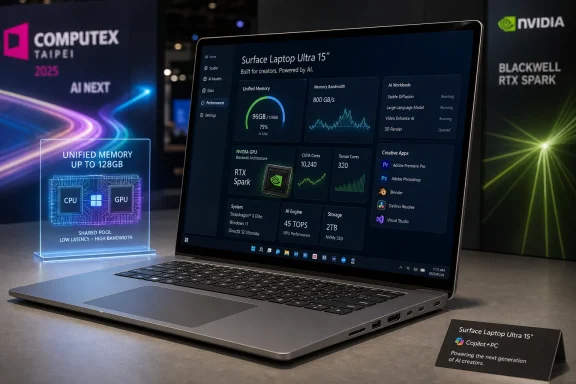 Microsoft Finally Stops Pretending the Surface Laptop Is Enough
For years, Surface has lived with an identity problem. It was aspirational enough to appear in coffee shops and developer demos, but rarely dominant enough to define the upper end of Windows laptops. Microsoft could set design trends, but Apple set the performance-per-watt narrative.The Surface Laptop Ultra is an admission that the old playbook has run out of runway. A nice chassis, a clean Windows image, and a good keyboard are no longer sufficient when the buyer at the top of the market is asking whether a laptop can cut video, compile code, run models locally, survive a full workday, and stay quiet while doing it.
Microsoft’s pitch is unusually explicit. The company describes creators, developers, and AI builders dealing with “massive scenes, long compile cycles, local models and datasets,” and says the machine was built to meet that work “without flinching.” That is not the language of a lifestyle laptop. It is the language of a workstation trying very hard not to look like one.
The result is a Surface that sounds less like a Surface Laptop Studio successor and more like a declaration that Windows needs its own reference-class mobile workstation. Microsoft has spent the Copilot+ era talking about AI PCs as a category. Surface Laptop Ultra is the first time the company has made that category feel like it might have a serious high-end anchor.
RTX Spark Gives Windows the Silicon Story It Has Been Missing
The headline component is NVIDIA RTX Spark, a new Arm-based “superchip” platform announced at Computex 2026 for laptops and compact desktops. NVIDIA’s pitch is blunt: RTX Spark combines a Blackwell RTX GPU, a high-performance Arm CPU, up to 128GB of unified memory, and full NVIDIA software-stack support in a package aimed at personal AI, creation, gaming, and workstation-class local workloads.That matters because Windows laptops have historically been a federation of parts. The CPU came from one vendor, the GPU from another, the memory pool was split, the drivers were layered, and the software story depended on how well everyone had behaved that month. Apple’s advantage with the MacBook Pro was never just raw speed; it was that the CPU, GPU, memory, media engines, battery behavior, thermals, and developer framework all looked like one argument.
RTX Spark is NVIDIA’s attempt to make a similar argument for Windows, but with CUDA at the center. Microsoft’s Surface Laptop Ultra is the showcase device for that argument, offering a Blackwell RTX GPU, up to 128GB of unified memory, and full CUDA support. That last phrase is doing a lot of work.
CUDA remains one of NVIDIA’s strongest moats. For AI developers, scientific workloads, 3D rendering pipelines, and many local model workflows, “runs on CUDA” still means “runs where the tools already are.” Apple has Metal, and Apple Silicon is formidable, but the developer gravity around NVIDIA remains enormous.
The catch is that RTX Spark’s success will depend on whether NVIDIA and Microsoft can make the entire Windows experience feel integrated rather than merely powerful. A spec sheet can promise one petaflop of AI compute and local 120-billion-parameter models. A laptop that earns trust has to wake reliably, manage memory intelligently, handle drivers cleanly, and not turn a creative workflow into a thermal negotiation.
The MacBook Pro Comparison Is the Point, Even If Microsoft Won’t Say It Too Loudly
Microsoft does not need to write “MacBook Pro rival” on the box for everyone to understand the target. A 15-inch premium creator laptop with unified memory, large local AI ambitions, serious GPU compute, a high-end display, a haptic trackpad, creator-friendly ports, and a tightly integrated silicon story is not aiming at a midrange Dell Inspiron. It is aiming directly at Apple’s most lucrative professional notebook narrative.The MacBook Pro has become the benchmark because it solved the thing Windows vendors kept treating as optional: consistency. Apple’s machines are not always the fastest in every benchmark and not always the best value, but they are predictable. They offer a clear line from software to silicon to battery life to thermals, and that clarity has become a product feature.
Surface Laptop Ultra attacks that from a different angle. Instead of saying Windows can match Apple by becoming Apple, Microsoft is saying Windows can win by being the best host for NVIDIA’s accelerated computing ecosystem. That is a much more credible argument than simply claiming a thinner chassis or a brighter display.
It is also a risky one. Apple owns its silicon roadmap, its operating system, its laptop design, and its developer frameworks. Microsoft owns Windows and Surface, but NVIDIA owns the most important new ingredient in this machine. If RTX Spark works, Microsoft gets a MacBook Pro-class story almost overnight. If it stumbles, Surface becomes the premium wrapper around someone else’s first-generation experiment.
That dependency is not new for Windows. The platform has always thrived by absorbing partner hardware. What is new is that Microsoft is trying to use a partner’s silicon not just as a component, but as the defining feature of its flagship laptop.
Unified Memory Is the Real Flex, Not the Petaflop
The “one petaflop” claim will get attention, because large numbers always do. But the more consequential specification is up to 128GB of unified memory. That is the part that explains why Microsoft and NVIDIA are talking about huge scenes, local models, long context windows, and simultaneous AI, rendering, and development workflows.Traditional Windows laptops with discrete GPUs divide system memory and video memory. That model works fine for many games and conventional creator workloads, but it becomes awkward when data sets grow, scenes swell, and AI models need large contiguous pools of memory. Unified memory lets the CPU and GPU access a shared pool, reducing some of the gymnastics required to move data back and forth.
Apple has used unified memory as one of the pillars of Apple Silicon. NVIDIA is now bringing a similar concept into the Windows performance conversation, but with a CUDA-centric twist. That could matter enormously for developers who want to run inference locally, test agents, fine-tune models at the edge, or work with heavy media and 3D assets without immediately reaching for cloud compute.
Still, unified memory is not magic. Bandwidth, latency, allocation behavior, thermals, software support, and pricing will determine whether Surface Laptop Ultra feels like a breakthrough or just an impressive demo machine. A 128GB unified memory configuration will almost certainly be expensive, and the buyers who need it will be the same buyers least impressed by marketing shorthand.
The more interesting question is whether Microsoft will offer enough lower configurations to make the machine broadly desirable without diluting the point of the product. If the base model feels compromised, the Ultra name becomes branding. If the high-end model is priced into mobile workstation territory, Microsoft will need enterprise, developer, and creator buyers to believe this is more than a halo device.
CUDA on a Surface Changes the Developer Conversation
For developers, the most important sentence in Microsoft’s announcement may be the one about full CUDA support. Surface has never been the obvious default for serious GPU compute. It has been elegant, portable, and Microsoft-approved, but not the machine you bought because your AI tooling, simulation pipeline, renderer, or research stack expected NVIDIA acceleration.Surface Laptop Ultra could change that. If it delivers credible CUDA performance in a portable machine with a large unified memory pool, it becomes something Microsoft has not really had before: a first-party Windows laptop that can serve as a local AI development box without sounding like a compromise.
That is a strategic shift. Microsoft is trying to make Windows feel like the natural home for developers building AI agents and local model workflows, not merely the endpoint where cloud-backed Copilot features appear. The company’s broader AI strategy depends heavily on Azure, but developers do not live entirely in the cloud. They prototype locally, debug locally, test models locally, and often want to avoid sending sensitive data off-device until the workflow demands it.
NVIDIA benefits just as much. The company already dominates data-center AI acceleration, but RTX Spark gives it a way to push the same ecosystem down into personal computing. If the developer’s laptop, desktop, workstation, and cloud instance all speak NVIDIA fluently, the lock-in becomes less a contract and more a habit.
That is why this machine matters beyond Surface fans. It is a test of whether the Windows laptop can again become the most obvious computer for builders, not just the most compatible one.
The Ports Tell a Story Microsoft Used to Avoid
Microsoft says Surface Laptop Ultra includes HDMI, USB-C, USB-A, an SD card slot, and a headphone jack. In 2026, that is almost a political statement. The modern premium laptop has spent a decade treating ports as evidence of moral weakness, forcing professionals into dongle chains while pretending minimalism was the same as progress.The Surface Laptop Ultra reverses that posture. Microsoft says the ports creators need were “picked on purpose,” and that line is worth taking seriously. An SD card slot matters to photographers and videographers. HDMI matters in conference rooms, studios, classrooms, and production setups. USB-A still matters because the real world remains full of equipment that refuses to die on schedule.
This is another way Microsoft is chasing the MacBook Pro rather than the MacBook Air. Apple itself had to walk back the USB-C-only maximalism of the 2016 MacBook Pro era, restoring HDMI, MagSafe, and SD in later models because professional users were right all along. Microsoft appears to have learned that lesson without pretending it invented the answer.
The haptic touchpad, described as the largest ever placed on a Surface, is part of the same argument. Trackpads, ports, displays, and cooling are not side dishes in a professional laptop. They are the places where a premium device either earns its price every day or gradually becomes resented.
Microsoft also emphasizes repairability alongside performance and durability. That is a welcome phrase, but one that deserves skepticism until the hardware is in teardown hands. Surface devices have improved over time, but the line’s reputation was shaped by years of elegant machines that were difficult or impractical to service. If Surface Laptop Ultra genuinely balances high performance, thin design, and repairability, that would be a meaningful break from old Surface habits.
Windows on Arm Gets a Very Different Ambassador
Surface Laptop Ultra also reframes Windows on Arm. Until now, the category’s mainstream story has largely been battery life, instant-on behavior, and compatibility gradually getting less annoying. Qualcomm’s Snapdragon X machines pushed Windows closer to Apple-like efficiency, but they did not fully answer the high-end GPU compute question.RTX Spark changes the emphasis. This is not Arm as a lightweight alternative to x86. This is Arm as the CPU half of a workstation-class NVIDIA platform. That is a much more aggressive claim, and it puts pressure on Windows to behave like a mature Arm operating system across professional software, drivers, peripherals, development tools, and games.
The risks are obvious. Windows on Arm has made progress, but compatibility remains a lived concern for buyers who depend on niche tools, old plug-ins, hardware utilities, anti-cheat systems, device drivers, and enterprise software that was written for a different era. Emulation can be impressive and still not be the same as native reliability.
For Microsoft, Surface Laptop Ultra is therefore a confidence play. The company is not merely asking users to trust a new Surface. It is asking the most demanding users to trust Windows on Arm with workloads where failure is expensive, embarrassing, or both.
That makes software support just as important as the silicon. Adobe, Autodesk, Blender, Unreal Engine, Visual Studio, Docker workflows, local AI runtimes, game engines, media encoders, VPN clients, endpoint security agents, and enterprise management tools all become part of the review, whether Microsoft wants them to or not.
NVIDIA Is Not Just Supplying a Chip; It Is Moving Up the PC Stack
The PC industry is used to NVIDIA as the GPU vendor. RTX Spark suggests NVIDIA wants to be something closer to a platform vendor for the AI PC era. That is a major shift, and it explains why the Surface Laptop Ultra announcement feels bigger than a normal component refresh.NVIDIA’s modern advantage is not just silicon. It is CUDA, TensorRT, DLSS, OptiX, Reflex, broadcast tooling, developer libraries, AI frameworks, and years of software expectation. RTX Spark packages that into a form that can sit inside slim laptops and compact desktops, giving OEMs a more integrated story than “we added a discrete GPU.”
That is threatening to several incumbents at once. Intel and AMD have spent decades owning the CPU foundation of Windows PCs. Qualcomm has spent the past few years trying to make Arm-based Windows laptops feel inevitable. Apple has used vertical integration to make the Mac the aspirational professional notebook. RTX Spark barges into all three conversations.
For Microsoft, that is both opportunity and complication. The opportunity is obvious: a Windows flagship that can credibly talk about AI compute, gaming, creator workloads, and development using NVIDIA’s strongest brand assets. The complication is that the center of gravity in the PC may shift further away from Microsoft’s traditional CPU partners.
There is also a market-shaping effect. If ASUS, Dell, HP, Lenovo, MSI, and others ship RTX Spark systems later this year, Surface Laptop Ultra becomes the reference design rather than the only design. That is classic Microsoft: build the aspirational version, let partners flood the market, and hope the category lifts Windows as a whole.
But the Surface brand changes the stakes. If a third-party RTX Spark laptop has rough edges, it is one OEM’s problem. If Surface Laptop Ultra has rough edges, it becomes a Microsoft problem and a Windows-on-Arm problem and an AI-PC problem all at once.
Apple’s Advantage Is No Longer Untouchable, but It Is Still Real
The temptation is to frame this as Microsoft finally building a MacBook Pro killer. That is emotionally satisfying and probably too simple. Apple’s advantage is not a single benchmark target; it is an ecosystem of trust built from years of consistent laptop execution.MacBook Pro buyers know broadly what they are getting. They expect long battery life, excellent displays, strong speakers, quiet performance, good trackpads, tight integration with iPhone and iPad, strong media engines, and a software ecosystem that increasingly treats Apple Silicon as the default Mac. That expectation is hard to dislodge with one ambitious Surface.
Surface Laptop Ultra can win in places where Apple is less compelling. CUDA is the obvious one. Local AI developers who already live in NVIDIA tooling may find RTX Spark more useful than Apple’s neural and GPU stack, especially if workflows scale more naturally from laptop to desktop to cloud GPU. Windows also remains the broader gaming platform, the enterprise default in many sectors, and the place where countless legacy tools still live.
But Apple will not stand still. By the time Surface Laptop Ultra ships later this year, MacBook Pro comparisons will likely involve Apple’s current or next-generation silicon roadmap, not just today’s models. Microsoft and NVIDIA will need to beat the product people can buy, not the product that existed when the press release was written.
The more realistic goal is not to kill the MacBook Pro. It is to make the high-end Windows laptop feel like a first-choice machine again. That would be a major achievement by itself.
The Missing Details Are the Details That Decide Everything
For all the excitement, Microsoft has not yet shared the two details that turn a concept into a buying decision: price and availability. The company says Surface Laptop Ultra is coming later this year, and other RTX Spark systems from major PC makers are expected in the same broad window. That is enough to start the hype cycle, not enough to close a purchase order.Pricing will be especially delicate. A 128GB unified memory Surface with a new NVIDIA platform, premium display, large haptic touchpad, and creator-class port selection will not be cheap. If Microsoft prices it like a mobile workstation, it has to perform like one. If it prices it like a MacBook Pro, it has to feel as polished as one.
Availability outside core markets is another open question. The original htxt report rightly notes the uncertainty around an official South African launch. That matters because Surface distribution has long been uneven globally, and a halo device that only ships in a handful of regions cannot fully reshape the Windows laptop story.
Battery life is the other silence. NVIDIA and Microsoft can talk about efficiency, but professional buyers will wait for real measurements under real workloads. A machine that crushes local inference but drains rapidly under mixed creative use may still be valuable, but it will not occupy the same mental category as a MacBook Pro.
Then there is noise. Thin performance laptops often fail not because they are slow, but because they are fast in ways users do not want to live with. Fan behavior, skin temperature, sustained clocks, power profiles, sleep drain, and dock reliability are the mundane details that decide whether a laptop becomes beloved or merely benchmark-famous.
Enterprise IT Will See Promise Wrapped in Risk
For IT departments, Surface Laptop Ultra is both intriguing and awkward. It promises a portable Windows machine capable of local AI and creator workloads that might otherwise require a workstation, cloud GPU instance, or specialized desktop. That could help organizations keep sensitive data local, reduce cloud costs for some workflows, and give developers more capable machines without leaving the managed Windows ecosystem.But first-generation platforms are rarely easy sells in conservative environments. IT teams will want driver stability, firmware maturity, predictable imaging, endpoint security compatibility, long support windows, spare parts, repair channels, and clear procurement timelines. A beautiful flagship does not matter if it complicates the standard operating environment.
Windows on Arm adds another layer. Enterprises have x86 assumptions embedded everywhere: line-of-business apps, management scripts, VPN clients, DLP agents, authentication tools, printer drivers, security stacks, and obscure utilities known only to the one person who retired last year. Even if most things work, the exceptions can dominate deployment planning.
Still, the opportunity is real. Local AI is not just a consumer novelty. Regulated industries, design firms, engineering teams, legal departments, researchers, and software organizations all have reasons to experiment with on-device models. A powerful, manageable Windows laptop with CUDA support could become a compelling pilot device for exactly those groups.
Microsoft’s job is to make sure the word “pilot” does not become a polite synonym for “science project.”
The AI PC Finally Gets a Machine Worth Arguing About
The “AI PC” label has often felt like a marketing department searching for a product. NPUs arrived, Copilot keys appeared, and vendors spent a year insisting that the next laptop refresh was historic because it could run background effects more efficiently. The result was technically important, but emotionally thin.Surface Laptop Ultra gives the AI PC a more serious frame. Instead of treating AI as a feature sprinkled over the same laptop categories, it treats local AI as a workload that changes memory needs, software stacks, GPU design, thermal priorities, and developer expectations. That is a much stronger argument.
It also clarifies the split in the market. Some AI PCs are about making ordinary laptops more responsive, private, and efficient when running small on-device features. RTX Spark machines are about making local AI a primary workload. Those are different products for different buyers, and the industry would be better off admitting it.
The Surface Laptop Ultra sits at the expensive, ambitious end of that split. It is for people who might actually care about running large models locally, rendering complex scenes, editing heavy media, compiling substantial projects, or keeping multiple demanding workflows alive at once. Whether that audience is large enough for a major Surface line remains to be seen.
But at least the premise is coherent. For the first time in a while, Microsoft’s premium laptop story is not just “here is a nicer Windows machine.” It is “here is what a Windows machine can do when NVIDIA’s AI and graphics stack becomes the organizing principle.”
The Surface Ultra Bet Comes Down to Five Hard Tests
Microsoft and NVIDIA have made the Surface Laptop Ultra sound like a turning point, but the market will judge it by less glamorous measures. The machine has to be fast, yes, but it also has to be boring in the best possible way: reliable, compatible, serviceable, and predictable under pressure.- Surface Laptop Ultra is Microsoft’s clearest attempt yet to build a first-party Windows alternative to the MacBook Pro rather than another premium general-purpose laptop.
- RTX Spark’s unified memory and CUDA support are more important to the product’s identity than any single headline AI-performance number.
- Windows on Arm will be judged by professional compatibility, not by how well the launch demos run.
- The creator-friendly port selection suggests Microsoft is prioritizing practical workstation behavior over minimalist laptop fashion.
- Price, battery life, fan noise, sustained performance, and global availability will determine whether this becomes a serious category shift or a polished halo product.
- Enterprise buyers will be interested in local AI capability, but they will not forgive immature drivers, weak management support, or fragile software compatibility.
References
- Primary source: htxt.co.za
Published: Mon, 01 Jun 2026 10:51:15 GMT
Loading…
htxt.co.za - Related coverage: investor.nvidia.com

NVIDIA and Microsoft Reinvent Windows PCs for the Age of Personal AI
RTX Spark — a 1-Petaflop Superchip, the Full CUDA and RTX Ecosystem, and Windows-Native Agents — a New Beginning for Personal Computers News Summary: NVIDIA RTX Spark powers the world’s first Windows PCs purpose-built for personal agents, featuring 1 petaflop of AI performance, industry-leading...investor.nvidia.com
- Related coverage: windowscentral.com
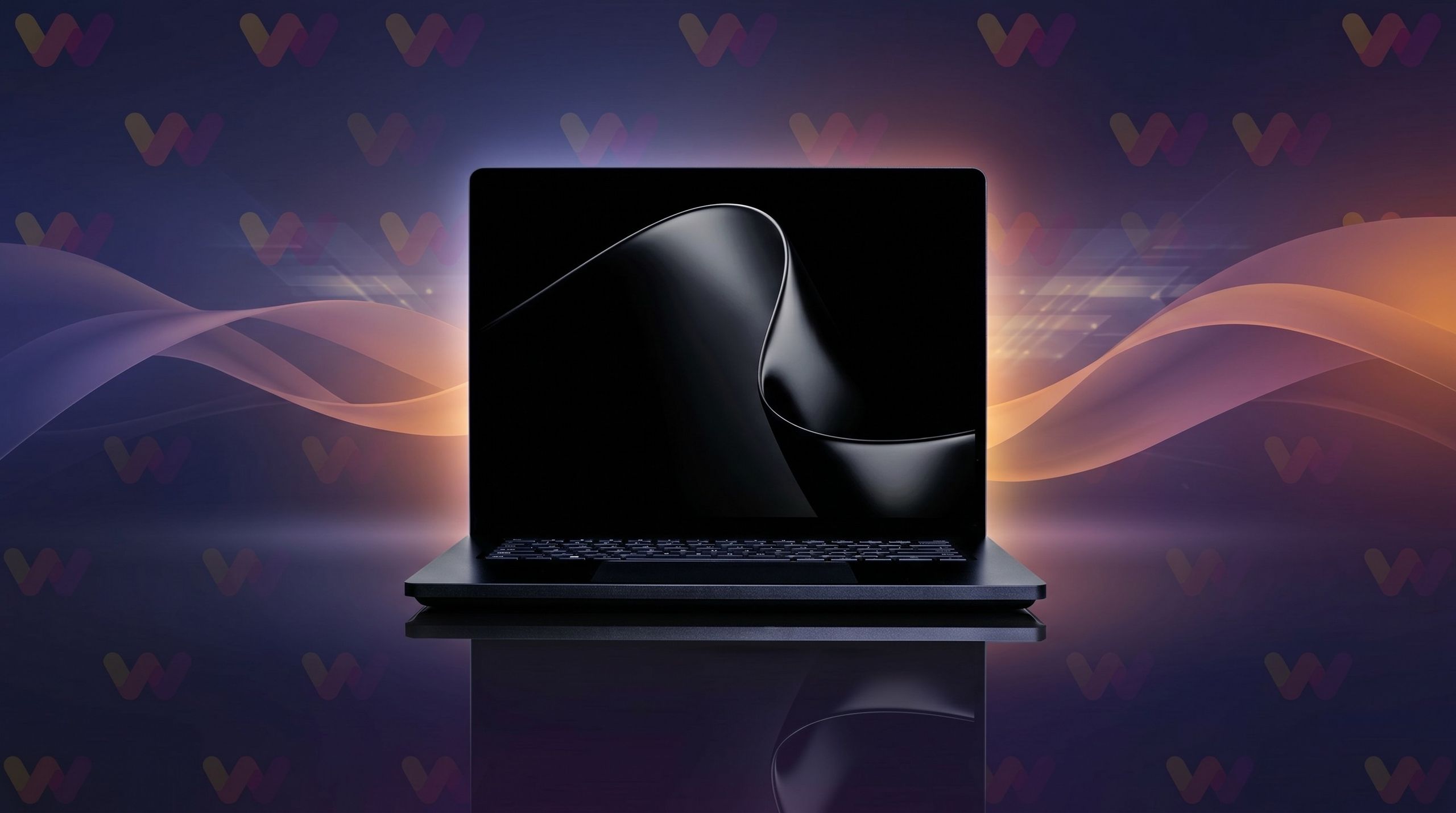
Microsoft and NVIDIA’s Surface Laptop Ultra pushes Windows on Arm into high‑performance territory
Microsoft and NVIDIA unveil the Surface Laptop Ultra, a 128GB RAM beast with Blackwell graphics and a mini-LED display that redefines performance for Windows on Arm. www.windowscentral.com
- Related coverage: windowslatest.com

Microsoft builds its ultimate MacBook Pro rival with the NVIDIA powered Surface Laptop Ultra
Microsoft launches the Surface Laptop Ultra with an NVIDIA RTX Spark chip and 128GB unified memory to challenge Apple MacBook Pro dominance. www.windowslatest.com
- Related coverage: tomshardware.com

Nvidia unveils RTX Spark Superchip for laptops and desktop PCs at Computex 2026 – new platform promises to turn Windows into an agentic AI OS with Arm CPU, Blackwell GPU, and 128GB unified memory
Over 30 laptops and 10 desktops coming this fall with "the most efficent platform ever built"www.tomshardware.com
- Related coverage: axios.com

Microsoft debuts Nvidia-powered Microsoft Surface Ultra laptop
Microsoft is trying again to redefine the PC for the AI era.www.axios.com
- Related coverage: notebookcheck.net

Surface Laptop Ultra: Microsoft shows off powerful laptop with RTX Spark and mini-LED screen
Microsoft has shown off its RTX Spark-powered Surface Laptop Ultra. It is expected to launch later this year with some impressive specifications. www.notebookcheck.net
- Related coverage: ixbt.com
Loading…
www.ixbt.com - Related coverage: phoronix.com
Loading…
www.phoronix.com - Related coverage: 01net.com
Loading…
www.01net.com - Related coverage: macrumors.com
Loading…
www.macrumors.com - Related coverage: signal65.com
Loading…
signal65.com - Official source: news.microsoft.com
Loading…
news.microsoft.com