

Microsoft announced on June 16, 2026, that Snapdragon X2 versions of the Surface Pro 12 and Surface Laptop 8 will ship for both consumers and business customers, with Surface for Business availability beginning July 14 and carrying enterprise-only options that raise the price. The important part is not simply that Qualcomm silicon is coming to Microsoft’s commercial Surface line. It is that the old Surface split — ARM for consumers, Intel for businesses — is collapsing into something more strategic. Microsoft is no longer selling business buyers a different chip story; it is selling them a different ownership model.
For the past two years, Microsoft’s Surface lineup has been unusually easy to misunderstand. The consumer machines became the public face of Windows on Arm, while the business machines remained the safe harbor for IT departments that wanted Intel compatibility, Windows 11 Pro, and familiar fleet management. That split made sense during the first Copilot+ PC wave, when Microsoft needed Snapdragon to carry the AI PC marketing story without asking enterprise buyers to swallow every risk at once.
The Snapdragon X2 Surface for Business announcement changes the meaning of that split. If the same processor family is available on both sides of the aisle, then “consumer” and “business” no longer map neatly to “ARM” and “Intel.” The extra money buys enterprise plumbing: warranty channels, deployment hooks, device management features, security defaults, and configuration options that matter more to a procurement officer than to a spec-sheet shopper.
That distinction is less glamorous than a new chip, but it is more important. Surface for Business is not just a premium SKU with a different box label. It is Microsoft’s argument that hardware, firmware, identity, deployment, and service should be purchased as one bundle, especially in an era when PCs are expected to be AI endpoints, security boundaries, and managed cloud assets at the same time.
The result is a sharper purchasing question. A consumer who wants a Snapdragon X2 Surface probably should not wander into the business catalog unless they know exactly why they are paying more. A company that buys hundreds or thousands of devices, however, may find that the price delta is not a markup so much as an insurance policy.
But the more telling move is that Surface for Business is not being kept on the Intel side of the fence. Microsoft is giving commercial customers the choice it previously made for them. That matters because enterprise IT is not a monolith: some organizations need x86 predictability, some care more about battery life and thermals, and some are ready to standardize on Arm if the management layer looks familiar enough.
This is why the Surface Pro 12 for Business and Surface Laptop 8 for Business are not merely “the expensive ones.” They are the machines Microsoft uses to court organizations that do not buy PCs one at a time. Those buyers care about whether the device can be enrolled before it reaches the employee, whether firmware settings can be governed from the cloud, whether the OS image aligns with corporate policy, and whether a broken laptop can be swapped with minimal downtime.
The consumer Surface buyer mostly experiences the device after unboxing. The business buyer experiences it before purchase, during procurement, through deployment, across years of support, and finally at retirement. Snapdragon X2 may make the device faster and more efficient, but it does not erase the operational burden around the device. That is where the business premium lives.
Microsoft’s integrated privacy screen option is the kind of feature that turns enterprise design into consumer temptation. Anyone who has worked on a plane, in a train station, or at a crowded café understands the problem. A display that narrows viewing angles on demand is not just a compliance nicety; it is a practical defense against shoulder surfing.
That is why this feature has become the emotional center of the Surface for Business value proposition. The business case is obvious: legal teams, finance departments, health care workers, sales staff, executives, consultants, and field employees all handle information that should not be visible to the person sitting nearby. But the consumer case is obvious too, which makes its business-only status feel slightly artificial.
Microsoft is walking a familiar line here. Enterprise features often arrive first where margins are higher and purchasing criteria are more formal. If the privacy screen proves popular, it would not be surprising to see the idea drift into mainstream Surface models later. For now, though, it gives the business machines something the consumer models lack that is not reducible to CPU choice.
That makes the inclusion of Windows 11 Pro or Enterprise less of a perk than a declaration of intended use. A Surface for Business device is meant to join a managed environment. It is meant to be controlled by policy, provisioned through enterprise workflows, and treated as a corporate asset rather than a personal gadget that happens to run Office.
Consumers can pay to upgrade a retail Surface to Windows 11 Pro, and some power users will. But that is not the same as buying into the business channel. The OS edition is only one layer of the commercial package. The deeper value is that the device, firmware, warranty, and enrollment path are all aligned with IT’s expectations from the start.
That matters because the modern Windows PC is no longer a self-contained purchase. It is an endpoint in an identity system, a node in a compliance posture, and often a target in a security audit. Windows 11 Pro opens the door, but the Surface for Business program is designed to make the whole device walk through it cleanly.
That is the crucial distinction. A consumer Surface is purchased, shipped, opened, personalized, and used. A business Surface may be ordered in bulk, assigned to a user, enrolled before delivery, configured automatically, restricted according to policy, monitored through a management portal, repaired under a corporate warranty plan, and eventually wiped or redeployed.
In that world, setup time is money. Every manual step introduces cost and risk. Every deviation from the standard build gives the help desk another branch in the troubleshooting tree. Microsoft’s business extras are a way of converting messy human processes into predictable workflows.
This is also why the price difference can look irrational to a consumer and perfectly reasonable to an enterprise. If a device costs more but reduces deployment time, shortens downtime, or avoids a support escalation, the math changes. The buyer is not only comparing laptops; they are comparing the total cost of keeping a fleet alive.
Cloud-based firmware control lets organizations restrict hardware behaviors without relying on users to respect local settings. That can include locking down boot options, cameras, radios, ports, or other platform-level capabilities depending on device support and policy. In regulated industries, those controls are not hypothetical. They are part of proving that devices are configured according to organizational rules.
The rise of AI PCs makes this even more relevant. As more sensitive work happens locally — whether through on-device models, cached data, biometric authentication, or privileged workflows — the physical device becomes a more important trust boundary. Microsoft’s commercial pitch is that Surface for Business gives administrators more ways to define and preserve that boundary.
Consumers rarely buy firmware governance. Businesses sometimes cannot operate responsibly without it. That is the quiet logic behind Microsoft’s segmentation: the same laptop can be a personal productivity device or a managed endpoint, but the second role demands a deeper control plane.
Pre-registration matters because it moves device identity upstream. The PC can be associated with the organization before the user receives it. When the employee signs in, the device can enroll, apply policy, install required apps, and land in a known state without an administrator touching it.
That is not just convenience. It is resilience. Companies with distributed staff, contractors, branch offices, and rapid hiring cycles need hardware logistics that do not depend on a central imaging room. The Surface for Business premium buys into that model.
This is also where Microsoft’s hardware ambitions and cloud ambitions meet. Surface is not merely competing with Dell, HP, and Lenovo on industrial design. It is competing on how tightly the PC can fit into Microsoft 365, Entra ID, Intune, Defender, and the broader management stack. The device becomes another expression of the Microsoft cloud.
Compatibility still matters. Many Windows applications now run well on Arm, and emulation has improved dramatically, but enterprise environments are full of old drivers, niche utilities, VPN clients, security agents, hardware dongles, and line-of-business software that can turn architecture purity into a support nightmare. The question is not whether Arm is good enough in general. The question is whether it is good enough for a specific organization’s weirdest dependency.
By offering both Intel and Snapdragon X2 in the business catalog, Microsoft is admitting reality without surrendering the future. Intel remains the known quantity, especially where peripheral support, specialized software, and conservative certification processes dominate. Snapdragon becomes the efficient, modern, Copilot+ aligned option for organizations whose workloads fit.
That is a healthier strategy than pretending one chip can satisfy every customer. It lets Microsoft sell Arm as a choice rather than a crusade. For IT departments, choice is not indecision; it is risk management.
The privacy screen is the exception. A consumer who desperately wants that feature may decide the premium is worth it. The same goes for someone who specifically wants Windows 11 Pro preinstalled, prefers commercial warranty terms, or needs a configuration that Microsoft reserves for business buyers.
But for most individuals, the extra cost buys capabilities they will never use. Autopilot tenant registration does nothing for a household. DFCI cloud management is pointless without an organization behind it. Enterprise onboarding pathways are not meaningful if the device will be linked to a personal Microsoft account and used like any other laptop.
That is the point Microsoft appears to be making with the new lineup. Surface for Business is not meant to be a secret enthusiast tier. It is meant to be a different sales channel for a different lifecycle. The closer the consumer and business machines get in silicon, the more obvious the non-silicon differences become.
That is a difficult position to market to consumers because it sounds like paperwork. It is easier to sell a thinner chassis or a faster benchmark. Yet in the commercial market, the paperwork is the product. Procurement teams care about service terms. Security teams care about control. Help desks care about standardization. Finance teams care about lifecycle cost.
This is why the Snapdragon X2 announcement should not be read as Microsoft simply catching up its business line to its consumer line. It is more like Microsoft normalizing Arm across the portfolio while reserving the deepest operational hooks for the customers that can pay for them. The same chip can serve different strategies depending on the management wrapper around it.
Surface has always occupied an awkward place in the PC market. It is both a Microsoft reference design and a commercial product. With Surface for Business, that awkwardness becomes useful. Microsoft can demonstrate what a fully Microsoft-aligned Windows endpoint looks like, then let OEM partners compete around, against, or alongside that model.
That makes Surface for Business an important test bed. If AI features become more central to Windows, then business buyers will need clearer lines between useful local intelligence and unacceptable data exposure. The device’s security posture, management tooling, and update cadence become part of the AI story.
Snapdragon X2’s neural processing capabilities may be the marketing engine, but enterprise trust will depend on policy. A faster NPU is not enough if administrators cannot control what features are enabled, which data is indexed, where outputs are stored, or how updates change behavior over time. The hardware unlocks possibilities; management decides whether those possibilities are deployable.
Microsoft knows this. The company’s greatest advantage in enterprise AI PCs is not that it makes the Surface. It is that it controls Windows, Microsoft 365, identity, endpoint management, and security tooling around it. Surface for Business is the place where those pieces can be packaged as a single argument.
Surface is rarely the cheapest way to buy a managed Windows fleet. Dell, HP, Lenovo, and others have mature enterprise programs, broad configuration ranges, repair networks, and procurement relationships that Microsoft must compete against. Surface’s advantage is not always price; it is coherence. The question is whether that coherence is worth paying for in a given organization.
For some companies, the answer will be yes. Standardizing on Surface may simplify executive fleets, high-mobility teams, regulated departments, or organizations already deeply invested in Microsoft’s management stack. For others, the premium may be hard to justify when comparable business laptops offer similar serviceability, broader ports, or better bulk pricing.
That tension is healthy. Microsoft should have to prove that its vertical integration produces operational benefits, not merely nicer product pages. The Snapdragon X2 business launch gives it another chance to make that case.
The timing matters because evaluation cycles are slow. A commercial Surface does not become a standard device because it looks good in a launch video. It has to survive app compatibility testing, security review, deployment validation, accessory checks, battery-life trials, support modeling, and executive preference.
For organizations already considering a Surface refresh, the best move is not to treat Snapdragon X2 as a universal replacement for Intel. It is to segment users by workload. Knowledge workers who live in Microsoft 365, browsers, Teams, and modern apps may be excellent candidates for Arm. Users tied to legacy software, specialized drivers, or hardware peripherals may remain better served by Intel.
That kind of segmentation is not glamorous, but it is how successful PC transitions happen. Architecture shifts fail when they are treated as ideology. They work when IT maps the device to the job.
Microsoft’s Surface strategy is getting less confusing precisely because the chip story is becoming less exclusive. Snapdragon X2 coming to Surface for Business means the old ARM-versus-Intel shorthand no longer explains the lineup; management does. The extra money gets you a PC that is easier to govern, easier to deploy, and better aligned with Microsoft’s enterprise stack — and as Windows PCs become AI endpoints as much as productivity machines, that control layer may become the real product Microsoft is selling.
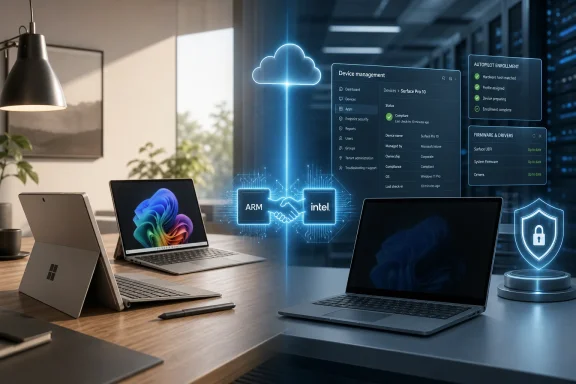 Microsoft Turns the Surface Split Into a Procurement Strategy
For the past two years, Microsoft’s Surface lineup has been unusually easy to misunderstand. The consumer machines became the public face of Windows on Arm, while the business machines remained the safe harbor for IT departments that wanted Intel compatibility, Windows 11 Pro, and familiar fleet management. That split made sense during the first Copilot+ PC wave, when Microsoft needed Snapdragon to carry the AI PC marketing story without asking enterprise buyers to swallow every risk at once.The Snapdragon X2 Surface for Business announcement changes the meaning of that split. If the same processor family is available on both sides of the aisle, then “consumer” and “business” no longer map neatly to “ARM” and “Intel.” The extra money buys enterprise plumbing: warranty channels, deployment hooks, device management features, security defaults, and configuration options that matter more to a procurement officer than to a spec-sheet shopper.
That distinction is less glamorous than a new chip, but it is more important. Surface for Business is not just a premium SKU with a different box label. It is Microsoft’s argument that hardware, firmware, identity, deployment, and service should be purchased as one bundle, especially in an era when PCs are expected to be AI endpoints, security boundaries, and managed cloud assets at the same time.
The result is a sharper purchasing question. A consumer who wants a Snapdragon X2 Surface probably should not wander into the business catalog unless they know exactly why they are paying more. A company that buys hundreds or thousands of devices, however, may find that the price delta is not a markup so much as an insurance policy.
The Chip Is the Headline, but It Is No Longer the Divider
Snapdragon X2 matters because Microsoft has spent years trying to make Windows on Arm feel less like a compatibility experiment and more like a default option. The first Snapdragon X generation gave Copilot+ PCs a credible battery-life and efficiency story. X2 is Microsoft’s chance to make that story less fragile, with better performance, stronger graphics, and a broader set of machines arriving without the sense that buyers are opting into a side quest.But the more telling move is that Surface for Business is not being kept on the Intel side of the fence. Microsoft is giving commercial customers the choice it previously made for them. That matters because enterprise IT is not a monolith: some organizations need x86 predictability, some care more about battery life and thermals, and some are ready to standardize on Arm if the management layer looks familiar enough.
This is why the Surface Pro 12 for Business and Surface Laptop 8 for Business are not merely “the expensive ones.” They are the machines Microsoft uses to court organizations that do not buy PCs one at a time. Those buyers care about whether the device can be enrolled before it reaches the employee, whether firmware settings can be governed from the cloud, whether the OS image aligns with corporate policy, and whether a broken laptop can be swapped with minimal downtime.
The consumer Surface buyer mostly experiences the device after unboxing. The business buyer experiences it before purchase, during procurement, through deployment, across years of support, and finally at retirement. Snapdragon X2 may make the device faster and more efficient, but it does not erase the operational burden around the device. That is where the business premium lives.
The Privacy Screen Is the Rare Enterprise Feature Consumers Will Actually Want
Most business-only PC features are invisible when they work. Autopilot registration is not something a coffee-shop customer envies. Firmware policy controls do not sell many laptops on a retail shelf. A privacy screen, however, is different: it is immediately understandable, physically useful, and easy to want even if you have never administered a tenant in your life.Microsoft’s integrated privacy screen option is the kind of feature that turns enterprise design into consumer temptation. Anyone who has worked on a plane, in a train station, or at a crowded café understands the problem. A display that narrows viewing angles on demand is not just a compliance nicety; it is a practical defense against shoulder surfing.
That is why this feature has become the emotional center of the Surface for Business value proposition. The business case is obvious: legal teams, finance departments, health care workers, sales staff, executives, consultants, and field employees all handle information that should not be visible to the person sitting nearby. But the consumer case is obvious too, which makes its business-only status feel slightly artificial.
Microsoft is walking a familiar line here. Enterprise features often arrive first where margins are higher and purchasing criteria are more formal. If the privacy screen proves popular, it would not be surprising to see the idea drift into mainstream Surface models later. For now, though, it gives the business machines something the consumer models lack that is not reducible to CPU choice.
Windows 11 Pro Is Table Stakes, Not a Luxury Badge
Windows 11 Pro is one of those upgrades that looks boring until you need it. For home users, Windows 11 Home is usually enough. For businesses, Pro is the minimum viable edition because it supports the management, security, and identity features that modern organizations expect.That makes the inclusion of Windows 11 Pro or Enterprise less of a perk than a declaration of intended use. A Surface for Business device is meant to join a managed environment. It is meant to be controlled by policy, provisioned through enterprise workflows, and treated as a corporate asset rather than a personal gadget that happens to run Office.
Consumers can pay to upgrade a retail Surface to Windows 11 Pro, and some power users will. But that is not the same as buying into the business channel. The OS edition is only one layer of the commercial package. The deeper value is that the device, firmware, warranty, and enrollment path are all aligned with IT’s expectations from the start.
That matters because the modern Windows PC is no longer a self-contained purchase. It is an endpoint in an identity system, a node in a compliance posture, and often a target in a security audit. Windows 11 Pro opens the door, but the Surface for Business program is designed to make the whole device walk through it cleanly.
The Real Premium Is Paid Before the Employee Opens the Box
The least consumer-friendly features of Surface for Business may be the most important ones. Windows Autopilot tenant pre-registration, Device Firmware Configuration Interface management, native corporate domain onboarding, and access to Microsoft’s Surface Management Portal are not designed to delight an individual buyer. They are designed to remove friction from IT operations at scale.That is the crucial distinction. A consumer Surface is purchased, shipped, opened, personalized, and used. A business Surface may be ordered in bulk, assigned to a user, enrolled before delivery, configured automatically, restricted according to policy, monitored through a management portal, repaired under a corporate warranty plan, and eventually wiped or redeployed.
In that world, setup time is money. Every manual step introduces cost and risk. Every deviation from the standard build gives the help desk another branch in the troubleshooting tree. Microsoft’s business extras are a way of converting messy human processes into predictable workflows.
This is also why the price difference can look irrational to a consumer and perfectly reasonable to an enterprise. If a device costs more but reduces deployment time, shortens downtime, or avoids a support escalation, the math changes. The buyer is not only comparing laptops; they are comparing the total cost of keeping a fleet alive.
Firmware Management Is the Unsexy Security Story
Device Firmware Configuration Interface, or DFCI, is exactly the sort of acronym that causes normal people to stop reading. But for administrators, firmware management is one of the places where endpoint security becomes real. It governs settings below the operating system, where mistakes can be harder to see and harder to remediate.Cloud-based firmware control lets organizations restrict hardware behaviors without relying on users to respect local settings. That can include locking down boot options, cameras, radios, ports, or other platform-level capabilities depending on device support and policy. In regulated industries, those controls are not hypothetical. They are part of proving that devices are configured according to organizational rules.
The rise of AI PCs makes this even more relevant. As more sensitive work happens locally — whether through on-device models, cached data, biometric authentication, or privileged workflows — the physical device becomes a more important trust boundary. Microsoft’s commercial pitch is that Surface for Business gives administrators more ways to define and preserve that boundary.
Consumers rarely buy firmware governance. Businesses sometimes cannot operate responsibly without it. That is the quiet logic behind Microsoft’s segmentation: the same laptop can be a personal productivity device or a managed endpoint, but the second role demands a deeper control plane.
Autopilot Makes the Box Part of the Cloud
Windows Autopilot is one of Microsoft’s most important answers to the modern workforce. Hybrid work weakened the old model in which every device passed through an IT bench before reaching an employee. Autopilot turns provisioning into a cloud-mediated process, allowing a machine to become corporate-ready as part of first boot.Pre-registration matters because it moves device identity upstream. The PC can be associated with the organization before the user receives it. When the employee signs in, the device can enroll, apply policy, install required apps, and land in a known state without an administrator touching it.
That is not just convenience. It is resilience. Companies with distributed staff, contractors, branch offices, and rapid hiring cycles need hardware logistics that do not depend on a central imaging room. The Surface for Business premium buys into that model.
This is also where Microsoft’s hardware ambitions and cloud ambitions meet. Surface is not merely competing with Dell, HP, and Lenovo on industrial design. It is competing on how tightly the PC can fit into Microsoft 365, Entra ID, Intune, Defender, and the broader management stack. The device becomes another expression of the Microsoft cloud.
Intel Remains the Compatibility Escape Hatch
The arrival of Snapdragon X2 in business Surface PCs does not make Intel irrelevant. In fact, the continued availability of Intel models may be one of the reasons Microsoft can push Arm harder. Enterprises are more willing to evaluate a new architecture when they know they are not being trapped.Compatibility still matters. Many Windows applications now run well on Arm, and emulation has improved dramatically, but enterprise environments are full of old drivers, niche utilities, VPN clients, security agents, hardware dongles, and line-of-business software that can turn architecture purity into a support nightmare. The question is not whether Arm is good enough in general. The question is whether it is good enough for a specific organization’s weirdest dependency.
By offering both Intel and Snapdragon X2 in the business catalog, Microsoft is admitting reality without surrendering the future. Intel remains the known quantity, especially where peripheral support, specialized software, and conservative certification processes dominate. Snapdragon becomes the efficient, modern, Copilot+ aligned option for organizations whose workloads fit.
That is a healthier strategy than pretending one chip can satisfy every customer. It lets Microsoft sell Arm as a choice rather than a crusade. For IT departments, choice is not indecision; it is risk management.
The Consumer Shortcut Is Now Less Tempting
When business Surface devices were the most direct route to a new Intel-powered Surface, some consumers had a reason to look across the aisle. That rationale weakens now that Snapdragon X2 appears on both sides and Intel is only one part of the business story. Buying a Surface for Business as a consumer may still be possible, but the value proposition is narrower.The privacy screen is the exception. A consumer who desperately wants that feature may decide the premium is worth it. The same goes for someone who specifically wants Windows 11 Pro preinstalled, prefers commercial warranty terms, or needs a configuration that Microsoft reserves for business buyers.
But for most individuals, the extra cost buys capabilities they will never use. Autopilot tenant registration does nothing for a household. DFCI cloud management is pointless without an organization behind it. Enterprise onboarding pathways are not meaningful if the device will be linked to a personal Microsoft account and used like any other laptop.
That is the point Microsoft appears to be making with the new lineup. Surface for Business is not meant to be a secret enthusiast tier. It is meant to be a different sales channel for a different lifecycle. The closer the consumer and business machines get in silicon, the more obvious the non-silicon differences become.
Surface Is Becoming a Service Boundary, Not Just a PC Brand
The larger story is that Microsoft is turning Surface into a managed platform. The hardware still matters — displays, cameras, haptics, battery life, keyboards, thermals, repairability, and performance all shape the experience. But Microsoft’s competitive edge is increasingly the integration between the device and the services wrapped around it.That is a difficult position to market to consumers because it sounds like paperwork. It is easier to sell a thinner chassis or a faster benchmark. Yet in the commercial market, the paperwork is the product. Procurement teams care about service terms. Security teams care about control. Help desks care about standardization. Finance teams care about lifecycle cost.
This is why the Snapdragon X2 announcement should not be read as Microsoft simply catching up its business line to its consumer line. It is more like Microsoft normalizing Arm across the portfolio while reserving the deepest operational hooks for the customers that can pay for them. The same chip can serve different strategies depending on the management wrapper around it.
Surface has always occupied an awkward place in the PC market. It is both a Microsoft reference design and a commercial product. With Surface for Business, that awkwardness becomes useful. Microsoft can demonstrate what a fully Microsoft-aligned Windows endpoint looks like, then let OEM partners compete around, against, or alongside that model.
The AI PC Pitch Needs Enterprise Discipline
The Copilot+ PC era has often been sold through consumer-facing demos: instant recall, image generation, background blur, local models, smarter search, and more responsive assistant features. Businesses will judge the same trend differently. They will ask whether these capabilities can be governed, audited, disabled, secured, and explained to regulators.That makes Surface for Business an important test bed. If AI features become more central to Windows, then business buyers will need clearer lines between useful local intelligence and unacceptable data exposure. The device’s security posture, management tooling, and update cadence become part of the AI story.
Snapdragon X2’s neural processing capabilities may be the marketing engine, but enterprise trust will depend on policy. A faster NPU is not enough if administrators cannot control what features are enabled, which data is indexed, where outputs are stored, or how updates change behavior over time. The hardware unlocks possibilities; management decides whether those possibilities are deployable.
Microsoft knows this. The company’s greatest advantage in enterprise AI PCs is not that it makes the Surface. It is that it controls Windows, Microsoft 365, identity, endpoint management, and security tooling around it. Surface for Business is the place where those pieces can be packaged as a single argument.
The Price Premium Is Easier to Defend Than to Love
There is no getting around the fact that Surface for Business machines cost more. Some of that reflects configuration, some reflects service, some reflects commercial channel economics, and some reflects Microsoft’s confidence that business buyers evaluate value differently than consumers. That does not mean every business should accept the premium without scrutiny.Surface is rarely the cheapest way to buy a managed Windows fleet. Dell, HP, Lenovo, and others have mature enterprise programs, broad configuration ranges, repair networks, and procurement relationships that Microsoft must compete against. Surface’s advantage is not always price; it is coherence. The question is whether that coherence is worth paying for in a given organization.
For some companies, the answer will be yes. Standardizing on Surface may simplify executive fleets, high-mobility teams, regulated departments, or organizations already deeply invested in Microsoft’s management stack. For others, the premium may be hard to justify when comparable business laptops offer similar serviceability, broader ports, or better bulk pricing.
That tension is healthy. Microsoft should have to prove that its vertical integration produces operational benefits, not merely nicer product pages. The Snapdragon X2 business launch gives it another chance to make that case.
July 14 Is the Date IT Buyers Should Circle
The practical story is simple enough, even if the strategy around it is not. Snapdragon X2 Surface for Business devices are scheduled to begin shipping on July 14, 2026. That is the point at which IT departments can start testing the new Qualcomm-based business machines against real corporate workloads rather than theoretical promises.The timing matters because evaluation cycles are slow. A commercial Surface does not become a standard device because it looks good in a launch video. It has to survive app compatibility testing, security review, deployment validation, accessory checks, battery-life trials, support modeling, and executive preference.
For organizations already considering a Surface refresh, the best move is not to treat Snapdragon X2 as a universal replacement for Intel. It is to segment users by workload. Knowledge workers who live in Microsoft 365, browsers, Teams, and modern apps may be excellent candidates for Arm. Users tied to legacy software, specialized drivers, or hardware peripherals may remain better served by Intel.
That kind of segmentation is not glamorous, but it is how successful PC transitions happen. Architecture shifts fail when they are treated as ideology. They work when IT maps the device to the job.
The Extra Money Buys Less Mystery and More Control
The most concrete Surface for Business advantages are not hidden in benchmark charts. They are found in the ownership experience around the machine. Microsoft is charging more because it is bundling the PC with options and pathways designed for managed environments.- Surface for Business buyers can choose enterprise-focused configurations and options that are not always available on consumer models.
- The integrated privacy screen is the most visibly desirable business-only feature because it solves a real confidentiality problem in public and shared spaces.
- Windows 11 Pro or Enterprise matters less as a bragging right than as the foundation for identity, policy, encryption, and device management.
- Autopilot pre-registration and corporate onboarding pathways reduce the manual work required to prepare devices for employees.
- DFCI and the Surface Management Portal give administrators more control over firmware-level settings and fleet visibility.
- Intel remains available for organizations that need maximum compatibility, while Snapdragon X2 gives businesses a path toward longer battery life, cooler operation, and the Copilot+ PC roadmap.
Microsoft’s Surface strategy is getting less confusing precisely because the chip story is becoming less exclusive. Snapdragon X2 coming to Surface for Business means the old ARM-versus-Intel shorthand no longer explains the lineup; management does. The extra money gets you a PC that is easier to govern, easier to deploy, and better aligned with Microsoft’s enterprise stack — and as Windows PCs become AI endpoints as much as productivity machines, that control layer may become the real product Microsoft is selling.
References
- Primary source: Windows Central
Published: Tue, 16 Jun 2026 17:36:35 GMT
Loading…
www.windowscentral.com - Official source: blogs.windows.com
Loading…
blogs.windows.com - Official source: microsoft.com
Loading…
www.microsoft.com - Related coverage: notebookcheck.net

New Microsoft Surface PCs launching with Qualcomm Snapdragon X2 in 2026
Microsoft has released Surface Laptop 8 and Surface Pro 12 devices globally. At the same time, the company has confirmed that Qualcomm Snapdragon X2 models are coming, but not until 'later this year'. www.notebookcheck.net
- Related coverage: thurrott.com
Loading…
www.thurrott.com - Related coverage: ubergizmo.com

Microsoft Launches Surface Pro 12 And Laptop 8 With Intel Core Ultra SoCs | Ubergizmo
Microsoft has officially introduced the Surface Pro 12 and Surface Laptop 8, focusing primarily on the business market. Moving away from an exclusive...www.ubergizmo.com
- Related coverage: techradar.com

Microsoft unveils new Surface for Business laptops and Surface Pro for Business 2 in 1 device
Microsoft wants your next work laptop or PC to be a Surface - and has a host of new devices to convince you.www.techradar.com