

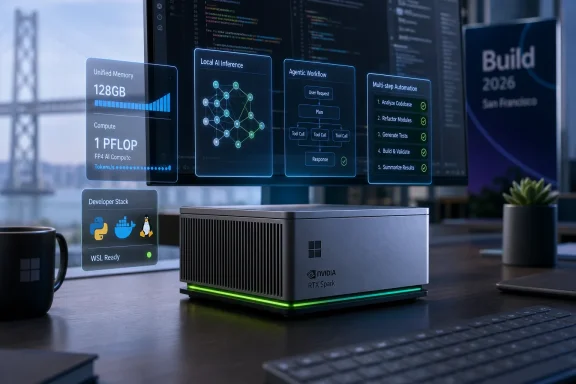
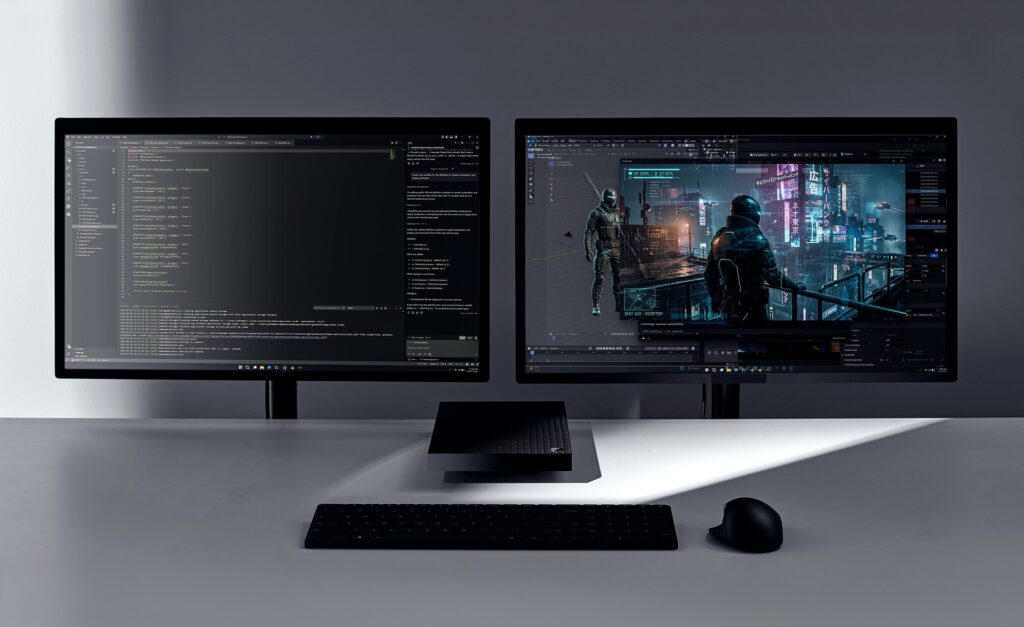
Microsoft announced the Surface RTX Spark Dev Box on June 2, 2026, at Build in San Francisco as a compact Windows 11 Pro developer PC built around Nvidia’s RTX Spark superchip for running large AI models locally. The box is not a consumer Surface in the familiar sense; it is a statement about where Microsoft thinks Windows development is going next. After a decade of nudging developers toward cloud-first workflows, Microsoft is now selling a desk-side machine whose pitch is almost defiantly local. The bet is that the next Windows platform war will be fought not only in Azure, but on the developer’s own desk.
The Surface RTX Spark Dev Box arrives at an awkward but revealing moment for the PC industry. For the past two years, “AI PC” has mostly meant a laptop with a neural processing unit fast enough to qualify for Copilot+ branding, plus a handful of local features that still felt modest next to what large cloud models could do. Microsoft’s new developer box changes the scale of the conversation.
The headline numbers are meant to do that work. Microsoft says the machine combines Nvidia’s RTX Spark superchip with up to 1 petaflop of AI compute and 128GB of unified memory. The company says that is enough to run 120-billion-parameter-plus models locally with a million-token context window at interactive speeds, or to fine-tune models that previously belonged on cloud GPU instances.
That does not mean every developer suddenly has a private Azure region under the desk. It does mean Microsoft is trying to collapse a workflow that has become expensive, fragmented, and psychologically distant. If developers can prototype, test, and iterate against serious local models without waiting on cloud capacity or watching a billing dashboard, Windows becomes a more credible platform for the next generation of AI software.
The Surface branding matters here. Microsoft could have left this to Nvidia’s DGX Spark ecosystem or to workstation vendors with boxy black towers and enterprise procurement channels. Instead, it put Surface on the device, signaling that local AI development is not a fringe workstation category but a first-class Windows platform priority.
Qualcomm’s role in the Windows revival is real. Snapdragon X-class chips helped Microsoft sell the idea that Windows laptops could be efficient, quiet, and competitive with Apple Silicon in ways older Intel-era Surface designs often were not. But developer workstations live by different rules. Sustained model inference, long-running jobs, fine-tuning, and agent pipelines care less about marketing-friendly NPU TOPS and more about memory capacity, GPU acceleration, thermals, software stack maturity, and whether the machine can keep performing after the keynote demo ends.
That is where Nvidia’s advantage is obvious. The RTX Spark platform pairs Arm CPU cores with Nvidia Blackwell-class graphics and a CUDA-centered developer ecosystem that already owns much of the AI tooling world. Microsoft is not merely buying a faster chip; it is buying proximity to the default stack used by developers training, quantizing, evaluating, and deploying modern models.
This does not make Qualcomm irrelevant. It does, however, draw a boundary around the current Copilot+ PC story. Qualcomm can help Microsoft sell efficient AI laptops to mainstream users. Nvidia is being invited into the higher tier where Windows must prove it can host the messy, heavy, experimental work of AI application development.
For Microsoft, that distinction is strategically useful. It lets the company keep pushing Arm Windows broadly while admitting, without quite saying it aloud, that the Arm vendor best suited to build a local AI workstation in 2026 is Nvidia.
That vision has been floating around the industry for years, but it has a practical bottleneck. Cloud agents are powerful but costly, latency-sensitive, and politically complicated. Local agents are more private and responsive, but they need enough compute and memory to reason over files, app state, codebases, documents, email, calendars, and long histories of user context without constantly phoning home.
The Surface RTX Spark Dev Box is aimed at the people who will build that layer. Microsoft says the device is preconfigured for developers at the Windows image level, with tools and settings tuned from first sign-in. The marketing language is polished, but the intent is clear: make the local AI development environment feel less like a weekend of driver wrangling and more like a Surface experience.
That matters because agentic Windows is not just a Copilot feature. It would require developers to think differently about how their applications expose state, accept commands, handle permissions, and cooperate with autonomous software. A local developer box gives Microsoft a controlled place to seed those patterns before they trickle down to mainstream PCs.
The better analogy is not a gaming PC, even though Nvidia’s RTX brand invites the comparison. It is a reference platform. Microsoft is trying to define what a serious Windows AI development machine looks like before the market fragments into half-compatible desktops, cloud notebooks, vendor appliances, and developer laptops with wildly different capabilities.
Cloud AI development is expensive in a way that changes behavior. Teams ration experiments. Independent developers avoid larger models. Startups burn credits on debugging. Enterprise developers wait for approvals, capacity, and compliance reviews before they can test ideas that would be trivial if the compute were already sitting beside them.
A workstation-class AI box shifts some of that cost from operating expense to capital expense. That is not automatically cheaper, and Microsoft has not yet given buyers the most important variable: price. But it changes the psychology. A developer with local access to a 120B-class model can experiment more casually, fail more often, and test more privately.
Privacy is part of the appeal, but it should not be overstated. Local execution can reduce the need to send prompts, files, embeddings, or proprietary code to cloud services. It does not solve every security problem, especially once agents start taking actions across applications. A local agent with broad permissions can still make local mistakes at machine speed.
For enterprises, the attraction is likely to be control. A secured-core Windows 11 Pro device that works with BitLocker, Defender, Entra ID, and Intune is easier to place into an existing management regime than a do-it-yourself Linux workstation under someone’s desk. Microsoft is offering IT departments a familiar handle on an unfamiliar workload.
Unified memory is the more practically interesting spec. The ability to address up to 128GB from a compact machine gives developers room to run models that would not fit comfortably on consumer GPUs with far smaller VRAM pools. For local large language model work, memory capacity often matters more than peak compute because a model that does not fit is not a slow model; it is a nonstarter.
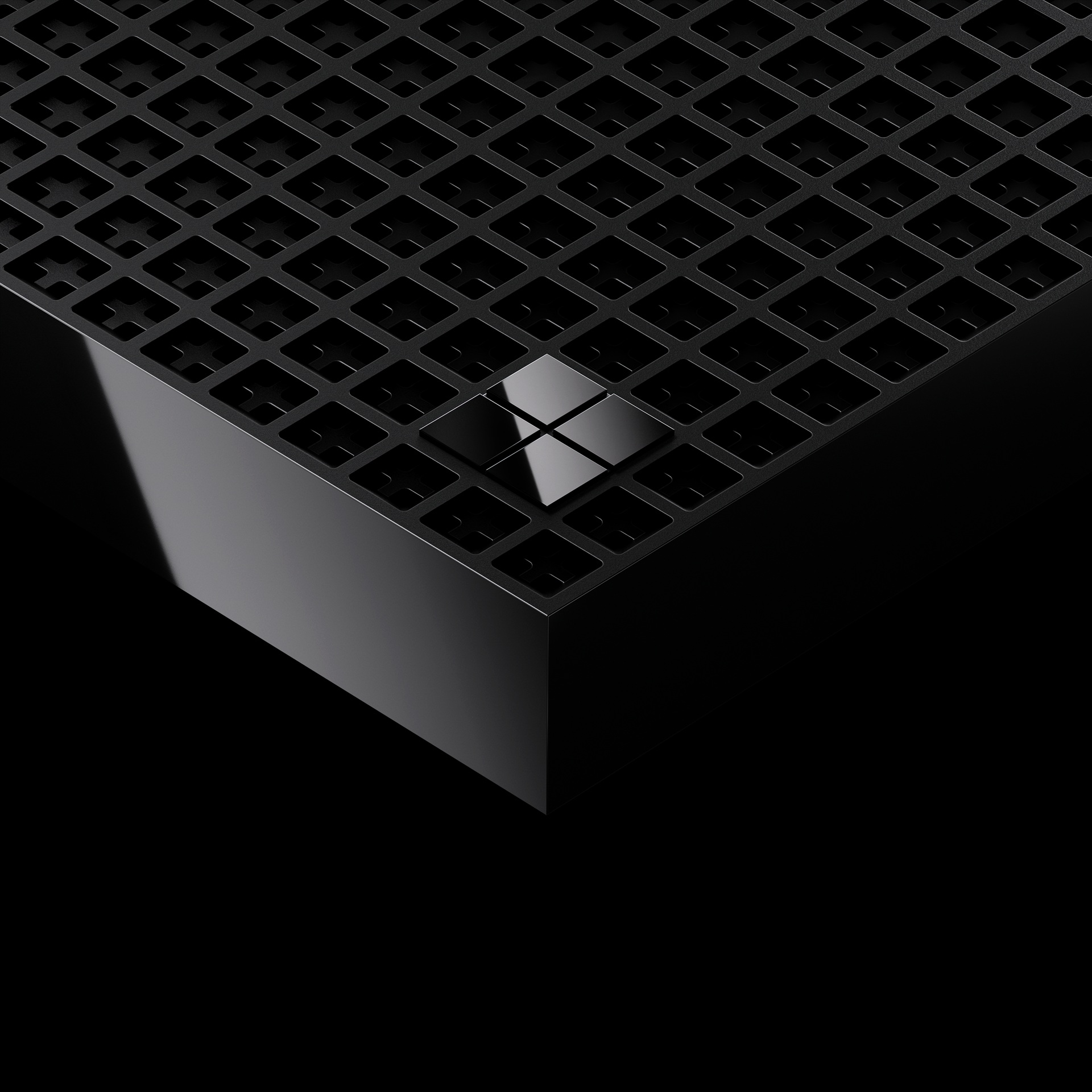
Microsoft’s chassis design also deserves attention. The company says the aluminum enclosure doubles as a heatsink, which suggests the box is built for sustained workloads rather than short benchmark bursts. That is a necessary claim, because AI developers will punish this machine in ways ordinary Surface devices rarely experience. Long-running inference loops and fine-tuning jobs are not the same as exporting a video or compiling a project.
Still, the success of the Dev Box depends less on the elegance of the enclosure than on whether Windows can feel like a natural home for this class of work. Developers need Python environments that do not rot, GPU acceleration that is easy to verify, container workflows that behave predictably, and compatibility across the libraries that dominate AI development. Microsoft has improved enormously here, especially through WSL and better developer tooling, but this machine raises expectations.
If the Surface RTX Spark Dev Box feels like a polished appliance for local AI development, it becomes a serious platform move. If it feels like premium hardware wrapped around fragile drivers and version conflicts, developers will forgive the idea less readily because Microsoft chose to put Surface on the front.
That has implications for the old Windows hardware order. Intel and AMD remain central to the PC market, and Qualcomm has made real progress in Windows on Arm. But Nvidia now has the one asset every AI company wants: developer gravity. CUDA, TensorRT, RTX acceleration, and the broader Nvidia software ecosystem are not just technical features; they are habits embedded across the AI industry.
Microsoft is pragmatic enough to follow that gravity. The Windows developer platform cannot become the preferred home for AI agents if the hardware underneath it feels disconnected from the frameworks developers already trust. Nvidia offers Microsoft a shortcut to credibility in a field where performance claims are quickly tested and loudly mocked.
The risk is dependency. Microsoft spent years trying to diversify Windows away from any single silicon story. Partnering deeply with Nvidia on premium AI PCs and developer workstations could create a new center of gravity that is every bit as powerful as the old Wintel alliance, but less predictable for OEMs and customers.
For Nvidia, the win is cleaner. RTX Spark extends its AI dominance down from data centers and workstations into personal developer machines. If tomorrow’s AI applications are prototyped locally before being scaled in the cloud, Nvidia wants its architecture to be present at both ends of that journey.
The Surface RTX Spark Dev Box brings back that laboratory function. It is not a mass-market product, and Microsoft should not pretend otherwise. Most Windows users do not need a compact AI workstation with 128GB of unified memory, and many developers will still be better served by cloud GPUs, existing desktops, or cheaper local hardware depending on their workload.
But Surface has often mattered most when it acted as a provocation. The original Surface Pro pressured OEMs to take detachable PCs seriously. Surface Studio made a case, however niche, for touch-centric creative desktops. The Dev Box is trying to do something similar for local AI development: define a category, set an expectation, and dare the ecosystem to respond.
The difference is that this time Microsoft is not merely pushing industrial design. It is pushing a model of computing. The Dev Box says the PC is not just a client for AI services, nor merely a thin endpoint for cloud intelligence. It can be a local participant in the AI stack, with enough horsepower to host serious models and enough enterprise plumbing to be managed like any other Windows device.
That is a more ambitious claim than “AI PC,” which has become too broad to mean much. Microsoft is effectively splitting the category in two. There are AI-capable PCs for users, and there are AI development PCs for the people building the agents those users will eventually encounter.
What is changing is the assumption that every meaningful AI experiment must begin there. Local machines with enough memory to run large models let developers prototype without turning every prompt into a metered event. They also make it easier to work with sensitive data that cannot casually leave a device or organization.
This is not a rejection of Azure so much as a rebalancing of the development loop. Local first does not mean local only. A developer may test an agent locally, fine-tune against a private sample, validate behavior, and then deploy the production system to cloud infrastructure. The desk-side box becomes a staging ground for ideas that would be too slow, too expensive, or too encumbered to explore entirely online.
Microsoft benefits either way. If developers build better Windows agents locally, Windows gets more valuable. If those agents later scale through Azure, Microsoft also wins in the cloud. The Dev Box is a bridge between those incentives.
That duality explains the careful positioning. Microsoft is not telling developers to abandon cloud computing. It is telling them that the most creative and iterative part of AI work should not be hostage to cloud economics.
Microsoft’s enterprise hooks are designed to calm that anxiety. The device is a Windows 11 secured-core PC and is positioned as compatible with the familiar security and management stack: BitLocker, Defender, Entra ID, and Intune. That gives IT teams a starting point for inventory, compliance, conditional access, encryption, and policy enforcement.
But conventional endpoint management was not designed around autonomous local agents. If a developer runs a model that can inspect source trees, generate scripts, call local tools, and interact with services, the boundary between application, user, and automation becomes blurrier. Security teams will need to decide how much agency is acceptable, how actions are audited, and whether model outputs should be treated like code, data, or something in between.
The local nature of the workload cuts both ways. Keeping sensitive data off third-party AI services can reduce exposure. Keeping more sensitive data and model state on powerful endpoints can increase the consequences of compromise. A stolen laptop is bad; a compromised local AI workstation with access to repositories, credentials, and internal documents could be worse.
That is why the Dev Box will probably be adopted first by teams that already have mature endpoint controls and a clear reason to experiment locally. The product is exciting for enthusiasts, but the real enterprise buyers will ask boring questions about image management, procurement, support lifecycle, firmware updates, and whether the performance justifies the governance burden.
Yet local AI development is still not simple. Model size is only one variable. Quantization, context length, inference speed, framework support, memory pressure, and tool compatibility all shape whether a machine feels liberating or merely expensive. A 120B model that technically runs may not be the right tool if a smaller model is faster, cheaper, and good enough for the task.
That distinction will matter as Microsoft markets the Dev Box. The headline promise of running huge models locally is powerful, but the everyday developer benefit may be more modest and more useful: running mid-sized models comfortably, testing multiple agents, keeping embeddings and data local, and working through iterations without waiting on cloud queues or approvals.
There is also a cultural shift. Many developers have grown used to treating AI as an API. Microsoft and Nvidia are nudging them back toward a world where hardware characteristics matter again. Memory bandwidth, thermals, drivers, and local storage suddenly become part of the AI development conversation, just as they were for game developers, video editors, and scientific computing users.
That may sound like regression, but it is also a restoration of agency. The cloud abstracted away machines at the cost of making compute feel rented, remote, and metered. The Surface RTX Spark Dev Box is an argument that at least some of that power should return to the person building the software.
The comparison point is not only a traditional workstation. Buyers will weigh it against cloud GPU credits, Nvidia’s own DGX Spark systems, existing RTX desktops, Mac Studio-class machines, and whatever OEMs ship this fall with RTX Spark inside. Microsoft’s Surface premium may be acceptable if the device is polished, quiet, secure, and tightly integrated with the Windows developer stack. It will be harder to justify if the same silicon appears in cheaper boxes with comparable performance.
Availability is also limited at launch. Microsoft says the Surface RTX Spark Dev Box will be available later this year in the United States through Microsoft.com. That makes it a controlled rollout rather than a global channel push, which is sensible for a first-generation developer machine but reinforces the idea that Microsoft is testing the category as much as selling a product.
The company has been here before with developer hardware. The Windows Dev Kit 2023, powered by Qualcomm, was useful for some Arm developers but never became a mainstream symbol of Windows development. The Surface RTX Spark Dev Box has a stronger market tailwind because AI developers are actively searching for local compute, but Microsoft still has to prove it can support a niche developer device beyond the launch cycle.
Price, support, and software polish will decide whether this becomes the reference box for agentic Windows or just another impressive object from a keynote.
That layered strategy is more credible than pretending one NPU-equipped laptop can carry the entire AI future. It acknowledges that summarizing a document, running a local assistant, fine-tuning a model, and orchestrating agent pipelines are different workloads. Different workloads need different machines.
For Windows enthusiasts, the device is also a reminder that the PC is not done evolving. The industry spent years treating the desktop as mature and the cloud as the only exciting frontier. Now Microsoft is saying the local machine matters again, not because nostalgia demands it, but because latency, privacy, cost, and experimentation all benefit from capable hardware within arm’s reach.
The sharpest questions now are practical ones:
 Microsoft Puts the AI Workstation Back Under the Monitor
The Surface RTX Spark Dev Box arrives at an awkward but revealing moment for the PC industry. For the past two years, “AI PC” has mostly meant a laptop with a neural processing unit fast enough to qualify for Copilot+ branding, plus a handful of local features that still felt modest next to what large cloud models could do. Microsoft’s new developer box changes the scale of the conversation.The headline numbers are meant to do that work. Microsoft says the machine combines Nvidia’s RTX Spark superchip with up to 1 petaflop of AI compute and 128GB of unified memory. The company says that is enough to run 120-billion-parameter-plus models locally with a million-token context window at interactive speeds, or to fine-tune models that previously belonged on cloud GPU instances.
That does not mean every developer suddenly has a private Azure region under the desk. It does mean Microsoft is trying to collapse a workflow that has become expensive, fragmented, and psychologically distant. If developers can prototype, test, and iterate against serious local models without waiting on cloud capacity or watching a billing dashboard, Windows becomes a more credible platform for the next generation of AI software.
The Surface branding matters here. Microsoft could have left this to Nvidia’s DGX Spark ecosystem or to workstation vendors with boxy black towers and enterprise procurement channels. Instead, it put Surface on the device, signaling that local AI development is not a fringe workstation category but a first-class Windows platform priority.
The Qualcomm Era Meets Its Performance Ceiling
The most interesting thing about the Surface RTX Spark Dev Box may be what it is not. It is not another Qualcomm-powered Windows-on-Arm showcase. That is a conspicuous turn after Microsoft spent years positioning Snapdragon-based Copilot+ PCs as the modern foundation for thin, efficient, AI-capable Windows devices.Qualcomm’s role in the Windows revival is real. Snapdragon X-class chips helped Microsoft sell the idea that Windows laptops could be efficient, quiet, and competitive with Apple Silicon in ways older Intel-era Surface designs often were not. But developer workstations live by different rules. Sustained model inference, long-running jobs, fine-tuning, and agent pipelines care less about marketing-friendly NPU TOPS and more about memory capacity, GPU acceleration, thermals, software stack maturity, and whether the machine can keep performing after the keynote demo ends.
That is where Nvidia’s advantage is obvious. The RTX Spark platform pairs Arm CPU cores with Nvidia Blackwell-class graphics and a CUDA-centered developer ecosystem that already owns much of the AI tooling world. Microsoft is not merely buying a faster chip; it is buying proximity to the default stack used by developers training, quantizing, evaluating, and deploying modern models.
This does not make Qualcomm irrelevant. It does, however, draw a boundary around the current Copilot+ PC story. Qualcomm can help Microsoft sell efficient AI laptops to mainstream users. Nvidia is being invited into the higher tier where Windows must prove it can host the messy, heavy, experimental work of AI application development.
For Microsoft, that distinction is strategically useful. It lets the company keep pushing Arm Windows broadly while admitting, without quite saying it aloud, that the Arm vendor best suited to build a local AI workstation in 2026 is Nvidia.
The Real Product Is Agentic Windows
Microsoft’s hardware announcement only makes sense if you take its software ambition seriously. The company is not building a mini workstation because developers need another expensive box for benchmarks. It is building one because Microsoft wants Windows to become a platform for agentic software: assistants that can plan, call tools, operate across applications, and complete multi-step tasks on the user’s behalf.That vision has been floating around the industry for years, but it has a practical bottleneck. Cloud agents are powerful but costly, latency-sensitive, and politically complicated. Local agents are more private and responsive, but they need enough compute and memory to reason over files, app state, codebases, documents, email, calendars, and long histories of user context without constantly phoning home.
The Surface RTX Spark Dev Box is aimed at the people who will build that layer. Microsoft says the device is preconfigured for developers at the Windows image level, with tools and settings tuned from first sign-in. The marketing language is polished, but the intent is clear: make the local AI development environment feel less like a weekend of driver wrangling and more like a Surface experience.
That matters because agentic Windows is not just a Copilot feature. It would require developers to think differently about how their applications expose state, accept commands, handle permissions, and cooperate with autonomous software. A local developer box gives Microsoft a controlled place to seed those patterns before they trickle down to mainstream PCs.
The better analogy is not a gaming PC, even though Nvidia’s RTX brand invites the comparison. It is a reference platform. Microsoft is trying to define what a serious Windows AI development machine looks like before the market fragments into half-compatible desktops, cloud notebooks, vendor appliances, and developer laptops with wildly different capabilities.
Local AI Is a Cost Argument Wearing a Privacy Jacket
Microsoft is careful to talk about local-first development in positive terms: speed, iteration, security, and developer ambition. Those are real benefits. But the commercial pressure underneath the announcement is just as important.Cloud AI development is expensive in a way that changes behavior. Teams ration experiments. Independent developers avoid larger models. Startups burn credits on debugging. Enterprise developers wait for approvals, capacity, and compliance reviews before they can test ideas that would be trivial if the compute were already sitting beside them.
A workstation-class AI box shifts some of that cost from operating expense to capital expense. That is not automatically cheaper, and Microsoft has not yet given buyers the most important variable: price. But it changes the psychology. A developer with local access to a 120B-class model can experiment more casually, fail more often, and test more privately.
Privacy is part of the appeal, but it should not be overstated. Local execution can reduce the need to send prompts, files, embeddings, or proprietary code to cloud services. It does not solve every security problem, especially once agents start taking actions across applications. A local agent with broad permissions can still make local mistakes at machine speed.
For enterprises, the attraction is likely to be control. A secured-core Windows 11 Pro device that works with BitLocker, Defender, Entra ID, and Intune is easier to place into an existing management regime than a do-it-yourself Linux workstation under someone’s desk. Microsoft is offering IT departments a familiar handle on an unfamiliar workload.
The Hardware Spec Is Impressive, but the Software Stack Will Decide
One petaflop sounds like a clean line between the old PC and the new AI workstation. In practice, the number needs context. AI performance claims often depend on precision, workload, framework, model architecture, and whether the demo aligns with the chip’s strengths. The Surface RTX Spark Dev Box may be powerful, but developers will judge it by tokens per second, memory behavior, thermals, driver stability, and how often the toolchain breaks.Unified memory is the more practically interesting spec. The ability to address up to 128GB from a compact machine gives developers room to run models that would not fit comfortably on consumer GPUs with far smaller VRAM pools. For local large language model work, memory capacity often matters more than peak compute because a model that does not fit is not a slow model; it is a nonstarter.
Microsoft’s chassis design also deserves attention. The company says the aluminum enclosure doubles as a heatsink, which suggests the box is built for sustained workloads rather than short benchmark bursts. That is a necessary claim, because AI developers will punish this machine in ways ordinary Surface devices rarely experience. Long-running inference loops and fine-tuning jobs are not the same as exporting a video or compiling a project.
Still, the success of the Dev Box depends less on the elegance of the enclosure than on whether Windows can feel like a natural home for this class of work. Developers need Python environments that do not rot, GPU acceleration that is easy to verify, container workflows that behave predictably, and compatibility across the libraries that dominate AI development. Microsoft has improved enormously here, especially through WSL and better developer tooling, but this machine raises expectations.
If the Surface RTX Spark Dev Box feels like a polished appliance for local AI development, it becomes a serious platform move. If it feels like premium hardware wrapped around fragile drivers and version conflicts, developers will forgive the idea less readily because Microsoft chose to put Surface on the front.
Nvidia Gets a New Door Into Windows
Nvidia’s role in this story is larger than supplying silicon. RTX Spark gives Nvidia a route into Windows PCs that goes beyond discrete GPUs and gaming laptops. The company is now being positioned as a full platform provider for a new class of AI-first Windows machines.That has implications for the old Windows hardware order. Intel and AMD remain central to the PC market, and Qualcomm has made real progress in Windows on Arm. But Nvidia now has the one asset every AI company wants: developer gravity. CUDA, TensorRT, RTX acceleration, and the broader Nvidia software ecosystem are not just technical features; they are habits embedded across the AI industry.
Microsoft is pragmatic enough to follow that gravity. The Windows developer platform cannot become the preferred home for AI agents if the hardware underneath it feels disconnected from the frameworks developers already trust. Nvidia offers Microsoft a shortcut to credibility in a field where performance claims are quickly tested and loudly mocked.
The risk is dependency. Microsoft spent years trying to diversify Windows away from any single silicon story. Partnering deeply with Nvidia on premium AI PCs and developer workstations could create a new center of gravity that is every bit as powerful as the old Wintel alliance, but less predictable for OEMs and customers.
For Nvidia, the win is cleaner. RTX Spark extends its AI dominance down from data centers and workstations into personal developer machines. If tomorrow’s AI applications are prototyped locally before being scaled in the cloud, Nvidia wants its architecture to be present at both ends of that journey.
Surface Becomes a Developer Signal Again
Surface has had several identities over the years. It began as Microsoft’s attempt to show PC makers what modern Windows hardware could be. It became a premium laptop and tablet brand. At times, it also served as a laboratory for ideas that the rest of the ecosystem was not yet ready to ship.The Surface RTX Spark Dev Box brings back that laboratory function. It is not a mass-market product, and Microsoft should not pretend otherwise. Most Windows users do not need a compact AI workstation with 128GB of unified memory, and many developers will still be better served by cloud GPUs, existing desktops, or cheaper local hardware depending on their workload.
But Surface has often mattered most when it acted as a provocation. The original Surface Pro pressured OEMs to take detachable PCs seriously. Surface Studio made a case, however niche, for touch-centric creative desktops. The Dev Box is trying to do something similar for local AI development: define a category, set an expectation, and dare the ecosystem to respond.
The difference is that this time Microsoft is not merely pushing industrial design. It is pushing a model of computing. The Dev Box says the PC is not just a client for AI services, nor merely a thin endpoint for cloud intelligence. It can be a local participant in the AI stack, with enough horsepower to host serious models and enough enterprise plumbing to be managed like any other Windows device.
That is a more ambitious claim than “AI PC,” which has become too broad to mean much. Microsoft is effectively splitting the category in two. There are AI-capable PCs for users, and there are AI development PCs for the people building the agents those users will eventually encounter.
The Cloud Is Not Going Away, but Its Monopoly on Experimentation Is Weakening
It would be easy to frame the Surface RTX Spark Dev Box as an anti-cloud product. That would also be wrong. Microsoft remains a cloud company, Azure remains central to its AI strategy, and large-scale training, deployment, monitoring, and enterprise integration will still live heavily in data centers.What is changing is the assumption that every meaningful AI experiment must begin there. Local machines with enough memory to run large models let developers prototype without turning every prompt into a metered event. They also make it easier to work with sensitive data that cannot casually leave a device or organization.
This is not a rejection of Azure so much as a rebalancing of the development loop. Local first does not mean local only. A developer may test an agent locally, fine-tune against a private sample, validate behavior, and then deploy the production system to cloud infrastructure. The desk-side box becomes a staging ground for ideas that would be too slow, too expensive, or too encumbered to explore entirely online.
Microsoft benefits either way. If developers build better Windows agents locally, Windows gets more valuable. If those agents later scale through Azure, Microsoft also wins in the cloud. The Dev Box is a bridge between those incentives.
That duality explains the careful positioning. Microsoft is not telling developers to abandon cloud computing. It is telling them that the most creative and iterative part of AI work should not be hostage to cloud economics.
Enterprise IT Will See Both a Managed Device and a New Attack Surface
For sysadmins, the Surface RTX Spark Dev Box is not just a shiny mini workstation. It is a policy problem with a Surface logo. A machine capable of running large local models can be an asset for regulated development, but it also introduces questions about data retention, model provenance, prompt logging, and what happens when an agent is allowed to manipulate files or applications.Microsoft’s enterprise hooks are designed to calm that anxiety. The device is a Windows 11 secured-core PC and is positioned as compatible with the familiar security and management stack: BitLocker, Defender, Entra ID, and Intune. That gives IT teams a starting point for inventory, compliance, conditional access, encryption, and policy enforcement.
But conventional endpoint management was not designed around autonomous local agents. If a developer runs a model that can inspect source trees, generate scripts, call local tools, and interact with services, the boundary between application, user, and automation becomes blurrier. Security teams will need to decide how much agency is acceptable, how actions are audited, and whether model outputs should be treated like code, data, or something in between.
The local nature of the workload cuts both ways. Keeping sensitive data off third-party AI services can reduce exposure. Keeping more sensitive data and model state on powerful endpoints can increase the consequences of compromise. A stolen laptop is bad; a compromised local AI workstation with access to repositories, credentials, and internal documents could be worse.
That is why the Dev Box will probably be adopted first by teams that already have mature endpoint controls and a clear reason to experiment locally. The product is exciting for enthusiasts, but the real enterprise buyers will ask boring questions about image management, procurement, support lifecycle, firmware updates, and whether the performance justifies the governance burden.
Developers Get Freedom, but Not Simplicity for Free
The developer appeal is obvious. Local access to a large model changes the cadence of work. Instead of writing prompts against a remote endpoint, developers can test retrieval pipelines, agent loops, context strategies, and fine-tuning ideas in an environment that feels immediate and private.Yet local AI development is still not simple. Model size is only one variable. Quantization, context length, inference speed, framework support, memory pressure, and tool compatibility all shape whether a machine feels liberating or merely expensive. A 120B model that technically runs may not be the right tool if a smaller model is faster, cheaper, and good enough for the task.
That distinction will matter as Microsoft markets the Dev Box. The headline promise of running huge models locally is powerful, but the everyday developer benefit may be more modest and more useful: running mid-sized models comfortably, testing multiple agents, keeping embeddings and data local, and working through iterations without waiting on cloud queues or approvals.
There is also a cultural shift. Many developers have grown used to treating AI as an API. Microsoft and Nvidia are nudging them back toward a world where hardware characteristics matter again. Memory bandwidth, thermals, drivers, and local storage suddenly become part of the AI development conversation, just as they were for game developers, video editors, and scientific computing users.
That may sound like regression, but it is also a restoration of agency. The cloud abstracted away machines at the cost of making compute feel rented, remote, and metered. The Surface RTX Spark Dev Box is an argument that at least some of that power should return to the person building the software.
The Missing Price Tag Is Not a Detail
Microsoft has not yet disclosed pricing, and that absence hangs over the announcement. A compact AI workstation can be revolutionary at one price and a boutique curiosity at another. Without a price, it is impossible to know whether the Dev Box is a broad developer platform or a halo device for well-funded teams.The comparison point is not only a traditional workstation. Buyers will weigh it against cloud GPU credits, Nvidia’s own DGX Spark systems, existing RTX desktops, Mac Studio-class machines, and whatever OEMs ship this fall with RTX Spark inside. Microsoft’s Surface premium may be acceptable if the device is polished, quiet, secure, and tightly integrated with the Windows developer stack. It will be harder to justify if the same silicon appears in cheaper boxes with comparable performance.
Availability is also limited at launch. Microsoft says the Surface RTX Spark Dev Box will be available later this year in the United States through Microsoft.com. That makes it a controlled rollout rather than a global channel push, which is sensible for a first-generation developer machine but reinforces the idea that Microsoft is testing the category as much as selling a product.
The company has been here before with developer hardware. The Windows Dev Kit 2023, powered by Qualcomm, was useful for some Arm developers but never became a mainstream symbol of Windows development. The Surface RTX Spark Dev Box has a stronger market tailwind because AI developers are actively searching for local compute, but Microsoft still has to prove it can support a niche developer device beyond the launch cycle.
Price, support, and software polish will decide whether this becomes the reference box for agentic Windows or just another impressive object from a keynote.
The Spark Box Draws a Line Through Microsoft’s AI PC Story
The most concrete lesson from the Surface RTX Spark Dev Box is that Microsoft’s AI PC strategy now has tiers. Copilot+ PCs are for mainstream users and light local AI features. RTX Spark systems are for developers, creators, and technical professionals who need serious local acceleration. Azure remains the scale-out destination for production workloads that exceed even powerful desk-side hardware.That layered strategy is more credible than pretending one NPU-equipped laptop can carry the entire AI future. It acknowledges that summarizing a document, running a local assistant, fine-tuning a model, and orchestrating agent pipelines are different workloads. Different workloads need different machines.
For Windows enthusiasts, the device is also a reminder that the PC is not done evolving. The industry spent years treating the desktop as mature and the cloud as the only exciting frontier. Now Microsoft is saying the local machine matters again, not because nostalgia demands it, but because latency, privacy, cost, and experimentation all benefit from capable hardware within arm’s reach.
The sharpest questions now are practical ones:
- Microsoft announced the Surface RTX Spark Dev Box at Build 2026 as a compact Surface-branded Windows 11 Pro machine for local AI development.
- The device uses Nvidia’s RTX Spark superchip and is advertised with up to 1 petaflop of AI compute and 128GB of unified memory.
- Microsoft says the system can run 120B-plus parameter models locally with a million-token context window at interactive speeds.
- The choice of Nvidia rather than Qualcomm suggests Microsoft sees a separate high-performance tier above today’s Snapdragon-led Copilot+ PC category.
- The box is aimed at developers building local AI agents and AI-native Windows workflows, not ordinary consumers.
- Pricing remains the unanswered variable that will determine whether this is a genuine platform seed or a premium halo device.
References
- Primary source: explosion.com
Published: 2026-06-02T21:19:29.221908
Loading…
www.explosion.com - Related coverage: axios.com

Microsoft debuts Nvidia-powered Microsoft Surface Ultra laptop
Microsoft is trying again to redefine the PC for the AI era.www.axios.com
- Related coverage: windowscentral.com
Loading…
www.windowscentral.com - Related coverage: tomshardware.com

Nvidia unveils RTX Spark Superchip for laptops and desktop PCs at Computex 2026 – new platform promises to turn Windows into an agentic AI OS with Arm CPU, Blackwell GPU, and 128GB unified memory
Over 30 laptops and 10 desktops coming this fall with "the most efficent platform ever built"www.tomshardware.com
- Official source: blogs.windows.com
Building the next generation of devices for developers: Surface RTX Spark Dev Box
Software developers are some of the most ambitious makers we serve. They push devices harder, ask more of their tools and expect their environment to help define the pace of modern software creation. Development today means longer runnin blogs.windows.com
- Official source: microsoft.com
Loading…
www.microsoft.com
- Related coverage: thewincentral.com
Microsoft Surface RTX Spark Dev Box Debuts at Build 2026 - WinCentral
Microsoft unveils the Surface RTX Spark Dev Box, a compact AI-powered developer PC built for local AI models, agents, and Windows development. - Read in Latest News on WinCentral thewincentral.com
- Official source: news.microsoft.com

Microsoft Build 2026: esprimere se stessi al lavoro - Source EMEA
Di Kyle Daigle, COO, GitHub and CMO of Developer, Microsoft Le piattaforme evolvono quando a costruirle sono gli sviluppatori. Sono loro a esplorare, scegliere gli strumenti, immaginare, creare. Questa evoluzione porta con sé più informazioni che mai, disponibili a portata di mano. Ma non si... news.microsoft.com
- Related coverage: arstechnica.com
Loading…
arstechnica.com - Related coverage: drwindows.de
Loading…
www.drwindows.de - Related coverage: tomsguide.com
Loading…
www.tomsguide.com - Related coverage: windowsforum.com
Loading…
windowsforum.com - Related coverage: signal65.com
Loading…
signal65.com - Related coverage: docs.nvidia.com
Loading…
docs.nvidia.com