Microsoft announced the Surface RTX Spark Dev Box on June 2, 2026, a compact Windows 11 Pro developer PC for local AI and Arm-native software work, powered by Nvidia’s new RTX Spark platform and due later this year through Microsoft’s online store in the United States. The box matters less as another cute Surface object than as a declaration that Microsoft is tired of waiting for Windows on Arm to become real by accident. After Qualcomm’s canceled Snapdragon Dev Kit left developers without the obvious desktop target they had been promised, Microsoft is now trying to make the developer machine itself part of the argument. The pitch is simple: if Windows is about to become an agentic, local-AI platform, developers need hardware that behaves like the future before consumers are asked to buy into it.

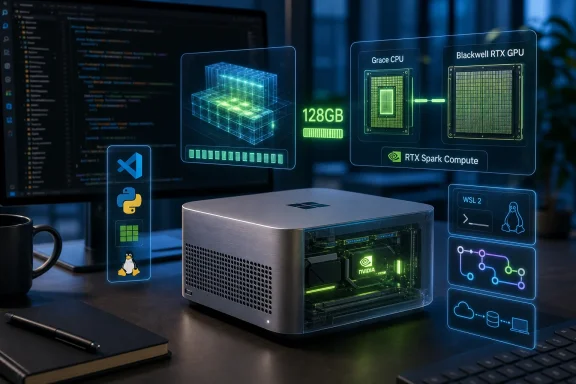
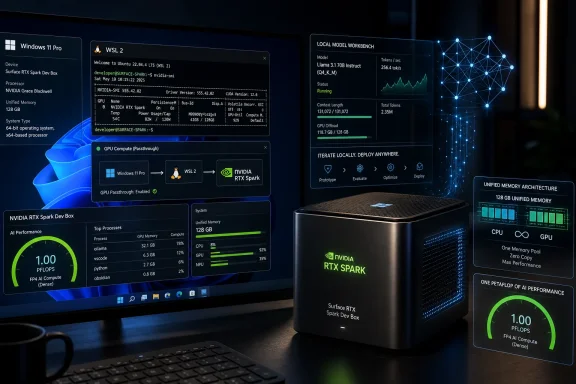
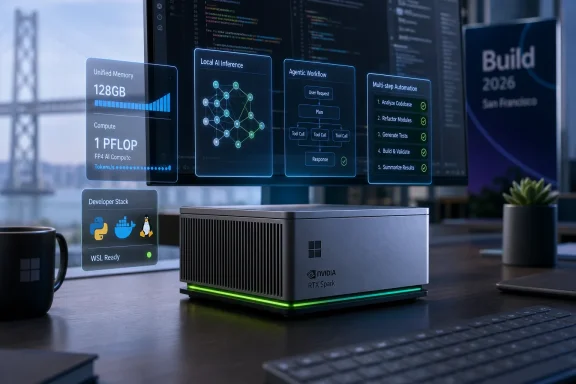
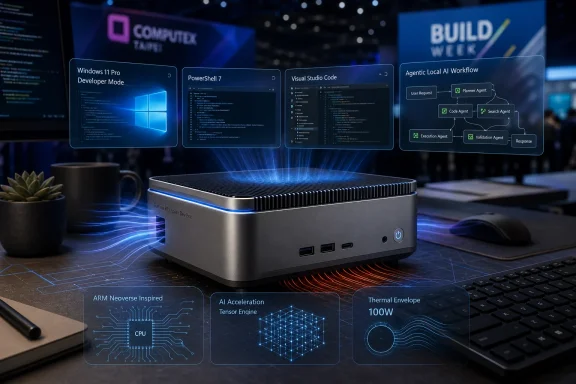
Metal mini server on a desk with AI-themed UI panels showing Windows, code tools, and agent workflow.Microsoft Finally Builds the Arm Dev Box Windows Needed Two Years Ago​

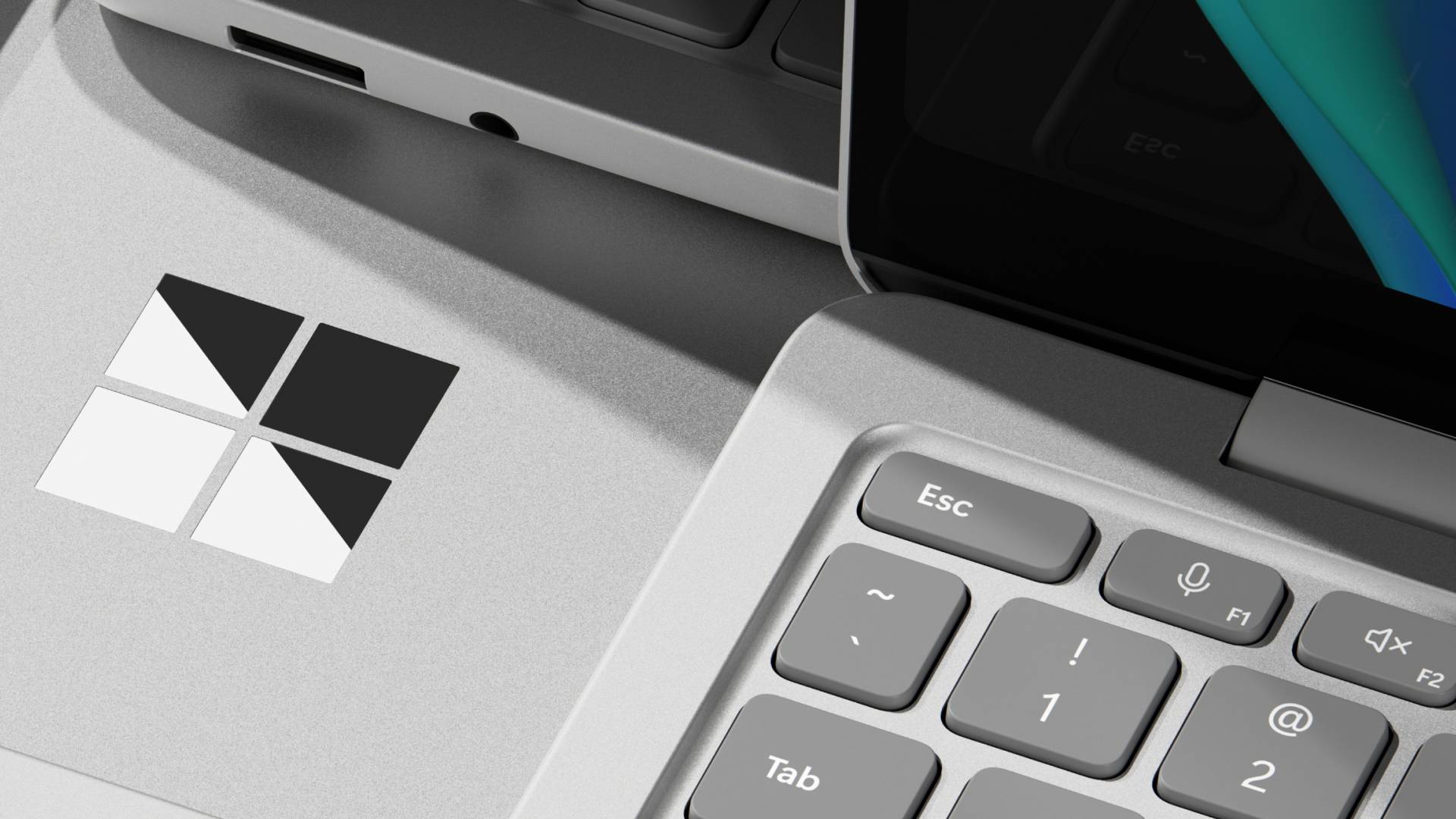
The most important fact about the Surface RTX Spark Dev Box is not its shape, though Microsoft’s small aluminum block inevitably invites comparisons to the top half of an Xbox Series X. It is that Microsoft is positioning it as a serious development target rather than a curiosity. The machine is meant to sit on a desk, run sustained workloads, and give developers a stable Windows-on-Arm environment with Nvidia’s AI and graphics stack close at hand.
That sounds obvious, but Windows on Arm has spent years suffering from a chicken-and-egg problem. Developers have been asked to optimize for a platform that often lacked widely available, compelling desktop hardware. Consumers were then asked to trust an app ecosystem that could not mature without those developers.
Qualcomm tried to address this gap with the Snapdragon Dev Kit, a small Windows on Arm desktop that was supposed to help developers port and test applications. That effort collapsed after delays and reported hardware-quality issues, leaving a visible hole in Microsoft’s platform story. The Surface RTX Spark Dev Box is Microsoft’s answer to that embarrassment, even if the company will not describe it that way.
The timing is not accidental. Microsoft and Nvidia are using Computex and Build week to present RTX Spark as a new Windows PC tier built for local AI agents, creative workloads, and Arm-native performance. The dev box is the least glamorous member of that pitch, but it may be the most strategically useful one.

The Chassis Is Small Because the Bet Is Big​

Microsoft says the Surface RTX Spark Dev Box uses an aluminum chassis that doubles as a heatsink, with a thermal envelope of 100 watts. That puts it above the 45-to-80-watt range associated with RTX Spark laptops and makes clear that this is not just a laptop motherboard stuffed into a novelty enclosure. It is designed for workloads that run long enough to expose the difference between burst performance and actual sustained throughput.
That distinction matters for AI development. Local inference, model tuning, code-generation agents, image workflows, and test harnesses do not behave like a benchmark loop built for a press deck. They chew through memory, punish thermals, and quickly reveal whether a machine is built for demos or daily work.
The headline spec is 128GB of unified memory, enough for Microsoft and Nvidia to claim support for running models as large as 120 billion parameters locally. As always, that claim deserves context: model size, quantization, context length, toolchain maturity, and actual latency will decide whether “can run” means “pleasant to use.” Still, the memory pool is large enough to move the conversation away from toy local models and toward serious experimentation.
This is where Microsoft’s Surface branding does real work. Surface devices have always been part product and part argument: a way for Microsoft to show OEMs what it thinks Windows hardware should become. The Surface RTX Spark Dev Box extends that habit into developer infrastructure. It says the future Windows workstation may be small, Arm-based, GPU-heavy, and optimized for local AI before it is optimized for spreadsheet nostalgia.

Nvidia’s PC Ambition Changes the Windows on Arm Equation​

The RTX Spark platform is not merely another Arm chip entering the Windows ecosystem. Nvidia is bringing an Arm-based Grace CPU design, Blackwell-generation graphics, CUDA, RTX technologies, TensorRT, and a large unified memory architecture into a class of Windows machines that includes laptops and compact desktops. That package changes the political economy of Windows on Arm.
Qualcomm’s Snapdragon X push made Windows on Arm credible for battery life and general productivity. Nvidia’s entry asks a different question: what if the reason to buy Arm Windows hardware is not just efficiency, but access to a local accelerated AI workstation? That is a much more aggressive story, and it plays directly to developers, creators, and technical users who already understand Nvidia’s software gravity.
CUDA remains one of the most durable moats in modern computing. Microsoft can talk about Windows as a platform for AI, but developers go where their frameworks, libraries, drivers, and debugging paths are least painful. If RTX Spark gives Windows on Arm a first-class Nvidia stack, Microsoft gets a stronger argument than it had with CPU efficiency alone.
There is also a competitive subtext. Apple normalized high-memory unified architectures for creative and AI-adjacent workflows on the Mac. Microsoft and its partners have spent years responding with a mixture of Intel, AMD, Qualcomm, discrete GPUs, NPUs, and cloud services. RTX Spark is a cleaner counterpunch: a Windows machine where the CPU, GPU, memory model, and AI software story are presented as one platform.
That does not guarantee success. Windows on Arm still has to deal with compatibility drag, driver expectations, peripherals, enterprise validation, and the long tail of x86 software. But Nvidia gives Microsoft something it did not previously have in this space: a performance narrative that is not defensive.

The Developer Image Is the Product Strategy in Miniature​

Microsoft’s description of the Dev Box software image is unusually specific. Windows 11 Pro ships preconfigured for developers, with dark theme enabled, the taskbar simplified, Widgets removed, Do Not Disturb turned on, Developer Mode enabled, and PowerShell 7 set as the default shell. Visual Studio Code, GitHub Copilot, and other tools are part of the out-of-box positioning.
That may sound like cosmetic tidying, but it points to a deeper shift. Microsoft is no longer treating the developer workstation as a generic Windows install waiting to be customized. It is treating the developer environment as a curated surface area, closer to how Apple presents Xcode on macOS or how Linux distributions pitch ready-made coding environments.
There is a risk here. Developers are famously allergic to vendor paternalism, and any “preconfigured for developers” machine can quickly become a bundle of assumptions. But Microsoft’s choices are revealing: remove distractions, privilege the shell, turn on developer features, and make AI assistance part of the baseline.
That baseline is also a statement about agentic Windows. Microsoft and Nvidia are not just selling faster local inference; they are preparing for a world where coding assistants, workflow agents, and model-driven tools are ordinary desktop processes. A developer box tuned for that world is a way to make the software ecosystem adapt before the average user ever sees the full experience.

Qualcomm’s Failure Became Microsoft’s Opening​

The shadow hanging over this announcement is Qualcomm’s canceled Snapdragon Dev Kit. That machine was supposed to be the obvious low-cost, low-friction desktop for Windows on Arm development. Instead, it became a cautionary tale about how hard it is to build confidence in a platform when the basic hardware pipeline stumbles.
Microsoft could have responded by waiting for OEMs to fill the gap. Instead, it is using Surface to seize the developer narrative. That matters because developer hardware is not simply about unit sales. It is about trust, documentation, reproducibility, and giving software teams a box they can standardize around.
The old Snapdragon Dev Kit story was about porting existing Windows apps to Arm. The Surface RTX Spark Dev Box story is broader and more ambitious: build apps for Arm, build local AI workflows, test Nvidia-accelerated software, and prepare for a version of Windows in which agents are treated as first-class workloads. That is a much bigger ask, but it also gives developers more reason to care.
It also neatly sidesteps one of Qualcomm’s constraints. Qualcomm had to prove that its silicon could carry Windows into a new era. Nvidia arrives with an installed developer mindshare that extends far beyond Windows laptops. If Microsoft can attach Windows on Arm to Nvidia’s AI ecosystem, it changes the emotional center of the platform from compromise to capability.

Local AI Is the Justification, Not the Whole Story​

Microsoft and Nvidia are framing RTX Spark around local AI, and that framing is understandable. A compact box with 128GB of unified memory and enough AI performance to run very large models locally is far easier to explain in 2026 than a generic Arm developer machine. The phrase “local AI” also solves several anxieties at once: latency, privacy, cloud cost, and developer iteration speed.
But local AI is only part of the story. The more consequential issue is whether Windows can become a coherent development platform across CPU architecture, GPU acceleration, AI runtimes, and security boundaries. That is what Microsoft has struggled to make feel inevitable.
The company’s broader RTX Spark messaging emphasizes Windows scheduler work, power and thermal management, app compatibility, Arm-native creative tools, Prism improvements, anti-cheat support, and agent containment primitives. In other words, the silicon announcement is inseparable from OS plumbing. Microsoft knows that a fast chip cannot rescue a platform that feels awkward under real workloads.
The Dev Box exists because developers will test those claims first. They will find the missing packages, the strange driver assumptions, the brittle build scripts, the tools that still expect x86, and the frameworks that behave differently outside the cloud. If Microsoft is serious, the dev box becomes both a product and a feedback trap.

Enterprise IT Will See Promise and a Procurement Headache​

For sysadmins and enterprise architects, the Surface RTX Spark Dev Box is intriguing but not automatically easy to adopt. A compact local AI workstation could help teams prototype privately, test agents against sensitive internal workflows, or reduce dependence on metered cloud experimentation. It could also create a new class of endpoint that looks like a developer workstation, a GPU node, and a compliance question at the same time.
That is where Microsoft’s Windows 11 Pro image and manageability story will matter. Enterprises are not short on AI pilots; they are short on AI pilots that fit cleanly into identity, endpoint management, data-loss prevention, auditability, and procurement rules. A box that runs large local models can be powerful precisely because it keeps data close, but that also means IT needs to know what those models can access and what agents are allowed to do.
Microsoft’s emphasis on OS-enforced identity, containment, and manageability is therefore not just marketing garnish. If agents are going to operate across files, apps, shells, and developer environments, they need boundaries that administrators can understand and enforce. Otherwise, local AI becomes another shadow-IT accelerant.
The hardware may also force organizations to rethink who gets workstation-class resources. In the old model, GPU workstations were for graphics, simulation, ML teams, or specialized engineering roles. In the agentic development model Microsoft is pushing, a broader set of developers may plausibly ask for local acceleration. That shift will make cost, availability, and lifecycle support just as important as raw specs.

The Missing Price Tag Keeps the Hype in Check​

Microsoft has not disclosed full specifications or pricing, and that omission matters. A miniature AI dev box can be a platform catalyst at one price and a boutique trophy at another. Developers may admire the idea, but organizations buy fleets according to budgets, support contracts, replacement cycles, and the dull arithmetic of ROI.
Availability is also limited in the initial description. Microsoft says the Surface RTX Spark Dev Box will arrive later this year in the United States through its online store. That is a cautious channel strategy, not a mass-market launch. It suggests Microsoft wants the device in the hands of motivated developers before it tries to turn the category into a broader Surface line.
There are other unknowns. Storage options, ports, networking, serviceability, external display support, Linux and WSL behavior, firmware update cadence, driver delivery, and warranty terms will all shape whether this becomes a practical developer staple or a fascinating niche box. For WindowsForum readers, the port map may be almost as important as the AI claims.
The lack of pricing also makes comparisons difficult. If this lands near traditional mini-PC territory, it could become a compelling Arm and AI development target. If it lands closer to workstation pricing, it will be judged against GPU desktops, Mac Studios, cloud GPU instances, and Nvidia’s own compact AI systems.

Microsoft Is Selling a Future Windows Has Not Fully Earned Yet​

The strongest version of Microsoft’s argument is that Windows needs local AI hardware to evolve beyond being a cloud-connected shell. If agents are going to summarize, code, search, manipulate apps, reason over local context, and preserve privacy, then endpoint hardware has to become more capable. RTX Spark gives Microsoft a way to say that the PC itself is still the center of gravity.
The weakest version of the argument is that the industry has been here before. Developers have seen specialized dev kits, AI accelerators, Arm transition boxes, and platform promises arrive with fanfare and then fade into unsupported corners. Windows users in particular have learned to ask whether the third-party ecosystem is truly ready or merely announced.
That skepticism is healthy. The history of Windows on Arm includes genuine progress, but also enough compatibility caveats to make technical buyers cautious. Prism has improved. Native app support is broader. Qualcomm’s latest systems made Arm Windows laptops more credible. But “credible” is not the same as frictionless.
The Surface RTX Spark Dev Box is therefore a test of whether Microsoft can compress years of ecosystem work into a developer object that people actually want to use. If the machine becomes a reliable way to build, test, and optimize for RTX Spark Windows PCs, it will have done its job even if it never becomes a mainstream product.
The Surface Box Turns Microsoft’s AI Pitch Into Something Developers Can Touch​

The practical read is that Microsoft is moving from platform rhetoric to platform provisioning. The Surface RTX Spark Dev Box gives developers a concrete target for the next phase of Windows on Arm, but it also exposes Microsoft to a simple test: whether the experience is good enough to make the ecosystem follow.
  • Microsoft is using Surface to replace the developer-hardware role Qualcomm failed to fill with the canceled Snapdragon Dev Kit.
  • The 100-watt thermal envelope suggests Microsoft wants sustained desktop workloads, not merely laptop-class burst performance in a smaller shell.
  • The 128GB unified memory configuration is the machine’s real differentiator because it makes large local AI experimentation plausible on a desk.
  • The preconfigured Windows 11 Pro developer image shows Microsoft treating the development environment itself as part of the product.
  • The unanswered questions around price, ports, storage, serviceability, and global availability will decide whether this is a useful platform tool or a premium niche device.
  • The box’s success will depend less on its industrial design than on whether Windows on Arm, Nvidia’s stack, and Microsoft’s agent security model work cleanly under real developer pressure.
The Surface RTX Spark Dev Box is not just Microsoft’s smallest new Surface; it is the company’s most direct admission that the next Windows platform fight will be won or lost before ordinary users ever encounter it. If developers get a fast, stable, well-supported local AI workstation, Microsoft gains a credible bridge from today’s Windows PCs to tomorrow’s agentic machines. If they get another expensive curiosity surrounded by compatibility footnotes, the industry will remember that the future of Windows on Arm has been announced many times before.

References​

  1. Primary source: The Verge
    Published: 2026-06-02T16:30:06.514399
  2. Independent coverage: Tom's Hardware
    Published: Tue, 02 Jun 2026 16:47:17 GMT
  3. Independent coverage: Engadget
    Published: Tue, 02 Jun 2026 16:45:24 GMT
  4. Independent coverage: Windows Blog
    Published: Tue, 02 Jun 2026 16:41:15 GMT
  5. Independent coverage: Let's Data Science
    Published: Tue, 02 Jun 2026 16:34:42 GMT
  6. Related coverage: windowscentral.com
  1. Related coverage: pcgamer.com
  2. Related coverage: arstechnica.com
  3. Related coverage: investor.nvidia.com
  4. Related coverage: axios.com
  5. Related coverage: gadgetsnow.indiatimes.com
  6. Related coverage: winbuzzer.com
  7. Related coverage: techtickerblog.com
  8. Related coverage: techtimes.com
  9. Related coverage: kucoin.com
  10. Official source: news.microsoft.com
  11. Related coverage: business-standard.com
  12. Related coverage: signal65.com
  13. Related coverage: docs.nvidia.com
  14. Related coverage: nvidianews.nvidia.com
 

Microsoft unveiled the Surface RTX Spark Dev Box at Build 2026 on June 2, positioning the compact Surface desktop as a Windows 11 Pro developer machine for local AI, agent, and machine-learning workloads powered by NVIDIA’s RTX Spark platform. The announcement is not really about Microsoft discovering the mini PC. It is about Microsoft trying to make Windows feel like the default workbench for the next generation of AI software, before that workbench hardens around Linux servers, Macs, or browser tabs pointed at rented GPUs.
The Surface RTX Spark Dev Box is Microsoft’s clearest admission yet that the AI PC story cannot end with a Copilot key, a neural processing unit, and a few background effects in Teams. Developers need machines that can run real models, test agents under realistic constraints, and iterate locally without turning every experiment into a cloud bill. Microsoft is betting that a small, expensive-looking box with NVIDIA silicon can make that argument better than another keynote slide.

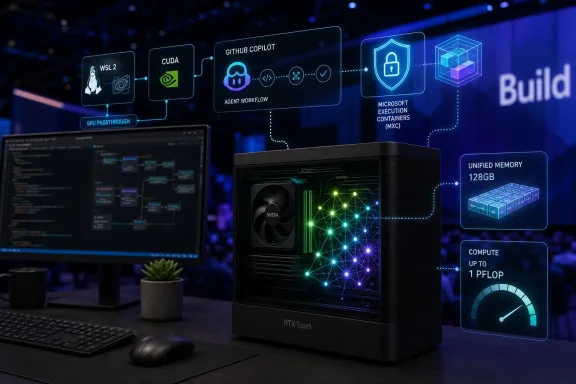
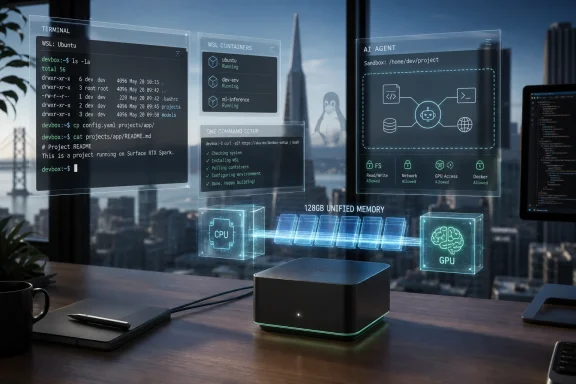
Office workstation with code editor and diagram showing CPU/GPU unified memory pipeline for AI agent processing.Microsoft Turns Surface Into a Developer Appliance​

Surface has always carried a second job inside Microsoft. It is a product line, but it is also a signal to OEMs about the kind of Windows hardware Microsoft wants the ecosystem to build. The Surface Pro made detachable tablets feel respectable. Surface Laptop pushed premium Windows notebooks toward better industrial design. Surface Studio tried, with mixed commercial success, to reframe the desktop as a creative canvas.
The Surface RTX Spark Dev Box belongs to that same lineage, but its audience is narrower and more strategic. This is not a family PC, a dorm-room desktop, or a tiny office machine meant to hide behind a monitor. It is a developer appliance for the local AI era, built to make one proposition feel normal: serious AI development should be able to happen on a Windows machine sitting on your desk.
That matters because the last several years of AI development have trained developers to think elsewhere. The serious work happened on cloud GPUs, Linux workstations, remote notebooks, managed inference endpoints, or Apple Silicon laptops with large unified-memory pools. Windows was often present in the workflow, but not always at the center of it.
Microsoft wants to change that before the habits become permanent. The company is pairing the Dev Box with a broader Windows developer push that includes preconfigured tooling, Windows AI APIs, agent infrastructure, containment mechanisms, and deeper NVIDIA integration. The hardware is the tangible part of a software-platform argument.
The box itself is therefore less interesting as a one-off Surface SKU than as a prototype for what Microsoft thinks an AI developer PC should be. Compact, local, preloaded, GPU-rich, memory-heavy, and opinionated. In other words, not a generic PC that can also do AI, but a PC whose reason for existing is AI development.

RTX Spark Gives Windows the Unified-Memory Pitch It Was Missing​

The headline numbers are deliberately provocative. RTX Spark is being pitched with up to 1 petaflop of AI compute, up to 128GB of unified memory, Arm-based CPU cores, NVIDIA Blackwell RTX graphics, and support for running large local models that would have been implausible on ordinary compact desktops. Microsoft’s Dev Box wraps that platform in Surface hardware and points it at developers building agents, AI apps, and Windows-native experiences.
The unified memory is the part that should make developers pay attention. Traditional PC architectures split memory between CPU system RAM and GPU VRAM, and that division becomes painful when models and datasets get large. Unified memory does not magically solve every bandwidth, latency, or framework problem, but it changes the shape of what is practical on a small machine.
Apple has spent years turning that architectural story into a developer advantage. A MacBook Pro with a large unified-memory configuration became attractive not only because it was fast, but because developers could run surprisingly large local workloads without managing a desktop tower or a remote GPU instance. Microsoft and NVIDIA are now making a similar pitch for Windows, but with CUDA and RTX as the gravitational pull.
That is the more important comparison than any single benchmark. If RTX Spark gives Windows developers a credible local machine with a large shared memory pool and NVIDIA’s software ecosystem, Microsoft gains a cleaner answer to a question it has struggled with: why should AI developers choose Windows as their primary local environment?
The answer Microsoft wants to offer is not nostalgia for Win32 or familiarity with Visual Studio Code. It is that Windows can host the entire loop: code, build, run, inspect, secure, contain, and deploy AI workloads. The Dev Box is meant to make that loop feel immediate.

The Mini PC Form Factor Is a Strategic Choice, Not a Cute One​

A mini PC is an odd place to make a grand platform statement, which is exactly why it works. Laptops are compromised by battery, thermals, displays, keyboards, and travel weight. Workstations are powerful but expensive, bulky, and often outside the psychological category of “personal development machine.” A compact desktop sits in the middle: permanent enough to sustain workloads, small enough to feel approachable, and appliance-like enough for teams to deploy in volume.
Microsoft appears to understand that developer hardware is as much about friction as peak performance. If a team can hand a new engineer a preconfigured Windows AI box with Visual Studio Code, GitHub Copilot, PowerShell 7, WSL, Developer Mode, and AI tooling already in place, the machine becomes part of the onboarding process. That is a different sell from “here is a fast PC.”
The preconfiguration angle should not be dismissed as marketing filler. Anyone who has tried to standardize AI development environments across a team knows the pain lives in drivers, runtimes, Python environments, GPU compatibility, container behavior, permissions, and model storage. The difference between an impressive demo and a working development workflow is often several days of yak-shaving.
The Dev Box is Microsoft’s attempt to compress that setup into first boot. Whether it succeeds will depend on the details: how current the drivers are, how cleanly CUDA tooling works on Windows on Arm, how WSL behaves, how reproducible environments are, and how much administrative control enterprises get. But the intent is clear enough. Microsoft wants to sell not just silicon, but time saved.
That may be the most credible commercial path for the product. Many individual developers will look at a specialized Surface AI desktop and wait for price, thermals, and compatibility reports. Enterprises, consultancies, and AI product teams may see a standardized local inference and agent-testing node as a practical procurement item.

Build 2026 Is Really About Agents Escaping the Demo Stage​

The Dev Box arrives inside Microsoft’s larger Build 2026 message: AI agents are moving from cloud demos into Windows workflows. That shift creates a hardware problem. An agent that can read local files, call tools, watch context, manipulate apps, and respond to user intent cannot be evaluated only as a remote chatbot. Developers need to test how it behaves on the client, under containment, with real permissions and real latency.
That is why local performance matters. For consumer-facing AI features, cloud inference may be acceptable or even preferable. For developer iteration, security testing, privacy-sensitive data, offline scenarios, and enterprise workflows, local execution changes the economics and the risk model. It lets teams fail faster, inspect more deeply, and avoid shipping every experiment to a remote service.
Microsoft’s agent push also makes Windows itself more important as a runtime surface. The company is not merely offering APIs for AI features; it is trying to define how agents interact with the operating system safely. That means containment, identity, permissions, auditability, and management become part of the developer story.
The Dev Box, then, is both a workstation and a test rig. It is meant to be where developers build agents that can later run across Windows devices with different levels of capability. A powerful local box gives teams a high ceiling for experimentation before they optimize down to laptops, Copilot+ PCs, or cloud-backed hybrid deployments.
This is also where Microsoft’s messaging becomes ambitious enough to invite skepticism. The company has repeatedly described Windows as the best place to build for broad PC deployment, and that is still true in terms of installed base. But AI-native development is not automatically won by installed base. It is won by tools, frameworks, reliability, performance, and trust.

Windows on Arm Gets Another Trial by Fire​

RTX Spark’s Arm-based architecture gives the Surface Dev Box a second job: proving that high-end Windows on Arm can serve developers without feeling like a compatibility science project. That is no small burden. Windows on Arm has improved significantly, but its reputation still carries the weight of earlier devices that felt promising in presentations and fussy in daily use.
For AI developers, compatibility is not merely a question of whether Office launches or a browser runs. It is whether the entire stack behaves: editors, shells, virtualization, containers, package managers, Python wheels, native extensions, GPU libraries, model runtimes, database tools, VPN clients, security agents, and legacy utilities. A single unsupported dependency can turn a beautiful dev machine into a side quest.
NVIDIA’s presence helps because CUDA remains one of the strongest moats in AI development. If RTX Spark delivers a polished CUDA experience on Windows on Arm, Microsoft gets to argue that developers no longer have to choose between Windows ergonomics and NVIDIA acceleration. But the burden of proof will be practical, not theoretical.
The most demanding early adopters will test the unglamorous edges first. They will install messy toolchains, clone old repos, run containerized services, try model servers, benchmark local inference, and see what breaks. They will not care that the box looks like the future if their preferred library has no native Arm build or falls back to emulation at the wrong moment.
That is the risk Microsoft has chosen. By targeting developers, it is targeting the audience least likely to be satisfied by surface-level compatibility claims. But if the Dev Box survives that scrutiny, it could do more for Windows on Arm credibility than another thin-and-light laptop ever could.

The Ghost of the Snapdragon Dev Kit Still Haunts the Room​

Microsoft has been here before, or close enough for developers to remember. The Windows Dev Kit 2023, powered by Qualcomm’s Snapdragon platform and sold as “Project Volterra,” was supposed to help developers prepare for Windows on Arm. It was intriguing, affordable, and conceptually sound. It also became a cautionary tale about how developer hardware can underdeliver when software readiness, support, and expectations are not aligned.
That history matters because the Surface RTX Spark Dev Box sounds like a spiritual successor with much higher stakes. It is another compact Windows developer machine. It is another attempt to make Arm-native Windows development feel serious. It is another signal that Microsoft wants developers building for architectures beyond conventional x86 PCs.
The difference is NVIDIA. RTX Spark brings a more compelling performance story and a clearer AI workload target than the older Snapdragon dev box ever had. Microsoft is not merely asking developers to port apps for architectural hygiene; it is asking them to build workloads that need this class of hardware.
Still, developer trust is cumulative. If the Dev Box ships late, costs too much, overheats under sustained loads, struggles with drivers, or receives uneven support, the damage will extend beyond this SKU. It would reinforce the perception that Microsoft’s developer hardware experiments are useful for keynote optics but risky as daily tools.
The Surface brand raises the expectations further. A Surface device is not supposed to feel like a reference board in a nice case. It is supposed to feel finished. For a product aimed at developers, “finished” means not only industrial design, but firmware, thermals, documentation, recovery images, driver cadence, and lifecycle clarity.

Local AI Is Also a Cloud Cost Story​

Microsoft’s messaging around local workloads is careful because the company is also one of the world’s largest cloud vendors. Azure benefits when AI developers train, fine-tune, evaluate, and deploy in the cloud. Yet the Dev Box is partly being sold on avoiding unpredictable cloud costs, which is a quiet admission that the economics of AI experimentation can become hostile.
That does not mean local hardware replaces the cloud. Large-scale training, production inference, collaboration, evaluation pipelines, and enterprise deployment will still lean heavily on cloud infrastructure. But the development loop is different. Developers want to try things repeatedly, cheaply, and privately before deciding what deserves rented compute.
A local AI dev box can be especially valuable when workloads are spiky and exploratory. Running a model locally overnight may be cheaper and less administratively annoying than filing for cloud quota, managing credentials, tracking spend, and cleaning up abandoned instances. For organizations with sensitive data, keeping early experiments local can also simplify governance.
Microsoft’s problem is to make that local loop feel complementary to Azure rather than competitive with it. The likely answer is a hybrid development story: prototype locally, scale in Azure, manage with GitHub, secure with Windows, and use Microsoft tooling throughout. The Dev Box is the local anchor in that chain.
If Microsoft executes well, this could strengthen Azure rather than weaken it. Developers who build locally on Microsoft’s stack may be more likely to deploy through Microsoft’s cloud. The box is not a retreat from cloud computing; it is a feeder system for it.

Surface Is Becoming a Map of Microsoft’s AI Priorities​

The Surface lineup has become a useful way to read Microsoft’s internal priorities. Copilot+ PCs pushed NPUs and battery-efficient AI features. Surface Laptop Ultra, announced around the same wave of RTX Spark news, aims at mobile high-performance AI and creator workloads. The Surface RTX Spark Dev Box focuses the same platform logic on desks, teams, and sustained development.
Together, they show a company trying to segment AI PCs by workload rather than by old categories alone. The NPU handles everyday background intelligence. RTX-class hardware handles heavier local inference, generation, simulation, and developer experimentation. Cloud AI handles scale and centralized services. Microsoft’s challenge is making these layers feel coherent instead of confusing.
That coherence will matter for Windows users who are not AI developers. Most people will never buy a Surface RTX Spark Dev Box. But the tools and assumptions shaped on machines like this may influence the apps they use later. Today’s developer box is often tomorrow’s software baseline.
There is also an ecosystem signaling effect. Microsoft rarely needs Surface to dominate unit volume. It needs Surface to give Dell, HP, Lenovo, ASUS, MSI, Acer, and others permission to build similar machines. NVIDIA has already framed RTX Spark as a platform for multiple OEMs, not a Microsoft exclusive.
That could lead to a more interesting Windows desktop market. Mini PCs have been having a moment thanks to efficient CPUs, small-form-factor gaming boxes, and office deployments. AI development gives the category a premium tier that is not just about being small, but about bringing workstation-like memory and acceleration to the desk without the workstation tower.

The Enterprise Buyer Will Ask the Boring Questions First​

For all the futurism around agents, enterprise IT will evaluate the Dev Box with familiar questions. How is it managed? How long is it supported? Can it be imaged, enrolled, patched, audited, locked down, and recovered at scale? Does it behave under endpoint security tools? Does it fit procurement cycles and compliance requirements?
That is where the Surface name may help. Microsoft knows how to sell managed hardware to organizations, and Windows 11 Pro gives the Dev Box a familiar administrative baseline. The inclusion of developer-oriented defaults does not remove the need for enterprise control; it makes that control more important.
The agent angle also raises new governance issues. Local agents with access to files, apps, terminals, and enterprise data are not just productivity tools. They are security principals in practice, even when marketed as assistants. Developers building such systems need hardware that lets them test containment, permissions, and failure modes under realistic local conditions.
That makes the Dev Box potentially useful for security teams, not only app developers. Red teams, platform teams, and governance groups may want local machines where they can evaluate how agents behave before broad deployment. If Microsoft’s containment and execution-container story is serious, this is the kind of hardware that can put it under pressure.
But enterprise adoption will be cautious until pricing and lifecycle commitments are clear. A powerful developer appliance with no published price is still an aspiration. A powerful developer appliance with predictable support, replaceable procurement channels, and validated management guidance becomes a product.

The Developer PC Is Becoming a Platform War Again​

For years, the developer laptop wars were mostly about operating-system preference, battery life, keyboards, displays, and Unix-like tooling. AI has reopened the hardware question. Memory architecture, GPU software ecosystems, local inference capability, and model compatibility now matter in ways that make traditional spec-sheet comparisons feel incomplete.
Apple has been strong here because its unified-memory Macs gave developers a simple local story. Linux workstations remain the default for many heavy AI workloads because the tooling is mature and the server environment matches deployment. Windows has Visual Studio Code, WSL, GitHub, a vast install base, and now an increasingly assertive AI platform message, but it has to prove the whole experience feels first-class.
The Surface RTX Spark Dev Box is Microsoft’s attempt to stop Windows from becoming merely the client OS that developers use to access AI infrastructure elsewhere. That is the strategic anxiety behind the product. If the future of software is built around agents, local models, and AI-native apps, Microsoft wants those developers building on Windows, not just shipping to Windows as an afterthought.
NVIDIA’s involvement sharpens the competitive edge. CUDA is not just a feature; it is an ecosystem habit. If Microsoft can combine Windows developer ergonomics with NVIDIA acceleration and large unified memory, it has a plausible answer to both Mac and Linux workstations. If it cannot, the Dev Box becomes another interesting but isolated Surface experiment.
The platform war will be decided by the boring daily experience. Do installs work? Do models load? Do agents run securely? Do fans scream? Do updates break drivers? Does the machine save time after the novelty wears off? Those questions will matter more than the petaflop number.

The Small Box Carries a Large Bet​

The Surface RTX Spark Dev Box announcement gives Windows developers several concrete things to watch as Microsoft moves from Build-stage ambition to shipping hardware.
  • Microsoft is positioning the Dev Box as a local-first AI development machine, not a general-purpose mini PC with an AI sticker.
  • NVIDIA’s RTX Spark platform gives Windows a more credible unified-memory and CUDA-centered answer to Apple Silicon for local AI work.
  • The machine’s success will depend less on peak AI compute claims than on driver quality, Arm compatibility, thermals, and developer-tool reliability.
  • Enterprises will judge the product by manageability, support lifecycle, security posture, and whether it can standardize AI development environments across teams.
  • The Dev Box is a Surface signal to OEMs as much as a Surface product, and its real impact may come from the broader RTX Spark Windows PC ecosystem that follows.
The striking thing about the Surface RTX Spark Dev Box is not that Microsoft built a small AI computer; it is that Microsoft is trying to redefine what a Windows developer machine is for. The PC is being asked to become a local model host, an agent testbed, a secure execution environment, and a bridge to cloud-scale deployment. If Microsoft and NVIDIA can make that feel ordinary rather than experimental, the Dev Box will be remembered less as a quirky Surface desktop and more as the moment Windows tried to reclaim the developer workstation for the AI age.

References​

  1. Primary source: Windows Central
    Published: Tue, 02 Jun 2026 17:06:55 GMT
  2. Independent coverage: XDA
    Published: Tue, 02 Jun 2026 16:47:56 GMT
  3. Independent coverage: thewincentral.com
    Published: 2026-06-02T17:26:07.654619
  4. Independent coverage: thurrott.com
    Published: Tue, 02 Jun 2026 17:11:26 GMT
  5. Independent coverage: Firstpost
    Published: Tue, 02 Jun 2026 16:53:34 GMT
  6. Related coverage: tomshardware.com
  1. Related coverage: pcgamer.com
  2. Official source: blogs.windows.com
  3. Related coverage: nvidianews.nvidia.com
  4. Official source: developer.microsoft.com
  5. Related coverage: banklesstimes.com
  6. Related coverage: nvidia.com
  7. Related coverage: arstechnica.com
  8. Related coverage: axios.com
  9. Related coverage: engadget.com
  10. Related coverage: winbuzzer.com
  11. Related coverage: docs.nvidia.com
  12. Related coverage: signal65.com
  13. Official source: microsoft.com
 

Microsoft announced the Surface RTX Spark Dev Box on June 2, 2026, at Microsoft Build as a compact Surface-branded Windows 11 Pro mini PC for AI developers, built around Nvidia’s RTX Spark superchip and scheduled for U.S. availability later this year through Microsoft’s own store. It is the newest Surface, but not a consumer Surface in the familiar sense. Microsoft is using the brand less to sell a general-purpose PC than to define what it thinks the next Windows development workstation should look like. The message is clear: the AI PC era is no longer just about NPUs in laptops; it is about pulling serious model work back onto the desk.

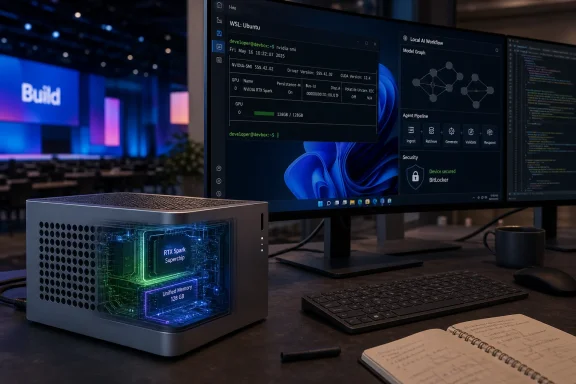
Futuristic AI workstation on a desk with holographic CPU/GPU specs and RTX Spark Compute branding.Surface Stops Pretending Every PC Is for Everyone​

For most of Surface history, Microsoft’s hardware line has played a dual role. It has been a retail product family, but also a signal to OEMs about where Windows hardware should go next. Surface Pro made detachable tablets respectable, Surface Laptop made Windows clamshells feel less compromised, and Surface Studio tried to give creative desktops a physical vocabulary of their own.
The Surface RTX Spark Dev Box belongs to that second tradition more than the first. It is not aimed at the person looking for a quiet family-room mini PC, a living-room Steam box, or a cheaper alternative to a Mac mini. It is a developer appliance dressed in Surface aluminum, intended for people building and testing AI workloads that are increasingly awkward to run on thin laptops and increasingly expensive to run entirely in the cloud.
That distinction matters because the word “Surface” still carries consumer expectations. A new Surface usually invites questions about battery life, screen quality, pen support, keyboard feel, and whether Microsoft has finally found the right price-to-performance balance. This one asks a different question: can Windows become the default local workstation for agentic AI development before developers simply standardize around Linux boxes, cloud GPUs, or Apple’s unified-memory Macs?
Microsoft’s answer is to put a lot of Nvidia silicon in a small box, preconfigure the Windows developer stack, and make the device boring in the way IT departments often like. Boring, in this context, means managed identity, BitLocker, Defender, Intune, Entra ID, WSL 2, CUDA, Python, Node.js, Git, VS Code, and GitHub Copilot already pointed in the same direction. The box is not just hardware; it is an argument that Windows can be a first-class AI development environment without asking developers to assemble the stack themselves.

Nvidia’s Spark Gives Microsoft the Missing Local AI Story​

The technical hook is Nvidia RTX Spark, a new Arm-based platform that combines a Grace CPU with a Blackwell RTX GPU and up to 128GB of unified memory. Microsoft and Nvidia are talking about up to one petaflop of AI compute, support for local 120-billion-parameter models, and long-context workloads that previously would have pushed many developers toward rented cloud GPUs. Those numbers are vendor claims and should be treated as peak-positioning figures, but the direction is not subtle.
The important phrase is unified memory. AI workloads are often constrained less by whether a system can technically perform the math than by whether the model, context, and working set fit in available memory without ugly compromises. A mini PC with 128GB of unified memory is not a replacement for a rack of datacenter GPUs, but it changes what a single developer can reasonably try locally.
That is why this device is more interesting than another small desktop with a mobile chip inside. A conventional mini PC is usually a story about space efficiency: how much CPU, storage, and connectivity can fit into a chassis the size of a paperback? The Surface RTX Spark Dev Box is about locality. It is for workloads where the developer wants the model, code, data, prompt history, and iteration loop close at hand.
Microsoft’s own framing says as much. The company is pitching the box for prototyping, fine-tuning, local inference, long-running training jobs, and agentic pipelines. That is not the language of casual Copilot demos. It is the language of teams trying to build software in an AI cycle where every experiment may otherwise turn into another metered cloud call.

The Mini PC Form Factor Is Doing More Than Saving Desk Space​

There is a reason Microsoft did not simply announce a hulking workstation tower. The Surface RTX Spark Dev Box is supposed to sit visibly in the same mental category as a Mac mini, an Intel NUC, or a small lab machine tucked next to a monitor. But Microsoft is also using the form factor to make AI development feel ordinary, almost office-native.
A small desktop changes the psychology of local compute. A rack server implies procurement, facilities, noise, heat, and shared scheduling. A cloud instance implies cost governance, credential management, network dependency, and data movement. A compact box on the desk implies ownership. It says the developer has a local sandbox powerful enough to be useful and isolated enough to be trusted.
That is a powerful pitch in regulated industries and security-conscious shops. A lot of AI development involves proprietary code, sensitive documents, customer records, design files, or internal operational data. Cloud platforms can handle that work under the right controls, but many organizations still prefer to keep early experiments and risky prototypes close until they understand what they are building. Microsoft is leaning into that tension rather than pretending everything should immediately go to Azure.
The chassis itself is part of the message. Microsoft describes an aluminum body designed to function as a heatsink, and reporting notes a grid of vents and a thermal envelope higher than what a laptop can sustain. That is a quiet admission that the most interesting AI workloads are not bursty demo tasks. They run for hours, chew through memory, and punish thin-and-light designs that look impressive on stage but throttle under sustained pressure.

Windows on Arm Is No Longer Just a Battery-Life Bet​

The Surface RTX Spark Dev Box also reframes Windows on Arm. For years, Microsoft’s Arm story has mostly been about efficiency, mobility, and eventually catching up with the app compatibility people expect from x86 Windows. Qualcomm-powered Copilot+ PCs moved that story forward, but they still largely lived in the laptop world: long battery life, instant wake, quiet operation, and enough AI acceleration for Windows features.
RTX Spark pushes Windows on Arm into a different lane. This is not primarily about making a laptop last through a flight. It is about using Arm CPU cores alongside Nvidia graphics and AI acceleration in machines that developers and creators might choose for performance reasons. If Microsoft can make that work, Windows on Arm stops being an alternative architecture and starts becoming a high-end workstation architecture.
That is a big “if.” Windows on Arm has improved, but developers are unforgiving about toolchain friction. The minute a compiler, driver, Python package, container workflow, VPN client, security agent, debugger, or obscure enterprise dependency breaks, the hardware story collapses. Microsoft knows this, which is why the Dev Box arrives with WSL 2, CUDA support, PowerShell 7, VS Code, Python, Node.js, GitHub Copilot, and other developer defaults already configured.
The preconfiguration is not a convenience feature; it is risk management. Microsoft is trying to reduce the number of moments where a developer says, “This is impressive, but I’ll just use my Linux workstation.” The more the company can make Windows feel like the path of least resistance for AI development, the more credible its larger agentic Windows ambitions become.

The Cloud Is Still There, but Microsoft Wants It Demoted​

Microsoft is not abandoning cloud AI. That would be absurd for a company that has tied much of its current strategy to Azure, OpenAI partnerships, Microsoft Foundry, GitHub, and enterprise Copilot services. But the Surface RTX Spark Dev Box shows a more nuanced strategy: the cloud remains the destination for scale, while the local machine becomes the workshop.
That shift is practical. Developers rarely need frontier-scale models for every iteration. Much of the work in AI-assisted application development involves testing prompts, evaluating smaller models, building retrieval pipelines, checking behavior against private data, running local agents, and tuning workflows before anything deserves expensive cloud deployment. If every loop requires a remote GPU, the feedback cycle slows and the bill grows.
Microsoft’s pitch is that local compute lets developers reserve cloud calls for the problems that genuinely need them. This is a cost argument, but also a sovereignty argument. A local machine gives developers more control over when data leaves the device, how experiments are staged, and what can be tested without waiting for cloud capacity or budget approval.
The catch is that local AI hardware can create its own fragmentation. If developers build against the capabilities of a 128GB RTX Spark workstation, they may produce workflows that do not translate cleanly to ordinary Copilot+ PCs, older x86 laptops, or enterprise desktops with modest GPUs. Microsoft will need to make the developer story scale down as well as up, or this box risks becoming a shiny island for a narrow class of AI teams.

The Surface Brand Becomes a Developer Flag​

Microsoft has sold developer-focused hardware before, but the Surface RTX Spark Dev Box is unusually explicit about its audience. This is not a consumer PC with developer appeal. It is a developer PC with almost no effort spent pretending otherwise.
That is a healthy bit of honesty. The PC market has spent the last two years slapping “AI” onto machines whose real-world local AI capabilities vary wildly. Some devices have NPUs designed mainly for power-efficient inference and Windows features. Others have discrete GPUs that can handle serious creative and AI workloads but at laptop thermal limits. The Surface RTX Spark Dev Box draws a line: this is for people building, testing, and running local AI workloads, not for people wondering whether they need a new box for email and web browsing.
It also gives Microsoft a reference platform. OEMs including Asus, Dell, HP, Lenovo, MSI, Acer, and Gigabyte are part of the broader RTX Spark wave, but Surface lets Microsoft demonstrate its preferred integration of hardware, Windows, developer tools, security controls, and cloud handoff. In the Windows ecosystem, that matters. Microsoft rarely wins by owning all the hardware; it wins when it defines the pattern others copy.
There is a risk, though, in using Surface as a halo for a device most Surface buyers should not buy. If Microsoft prices this like a specialized workstation, as seems likely, casual buyers may see only another expensive niche machine. But for the intended audience, the more relevant comparison may be monthly cloud GPU spend, internal workstation procurement, or the cost of developer time lost to slow iteration.

The Agentic Windows Pitch Needs Hardware That Can Take a Punch​

The Surface RTX Spark Dev Box arrives alongside Microsoft and Nvidia’s broader push toward “agentic” computing, a term that has already been inflated by marketing departments across the industry. In plain English, the goal is software that can plan and execute multi-step tasks across apps, files, codebases, and services with less human micromanagement. That kind of software needs more than a chat window; it needs compute, memory, permissions, containment, identity, and policy.
This is where the Dev Box becomes more than a mini PC. Microsoft and Nvidia are trying to lay the groundwork for agents that run locally, interact with Windows, and obey enterprise controls. If agents are going to inspect files, modify code, drive applications, or route sensitive prompts between local and cloud models, then the operating system has to become part of the safety architecture.
That is the strategic reason Microsoft keeps emphasizing security primitives, Zero Trust alignment, Secured-core PC architecture, BitLocker, Defender, Entra ID, and Intune. The company is not just selling faster inference. It is trying to convince businesses that local AI agents can be governed like other enterprise workloads. For WindowsForum readers who manage fleets, that may matter more than the petaflop headline.
Still, the industry has a habit of describing future agent capabilities before the current implementations deserve the confidence. Local agents remain difficult to secure, difficult to evaluate, and difficult to trust with ambiguous instructions. The Dev Box gives developers the hardware to experiment, but it does not magically solve the problem of making agents reliable. It simply moves more of that experimentation onto Windows machines Microsoft can manage.

The Mac Mini Comparison Is Tempting but Misleading​

The obvious consumer comparison is Apple’s Mac mini, especially because Apple has made unified memory, Arm CPUs, and compact desktops feel mainstream. But the Surface RTX Spark Dev Box is not really Microsoft’s Mac mini moment. It is closer to a Windows AI lab machine in a Mac-mini-sized costume.
Apple’s advantage has been coherence. The company controls the silicon, operating system, developer frameworks, and hardware design tightly enough that its small desktops can serve hobbyists, professionals, and developers in the same product family. Microsoft’s advantage is different: it has the Windows ecosystem, Nvidia’s AI software stack, enterprise identity, developer tools, and a vast installed base of organizations that already manage Windows devices.
That means the Surface RTX Spark Dev Box will be judged less on elegance and more on whether the stack holds together. Does CUDA behave predictably under WSL 2? Do AI frameworks install cleanly? Do Python environments and model toolkits perform as expected? Do enterprise security products get in the way? Do Arm compatibility layers stay invisible enough? Does the box remain quiet and stable under sustained loads?
If the answer to those questions is yes, Microsoft will have something more valuable than a Mac mini rival. It will have a credible Windows reference machine for the local AI development workflow. If the answer is no, the device becomes another impressive Surface experiment admired from a distance and avoided by the people it was built to serve.

Price and Availability Are the Missing Reality Check​

Microsoft has not yet supplied the most grounding detail: price. That omission is not trivial. A small AI workstation can be a bargain compared with cloud GPU spend and still be wildly expensive compared with mainstream mini PCs. Without pricing, the device exists in the comfortable fog where every vendor claim sounds plausible.
Availability is also narrow. Microsoft says the Surface RTX Spark Dev Box will arrive later this year in the United States and be sold through Microsoft.com. That sounds more like a controlled launch than a mass-market rollout. For a developer reference device, that may be enough. For a category-defining PC, it is only the first step.
The lack of international detail may frustrate developers outside the U.S., especially given that AI development is not geographically tidy. Microsoft may be using the initial launch to manage supply, certification, support, and demand. But if Windows on RTX Spark is to become a serious platform, the hardware cannot remain a boutique domestic curiosity for long.
There is also the broader procurement question. Enterprises do not buy developer hardware just because it is interesting. They need lifecycle commitments, repair policies, deployment tooling, security baselines, and predictable replacement cycles. Surface has some credibility there, but specialized AI workstations bring specialized support expectations.

The Desk Is Becoming the New Edge​

The phrase “edge AI” usually conjures factories, cameras, robots, retail systems, and embedded devices. The Surface RTX Spark Dev Box suggests another edge: the developer’s desk. That is where models are tested against proprietary data, where agents are broken and repaired, where prompts become workflows, and where the difference between a ten-second iteration and a ten-minute iteration changes what gets built.
This is the real significance of Microsoft’s mini PC. It is not that everyone needs a tiny Surface with Nvidia silicon. Most people do not. It is that Microsoft is acknowledging that the AI PC cannot be defined only by consumer features like Recall, image generation, live captions, or assistant shortcuts. For the Windows ecosystem to matter in AI, it has to matter to the people building AI software.
That puts pressure on the rest of the Windows stack. Local AI development needs predictable GPU access, good package compatibility, strong virtualization, fast storage, sensible power management, and security controls that do not suffocate experimentation. It also needs documentation and defaults that assume developers move between Windows, Linux tools, containers, cloud services, and IDEs all day.
The Surface RTX Spark Dev Box is Microsoft’s attempt to package that assumption into hardware. It says the developer should not have to choose between the manageability of Windows, the AI gravity of Nvidia, and the tool comfort of Linux workflows. Whether that promise survives first contact with real projects will determine whether the box is a milestone or merely a curiosity.

The Surface Mini PC Tells Us Who the AI PC Is Really For​

The most concrete lesson from the Surface RTX Spark Dev Box is not that Microsoft has discovered mini PCs. It is that the AI PC category is splitting into layers. Consumer Copilot+ PCs handle lightweight local experiences. Creator laptops chase portable acceleration. Developer boxes like this one target sustained local model work. Enterprise workstations and cloud GPUs remain above them for the heaviest jobs.
That hierarchy is more honest than pretending a single “AI PC” label explains everything. It also gives Windows a better story. Instead of asking one NPU-equipped laptop to symbolize the entire future, Microsoft can point to a continuum from mobile PCs to local developer hardware to cloud deployment.
  • The Surface RTX Spark Dev Box is a Surface-branded mini PC for AI developers, not a mainstream desktop for ordinary home users.
  • Its main technical promise is local AI work on Nvidia RTX Spark hardware with up to 128GB of unified memory and strong sustained performance.
  • Microsoft is using the device to make Windows, WSL 2, CUDA, VS Code, GitHub Copilot, and its AI tooling feel like one integrated developer platform.
  • The box is strategically about reducing dependence on cloud GPUs for everyday experimentation, not replacing cloud infrastructure for frontier-scale work.
  • Price, real-world thermals, Arm compatibility, and enterprise support will decide whether the product becomes a reference platform or a niche showcase.
Microsoft’s newest Surface is therefore less a product for the average buyer than a marker for where Windows wants to go next: toward local, managed, Nvidia-accelerated AI development that treats the desk as part of the cloud-to-edge continuum. If the company can make the software experience as coherent as the hardware pitch, the Surface RTX Spark Dev Box may become one of those odd Surface devices that sells in modest numbers while quietly teaching the rest of the PC industry what to build next.

References​

  1. Primary source: PCWorld
    Published: Tue, 02 Jun 2026 17:23:00 GMT
  2. Independent coverage: Liliputing
    Published: Tue, 02 Jun 2026 17:54:50 GMT
  3. Related coverage: tomshardware.com
  4. Related coverage: techradar.com
  5. Related coverage: axios.com
  6. Related coverage: windowscentral.com
  1. Related coverage: nvidianews.nvidia.com
  2. Related coverage: minis-pc.com
  3. Related coverage: acer.com
  4. Official source: blogs.windows.com
  5. Official source: microsoft.com
  6. Related coverage: builders.intel.com
  7. Official source: cdn-dynmedia-1.microsoft.com
  8. Related coverage: vintageapple.org
  9. Official source: news.microsoft.com
 

Microsoft introduced the Surface RTX Spark Dev Box at Build 2026 on June 2, 2026, as a compact Windows 11 Pro developer desktop built with NVIDIA’s RTX Spark superchip, up to one petaflop of AI compute, and 128GB of unified memory for local AI development. The machine is not just another Surface experiment in small-form-factor hardware. It is Microsoft’s clearest statement yet that the next phase of Windows development will be judged by how much serious AI work can happen on the desk, not only in the cloud. For developers and IT shops, the pitch is seductive: fewer cloud round trips, more private experimentation, and a Windows workstation shaped around the messy reality of building with large models.

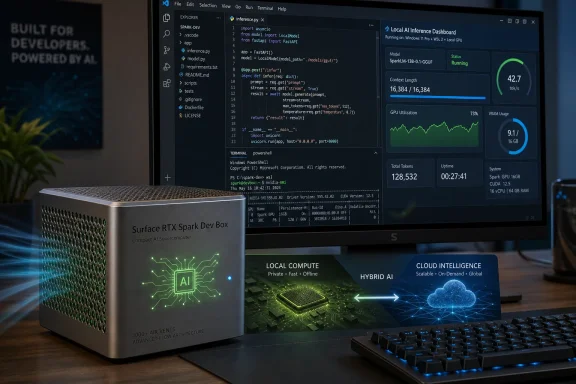
Demo setup shows NVIDIA RTX Spark Dev Box with Windows 11 Pro and local model/compute dashboards.Microsoft Turns the Dev Box Into a Bet on Local AI​

For the last few years, Microsoft’s AI strategy has looked overwhelmingly cloud-first. Azure provided the scale, OpenAI provided the halo, Copilot provided the user-facing packaging, and Windows increasingly became the place where those services surfaced. The Surface RTX Spark Dev Box shifts that emphasis without abandoning the cloud: Microsoft is now trying to convince developers that local inference and local fine-tuning are not edge cases, but part of the default AI development loop.
That matters because the economics of AI development have been awkward for small teams, enterprise labs, and independent developers. Prototype too much in the cloud and the meter runs quickly. Prototype only on ordinary PCs and the model sizes that matter become impractical. A desktop-class AI box with 128GB of unified memory is Microsoft’s answer to the gap between “toy demo on a laptop” and “submit another expense report for GPU instances.”
The Surface branding is also doing work here. Microsoft could have left this category to NVIDIA’s DGX line or to workstation vendors, but putting Surface on the chassis makes the machine part of the Windows platform story. It says that AI development hardware is no longer a peripheral concern for Microsoft. It belongs in the same product universe as laptops, tablets, developer tools, and Windows itself.
The timing is equally revealing. Build is where Microsoft courts developers, sells platform direction, and tries to make its architectural bets feel inevitable. Announcing a local AI development box there frames RTX Spark not as a niche workstation component, but as a new baseline for the kind of Windows PC Microsoft wants developers to target.

The One-Petaflop Number Is Marketing, but the Memory Is the Message​

The headline specification is one petaflop of AI compute. That number will look spectacular in a keynote slide, and it gives Microsoft and NVIDIA a convenient shorthand for “this is not your office mini-PC.” But for many AI workloads, the more important spec is the 128GB of unified memory shared across the CPU and GPU.
Memory capacity determines what kinds of models developers can load, test, and iterate on locally. A model that technically fits but thrashes across memory boundaries is not a practical local development experience. Unified memory is therefore central to the Surface RTX Spark Dev Box pitch: it reduces the friction between CPU-side orchestration and GPU-side acceleration, letting larger models and workloads live in a single shared pool.
Microsoft says the system is intended to run models with more than 120 billion parameters locally. That statement should be read carefully. Parameter count alone does not describe performance, quantization level, context length, throughput, or the usability of a model in a real application. Still, the claim establishes the class of work Microsoft has in mind: this box is being positioned for frontier-adjacent development, not just small chatbots and image filters.
The Blackwell RTX GPU and Grace CPU pairing is also a strategic break from the familiar Intel-or-AMD Windows workstation template. NVIDIA is not merely supplying a discrete accelerator; it is supplying the platform architecture around which these systems are built. That gives Microsoft a way to sell a Windows AI workstation with CUDA compatibility and NVIDIA’s AI software stack as first-class assumptions rather than optional extras.
This is why the Surface RTX Spark Dev Box is more interesting than its size. The small chassis is a packaging story. The real story is Microsoft validating a new Windows developer hardware tier where the local machine is expected to be powerful enough to participate directly in the AI pipeline.

Windows on Arm Gets a Workstation-Class Argument​

Windows on Arm has spent years carrying the burden of promise. Battery life was supposed to improve. Always-connected PCs were supposed to feel modern. Emulation was supposed to smooth over compatibility gaps. The problem was that the platform often sounded more compelling in principle than it felt in the hands of developers who needed uncompromised tools.
RTX Spark gives Windows on Arm a sharper purpose. Instead of asking developers to care about Arm because it is efficient, Microsoft can now ask them to care because it enables a tightly integrated CPU-GPU memory architecture for AI work. That is a better argument, because it is tied to a concrete workload rather than a vague platform migration.
The Dev Box also arrives with the software pieces Microsoft knows developers will ask about. Windows 11 Pro is configured for development, with WSL 2 and GPU passthrough, CUDA support, PowerShell 7, Git, Python, Node.js, GitHub Copilot, and Visual Studio Code called out as part of the out-of-box environment. The message is not merely that the hardware is capable. It is that Microsoft wants to reduce the ceremony before the first useful experiment.
That is important because developers are allergic to “promising platform, missing toolchain” stories. If CUDA, Python, Linux tooling, editors, and package managers do not behave predictably, the petaflop number becomes trivia. Microsoft appears to understand that the credibility of the box depends less on a benchmark and more on whether a developer can clone a repo, load a model, and get work done without turning setup into a weekend project.
Still, Windows on Arm remains a risk factor. The AI stack may be ready first because Microsoft and NVIDIA have clear incentives to polish it, but broader development environments vary wildly. Enterprise developers may have legacy tooling, custom binaries, drivers, and security agents that were never designed with Arm workstations in mind. The Dev Box will therefore be judged not only by AI demos, but by how gracefully it handles the unglamorous dependencies that real development teams drag along.

Microsoft Is Selling a Workflow, Not Just a Workstation​

The Surface RTX Spark Dev Box is being presented as local-first AI development hardware, but Microsoft’s broader ambition is workflow control. The company wants Windows, Visual Studio Code, GitHub Copilot, Windows ML, AI Toolkit, Microsoft Foundry, WSL, and CUDA to feel like one coherent path from experiment to deployment. The hardware is the anchor that makes that story more tangible.
This is a different kind of Surface product. Traditional Surface devices often tried to define a user experience: the tablet that could replace your laptop, the premium notebook, the creator machine, the enterprise-friendly 2-in-1. The Dev Box defines a development loop. It is aimed at the moment when a model needs to be tested, refined, inspected, quantized, integrated, and shipped.
That loop has been fragmented. Developers may prototype with hosted APIs, experiment with open models on local GPUs, shift to cloud notebooks for larger jobs, and then deploy into yet another environment. Each handoff introduces latency, cost, governance concerns, and reproducibility problems. Microsoft’s pitch is that a sufficiently capable Windows AI workstation can collapse more of that loop into a single local environment.
The privacy argument is implicit but powerful. If developers can run meaningful model experiments on local hardware, more sensitive data can stay inside the organization during early testing. That does not eliminate compliance obligations, but it changes the default posture. Instead of sending every prompt, document, vector store, or test workload to a remote service, teams can choose what needs cloud scale and what can remain on the desk.
For enterprises, that may be more compelling than raw performance. A local AI workstation can be enrolled, managed, secured, and audited like other Windows PCs. Microsoft highlights the machine as a secured-core PC that works with BitLocker, Microsoft Defender, Entra ID, and Intune. That is not glamorous, but it is exactly the language IT departments listen for when a new class of developer hardware appears.

NVIDIA Gets Its Windows Beachhead​

For NVIDIA, RTX Spark is not just a chip story. It is an attempt to make the Windows PC feel like a natural home for agentic AI workloads, local assistants, model experimentation, and accelerated creator workflows. The Surface Dev Box gives that effort a prominent Microsoft-backed showcase.
NVIDIA already owns the imagination of AI developers in the data center. CUDA remains one of the strongest moats in modern computing, and the company’s GPUs are the default mental model for accelerated AI work. The open question has been how much of that dominance can move down into personal workstations and compact desktops without turning every developer setup into a noisy, expensive, power-hungry tower.
RTX Spark is NVIDIA’s answer: compress the AI workstation into a PC-class form factor, pair Blackwell GPU architecture with a Grace CPU, and give developers a shared memory pool large enough to matter. Microsoft’s participation validates the platform in a way that a standalone NVIDIA device could not. Windows is still where enormous numbers of developers, enterprises, and creators live.
There is also a competitive subtext. Apple has spent years normalizing the idea of unified memory as a practical advantage for high-end creative and development workloads. Apple Silicon made the laptop feel like a serious local compute environment again. Microsoft and NVIDIA are now responding with a Windows version of that argument, but tuned for CUDA-centric AI rather than Apple’s vertically integrated macOS stack.
The Surface RTX Spark Dev Box is therefore partly a message to developers who have drifted toward Macs for quiet, high-memory local work. Microsoft is saying Windows can offer the same broad idea — a compact machine with a large unified memory pool — while retaining the NVIDIA AI ecosystem many machine learning developers already rely on. That is a more credible counterpunch than another generic “AI PC” sticker.

The Cloud Is Not Being Replaced; It Is Being Repriced​

It would be easy to frame the Surface RTX Spark Dev Box as a rebellion against cloud AI. That would be too simple. Microsoft is not trying to kill Azure consumption with a desktop box; it is trying to make Azure the scale-out destination after local development has become more productive.
The cloud remains essential for training large frontier models, running massive batch jobs, serving high-traffic inference, and coordinating enterprise-scale deployments. A compact developer workstation is not going to replace clustered GPUs, managed model endpoints, data pipelines, or global inference infrastructure. Microsoft knows this better than anyone, because Azure is one of the main beneficiaries of those workloads.
What the Dev Box changes is the early and middle part of the pipeline. Developers can test model behavior, experiment with prompts and tools, evaluate quantized models, prototype agents, and fine-tune smaller or specialized models locally. That reduces the number of cloud experiments needed to answer basic questions. It also makes development feel less like scheduling time on remote infrastructure.
This is where the economics become interesting. Cloud GPUs are excellent when utilization is high and workloads are bursty or too large for local machines. They are frustrating when developers are doing iterative, exploratory work that involves waiting, tweaking, rerunning, and debugging. A local AI box shifts some of that cost from operating expense to capital expense, which some organizations will prefer.
The tension for Microsoft is obvious. Azure benefits when developers consume cloud compute, but the Windows ecosystem benefits when the local PC remains indispensable. The Dev Box is an attempt to square that circle: make Windows the best place to build AI applications locally, then make Microsoft’s cloud the obvious place to deploy, scale, and manage them.

The Developer Setup Is the Product​

The most revealing part of Microsoft’s announcement may not be the silicon at all. It is the emphasis on what ships ready to use. WSL 2 with GPU passthrough, CUDA, Python, Node.js, Git, PowerShell, Visual Studio Code, GitHub Copilot, AI Toolkit, Windows ML, TensorRT, Microsoft Foundry — this is the checklist of a company that knows the hardware sale depends on reducing setup friction.
Developers do not buy “AI compute” in the abstract. They buy the ability to run their stack with fewer compromises. If WSL 2 can provide a familiar Linux-oriented environment while Windows handles identity, device management, security, and desktop integration, Microsoft gets to present Windows as both developer-friendly and enterprise-governable.
That dual identity has long been one of Windows’ strengths, but AI has strained it. Many machine learning workflows were born in Linux environments, then awkwardly adapted to Windows or run inside containers, remote servers, or WSL. By pairing WSL with GPU passthrough on dedicated AI hardware, Microsoft is trying to make the old Windows-versus-Linux tension less relevant. The developer may still use Linux tools, but the machine remains a Windows PC.
GitHub Copilot’s presence in the story is equally predictable and important. Microsoft does not want AI development to mean only model execution. It wants coding assistance, repository workflows, cloud deployment, model tooling, and local acceleration to reinforce each other. The Dev Box is a physical expression of Microsoft’s larger platform bundling strategy.
The risk is that bundled convenience can become bundled complexity. Developers will want to know which parts are standard, which are Microsoft-specific, which require subscriptions, which are optimized for Azure, and which work cleanly with non-Microsoft models and deployment targets. The more Microsoft frames the Dev Box as an open developer machine rather than a captive Copilot-and-Azure appliance, the broader its appeal will be.

IT Departments Will Like the Control and Fear the Exception​

For sysadmins, the Surface RTX Spark Dev Box cuts both ways. On one hand, it is a Windows 11 Pro secured-core PC with familiar management hooks. That is far easier to accept than a shadow fleet of self-built GPU towers, unmanaged Linux boxes, or developers expensing cloud services with inconsistent governance.
On the other hand, any new developer hardware class creates exceptions. Security teams will ask what data is being used for local model testing, how models are obtained, whether downloaded weights are scanned, how inference logs are handled, and whether local agents can access corporate resources too broadly. The box may be easier to manage than an ad hoc workstation, but AI development itself remains a governance problem.
There is also the question of hardware lifecycle. A one-petaflop AI desktop sounds powerful in 2026, but AI tooling moves quickly and model expectations inflate even faster. Enterprises will need to decide whether this is a three-year developer workstation, a specialized lab device, or an expensive bridge while cloud and local AI architectures settle. Pricing, which Microsoft has not disclosed, will shape that conversation sharply.
Support will matter as much as performance. If these devices are deployed to developers, IT teams will need predictable driver updates, firmware servicing, recovery images, security baselines, and compatibility documentation. A premium Surface-branded workstation cannot behave like an enthusiast kit. It has to behave like a managed endpoint that happens to contain unusually serious AI silicon.
That is why Microsoft’s positioning around Intune, Entra ID, Defender, and BitLocker is not boilerplate. It is the enterprise sales argument. The company is telling IT departments that developers can get local AI horsepower without leaving the Windows management perimeter.

The AI PC Label Finally Grows Up​

The PC industry has spent the last few years abusing the phrase “AI PC.” Too often it meant a neural processing unit powerful enough for background effects, local transcription, webcam features, or a few Copilot-adjacent tricks. Useful, perhaps, but not transformative enough to justify the marketing avalanche.
The Surface RTX Spark Dev Box belongs to a different category. It is not an AI PC because it has a token accelerator. It is an AI PC because its purpose is to run and develop AI workloads locally at a scale that changes what a developer can reasonably attempt on personal hardware. That distinction matters.
This also exposes the weakness of the broader AI PC campaign. If every new laptop is called an AI PC, the label stops helping buyers understand anything. A system with an NPU for lightweight inference is not the same as a workstation-class box with a Blackwell GPU, CUDA support, and 128GB of unified memory. Microsoft and NVIDIA are effectively creating a more serious top tier under the same noisy umbrella.
That may force the rest of the Windows ecosystem to become more precise. Developers, creators, and IT buyers will ask whether a machine is built for AI features, AI usage, or AI development. Those are different markets. A laptop that makes video calls better is not competing with a local model fine-tuning workstation, even if both wear the same AI branding.
The Dev Box is useful because it clarifies the high end. It gives Microsoft a reference point for what local AI development on Windows is supposed to mean. The rest of the market can then either follow, specialize, or admit that most “AI PCs” are client devices for AI features rather than machines for building AI systems.

The Surface Portfolio Is Becoming Less About Form and More About Role​

Surface began as a hardware argument about what Windows devices could look like. The original Surface line pushed detachable keyboards, kickstands, pens, premium industrial design, and Microsoft’s willingness to compete with its own OEM partners when it believed the ecosystem needed a reference device. The Surface RTX Spark Dev Box suggests a different role for the brand.
This is not a mass-market Surface. It is not trying to define the default home computer, the office laptop, or the school tablet. It is a purpose-built machine for a narrow but influential audience: developers building AI software, enterprise teams experimenting with models, and technical users who need local acceleration without assembling a workstation.
That makes it closer in spirit to a developer kit than a conventional PC. But Microsoft is not calling it a temporary kit or a prototype board. It is a Surface product, which implies polish, support, and a place in the commercial lineup. That distinction matters because it suggests Microsoft sees local AI development hardware as a durable category, not a one-off reference design.
The announcement also sits alongside the Surface Laptop Ultra, which uses the same broader RTX Spark platform story in a portable flagship. Together, the laptop and Dev Box create a two-pronged message: AI developers may want mobility, or they may want a compact desktop that stays on a desk, but Microsoft wants both scenarios inside the Surface universe.
This is a more segmented Surface strategy. Instead of one design idea stretched across consumer and business markets, Microsoft is building machines around roles: creator, developer, AI professional, managed enterprise user. The Dev Box is the most explicit version of that shift.

Pricing Will Decide Whether This Is a Movement or a Trophy​

Microsoft has not disclosed pricing, and that omission is not a detail. It is the hinge on which the product’s real market turns. A local AI workstation can be a practical tool if it undercuts enough cloud usage, saves enough developer time, or replaces enough piecemeal hardware. It becomes a trophy if the price pushes it into executive-demo and elite-lab territory.
The comparisons will be messy. Buyers will weigh it against cloud GPU spending, conventional RTX workstations, Apple Silicon machines with large unified memory configurations, NVIDIA’s own DGX Spark-class hardware, and high-end developer laptops. Each comparison will produce a different answer depending on workload, utilization, security requirements, and how much the organization values local control.
Microsoft also has to avoid the trap of selling only to people who already know they need it. The Dev Box’s success depends on whether teams that are merely AI-curious can justify buying one or two units to accelerate experimentation. If pricing is too high, it will reinforce the idea that serious AI development remains a privileged activity for well-funded labs.
Availability will matter too. Microsoft says the device is coming later this year in the United States through its online store. That sounds straightforward, but enterprise buyers will want procurement channels, support plans, replacement policies, and global availability. A developer machine that cannot be easily standardized across teams will remain a boutique option.
There is a broader ecosystem effect as well. If Microsoft’s own Surface entry is expensive but credible, OEM partners may fill in adjacent price bands with RTX Spark desktops and laptops of their own. In that scenario, the Dev Box does not need to dominate unit sales. It needs to set the template.

Developers Get a New Local Loop, but Not a Free Pass​

For developers, the attraction is obvious. Local model work can be faster, more private, and more tactile than remote experimentation. You can test without waiting for a cloud instance, iterate without watching a usage meter, and keep sensitive materials closer to the machine you control.
But local AI development does not remove the hard parts. Model evaluation is still difficult. Fine-tuning can still produce brittle or misleading results. Quantization can trade quality for speed in ways that are not always obvious. Agentic workflows can still behave unpredictably when tools, permissions, memory, and external systems are involved.
A powerful local box may even make it easier to create problems faster. Developers can spin up larger models, connect them to more tools, and test more ambitious workflows before governance has caught up. That is not an argument against the machine. It is a reminder that AI development needs discipline, not just compute.
The best use case may be controlled acceleration. Teams can use the Dev Box to explore model behavior, test application logic, validate local inference paths, and prepare workloads before moving them to managed infrastructure. That is a sane division of labor: local for iteration, cloud for scale, managed environments for production.
If Microsoft can make that workflow feel natural, the Dev Box becomes more than a workstation. It becomes a missing link between the developer’s desk and the enterprise AI platform.

The Small Box Carries a Very Large Windows Bet​

The Surface RTX Spark Dev Box is not important because every Windows developer will buy one. Most will not. It is important because it defines the direction Microsoft wants the Windows developer ecosystem to move: toward local AI capability, tighter NVIDIA integration, Arm-based high-performance systems, and a development stack that treats AI as a native workload rather than an add-on.
Here is the practical shape of that bet:
  • The Surface RTX Spark Dev Box gives Microsoft a first-party Windows machine aimed squarely at local AI development rather than generic productivity or lightweight AI features.
  • The combination of Blackwell RTX graphics, a Grace CPU, and 128GB of unified memory is meant to make large local model work practical in a compact desktop form factor.
  • The preconfigured developer stack is as important as the silicon because setup friction can kill adoption faster than weak benchmarks.
  • Enterprise appeal will depend on whether Microsoft can make the device feel like a manageable secured-core Windows endpoint, not an exotic AI appliance.
  • Pricing and availability will decide whether the Dev Box becomes a widely used development tool or a premium reference machine that mainly shapes what OEM partners build next.
  • The product strengthens Microsoft’s argument that Windows can be both the front end for cloud AI and a serious local platform for building AI software.
The Surface RTX Spark Dev Box lands at a moment when the PC industry is desperate to make “AI PC” mean something more than a badge on a spec sheet. Microsoft’s bet is that developers will not be satisfied with AI features sprinkled onto ordinary machines; they will want local systems capable of building, testing, and refining the software that makes those features possible. If the hardware, tooling, pricing, and enterprise management story hold together, this small Surface box could mark the point where Windows stops merely consuming AI from the cloud and starts treating local AI development as one of the PC’s central jobs.

References​

  1. Primary source: Windows Report
    Published: 2026-06-02T17:52:07.851818
  2. Related coverage: tomshardware.com
  3. Related coverage: pcgamer.com
  4. Official source: microsoft.com
  5. Related coverage: nvidianews.nvidia.com
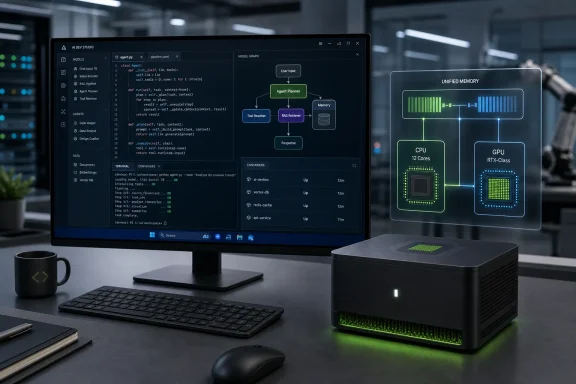
  6. Official source: blogs.windows.com
  1. Related coverage: investor.nvidia.com
  2. Related coverage: livemint.com
  3. Related coverage: windowscentral.com
  4. Related coverage: nvidia.com
  5. Related coverage: gadgetsnow.indiatimes.com
  6. Related coverage: axios.com
  7. Related coverage: signal65.com
  8. Related coverage: amax.com
  9. Related coverage: tdsynnex.com
 

Microsoft unveiled the Surface RTX Spark Dev Box on June 2, 2026, at its Build developer conference, positioning the compact Windows desktop as a local AI development machine with Nvidia RTX Spark silicon, 128GB of unified memory, and up to one petaflop of AI compute. The pitch is simple enough to fit on a keynote slide: give developers a box that can run frontier-adjacent models without renting a cloud GPU every time they want to test an agent. The more consequential claim is buried beneath the specs. Microsoft is trying to make Windows the place where AI agents are built, contained, governed, and eventually trusted.
That is a bigger swing than another Surface form factor. For most of the AI boom, Windows has been the client endpoint, Azure has been the compute story, and developers have tolerated the awkward middle ground between local experimentation and cloud-scale deployment. Surface RTX Spark Dev Box is Microsoft’s attempt to close that gap, not by replacing the cloud, but by making the local Windows machine feel like a legitimate first-class node in the AI development pipeline.

A desktop with an RTX Spark server powering a blue tech workflow diagram of AI/cloud builds.Microsoft Turns the Developer PC Into an AI Appliance​

The Surface RTX Spark Dev Box is not being sold as a general-purpose mini PC with a fashionable AI badge. Microsoft describes it as a developer machine built around Nvidia’s RTX Spark platform, combining a Blackwell-class RTX GPU, Grace CPU technology, CUDA support, and a unified memory architecture that lets the CPU and GPU share a large memory pool. The headline numbers are aggressive for a desktop that is intended to sit near a monitor rather than in a rack: up to one petaflop of AI compute and 128GB of unified memory.
The memory figure matters more than the petaflop figure for many developers. AI performance marketing tends to orbit peak throughput, but the first practical question for local model work is brutally mundane: will the model fit? Microsoft says the Dev Box can run models with up to 120 billion parameters using 4-bit quantization, which places it well beyond the class of hobbyist local AI boxes and into the territory where serious prototyping becomes plausible.
That does not mean developers are suddenly training the next GPT-class model under a desk. The Surface RTX Spark Dev Box is better understood as a local inference, experimentation, agent orchestration, and workflow development machine. It is the place where a team can test a model, wire it into tools, simulate agent behavior, and iterate before pushing the workload into Azure or another production environment.
Microsoft’s timing is not accidental. Build has become the company’s annual venue for explaining how it wants developers to think about the platform beneath their code. In 2026, that platform story is no longer “Windows plus Visual Studio plus Azure.” It is Windows as the operating substrate for AI agents, with Visual Studio Code, GitHub Copilot, WSL 2, CUDA, containers, policy enforcement, and cloud handoff all arranged into a single funnel.

The Cloud Is Still the Destination, but Local Compute Is the New On-Ramp​

For years, the economic logic of AI development has pushed serious work into the cloud. If a developer needed access to high-end GPUs, the answer was not to buy a workstation; it was to rent capacity from Azure, AWS, Google Cloud, CoreWeave, or another provider. That model is not going away, but it has become increasingly uncomfortable for experimentation.
Cloud GPUs are powerful, but they introduce friction. Developers must provision resources, manage cost, move data, navigate quotas, and deal with latency. For enterprise teams, there are also governance questions about where sensitive prompts, embeddings, logs, and proprietary code are going. A local AI development box does not eliminate those problems, but it changes the rhythm of early-stage work.
The Surface RTX Spark Dev Box is Microsoft’s answer to a specific developer pain point: the AI workflow has become too cloud-dependent too early. If the first meaningful test of an agent requires a paid GPU instance, a cloud sandbox, and an approval chain, experimentation slows. If the same work can begin locally on Windows with the same tooling stack that will later connect to Azure, Microsoft gains leverage over the developer’s entire path from prototype to production.
That leverage is the real product. Hardware margins are not the reason Microsoft is putting Surface branding on an Nvidia-powered AI desktop. The Dev Box is a physical argument that Windows should remain central even as more development moves toward AI-native systems. It tells developers: do your local testing here, use our editor, use our agent tooling, use our containment model, and when you need scale, the cloud handoff is already waiting.
This is why the inclusion of WSL 2 GPU passthrough and CUDA support is so important. Microsoft cannot win serious AI developers by pretending Windows-native tooling alone is enough. The modern AI stack is deeply tied to Linux workflows, Python environments, CUDA libraries, open-source model tooling, and containerized deployment habits. By making WSL 2 a first-class bridge to Nvidia acceleration, Microsoft is trying to prevent developers from leaving Windows just because their AI toolchain expects Linux.

Nvidia Gets the Silicon Win Microsoft Could Not Build Alone​

The Surface RTX Spark Dev Box also says something uncomfortable about Microsoft’s hardware ambitions: for this generation of AI PCs, Nvidia owns the most important layer. Microsoft has invested heavily in custom silicon for the cloud, including its own AI accelerators, but the developer desktop is a different battlefield. CUDA remains the gravitational center of practical AI development, and Nvidia’s software stack is still the default assumption for many frameworks, libraries, and model workflows.
That makes RTX Spark strategically convenient for Microsoft. It gives Windows a credible local AI engine without requiring Microsoft to build and evangelize an entirely new developer compute stack from scratch. Nvidia supplies the GPU architecture, the CUDA ecosystem, and the AI software credibility; Microsoft supplies Windows, Surface industrial design, developer tooling, identity, management, and the enterprise channel.
The partnership is also a hedge against Apple. Apple’s unified memory architecture and increasingly capable Neural Engine and GPU stack have made Macs attractive to many developers working with local models, especially those who value battery life, silence, and a Unix-like development environment. Microsoft cannot answer that merely by saying Windows has more users. It needs hardware that makes local AI feel technically serious.
The Surface RTX Spark Dev Box is not a Mac Studio clone, but the comparison is unavoidable. Both ideas revolve around the same basic premise: put a large shared memory pool close to accelerated compute and let developers work locally on models that would choke ordinary PCs. Microsoft’s differentiator is not elegance; it is enterprise Windows integration and Nvidia compatibility.
That is a credible differentiation, but not a guaranteed victory. Apple’s advantage is coherence. Nvidia and Microsoft’s advantage is ecosystem reach. The Surface box will succeed only if the Windows AI development experience feels less like a pile of adapters and more like a platform.

The Agent-Native Windows Pitch Is Really a Security Pitch​

The hardware announcement landed alongside a more important software claim: Microsoft wants Windows to become an “agent-native runtime.” That phrase risks sounding like keynote vapor, but the substance is worth attention. As AI agents move from chat windows into actual task execution, the operating system has to decide what an agent is allowed to see, touch, change, and remember.
Microsoft’s answer is Microsoft Execution Containers, or MXC, now in preview. The company describes MXC as a policy-driven execution layer for agents across Windows and WSL, intended to give developers and IT administrators a way to create enterprise sandbox environments. In plain English, Microsoft is acknowledging that agents cannot be allowed to roam around a user’s PC or a corporate environment with the same vague permissions model that governed earlier desktop automation.
That acknowledgement is overdue. The risk profile of an AI agent is different from that of a traditional application. A normal app generally performs operations the developer anticipated. An agent interprets intent, calls tools, reads context, chains actions, and may interact with files, browsers, terminals, APIs, and other apps. The more useful it becomes, the more dangerous a sloppy permission model becomes.
Microsoft says MXC can help define agent boundaries at the operating system level, manage inference, enforce policies, mask personally identifiable information, and limit visibility into systems and data. Those are the right nouns. The question is whether they become enforceable primitives that administrators can trust or merely another policy surface that works until a developer needs to bypass it for convenience.
Enterprise IT will be skeptical, and it should be. Windows history is full of powerful technologies whose security posture depended on how well they were configured in the real world. If MXC is to matter, it must be manageable through familiar enterprise tools, observable during incidents, compatible with developer workflows, and resistant to the slow erosion that happens when productivity pressure meets security policy.

The Agent Boom Has a Permissions Problem Windows Cannot Ignore​

The excitement around agents is easy to understand. A useful agent can file tickets, summarize documents, modify code, operate a browser, query databases, and coordinate work across multiple services. The problem is that each of those capabilities requires access, and access is where enterprise security programs go to lose sleep.
The old desktop security model was built around users, applications, files, processes, and network boundaries. Agentic systems blur those lines. An agent may be acting on behalf of a user, inside an application, through a browser, with access to cloud credentials, while generating code or commands that another tool executes. If something goes wrong, the blame chain is not obvious.
That is why Microsoft’s Build message is broader than a new Surface. The company is trying to define the control plane for agents before the ecosystem settles into unsafe defaults. If developers begin building agents on Windows with MXC, Foundry Agent Service, GitHub Copilot, and managed identity baked into the workflow, Microsoft gets to shape the assumptions of the next generation of Windows software.
The alternative is less attractive for Redmond. If agent development standardizes around browser extensions, ad hoc Python scripts, open-source desktop automation tools, and cloud-only sandboxes, Windows becomes the thing being automated rather than the platform doing the governing. That would leave Microsoft defending the endpoint while others control the agent runtime.
There is also a consumer angle, though Microsoft is wisely leading with developers and enterprises. The company has more than a billion Windows users, and any future in which everyday PC users delegate tasks to AI agents will require a permissions model ordinary people can understand. “This agent can see your Downloads folder but not your tax documents” is not a trivial user experience problem. Neither is “this agent can use your browser session but cannot submit forms without approval.”

GitHub Copilot Moves From Pair Programmer to Agent Manager​

The preview of a GitHub Copilot app for developers fits neatly into this strategy. Microsoft describes a workflow where developers can begin from a natural-language idea, an existing issue, or a code merge suggestion, then coordinate multiple agents in parallel through review, integration, and final merge. Copilot uses Git worktrees to manage multiple branch tasks, while the developer remains in control.
That last clause is doing a lot of work. Every AI coding assistant now has to reassure developers that they remain in control, because the industry has raced from autocomplete to autonomous code modification with very little time for teams to absorb the implications. The productivity upside is obvious. The review burden, security exposure, and maintenance risk are just as real.
The use of Git worktrees is a practical detail that suggests Microsoft understands the messiness of real development. Parallel agent work sounds impressive until two agents edit overlapping files, generate incompatible assumptions, or produce code that passes local tests but violates architectural intent. Git gives Microsoft a familiar structure for isolating work, comparing changes, and forcing human review before integration.
Still, the agentic coding market is not waiting for Microsoft. OpenAI, Anthropic, Google, JetBrains, Cursor, Sourcegraph, and a swarm of startups are pushing toward deeper codebase awareness and more autonomous software development. Microsoft’s advantage is GitHub itself. If Copilot becomes the agent manager inside the repository where the work already happens, it does not need to be the flashiest coding agent to become the default.
The Surface RTX Spark Dev Box makes that pitch more tangible. A developer can run local models, use Copilot, test agent workflows, and keep sensitive code closer to the machine rather than constantly sending context to remote services. That does not solve every privacy or IP question, but it gives Microsoft a better answer than “trust the cloud.”

Foundry Becomes the Cloud Half of the Same Story​

Microsoft’s Foundry Agent Service, also discussed in preview form, supplies the other half of the architecture. For cloud-hosted agents, Microsoft is emphasizing session-by-session isolated execution, persistent memory, and elastic scaling. The language mirrors the local MXC story: isolation, control, memory, scale.
That symmetry matters. Microsoft does not want local and cloud AI development to feel like separate worlds. It wants developers to build and test locally, then move to managed cloud execution when the workload demands more capacity, multi-user access, compliance controls, or integration with enterprise systems. Surface RTX Spark Dev Box is the workstation; Foundry is the production lane.
This is classic Microsoft platform strategy. The company rarely wins by owning only one layer. It wins when the layers reinforce one another: Windows client, developer tools, identity, management, cloud services, collaboration software, and now AI agents. The more coherent the path between those layers, the harder it is for competitors to dislodge one piece.
But the coherence is also where Microsoft must be careful. Developers are allergic to funnels that look like lock-in. If the Surface RTX Spark Dev Box works best only when paired with Microsoft services, it will be seen as an Azure acquisition device in aluminum clothing. If it works well with open models, standard tools, WSL workflows, CUDA libraries, GitHub repositories, and competing deployment targets, it has a better chance of becoming trusted developer hardware.
The strongest version of Microsoft’s strategy is not “all AI roads lead to Azure.” It is “Windows is the most practical place to build AI systems that may later run anywhere.” That is a more developer-friendly argument, and it is the one Microsoft should lean into if it wants adoption beyond committed Microsoft shops.

Scientific Discovery Gives the AI Push a More Serious Costume​

Microsoft also officially launched Discovery, an AI platform aimed at scientific research. This could be read as a separate announcement, but it belongs in the same strategic frame. Microsoft is trying to show that its AI platform is not merely about office productivity and code generation; it wants to be infrastructure for research, simulation, materials science, chemistry, and other high-value domains.
Scientific AI is attractive because it gives the industry a more substantive story than “the chatbot can write your email.” It also demands workflows that are compute-heavy, data-sensitive, and tool-rich. Researchers need local experimentation, reproducible environments, access to specialized models, and scalable cloud resources. That sounds a lot like the Surface-to-Foundry path Microsoft is assembling.
The launch of Discovery also helps Microsoft answer a growing skepticism around generative AI’s economic value. Enterprise buyers are increasingly asking where the durable return is. Coding assistance has a clearer productivity case than many office copilots, and scientific acceleration may have an even more compelling long-term payoff if AI can shorten research cycles or surface candidate materials and molecules faster.
The risk is that “AI for science” becomes another broad platform claim without enough concrete adoption evidence. Microsoft will need case studies, not just demos. Researchers and labs are demanding customers; they care less about keynote integration and more about reproducibility, model validity, data provenance, and whether the system helps produce results that survive peer scrutiny.
Still, Discovery reinforces the broader message of Build 2026. Microsoft is positioning AI not as a feature sprinkled onto Windows, but as a workload category that needs new machines, new runtime boundaries, new developer loops, and new cloud services.

Windows on Arm Gets a Developer Story It Badly Needed​

The Nvidia RTX Spark platform also gives Windows on Arm a sharper reason to exist. For years, Windows on Arm has been caught between promise and compromise. Battery life, connectivity, and modern silicon designs were appealing, but app compatibility, performance expectations, and developer confidence lagged. AI changes the calculation because the desired machine is no longer just a thinner laptop; it is a device with a large shared memory architecture and efficient accelerated compute.
The Surface RTX Spark Dev Box is not primarily about mobility, but it participates in the same shift as the newly announced RTX Spark laptops. Microsoft and Nvidia are arguing that Windows on Arm can become the foundation for high-performance local AI systems, not merely a Qualcomm-powered alternative to Intel ultrabooks. That is a much more ambitious identity.
For developers, the success of that identity depends on boring details. Toolchains must work. Drivers must be stable. WSL 2 must feel seamless. CUDA support must behave predictably. Visual Studio Code extensions, Python packages, containers, and model runtimes must not turn into compatibility treasure hunts. The hardware can be impressive and still fail if the developer experience feels brittle.
Microsoft appears to understand that the developer audience will not be persuaded by AI PC branding alone. That is why the company is emphasizing Visual Studio Code, GitHub Copilot, WSL 2 GPU passthrough, CUDA, and enterprise security integration out of the box. It is not selling a benchmark. It is selling a prepared environment.
The catch is that prepared environments age quickly. AI frameworks move fast, model formats change, quantization techniques evolve, and developers often need low-level control. Microsoft and Nvidia will need to keep the platform current after launch, not just polished on day one.

The Price Question Hangs Over the Whole Machine​

Microsoft has not made price the center of the announcement, and that omission is telling. A 128GB unified-memory Nvidia-powered Surface developer desktop is unlikely to be cheap. That does not make it unviable, but it narrows the audience.
For individual developers, the value calculation will depend on how often they currently rent cloud GPU time, how much they need local privacy, and whether their workloads fit within the machine’s capabilities. For startups and enterprise teams, the question is different: can a fleet of local AI dev boxes reduce cloud experimentation costs, accelerate development, or satisfy data-handling requirements that cloud workflows complicate?
The total cost argument could be compelling in some cases. Cloud GPUs are flexible, but persistent experimentation can become expensive, especially when teams leave instances running or duplicate environments across projects. A local box with predictable cost and immediate availability has appeal, particularly for teams doing repeated inference, evaluation, and agent testing.
But local hardware also has disadvantages. It depreciates. It must be managed. It can be lost, damaged, underutilized, or outgrown. It may not match the production environment. It may tempt teams to optimize for a local configuration that differs from cloud deployment realities. IT departments will want management hooks, security baselines, and procurement clarity before they treat this as more than a specialist workstation.
This is where Microsoft’s Surface branding helps and hurts. Surface implies a premium, integrated, polished device. It also implies premium pricing and a degree of vendor control. The Dev Box will have to justify itself against not only cloud GPUs, but also custom workstations, Nvidia DGX-style personal AI systems, Mac Studio configurations, and whatever PC OEMs ship around the same RTX Spark platform.

The Real Competition Is the Developer’s Default Workflow​

The most important rival to the Surface RTX Spark Dev Box is not a specific machine. It is inertia. Developers already have workflows, and AI developers in particular are accustomed to cobbling together whatever works: a MacBook for coding, a Linux box for local tests, a rented GPU for heavier inference, GitHub for collaboration, containers for deployment, and Slack messages for everything that breaks in between.
Microsoft wants to collapse that sprawl into a Windows-centered workflow. The Dev Box is a beachhead. It says the local Windows machine can host serious models, run Linux-based AI tooling through WSL, use Nvidia acceleration, coordinate coding agents, enforce containment policy, and connect naturally to cloud-hosted agent services.
That is an appealing vision if it works. It is also a lot to ask of one platform transition. Developers will test the weak seams first. They will ask whether model runtimes perform as expected, whether GPU passthrough is reliable, whether the memory architecture delivers practical benefits, whether Copilot’s agents create more review work than they save, and whether MXC gets in the way of real tasks.
Microsoft’s advantage is distribution. Windows remains the default enterprise desktop, GitHub is central to modern software development, Visual Studio Code is everywhere, and Azure is deeply entrenched in corporate IT. If Microsoft can make the AI developer workflow feel native across those assets, it does not need every independent researcher to switch overnight.
The danger is complacency. AI developers have shown they will move quickly toward tools that save time, even if those tools come from small companies or open-source communities. Microsoft cannot rely on Windows’ installed base to win an AI-native development market. It has to earn the default.

The Surface Box Is a Signal to OEMs as Much as Developers​

Surface devices have often served as reference designs for the broader Windows ecosystem. The Surface RTX Spark Dev Box should be read the same way. Microsoft is showing PC makers what an AI developer desktop can look like, while Nvidia supplies the silicon platform that OEMs can build around.
That matters because the AI PC category has been muddled. Many machines sold as AI PCs have featured neural processing units useful for certain local effects, background tasks, and optimized inference scenarios, but they have not fundamentally changed what developers can do. A machine that can load much larger models locally is a different proposition.
If OEMs follow with varied RTX Spark desktops and laptops, Microsoft benefits even if Surface itself remains niche. The company needs a class of Windows machines capable of making its agent-native runtime credible. A runtime for local agents is less persuasive if most PCs cannot run meaningful models or if developers must immediately offload everything to the cloud.
Nvidia benefits too. The company extends its AI dominance from data centers and workstations into a new category of personal AI computers. CUDA becomes not only the cloud training and inference substrate, but also the local agent development substrate. That is a powerful continuity story for developers.
The broader PC industry badly wants this kind of story. After years of incremental upgrades, “AI PC” has often felt like a marketing wrapper waiting for a killer use case. Local agents and large-model development may finally provide one, though it will begin at the high end before trickling down.

The Windows AI Future Now Depends on Trust, Not Demos​

Microsoft’s Build 2026 announcements are impressive in the way platform announcements are often impressive: the pieces line up cleanly on stage. A powerful local AI desktop. A preview containment layer. A Copilot app that coordinates coding agents. A cloud service for isolated agent execution. A scientific discovery platform. A Windows story that stretches from silicon to sandbox to Azure.
The harder part begins after the keynote. Developers will judge the Surface RTX Spark Dev Box by latency, compatibility, thermals, noise, tooling, price, and whether it saves them real time. Administrators will judge MXC by manageability, auditability, and whether it prevents agent behavior from becoming the next shadow IT nightmare. Security teams will judge the entire agent-native Windows pitch by what happens when a model is tricked, a tool is misused, or a boundary is tested.
Microsoft’s strongest move is that it is treating agent safety as an operating-system problem rather than a documentation problem. That is the right instinct. Prompts can be manipulated, models can hallucinate, plugins can overreach, and users can approve things they do not understand. Durable safety has to live below the agent, in identity, policy, isolation, and observable execution.
But operating-system-level trust is hard-won. Windows users remember eras of ActiveX, macro malware, UAC fatigue, driver chaos, and enterprise policy sprawl. If Microsoft wants Windows to host autonomous software actors, it must make the boundaries visible, enforceable, and boring. The future of agentic Windows depends less on whether an AI can book a meeting and more on whether IT can prove what the agent did, why it did it, and what it was prevented from doing.

The Dev Box Draws a New Line Around Local AI​

Microsoft’s announcement is not just another entry in the premium developer hardware catalog. It marks a shift in where the company thinks AI work should begin, how it should be governed, and which platform should mediate the jump from experiment to production.
  • The Surface RTX Spark Dev Box is designed for local AI development, with up to one petaflop of AI compute, 128GB of unified memory, and support for running models up to 120 billion parameters with 4-bit quantization.
  • Microsoft is using Nvidia’s RTX Spark platform to give Windows developers access to a CUDA-friendly local AI stack without abandoning WSL-based Linux workflows.
  • Microsoft Execution Containers are the most strategically important software piece because they frame agent safety as an operating-system containment problem.
  • The new GitHub Copilot app points toward a future in which developers manage multiple coding agents rather than merely accept autocomplete suggestions.
  • Foundry Agent Service gives Microsoft a cloud continuation of the local development story, with isolated execution, persistent memory, and scaling for production agent workloads.
  • The success of the whole strategy will depend on price, reliability, enterprise manageability, and whether developers see the Surface box as a time-saver rather than a locked-down Azure gateway.
The Surface RTX Spark Dev Box is Microsoft’s clearest admission yet that the next phase of AI development cannot live entirely in the cloud and cannot be trusted to run loose on the client. If Windows is to matter in the agent era, it has to become both a powerful local AI workstation and a disciplined runtime for software that acts on a user’s behalf. Microsoft now has the silicon partner, the developer tools, and the security vocabulary to make that case; the next test is whether the shipping product can turn a keynote architecture into a daily habit.

References​

  1. Primary source: 디지털투데이
    Published: 2026-06-02T19:52:12.462950
  2. Independent coverage: The Economic Times
    Published: 2026-06-02T17:52:12.465645
  3. Related coverage: tomshardware.com
  4. Related coverage: windowscentral.com
  5. Related coverage: axios.com
  6. Official source: microsoft.com
  1. Related coverage: nvidianews.nvidia.com
  2. Official source: blogs.windows.com
  3. Official source: news.microsoft.com
  4. Related coverage: investor.nvidia.com
  5. Related coverage: banklesstimes.com
  6. Related coverage: signal65.com
 

Microsoft announced the Surface RTX Spark Dev Box on June 2, 2026, at Microsoft Build in San Francisco as a compact Windows 11 Pro developer workstation powered by Nvidia’s RTX Spark superchip, 128GB of unified memory, and up to one petaflop of advertised AI compute. The device is not another Surface mini PC for the living room or a nostalgia play for the old Windows Dev Kit era. It is Microsoft’s clearest signal yet that the company wants Windows to become the default workbench for local AI development, not merely the client that calls models running somewhere else. The bet is simple, expensive, and very Microsoft: if developers are going to build agents, Microsoft wants the operating system, the tooling, the identity layer, and the hardware box all sitting on the same desk.

Laptop displays Linux GPU stats and AI workflow while a desktop unit labeled “RTX Superchip” glows in front.Microsoft Puts a Workstation Where the Cloud Pitch Used to Be​

For the last several years, Microsoft’s AI story has been overwhelmingly cloud-shaped. Azure supplied the GPUs, GitHub Copilot supplied the developer wedge, and Windows increasingly became the surface on which cloud-backed intelligence appeared. The Surface RTX Spark Dev Box complicates that story in a useful way: Microsoft is now admitting that not every AI development loop belongs in the cloud.
That is not a retreat from Azure. It is a rebalancing of the development workflow. The new box is pitched for prototyping, fine-tuning, inference, agentic pipelines, and model experimentation that can happen locally before the heavy production work moves to cloud infrastructure.
The economics are obvious to anyone who has watched a team burn through hosted inference credits while debugging prompts, evaluating model behavior, or iterating on retrieval pipelines. A local workstation cannot replace frontier-scale training clusters, but it can make the everyday loop less metered. Microsoft’s message is that developers should stop treating every token as a billable event.
That makes the Dev Box interesting even before price enters the conversation. Microsoft has not made this a general-purpose Surface desktop first and an AI box second. It is a developer appliance, and the appliance exists because local AI work has become too large for ordinary PCs and too frequent to leave entirely to cloud meters.

Nvidia’s Superchip Gives Surface a Different Center of Gravity​

The heart of the machine is Nvidia’s RTX Spark silicon, built around a Blackwell RTX GPU and a Grace CPU design. Microsoft says the Surface RTX Spark Dev Box offers up to one petaflop of AI compute and 128GB of unified memory, with CPU and GPU sharing a single memory pool. Nvidia’s broader RTX Spark platform claims a 20-core Arm CPU, 6,144 CUDA cores, fifth-generation Tensor Cores, FP4 support, and enough memory headroom to run 120-billion-parameter models with very large context windows locally.
The important number is not only the petaflop claim, which comes with the usual theoretical-performance caveats. The important number is 128GB. Local AI development is increasingly constrained less by raw enthusiasm and more by memory ceilings, especially when developers want to test larger open models, run multiple agents, or keep long context available without compressing everything into toy demos.
Unified memory also changes the Windows workstation conversation. Traditional desktop GPUs have lived behind the boundary of VRAM capacity. When the GPU runs out of memory, the experience gets ugly fast. A 128GB shared pool does not magically make all workloads fast, but it gives developers a far wider local sandbox than a conventional consumer GPU configuration.
This is where Microsoft’s Surface branding matters. Surface has long been the company’s design argument for what Windows hardware should look like. In this case, the argument is not a hinge, a pen, or a detachable keyboard. It is that the next premium Windows developer machine should be built around Nvidia’s AI stack rather than Intel’s or AMD’s familiar workstation grammar.

The Box Is Small, but the Strategy Is Not​

The Surface RTX Spark Dev Box is physically framed as compact, but Microsoft is not treating it like a novelty. The company describes an anodized aluminum, 3D-printed body with a grid chassis and 1,000 air vents, a visual wink at the 1,000-teraflop marketing line. The chassis is designed to double as part of the cooling system, with Microsoft citing a 100W thermal envelope intended to sustain long-running workloads.
That detail matters because AI workstations fail or succeed on sustained behavior, not launch-event arithmetic. A machine that can briefly hit impressive numbers and then throttle through a multi-hour fine-tune is a demo prop. Microsoft is explicitly trying to position this as a desk appliance for long jobs, where thermals, acoustics, drivers, and stability matter as much as the silicon logo.
The port selection is practical rather than flashy: USB-C, USB-A, HDMI, Ethernet, and a headphone jack. That reads like Microsoft remembering that developers attach old peripherals, lab gear, displays, KVMs, external storage, and whatever else happens to be in the office. A developer box that requires a dongle nest on day one has already lost part of the argument.
Still, Microsoft’s design language is doing brand work here. The company could have let Nvidia and OEM partners carry the desktop Spark story. Instead, Surface is putting a first-party object on the table, which tells developers and OEMs alike that this category is not being left to reference designs alone.

Windows on Arm Gets Its Most Serious Developer Test Yet​

There is an unavoidable subtext to the announcement: this is another Windows on Arm moment, but with Nvidia rather than Qualcomm at center stage. Microsoft has spent years trying to make Arm-based Windows feel inevitable, only to watch developers, driver vendors, and enterprise buyers respond with varying degrees of caution. The Surface RTX Spark Dev Box raises the stakes because it is not selling Arm as battery life. It is selling Arm as the CPU half of a serious AI workstation.
That changes the software compatibility question. Developers are not merely browsing, writing documents, and running Electron apps. They are compiling dependencies, invoking Python packages, moving between Windows and WSL, using CUDA, testing frameworks, loading models, and relying on command-line tools that may have uneven Arm support.
Microsoft appears aware of this. The Dev Box ships with a developer-optimized Windows 11 Pro image that includes Visual Studio Code, GitHub Copilot in Windows Terminal, WSL, PowerShell 7, Git, Python, Node.js, and GPU passthrough with CUDA support under WSL 2. Developer Mode is enabled, PowerShell 7 is the default shell, and Microsoft says the Windows image is tuned so the machine starts in a development posture rather than a consumer PC posture.
That preconfiguration is more than convenience. It is an attempt to reduce the first-week friction that can poison a new architecture. If Microsoft wants developers to treat RTX Spark as a practical workstation platform, the out-of-box experience cannot involve a scavenger hunt through drivers, preview runtimes, package incompatibilities, and half-documented WSL tweaks.

The Developer Image Is the Product, Not Just the Packaging​

The most revealing part of Microsoft’s announcement may not be the hardware at all. It is the curated Windows image. Dark theme, simplified taskbar, Widgets removed, Do Not Disturb enabled, command-line tools ready, WSL configured, CUDA available, Copilot present at the terminal: this is Microsoft admitting that default Windows is not quite the same thing as developer-ready Windows.
That admission is welcome. Windows has become a strong developer platform in part because of WSL, VS Code, Windows Terminal, PowerToys, package managers, and cross-platform runtimes. But those pieces have often arrived as a kit the developer assembles after buying a normal PC. The Dev Box turns that kit into the default state.
There is a subtle strategic move in that packaging. Microsoft is not just competing with Mac Studio-class hardware or Linux workstations. It is competing with the developer’s mental model of what a clean AI workstation should feel like. Apple wins some developer loyalty by making the hardware-software boundary feel quiet. Linux wins by being close to the metal and the server. Microsoft is trying to thread the gap: Windows as the managed desktop, WSL as the Linux-adjacent workspace, CUDA as the accelerator layer, and Azure or Foundry as the scale-out path.
That will only work if the abstraction holds under pressure. Developers are forgiving of rough edges when they choose a tinkering platform. They are less forgiving when a vendor sells an integrated workstation and promises day-one productivity.

The Mac Studio Comparison Is Useful, but Incomplete​

Several early reports have framed the Surface RTX Spark Dev Box as a Mac Studio rival, and the comparison is fair at a distance. Both are compact, premium desktops with large unified memory pools, serious creative and developer ambitions, and a pitch that local compute still matters in a cloud-heavy world. Both are also ecosystem statements as much as hardware products.
But the comparison breaks down quickly. Apple’s advantage is vertical integration: macOS, Apple Silicon, developer tools, media engines, and hardware design all come from one company. Microsoft’s version is more federated. Windows comes from Microsoft, the accelerator stack comes from Nvidia, the CPU architecture is Arm-based, the Linux compatibility story runs through WSL, and much of the AI developer ecosystem is open-source or cloud-linked.
That federation is a weakness when compatibility gets messy. It is a strength when developers need CUDA, existing Nvidia tooling, cross-platform frameworks, enterprise identity, and a path from local prototypes into Microsoft’s cloud services. The Dev Box is not trying to be an elegant sealed creative appliance in the Apple mold. It is trying to be a compact node in a larger Windows-Nvidia-Azure development fabric.
The real competitive target may be less the Mac Studio than the growing habit of serious AI developers assembling ad hoc local rigs with high-memory GPUs, Linux installs, and a tolerance for noise, heat, and weirdness. Microsoft is asking whether some of those developers would rather buy an integrated, manageable, secure Windows workstation with a vendor-supported stack.

Security Becomes the Argument for Local AI​

Microsoft is careful to make local development sound like a security feature, not just a cost-saving measure. The Surface RTX Spark Dev Box is described as a Windows 11 secured-core PC with BitLocker, Microsoft Defender, Entra ID, and Intune integration. For organizations handling proprietary models, sensitive datasets, customer records, or regulated information, the ability to keep more experimentation local is not merely convenient.
That matters because AI development has created a new shadow-IT problem. Developers want capable models and fast iteration, but the easiest path often involves sending prompts, embeddings, documents, traces, and test data to hosted services. Enterprises then face the familiar question in a new form: where did the data go, who processed it, and what policies applied?
A local workstation does not solve governance by itself. It can still leak data through bad tooling, insecure agents, careless sync, or cloud-connected extensions. But it gives IT departments a more familiar control surface. Identity, device management, encryption, endpoint protection, and policy enforcement are all things Windows shops already understand.
This is where the Dev Box becomes more than a toy for AI hobbyists. Microsoft is making a pitch to enterprises that want developers to use modern AI workflows without turning every experiment into a procurement exception or compliance review. If the box can be enrolled, managed, encrypted, monitored, and updated like other Windows hardware, local AI becomes easier to authorize.

Agents Are the Real Operating System Story​

The announcement sits inside Microsoft and Nvidia’s larger push toward so-called agentic Windows experiences. Nvidia has described RTX Spark PCs as systems purpose-built for personal AI agents, with local models, Windows-native agent capabilities, and security primitives meant to constrain what agents can do. Microsoft, meanwhile, is weaving local models, GitHub Copilot, Windows Copilot Runtime, Windows ML, TensorRT, and Microsoft Foundry into a story about hybrid compute.
That phrase, hybrid compute, is doing a lot of work. In Microsoft’s version, cloud agents can plan and delegate, while smaller local models handle tasks that do not require frontier-scale intelligence. A coding agent might use cloud reasoning for the high-level plan and a local model for subtasks, reducing latency and cost while keeping some work on the device.
This is the most ambitious reading of the Dev Box. It is not simply a machine for developers who want to run large language models under their desks. It is a proving ground for a Windows architecture where the PC becomes an active participant in AI workflows again. After years of PCs being thin clients for increasingly powerful services, Microsoft and Nvidia want the endpoint to matter.
The risk is that the agent story runs ahead of user trust. Giving local agents access to files, apps, terminals, and development environments raises obvious safety questions. Microsoft and Nvidia can talk about containment, identity, policy, and user control, but developers and admins will judge the platform by failure modes, not keynote vocabulary.

Pricing Is the Missing Variable That Could Change the Whole Story​

The biggest unknown is price. Microsoft has said the Surface RTX Spark Dev Box will be available later this year in the United States exclusively through Microsoft.com, but availability timing and pricing remain thin. That omission makes every value judgment provisional.
If the Dev Box lands at a workstation-class but defensible price, it could become a credible standard machine for AI teams, research groups, advanced developers, and enterprise labs. If it arrives as a prestige object priced well beyond comparable DIY or OEM options, it risks becoming a symbol rather than a platform.
The comparison set will be unforgiving. Developers will look at high-end Nvidia desktop GPUs, Mac Studio configurations, used server cards, cloud GPU rates, OEM Spark desktops, and whatever Nvidia’s own DGX Spark machines cost by the time Microsoft ships. The question will not be whether the Surface box is powerful. It will be whether the integrated Windows experience, compact design, support story, and security posture justify any premium.
Microsoft also has to avoid the ghost of earlier developer hardware experiments. The Windows Dev Kit 2023 was interesting but never became the center of gravity for Windows on Arm development. If the Surface RTX Spark Dev Box is to matter, it needs availability, documentation, stable drivers, a clear software support lifecycle, and enough developer adoption that troubleshooting does not feel lonely.

IT Departments Will See Both a Gift and a New Class of Risk​

For enterprise IT, the Dev Box is attractive precisely because it looks governable. A compact Windows AI workstation enrolled in Intune is easier to reason about than a lab full of self-built Linux towers and unmanaged GPUs. Microsoft’s secured-core positioning, Entra ID integration, BitLocker support, and Defender alignment give administrators a familiar language for approving the device.
But local AI compute also creates new operational concerns. A machine that can run large models locally can also store large datasets locally. A developer workstation powerful enough for private inference may become a magnet for sensitive data copies, model weights, evaluation sets, credentials, and proprietary prompts.
That means procurement cannot be the end of governance. Organizations will need policies for model storage, approved runtimes, agent permissions, data retention, logging, and cloud handoff. Local compute reduces some exposure, but it also concentrates valuable assets on endpoints that must be protected and eventually decommissioned.
The upside is that Windows shops already have many of the management primitives. The hard part will be adapting them to AI workflows that move faster than traditional endpoint policy. If the Dev Box succeeds, it will force IT teams to treat AI developer workstations as a managed class of infrastructure, not as fancy PCs.

The Silicon Alliance Leaves Intel and AMD in an Awkward Frame​

Microsoft’s decision to make a first-party Surface developer desktop around Nvidia silicon is symbolically loud. Intel and AMD remain central to the Windows ecosystem, and Microsoft is still talking about a range of capable AI PCs across vendors. But Surface has always been a showcase, and this showcase puts Nvidia’s GPU-first architecture at the center of the most demanding Windows developer story.
That does not mean the x86 workstation is doomed. Far from it. Many developers will still prefer x86 compatibility, discrete GPU flexibility, upgrade paths, and mature driver ecosystems. AMD’s high-memory workstation chips and Intel’s continued platform work will remain relevant, especially where organizations prize conventional procurement and software predictability.
But Nvidia has something neither Intel nor AMD can easily duplicate in AI development: CUDA as the default mental model for accelerated computing. For developers building and testing AI workloads, software gravity matters. Microsoft choosing Nvidia for this Surface device is an acknowledgment that the AI workstation market is shaped by frameworks and runtimes as much as CPU benchmarks.
The more interesting question is whether RTX Spark becomes a broad Windows platform or a premium niche. Nvidia says multiple OEMs will ship Spark laptops and compact desktops, which could prevent Microsoft’s box from becoming an isolated curiosity. If those systems arrive in volume, Windows on Arm may get a developer-class push that Qualcomm alone has struggled to deliver.

The Surface Brand Finally Finds a Developer Desktop Role​

Surface has often been at its best when it gives OEMs permission to try something different. The original Surface Pro argued for the detachable. Surface Studio argued for the creative drafting-table PC. Surface Laptop argued that Microsoft could build a conventional premium notebook. The Surface RTX Spark Dev Box argues for a new category: the local AI developer appliance.
That category is still fragile. It depends on developers believing that local models will remain useful even as cloud models improve. It depends on enough open and enterprise models fitting within the local memory and performance envelope. It depends on software stacks making local inference, fine-tuning, evaluation, and deployment feel routine rather than heroic.
Yet the timing is sensible. Developers are no longer just adding a chatbot panel to applications. They are building retrieval systems, agents, copilots, local assistants, multimodal tools, and workflows that must be tested under realistic constraints. The cloud can provide scale, but the desk can provide iteration speed, privacy, and cost predictability.
Microsoft’s hardware move therefore feels less like a moonshot than a delayed correction. If AI is becoming part of normal software development, the developer workstation had to change. The Surface RTX Spark Dev Box is Microsoft’s answer to what that workstation should look like when Windows, Nvidia, WSL, Copilot, and Azure are treated as one pipeline.

The Surface Box Makes Microsoft’s AI PC Pitch Concrete​

Microsoft has spent plenty of time selling the AI PC as a consumer category, often with mixed clarity. Copilot keys, NPUs, recall features, and local effects have not always convinced users that a new PC class has arrived. The Dev Box is a cleaner pitch because the workload is real and the buyer is specific.
Developers understand why local compute matters. They understand why memory matters. They understand why a CUDA-capable environment matters. They understand why cloud costs matter. Microsoft does not have to persuade them that AI exists; it has to persuade them that this particular Windows machine is a better place to build with it.
That is a stronger starting point than the consumer AI PC narrative, where benefits can feel abstract. A developer can measure whether a model loads, whether inference is fast enough, whether WSL behaves, whether tools compile, whether agents are useful, and whether cloud bills fall. The product either earns its desk space or it does not.
The broader AI PC market may benefit if the Dev Box proves the high end first. Workstation-class machines often establish workflows that later trickle down to mainstream hardware. If local agents, hybrid delegation, and Windows ML tooling become normal on a Spark box, Microsoft can later scale those experiences to less exotic PCs.

The Details That Will Decide Whether This Becomes More Than a Launch Demo​

The Surface RTX Spark Dev Box is compelling on paper, but the paper is not the product. Microsoft’s recent hardware and Windows history is full of promising ideas that depended on execution after the announcement. This device will be judged in the months after shipment, when developers discover what works, what breaks, and what was merely aspirational.
Several concrete points will matter more than the keynote language:
  • Microsoft must publish clear pricing, availability, and support terms before developers can decide whether the box is a tool or a trophy.
  • Nvidia’s drivers, CUDA support, WSL integration, and AI frameworks must behave like production infrastructure rather than a preview stack.
  • The Windows developer image must remain maintainable over time, because a perfectly configured day-one machine is not useful if updates break the carefully tuned workflow.
  • Enterprise buyers will need documentation for management, security baselines, model governance, and lifecycle handling before they deploy these systems broadly.
  • The local-agent story must prove that containment, identity, and policy controls can survive real developer behavior, not just scripted demos.
  • Microsoft needs OEM momentum around RTX Spark so the Surface model defines a category rather than standing alone as a boutique experiment.
The Surface RTX Spark Dev Box is Microsoft’s most concrete acknowledgment that the future of AI development will not be cloud-only, even for a company whose AI business depends heavily on the cloud. If Microsoft and Nvidia can make the hardware reliable, the software stack boring in the best possible way, and the economics defensible, this little workstation could become a serious new anchor for Windows developers. If they cannot, it will still be remembered as a striking artifact of the moment when every platform vendor realized that the AI race had moved from the data center back onto the desk.

References​

  1. Primary source: Neowin
    Published: Tue, 02 Jun 2026 17:12:00 GMT
  2. Independent coverage: Android Headlines
    Published: Tue, 02 Jun 2026 21:51:33 GMT
  3. Independent coverage: SiliconANGLE
    Published: Tue, 02 Jun 2026 17:40:37 GMT
  4. Independent coverage: Notebookcheck
    Published: Tue, 02 Jun 2026 17:31:00 GMT
  5. Independent coverage: breakingthenews.net
    Published: Tue, 02 Jun 2026 16:46:00 GMT
  6. Independent coverage: videocardz.com
    Published: Tue, 02 Jun 2026 16:44:14 GMT
  1. Related coverage: tomshardware.com
  2. Related coverage: windowscentral.com
  3. Related coverage: axios.com
  4. Related coverage: gamesradar.com
  5. Official source: microsoft.com
  6. Official source: blogs.windows.com
  7. Related coverage: nvidianews.nvidia.com
  8. Related coverage: nvidia.com
  9. Related coverage: phoronix.com
  10. Related coverage: anatoliapulse.com
  11. Related coverage: techspot.com
  12. Related coverage: docs.nvidia.com
  13. Official source: news.microsoft.com
 

Microsoft announced the Surface RTX Spark Dev Box at Build 2026 on June 2 in San Francisco, positioning the compact Surface-branded desktop as a Windows 11 Pro developer workstation for local AI workloads powered by Nvidia’s RTX Spark silicon and shipping later this year in the United States. The machine is not another general-purpose Surface trying to charm consumers at Best Buy. It is Microsoft’s clearest admission yet that the next fight over Windows development will be fought on the desk, next to the keyboard, before a workload ever reaches Azure. The box is small, but the bet behind it is not.

Desktop shows local AI inference dashboard running on a GPU while a Surface RTX Spark Dev Box powers development.Microsoft Puts a Surface Badge on the Local AI Backlash​

For the last two years, Microsoft’s AI story has been almost inseparable from the cloud. Copilot, Azure OpenAI Service, GitHub Copilot, Microsoft Foundry, and the broader “agentic” development push all orbit a familiar model: send work to someone else’s GPU, wait for the answer, and pay by usage, capacity, or subscription. The Surface RTX Spark Dev Box is interesting because it turns that architecture inside out.
This is not Microsoft abandoning the cloud. It is Microsoft trying to make the cloud feel less mandatory. The company is pitching the Dev Box as a way to prototype, fine-tune, run inference, and test agents locally, then escalate only the largest or most production-bound work to cloud infrastructure.
That distinction matters. Developers have spent the Copilot era learning that AI tools can be useful, expensive, brittle, and dependent on latency all at once. Microsoft is now selling a machine for the part of the workflow where experimentation is constant and metered cloud calls can feel like a tax on curiosity.
The result is a new kind of Surface device: not a tablet, not a laptop, not a showcase for pen input, not even a consumer premium PC. It is a compact, GPU-first Windows box designed to make local AI development boring enough to become normal.

The Spec Sheet Is Really a Strategy Document​

Microsoft says the Surface RTX Spark Dev Box uses Nvidia’s RTX Spark superchip, combining a Blackwell-class RTX GPU with a Grace CPU and 128GB of unified memory. The headline number is up to one petaflop of AI compute, though Microsoft and Nvidia are careful to frame that around theoretical FP4 performance and sparsity rather than a universal real-world benchmark. That caveat should not be dismissed, but neither should the larger shift: Microsoft wants developers to think of a Windows desktop as a serious place to run large models again.
The 128GB unified memory figure is arguably more important than the petaflop claim. Local AI work is often constrained less by raw compute than by whether the model, context, and supporting pipeline fit comfortably in memory. Microsoft says the box can run 120-billion-plus-parameter models with a one-million-token context locally at interactive speeds, a claim that will need independent testing once hardware ships.
The design is also telling. Microsoft’s own product page describes an anodized aluminum, 3D-printed body with 1,000 air vents, a visual nod to the “1,000 teraflops” marketing line. The chassis doubles as part of the cooling system, and Microsoft lists a 100W thermal envelope meant to support sustained training runs, large inference workloads, and agent pipelines.
That 100W figure separates this device from the newly announced Surface Laptop Ultra, which also uses Nvidia RTX Spark silicon but must live inside a portable thermal budget. A laptop can demo the future; a desk box can sit there chewing through a job overnight. Microsoft’s argument is that AI development needs both.
The port selection is refreshingly prosaic: USB-C, USB-A, HDMI, Ethernet, and a headphone jack. That may sound mundane, but it reinforces the purpose of the machine. A dev box should disappear into a desk setup, connect to monitors and peripherals, and spend more time working than explaining itself.

Windows on Arm Gets a Workstation-Class Reframing​

The RTX Spark platform is Arm-based, which means Microsoft is once again asking Windows developers to take Windows on Arm seriously. This time, however, the pitch is different from the old battery-life-and-thinness story. Microsoft and Nvidia are not selling Arm as a compromise that saves watts; they are selling it as the foundation for a new class of local AI workstation.
That is a meaningful change. Windows on Arm has long been haunted by app compatibility, driver support, performance translation, and developer indifference. Qualcomm’s Snapdragon X Elite systems improved the narrative for Copilot+ PCs, but they did not erase the perception that Arm Windows was still a parallel universe to the mainstream x86 Windows ecosystem.
Nvidia’s involvement gives Microsoft a second lever. The CUDA ecosystem has enormous gravity among AI developers, researchers, and tool vendors. If RTX Spark delivers enough of the Nvidia stack on Windows, it could make Arm less of a platform risk and more of a way to get at a particular AI hardware configuration.
But this also raises the stakes. Developers will not judge this machine only by whether Word opens or Edge runs quickly. They will judge it by whether Python packages behave, whether containers work, whether WSL 2 GPU passthrough is reliable, whether CUDA libraries are current, whether obscure dependencies install without drama, and whether the Windows-native and Linux-adjacent halves of the environment cooperate under pressure.
Microsoft knows this. That is why the Dev Box is less a blank Windows install than a curated developer image.

The Developer Image Is the Product​

Microsoft says the Surface RTX Spark Dev Box ships with a developer-optimized Windows 11 Pro experience. Visual Studio Code, GitHub Copilot, Git, Python, Node.js, WSL 2, PowerShell 7, and GPU-enabled Linux workflows are part of the pitch. Developer Mode is enabled, PowerShell 7 is the default shell, and the interface is tuned away from consumer clutter with details like a simplified taskbar, dark theme, Widgets removed, and Do Not Disturb enabled.
That sounds cosmetic until you remember how much of developer productivity is lost to setup friction. A machine that arrives with WSL 2 configured for GPU passthrough and CUDA support is not merely convenient. It is Microsoft trying to define the default shape of AI development on Windows before developers assemble their own stack from scattered GitHub READMEs and driver downloads.
The inclusion of GitHub Copilot inside Windows Terminal also signals the direction of travel. Microsoft wants the command line to become a place where agents plan, debug, scaffold, and execute. The “Intelligent Terminal” idea is part of a broader Build 2026 story in which Windows becomes not just the place where developer tools run, but an orchestrator for local and cloud agents.
There is obvious risk here. Developers are allergic to environments that feel like vendor funnels. A preconfigured workstation is welcome if it saves time, but resented if it pushes a preferred subscription path too aggressively. Microsoft will need to prove that the Dev Box is a capable Windows AI machine first and a Microsoft services on-ramp second.
The best version of this product is a machine that lets a developer use VS Code, JetBrains tools, Python, Node, local models, WSL, containers, Copilot, or competing agents without feeling trapped. The worst version is a beautiful aluminum kiosk for Microsoft’s own AI stack.

Nvidia Gets the Windows Desk It Always Wanted​

For Nvidia, RTX Spark is more than a chip launch. It is a campaign to make the personal computer relevant to AI development again, with CUDA, TensorRT, RTX graphics, DLSS, and Blackwell-era AI acceleration packed into laptops and compact desktops. Microsoft gives that campaign the Windows distribution channel Nvidia cannot create alone.
The partnership is shrewd. Nvidia already dominates the data center AI conversation and has deep roots in PC gaming and professional graphics. What it has not fully owned is the day-to-day Windows developer workstation for local agents and large-model experimentation. RTX Spark aims squarely at that missing middle.
Microsoft benefits because Windows needs a credible high-end local AI story. Copilot+ PCs established a baseline for neural processing units and on-device features, but NPU performance on mainstream laptops is not enough to excite developers working with large models, fine-tuning, or complex agent chains. Nvidia brings the kind of AI brand permission that Microsoft’s own silicon partners cannot easily match.
The timing is also not accidental. Microsoft announced the Surface Laptop Ultra ahead of Build, then followed with the Dev Box at the developer conference itself. One device says RTX Spark can be mobile. The other says it can be serious.
That gives Microsoft a tidy narrative: Windows scales from Copilot+ PCs to Surface RTX Spark Dev Box to DGX Station for Windows. The desktop becomes an intermediate rung between commodity client hardware and enterprise-class AI infrastructure.

The Ghost of Earlier Dev Kits Hovers Over the Announcement​

Windows enthusiasts have reason to be skeptical of Microsoft-branded developer hardware. The company has tried before to seed new architectures and experiences through special-purpose kits, and not all of them aged gracefully. The Surface RTX Spark Dev Box arrives with enough ambition to invite comparison to past Windows on Arm efforts, including devices that were more useful as statements than as daily machines.
The difference this time is that Microsoft is not merely asking developers to port apps to a platform for the sake of platform health. It is offering a concrete workload: run AI models locally, reduce metered cloud dependency, fine-tune privately, and test agents against the same Windows environment users actually run. That is a stronger argument than “please care about our architecture transition.”
Still, the proof will come after launch. Pricing is unknown. Real availability is limited to later this year in the U.S. through Microsoft.com. The product remains pre-release and subject to regulatory approval, including FCC authorization. Those are not minor details for IT buyers who need predictable procurement, support terms, and fleet planning.
Microsoft’s Surface hardware also has a complicated relationship with repairability, lifecycle consistency, and enterprise serviceability. A compact aluminum dev box may be elegant, but sysadmins will want to know what happens when a fan, port, storage component, power supply, or board fails. A development workstation is only as enterprise-friendly as its support model.
If Microsoft prices this like a boutique AI appliance, the audience narrows quickly. If it prices it aggressively enough to compete with DIY GPU workstations, Mac Studio-class machines, and Nvidia’s own DGX Spark ecosystem, it becomes much more disruptive.

Local AI Is Also a Security Argument​

Microsoft is not only selling performance. It is selling control. The company emphasizes that local AI workloads can keep sensitive data, models, and intellectual property closer to the developer, rather than constantly sending prompts, embeddings, code, logs, and test data through remote services.
That matters for enterprises that have warmed to AI tools but remain cautious about data exposure. For many organizations, the problem is not whether a cloud AI provider has good security. The problem is that every external service adds another policy surface, audit trail, contractual boundary, and potential compliance headache.
Surface RTX Spark Dev Box is being positioned as a secured-core PC with BitLocker, Microsoft Defender, Entra ID, and Intune integration. That tells us Microsoft expects organizations, not just solo enthusiasts, to consider it. A local AI workstation that can be enrolled, governed, encrypted, and managed like other Windows endpoints has a clearer path into corporate environments than a hobbyist Linux box under someone’s desk.
The security story also connects to Microsoft and Nvidia’s broader agent strategy. Nvidia has been talking about OpenShell, policy controls, privacy-aware routing, and local agents that can act across applications. Microsoft, meanwhile, is building Windows primitives for identity, containment, and policy around agents. Both companies understand that an AI agent with desktop access is not just a productivity feature; it is a new attack surface.
Running more intelligence locally does not automatically make it safe. A badly constrained local agent can still leak data, mis-handle credentials, execute unwanted commands, or become a new persistence mechanism for attackers. But a managed local machine gives IT departments more familiar levers than a purely remote service stitched into a browser extension.

The Cloud Cost Pitch Will Resonate, but It Needs Math​

One of Microsoft’s sharper claims is that local experimentation can reduce per-token API costs and cloud compute fees. That is intuitively true, especially for developers who repeatedly test prompts, run local inference, evaluate models, or fine-tune on proprietary datasets. The machine turns some recurring operational spending into capital expense.
But that argument depends entirely on price, utilization, and workload fit. A developer who occasionally calls an API will not save money buying a specialized workstation. A team constantly iterating on agents, running local evaluations, and testing privacy-sensitive workflows might.
This is where Microsoft needs to be careful. “Avoid cloud costs” is a seductive line, but local compute is not free. Hardware has a purchase price, power draw, support overhead, depreciation curve, and opportunity cost. It also has a ceiling. The moment a workload needs more memory, larger-scale training, distributed evaluation, or production-grade serving, the cloud returns.
The better pitch is not that Surface RTX Spark Dev Box replaces Azure. It is that it changes when Azure enters the conversation. Local boxes are good for iteration, privacy, and responsiveness. Cloud infrastructure is good for scale, collaboration, deployment, and burst capacity. Developers want both, but they want to decide which one they are using rather than discover it after a bill arrives.
Microsoft’s Build messaging leans into that hybrid framing. Local models can handle some tasks; cloud agents can plan or route larger jobs; Microsoft Foundry can bridge experimentation to production. If it works, Windows becomes the control plane for a tiered AI workflow.

The 120B-Parameter Claim Is the Line to Watch​

The most eye-catching technical claim is that RTX Spark-class systems can run 120-billion-plus-parameter models with a one-million-token context locally at interactive speeds. That is an extraordinary statement for a compact desktop, even with quantization, FP4 math, and a unified-memory architecture. It is also precisely the kind of claim that will define perception once reviewers and developers get production hardware.
Model size alone is not the whole story. Parameter count, quantization method, context length, batch size, latency, throughput, tool use, retrieval, agent orchestration, and memory bandwidth all affect whether a local setup feels usable. A demo that returns an answer eventually is different from a workstation that supports a productive coding or analysis loop.
The one-million-token context claim also deserves scrutiny. Long context can be valuable for codebases, documents, logs, and enterprise knowledge, but it is not magic. The quality of retrieval, attention behavior, cost of context processing, and model reliability still matter. A massive context window can become an expensive way to be imprecise if the surrounding tooling is weak.
That is why the Dev Box should be judged as a system, not a chip. The hardware has to be capable, but the software path matters just as much: Windows ML, TensorRT, WSL, CUDA, VS Code tooling, Copilot integration, local model management, and handoff to cloud deployment. A petaflop box with rough tooling is a science project. A slightly less dramatic box with dependable tooling is a product.
Microsoft is betting that developers will value the second outcome more.

The Surface Brand Is Being Stretched Toward Infrastructure​

Surface began as Microsoft’s proof that Windows hardware could be modern, premium, and touch-first. Over time it became a family of laptops, tablets, convertibles, and oddities that often served as reference designs for the broader PC ecosystem. The RTX Spark Dev Box pushes Surface into stranger territory: deskside AI infrastructure for developers.
That may be exactly what the brand needs. Surface has spent years competing in mature PC categories where differentiation is increasingly difficult. A Surface Pro can be lovely, but it exists in a crowded field. A Surface Laptop can be polished, but it still has to compete against every premium notebook and MacBook alternative. A Surface AI dev box gives Microsoft room to define a category rather than merely participate in one.
It also lets Microsoft show OEMs what a Windows AI workstation could look like without waiting for the market to converge. Nvidia says RTX Spark-powered compact desktops and laptops will come from multiple manufacturers, including ASUS, Dell, HP, Lenovo, Microsoft Surface, MSI, and others. Microsoft’s own box therefore serves both as product and provocation.
The danger is that Surface becomes a label for experiments with limited follow-through. Developers remember when Microsoft got excited about a device category, shipped something intriguing, then moved on when the market was not immediate. The Dev Box needs a roadmap, not just a launch blog post.
That roadmap should include driver updates, documented deployment guidance, enterprise procurement channels beyond a narrow storefront, model tooling, support commitments, and clarity on how quickly the Nvidia stack will track upstream AI frameworks. Developers forgive early rough edges when they believe a platform is alive.

Windows Wants to Be the Agent Workbench​

The Surface RTX Spark Dev Box is only one piece of Microsoft’s Build 2026 developer story. The broader message is that Windows is being remodeled for agent-driven development. Microsoft talked about developer-optimized defaults, new Windows AI APIs, local small language models, expanded GPU support, AI in the terminal, and routing work between cloud and local subagents.
In that context, the Dev Box is a physical manifestation of the platform plan. Microsoft does not want AI development to happen somewhere else while Windows merely displays the result. It wants Windows to be where agents run, where tools cooperate, where local and cloud models are orchestrated, and where enterprise policy applies.
That is an ambitious inversion of the last decade. Many developers tolerated Windows because corporate fleets used it, then escaped into WSL, containers, cloud IDEs, Macs, or Linux machines for serious work. Microsoft’s best developer moves have often been about reducing the penalty of using Windows: WSL, Windows Terminal, VS Code, package managers, better virtualization, and friendlier command-line tooling.
The AI era gives Microsoft a chance to make Windows feel not merely acceptable, but advantageous. If a Windows machine can combine local Nvidia acceleration, Linux-compatible workflows, enterprise management, agent containment, and smooth cloud handoff, it becomes more than a legacy desktop OS with an AI sidebar.
That is the optimistic version. The pessimistic version is that Microsoft adds another layer of Copilot-branded complexity to Windows while developers continue to assemble their preferred environments elsewhere. The Dev Box will help reveal which path is more real.

The Mac Studio Comparison Is Unavoidable​

Microsoft may not say “Mac Studio” in its marketing, but the comparison is obvious. Apple has already normalized compact desktops with large unified memory pools and strong local AI-adjacent performance for creative and developer workflows. Nvidia and Microsoft are now answering with a Windows-native machine that leans harder into CUDA, RTX, and local model development.
The comparison will not be simple. Apple’s advantage is system integration: hardware, OS, developer tools, media engines, and silicon roadmap under one roof. Nvidia’s advantage is the AI software ecosystem and the enormous installed base of CUDA-oriented tools. Microsoft’s advantage is enterprise Windows gravity and the ability to bridge local endpoints to Azure, GitHub, Intune, Entra, and Foundry.
For developers already committed to CUDA workflows, Apple’s unified memory story has always come with a translation problem. Apple Silicon is powerful, but the AI world still often speaks Nvidia first. RTX Spark gives Windows a compact machine that can argue from ecosystem familiarity rather than raw elegance alone.
For creative professionals, Nvidia is also making claims around 90GB-plus 3D scenes, 12K video workflows, 4K AI video generation, and strong gaming performance. Microsoft’s Surface Dev Box messaging is more developer-focused, but the underlying platform is not limited to code. If OEMs build attractive RTX Spark desktops and laptops, the category could spill into creator and prosumer markets quickly.
Still, Microsoft’s own device is clearly aimed at developers. External monitor and keyboard sold separately is not a lifestyle flourish. It is a box meant to sit in the workflow, not become the workflow’s visual centerpiece.

Availability Is Narrow by Design, and That Limits the Blast Radius​

Microsoft says the Surface RTX Spark Dev Box will ship later this year in the U.S. exclusively through Microsoft.com. No price has been announced. The product is pre-release, features may change, and shipment depends on regulatory authorization. That is a cautious launch for a product carrying a bold platform message.
The narrow availability suggests Microsoft is calibrating demand rather than flooding the channel. This is sensible. AI developer hardware is a real market, but it is not yet a mainstream PC category. Microsoft likely wants feedback from developers, enterprise pilots, and enthusiasts before deciding whether this becomes a recurring Surface line.
It also limits disappointment if the first generation is rough. New silicon, Arm Windows, Nvidia AI tooling, WSL GPU workflows, local agents, and a custom chassis create plenty of places for surprises. A limited first rollout gives Microsoft room to tune.
But limited availability also weakens the enterprise pitch. Large organizations do not love devices they cannot procure globally, standardize across regions, or replace predictably. If Microsoft wants the Dev Box to be more than a developer conference artifact, it will need a broader commercial story.
The same goes for price. If the machine lands near high-end workstation territory, it must justify itself against configurable x86 desktops with discrete Nvidia GPUs. If it lands closer to Mac Studio pricing, it becomes a more approachable local AI appliance. If it lands in boutique-supercomputer territory, it becomes a symbol more than a fleet device.

The Real Audience Is the Developer Who Hates Waiting​

The Dev Box is not for every Windows user, and Microsoft should resist pretending otherwise. It is not a family PC, not a gaming console, not a typical office desktop, and not a generic mini PC. Its natural buyer is a developer or technical team that is already bumping into the limits of cloud-only AI iteration.
That might include someone building agentic workflows against local files and enterprise apps. It might include a team fine-tuning models on proprietary data. It might include a startup testing inference performance before deploying to cloud infrastructure. It might include a corporate AI lab that needs governed local experimentation without opening every dataset to a hosted model endpoint.
The common trait is impatience. These are users who hate waiting for cloud round trips, hate managing credits and quotas during exploration, hate fragile setup scripts, and hate explaining to security why a prototype needs another external service. Microsoft is offering them a sanctioned Windows machine with enough local horsepower to make experimentation feel less rationed.
That is a compelling story if the product works. The best developer hardware fades into the background, becoming trusted because it removes excuses. The Surface RTX Spark Dev Box has to do that in a category where hype is thick and patience is thin.
It also has to avoid becoming obsolete in developer imagination before it ships. AI hardware cycles are moving quickly, model efficiency is improving, and cloud providers are constantly changing prices and capabilities. Microsoft’s window is real, but not endless.

The Small Box Carries the Big Windows Bet​

The concrete facts are easy to summarize, but the strategic meaning is larger than the spec sheet. Microsoft is putting Surface hardware, Windows 11 Pro, Nvidia RTX Spark, GitHub tooling, WSL, Copilot, and enterprise management into one desktop-shaped argument for local AI development.
  • The Surface RTX Spark Dev Box is scheduled for later this year in the United States, with sales planned exclusively through Microsoft.com.
  • The machine uses Nvidia RTX Spark silicon with up to one petaflop of AI compute and 128GB of unified memory shared across CPU and GPU.
  • Microsoft is positioning the device for local model inference, fine-tuning, long-running training jobs, and agentic AI pipelines rather than ordinary consumer PC tasks.
  • The Windows 11 Pro image is preconfigured for developers, including VS Code, GitHub Copilot integration, WSL 2, PowerShell 7, Git, Python, Node.js, and GPU-enabled Linux workflows.
  • The product remains pre-release, has no announced price, and is still subject to final regulatory clearance before shipment.
  • The broader strategy is hybrid AI development, where local compute handles iteration and privacy-sensitive work while cloud services remain available for scale and deployment.
Microsoft has spent years telling developers that Windows can be their best workstation; with the Surface RTX Spark Dev Box, it is finally making that argument in silicon, memory, thermals, and desk space. The unanswered questions are price, performance, reliability, and whether the developer image feels like liberation or lock-in. If Microsoft gets those right, this odd little Surface may be remembered less as a mini workstation than as the moment Windows stopped treating local AI as an accessory and started treating it as the next developer platform.

References​

  1. Primary source: thurrott.com
    Published: Tue, 02 Jun 2026 19:28:34 GMT
  2. Related coverage: tomshardware.com
  3. Related coverage: axios.com
  4. Related coverage: windowscentral.com
  5. Related coverage: gamesradar.com
  6. Official source: microsoft.com
  1. Official source: blogs.windows.com
  2. Related coverage: nvidia.com
  3. Related coverage: nvidianews.nvidia.com
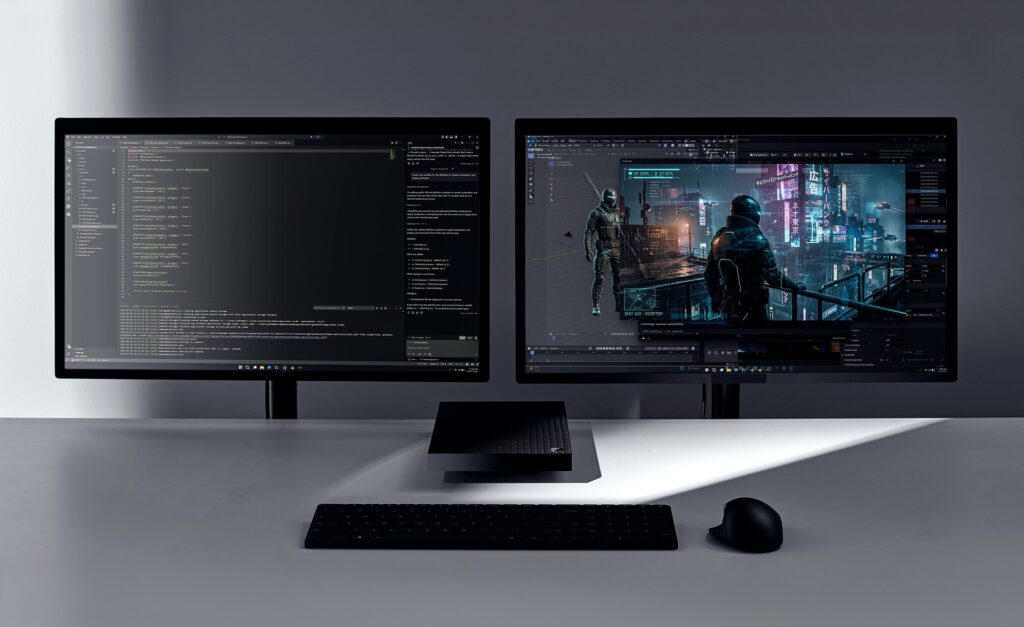
  4. Related coverage: blogs.nvidia.com
  5. Related coverage: anatoliapulse.com
  6. Related coverage: techradar.com
  7. Related coverage: signal65.com
  8. Related coverage: docs.nvidia.com
 

Microsoft announced the Surface RTX Spark Dev Box on June 2, 2026, at Build in San Francisco as a compact Windows 11 Pro developer PC built around Nvidia’s RTX Spark superchip for running large AI models locally. The box is not a consumer Surface in the familiar sense; it is a statement about where Microsoft thinks Windows development is going next. After a decade of nudging developers toward cloud-first workflows, Microsoft is now selling a desk-side machine whose pitch is almost defiantly local. The bet is that the next Windows platform war will be fought not only in Azure, but on the developer’s own desk.

Office workstation with an NVIDIA RTX Spark server running AI build workflow holograms and coding screens.Microsoft Puts the AI Workstation Back Under the Monitor​

The Surface RTX Spark Dev Box arrives at an awkward but revealing moment for the PC industry. For the past two years, “AI PC” has mostly meant a laptop with a neural processing unit fast enough to qualify for Copilot+ branding, plus a handful of local features that still felt modest next to what large cloud models could do. Microsoft’s new developer box changes the scale of the conversation.
The headline numbers are meant to do that work. Microsoft says the machine combines Nvidia’s RTX Spark superchip with up to 1 petaflop of AI compute and 128GB of unified memory. The company says that is enough to run 120-billion-parameter-plus models locally with a million-token context window at interactive speeds, or to fine-tune models that previously belonged on cloud GPU instances.
That does not mean every developer suddenly has a private Azure region under the desk. It does mean Microsoft is trying to collapse a workflow that has become expensive, fragmented, and psychologically distant. If developers can prototype, test, and iterate against serious local models without waiting on cloud capacity or watching a billing dashboard, Windows becomes a more credible platform for the next generation of AI software.
The Surface branding matters here. Microsoft could have left this to Nvidia’s DGX Spark ecosystem or to workstation vendors with boxy black towers and enterprise procurement channels. Instead, it put Surface on the device, signaling that local AI development is not a fringe workstation category but a first-class Windows platform priority.

The Qualcomm Era Meets Its Performance Ceiling​

The most interesting thing about the Surface RTX Spark Dev Box may be what it is not. It is not another Qualcomm-powered Windows-on-Arm showcase. That is a conspicuous turn after Microsoft spent years positioning Snapdragon-based Copilot+ PCs as the modern foundation for thin, efficient, AI-capable Windows devices.
Qualcomm’s role in the Windows revival is real. Snapdragon X-class chips helped Microsoft sell the idea that Windows laptops could be efficient, quiet, and competitive with Apple Silicon in ways older Intel-era Surface designs often were not. But developer workstations live by different rules. Sustained model inference, long-running jobs, fine-tuning, and agent pipelines care less about marketing-friendly NPU TOPS and more about memory capacity, GPU acceleration, thermals, software stack maturity, and whether the machine can keep performing after the keynote demo ends.
That is where Nvidia’s advantage is obvious. The RTX Spark platform pairs Arm CPU cores with Nvidia Blackwell-class graphics and a CUDA-centered developer ecosystem that already owns much of the AI tooling world. Microsoft is not merely buying a faster chip; it is buying proximity to the default stack used by developers training, quantizing, evaluating, and deploying modern models.
This does not make Qualcomm irrelevant. It does, however, draw a boundary around the current Copilot+ PC story. Qualcomm can help Microsoft sell efficient AI laptops to mainstream users. Nvidia is being invited into the higher tier where Windows must prove it can host the messy, heavy, experimental work of AI application development.
For Microsoft, that distinction is strategically useful. It lets the company keep pushing Arm Windows broadly while admitting, without quite saying it aloud, that the Arm vendor best suited to build a local AI workstation in 2026 is Nvidia.

The Real Product Is Agentic Windows​

Microsoft’s hardware announcement only makes sense if you take its software ambition seriously. The company is not building a mini workstation because developers need another expensive box for benchmarks. It is building one because Microsoft wants Windows to become a platform for agentic software: assistants that can plan, call tools, operate across applications, and complete multi-step tasks on the user’s behalf.
That vision has been floating around the industry for years, but it has a practical bottleneck. Cloud agents are powerful but costly, latency-sensitive, and politically complicated. Local agents are more private and responsive, but they need enough compute and memory to reason over files, app state, codebases, documents, email, calendars, and long histories of user context without constantly phoning home.
The Surface RTX Spark Dev Box is aimed at the people who will build that layer. Microsoft says the device is preconfigured for developers at the Windows image level, with tools and settings tuned from first sign-in. The marketing language is polished, but the intent is clear: make the local AI development environment feel less like a weekend of driver wrangling and more like a Surface experience.
That matters because agentic Windows is not just a Copilot feature. It would require developers to think differently about how their applications expose state, accept commands, handle permissions, and cooperate with autonomous software. A local developer box gives Microsoft a controlled place to seed those patterns before they trickle down to mainstream PCs.
The better analogy is not a gaming PC, even though Nvidia’s RTX brand invites the comparison. It is a reference platform. Microsoft is trying to define what a serious Windows AI development machine looks like before the market fragments into half-compatible desktops, cloud notebooks, vendor appliances, and developer laptops with wildly different capabilities.

Local AI Is a Cost Argument Wearing a Privacy Jacket​

Microsoft is careful to talk about local-first development in positive terms: speed, iteration, security, and developer ambition. Those are real benefits. But the commercial pressure underneath the announcement is just as important.
Cloud AI development is expensive in a way that changes behavior. Teams ration experiments. Independent developers avoid larger models. Startups burn credits on debugging. Enterprise developers wait for approvals, capacity, and compliance reviews before they can test ideas that would be trivial if the compute were already sitting beside them.
A workstation-class AI box shifts some of that cost from operating expense to capital expense. That is not automatically cheaper, and Microsoft has not yet given buyers the most important variable: price. But it changes the psychology. A developer with local access to a 120B-class model can experiment more casually, fail more often, and test more privately.
Privacy is part of the appeal, but it should not be overstated. Local execution can reduce the need to send prompts, files, embeddings, or proprietary code to cloud services. It does not solve every security problem, especially once agents start taking actions across applications. A local agent with broad permissions can still make local mistakes at machine speed.
For enterprises, the attraction is likely to be control. A secured-core Windows 11 Pro device that works with BitLocker, Defender, Entra ID, and Intune is easier to place into an existing management regime than a do-it-yourself Linux workstation under someone’s desk. Microsoft is offering IT departments a familiar handle on an unfamiliar workload.

The Hardware Spec Is Impressive, but the Software Stack Will Decide​

One petaflop sounds like a clean line between the old PC and the new AI workstation. In practice, the number needs context. AI performance claims often depend on precision, workload, framework, model architecture, and whether the demo aligns with the chip’s strengths. The Surface RTX Spark Dev Box may be powerful, but developers will judge it by tokens per second, memory behavior, thermals, driver stability, and how often the toolchain breaks.
Unified memory is the more practically interesting spec. The ability to address up to 128GB from a compact machine gives developers room to run models that would not fit comfortably on consumer GPUs with far smaller VRAM pools. For local large language model work, memory capacity often matters more than peak compute because a model that does not fit is not a slow model; it is a nonstarter.
Microsoft’s chassis design also deserves attention. The company says the aluminum enclosure doubles as a heatsink, which suggests the box is built for sustained workloads rather than short benchmark bursts. That is a necessary claim, because AI developers will punish this machine in ways ordinary Surface devices rarely experience. Long-running inference loops and fine-tuning jobs are not the same as exporting a video or compiling a project.
Still, the success of the Dev Box depends less on the elegance of the enclosure than on whether Windows can feel like a natural home for this class of work. Developers need Python environments that do not rot, GPU acceleration that is easy to verify, container workflows that behave predictably, and compatibility across the libraries that dominate AI development. Microsoft has improved enormously here, especially through WSL and better developer tooling, but this machine raises expectations.
If the Surface RTX Spark Dev Box feels like a polished appliance for local AI development, it becomes a serious platform move. If it feels like premium hardware wrapped around fragile drivers and version conflicts, developers will forgive the idea less readily because Microsoft chose to put Surface on the front.

Nvidia Gets a New Door Into Windows​

Nvidia’s role in this story is larger than supplying silicon. RTX Spark gives Nvidia a route into Windows PCs that goes beyond discrete GPUs and gaming laptops. The company is now being positioned as a full platform provider for a new class of AI-first Windows machines.
That has implications for the old Windows hardware order. Intel and AMD remain central to the PC market, and Qualcomm has made real progress in Windows on Arm. But Nvidia now has the one asset every AI company wants: developer gravity. CUDA, TensorRT, RTX acceleration, and the broader Nvidia software ecosystem are not just technical features; they are habits embedded across the AI industry.
Microsoft is pragmatic enough to follow that gravity. The Windows developer platform cannot become the preferred home for AI agents if the hardware underneath it feels disconnected from the frameworks developers already trust. Nvidia offers Microsoft a shortcut to credibility in a field where performance claims are quickly tested and loudly mocked.
The risk is dependency. Microsoft spent years trying to diversify Windows away from any single silicon story. Partnering deeply with Nvidia on premium AI PCs and developer workstations could create a new center of gravity that is every bit as powerful as the old Wintel alliance, but less predictable for OEMs and customers.
For Nvidia, the win is cleaner. RTX Spark extends its AI dominance down from data centers and workstations into personal developer machines. If tomorrow’s AI applications are prototyped locally before being scaled in the cloud, Nvidia wants its architecture to be present at both ends of that journey.

Surface Becomes a Developer Signal Again​

Surface has had several identities over the years. It began as Microsoft’s attempt to show PC makers what modern Windows hardware could be. It became a premium laptop and tablet brand. At times, it also served as a laboratory for ideas that the rest of the ecosystem was not yet ready to ship.
The Surface RTX Spark Dev Box brings back that laboratory function. It is not a mass-market product, and Microsoft should not pretend otherwise. Most Windows users do not need a compact AI workstation with 128GB of unified memory, and many developers will still be better served by cloud GPUs, existing desktops, or cheaper local hardware depending on their workload.
But Surface has often mattered most when it acted as a provocation. The original Surface Pro pressured OEMs to take detachable PCs seriously. Surface Studio made a case, however niche, for touch-centric creative desktops. The Dev Box is trying to do something similar for local AI development: define a category, set an expectation, and dare the ecosystem to respond.
The difference is that this time Microsoft is not merely pushing industrial design. It is pushing a model of computing. The Dev Box says the PC is not just a client for AI services, nor merely a thin endpoint for cloud intelligence. It can be a local participant in the AI stack, with enough horsepower to host serious models and enough enterprise plumbing to be managed like any other Windows device.
That is a more ambitious claim than “AI PC,” which has become too broad to mean much. Microsoft is effectively splitting the category in two. There are AI-capable PCs for users, and there are AI development PCs for the people building the agents those users will eventually encounter.

The Cloud Is Not Going Away, but Its Monopoly on Experimentation Is Weakening​

It would be easy to frame the Surface RTX Spark Dev Box as an anti-cloud product. That would also be wrong. Microsoft remains a cloud company, Azure remains central to its AI strategy, and large-scale training, deployment, monitoring, and enterprise integration will still live heavily in data centers.
What is changing is the assumption that every meaningful AI experiment must begin there. Local machines with enough memory to run large models let developers prototype without turning every prompt into a metered event. They also make it easier to work with sensitive data that cannot casually leave a device or organization.
This is not a rejection of Azure so much as a rebalancing of the development loop. Local first does not mean local only. A developer may test an agent locally, fine-tune against a private sample, validate behavior, and then deploy the production system to cloud infrastructure. The desk-side box becomes a staging ground for ideas that would be too slow, too expensive, or too encumbered to explore entirely online.
Microsoft benefits either way. If developers build better Windows agents locally, Windows gets more valuable. If those agents later scale through Azure, Microsoft also wins in the cloud. The Dev Box is a bridge between those incentives.
That duality explains the careful positioning. Microsoft is not telling developers to abandon cloud computing. It is telling them that the most creative and iterative part of AI work should not be hostage to cloud economics.

Enterprise IT Will See Both a Managed Device and a New Attack Surface​

For sysadmins, the Surface RTX Spark Dev Box is not just a shiny mini workstation. It is a policy problem with a Surface logo. A machine capable of running large local models can be an asset for regulated development, but it also introduces questions about data retention, model provenance, prompt logging, and what happens when an agent is allowed to manipulate files or applications.
Microsoft’s enterprise hooks are designed to calm that anxiety. The device is a Windows 11 secured-core PC and is positioned as compatible with the familiar security and management stack: BitLocker, Defender, Entra ID, and Intune. That gives IT teams a starting point for inventory, compliance, conditional access, encryption, and policy enforcement.
But conventional endpoint management was not designed around autonomous local agents. If a developer runs a model that can inspect source trees, generate scripts, call local tools, and interact with services, the boundary between application, user, and automation becomes blurrier. Security teams will need to decide how much agency is acceptable, how actions are audited, and whether model outputs should be treated like code, data, or something in between.
The local nature of the workload cuts both ways. Keeping sensitive data off third-party AI services can reduce exposure. Keeping more sensitive data and model state on powerful endpoints can increase the consequences of compromise. A stolen laptop is bad; a compromised local AI workstation with access to repositories, credentials, and internal documents could be worse.
That is why the Dev Box will probably be adopted first by teams that already have mature endpoint controls and a clear reason to experiment locally. The product is exciting for enthusiasts, but the real enterprise buyers will ask boring questions about image management, procurement, support lifecycle, firmware updates, and whether the performance justifies the governance burden.

Developers Get Freedom, but Not Simplicity for Free​

The developer appeal is obvious. Local access to a large model changes the cadence of work. Instead of writing prompts against a remote endpoint, developers can test retrieval pipelines, agent loops, context strategies, and fine-tuning ideas in an environment that feels immediate and private.
Yet local AI development is still not simple. Model size is only one variable. Quantization, context length, inference speed, framework support, memory pressure, and tool compatibility all shape whether a machine feels liberating or merely expensive. A 120B model that technically runs may not be the right tool if a smaller model is faster, cheaper, and good enough for the task.
That distinction will matter as Microsoft markets the Dev Box. The headline promise of running huge models locally is powerful, but the everyday developer benefit may be more modest and more useful: running mid-sized models comfortably, testing multiple agents, keeping embeddings and data local, and working through iterations without waiting on cloud queues or approvals.
There is also a cultural shift. Many developers have grown used to treating AI as an API. Microsoft and Nvidia are nudging them back toward a world where hardware characteristics matter again. Memory bandwidth, thermals, drivers, and local storage suddenly become part of the AI development conversation, just as they were for game developers, video editors, and scientific computing users.
That may sound like regression, but it is also a restoration of agency. The cloud abstracted away machines at the cost of making compute feel rented, remote, and metered. The Surface RTX Spark Dev Box is an argument that at least some of that power should return to the person building the software.

The Missing Price Tag Is Not a Detail​

Microsoft has not yet disclosed pricing, and that absence hangs over the announcement. A compact AI workstation can be revolutionary at one price and a boutique curiosity at another. Without a price, it is impossible to know whether the Dev Box is a broad developer platform or a halo device for well-funded teams.
The comparison point is not only a traditional workstation. Buyers will weigh it against cloud GPU credits, Nvidia’s own DGX Spark systems, existing RTX desktops, Mac Studio-class machines, and whatever OEMs ship this fall with RTX Spark inside. Microsoft’s Surface premium may be acceptable if the device is polished, quiet, secure, and tightly integrated with the Windows developer stack. It will be harder to justify if the same silicon appears in cheaper boxes with comparable performance.
Availability is also limited at launch. Microsoft says the Surface RTX Spark Dev Box will be available later this year in the United States through Microsoft.com. That makes it a controlled rollout rather than a global channel push, which is sensible for a first-generation developer machine but reinforces the idea that Microsoft is testing the category as much as selling a product.
The company has been here before with developer hardware. The Windows Dev Kit 2023, powered by Qualcomm, was useful for some Arm developers but never became a mainstream symbol of Windows development. The Surface RTX Spark Dev Box has a stronger market tailwind because AI developers are actively searching for local compute, but Microsoft still has to prove it can support a niche developer device beyond the launch cycle.
Price, support, and software polish will decide whether this becomes the reference box for agentic Windows or just another impressive object from a keynote.

The Spark Box Draws a Line Through Microsoft’s AI PC Story​

The most concrete lesson from the Surface RTX Spark Dev Box is that Microsoft’s AI PC strategy now has tiers. Copilot+ PCs are for mainstream users and light local AI features. RTX Spark systems are for developers, creators, and technical professionals who need serious local acceleration. Azure remains the scale-out destination for production workloads that exceed even powerful desk-side hardware.
That layered strategy is more credible than pretending one NPU-equipped laptop can carry the entire AI future. It acknowledges that summarizing a document, running a local assistant, fine-tuning a model, and orchestrating agent pipelines are different workloads. Different workloads need different machines.
For Windows enthusiasts, the device is also a reminder that the PC is not done evolving. The industry spent years treating the desktop as mature and the cloud as the only exciting frontier. Now Microsoft is saying the local machine matters again, not because nostalgia demands it, but because latency, privacy, cost, and experimentation all benefit from capable hardware within arm’s reach.
The sharpest questions now are practical ones:
  • Microsoft announced the Surface RTX Spark Dev Box at Build 2026 as a compact Surface-branded Windows 11 Pro machine for local AI development.
  • The device uses Nvidia’s RTX Spark superchip and is advertised with up to 1 petaflop of AI compute and 128GB of unified memory.
  • Microsoft says the system can run 120B-plus parameter models locally with a million-token context window at interactive speeds.
  • The choice of Nvidia rather than Qualcomm suggests Microsoft sees a separate high-performance tier above today’s Snapdragon-led Copilot+ PC category.
  • The box is aimed at developers building local AI agents and AI-native Windows workflows, not ordinary consumers.
  • Pricing remains the unanswered variable that will determine whether this is a genuine platform seed or a premium halo device.
The Surface RTX Spark Dev Box is not the future Windows PC most people will buy, but it may be the machine on which that future is prototyped. Microsoft is trying to make local AI development feel native to Windows before agentic software becomes ordinary enough to disappear into the operating system. If the company gets the hardware, tooling, and security model right, this little box could mark the moment the AI PC stopped being a slogan and started becoming a workstation category.

References​

  1. Primary source: explosion.com
    Published: 2026-06-02T21:19:29.221908
  2. Related coverage: axios.com
  3. Related coverage: windowscentral.com
  4. Related coverage: tomshardware.com
  5. Official source: blogs.windows.com
  6. Official source: microsoft.com
  1. Related coverage: thewincentral.com
  2. Official source: news.microsoft.com
  3. Related coverage: arstechnica.com
  4. Related coverage: drwindows.de
  5. Related coverage: tomsguide.com
  6. Related coverage: windowsforum.com
  7. Related coverage: signal65.com
  8. Related coverage: docs.nvidia.com
 

Microsoft used Build 2026 on June 2 in San Francisco to pitch Windows developers a new Surface RTX Spark Dev Box, fresh Linux-friendly tooling, and a one-command developer configuration system for Windows 11. The headline is not merely that Microsoft has another small developer PC. It is that Redmond is trying to make Windows feel less like the place where developers tolerate their tools and more like the default cockpit for local AI, Linux workflows, and agent-era software. The gamble is that a tighter Windows developer stack can pull attention back from macOS, cloud workstations, and Linux-native environments at exactly the moment AI development is making hardware matter again.

Smart device on a desk with holographic AI/WSL terminal panels showing CPU, GPU, and unified memory.Microsoft’s Developer Pitch Has Moved From “Run Windows” to “Stay on Windows”​

For years, Microsoft’s Windows developer story has been defensive. Windows had Visual Studio, Win32, .NET, games, enterprise management, and enormous installed-base gravity, but the developer zeitgeist kept drifting toward Unix-like tooling, web stacks, containers, and cloud-hosted environments. Microsoft’s answer was not to fight that drift head-on, but to absorb it: Windows Subsystem for Linux, Windows Terminal, PowerShell’s cross-platform reinvention, winget, Dev Home, and deeper GitHub integration all served the same strategic purpose.
Build 2026 sharpens that strategy. Microsoft is no longer just saying that Windows can run Linux tools if you need them. It is saying Windows should be the host operating system where Linux containers, AI agents, shell automation, local models, and enterprise policy all meet. That is a more ambitious claim, and a more vulnerable one.
The new Surface RTX Spark Dev Box is the physical symbol of that shift. Microsoft describes it as a compact developer PC powered by Nvidia’s RTX Spark silicon, with up to 128GB of unified memory and a Windows 11 Pro image tuned for development. Its job is not to compete with a mass-market Surface Laptop or a gaming desktop. Its job is to convince developers that Windows deserves a serious place on the desk again.
That matters because the developer machine has become a statement of workflow identity. A Mac Studio says you want Unix tooling, strong local compute, and a relatively controlled hardware/software stack. A Linux workstation says you want transparency, containers, kernels, and fewer platform compromises. Microsoft’s new box says Windows can now claim part of that territory too — provided developers believe the integration story.

The RTX Spark Box Is Really a Local AI Workstation in Surface Clothing​

The Surface RTX Spark Dev Box arrives at a moment when “AI PC” has become one of the most abused phrases in the industry. Most consumer AI PC pitches still revolve around NPUs, camera effects, assistant features, and the hope that software will eventually justify the silicon. Microsoft’s developer box is more concrete. It is aimed at people who need local inference, model testing, agent tooling, and GPU memory capacity.
The key specification is not just “RTX.” It is 128GB of unified memory shared across CPU and GPU resources. For local AI work, memory capacity is often the hard wall. A fast GPU with too little VRAM is impressive until the model does not fit. Unified memory does not magically erase all performance trade-offs, but it changes what developers can attempt without renting time in the cloud.
Nvidia’s RTX Spark platform pairs Arm CPU cores with Blackwell-generation graphics and AI acceleration, positioning it as a Windows-on-Arm platform for developers, creators, and local AI workloads. Microsoft’s Surface version appears to be a curated implementation of that idea: small, managed, and pointed explicitly at developers rather than gamers or general productivity buyers. In other words, this is not a new Xbox-shaped curiosity. It is Microsoft’s answer to the question of where developers should prototype agentic software when the cloud bill starts looking like a second salary.
The comparison to Apple is unavoidable. Apple’s unified-memory Macs have become popular among developers experimenting with local models because they combine high memory ceilings, quiet desktops, and a mature Unix-adjacent environment. Microsoft and Nvidia are trying to build a Windows-flavored counterargument: CUDA gravity, enterprise manageability, Windows app compatibility, and a developer image that includes the tools many teams already use.
But the Surface RTX Spark Dev Box also inherits the burden of Windows on Arm. Microsoft has improved x86-to-Arm translation with Prism, and the Windows on Arm ecosystem is more credible than it was during the awkward Snapdragon 8cx years. Still, developers have long memories. If drivers, command-line tools, native dependencies, virtualization paths, or obscure build chains break, the spec sheet will not save the product.

Project Volterra’s Ghost Is Still in the Room​

Microsoft has been here before, though in a smaller and less glamorous way. The Windows Dev Kit 2023, better known by its “Project Volterra” codename, was a Qualcomm-powered Arm developer box designed to help software makers prepare for Windows on Arm. It was interesting, useful for a narrow audience, and never quite became the catalyst Microsoft wanted it to be.
Volterra’s core problem was timing. The hardware was not powerful enough to make developers fall in love with the platform, and Windows on Arm had not yet reached a point where mainstream developer friction disappeared. It was a bridge device, but the far side of the bridge was still under construction.
The RTX Spark Dev Box is a more serious attempt because the market conditions are different. Local AI has made desktop-class compute fashionable again. Developers are suddenly willing to think about memory bandwidth, model size, inference latency, and whether a workstation can run meaningful workloads without a data-center detour. Microsoft can now pitch an Arm dev box not just as preparation for future Windows devices, but as an immediately useful AI machine.
That does not eliminate the old risks. The box still needs native toolchain support, stable container workflows, predictable thermals, good documentation, and pricing that does not make cloud GPUs look merciful by comparison. Microsoft has not always excelled at turning developer hardware into durable ecosystems. The Zune did not define music devices, HoloLens did not define mixed reality, and even Surface had to survive several awkward generations before becoming a serious PC brand.
The difference this time is that the developer box is not the product in isolation. It is part of a broader Windows developer platform push. If the box is merely expensive hardware, it will become a niche curiosity. If it becomes the easiest way to build and test Windows-native AI agents, local inference features, and cross-platform developer workflows, it could matter well beyond its sales volume.

Linux Is No Longer the Guest Microsoft Pretends Not to Notice​

The more revealing Build announcement may not be the hardware at all. Microsoft is introducing Windows-native versions of core Unix-style command-line utilities, expanding Windows Subsystem for Linux capabilities, and preparing a WSL containers CLI intended to build, run, and deploy Linux containers directly on Windows. That is a strikingly different posture from the Windows of old.
For decades, Windows treated Unix-like tooling as either foreign territory or third-party garnish. Cygwin, MinGW, Git Bash, and later WSL filled real gaps because developers wanted a command-line world that behaved predictably across systems. Microsoft eventually stopped resisting and started integrating. Build 2026 suggests that integration is moving from “nice to have” to strategic infrastructure.
A Windows-native coreutils package is especially telling. Commands like ls, cp, mv, cat, and related utilities are not glamorous, but they are muscle memory for generations of developers. Making them available natively is less about novelty than reducing the tiny cuts that make Windows feel alien in mixed-platform workflows. Scripts, automation, documentation, and habits all become easier to carry across environments.
WSL inside container workflows is the other half of the equation. Containers made Linux the lingua franca of modern deployment, even for developers who spend all day on Windows laptops. If Microsoft can make Linux containers feel first-class on Windows without forcing developers into awkward context switches, it strengthens Windows as a host platform. If it cannot, developers will continue to dual-boot emotionally, even when they do not dual-boot literally.
This is Microsoft’s recurring paradox: Windows wins when it becomes less parochially Windows. The more it accommodates Linux conventions, open-source defaults, and cloud-native assumptions, the more credible it becomes as the operating system for people who do not want to think about operating systems all day.

One Command to Configure a Developer PC Is a Small Feature With Big Institutional Meaning​

Windows Developer Configurations may sound like another setup wizard wearing a Build badge, but it points at a genuine pain. Developers spend too much time turning new machines into usable machines. They install editors, shells, package managers, SDKs, terminals, fonts, extensions, WSL distributions, Git tooling, runtime versions, and policy exceptions. Then they do it again for the next laptop, the next contractor, the next clean image, or the next corporate refresh.
Microsoft’s pitch is that a single winget-powered command can create a developer-focused Windows 11 environment with Visual Studio Code, GitHub Copilot, WSL, PowerShell 7, Windows Terminal integration, and development-optimized settings. That sounds ordinary until you consider who benefits most. Individual enthusiasts like convenience. Enterprises need repeatability.
For IT departments, standardized developer setup is not just about speed. It is about auditability, compliance, and support. A developer workstation that can be rebuilt from a known configuration is easier to secure than one assembled through tribal knowledge and half-remembered wiki pages. A sanctioned path for WSL and Linux tooling is easier to manage than a shadow ecosystem of personal scripts and unofficial installers.
This is where Microsoft’s enterprise instincts may help rather than hurt. The company understands Entra ID, Intune, Defender, BitLocker, policy baselines, and the bureaucratic reality of managed fleets. A developer box that plays nicely with those systems has an advantage over a hobbyist workstation, especially in regulated environments where local AI experimentation raises immediate questions about data handling.
The risk is that “developer-optimized” becomes another Microsoft-controlled opinion layer that serious developers immediately undo. Developers do not want a corporate theme park. They want fast setup, transparent configuration, and the ability to modify everything. The closer Microsoft’s new configuration system stays to open manifests, predictable package management, and reversible choices, the better its odds.

Local AI Is the Real Reason Windows Suddenly Needs Workstation Credibility Again​

Microsoft’s recent Windows story has been dominated by Copilot, Recall, NPU requirements, and arguments over whether AI features are useful, invasive, or simply premature. The Surface RTX Spark Dev Box reframes the AI PC conversation around developers rather than consumers. That is a wiser starting point.
Developers can actually use local AI compute today. They can run models, test retrieval-augmented applications, prototype agent workflows, evaluate latency, and build privacy-sensitive features without sending every experiment to a cloud endpoint. They can also discover all the ugly practical problems that marketing demos hide: model quantization trade-offs, tool-calling reliability, memory limits, sandboxing, prompt injection, data leakage, and the difference between a clever demo and a maintainable product.
That makes local developer hardware more important than consumer AI branding. If Microsoft wants Windows to be a serious platform for agentic applications, it needs developers to build, test, debug, and distrust those agents locally. You cannot do that entirely through glossy Copilot demos. You need machines with enough memory, GPU support, container support, and system integration to make experimentation routine.
The phrase “local-first AI development” is doing a lot of work here. It suggests lower latency, better privacy, reduced cloud dependency, and more predictable costs. It also suggests a shift in power. Cloud AI platforms rent capability by the token, the minute, or the accelerator. Local hardware turns some of that spending into capital expense and gives developers more room to iterate without asking permission from the billing dashboard.
Of course, not every team will want this. Frontier-scale training remains a data-center sport. Many production workloads will still live in Azure, AWS, Google Cloud, or specialized AI infrastructure. But the development loop is different from production. If Microsoft can own more of that loop on Windows, Azure still benefits later.

The Agent Story Needs Sandboxes More Than Slogans​

Microsoft’s Build keynote, like much of the industry, leaned into agents: tools that can perform tasks, scan code, interact with data, and take actions on behalf of users. The problem is that agents are both the most exciting and least settled part of the AI software wave. They promise automation, but they also introduce new failure modes that traditional desktop security models were not designed around.
A developer platform for agents needs isolation, observability, permissions, rollback, and clear boundaries between user data, enterprise data, model output, and executable action. That is why Microsoft’s Windows developer announcements around sandboxing, WSL, containers, and managed configuration should be read together. The company is trying to build a place where agents can run near real workflows without being handed the keys to the building.
The hard part is that Windows is not a clean-room operating system. It carries decades of compatibility, legacy APIs, shell integration, registry assumptions, driver complexity, and enterprise customization. That history is the reason Windows remains so valuable, but it is also why agentic automation on Windows is more dangerous than agentic automation inside a neatly scoped web app.
Microsoft knows this. The company’s security messaging around secured-core PCs, Defender, BitLocker, Entra ID, and Intune is not decorative. It is meant to reassure businesses that local AI workloads do not require abandoning the management model they already understand. The Surface RTX Spark Dev Box is being positioned not merely as fast hardware, but as hardware that can live under familiar controls.
Still, the agent era will test Microsoft’s ability to say no. Developers will want power. Enterprises will want restrictions. Users will want convenience. Attackers will want the seams between all three. The winning platform will not be the one with the most enthusiastic agent demo; it will be the one whose failure modes are boring enough for IT to tolerate.

Nvidia Gets a New Front Door Into Windows Development​

Nvidia’s role in this story is larger than supplying a chip. RTX Spark is an attempt to bring Nvidia’s AI stack, GPU architecture, and CUDA-centered developer gravity into a new class of Windows PCs. For years, Nvidia dominated discrete GPUs while CPU platform control belonged to Intel and AMD in the Windows world. RTX Spark blurs that line.
By pairing Arm CPU cores with Blackwell GPU technology and large unified memory configurations, Nvidia is reaching toward the full system experience rather than the add-in-card slot. That matters strategically. If developers build local AI workflows around RTX Spark-class machines, Nvidia gains influence over software assumptions, optimization targets, and deployment patterns.
Microsoft benefits because Nvidia gives Windows a credible answer to high-memory local AI Macs and Linux GPU workstations. Nvidia benefits because Microsoft gives RTX Spark immediate legitimacy inside Windows, Surface, Build, and the enterprise developer conversation. Each company is lending the other something it lacks.
The unanswered question is how much this platform depends on Nvidia-specific paths. CUDA is a major asset, but it is also a lock-in mechanism. Developers building cross-platform AI applications already juggle CUDA, DirectML, ONNX Runtime, Apple’s Metal ecosystem, Vulkan-adjacent approaches, and cloud-specific accelerators. Microsoft has an incentive to make Windows AI development feel broad and portable. Nvidia has an incentive to make RTX Spark feel uniquely capable.
That tension is not necessarily bad. Platform competition often produces better tools. But Windows developers should pay attention to where the abstractions are clean and where they quietly hard-code a vendor future.

Windows on Arm Is Getting Another Chance, This Time With a Better Excuse​

The most important architectural detail of RTX Spark is not the GPU brand but the Arm CPU foundation. Windows on Arm has spent years trying to escape the perception that it is a compatibility science project. Qualcomm’s recent Snapdragon X systems helped, Microsoft’s Prism translation layer helped, and more native applications helped. But “helped” is not the same as “settled.”
Developers are a tougher audience than casual users. They run unusual binaries, old SDKs, custom drivers, local databases, virtualization tools, emulators, compilers, debuggers, and private build systems that may not have been tested on Windows on Arm. A browser, Office, Slack, and Teams working well is not enough.
That is why the Dev Box is such a high-stakes signal. Microsoft is effectively saying that Windows on Arm is ready not just for premium laptops, but for serious developer workstations. If true, that is a milestone. If premature, it will reinforce every old suspicion about Arm Windows arriving almost ready and staying there.
The AI angle gives Windows on Arm a stronger rationale than battery life alone. Developers may accept some compatibility rough edges if the reward is local model capability, large unified memory, and a compact machine tuned for modern AI workloads. They are less likely to accept those rough edges if pricing is high, performance is inconsistent, or native tooling lags.
The platform therefore needs ruthless honesty from Microsoft. Which tools are native? Which run translated? Which workflows are unsupported? Which containers, hypervisors, drivers, debuggers, and SDKs are ready on day one? Developers can forgive limitations. They are less forgiving when marketing turns limitations into scavenger hunts.

The Real Competition Is the Developer’s Existing Desk​

Microsoft is not launching the Surface RTX Spark Dev Box into an empty market. It is competing with Macs already loved by AI tinkerers, Linux workstations already trusted by infrastructure teams, gaming PCs already packed with Nvidia GPUs, cloud workstations already integrated with enterprise billing, and ordinary Windows laptops already good enough for many coders.
That means Microsoft has to justify the box as more than a neat object. The strongest argument is convenience: a compact Windows machine with large unified memory, Nvidia AI acceleration, preconfigured developer tools, WSL support, enterprise security, and local AI capacity. The weakest argument is branding. Developers do not buy developer hardware because the casing looks official.
Price will be decisive. Microsoft and Nvidia have not trained the market to expect bargains in this category. If the Dev Box lands near workstation pricing, buyers will compare it against high-end Macs, GPU towers, and cloud alternatives. If it is priced aggressively enough to become a standard issue for AI application teams, it could seed the ecosystem Microsoft wants.
Thermals and noise will matter too. Small AI workstations live or die by whether they can sustain performance without sounding like a rack server trying to escape. Microsoft’s design language has long valued compactness and quiet surfaces. Nvidia-class local AI workloads do not care about design language. They care about heat.
Then there is repairability and lifecycle. Enterprises may like Surface branding, but they also like predictable support windows, replacement parts, deployment images, and fleet management. Enthusiasts may like compact power, but they also ask whether memory, storage, networking, and cooling choices will age gracefully. A developer box is not a fashion accessory. It is infrastructure with a desk footprint.

Microsoft Is Selling a Stack, Not a Gadget​

The most coherent reading of Build 2026 is that Microsoft is assembling a vertical developer stack for the AI era. At the bottom is Nvidia-powered local hardware. Above that is Windows 11 Pro with developer defaults. Beside it are WSL, containers, coreutils, PowerShell, Terminal, winget, VS Code, GitHub Copilot, and enterprise management. Above all of it sit Microsoft’s agent and cloud ambitions.
That is a strong stack, but it is also a complicated one. Microsoft’s greatest platform successes often come from making complexity feel inevitable and manageable. Windows itself won because it absorbed hardware diversity, software compatibility, business workflows, and consumer demand into one messy but durable platform. The new developer push is trying to do something similar for AI-era development.
The danger is that the stack becomes too Microsoft-shaped. Developers like integration until it becomes enclosure. GitHub Copilot in the terminal may be useful, but developers will resist if every workflow feels like an upsell path into Microsoft’s AI services. WSL is loved partly because it gives developers access to a broader Linux world, not because it turns Linux into a Windows feature demo.
The best version of this strategy is generous. Windows becomes a superb host for whatever developers need: Linux tools, open models, Nvidia acceleration, Microsoft services, non-Microsoft services, local containers, cloud deployment, and enterprise controls. The worst version is performative openness wrapped around a funnel.
Microsoft has done both in its history. Build 2026 gives developers reason to hope for the former, and enough history to watch for the latter.

The New Windows Dev Pitch Lives or Dies in the Setup Log​

The practical significance of Microsoft’s announcements will show up less in keynote demos than in first-week developer experiences. If setup is clean, native support is clear, and local AI workloads run reliably, Microsoft will have earned attention. If the experience devolves into driver hunts, Arm compatibility caveats, container weirdness, and Copilot branding, developers will quietly return to the machines they already trust.
  • Microsoft is positioning the Surface RTX Spark Dev Box as a compact Windows 11 Pro workstation for local-first AI development, not as a general-purpose mini PC.
  • The 128GB unified-memory pitch is central because local AI development is constrained as much by memory capacity as by raw accelerator performance.
  • Windows-native coreutils and expanded WSL container support show Microsoft continuing to absorb Linux conventions rather than pretending Windows developers live in a Windows-only world.
  • One-command developer configurations could matter most inside enterprises, where repeatable setup and manageable policy are often more valuable than another flashy tool.
  • The platform’s credibility depends on Windows on Arm compatibility, native developer tooling, thermals, pricing, and honest documentation.
  • Microsoft’s broader goal is to make Windows the managed, local, AI-capable developer cockpit before macOS, Linux, and cloud workstations define that role without it.
The Surface RTX Spark Dev Box may never sell in mainstream numbers, and it does not need to. Its real purpose is to test whether Windows can become the default place where developers build the next generation of AI-heavy, Linux-aware, enterprise-managed software. If Microsoft gets the details right, Build 2026 will look less like another AI keynote and more like the moment Windows stopped apologizing for its developer story; if it gets them wrong, the box will become another handsome reminder that developers do not reward platforms for ambition alone.

References​

  1. Primary source: Ars Technica
    Published: Tue, 02 Jun 2026 22:51:10 GMT
  2. Related coverage: tomshardware.com
  3. Related coverage: axios.com
  4. Related coverage: windowscentral.com
  5. Related coverage: pcgamer.com
  6. Official source: microsoft.com
  1. Official source: blogs.windows.com
  2. Official source: blogs.microsoft.com
  3. Official source: developer.microsoft.com
  4. Related coverage: nvidianews.nvidia.com
  5. Related coverage: techcrunch.com
  6. Official source: news.microsoft.com
  7. Official source: cdn.techcommunity.microsoft.com
 

Back
Top