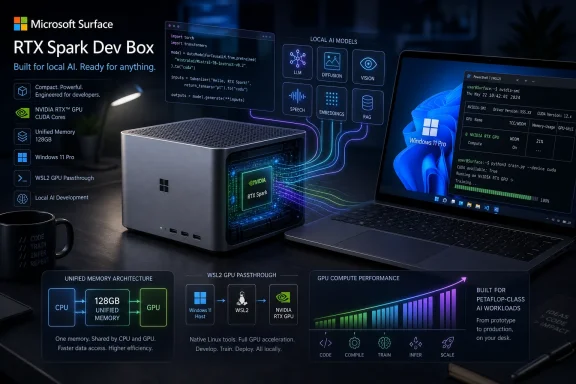
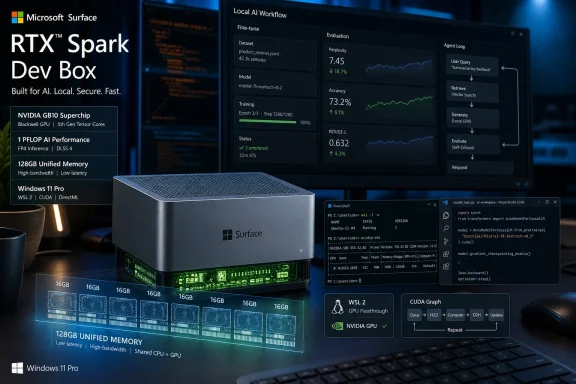
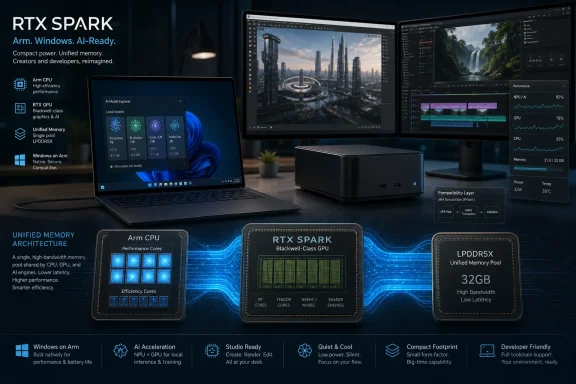
Nvidia and Microsoft unveiled RTX Spark at Computex 2026 in Taipei as a Windows on Arm platform built around Nvidia’s Blackwell GPU technology, a 20-core Arm CPU, up to 128GB of unified memory, and a claimed 1 petaflop of local AI compute. The announcement matters because Windows on Arm has spent more than a decade being defined by caveats: battery life, compatibility, performance, and whether anyone outside Qualcomm would take it seriously. RTX Spark does not erase those questions, but it changes their scale. Microsoft is no longer asking Windows users to accept Arm as a compromise; it is trying to sell Arm as the fastest path to the next PC.
For most of its modern life, Windows on Arm has been marketed as a battery-life proposition. Qualcomm’s Snapdragon X Elite and X Plus machines pushed that story further than earlier Windows RT and Snapdragon 8cx-era devices ever could, finally making thin Windows laptops feel credible without Intel or AMD silicon. But the center of gravity remained familiar: quiet machines, long standby, good enough native apps, and an emulator that no longer embarrassed itself.
RTX Spark is a different pitch. Nvidia is not walking into Windows on Arm as a polite efficiency partner. It is bringing the branding, developer ecosystem, graphics credibility, and AI hardware muscle that made RTX a default assumption in large parts of the creator, gaming, and machine-learning PC market.
That is why the numbers matter even before we know how they behave in real shipping laptops. A Blackwell-class GPU with 6,144 CUDA cores, fifth-generation Tensor Cores, up to 128GB of unified memory, and around 600GB/s of memory bandwidth is not the usual “Arm laptop” vocabulary. It is closer to the language of compact workstations and AI developer boxes than fanless ultraportables.
The central bet is that the next Windows PC will not be judged only by browser tabs, Office responsiveness, and video-call endurance. Microsoft and Nvidia are positioning local AI agents, generative creative tools, developer workflows, and GPU-accelerated applications as the workloads that decide whether a PC feels modern. If that premise holds, Windows on Arm needed more than respectable CPU cores. It needed a reason for demanding users to care.
The first wave of Copilot+ PCs leaned heavily on NPU performance as the headline metric. That made sense for Microsoft’s minimum platform definition, but it also trained buyers to focus on an abstract number. The practical bottleneck for serious local models, creative pipelines, and multi-app agent workflows is often memory capacity and bandwidth, not whether a small NPU can run a demo feature in isolation.
Nvidia understands that better than almost anyone in the client PC ecosystem. CUDA’s dominance did not come from a single benchmark category. It came from giving developers a predictable target for parallel workloads, then surrounding that target with libraries, frameworks, drivers, and habits. RTX Spark imports that model into Windows on Arm with a much more coherent story than “here is another NPU.”
Unified memory also lets Nvidia and Microsoft borrow a page from Apple Silicon without admitting too loudly that Apple got there first. Apple’s M-series Macs changed expectations around how laptops handle CPU, GPU, neural, and media workloads inside a shared memory architecture. Microsoft’s Windows partners have had pieces of that story, but rarely the whole stack in a form that felt aspirational.
RTX Spark is not automatically an Apple Silicon killer. Windows has a broader hardware ecosystem, a messier software legacy, and far more variation in OEM execution. But Nvidia’s platform gives Microsoft a way to argue that Windows can compete where Apple has been most persuasive: compact machines that feel like workstations because the memory architecture and accelerators are designed together.
Prism is much better than the old Windows on Arm emulation story, and native Arm64 app support has improved dramatically. But the Windows ecosystem is not the Mac ecosystem. Apple could force a transition because it controls the hardware roadmap, the OS, the developer tools, and the customer expectation that older software may eventually be cut loose. Microsoft has to bring along decades of business software, anti-cheat systems, device drivers, shell extensions, VPN clients, accounting packages, and niche engineering tools.
That is where Nvidia’s entrance helps and complicates matters. On one hand, Nvidia brings a driver and developer ecosystem that Qualcomm could never match in PC graphics. On the other hand, the existence of an RTX-class GPU inside an Arm Windows machine will invite users to run exactly the kinds of software most likely to expose compatibility gaps: games, creative suites, GPU plug-ins, AI frameworks, and performance-sensitive tools that assume x86 conventions somewhere in the stack.
Microsoft’s claim that Prism will be present and optimized for RTX Spark is therefore not a footnote. It is a survival requirement. If these machines ship with workstation-class marketing and ultrabook-class compatibility caveats, the backlash will be swift.
There is a plausible technical argument here. Local models benefit from low latency, privacy, persistent context, and access to local files and applications. A machine with a strong GPU, abundant unified memory, and Windows integration could run more capable models than today’s NPU-first laptops. Nvidia’s own Nemotron models, Adobe’s announced support, and MCP-style tool connections all fit the direction of travel.
But the agentic PC remains more roadmap than lived experience. Most users have not seen a local agent reliably manage a serious workflow without supervision, hallucination, awkward permissions, or brittle app handoffs. The difference between an impressive keynote demo and a trustworthy assistant that can touch your work documents, emails, creative assets, and source code is enormous.
That gap matters because Nvidia is not merely selling silicon. It is helping Microsoft revive the idea that Windows itself can become the surface for AI work. After the uneven rollout of Copilot features and the controversy around Recall, Microsoft needs the next iteration of AI on Windows to feel useful rather than intrusive. RTX Spark gives it hardware credibility, but the trust problem remains a software and governance problem.
The “Ultra” branding also matters because Surface has needed a clearer performance flagship. Surface Laptop has become cleaner and more conventional over time, while Surface Pro remains the identity product. A powerful Arm-based Surface with Nvidia silicon gives Microsoft a chance to reset expectations around what a Windows laptop can be without copying the MacBook Pro too obviously.
For OEMs, the bigger story is that RTX Spark appears to arrive with broad partner interest. Asus, Dell, HP, Lenovo, MSI, and Microsoft all being associated with the platform suggests this is not a one-off science project. The old Windows on Arm problem was not simply that the chips were weak; it was that the ecosystem felt tentative. Retail shelves, enterprise procurement catalogs, driver support, accessories, and software optimization all follow confidence.
Still, partner logos are not products. The difference between a great reference platform and a great Windows laptop is execution: thermals, firmware, display choices, keyboard quality, fan noise, idle drain, sleep reliability, and whether the machine behaves consistently after six months of driver updates. Nvidia can raise the ceiling. OEMs can still lower the floor.
Microsoft’s workload profile scheduling and Microsoft Power and Thermal Framework support are therefore not boring platform plumbing. They are the mechanism by which this entire idea either feels seamless or becomes another Windows performance science fair. The machine has to know when to favor battery life, when to feed the GPU, when to keep an AI model resident, when to cool down, and when to avoid turning a premium laptop into a desk fan.
This is one of the places where Windows historically struggles compared with vertically integrated platforms. Microsoft can build frameworks, Nvidia can expose controls, and OEMs can tune firmware, but the user experiences the result as one machine. If background agents, creative apps, browser processes, and emulated x86 software all fight for the same thermal budget, the spec sheet will not save the product.
There is also a messaging risk. “All-day battery life” and “1 petaflop AI workstation” are not impossible in the same product, but they are not the same mode of operation. Buyers will need to understand that RTX Spark’s most impressive capabilities will consume power, generate heat, and depend on chassis design. If Microsoft and Nvidia blur that distinction too much, reviewers will make it for them.
But RTX Spark threatens Qualcomm’s strategic comfort. Until now, Qualcomm could argue that Windows on Arm essentially meant Snapdragon. Nvidia’s arrival turns the category into a real market, and real markets create segmentation. Qualcomm may remain attractive for battery-first laptops, fanless designs, and mainstream productivity machines. Nvidia will target creators, developers, gamers, and AI users who care less about architectural purity than about whether CUDA, RTX, and local models work.
That division could benefit Microsoft. Windows on Arm has needed more than one silicon story because Windows itself serves too many audiences. A single vendor cannot plausibly satisfy enterprise fleets, students, gamers, creators, developers, and workstation users at once. Nvidia gives Microsoft a high-end anchor that Qualcomm could not easily provide.
It also pressures Intel and AMD in a more complicated way. Both x86 vendors have been building stronger NPUs and improving efficiency, but Nvidia’s pitch shifts the competitive field toward GPU-accelerated local AI and unified memory. If Windows buyers start associating the “serious AI PC” with Nvidia Arm silicon, Intel and AMD will need more than incremental NPU slides to defend premium laptops.
This is where Nvidia has a real advantage over Qualcomm. Qualcomm’s Adreno graphics were good enough for many PC tasks but struggled to command trust in Windows gaming, especially around drivers, anti-cheat compatibility, and game-specific optimizations. Nvidia has spent decades making PC gamers expect day-one drivers, control-panel knobs, DLSS support, and broad developer alignment.
The challenge is that games are among the least forgiving Windows applications. Many depend on x86 code, kernel-level anti-cheat, launchers, overlays, copy protection, and performance assumptions that do not translate cleanly to Arm. Even when GPU performance is strong, CPU translation overhead and compatibility blocks can make the user experience uneven.
Nvidia does not need RTX Spark to beat every gaming laptop. It needs the platform to avoid becoming a “technically powerful, practically frustrating” machine. If popular titles run well, if anti-cheat vendors cooperate, and if DLSS and RTX features behave normally, Windows on Arm’s reputation could shift quickly. If not, the RTX badge may set expectations the platform cannot meet.
Developers working on AI applications, data scientists prototyping locally, designers using GPU-accelerated creative tools, and executives who want premium battery life with real performance could all be plausible early adopters. A Windows machine that can run meaningful local models without sending every prompt to the cloud is appealing in regulated environments, at least in theory.
But enterprise adoption will hinge on boring details. VPN clients must work. Endpoint security agents must work. DLP tools must work. Print drivers, smart-card middleware, virtualization tools, remote management, firmware updates, and compliance baselines must behave predictably. Windows on Arm has improved, but every new silicon platform restarts part of the validation process.
There is also the question of local AI governance. A machine powerful enough to run agents and models locally is a machine that may process sensitive documents outside centralized cloud controls. That can be a feature for privacy and latency, but it also creates audit, retention, and policy questions. Microsoft’s enterprise pitch will need to explain not just how RTX Spark accelerates AI, but how administrators can constrain it.
Nvidia’s strength is that it already knows how to make a hardware platform feel larger than hardware. CUDA, RTX, DLSS, TensorRT, Broadcast, Studio drivers, Omniverse, and its AI software ecosystem all function as gravity wells. Developers do not merely target Nvidia GPUs because they are fast. They target them because the tooling, documentation, installed base, and commercial incentives are already there.
Microsoft needs that gravity. The Copilot+ PC launch created a category, but the initial user-facing AI features were not strong enough to define a new era of computing. RTX Spark gives Microsoft a second chance to make the AI PC feel substantive, especially if local agents and creative tools can do things that cloud-only Copilot experiences cannot.
The danger is fragmentation. If some AI features require an NPU, others prefer Nvidia Tensor Cores, some apps are Arm-native, others rely on Prism, and performance varies dramatically between Snapdragon, RTX Spark, Intel, and AMD systems, users may find the “AI PC” label more confusing than helpful. Microsoft’s job is to prevent capability tiers from becoming a maze.
But Windows history is littered with “new era of PC” moments that became smaller once they hit channel inventory, driver updates, and user habits. Windows RT promised a modern, efficient Windows and mostly taught buyers to distrust compatibility footnotes. Early connected PCs promised smartphone-like mobility and delivered too many compromises. Even Copilot+ PCs arrived with stronger hardware than software.
RTX Spark has a better shot because the market is finally aligned around local AI, efficient performance, and heterogeneous compute. Developers understand GPUs. Users understand that AI workloads can be heavy. OEMs understand that premium laptops need differentiation beyond thinner bezels. Microsoft understands that Windows cannot let Apple own the narrative of integrated performance.
The burden of proof, however, is not a keynote. It is six months of real machines, real reviews, real apps, and real users discovering whether the platform disappears beneath their work or constantly reminds them that they bought the future early.
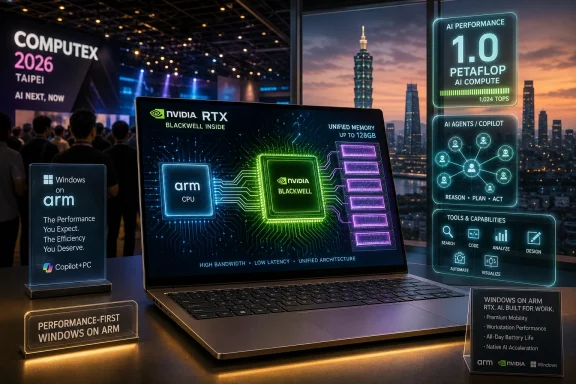 Nvidia Turns Windows on Arm From Efficiency Story to Performance Story
For most of its modern life, Windows on Arm has been marketed as a battery-life proposition. Qualcomm’s Snapdragon X Elite and X Plus machines pushed that story further than earlier Windows RT and Snapdragon 8cx-era devices ever could, finally making thin Windows laptops feel credible without Intel or AMD silicon. But the center of gravity remained familiar: quiet machines, long standby, good enough native apps, and an emulator that no longer embarrassed itself.RTX Spark is a different pitch. Nvidia is not walking into Windows on Arm as a polite efficiency partner. It is bringing the branding, developer ecosystem, graphics credibility, and AI hardware muscle that made RTX a default assumption in large parts of the creator, gaming, and machine-learning PC market.
That is why the numbers matter even before we know how they behave in real shipping laptops. A Blackwell-class GPU with 6,144 CUDA cores, fifth-generation Tensor Cores, up to 128GB of unified memory, and around 600GB/s of memory bandwidth is not the usual “Arm laptop” vocabulary. It is closer to the language of compact workstations and AI developer boxes than fanless ultraportables.
The central bet is that the next Windows PC will not be judged only by browser tabs, Office responsiveness, and video-call endurance. Microsoft and Nvidia are positioning local AI agents, generative creative tools, developer workflows, and GPU-accelerated applications as the workloads that decide whether a PC feels modern. If that premise holds, Windows on Arm needed more than respectable CPU cores. It needed a reason for demanding users to care.
The PC Is Being Recast Around Memory, Not Just Cores
The most interesting RTX Spark specification may not be the petaflop claim or the CUDA core count. It is the unified memory ceiling. Up to 128GB of shared system memory changes the conversation for local AI in a way that raw TOPS figures never quite did.The first wave of Copilot+ PCs leaned heavily on NPU performance as the headline metric. That made sense for Microsoft’s minimum platform definition, but it also trained buyers to focus on an abstract number. The practical bottleneck for serious local models, creative pipelines, and multi-app agent workflows is often memory capacity and bandwidth, not whether a small NPU can run a demo feature in isolation.
Nvidia understands that better than almost anyone in the client PC ecosystem. CUDA’s dominance did not come from a single benchmark category. It came from giving developers a predictable target for parallel workloads, then surrounding that target with libraries, frameworks, drivers, and habits. RTX Spark imports that model into Windows on Arm with a much more coherent story than “here is another NPU.”
Unified memory also lets Nvidia and Microsoft borrow a page from Apple Silicon without admitting too loudly that Apple got there first. Apple’s M-series Macs changed expectations around how laptops handle CPU, GPU, neural, and media workloads inside a shared memory architecture. Microsoft’s Windows partners have had pieces of that story, but rarely the whole stack in a form that felt aspirational.
RTX Spark is not automatically an Apple Silicon killer. Windows has a broader hardware ecosystem, a messier software legacy, and far more variation in OEM execution. But Nvidia’s platform gives Microsoft a way to argue that Windows can compete where Apple has been most persuasive: compact machines that feel like workstations because the memory architecture and accelerators are designed together.
Microsoft Knows the Emulator Is Still the Tripwire
The XDA summary correctly highlights Prism, Microsoft’s x86 and x64 translation layer for Windows on Arm, because compatibility remains the emotional scar tissue in this market. Windows users do not buy architectures. They buy the expectation that the installer they downloaded, the peripheral they already own, and the slightly ancient utility their company still depends on will work.Prism is much better than the old Windows on Arm emulation story, and native Arm64 app support has improved dramatically. But the Windows ecosystem is not the Mac ecosystem. Apple could force a transition because it controls the hardware roadmap, the OS, the developer tools, and the customer expectation that older software may eventually be cut loose. Microsoft has to bring along decades of business software, anti-cheat systems, device drivers, shell extensions, VPN clients, accounting packages, and niche engineering tools.
That is where Nvidia’s entrance helps and complicates matters. On one hand, Nvidia brings a driver and developer ecosystem that Qualcomm could never match in PC graphics. On the other hand, the existence of an RTX-class GPU inside an Arm Windows machine will invite users to run exactly the kinds of software most likely to expose compatibility gaps: games, creative suites, GPU plug-ins, AI frameworks, and performance-sensitive tools that assume x86 conventions somewhere in the stack.
Microsoft’s claim that Prism will be present and optimized for RTX Spark is therefore not a footnote. It is a survival requirement. If these machines ship with workstation-class marketing and ultrabook-class compatibility caveats, the backlash will be swift.
Nvidia Is Selling the Agentic PC Before Users Have Seen One
The word agentic is doing a lot of work in this launch. Nvidia and Microsoft are framing RTX Spark as a platform for local agents that can see context, call tools, run models, and coordinate work across applications. That is a bolder claim than “AI features run faster,” and it moves the PC from being an endpoint to being an active collaborator.There is a plausible technical argument here. Local models benefit from low latency, privacy, persistent context, and access to local files and applications. A machine with a strong GPU, abundant unified memory, and Windows integration could run more capable models than today’s NPU-first laptops. Nvidia’s own Nemotron models, Adobe’s announced support, and MCP-style tool connections all fit the direction of travel.
But the agentic PC remains more roadmap than lived experience. Most users have not seen a local agent reliably manage a serious workflow without supervision, hallucination, awkward permissions, or brittle app handoffs. The difference between an impressive keynote demo and a trustworthy assistant that can touch your work documents, emails, creative assets, and source code is enormous.
That gap matters because Nvidia is not merely selling silicon. It is helping Microsoft revive the idea that Windows itself can become the surface for AI work. After the uneven rollout of Copilot features and the controversy around Recall, Microsoft needs the next iteration of AI on Windows to feel useful rather than intrusive. RTX Spark gives it hardware credibility, but the trust problem remains a software and governance problem.
The Surface Laptop Ultra Is a Signal to OEMs, Not Just a New Surface
Microsoft putting RTX Spark into a Surface Laptop Ultra is strategically important even if the device itself becomes a premium niche product. Surface has long served as Microsoft’s reference argument to the rest of the PC industry: this is what we think Windows hardware should feel like when the OS and device are designed together. A high-end RTX Spark Surface tells OEMs that Windows on Arm is no longer supposed to live only in conservative productivity machines.The “Ultra” branding also matters because Surface has needed a clearer performance flagship. Surface Laptop has become cleaner and more conventional over time, while Surface Pro remains the identity product. A powerful Arm-based Surface with Nvidia silicon gives Microsoft a chance to reset expectations around what a Windows laptop can be without copying the MacBook Pro too obviously.
For OEMs, the bigger story is that RTX Spark appears to arrive with broad partner interest. Asus, Dell, HP, Lenovo, MSI, and Microsoft all being associated with the platform suggests this is not a one-off science project. The old Windows on Arm problem was not simply that the chips were weak; it was that the ecosystem felt tentative. Retail shelves, enterprise procurement catalogs, driver support, accessories, and software optimization all follow confidence.
Still, partner logos are not products. The difference between a great reference platform and a great Windows laptop is execution: thermals, firmware, display choices, keyboard quality, fan noise, idle drain, sleep reliability, and whether the machine behaves consistently after six months of driver updates. Nvidia can raise the ceiling. OEMs can still lower the floor.
Power and Thermals Will Decide Whether the Promise Survives Contact With a Laptop
The reported 45W to 80W operating profile places RTX Spark in a fascinating middle ground. It is far above the power envelope most people associate with thin Arm laptops, but below the combined CPU-and-discrete-GPU draw of many traditional creator notebooks and gaming laptops. That gives Nvidia room to claim workstation-like acceleration in portable designs, but it also removes the easy excuse that Arm automatically means cool and silent.Microsoft’s workload profile scheduling and Microsoft Power and Thermal Framework support are therefore not boring platform plumbing. They are the mechanism by which this entire idea either feels seamless or becomes another Windows performance science fair. The machine has to know when to favor battery life, when to feed the GPU, when to keep an AI model resident, when to cool down, and when to avoid turning a premium laptop into a desk fan.
This is one of the places where Windows historically struggles compared with vertically integrated platforms. Microsoft can build frameworks, Nvidia can expose controls, and OEMs can tune firmware, but the user experiences the result as one machine. If background agents, creative apps, browser processes, and emulated x86 software all fight for the same thermal budget, the spec sheet will not save the product.
There is also a messaging risk. “All-day battery life” and “1 petaflop AI workstation” are not impossible in the same product, but they are not the same mode of operation. Buyers will need to understand that RTX Spark’s most impressive capabilities will consume power, generate heat, and depend on chassis design. If Microsoft and Nvidia blur that distinction too much, reviewers will make it for them.
Qualcomm Just Lost Its Monopoly on the Future It Helped Build
Qualcomm deserves credit for dragging Windows on Arm back into relevance. The Snapdragon X launch gave Microsoft a credible Copilot+ PC baseline, forced Intel and AMD to respond more aggressively on efficiency and AI acceleration, and persuaded developers that Arm64 Windows was no longer a historical curiosity. Without that work, Nvidia would be entering a colder market.But RTX Spark threatens Qualcomm’s strategic comfort. Until now, Qualcomm could argue that Windows on Arm essentially meant Snapdragon. Nvidia’s arrival turns the category into a real market, and real markets create segmentation. Qualcomm may remain attractive for battery-first laptops, fanless designs, and mainstream productivity machines. Nvidia will target creators, developers, gamers, and AI users who care less about architectural purity than about whether CUDA, RTX, and local models work.
That division could benefit Microsoft. Windows on Arm has needed more than one silicon story because Windows itself serves too many audiences. A single vendor cannot plausibly satisfy enterprise fleets, students, gamers, creators, developers, and workstation users at once. Nvidia gives Microsoft a high-end anchor that Qualcomm could not easily provide.
It also pressures Intel and AMD in a more complicated way. Both x86 vendors have been building stronger NPUs and improving efficiency, but Nvidia’s pitch shifts the competitive field toward GPU-accelerated local AI and unified memory. If Windows buyers start associating the “serious AI PC” with Nvidia Arm silicon, Intel and AMD will need more than incremental NPU slides to defend premium laptops.
Gaming Is the Opportunity Nvidia Cannot Avoid
Nvidia may talk about agents, creators, and developers, but the RTX brand inevitably invites a gaming question. If a Windows laptop has Blackwell RTX cores, users will ask how it runs games. If it runs Windows on Arm, the answer will be complicated.This is where Nvidia has a real advantage over Qualcomm. Qualcomm’s Adreno graphics were good enough for many PC tasks but struggled to command trust in Windows gaming, especially around drivers, anti-cheat compatibility, and game-specific optimizations. Nvidia has spent decades making PC gamers expect day-one drivers, control-panel knobs, DLSS support, and broad developer alignment.
The challenge is that games are among the least forgiving Windows applications. Many depend on x86 code, kernel-level anti-cheat, launchers, overlays, copy protection, and performance assumptions that do not translate cleanly to Arm. Even when GPU performance is strong, CPU translation overhead and compatibility blocks can make the user experience uneven.
Nvidia does not need RTX Spark to beat every gaming laptop. It needs the platform to avoid becoming a “technically powerful, practically frustrating” machine. If popular titles run well, if anti-cheat vendors cooperate, and if DLSS and RTX features behave normally, Windows on Arm’s reputation could shift quickly. If not, the RTX badge may set expectations the platform cannot meet.
Enterprise IT Will See Both a Breakthrough and a New Risk Surface
For IT departments, RTX Spark is not just another laptop platform. It is a new combination of architecture, GPU stack, AI runtime, memory model, emulation layer, and management expectations. That makes it attractive for certain high-value users and risky for broad deployment.Developers working on AI applications, data scientists prototyping locally, designers using GPU-accelerated creative tools, and executives who want premium battery life with real performance could all be plausible early adopters. A Windows machine that can run meaningful local models without sending every prompt to the cloud is appealing in regulated environments, at least in theory.
But enterprise adoption will hinge on boring details. VPN clients must work. Endpoint security agents must work. DLP tools must work. Print drivers, smart-card middleware, virtualization tools, remote management, firmware updates, and compliance baselines must behave predictably. Windows on Arm has improved, but every new silicon platform restarts part of the validation process.
There is also the question of local AI governance. A machine powerful enough to run agents and models locally is a machine that may process sensitive documents outside centralized cloud controls. That can be a feature for privacy and latency, but it also creates audit, retention, and policy questions. Microsoft’s enterprise pitch will need to explain not just how RTX Spark accelerates AI, but how administrators can constrain it.
The Software Stack Is the Product
The most tempting mistake is to treat RTX Spark as a chip story. It is really a stack story. The silicon matters because it lets Microsoft and Nvidia make claims that were previously unrealistic, but the product users experience will be Windows, drivers, frameworks, app support, emulation, model runtimes, power management, OEM firmware, and cloud-adjacent services operating as one system.Nvidia’s strength is that it already knows how to make a hardware platform feel larger than hardware. CUDA, RTX, DLSS, TensorRT, Broadcast, Studio drivers, Omniverse, and its AI software ecosystem all function as gravity wells. Developers do not merely target Nvidia GPUs because they are fast. They target them because the tooling, documentation, installed base, and commercial incentives are already there.
Microsoft needs that gravity. The Copilot+ PC launch created a category, but the initial user-facing AI features were not strong enough to define a new era of computing. RTX Spark gives Microsoft a second chance to make the AI PC feel substantive, especially if local agents and creative tools can do things that cloud-only Copilot experiences cannot.
The danger is fragmentation. If some AI features require an NPU, others prefer Nvidia Tensor Cores, some apps are Arm-native, others rely on Prism, and performance varies dramatically between Snapdragon, RTX Spark, Intel, and AMD systems, users may find the “AI PC” label more confusing than helpful. Microsoft’s job is to prevent capability tiers from becoming a maze.
The Hype Is Earned, but the Burden of Proof Is Heavy
There is a reason this announcement feels bigger than a routine silicon launch. Nvidia is the company that turned GPUs into the defining infrastructure of the AI boom, and Microsoft is the company that still controls the desktop OS used across much of the working world. Their collaboration on a high-end Windows on Arm platform gives the category the kind of institutional force it has lacked.But Windows history is littered with “new era of PC” moments that became smaller once they hit channel inventory, driver updates, and user habits. Windows RT promised a modern, efficient Windows and mostly taught buyers to distrust compatibility footnotes. Early connected PCs promised smartphone-like mobility and delivered too many compromises. Even Copilot+ PCs arrived with stronger hardware than software.
RTX Spark has a better shot because the market is finally aligned around local AI, efficient performance, and heterogeneous compute. Developers understand GPUs. Users understand that AI workloads can be heavy. OEMs understand that premium laptops need differentiation beyond thinner bezels. Microsoft understands that Windows cannot let Apple own the narrative of integrated performance.
The burden of proof, however, is not a keynote. It is six months of real machines, real reviews, real apps, and real users discovering whether the platform disappears beneath their work or constantly reminds them that they bought the future early.
The Spark That Has to Become a Platform
This launch should be read less as a finished victory lap and more as a forcing function for the Windows ecosystem.- RTX Spark gives Windows on Arm a premium-performance identity that Qualcomm alone could not provide.
- The 128GB unified memory option may matter more for local AI and creator workflows than the headline petaflop figure.
- Prism compatibility, native Arm64 applications, and Nvidia’s driver maturity will determine whether the platform feels powerful or merely impressive on paper.
- Surface Laptop Ultra gives Microsoft a reference design that tells OEMs Windows on Arm now belongs in flagship hardware.
- Enterprise adoption will depend on management, security, app compatibility, and policy controls as much as raw performance.
- Nvidia’s biggest contribution may be its software ecosystem, because CUDA and RTX developer gravity can make Arm Windows machines worth targeting.
References
- Primary source: XDA
Published: Mon, 01 Jun 2026 04:38:49 GMT
Nvidia's RTX Spark will "reinvent the PC," giving Windows on Arm the huge boost it deserves
It already has a home in a powerful new laptop. www.xda-developers.com
- Related coverage: tomshardware.com
Nvidia and Microsoft tease "a new era of PC" ahead of Computex 2026 — coordinated social media posts could indicate that rumored N1X laptops will be Windows on Arm systems | Tom's Hardware
An Nvidia-powered Arm PC running Windows could inspire new local AI experiences beyond Copilot+.www.tomshardware.com - Related coverage: tomsguide.com
Nvidia N1X and N1 CPU: Everything we know so far | Tom's Guide
Nvidia has confirmed it's releasing its own CPU in collaboration with MediaTek, including a desktop-level N1X Arm chip and the N1 for gaming laptops, and now a surprise Intel x86 RTX silicon from an Nvidia and Intel partnership means another chip will be on the way. Find out everything we know...www.tomsguide.com - Related coverage: pcgamer.com
Nvidia's still-yet-to-be-announced N1X Arm chip is referenced on a Lenovo login page, so make of that what you will | PC Gamer
Sneaky little fella.www.pcgamer.com - Related coverage: investor.nvidia.com
NVIDIA Corporation - NVIDIA and Microsoft Reinvent Windows PCs for the Age of Personal AI
RTX Spark — a 1-Petaflop Superchip, the Full CUDA and RTX Ecosystem, and Windows-Native Agents — a New Beginning for Personal Computers News Summary: NVIDIA RTX Spark powers the world’s first Windows PCs purpose-built for personal agents, featuring 1 petaflop of AI performance, industry-leading...investor.nvidia.com - Related coverage: notebookcheck.net
Nvidia N1X officially confirmed to arrive as the RTX Spark - Notebookcheck News
Nvidia’s first consumer-grade laptop chip, the RTX Spark, is finally here. It is essentially a modified version of the DGX Spark launched last year, but with Windows support. www.notebookcheck.net
- Related coverage: windowslatest.com
Report: Nvidia prepares multiple Arm-based chips for 2026 and 2027, first-gen could debut with Windows 11 26H1
NVIDIA is still planning a Windows on Arm chip, with N1X-based laptops expected as early as Q1 2026. More CPUs are planned. www.windowslatest.com
- Official source: blogs.windows.com
Introducing a powerful new chapter for Windows PCs, accelerated by NVIDIA RTX Spark
Today at NVIDIA GTC, Microsoft and NVIDIA announced the world’s most powerful and efficient thin-and-light Windows PCs ever. Accelerated by NVIDIA RTX Sparkblogs.windows.com - Related coverage: overclock3d.net
Nvidia kickstarts a "new era of PC" with RTX Spark - OC3D
Nvidia has unveiled RTX Spark, Nvidia's new Windows PC platform that brings together ARM CPU cores and powerful RTX graphics. A new era of PC.overclock3d.net - Related coverage: whatjobs.com
Nvidia Enters the PC Market With Arm-Based N1X Chip in Dell, HP, and Microsoft Laptops | WhatJobs News
Nvidia is expanding beyond data-center AI accelerators into personal computers, unveiling an Arm-based N1X processor paired with its graphicswww.whatjobs.com - Related coverage: windowscentral.com
Leaked NVIDIA N1x chip has as many CUDA cores as an RTX 5070 | Windows Central
Leaked info from a Geekbench OpenCL listing has me more excited than ever for NVIDIA's new SoC.www.windowscentral.com - Related coverage: techradar.com
Windows 11's Xbox app arrives on Arm PCs — just in time for Nvidia's rumored debut with its N1X CPU | TechRadar
Not forgetting Qualcomm's Snapdragon X2 chips, eitherwww.techradar.com - Related coverage: winbuzzer.com

NVIDIA Targets Q1 2026 Launch for Windows on Arm Laptops After Years of Delays
NVIDIA has targeted Q1 2026 for launching Windows on Arm laptops powered by its N1X chip, marking its first entry into the Arm-based PC market after years of delays.
winbuzzer.com
- Related coverage: windowsforum.com
Microsoft x NVIDIA “New Era of PC” Tease: Arm N1X Rumor Heads to Computex | Windows Forum
Microsoft and NVIDIA jointly teased “a new era of PC” on May 29, 2026, using matching social posts that point toward Computex in Taipei and have intensified...windowsforum.com - Related coverage: elpais.com
Nvidia anuncia la reinvención del ordenador personal con un chip de IA con el que reta a Intel y AMD | Economía | EL PAÍS
El gigante crea un procesador diseñado junto a Microsoft. Fabricantes como Dell, HP y Asus se unen al proyectoelpais.com - Related coverage: igorslab.de
NVIDIA N1 and N1X: new leak data show multiple Windows-on-Arm chips f…
Shortly before Computex, NVIDIA’s alleged entry into the Windows PC market is becoming remarkably concrete.www.igorslab.de