Nvidia RTX Spark Brings Blackwell AI Power to Windows on Arm (Computex 2026)

Nvidia and Microsoft unveiled RTX Spark at Computex 2026 in Taipei as a Windows on Arm platform built around Nvidia’s Blackwell GPU technology, a 20-core Arm CPU, up to 128GB of unified memory, and a claimed 1 petaflop of local AI compute. The announcement matters because Windows on Arm has spent more than a decade being defined by caveats: battery life, compatibility, performance, and whether anyone outside Qualcomm would take it seriously. RTX Spark does not erase those questions, but it changes their scale. Microsoft is no longer asking Windows users to accept Arm as a compromise; it is trying to sell Arm as the fastest path to the next PC.

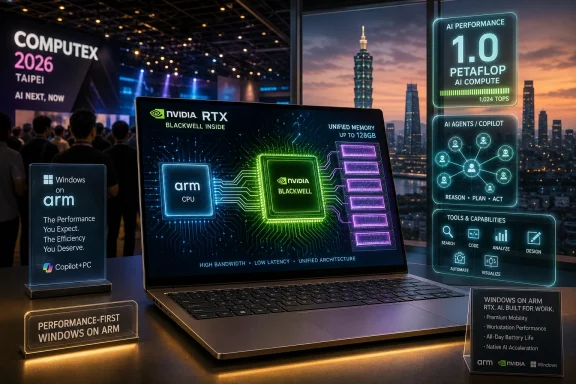
Promotional expo display showing an NVIDIA Blackwell ARM laptop with AI performance and capabilities graphics.Nvidia Turns Windows on Arm From Efficiency Story to Performance Story​

For most of its modern life, Windows on Arm has been marketed as a battery-life proposition. Qualcomm’s Snapdragon X Elite and X Plus machines pushed that story further than earlier Windows RT and Snapdragon 8cx-era devices ever could, finally making thin Windows laptops feel credible without Intel or AMD silicon. But the center of gravity remained familiar: quiet machines, long standby, good enough native apps, and an emulator that no longer embarrassed itself.
RTX Spark is a different pitch. Nvidia is not walking into Windows on Arm as a polite efficiency partner. It is bringing the branding, developer ecosystem, graphics credibility, and AI hardware muscle that made RTX a default assumption in large parts of the creator, gaming, and machine-learning PC market.
That is why the numbers matter even before we know how they behave in real shipping laptops. A Blackwell-class GPU with 6,144 CUDA cores, fifth-generation Tensor Cores, up to 128GB of unified memory, and around 600GB/s of memory bandwidth is not the usual “Arm laptop” vocabulary. It is closer to the language of compact workstations and AI developer boxes than fanless ultraportables.
The central bet is that the next Windows PC will not be judged only by browser tabs, Office responsiveness, and video-call endurance. Microsoft and Nvidia are positioning local AI agents, generative creative tools, developer workflows, and GPU-accelerated applications as the workloads that decide whether a PC feels modern. If that premise holds, Windows on Arm needed more than respectable CPU cores. It needed a reason for demanding users to care.

The PC Is Being Recast Around Memory, Not Just Cores​

The most interesting RTX Spark specification may not be the petaflop claim or the CUDA core count. It is the unified memory ceiling. Up to 128GB of shared system memory changes the conversation for local AI in a way that raw TOPS figures never quite did.
The first wave of Copilot+ PCs leaned heavily on NPU performance as the headline metric. That made sense for Microsoft’s minimum platform definition, but it also trained buyers to focus on an abstract number. The practical bottleneck for serious local models, creative pipelines, and multi-app agent workflows is often memory capacity and bandwidth, not whether a small NPU can run a demo feature in isolation.
Nvidia understands that better than almost anyone in the client PC ecosystem. CUDA’s dominance did not come from a single benchmark category. It came from giving developers a predictable target for parallel workloads, then surrounding that target with libraries, frameworks, drivers, and habits. RTX Spark imports that model into Windows on Arm with a much more coherent story than “here is another NPU.”
Unified memory also lets Nvidia and Microsoft borrow a page from Apple Silicon without admitting too loudly that Apple got there first. Apple’s M-series Macs changed expectations around how laptops handle CPU, GPU, neural, and media workloads inside a shared memory architecture. Microsoft’s Windows partners have had pieces of that story, but rarely the whole stack in a form that felt aspirational.
RTX Spark is not automatically an Apple Silicon killer. Windows has a broader hardware ecosystem, a messier software legacy, and far more variation in OEM execution. But Nvidia’s platform gives Microsoft a way to argue that Windows can compete where Apple has been most persuasive: compact machines that feel like workstations because the memory architecture and accelerators are designed together.

Microsoft Knows the Emulator Is Still the Tripwire​

The XDA summary correctly highlights Prism, Microsoft’s x86 and x64 translation layer for Windows on Arm, because compatibility remains the emotional scar tissue in this market. Windows users do not buy architectures. They buy the expectation that the installer they downloaded, the peripheral they already own, and the slightly ancient utility their company still depends on will work.
Prism is much better than the old Windows on Arm emulation story, and native Arm64 app support has improved dramatically. But the Windows ecosystem is not the Mac ecosystem. Apple could force a transition because it controls the hardware roadmap, the OS, the developer tools, and the customer expectation that older software may eventually be cut loose. Microsoft has to bring along decades of business software, anti-cheat systems, device drivers, shell extensions, VPN clients, accounting packages, and niche engineering tools.
That is where Nvidia’s entrance helps and complicates matters. On one hand, Nvidia brings a driver and developer ecosystem that Qualcomm could never match in PC graphics. On the other hand, the existence of an RTX-class GPU inside an Arm Windows machine will invite users to run exactly the kinds of software most likely to expose compatibility gaps: games, creative suites, GPU plug-ins, AI frameworks, and performance-sensitive tools that assume x86 conventions somewhere in the stack.
Microsoft’s claim that Prism will be present and optimized for RTX Spark is therefore not a footnote. It is a survival requirement. If these machines ship with workstation-class marketing and ultrabook-class compatibility caveats, the backlash will be swift.

Nvidia Is Selling the Agentic PC Before Users Have Seen One​

The word agentic is doing a lot of work in this launch. Nvidia and Microsoft are framing RTX Spark as a platform for local agents that can see context, call tools, run models, and coordinate work across applications. That is a bolder claim than “AI features run faster,” and it moves the PC from being an endpoint to being an active collaborator.
There is a plausible technical argument here. Local models benefit from low latency, privacy, persistent context, and access to local files and applications. A machine with a strong GPU, abundant unified memory, and Windows integration could run more capable models than today’s NPU-first laptops. Nvidia’s own Nemotron models, Adobe’s announced support, and MCP-style tool connections all fit the direction of travel.
But the agentic PC remains more roadmap than lived experience. Most users have not seen a local agent reliably manage a serious workflow without supervision, hallucination, awkward permissions, or brittle app handoffs. The difference between an impressive keynote demo and a trustworthy assistant that can touch your work documents, emails, creative assets, and source code is enormous.
That gap matters because Nvidia is not merely selling silicon. It is helping Microsoft revive the idea that Windows itself can become the surface for AI work. After the uneven rollout of Copilot features and the controversy around Recall, Microsoft needs the next iteration of AI on Windows to feel useful rather than intrusive. RTX Spark gives it hardware credibility, but the trust problem remains a software and governance problem.

The Surface Laptop Ultra Is a Signal to OEMs, Not Just a New Surface​

Microsoft putting RTX Spark into a Surface Laptop Ultra is strategically important even if the device itself becomes a premium niche product. Surface has long served as Microsoft’s reference argument to the rest of the PC industry: this is what we think Windows hardware should feel like when the OS and device are designed together. A high-end RTX Spark Surface tells OEMs that Windows on Arm is no longer supposed to live only in conservative productivity machines.
The “Ultra” branding also matters because Surface has needed a clearer performance flagship. Surface Laptop has become cleaner and more conventional over time, while Surface Pro remains the identity product. A powerful Arm-based Surface with Nvidia silicon gives Microsoft a chance to reset expectations around what a Windows laptop can be without copying the MacBook Pro too obviously.
For OEMs, the bigger story is that RTX Spark appears to arrive with broad partner interest. Asus, Dell, HP, Lenovo, MSI, and Microsoft all being associated with the platform suggests this is not a one-off science project. The old Windows on Arm problem was not simply that the chips were weak; it was that the ecosystem felt tentative. Retail shelves, enterprise procurement catalogs, driver support, accessories, and software optimization all follow confidence.
Still, partner logos are not products. The difference between a great reference platform and a great Windows laptop is execution: thermals, firmware, display choices, keyboard quality, fan noise, idle drain, sleep reliability, and whether the machine behaves consistently after six months of driver updates. Nvidia can raise the ceiling. OEMs can still lower the floor.

Power and Thermals Will Decide Whether the Promise Survives Contact With a Laptop​

The reported 45W to 80W operating profile places RTX Spark in a fascinating middle ground. It is far above the power envelope most people associate with thin Arm laptops, but below the combined CPU-and-discrete-GPU draw of many traditional creator notebooks and gaming laptops. That gives Nvidia room to claim workstation-like acceleration in portable designs, but it also removes the easy excuse that Arm automatically means cool and silent.
Microsoft’s workload profile scheduling and Microsoft Power and Thermal Framework support are therefore not boring platform plumbing. They are the mechanism by which this entire idea either feels seamless or becomes another Windows performance science fair. The machine has to know when to favor battery life, when to feed the GPU, when to keep an AI model resident, when to cool down, and when to avoid turning a premium laptop into a desk fan.
This is one of the places where Windows historically struggles compared with vertically integrated platforms. Microsoft can build frameworks, Nvidia can expose controls, and OEMs can tune firmware, but the user experiences the result as one machine. If background agents, creative apps, browser processes, and emulated x86 software all fight for the same thermal budget, the spec sheet will not save the product.
There is also a messaging risk. “All-day battery life” and “1 petaflop AI workstation” are not impossible in the same product, but they are not the same mode of operation. Buyers will need to understand that RTX Spark’s most impressive capabilities will consume power, generate heat, and depend on chassis design. If Microsoft and Nvidia blur that distinction too much, reviewers will make it for them.

Qualcomm Just Lost Its Monopoly on the Future It Helped Build​

Qualcomm deserves credit for dragging Windows on Arm back into relevance. The Snapdragon X launch gave Microsoft a credible Copilot+ PC baseline, forced Intel and AMD to respond more aggressively on efficiency and AI acceleration, and persuaded developers that Arm64 Windows was no longer a historical curiosity. Without that work, Nvidia would be entering a colder market.
But RTX Spark threatens Qualcomm’s strategic comfort. Until now, Qualcomm could argue that Windows on Arm essentially meant Snapdragon. Nvidia’s arrival turns the category into a real market, and real markets create segmentation. Qualcomm may remain attractive for battery-first laptops, fanless designs, and mainstream productivity machines. Nvidia will target creators, developers, gamers, and AI users who care less about architectural purity than about whether CUDA, RTX, and local models work.
That division could benefit Microsoft. Windows on Arm has needed more than one silicon story because Windows itself serves too many audiences. A single vendor cannot plausibly satisfy enterprise fleets, students, gamers, creators, developers, and workstation users at once. Nvidia gives Microsoft a high-end anchor that Qualcomm could not easily provide.
It also pressures Intel and AMD in a more complicated way. Both x86 vendors have been building stronger NPUs and improving efficiency, but Nvidia’s pitch shifts the competitive field toward GPU-accelerated local AI and unified memory. If Windows buyers start associating the “serious AI PC” with Nvidia Arm silicon, Intel and AMD will need more than incremental NPU slides to defend premium laptops.

Gaming Is the Opportunity Nvidia Cannot Avoid​

Nvidia may talk about agents, creators, and developers, but the RTX brand inevitably invites a gaming question. If a Windows laptop has Blackwell RTX cores, users will ask how it runs games. If it runs Windows on Arm, the answer will be complicated.
This is where Nvidia has a real advantage over Qualcomm. Qualcomm’s Adreno graphics were good enough for many PC tasks but struggled to command trust in Windows gaming, especially around drivers, anti-cheat compatibility, and game-specific optimizations. Nvidia has spent decades making PC gamers expect day-one drivers, control-panel knobs, DLSS support, and broad developer alignment.
The challenge is that games are among the least forgiving Windows applications. Many depend on x86 code, kernel-level anti-cheat, launchers, overlays, copy protection, and performance assumptions that do not translate cleanly to Arm. Even when GPU performance is strong, CPU translation overhead and compatibility blocks can make the user experience uneven.
Nvidia does not need RTX Spark to beat every gaming laptop. It needs the platform to avoid becoming a “technically powerful, practically frustrating” machine. If popular titles run well, if anti-cheat vendors cooperate, and if DLSS and RTX features behave normally, Windows on Arm’s reputation could shift quickly. If not, the RTX badge may set expectations the platform cannot meet.

Enterprise IT Will See Both a Breakthrough and a New Risk Surface​

For IT departments, RTX Spark is not just another laptop platform. It is a new combination of architecture, GPU stack, AI runtime, memory model, emulation layer, and management expectations. That makes it attractive for certain high-value users and risky for broad deployment.
Developers working on AI applications, data scientists prototyping locally, designers using GPU-accelerated creative tools, and executives who want premium battery life with real performance could all be plausible early adopters. A Windows machine that can run meaningful local models without sending every prompt to the cloud is appealing in regulated environments, at least in theory.
But enterprise adoption will hinge on boring details. VPN clients must work. Endpoint security agents must work. DLP tools must work. Print drivers, smart-card middleware, virtualization tools, remote management, firmware updates, and compliance baselines must behave predictably. Windows on Arm has improved, but every new silicon platform restarts part of the validation process.
There is also the question of local AI governance. A machine powerful enough to run agents and models locally is a machine that may process sensitive documents outside centralized cloud controls. That can be a feature for privacy and latency, but it also creates audit, retention, and policy questions. Microsoft’s enterprise pitch will need to explain not just how RTX Spark accelerates AI, but how administrators can constrain it.

The Software Stack Is the Product​

The most tempting mistake is to treat RTX Spark as a chip story. It is really a stack story. The silicon matters because it lets Microsoft and Nvidia make claims that were previously unrealistic, but the product users experience will be Windows, drivers, frameworks, app support, emulation, model runtimes, power management, OEM firmware, and cloud-adjacent services operating as one system.
Nvidia’s strength is that it already knows how to make a hardware platform feel larger than hardware. CUDA, RTX, DLSS, TensorRT, Broadcast, Studio drivers, Omniverse, and its AI software ecosystem all function as gravity wells. Developers do not merely target Nvidia GPUs because they are fast. They target them because the tooling, documentation, installed base, and commercial incentives are already there.
Microsoft needs that gravity. The Copilot+ PC launch created a category, but the initial user-facing AI features were not strong enough to define a new era of computing. RTX Spark gives Microsoft a second chance to make the AI PC feel substantive, especially if local agents and creative tools can do things that cloud-only Copilot experiences cannot.
The danger is fragmentation. If some AI features require an NPU, others prefer Nvidia Tensor Cores, some apps are Arm-native, others rely on Prism, and performance varies dramatically between Snapdragon, RTX Spark, Intel, and AMD systems, users may find the “AI PC” label more confusing than helpful. Microsoft’s job is to prevent capability tiers from becoming a maze.

The Hype Is Earned, but the Burden of Proof Is Heavy​

There is a reason this announcement feels bigger than a routine silicon launch. Nvidia is the company that turned GPUs into the defining infrastructure of the AI boom, and Microsoft is the company that still controls the desktop OS used across much of the working world. Their collaboration on a high-end Windows on Arm platform gives the category the kind of institutional force it has lacked.
But Windows history is littered with “new era of PC” moments that became smaller once they hit channel inventory, driver updates, and user habits. Windows RT promised a modern, efficient Windows and mostly taught buyers to distrust compatibility footnotes. Early connected PCs promised smartphone-like mobility and delivered too many compromises. Even Copilot+ PCs arrived with stronger hardware than software.
RTX Spark has a better shot because the market is finally aligned around local AI, efficient performance, and heterogeneous compute. Developers understand GPUs. Users understand that AI workloads can be heavy. OEMs understand that premium laptops need differentiation beyond thinner bezels. Microsoft understands that Windows cannot let Apple own the narrative of integrated performance.
The burden of proof, however, is not a keynote. It is six months of real machines, real reviews, real apps, and real users discovering whether the platform disappears beneath their work or constantly reminds them that they bought the future early.
The Spark That Has to Become a Platform​

This launch should be read less as a finished victory lap and more as a forcing function for the Windows ecosystem.
  • RTX Spark gives Windows on Arm a premium-performance identity that Qualcomm alone could not provide.
  • The 128GB unified memory option may matter more for local AI and creator workflows than the headline petaflop figure.
  • Prism compatibility, native Arm64 applications, and Nvidia’s driver maturity will determine whether the platform feels powerful or merely impressive on paper.
  • Surface Laptop Ultra gives Microsoft a reference design that tells OEMs Windows on Arm now belongs in flagship hardware.
  • Enterprise adoption will depend on management, security, app compatibility, and policy controls as much as raw performance.
  • Nvidia’s biggest contribution may be its software ecosystem, because CUDA and RTX developer gravity can make Arm Windows machines worth targeting.
If RTX Spark succeeds, it will not be because Nvidia and Microsoft “reinvented the PC” in a single Computex keynote. It will be because they gave Windows on Arm the one thing it has never had at the high end: a reason for ambitious users to choose it first, rather than tolerate it for battery life. The next year will show whether that reason survives outside the demo hall, but for the first time in a long while, Windows on Arm looks less like a compromise architecture and more like a battlefield where the future PC might actually be decided.

References​

  1. Primary source: XDA
    Published: Mon, 01 Jun 2026 04:38:49 GMT
  2. Related coverage: tomshardware.com
  3. Related coverage: tomsguide.com
  4. Related coverage: pcgamer.com
  5. Related coverage: investor.nvidia.com
  6. Related coverage: notebookcheck.net
  1. Related coverage: windowslatest.com
  2. Official source: blogs.windows.com
  3. Related coverage: overclock3d.net
  4. Related coverage: whatjobs.com
  5. Related coverage: windowscentral.com
  6. Related coverage: techradar.com
  7. Related coverage: winbuzzer.com
  8. Related coverage: windowsforum.com
  9. Related coverage: elpais.com
  10. Related coverage: igorslab.de
 

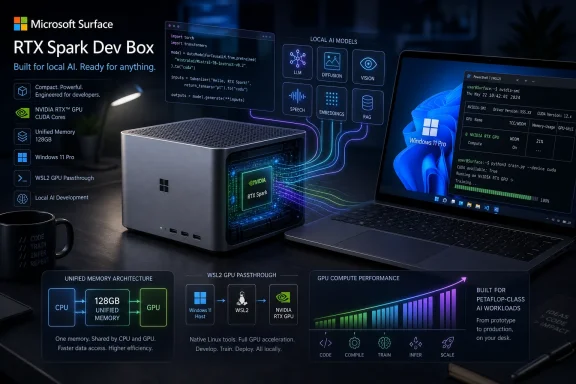
Microsoft introduced Surface RTX Spark Dev Box on June 2, 2026, as a compact Windows 11 Pro developer desktop built with Nvidia’s RTX Spark superchip, 128GB of unified memory, and a Surface-designed chassis aimed at local AI development. It arrives as the Windows-on-Arm ecosystem is still carrying the bruise from Qualcomm’s canceled Snapdragon Dev Kit for Windows. The important story is not that Microsoft has made another small box. It is that Microsoft has decided the next serious Windows Arm development machine needs Nvidia’s AI stack, Surface hardware discipline, and a much clearer reason to exist.

Microsoft Surface RTX Spark Dev Box shown as a local AI workstation with laptop, GPU visuals, and performance charts.Microsoft Stops Pretending Windows on Arm Is Just About Battery Life​

For most consumers, Windows on Arm has been sold with a simple pitch: thinner laptops, longer battery life, quieter fans, and enough performance to make x86 emulation less painful than it used to be. That story made sense for Copilot+ PCs, and Qualcomm’s Snapdragon X chips gave Microsoft its first credible consumer Windows Arm push in years. But developers do not buy platforms because a keynote slide says the battery lasts all day.
Developers buy platforms when they can test real workloads, reproduce customer bugs, compile without waiting forever, and trust that the hardware under the desk will still be supported six months later. That is where Qualcomm’s 2024 Snapdragon Dev Kit was supposed to matter. It promised a compact, relatively affordable Snapdragon X Elite desktop for app makers trying to get ahead of the Copilot+ PC wave.
Then Qualcomm canceled it. The company said the product had not met its standards, refunded preorders, and left a strange half-presence in the ecosystem: some units had reportedly shipped, but the official developer platform no longer existed as a dependable thing one could simply order and build around. For an ecosystem that already had to persuade developers to recompile, test, and optimize for Arm, that was not a footnote. It was a credibility problem.
Surface RTX Spark Dev Box is Microsoft’s answer, but it is not a like-for-like replacement. Qualcomm’s dev kit was about getting Snapdragon X Elite hardware onto developers’ desks. Microsoft’s new box is about making Windows on Arm part of the local AI workstation story. That shift matters because it changes the question from “Can Windows Arm run my existing app?” to “Can Windows Arm become the machine where new AI-native Windows software is built?”

Qualcomm Left a Hardware Hole, But the Software Hole Was Bigger​

The easy version of the story is that Qualcomm stumbled and Microsoft stepped in. That is true, but incomplete. The Snapdragon Dev Kit’s cancellation hurt because developer kits are symbolic objects as much as practical ones. They tell software makers that the platform owner understands their needs well enough to produce a boring, reliable machine that can sit on a desk and take abuse.
A dev kit that never becomes broadly available sends the opposite signal. It says the ecosystem is still improvising. It also forces developers back to laptops, retail availability quirks, and workarounds that may be acceptable for enthusiasts but are less attractive for teams managing build systems, test labs, and compatibility matrices.
Microsoft has been here before. Windows on Arm has spent years trapped between technical possibility and market hesitation. The operating system improved, emulation improved, native apps improved, and yet the platform kept struggling with the same chicken-and-egg problem: developers wait for users, users wait for apps, and hardware partners wait for signs that both are arriving.
The Surface RTX Spark Dev Box tries to attack that loop from a different angle. Instead of saying, “Please port your app because Arm laptops are coming,” Microsoft is saying, “Here is a local AI development machine that happens to be Arm, ships with the Windows developer stack, and gives you CUDA.” That is a more compelling bargain for a certain class of developer, because the reward is not ideological support for Windows Arm. The reward is access to a practical local AI workstation.

Nvidia Gives Windows Arm the Ingredient Qualcomm Could Not​

The decisive difference is CUDA. Qualcomm can talk about NPUs, TOPS, efficiency, and on-device AI until the conference lights dim, but much of the AI development world still revolves around Nvidia’s tooling. CUDA is not merely a feature. It is the installed base, the habit, the documentation trail, the Stack Overflow answer, the framework assumption, and the thing many developers quietly mean when they say they need GPU acceleration.
Nvidia’s RTX Spark platform brings that gravitational pull into the Windows Arm conversation. Microsoft says the Dev Box uses an Nvidia RTX Spark superchip pairing a Blackwell RTX GPU with a Grace CPU, delivering up to 1 petaflop of FP4 AI compute and 128GB of unified memory. Nvidia’s broader Spark positioning emphasizes local prototyping, fine-tuning, inference, and agentic AI workflows in small desktops and laptops.
Those numbers need context. “Up to” performance claims are vendor claims, FP4 is not a universal measure of all workloads, and real-world AI development is usually constrained by memory behavior, framework support, thermals, storage, and software maturity as much as by headline compute. But the pitch is still more concrete than the vague AI PC language that has surrounded much of the Windows hardware market.
The unified-memory design is central to that pitch. A conventional desktop with a discrete GPU can offer tremendous performance, but it also creates hard boundaries between system RAM and VRAM. For large models and experimental workflows, those boundaries become planning constraints. A 128GB unified pool does not magically make every model fast, but it changes what can be loaded, tested, and iterated locally without immediately renting cloud GPUs.

Surface Hardware Turns the Dev Kit Into a Promise​

The Surface branding is doing real work here. Microsoft is not presenting this as a generic reference board or a partner experiment. It is presenting it as a Surface device, with a compact aluminum chassis engineered to double as a heatsink and an explicit focus on sustained workloads such as long-running training jobs, large-model inference, and complex agentic pipelines.
That matters because developer hardware fails in boring ways. Ports matter. Thermals matter. Firmware updates matter. Whether the machine throttles after an hour matters. Whether the vendor still acknowledges the device after launch matters. Qualcomm’s canceled dev kit made those mundane issues feel strategic, because Windows on Arm could not afford to look casual about the machines developers were supposed to trust.
Microsoft’s design language also seems intentionally familiar. The compact block, aluminum construction, and vented top inevitably invite comparisons to Xbox Series X and earlier Surface desktop-adjacent experiments. That is not accidental in spirit, even if the product category is different. Microsoft wants the box to look less like a prototype and more like a durable appliance for people who leave jobs running overnight.
The risk is that Surface polish can become a substitute for openness. Developers do not just need a beautiful chassis; they need predictable support, transparent firmware behavior, useful diagnostics, and a path for tooling updates that does not vanish after the launch window. Microsoft has often been better at making desirable hardware than at explaining long-term developer device strategy. This box will test whether Surface can be more than an attractive wrapper around Nvidia silicon.

The Preconfigured Image Is the Quietest Admission​

The most revealing part of Microsoft’s announcement may not be the chip. It may be the software image. Surface RTX Spark Dev Box ships with Windows 11 Pro preconfigured for developers, with Developer Mode enabled, PowerShell 7 as the default shell, WSL 2 configured with GPU passthrough and CUDA support, and common tools such as VS Code, GitHub Copilot, Git, Python, and Node.js already installed.
That is not glamorous. It is also exactly the kind of work platform vendors routinely underestimate. Developers are allergic to ceremony. A machine that requires a day of driver hunting, shell configuration, preview builds, SDK confusion, and manual CUDA plumbing has already lost part of its audience before the first benchmark runs.
Microsoft is effectively admitting that the Windows developer experience has too often been assembled rather than delivered. Windows is powerful, flexible, and still indispensable in many organizations, but it has historically made developers stitch together their own environment from a pile of installers, package managers, terminals, subsystem settings, and vendor utilities. The Dev Box says the default experience should be a development environment, not a consumer desktop with developer features hidden behind switches.
There is also a competitive subtext. Apple’s developer machines win loyalty not only because of silicon efficiency, but because the hardware, operating system, toolchain, and power-management story feel like parts of a single argument. Microsoft cannot copy macOS, and Windows serves a much broader hardware world. But with Surface RTX Spark Dev Box, it can at least build one machine where the whole stack is curated.

Local AI Is the New Workstation War​

Microsoft’s positioning is blunt: developers should be able to prototype, fine-tune, and run capable models locally, then use the cloud when the work demands it. That is both a technical claim and a cost argument. Cloud GPUs are flexible, but they are not psychologically free. Every experiment becomes a small budget decision, every idle instance a minor sin, and every sensitive dataset a governance conversation.
A local AI box changes that rhythm. It lets developers iterate privately, test agent pipelines without metering anxiety, and keep some proprietary data closer to home. For enterprises, that does not eliminate cloud governance, but it can reduce the number of early-stage experiments that need to touch shared infrastructure.
This is where the Surface RTX Spark Dev Box becomes more interesting than a normal mini PC. Microsoft is tying it to AI Toolkit for VS Code, Windows ML with TensorRT, Windows Copilot Runtime, Microsoft Foundry, GitHub Copilot, WSL, and CUDA. In other words, the box is not just hardware. It is a funnel into Microsoft’s developer and AI platform.
That funnel cuts both ways. For Microsoft, it is a way to keep AI developers inside Windows instead of watching them default to Linux workstations, MacBook Pros, or cloud notebooks. For developers, it could be a productive integrated environment — if the integration is real, current, and not just a launch-day alignment of brand names.

The Arm Question Has Not Gone Away​

Nvidia’s presence does not erase the old Windows Arm problem. Compatibility still matters. Native Arm builds still matter. Emulation still matters. Driver support still matters. Developers who live in niche toolchains, obscure USB hardware, legacy enterprise utilities, or custom kernel-adjacent workflows will not be reassured by AI performance claims alone.
The Surface RTX Spark Dev Box may actually sharpen the issue. If Microsoft and Nvidia want developers to use this as a serious Windows machine, not just an AI appliance with a Windows logo, then the broader Windows application universe has to behave. Claims that Windows apps will run well on new Arm hardware will be tested not in demos, but in the ugly edges: installers, plug-ins, debuggers, virtualization tools, license managers, older games, specialized drivers, and enterprise security agents.
That is why the Qualcomm cancellation still shadows the announcement. The Snapdragon Dev Kit’s failure was not only a supply-chain or quality-control embarrassment. It interrupted the ecosystem’s ability to test the messy middle of Windows Arm compatibility at scale. A new Nvidia-powered box can restart that work, but it changes the target hardware profile in the process.
For developers targeting mainstream Snapdragon laptops, the Surface RTX Spark Dev Box may not be a perfect proxy. Its GPU, memory architecture, thermal envelope, and AI focus are different. That does not make it useless; it makes it a different kind of development machine. Microsoft should be careful not to imply that one high-end AI box solves all Windows Arm testing needs.

Three Silicon Stories Are Better Than One, If Microsoft Can Explain Them​

Microsoft now appears to be building a more explicit three-lane Windows hardware strategy. Qualcomm remains the efficiency and battery-life story. Intel and AMD remain the compatibility, enterprise familiarity, and traditional PC performance story. Nvidia’s RTX Spark becomes the local AI, CUDA, and developer workstation story.
That is a healthier map than pretending one chip vendor can satisfy every Windows use case. It also reflects the reality that the PC market is fragmenting again. The old Wintel default is no longer the only center of gravity, but the replacement is not a single new monoculture. It is a portfolio of architectures, accelerators, and workload-specific machines.
The challenge is messaging. Microsoft spent years teaching users that a Windows PC was a Windows PC, and that the underlying architecture was mostly invisible. Windows on Arm complicates that promise. AI accelerators complicate it further. A developer buying hardware now has to think about x86 compatibility, Arm native performance, NPU support, CUDA, memory topology, Linux subsystem behavior, model size, and management tooling.
That complexity is manageable for enthusiasts and IT pros, but it is not self-explanatory. If Microsoft wants this strategy to work, it needs to be unusually clear about which machine is for which job. A Surface RTX Spark Dev Box should not be marketed as a universal desktop. It should be marketed as a local AI development workstation for Windows developers who specifically benefit from Nvidia acceleration and high unified memory.

Enterprise IT Will Ask the Boring Questions First​

For organizations, the Dev Box’s most important features may be the least flashy ones. Microsoft says it supports Secured-core PC architecture, BitLocker, Microsoft Defender, Entra ID, and Intune. That is the language procurement teams understand, because a machine that cannot be enrolled, governed, encrypted, patched, and audited is a lab toy no matter how impressive its AI demos look.
The security framing also fits the local AI pitch. If teams are experimenting with proprietary code, customer data, internal documents, or unreleased models, keeping more work local can be attractive. But local hardware is not automatically safer than cloud infrastructure. It simply moves the security boundary. Devices still need identity controls, update discipline, endpoint protection, physical security, and policies around what models and datasets can be stored locally.
There is also the question of cost. Microsoft has not disclosed pricing, and that omission is not trivial. A machine with 128GB of unified memory, Nvidia’s newest AI silicon, Surface industrial design, and enterprise management hooks is unlikely to be impulse-buy cheap. If it lands too high, it becomes a boutique device for AI teams and executive demos. If it lands aggressively, it could become the default Windows AI dev box in organizations that have been waiting for a supported alternative to Linux workstations.
Availability is another constraint. Microsoft says the device will be available later this year in the United States exclusively through Microsoft’s online store. That sounds clean for launch, but enterprises will want predictable volume purchasing, support channels, replacement logistics, and regional plans. Developer enthusiasm can be created with a good announcement. IT adoption requires a supply chain.

The Dev Box Is a Bet Against Cloud-Only AI Development​

The timing is telling. For the last few years, the default assumption in serious AI work has been that meaningful compute lives in the cloud or in a specialized lab. Local machines were for editing code, running smaller tests, and connecting to remote resources. Microsoft and Nvidia are pushing back against that assumption, not because the cloud is going away, but because developers hate waiting on centralized resources for every iteration.
The Dev Box is part of a broader swing back toward the workstation. Not the beige tower of the 1990s, and not the gamer rig with a glowing GPU, but a compact, managed, AI-capable appliance that sits near the developer and handles the middle tier of work. The biggest models and production training runs still go elsewhere. But a large amount of useful experimentation can happen before the cloud meter starts running.
This could alter how Windows participates in AI development. Windows has often been the client OS around AI rather than the place where the deepest AI work happens. Linux dominates much of the server-side AI stack, and macOS has won a loyal segment of local development because Apple Silicon offers a coherent memory and power story. Microsoft wants Windows to be credible again at the desk where models are tested, agents are built, and prototypes become products.
Nvidia makes that ambition more plausible. But Nvidia also brings its own center of gravity. Developers may see the Dev Box less as a Microsoft machine than as the most convenient Windows vessel for CUDA on Arm. That is not a bad outcome for Microsoft, as long as Windows remains essential to the workflow rather than incidental to the hardware.

The Lesson From Qualcomm Is That Developers Remember​

The Snapdragon Dev Kit saga will not define Windows on Arm forever, but it will linger because developers have long memories for platform pain. When a company asks them to port, test, optimize, and evangelize, it is also asking them to spend political capital inside their own teams. If the platform owner then cancels the hardware runway, that trust is expensive to rebuild.
Microsoft’s advantage with Surface RTX Spark Dev Box is that it controls more of the experience. It can align hardware, Windows, WSL, developer tools, identity, management, and support under one roof. Nvidia controls the AI acceleration story, but Microsoft controls the platform packaging. That gives this device a better chance of feeling finished.
The disadvantage is expectation. A Surface-branded developer machine will be judged more harshly than a reference kit. If it is expensive, noisy, hard to buy, thermally constrained, or slow to receive fixes, the disappointment will land directly on Microsoft. The company cannot blame an ecosystem partner for the experience of a Surface product.
That is why the Dev Box’s real benchmark will not be a single model demo. It will be whether developers leave it running for months, whether teams standardize on it, whether Windows Arm bugs get found and fixed faster because it exists, and whether Microsoft keeps updating the image as frameworks, drivers, and AI tools move at their usual reckless pace.

The Small Box Carries a Large Windows Bet​

The concrete takeaways are less about one new Surface device than about where Microsoft now thinks Windows development is headed. The company is not merely replacing Qualcomm’s canceled hardware; it is trying to redefine the Windows Arm developer machine around local AI, Nvidia acceleration, and a curated software stack.
  • Surface RTX Spark Dev Box is a compact Windows 11 Pro developer desktop announced on June 2, 2026, with Nvidia RTX Spark silicon and 128GB of unified memory.
  • Microsoft is positioning the machine for local AI prototyping, fine-tuning, inference, and agentic workflows rather than as a general-purpose Snapdragon Dev Kit replacement.
  • The inclusion of native CUDA support through Nvidia’s platform gives the device a stronger AI developer story than earlier Windows Arm development hardware.
  • The preconfigured Windows image, WSL 2 GPU passthrough, PowerShell 7 default, and bundled developer tools suggest Microsoft is trying to reduce setup friction rather than simply ship hardware.
  • Qualcomm’s canceled Snapdragon Dev Kit remains the cautionary backdrop, because developer ecosystems depend on reliable, available machines as much as on promising silicon.
  • Pricing, real-world thermals, enterprise availability, and long-term update support will determine whether this becomes a standard developer workstation or a polished niche device.
Microsoft’s Surface RTX Spark Dev Box is not the final answer to Windows on Arm, and it should not be mistaken for one. It is more interesting than that: a recognition that the next phase of Windows development will be shaped by AI workloads, local compute economics, and the uncomfortable fact that developers will not optimize for platforms they cannot trust. If Microsoft can turn this box from a launch-day symbol into a durable workstation with timely software support, Windows Arm may finally get something it has lacked for years — not just better chips, but a reason for developers to build there first.

References​

  1. Primary source: Gadget Review
    Published: Tue, 02 Jun 2026 17:37:42 GMT
  2. Related coverage: tomshardware.com
  3. Related coverage: windowscentral.com
  4. Related coverage: axios.com
  5. Related coverage: pcgamer.com
  6. Related coverage: qualcomm.com
  1. Official source: blogs.windows.com
  2. Related coverage: pcworld.com
  3. Related coverage: howtogeek.com
  4. Related coverage: arstechnica.com
  5. Related coverage: techfoogle.com
  6. Related coverage: nvidia.com
  7. Related coverage: techzine.eu
  8. Related coverage: windowslatest.com
  9. Related coverage: engadget.com
  10. Related coverage: techradar.com
  11. Related coverage: amax.com
 

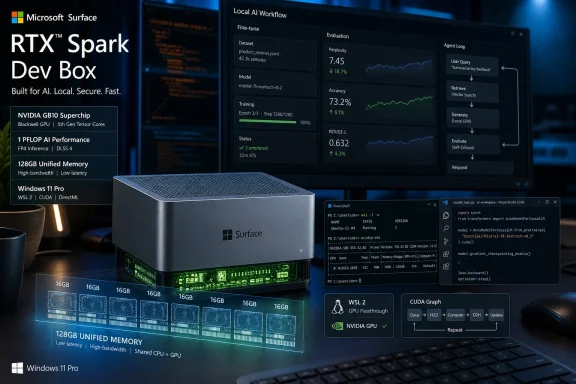
Microsoft announced the Surface RTX Spark Dev Box at Build 2026 on June 2, a compact Windows 11 Pro developer workstation using NVIDIA’s RTX Spark superchip to deliver up to 1 petaflop of AI compute and 128GB of unified memory for local AI model development. The machine is not a general-purpose Surface curiosity dressed up for the AI cycle. It is Microsoft’s most direct admission yet that Windows on Arm will not win developers through battery-life demos alone. It needs horsepower, CUDA gravity, and a reason for serious builders to keep their workflows on Windows instead of drifting to Linux servers or Apple Silicon Macs.

Microsoft Surface RTX Spark Dev Box marketing image showing AI workflow on screens and unified GPU memory.Microsoft Finally Gives Windows on Arm a Workstation Argument​

For most of its life, Windows on Arm has been sold as a promise just over the horizon. The story has shifted from instant-on computing to fanless thin-and-lights, from phone-adjacent experiments to Copilot+ PCs, and from battery life to neural processing units. Each generation has made the platform more credible, but credibility is not the same thing as inevitability.
The Surface RTX Spark Dev Box changes the tone because it does not ask developers to care about Arm as an ideology. It asks them to care about a box on a desk that can run large AI workloads locally, integrate with Windows tooling, and still reach into the cloud when the local machine is not enough. That is a better sales pitch because it begins with a job to be done rather than a processor architecture to be defended.
Microsoft’s stated target is local-first AI development. In plain English, that means giving developers enough compute and memory to build, test, fine-tune, and iterate on models without turning every experiment into a metered cloud event. The machine is still a prototype-style developer device, not a mass-market PC, but that distinction is part of the point. Microsoft is trying to seed the workflows before it sells the lifestyle.
The Surface brand has done this before. The original Surface was less about tablets than about forcing Windows hardware partners to treat hybrid PCs seriously. The Surface Studio was less about volume than about proving Microsoft could make a category-defining creative desktop. The Surface RTX Spark Dev Box sits in that same lineage: not necessarily the device everyone buys, but the one Microsoft wants everyone else to react to.

The Petaflop Number Is Marketing, but the Memory Pool Is the Plot​

The headline figure is impossible to miss: up to 1 petaflop of AI compute. That number is useful, but only in the way peak performance numbers are usually useful. It tells you Microsoft and NVIDIA have built something substantially more ambitious than a conventional mini PC, but it does not tell you how fast your own model, tokenizer, vector database, IDE, container stack, and inference path will run on a Tuesday afternoon.
The more consequential spec is 128GB of unified memory. AI development on client hardware is often less constrained by raw arithmetic than by where the model fits and how awkwardly the system has to shuffle data between CPU memory and GPU memory. A huge unified pool changes the character of the machine because it lets developers treat memory as a shared working space rather than a series of expensive fences.
That is why Microsoft’s claim that the box can run models with more than 120 billion parameters locally matters. The catch, as always, is that such claims depend on quantization, model format, context length, and runtime efficiency. Still, even with all the caveats, this is a different class of desktop proposition from “run a small chatbot demo next to your browser.”
The NVIDIA RTX Spark superchip combines a Blackwell RTX GPU with a Grace CPU, which immediately gives the project more credibility with AI developers than a Windows-only accelerator story would have had. CUDA remains the center of gravity in much of the machine-learning world. Microsoft can talk about Windows AI APIs, Copilot Runtime, and developer experience, but the presence of NVIDIA’s stack is what makes the pitch feel practical rather than purely aspirational.
That is also why this is not simply an NPU story. NPUs are important for efficient, always-on, consumer-facing AI tasks, but serious developer workflows still lean heavily on GPU acceleration and mature software ecosystems. The Surface RTX Spark Dev Box is Microsoft acknowledging that the road to useful local AI development runs through the tooling developers already trust.

The Desk Becomes the New Edge​

The cloud will not disappear from AI development, and Microsoft is not pretending otherwise. Azure remains the company’s strategic center of gravity, and any serious model lifecycle will still involve hosted training, evaluation, deployment, observability, and governance. But the economics of constant experimentation have become painful enough that a powerful local workstation now looks less nostalgic than practical.
Every prompt test, agent loop, fine-tuning pass, and evaluation run carries cost when it lives entirely in the cloud. The cost is not only financial. It is also latency, data movement, credential management, network dependency, and the psychological friction of knowing that every iteration is billable.
A local AI box changes that loop. Developers can prototype more freely, test privately, and reserve cloud resources for the moments when scale actually matters. That does not make the desktop a replacement for Azure, but it does make it a more meaningful participant in the AI workflow.
This is where Microsoft’s “local-first” framing does real work. The phrase does not mean “local-only.” It means the first iteration happens close to the developer, with the cloud becoming an extension rather than the default substrate. For enterprise teams, that could be appealing not because it is cheaper in every case, but because it gives architects another place to draw the boundary between sensitive data, experimental code, and production infrastructure.
There is a governance angle too. Microsoft says the device supports secured-core PC architecture, BitLocker, Microsoft Defender, Entra ID, and Intune. Those details are easy to skim past in a spec sheet, but they are the difference between a cool lab toy and a machine that an IT department might actually allow on a managed network.

The Developer Image Is a Small Detail With Big Intent​

Microsoft is not merely shipping Windows 11 Pro and asking developers to spend an afternoon making it tolerable. The Dev Box is preconfigured at the image level with a developer-optimized setup: dark theme, simplified taskbar, Widgets removed, Do Not Disturb enabled, Developer Mode turned on, and PowerShell 7 as the default shell. It also includes WSL 2 with GPU passthrough and CUDA support, plus familiar tools such as VS Code, GitHub Copilot, Git, Python, and Node.js.
Some of that may sound cosmetic, especially to developers who already have a dotfiles repo and a setup script. But Microsoft’s willingness to ship a less consumerized Windows experience matters. It suggests the company understands that professional developers do not want a first-run tour, a news feed, a weather widget, and a nagging identity funnel standing between them and a terminal.
The inclusion of WSL 2 with GPU passthrough is particularly important. Windows has made enormous progress as a development platform, but the modern AI stack still has deep Linux roots. WSL has become Microsoft’s pressure valve: a way to keep developers on Windows while giving them access to the Linux workflows they need.
That compromise is not perfect. Abstractions leak, drivers matter, containers behave differently at the edges, and the cleanest documentation for many AI projects still assumes a native Linux environment. But the Surface RTX Spark Dev Box is built around the idea that “Windows plus WSL plus CUDA” is good enough to be a default workstation for AI developers.
This is the most pragmatic version of Microsoft’s developer strategy. The company is not trying to convince the world that Windows alone is the only environment that matters. It is trying to make Windows the place where Linux tools, NVIDIA acceleration, GitHub workflows, enterprise identity, and local AI compute converge.

NVIDIA Gives Microsoft the Ecosystem It Could Not Build Alone​

The Surface RTX Spark Dev Box is a Microsoft product, but the gravitational force comes from NVIDIA. That is not a slight. It is the reality of the current AI developer market.
NVIDIA owns the software expectation around accelerated AI. CUDA, TensorRT, optimized libraries, driver maturity, and broad framework support are not interchangeable marketing assets. They are the reason developers tolerate expensive hardware and the reason procurement departments keep approving it.
For Microsoft, partnering deeply with NVIDIA solves two problems at once. It gives Windows on Arm a performance halo it has often lacked, and it gives AI developers a reason to believe that local Windows machines can participate in the same ecosystem as their cloud and datacenter workflows. The Dev Box is not asking developers to bet on a bespoke Microsoft accelerator with uncertain adoption.
That matters because developers are conservative in ways product marketers often underestimate. They will experiment with almost anything, but they build durable workflows around tools that remain available, documented, and supported across machines. The closer the Surface RTX Spark Dev Box feels to the broader NVIDIA ecosystem, the less it feels like another Windows hardware detour.
There is also a competitive subtext. Apple Silicon reset expectations for what integrated CPU-GPU memory architectures could do in compact systems. Microsoft and NVIDIA are now answering with a Windows machine that borrows the unified-memory lesson while leaning into CUDA and enterprise manageability. It is not a Mac Studio clone, but it is clearly aimed at the same psychological space: a small desktop that feels much larger than its volume.

Windows on Arm Needed More Than Thin Laptops​

The Windows on Arm revival has recently leaned on Qualcomm-powered Copilot+ PCs, and for good reason. Those systems made the platform more visible, more efficient, and more credible for everyday productivity. But developer adoption requires a different kind of proof.
Developers do not choose platforms only because the laptop wakes instantly or lasts through a flight. They choose platforms because compilers, package managers, containers, debuggers, dependencies, drivers, and runtimes behave predictably. Windows on Arm has had to fight the perception that it is a compatibility project first and a performance platform second.
The RTX Spark effort gives Microsoft a sharper answer. Instead of saying Windows on Arm can emulate enough old apps to be acceptable, Microsoft can say the platform is becoming the foundation for new AI-native workflows. That reframes Arm not as a compromise, but as part of a high-performance design.
The challenge is that this argument only works if the software follows. Native Arm support, Prism-optimized applications, driver stability, and developer documentation will matter as much as the silicon. A petaflop box that spends too much time waiting on incompatible tooling would quickly become a monument to theoretical performance.
Microsoft knows this, which is why the Dev Box’s preloaded environment is not incidental. The company is trying to reduce the number of “first five hours” failures that poison developer perception. If the first boot leads quickly to a working CUDA-enabled WSL environment, a cloned repository, and a model running locally, the hardware has a chance to make its case.

The Enterprise Pitch Is Security, Cost Control, and Fewer Cloud Excuses​

For enterprise IT, the Surface RTX Spark Dev Box will not be judged like a gaming desktop or a creator workstation. It will be judged by whether it can be managed, secured, justified, and supported without creating a shadow-AI mess under every developer’s desk.
The security story is therefore more than boilerplate. Secured-core PC architecture, BitLocker, Microsoft Defender, Entra ID, and Intune integration give IT departments familiar levers. If a company is going to allow local copies of models, datasets, prompts, embeddings, or proprietary code to live on developer hardware, centralized governance becomes non-negotiable.
There is also a data-sovereignty dimension. Many organizations want to experiment with AI but are cautious about sending sensitive material to hosted models or third-party APIs. Local inference and fine-tuning do not eliminate compliance obligations, but they can make some experimentation easier to approve, especially in regulated environments.
Cost control may be the more immediate sell. Cloud GPUs are flexible but expensive, and idle time is a constant management problem. A local workstation has its own procurement and depreciation costs, but it gives teams a fixed-capacity sandbox for day-to-day iteration. For some organizations, that predictability will be worth as much as the raw performance.
The risk is fragmentation. If every team buys its own local AI box, enterprises could end up with inconsistent model versions, duplicated data, unmanaged artifacts, and unclear handoff paths to production. Microsoft’s challenge is to make the Dev Box feel like part of a managed AI development pipeline, not an attractive island.

The Form Factor Says Microsoft Wants This on Real Desks​

The physical design is not the main story, but it is not irrelevant. Microsoft’s compact aluminum chassis and perforated top section give the Dev Box a deliberate “serious hardware” presence without turning it into a tower. The comparison to Xbox Series X styling is inevitable, even if the shape is flatter and more workstation-like.
That matters because developer hardware has to live in offices, labs, home setups, and shared workspaces. A local AI workstation that sounds like a rack server or looks like a mining rig would limit its own market. Microsoft is instead presenting the Dev Box as something that belongs next to a monitor, not in a closet.
The port selection reinforces that practical identity. USB-C, USB-A, HDMI, Ethernet, and a headphone jack may not be glamorous, but they signal a machine meant to be used directly rather than hidden behind remote access. The box is a desk appliance for people who build things.
The industrial design also performs a more subtle function: it makes AI compute feel personal. For years, serious AI hardware has been abstracted away as a cloud instance, a cluster allocation, or a datacenter acronym. Putting a petaflop-class claim into a Surface-branded desktop makes the AI workstation legible to a broader class of developers and managers.
Of course, thermals will decide whether the design is elegant or merely photogenic. Sustained AI workloads are not bursty office tasks. If the Dev Box cannot maintain performance without intrusive noise or throttling, the compact chassis will become a liability rather than a flex.

The Unanswered Questions Are the Ones That Matter Most​

Microsoft has announced the Surface RTX Spark Dev Box, but the announcement leaves several practical questions unresolved. Price is the obvious one. A compact AI workstation with NVIDIA’s newest integrated silicon and 128GB of unified memory is unlikely to be cheap, and the value proposition changes dramatically depending on whether it lands near premium desktop territory or workstation-appliance territory.
Availability is another. Microsoft says the device is coming later this year in the United States, but developer platforms live or die by timing. If the hardware arrives slowly, in limited quantities, or mainly as a showcase for select partners, its ecosystem impact will be muted.
Performance details also need scrutiny. The peak AI compute figure is useful for a launch slide, but developers will want benchmarks across real models, real runtimes, real quantization settings, and real thermal conditions. They will want to know how the machine behaves after two hours, not just during a staged demo.
The Arm compatibility story remains a moving target. Windows has improved, Prism emulation has improved, and more native applications are arriving, but AI development environments can be brutally specific. One unsupported dependency, one driver mismatch, or one package that assumes x86 can turn a beautiful workstation into a troubleshooting exercise.
Then there is the strategic question: does Microsoft want this to become a broad class of Windows AI workstations, or is it content to use Surface as a reference design while OEMs carry the volume? The answer will determine whether the Dev Box becomes a curiosity or the first visible member of a real platform shift.

The Spark Box Turns Microsoft’s AI PC Story From Ambient to Industrial​

The AI PC category has often been pitched through consumer convenience: recall a file, summarize a meeting, blur a background, generate an image, ask an assistant to rearrange your desktop life. Those features may matter, but they have also made the category feel soft. The Surface RTX Spark Dev Box points in a harder direction.
This is an AI PC for production work, not ambient magic. It is about models, memory, runtimes, agents, and iteration. It is about giving developers a machine that can participate meaningfully in the AI software supply chain rather than merely consume AI features provided by someone else.
That distinction could reshape how Windows users understand the AI PC. A Copilot+ laptop says AI is becoming part of the user experience. A Surface RTX Spark Dev Box says AI is becoming part of the developer workstation. The second claim is less flashy, but arguably more important.
If Microsoft can make that workstation credible, it strengthens Windows at a moment when developer loyalty is less guaranteed than ever. Apple owns the premium laptop mindshare among many software builders. Linux owns the server and container substrate. Cloud platforms own elastic AI compute. Microsoft is trying to make Windows the bridge rather than the leftover.
The Dev Box is therefore best understood as infrastructure with a Surface badge. It is a bet that the future of Windows development will be hybrid: local and cloud, Arm and Linux-compatible, managed and experimental, GUI-friendly and terminal-first. That is a more complex story than “AI PC,” but it is also a more believable one.

The Concrete Stakes Behind Microsoft’s Petaflop Pitch​

Microsoft’s announcement is big because it turns a familiar set of strategic ambitions into a piece of hardware developers can evaluate. The Surface RTX Spark Dev Box will not settle the Windows on Arm debate by itself, but it gives that debate a new center of gravity.
  • Microsoft is positioning the Surface RTX Spark Dev Box as a local-first AI development machine, not as a mainstream consumer desktop.
  • NVIDIA’s RTX Spark superchip gives Windows on Arm a CUDA-centered performance story that Microsoft could not credibly create alone.
  • The 128GB unified memory pool may matter more to real AI workflows than the headline 1 petaflop peak compute claim.
  • The preconfigured Windows 11 Pro developer image shows Microsoft is trying to remove the consumer-Windows friction that often irritates professional users.
  • Enterprise features such as secured-core PC design, BitLocker, Defender, Entra ID, and Intune integration are central to making local AI work acceptable inside managed organizations.
  • Price, availability, sustained performance, and Arm software compatibility remain the unresolved tests that will decide whether the box becomes a platform signal or a niche artifact.
The Surface RTX Spark Dev Box is not proof that Windows on Arm has arrived, and it is not proof that local AI workstations will displace cloud GPUs. It is something more interesting: a serious attempt to make Windows feel like a first-class place to build the next generation of AI software. If Microsoft and NVIDIA can turn the launch claims into reliable developer experience, the most important thing about the box may not be the petaflop on the spec sheet, but the message it sends to every Windows OEM and enterprise IT shop watching from the sidelines.

References​

  1. Primary source: HotHardware
    Published: Wed, 03 Jun 2026 13:57:00 GMT
  2. Related coverage: tomshardware.com
  3. Related coverage: windowscentral.com
  4. Related coverage: axios.com
  5. Related coverage: pcgamer.com
  6. Official source: microsoft.com
  1. Official source: blogs.windows.com
  2. Related coverage: siliconangle.com
  3. Related coverage: banklesstimes.com
  4. Related coverage: macrumors.com
  5. Related coverage: thesiliconreview.com
  6. Related coverage: techspot.com
  7. Official source: news.microsoft.com
  8. Official source: learn.microsoft.com
  9. Related coverage: ltec-biz.com
  10. Related coverage: amax.com
 

NVIDIA announced RTX Spark for Windows laptops and desktops in early June 2026, pairing Arm CPU cores, Blackwell-class RTX graphics, and up to 128GB of unified memory in systems from Microsoft, ASUS, Dell, and other PC makers. The pitch is bigger than another AI PC badge. It is NVIDIA’s attempt to turn Windows on Arm from a battery-life story into a workstation story. If it works, Windows may finally get a version of the Apple Silicon transition that is not merely about efficiency, but about changing what developers and creators expect a PC to be.

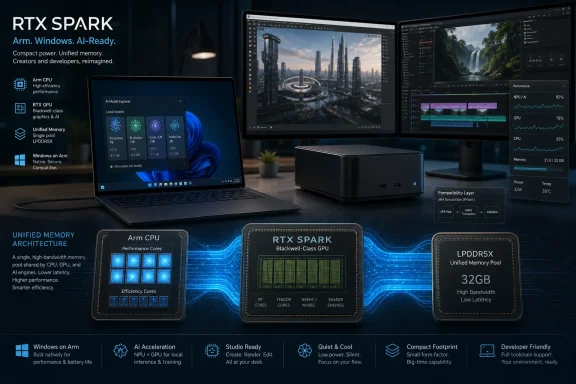
An RTX SPARK laptop and desktop with UI panels showcase Arm CPU, Blackwell-class GPU, and 32GB unified memory.NVIDIA Is Not Selling a Faster Laptop So Much as a New Windows Assumption​

For most of the PC industry, Arm has been a defensive move. Qualcomm’s Snapdragon X chips gave Windows laptops a credible answer to MacBook Air battery life, but they did not make Intel and AMD workstations look conceptually outdated overnight. They proved that Windows could survive away from x86; they did not prove that Windows users should prefer it.
RTX Spark is a different argument. NVIDIA is not arriving with a thin-and-light processor that happens to run Word for a long time. It is arriving with a platform built around the premise that local AI, graphics, media work, and developer workloads want the same thing: a large pool of fast memory that the GPU can actually use.
That is the part that sounds familiar to anyone who watched Apple’s M-series chips reset expectations for the Mac. Apple did not win the early Apple Silicon years simply by moving to Arm. It won by making the whole machine feel designed around a single memory and power model, then forcing macOS and its developers to follow.
Windows has never had that kind of clean break. It has had decades of compatibility, modularity, driver sprawl, OEM experimentation, and the glorious mess that made the PC the PC. RTX Spark does not erase that history, but it does put pressure on Microsoft to make Windows feel less like an x86 operating system that tolerates Arm and more like a platform that can exploit it.

Copilot+ Built the Runway, Even If Its First Flight Was Awkward​

The first wave of Copilot+ PCs was supposed to make AI the reason to buy a new Windows machine. That was always the weakest part of the pitch. Consumers did not line up for neural processing units because they wanted background blur, image generation widgets, or Recall, especially once privacy concerns turned Recall into a symbol of Microsoft’s worst instincts.
But Copilot+ did accomplish something less flashy and more durable. It forced the Windows laptop market to normalize higher baseline specs, better battery life claims, more serious Arm support, and a clearer distinction between old commodity PCs and modern premium machines. A 16GB RAM floor suddenly stopped looking extravagant. Emulation quality became a mainstream buying concern rather than a niche developer complaint.
That matters because RTX Spark is not entering a cold market. It is entering a Windows ecosystem that has already spent two years arguing about Arm compatibility, native apps, NPUs, and the future of local AI. Microsoft’s Prism emulator, whatever its limits, is no longer a footnote. It is part of the Windows sales pitch.
The irony is that the AI features Microsoft used to sell Copilot+ may be less important than the plumbing Copilot+ required. Windows on Arm needed a forcing function. Copilot+ provided one, even if many users never cared about the actual Copilot+ features.
RTX Spark now gives that plumbing a harder test. Running Office, Edge, Slack, and a handful of creative apps is one thing. Convincing power users that an Arm Windows machine can be their main workstation is quite another.

The MacBook Pro Comparison Is Obvious Because the PC Industry Made It Obvious​

The first RTX Spark systems invite comparison to Apple’s MacBook Pro because they are aimed at the same psychological target: the user who wants enormous performance without returning to the era of hot, loud, heavy mobile workstations. Windows has always had powerful laptops, but many of them achieved that power by brute force. They were movable desktops, not elegant portable machines.
Apple Silicon made that bargain look old. A MacBook Pro could be fast, quiet, efficient, and coherent in a way that traditional Windows workstations often were not. The performance did not always beat every discrete GPU laptop in every task, but the overall system experience changed expectations.
NVIDIA’s version of that story is necessarily more complicated. Apple controls the silicon, the OS, the hardware design, and the developer tools. NVIDIA controls an enormous chunk of the GPU software stack, but it still has to work through Microsoft, OEMs, Arm compatibility, Windows driver realities, and the tastes of PC buyers who expect choice.
Still, the broad shape is similar. RTX Spark takes the pieces that made Apple Silicon compelling — Arm CPU cores, integrated GPU horsepower, unified memory, and tight power-management ambitions — and translates them into a Windows world where CUDA, RTX, DLSS, and PC gaming matter.
That is why this is not merely another “AI chip” announcement. NVIDIA is trying to make Windows machines that feel architecturally modern in the same way Apple’s M-series Macs did in 2020 and 2021. The question is whether Windows can become coherent enough to take advantage of that.

Unified Memory Is the Real Product​

The headline specs are easy to recite: up to 20 Arm CPU cores, Blackwell RTX graphics, 6,144 CUDA cores, and up to 128GB of LPDDR5X unified memory. But the memory architecture is the part that changes the conversation. A conventional PC with lots of system RAM and a discrete GPU with separate VRAM is powerful, but it also forces workloads to live across a boundary.
Unified memory weakens that boundary. The GPU can address a much larger shared pool, which is especially attractive for local AI models, large media projects, complex 3D scenes, and development workflows that do not fit neatly into the VRAM capacity of a normal laptop GPU. That does not magically make memory bandwidth infinite, and it does not mean every workload benefits equally. But it gives system designers a different set of compromises.
This is the Apple Silicon lesson NVIDIA clearly absorbed. Apple made unified memory legible to mainstream buyers by tying it to performance, battery life, and the feeling that the computer did not bog down under heavy creative work. NVIDIA is adapting the concept for a Windows audience that cares more about RTX acceleration, CUDA libraries, model size, and application compatibility.
The local AI angle is not marketing fluff here. If users want to run larger models locally, the relevant question is often less “How many TOPS does the NPU have?” and more “How much usable memory can the accelerator reach?” A fast accelerator starved by memory capacity is less useful than a slightly less elegant system that can actually load the model.
That is where RTX Spark differs from the first wave of NPU-centric AI PCs. It is not asking users to care about small OS features that happen to use an NPU. It is giving developers and enthusiasts a reason to run heavy workloads locally and then daring software makers to optimize for it.

The CPU May Be the Least Exciting Part of NVIDIA’s Big Swing​

The awkward detail in NVIDIA’s pitch is that RTX Spark’s CPU cores do not look like the futuristic part of the platform. The configuration associated with NVIDIA’s related DGX Spark hardware uses ten Cortex-X925 cores and ten Cortex-A725 cores. Those are serious Arm cores, but they are not the newest possible CPU story in 2026.
That matters because premium Windows buyers will not judge RTX Spark only against old Intel workstations. They will compare it to Apple’s current M-series systems, Qualcomm’s newest Oryon-based Snapdragon designs, and AMD’s increasingly aggressive Ryzen AI Max chips. NVIDIA can win the GPU and memory argument while still leaving reviewers unimpressed by pure CPU performance per dollar.
That may be acceptable if NVIDIA positions RTX Spark honestly. This is not primarily a CPU platform. It is a GPU-first, memory-first, AI-and-creator workstation platform that happens to use Arm CPU cores. For many target users, that tradeoff may be fine.
But Windows is not macOS, and the PC market punishes imbalance. If RTX Spark systems cost workstation money, buyers will expect workstation competence across the board. Emulated x86 performance, browser responsiveness, compile times, thermals, battery life, game compatibility, driver maturity, and sleep behavior will all be part of the judgment.
The CPU detail also complicates the Apple Silicon analogy. Apple’s transition worked partly because its CPU performance was immediately and visibly strong. NVIDIA may instead be betting that the future of high-end Windows differentiation is less about CPU leadership and more about GPU-accessible memory and accelerated workloads.

Prism Becomes the Compatibility Layer Microsoft Can No Longer Treat as Secondary​

Every serious Windows on Arm conversation eventually comes back to software compatibility. Native Arm applications are ideal, but Windows users do not live in an ideal world. They live in a world of old utilities, corporate agents, game launchers, printer tools, plug-ins, VPN clients, DRM systems, and applications whose developers may not prioritize Arm until enough customers demand it.
Microsoft’s Prism emulator is therefore not a convenience feature. It is the bridge on which this whole strategy depends. If Prism feels invisible for ordinary apps and tolerable for heavier ones, RTX Spark has room to grow. If users repeatedly hit compatibility walls, the platform becomes another promising Windows on Arm experiment remembered mostly by early adopters.
NVIDIA appears to understand this. Reports around RTX Spark have emphasized Microsoft and NVIDIA working together on Windows 11 optimizations, including scheduling, memory management, power management, and emulation behavior. That is precisely the sort of unglamorous work that separates a real platform transition from a spec-sheet stunt.
Gaming is the most visible stress test. Windows on Arm has historically struggled not only with raw performance but with anti-cheat systems, DRM, and middleware that assumes x86. NVIDIA’s claim that major anti-cheat and DRM technologies will work on RTX Spark is important because gamers are often the quickest to expose platform gaps.
Yet the larger audience is enterprise and professional software. A creator can forgive one game not launching. A business cannot forgive a required security agent or line-of-business app failing silently. RTX Spark’s success will depend less on whether Jensen Huang can promise that Windows apps will run and more on whether IT departments can verify that their particular stack behaves predictably.

AMD Is the Rival That Keeps the Story Honest​

It is tempting to frame RTX Spark as NVIDIA versus Apple, but the more immediate Windows competitor may be AMD. Ryzen AI Max and Ryzen AI Max Pro systems already push a similar high-memory, integrated-design idea from the x86 side. AMD’s newer Ryzen AI Max 400 series raises the ceiling to as much as 192GB of unified memory, at least in announced configurations.
That gives AMD a blunt advantage: compatibility. An x86 Windows workstation does not need Prism for legacy Windows software. It does not have to persuade buyers that their old tools will probably work. It can say, with far less qualification, that it is still a Windows PC in the traditional sense.
NVIDIA’s counterargument is GPU software gravity. CUDA remains one of the strongest moats in computing, and NVIDIA’s RTX ecosystem gives developers, researchers, creators, and gamers reasons to accept inconvenience. For many AI and accelerated-computing workloads, the NVIDIA logo is not cosmetic. It is the difference between fighting the stack and using the stack.
This is where the Windows market gets interesting. AMD can offer a more conservative path to unified-memory workstations. NVIDIA can offer the more disruptive path, with Arm efficiency ambitions and a GPU ecosystem that many target users already prefer. Microsoft benefits if both approaches force Windows to become better at heterogeneous computing.
The danger for NVIDIA is price. If RTX Spark systems start around the territory suggested by DGX Spark-class hardware, they will not be mainstream premium PCs. They will be expensive specialist machines. At that point, AMD does not need to beat NVIDIA in every benchmark; it only needs to offer enough performance and memory with fewer compatibility anxieties.

This Is an AI PC for People Who Actually Use AI​

The phrase “AI PC” has been abused into near uselessness. For much of the Copilot+ cycle, it meant a laptop with an NPU powerful enough to satisfy a Microsoft requirement and run a few local effects. That was not nothing, but it rarely justified the breathless language around a new era of computing.
RTX Spark is more credible because it targets users already changing their workflows around local models, agents, code assistants, media generation, and accelerated experimentation. These users do not need to be convinced that local AI can matter. They need machines that can hold larger models, run them acceptably, and integrate them into real work without sending everything to a cloud endpoint.
That distinction is crucial. Microsoft tried to sell AI as an operating-system experience first. NVIDIA is selling it as a capability layer for people who already know what they want to run. The former depends on mass-market delight. The latter depends on giving a smaller group of high-value users enough headroom to justify the cost.
Developers are the obvious audience. A local box with a large unified memory pool and NVIDIA acceleration could be attractive for testing agents, prototyping inference workflows, building AI-assisted applications, or working offline with models that would otherwise require a cloud bill. It will not replace large training clusters, but that is not the point.
Creators are the second audience. Video editing, visual effects, 3D rendering, generative tools, and game-development workflows all benefit from reducing friction between CPU, GPU, and memory. If RTX Spark laptops can deliver that without turning into jet engines, they will have a real story beyond AI buzzwords.
The third audience is enthusiasts, and they may be the loudest. These are the people who buy too much RAM, run local models for fun, compile things overnight, and treat hardware limits as personal insults. They will also be the first to discover whether RTX Spark is a platform or a promise.

The Enterprise Case Is Powerful, but Not Automatic​

For enterprise IT, RTX Spark presents an appealing but uncomfortable proposition. Local AI has obvious advantages: lower latency, better data locality, reduced dependency on cloud inference, and potentially stronger control over sensitive workflows. A portable workstation that can run meaningful models locally could be useful in engineering, design, security, finance, healthcare, and software development.
But enterprise adoption is not driven by theoretical capability alone. IT teams will ask whether management tools work, whether endpoint security vendors support the platform, whether VPN clients behave, whether drivers are stable, and whether Arm compatibility creates a new class of help-desk tickets. The more expensive the device, the less patience there is for science-project behavior.
Microsoft has a strong incentive to make this work. Windows cannot afford to look like the platform of yesterday while macOS owns the efficiency narrative and Linux dominates much of the AI infrastructure conversation. RTX Spark gives Microsoft a chance to show that Windows can be the best local AI workstation environment, not merely the default corporate desktop.
NVIDIA also has a strong enterprise story, but it is not identical to Microsoft’s. NVIDIA wants local RTX systems to sit naturally within its broader AI ecosystem, from developer tools to data-center workflows. A Spark-class Windows machine could become a front-end development node for projects that later scale to larger NVIDIA infrastructure.
That vision is persuasive. It also depends on execution. Enterprises have long memories for platform transitions that promised simplicity and delivered edge cases. If RTX Spark is to become more than a halo product, Microsoft, NVIDIA, and OEMs will need to make deployment feel boring.

The Price Will Decide Whether This Is a Revolution or a Showcase​

The most sobering part of the RTX Spark story is cost. NVIDIA’s DGX Spark-class machine has lived in a price band closer to professional workstations than consumer laptops. If early RTX Spark PCs land around several thousand dollars, the first wave will belong to developers, creators, researchers, enthusiasts, and companies with clear use cases.
That does not make the platform unimportant. Apple’s early high-end Apple Silicon systems also served as proof points for a broader transition. Expensive machines can set expectations that later trickle down into more accessible products. The question is whether NVIDIA and its partners can move quickly enough from halo hardware to systems normal premium buyers can consider.
There is reason for skepticism. The PC industry has a habit of announcing beautiful, expensive reference-class machines that win awards and then disappear into procurement niches. Supply constraints, memory pricing, OEM caution, and software compatibility can all turn a bold platform into a boutique category.
There is also reason for optimism. NVIDIA has the market power to pull developers toward its hardware. Microsoft has strategic reasons to improve Windows on Arm. OEMs are desperate for a premium story that is not just another Intel or AMD refresh. And users who have watched Apple enjoy years of efficiency leadership may be ready for Windows hardware that feels equally ambitious.
The likely path is uneven. First-generation RTX Spark systems will be expensive, scrutinized, and sometimes frustrating. They will also show whether the unified-memory Windows workstation idea has legs. If the answer is yes, cheaper derivatives and more refined designs could matter far more than the launch machines themselves.

The Real Test Is Whether Windows Learns From the Hardware​

Hardware transitions fail when the operating system treats them as accessories. Windows has spent decades thriving precisely because it abstracts hardware variety, but that strength can become a weakness when a new architecture needs deeper coordination. Apple Silicon worked because macOS, the chips, and the developer ecosystem moved together.
Microsoft does not have Apple’s control, and it should not pretend otherwise. The Windows ecosystem’s diversity is a feature, not a bug. But RTX Spark requires Microsoft to become more opinionated about scheduling, emulation, power states, memory behavior, GPU acceleration, and native Arm development.
That work can benefit more than RTX Spark. Improvements made for Arm scheduling, Prism compatibility, and heterogeneous memory management could help Qualcomm systems, future Arm PCs, and even x86 machines with increasingly complex CPU-GPU-NPU designs. The PC is becoming less like a CPU with peripherals and more like a collection of specialized engines sharing work.
This is where the “Apple Silicon moment” phrase is useful but incomplete. Windows does not need to become macOS. It needs its own transition, one that preserves compatibility while making new hardware feel native rather than bolted on. RTX Spark may be the first Windows on Arm platform powerful enough to make that demand impossible to ignore.
The burden is not only on Microsoft. Developers need incentives to ship native Arm versions, optimize for RTX acceleration, and test real-world workflows instead of assuming emulation will cover everything. OEMs need to build machines that justify their prices with thermals, battery life, displays, keyboards, ports, and reliability. NVIDIA needs to make the driver and software story feel as mature as the spec sheet sounds.
If any one of those pieces fails, RTX Spark becomes a niche curiosity. If enough of them work, it becomes a forcing function for the next decade of Windows PC design.

The Spark Era Will Be Judged by the Boring Details​

The first wave of coverage will focus on benchmarks, model sizes, battery charts, and whether these systems can beat a MacBook Pro in a particular creator workload. Those numbers will matter. But the platform’s fate will be decided by daily irritations or the absence of them.
A true workstation does not merely run a demo. It wakes reliably, connects to docks, supports weird peripherals, survives driver updates, runs security tools, handles browser tabs without drama, and lets users forget the architecture underneath. Apple Silicon’s great triumph was not just speed; it was making the transition feel less disruptive than expected.
RTX Spark has to do something harder because Windows users have more varied expectations. A Windows workstation might be asked to run Adobe apps, Visual Studio, Blender, Docker workflows, obscure USB hardware, Steam, corporate VPN software, and a ten-year-old utility that no one has updated because it still works. That is the ecosystem NVIDIA is entering.
The encouraging sign is that Microsoft and NVIDIA appear to be treating compatibility as a platform problem rather than a footnote. The worrying sign is that Windows history is full of platform problems that took years to smooth out. Early adopters should expect progress, not perfection.
The best-case scenario is not that every Windows PC suddenly becomes Arm-based. That is neither realistic nor necessary. The best-case scenario is that RTX Spark proves there is a high-end Windows market for Arm systems when the GPU, memory, and software stack are compelling enough.

A Windows Workstation Future Is Starting to Look Less x86-Certain​

The most concrete lesson of RTX Spark is that x86 no longer owns the definition of a serious Windows PC. Qualcomm pushed that idea into ultraportables. NVIDIA is pushing it toward workstations. AMD, meanwhile, is defending x86 by adopting some of the same system-level ideas that made Arm-based competitors so disruptive.
That is a healthy fight. For years, Windows hardware progress often felt incremental: thinner chassis, newer CPUs, better screens, slightly improved battery life. The rise of unified-memory, accelerator-heavy systems makes the next phase more architectural. The interesting question is not just which chip is faster, but which design lets the whole computer do work that used to require a desk full of compromises.
The near-term winners will be users whose workloads map cleanly onto the hardware. Local AI developers, model tinkerers, video professionals, 3D creators, and GPU-dependent programmers have the clearest reasons to care. Mainstream buyers should wait for prices, reviews, software compatibility reports, and second-generation hardware.
The strategic winner, if Microsoft plays this well, could be Windows itself. A Windows ecosystem with credible Arm ultraportables, NVIDIA-powered unified-memory workstations, and AMD x86 systems fighting on similar design terrain is more interesting than one still arguing about whether Arm is viable. RTX Spark does not settle that argument. It raises the cost of ignoring it.

The First Spark Machines Will Tell Us More Than the Launch Slides​

The launch narrative is compelling, but the first shipping systems will expose the truth quickly. A platform like this cannot hide behind synthetic AI demos forever. Reviewers and early buyers will test the uncomfortable stuff: emulated app performance, battery drain under mixed workloads, heat under sustained GPU use, native Arm app gaps, game compatibility, and whether 128GB of unified memory behaves as usefully as NVIDIA implies.
The Surface Ultra and ASUS ProArt-style systems are especially important because they define the category’s tone. If they feel like elegant workstations, RTX Spark gets to borrow some of the emotional space Apple created with the MacBook Pro. If they feel like expensive prototypes, the market will retreat to safer x86 machines and cloud GPUs.
This is also why pricing matters so much. A $4,000-class machine can be forgiven for being specialized, but not for feeling unfinished. At that level, buyers are not purchasing potential. They are purchasing a tool.
Still, first-generation roughness would not invalidate the concept. The original Apple Silicon Macs were not the complete expression of Apple’s plan; they were the proof that the plan was real. RTX Spark’s job is similar. It must prove that Windows on Arm can be more than efficient, and that NVIDIA’s memory-rich GPU-first design can justify the disruption.

The Specs That Matter Are the Ones Users Will Feel​

RTX Spark’s most important numbers are not just there for benchmark tables. They define which buyers should pay attention and which should wait.
  • RTX Spark systems are expected to pair Arm CPU cores with Blackwell-class RTX graphics and up to 128GB of unified LPDDR5X memory.
  • The platform’s strongest case is for local AI, creator, developer, and GPU-heavy workloads that benefit from large memory pools accessible to the accelerator.
  • Legacy Windows compatibility will depend heavily on Microsoft’s Prism emulator, native Arm app momentum, and vendor support for drivers, security tools, anti-cheat systems, and professional plug-ins.
  • AMD’s Ryzen AI Max family gives Windows buyers a less disruptive x86 alternative with unified-memory ambitions of its own, including announced configurations reaching up to 192GB.
  • Early RTX Spark machines are likely to be expensive halo systems, so the broader impact depends on whether NVIDIA and OEMs can turn the architecture into cheaper, more mainstream designs.
RTX Spark is not guaranteed to give Windows its Apple Silicon moment, but it is the first Windows on Arm effort that makes the comparison feel more than aspirational. If Microsoft uses it to harden Windows for Arm, if NVIDIA delivers the software maturity its audience expects, and if OEMs avoid turning the first systems into overpriced curiosities, the Windows PC could finally move from imitating Apple’s transition to staging one of its own.

References​

  1. Primary source: Engadget
    Published: Fri, 05 Jun 2026 12:00:00 GMT
  2. Related coverage: tomshardware.com
  3. Related coverage: windowscentral.com
  4. Related coverage: pcgamer.com
  5. Related coverage: axios.com
  6. Related coverage: nvidia.com
  1. Related coverage: digitaltrends.com
  2. Related coverage: windowslatest.com
  3. Related coverage: wccftech.com
  4. Related coverage: docs.nvidia.com
  5. Related coverage: signal65.com
 

Back
Top