

Microsoft and Nvidia used Computex 2026 in Taipei to unveil RTX Spark, a Windows-on-Arm PC platform built around a 20-core Arm CPU, Blackwell-class Nvidia graphics, up to 128GB of unified memory, and fall-2026 systems from Microsoft Surface, Asus, Dell, HP, Lenovo, MSI, Acer, and Gigabyte. The headline is not merely that Surface is getting Nvidia silicon again. It is that Nvidia is trying to move its AI workstation stack from deskside Linux boxes into premium Windows laptops. If it works, the first serious challenger to Apple’s unified-memory MacBook Pro model may come not from Intel, AMD, or Qualcomm, but from a company best known for selling GPUs to everyone else.
RTX Spark is the consumer-facing descendant of Nvidia’s Grace Blackwell workstation push: a single package combining a Grace-derived Arm CPU, a Blackwell GPU, and a large shared memory pool. Nvidia rates the platform at up to 1 petaflop of AI compute and says the top configurations can run 120-billion-parameter models locally with very large context windows. That is the sort of claim that would have sounded absurd for a laptop pitch a few years ago, when “AI PC” mostly meant a modest NPU and a handful of camera effects.
The interesting part is the memory, not the marketing number. A conventional gaming laptop can have a fast GPU, but its VRAM ceiling determines what it can actually load. RTX Spark’s unified memory model is meant to let the CPU and GPU draw from the same pool, which is why 128GB matters more here than the raw comparison to an RTX 5070-class CUDA core count.
That puts Nvidia closer to Apple’s architectural argument than to the usual Windows gaming-laptop arms race. Apple Silicon normalized the idea that creators and developers would pay for tightly integrated CPU, GPU, NPU, media engines, and unified memory if the software stack made it feel coherent. Nvidia’s wager is that Windows users want that same class of integration, but with CUDA, TensorRT, RTX, DLSS, OptiX, and the broader Nvidia developer ecosystem attached.
There is also a strategic twist. Qualcomm spent the last few years making Windows on Arm plausible for mainstream laptops. Nvidia is now trying to make it aspirational at the top end.
That matters because Surface has history here. The original Surface RT, powered by Nvidia Tegra silicon in 2012, helped sour an entire generation of users on Windows on Arm. It was underpowered, confusingly limited, and trapped between the expectations of Windows users and the realities of a new architecture. The Surface Laptop Ultra is, in a sense, Microsoft returning to the scene of the crime with a much bigger engine and a much better story.
The hardware pitch is clearly aimed above the current Surface Laptop line. The 15-inch mini-LED PixelSense Ultra display, quoted at 2,880 x 1,920 and up to 2,000 nits peak HDR brightness, is a deliberately premium panel choice. Mini-LED also lets Microsoft chase high brightness without stepping directly into the OLED burn-in anxieties that still make some productivity users cautious.
The rest of the design sounds unusually practical for a modern Surface: HDMI, USB-C, USB-A, a full-size SD card slot, and a headphone jack. That port selection is not glamorous, but it is telling. Microsoft is pitching this at people who connect cameras, displays, cards, audio gear, and external storage, not just people who live inside Teams and a browser.
The missing details are just as important. Microsoft has not yet disclosed pricing, storage configurations, battery capacity, or the full spread of performance tiers. A 128GB unified-memory Surface with Nvidia silicon and a mini-LED HDR display is unlikely to be inexpensive. The real question is whether Microsoft can make the lower configurations feel like real creator machines rather than expensive entry points into a platform whose best features require the top SKU.
The ProArt P16 looks like the flagship: a 16-inch-class creator notebook with a 4K 120Hz Lumina Pro OLED panel, variable refresh, G-Sync, 100 percent DCI-P3 coverage, Pantone validation, and Delta E under 1 color accuracy claims. The smaller P14 steps down to a 3K 120Hz panel but keeps the same creator logic. These are not commodity screens attached to a speculative chip; they are the sort of panels buyers expect in machines meant to compete with MacBook Pros and high-end Windows creator laptops.
The physical numbers also make the platform feel less theoretical. Asus says the P16 is 12.9mm thick and weighs 1.77kg with a 99.9Wh battery, while the P14 is 13.9mm and 1.48kg with a 90Wh battery. If those figures survive shipping hardware, Nvidia’s Arm platform will not be confined to hulking mobile workstations.
Connectivity is equally deliberate: multiple USB-C ports, USB-A, HDMI 2.1, a full-size SD card reader, a headphone jack, and Wi-Fi 7. For all the talk about local AI, these systems still have to function as professional laptops. A creator notebook without an SD card reader is a fashion statement; Asus seems to understand that this launch cannot afford too many fashion statements.
The ProArt Mini PC may be even more strategically revealing. A compact box with up to 128GB unified memory, expandable NVMe storage, four USB-C ports, HDMI, and 10Gb Ethernet makes RTX Spark less dependent on laptop thermals and battery-life promises. It also gives Nvidia and Asus a Mac Studio-shaped target: a small, quiet, high-memory machine for developers and creators who want local AI horsepower without buying a rackmount workstation or living in the cloud.
That branding choice is bold. XPS has historically meant Dell’s premium consumer and prosumer PC identity: high-end displays, thin designs, and a certain mainstream polish. Using it for RTX Spark suggests Dell does not want this platform seen only as a developer oddity or a portable AI lab. It wants it treated as a top-tier creative Windows laptop.
The confirmed details are sparse but pointed. Dell is talking about a 16-inch tandem OLED display with True Black HDR 600 certification, up to 128GB unified memory, HDMI, and an SD card reader. The workload claims are equally familiar: 4K 4:2:2 timeline playback, faster exports, and 3D work that would overwhelm thinner systems.
The unknowns remain the problem. Dell has not disclosed storage tiers, battery size, price, or the full shape of the configuration stack. Without those, the XPS 16 Creator Edition is more promise than product. But the mere fact that Dell is using XPS for the first Nvidia Arm Windows platform tells us where the company thinks the opening is: not budget AI PCs, but premium creative laptops where buyers already accept high prices if the workflow improvement is real.
Dell’s unnamed small-form-factor desktop is even more tentative. It appears to be a concept rather than a locked product, with a small square chassis, mesh sides, front USB-C ports, and an SD card slot. Still, it signals that Dell sees RTX Spark as a desktop opportunity too. That makes sense: Dell already has experience with GB10-class compact workstations, and a Windows version could reach buyers who would never consider a Linux-based AI box.
What HP has not disclosed is more revealing: display specifications, storage, battery capacity, ports, weight, pricing, and most configuration details. The systems support the platform’s broader claims, including local large-model inference in 128GB configurations and high-end video workflows, but HP is still withholding the sort of data that lets buyers compare machines seriously.
That may simply reflect timing. Computex launches often arrive before final SKUs are ready, and OEMs sometimes prefer to reveal exact configurations closer to retail availability. But RTX Spark is not a normal spec bump. The platform asks buyers to trust a new CPU architecture, a new class of Windows-on-Arm performance, and a premium Nvidia integration story. Thinness alone will not carry that burden.
HP’s compact RTX Spark desktop is similarly under wraps. The company already has experience building a tiny GB10-based AI station, so the desktop path is credible. But for now, HP’s presence in the RTX Spark launch feels more like a marker on Nvidia’s partner slide than a fully formed product argument.
The Yoga Pro 9n follows the premium creator-laptop formula with a 15-inch display, aluminum chassis, top-firing speakers, backlit keyboard, HDMI, SD card support, and a large trackpad with pen input. The top configuration reaches the full 20-core RTX Spark chip and 128GB unified memory. Lenovo is also promising all-day battery life, though without a number attached, that phrase remains more positioning than measurement.
The pen-capable trackpad is a curious but fitting detail. Creator machines often struggle to reconcile laptop ergonomics with sketching, masking, annotation, and timeline work. If Lenovo can make pen input feel natural without forcing a full convertible design, it may have a small but meaningful differentiator.
The broader significance is that Lenovo already participates in the GB10 workstation world. Moving similar capabilities into a Yoga-branded Windows laptop brings the idea out of the lab and into the premium consumer channel. That is exactly the transition Nvidia wants: from AI workstation to aspirational PC.
The upside is obvious. Digital artists, designers, and creative professionals often have to choose between strong GPU performance and flexible pen-input hardware. A convertible with a color-accurate, high-brightness OLED display and serious local AI capability could be unusually compelling if the weight, thermals, and hinge behavior are right.
The risk is just as obvious. Convertibles live or die on physical compromises. A 16-inch device can become awkward in tablet mode, and high-performance silicon can make heat and battery life harder to manage. MSI is taking the most interesting swing here, but also the one most likely to need hands-on proof.
The EdgeMesa N AI+ mini PC is a different kind of bet. MSI is pitching it less as a creator desktop and more as an edge-AI deployment machine for healthcare, retail, finance, robotics, and smart-city environments. The emphasis on 10Gb Ethernet, multiple displays, and compact deployment makes it the clearest sign that RTX Spark is not only a laptop story. Nvidia wants the same silicon family to reach desks, studios, kiosks, labs, and edge nodes.
Asus chose ProArt, not ROG. Dell chose XPS, not Alienware. MSI chose Prestige, not Raider or Titan. Lenovo chose Yoga, not Legion. HP chose OmniBook, not Omen. That is not an accident; it is a collective decision by the OEMs to put RTX Spark first in creator and AI machines rather than gaming laptops.
There are two plausible reasons. The charitable interpretation is that the first wave targets buyers most likely to pay for 128GB unified memory and CUDA in a portable machine. Creators, developers, researchers, and AI tinkerers can justify high prices in ways mainstream gamers may not.
The less charitable interpretation is that Windows-on-Arm gaming still carries enough uncertainty that no one wants to sell this as a gaming platform first. Prism emulation has improved, but compatibility layers, anti-cheat systems, drivers, launchers, overlays, and legacy software are all part of the PC gaming experience. A game that runs well in a controlled demo is not the same thing as a Steam library that behaves predictably for millions of users.
That does not mean RTX Spark cannot game. It means the OEMs appear to know where the day-one risk is. Creator apps and AI frameworks can be optimized, curated, and marketed around known workloads. PC gaming is messier, louder, and less forgiving.
For Windows enthusiasts, this is the uncomfortable familiar part. Windows succeeds because it carries decades of software forward. That inheritance is also why architecture transitions are so hard. Apple could force developers and users through a tightly managed transition because it controls the hardware, operating system, and much of the developer story. Microsoft has a broader ecosystem, which is both its moat and its burden.
The good news is that RTX Spark is not trying to rely on Arm purity. Nvidia brings CUDA, RTX, TensorRT, OptiX, DLSS, and a familiar developer ecosystem that already matters to AI and creative software. If the apps people care about are native or properly accelerated, the platform can feel less like an emulation gamble and more like a specialist workstation with a compatibility fallback.
The bad news is that Windows users tend to have long tails of old utilities, drivers, plug-ins, VPN clients, printer packages, capture tools, and line-of-business software. Enterprise IT knows this pain intimately. A laptop can be astonishingly fast in Blender, DaVinci Resolve, PyTorch, or local inference and still fail a corporate rollout because one security agent or peripheral driver does not cooperate.
That is why Microsoft’s own Surface involvement matters. Surface Laptop Ultra is not just a product; it is Microsoft accepting responsibility for the experience. If Prism, drivers, Windows Update, firmware, and Nvidia’s stack do not behave, the blame will not stop at Nvidia.
Apple has owned that story for years. A fully loaded MacBook Pro is expensive, but the pitch is coherent. You get long battery life, strong displays, excellent media engines, quiet performance, and a software ecosystem that increasingly treats Apple Silicon as the default.
Windows has struggled to answer that with equal clarity. Intel and AMD laptops can be fast, but high-performance discrete GPUs often mean heat, battery trade-offs, and separate VRAM limits. Qualcomm’s Snapdragon X machines helped with battery life and thinness, but they did not bring Nvidia’s graphics and CUDA stack. RTX Spark tries to combine the pieces Windows buyers have wanted in one machine.
The price will be decisive. Top-end RTX Spark systems are unlikely to be remotely cheap, and 128GB unified memory will almost certainly be a premium configuration. If vendors price these machines like mobile workstations, they will need to deliver workstation confidence. If they price them like MacBook Pro competitors, they will need to deliver MacBook Pro polish.
The first generation may therefore be less about mass adoption than proof. Nvidia, Microsoft, and the OEMs need to show that Windows on Arm can be more than thin-and-light efficiency hardware. They need to show it can be the best Windows experience for people who do demanding local work.
For developers, 128GB unified memory can change what is practical on a personal machine. Local prototyping, model evaluation, retrieval-augmented workflows, code assistants, fine-tuning experiments, and agentic systems all become more plausible when the machine has enough memory to avoid immediately offloading the serious work elsewhere. The cloud still matters, but the laptop becomes a credible first workstation rather than a thin client with a nice screen.
For creators, the AI story overlaps with existing workflows. Video upscaling, transcription, object masking, generative fill, image generation, 3D asset work, denoising, and timeline acceleration are all more compelling when they happen locally and predictably. The platform’s success will depend on whether Adobe, Blackmagic, Autodesk, Blender, game engines, local model tools, and open-source frameworks make the hardware feel broadly useful rather than narrowly impressive.
For sysadmins and security-minded buyers, local AI has another angle: data governance. Sending source code, legal documents, medical notes, financial files, or internal recordings to external model providers can be a policy problem. A powerful local box does not solve governance by itself, but it gives organizations another architecture option.
That is why the mini PCs may matter as much as the laptops. A small RTX Spark desktop with 10Gb Ethernet and 128GB unified memory can sit in a lab, studio, small office, classroom, or edge environment and provide local inference without becoming a full server project. In some organizations, that may be easier to approve than cloud spending that scales unpredictably with usage.
The partner list also supports the platform argument. Microsoft Surface, Asus, Dell, HP, Lenovo, and MSI are in the first wave, with Acer and Gigabyte expected to follow. Nvidia says more than 30 laptops and 10 desktops are in the pipeline. Even allowing for Computex optimism, that is more than a science project.
But platform credibility requires more than logos. It requires shipping machines, stable drivers, predictable performance, clear configuration tiers, and a software story that survives contact with real users. Windows enthusiasts have seen too many promising hardware ideas arrive with caveats that only become obvious after launch.
Pricing is the first unknown. If the entry-level systems are constrained enough that they cannot run the workloads Nvidia is using to sell the platform, the story gets muddy. If the 128GB machines cost workstation money, the buyers will expect workstation reliability. Nvidia and Microsoft cannot lean forever on the excitement of local AI; by fall, the question will be whether these machines are worth their invoices.
Battery life is the second unknown. Arm efficiency is part of the pitch, but RTX Spark systems are not Snapdragon ultraportables. They are high-performance creator and AI machines with large displays and serious GPU resources. “All-day battery” is a phrase that needs independent testing, especially under mixed native and emulated workloads.
The third unknown is thermals. A compact laptop can advertise the same platform name as a mini PC, but sustained performance may differ dramatically. The mini desktops may become the more honest expression of RTX Spark’s AI ambitions, while laptops become the flexible but thermally constrained versions. That would not be a failure, but it would complicate the simple “MacBook Pro rival” story.
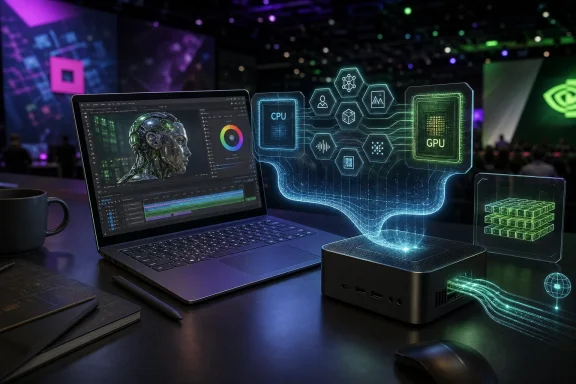 Nvidia Turns the Windows Laptop Into a Local AI Workstation
RTX Spark is the consumer-facing descendant of Nvidia’s Grace Blackwell workstation push: a single package combining a Grace-derived Arm CPU, a Blackwell GPU, and a large shared memory pool. Nvidia rates the platform at up to 1 petaflop of AI compute and says the top configurations can run 120-billion-parameter models locally with very large context windows. That is the sort of claim that would have sounded absurd for a laptop pitch a few years ago, when “AI PC” mostly meant a modest NPU and a handful of camera effects.The interesting part is the memory, not the marketing number. A conventional gaming laptop can have a fast GPU, but its VRAM ceiling determines what it can actually load. RTX Spark’s unified memory model is meant to let the CPU and GPU draw from the same pool, which is why 128GB matters more here than the raw comparison to an RTX 5070-class CUDA core count.
That puts Nvidia closer to Apple’s architectural argument than to the usual Windows gaming-laptop arms race. Apple Silicon normalized the idea that creators and developers would pay for tightly integrated CPU, GPU, NPU, media engines, and unified memory if the software stack made it feel coherent. Nvidia’s wager is that Windows users want that same class of integration, but with CUDA, TensorRT, RTX, DLSS, OptiX, and the broader Nvidia developer ecosystem attached.
There is also a strategic twist. Qualcomm spent the last few years making Windows on Arm plausible for mainstream laptops. Nvidia is now trying to make it aspirational at the top end.
Surface Becomes the Proof Point Microsoft Needed
The Surface Laptop Ultra is the symbolic center of the launch because Microsoft rarely lets Surface be merely another OEM design. When Microsoft calls it the most powerful Surface it has ever made, the company is not only selling a laptop; it is putting its own hardware brand behind Nvidia’s version of the Windows-on-Arm future.That matters because Surface has history here. The original Surface RT, powered by Nvidia Tegra silicon in 2012, helped sour an entire generation of users on Windows on Arm. It was underpowered, confusingly limited, and trapped between the expectations of Windows users and the realities of a new architecture. The Surface Laptop Ultra is, in a sense, Microsoft returning to the scene of the crime with a much bigger engine and a much better story.
The hardware pitch is clearly aimed above the current Surface Laptop line. The 15-inch mini-LED PixelSense Ultra display, quoted at 2,880 x 1,920 and up to 2,000 nits peak HDR brightness, is a deliberately premium panel choice. Mini-LED also lets Microsoft chase high brightness without stepping directly into the OLED burn-in anxieties that still make some productivity users cautious.
The rest of the design sounds unusually practical for a modern Surface: HDMI, USB-C, USB-A, a full-size SD card slot, and a headphone jack. That port selection is not glamorous, but it is telling. Microsoft is pitching this at people who connect cameras, displays, cards, audio gear, and external storage, not just people who live inside Teams and a browser.
The missing details are just as important. Microsoft has not yet disclosed pricing, storage configurations, battery capacity, or the full spread of performance tiers. A 128GB unified-memory Surface with Nvidia silicon and a mini-LED HDR display is unlikely to be inexpensive. The real question is whether Microsoft can make the lower configurations feel like real creator machines rather than expensive entry points into a platform whose best features require the top SKU.
Asus Shows What a Finished RTX Spark Laptop Might Look Like
Among the first wave, Asus appears to have brought the most complete product story. The ProArt P16 and ProArt P14 fit naturally into the company’s creator line, which already targets video editors, designers, photographers, and 3D artists rather than esports buyers. That makes them an obvious home for RTX Spark’s blend of AI memory capacity, Nvidia software support, and premium display hardware.The ProArt P16 looks like the flagship: a 16-inch-class creator notebook with a 4K 120Hz Lumina Pro OLED panel, variable refresh, G-Sync, 100 percent DCI-P3 coverage, Pantone validation, and Delta E under 1 color accuracy claims. The smaller P14 steps down to a 3K 120Hz panel but keeps the same creator logic. These are not commodity screens attached to a speculative chip; they are the sort of panels buyers expect in machines meant to compete with MacBook Pros and high-end Windows creator laptops.
The physical numbers also make the platform feel less theoretical. Asus says the P16 is 12.9mm thick and weighs 1.77kg with a 99.9Wh battery, while the P14 is 13.9mm and 1.48kg with a 90Wh battery. If those figures survive shipping hardware, Nvidia’s Arm platform will not be confined to hulking mobile workstations.
Connectivity is equally deliberate: multiple USB-C ports, USB-A, HDMI 2.1, a full-size SD card reader, a headphone jack, and Wi-Fi 7. For all the talk about local AI, these systems still have to function as professional laptops. A creator notebook without an SD card reader is a fashion statement; Asus seems to understand that this launch cannot afford too many fashion statements.
The ProArt Mini PC may be even more strategically revealing. A compact box with up to 128GB unified memory, expandable NVMe storage, four USB-C ports, HDMI, and 10Gb Ethernet makes RTX Spark less dependent on laptop thermals and battery-life promises. It also gives Nvidia and Asus a Mac Studio-shaped target: a small, quiet, high-memory machine for developers and creators who want local AI horsepower without buying a rackmount workstation or living in the cloud.
Dell Revives XPS for a Very Un-Intel Moment
Dell’s XPS 16 Creator Edition is notable partly because of what it is not. It is not Alienware, not a Precision workstation, and not one of Dell’s short-lived naming experiments. It is XPS, a brand Dell tried to retire and then brought back, now attached to an Arm-based Nvidia platform that breaks with decades of Intel-centered expectations.That branding choice is bold. XPS has historically meant Dell’s premium consumer and prosumer PC identity: high-end displays, thin designs, and a certain mainstream polish. Using it for RTX Spark suggests Dell does not want this platform seen only as a developer oddity or a portable AI lab. It wants it treated as a top-tier creative Windows laptop.
The confirmed details are sparse but pointed. Dell is talking about a 16-inch tandem OLED display with True Black HDR 600 certification, up to 128GB unified memory, HDMI, and an SD card reader. The workload claims are equally familiar: 4K 4:2:2 timeline playback, faster exports, and 3D work that would overwhelm thinner systems.
The unknowns remain the problem. Dell has not disclosed storage tiers, battery size, price, or the full shape of the configuration stack. Without those, the XPS 16 Creator Edition is more promise than product. But the mere fact that Dell is using XPS for the first Nvidia Arm Windows platform tells us where the company thinks the opening is: not budget AI PCs, but premium creative laptops where buyers already accept high prices if the workflow improvement is real.
Dell’s unnamed small-form-factor desktop is even more tentative. It appears to be a concept rather than a locked product, with a small square chassis, mesh sides, front USB-C ports, and an SD card slot. Still, it signals that Dell sees RTX Spark as a desktop opportunity too. That makes sense: Dell already has experience with GB10-class compact workstations, and a Windows version could reach buyers who would never consider a Linux-based AI box.
HP Is Selling Thinness Before It Sells the Computer
HP brought the OmniBook Ultra 16 and OmniBook X 14, but its RTX Spark story is the least complete of the major laptop vendors. The company is emphasizing thinness, calling the machines the world’s thinnest RTX Spark systems, with the X 14 measuring 13.53mm at the rear and the Ultra 16 at 15.73mm. That claim will need careful comparison once shipping models exist, because vendors often measure thickness in slightly different ways.What HP has not disclosed is more revealing: display specifications, storage, battery capacity, ports, weight, pricing, and most configuration details. The systems support the platform’s broader claims, including local large-model inference in 128GB configurations and high-end video workflows, but HP is still withholding the sort of data that lets buyers compare machines seriously.
That may simply reflect timing. Computex launches often arrive before final SKUs are ready, and OEMs sometimes prefer to reveal exact configurations closer to retail availability. But RTX Spark is not a normal spec bump. The platform asks buyers to trust a new CPU architecture, a new class of Windows-on-Arm performance, and a premium Nvidia integration story. Thinness alone will not carry that burden.
HP’s compact RTX Spark desktop is similarly under wraps. The company already has experience building a tiny GB10-based AI station, so the desktop path is credible. But for now, HP’s presence in the RTX Spark launch feels more like a marker on Nvidia’s partner slide than a fully formed product argument.
Lenovo Makes the Creator Laptop an Nvidia Laptop
Lenovo’s Yoga Pro 9n is one of the clearer statements of intent in the lineup. The “n” appears to mean Nvidia, distinguishing it from the Intel-based Yoga Pro 9i. That simple naming move says a lot: Lenovo is treating Nvidia as a platform identity, not just a GPU supplier hiding behind the specs sheet.The Yoga Pro 9n follows the premium creator-laptop formula with a 15-inch display, aluminum chassis, top-firing speakers, backlit keyboard, HDMI, SD card support, and a large trackpad with pen input. The top configuration reaches the full 20-core RTX Spark chip and 128GB unified memory. Lenovo is also promising all-day battery life, though without a number attached, that phrase remains more positioning than measurement.
The pen-capable trackpad is a curious but fitting detail. Creator machines often struggle to reconcile laptop ergonomics with sketching, masking, annotation, and timeline work. If Lenovo can make pen input feel natural without forcing a full convertible design, it may have a small but meaningful differentiator.
The broader significance is that Lenovo already participates in the GB10 workstation world. Moving similar capabilities into a Yoga-branded Windows laptop brings the idea out of the lab and into the premium consumer channel. That is exactly the transition Nvidia wants: from AI workstation to aspirational PC.
MSI Bets That RTX Spark Can Bend
MSI’s Prestige N16 Flip AI+ is the form-factor wildcard. It is the only announced RTX Spark convertible so far, and that alone makes it worth watching. A 16-inch 2-in-1 with a tandem OLED display, pen support, a 99.9Wh battery, and Nvidia’s high-memory local-AI platform is not a common object in the PC market.The upside is obvious. Digital artists, designers, and creative professionals often have to choose between strong GPU performance and flexible pen-input hardware. A convertible with a color-accurate, high-brightness OLED display and serious local AI capability could be unusually compelling if the weight, thermals, and hinge behavior are right.
The risk is just as obvious. Convertibles live or die on physical compromises. A 16-inch device can become awkward in tablet mode, and high-performance silicon can make heat and battery life harder to manage. MSI is taking the most interesting swing here, but also the one most likely to need hands-on proof.
The EdgeMesa N AI+ mini PC is a different kind of bet. MSI is pitching it less as a creator desktop and more as an edge-AI deployment machine for healthcare, retail, finance, robotics, and smart-city environments. The emphasis on 10Gb Ethernet, multiple displays, and compact deployment makes it the clearest sign that RTX Spark is not only a laptop story. Nvidia wants the same silicon family to reach desks, studios, kiosks, labs, and edge nodes.
The Gaming Silence Is Louder Than the AI Pitch
One of the strangest things about the launch is that Nvidia talked about gaming, but the OEMs mostly did not. A Blackwell GPU with 6,144 CUDA cores invites comparison to the RTX 5070, and Nvidia has every incentive to remind users that RTX, DLSS, Reflex, and G-Sync are part of the stack. Yet the first systems are not wearing the familiar gaming badges.Asus chose ProArt, not ROG. Dell chose XPS, not Alienware. MSI chose Prestige, not Raider or Titan. Lenovo chose Yoga, not Legion. HP chose OmniBook, not Omen. That is not an accident; it is a collective decision by the OEMs to put RTX Spark first in creator and AI machines rather than gaming laptops.
There are two plausible reasons. The charitable interpretation is that the first wave targets buyers most likely to pay for 128GB unified memory and CUDA in a portable machine. Creators, developers, researchers, and AI tinkerers can justify high prices in ways mainstream gamers may not.
The less charitable interpretation is that Windows-on-Arm gaming still carries enough uncertainty that no one wants to sell this as a gaming platform first. Prism emulation has improved, but compatibility layers, anti-cheat systems, drivers, launchers, overlays, and legacy software are all part of the PC gaming experience. A game that runs well in a controlled demo is not the same thing as a Steam library that behaves predictably for millions of users.
That does not mean RTX Spark cannot game. It means the OEMs appear to know where the day-one risk is. Creator apps and AI frameworks can be optimized, curated, and marketed around known workloads. PC gaming is messier, louder, and less forgiving.
Prism Is the Platform’s Hidden Kingmaker
The hardware story is impressive, but Windows compatibility will determine whether RTX Spark feels revolutionary or merely ambitious. These are Arm Windows machines, and that means x86 and x64 applications may depend on Microsoft’s Prism emulation layer unless native Arm builds exist. Microsoft says it has tuned Prism for this chip, but buyers will not judge the platform by claims; they will judge it by whether their actual apps run correctly.For Windows enthusiasts, this is the uncomfortable familiar part. Windows succeeds because it carries decades of software forward. That inheritance is also why architecture transitions are so hard. Apple could force developers and users through a tightly managed transition because it controls the hardware, operating system, and much of the developer story. Microsoft has a broader ecosystem, which is both its moat and its burden.
The good news is that RTX Spark is not trying to rely on Arm purity. Nvidia brings CUDA, RTX, TensorRT, OptiX, DLSS, and a familiar developer ecosystem that already matters to AI and creative software. If the apps people care about are native or properly accelerated, the platform can feel less like an emulation gamble and more like a specialist workstation with a compatibility fallback.
The bad news is that Windows users tend to have long tails of old utilities, drivers, plug-ins, VPN clients, printer packages, capture tools, and line-of-business software. Enterprise IT knows this pain intimately. A laptop can be astonishingly fast in Blender, DaVinci Resolve, PyTorch, or local inference and still fail a corporate rollout because one security agent or peripheral driver does not cooperate.
That is why Microsoft’s own Surface involvement matters. Surface Laptop Ultra is not just a product; it is Microsoft accepting responsibility for the experience. If Prism, drivers, Windows Update, firmware, and Nvidia’s stack do not behave, the blame will not stop at Nvidia.
The Real Competition Is the MacBook Pro, Not the RTX 5070
The easiest way to misunderstand RTX Spark is to benchmark it like a normal GPU. The 6,144 CUDA-core comparison is useful, but it is not the heart of the product. The better comparison is the MacBook Pro’s unified-memory promise: one premium machine that can handle development, content creation, media work, AI experimentation, and high-end everyday use without the seams showing.Apple has owned that story for years. A fully loaded MacBook Pro is expensive, but the pitch is coherent. You get long battery life, strong displays, excellent media engines, quiet performance, and a software ecosystem that increasingly treats Apple Silicon as the default.
Windows has struggled to answer that with equal clarity. Intel and AMD laptops can be fast, but high-performance discrete GPUs often mean heat, battery trade-offs, and separate VRAM limits. Qualcomm’s Snapdragon X machines helped with battery life and thinness, but they did not bring Nvidia’s graphics and CUDA stack. RTX Spark tries to combine the pieces Windows buyers have wanted in one machine.
The price will be decisive. Top-end RTX Spark systems are unlikely to be remotely cheap, and 128GB unified memory will almost certainly be a premium configuration. If vendors price these machines like mobile workstations, they will need to deliver workstation confidence. If they price them like MacBook Pro competitors, they will need to deliver MacBook Pro polish.
The first generation may therefore be less about mass adoption than proof. Nvidia, Microsoft, and the OEMs need to show that Windows on Arm can be more than thin-and-light efficiency hardware. They need to show it can be the best Windows experience for people who do demanding local work.
Local AI Finally Gets a PC Shape That Makes Sense
The phrase “AI PC” has been diluted by months of vague NPU claims and software features that many users never asked for. RTX Spark is different because its appeal is concrete: load larger models locally, keep data on-device, use familiar Nvidia tools, and avoid depending entirely on cloud inference. That does not make every buyer an AI researcher, but it does make the hardware’s purpose easier to explain.For developers, 128GB unified memory can change what is practical on a personal machine. Local prototyping, model evaluation, retrieval-augmented workflows, code assistants, fine-tuning experiments, and agentic systems all become more plausible when the machine has enough memory to avoid immediately offloading the serious work elsewhere. The cloud still matters, but the laptop becomes a credible first workstation rather than a thin client with a nice screen.
For creators, the AI story overlaps with existing workflows. Video upscaling, transcription, object masking, generative fill, image generation, 3D asset work, denoising, and timeline acceleration are all more compelling when they happen locally and predictably. The platform’s success will depend on whether Adobe, Blackmagic, Autodesk, Blender, game engines, local model tools, and open-source frameworks make the hardware feel broadly useful rather than narrowly impressive.
For sysadmins and security-minded buyers, local AI has another angle: data governance. Sending source code, legal documents, medical notes, financial files, or internal recordings to external model providers can be a policy problem. A powerful local box does not solve governance by itself, but it gives organizations another architecture option.
That is why the mini PCs may matter as much as the laptops. A small RTX Spark desktop with 10Gb Ethernet and 128GB unified memory can sit in a lab, studio, small office, classroom, or edge environment and provide local inference without becoming a full server project. In some organizations, that may be easier to approve than cloud spending that scales unpredictably with usage.
Fall 2026 Will Test the Difference Between a Platform and a Launch
Nvidia is talking about RTX Spark as a platform, not a one-off chip. The company has signaled a multi-generation roadmap beyond the Grace Blackwell-derived first wave, including future generations tied to its broader GPU architecture roadmap. That matters because developers and OEMs are unlikely to invest deeply if they think the product dies after one round.The partner list also supports the platform argument. Microsoft Surface, Asus, Dell, HP, Lenovo, and MSI are in the first wave, with Acer and Gigabyte expected to follow. Nvidia says more than 30 laptops and 10 desktops are in the pipeline. Even allowing for Computex optimism, that is more than a science project.
But platform credibility requires more than logos. It requires shipping machines, stable drivers, predictable performance, clear configuration tiers, and a software story that survives contact with real users. Windows enthusiasts have seen too many promising hardware ideas arrive with caveats that only become obvious after launch.
Pricing is the first unknown. If the entry-level systems are constrained enough that they cannot run the workloads Nvidia is using to sell the platform, the story gets muddy. If the 128GB machines cost workstation money, the buyers will expect workstation reliability. Nvidia and Microsoft cannot lean forever on the excitement of local AI; by fall, the question will be whether these machines are worth their invoices.
Battery life is the second unknown. Arm efficiency is part of the pitch, but RTX Spark systems are not Snapdragon ultraportables. They are high-performance creator and AI machines with large displays and serious GPU resources. “All-day battery” is a phrase that needs independent testing, especially under mixed native and emulated workloads.
The third unknown is thermals. A compact laptop can advertise the same platform name as a mini PC, but sustained performance may differ dramatically. The mini desktops may become the more honest expression of RTX Spark’s AI ambitions, while laptops become the flexible but thermally constrained versions. That would not be a failure, but it would complicate the simple “MacBook Pro rival” story.
The First RTX Spark Wave Has Already Told Us Who It Is For
The lack of pricing and final configurations makes buyer advice premature, but the launch pattern is already clear. This is not a mainstream Windows refresh. It is Nvidia and Microsoft trying to create a new premium category before Intel, AMD, Qualcomm, and Apple define it for them.- RTX Spark’s most important specification is not the 6,144 CUDA-core count, but the option for up to 128GB of unified memory shared across CPU and GPU workloads.
- Microsoft’s Surface Laptop Ultra gives the platform credibility because it makes Windows on Arm, Nvidia CUDA, and premium Surface hardware part of the same story.
- Asus currently looks closest to a complete retail pitch, with detailed ProArt laptop specifications and a compact desktop that directly targets creator and AI workflows.
- Dell, HP, Lenovo, and MSI are all treating RTX Spark as a creator or edge-AI platform first, even though Nvidia is also talking about gaming.
- Prism emulation, driver maturity, anti-cheat compatibility, and native Arm application support will decide whether these machines feel like polished Windows PCs or high-end experiments.
- The fall 2026 launch will be judged less by keynote claims than by pricing, battery life, sustained performance, and whether the 128GB configurations are available in machines people can actually buy.
References
- Primary source: XDA
Published: Mon, 08 Jun 2026 15:00:30 GMT
Microsoft built its most powerful Surface ever on Nvidia's new chip, and we saw every RTX Spark competitor coming this fall
There are a ton of cool new laptops powered by the RTX Spark to get excited about. www.xda-developers.com
- Related coverage: windowscentral.com
Microsoft is making a Surface mini PC for AI developers: Meet the Surface RTX Spark Dev Box, featuring 128GB RAM and one petaflop of AI compute power | Windows Central
Coming later this year, Microsoft is shipping its first Surface branded mini PC, aimed solely at AI developers looking to adopt NVIDIA's new RTX Spark platform.www.windowscentral.com - Related coverage: tomshardware.com
Computex 2026 Day Zero Wrap-Up: Nvidia launches RTX Spark Superchip assault on laptop and desktop markets, Intel readies Xeon 6+ | Tom's Hardware
Computex 2026 is off to a strong startwww.tomshardware.com - Related coverage: t3.com
Microsoft might finally have a MacBook Pro-beater on its hands – Surface Laptop Ultra could provide that extra Spark | T3
This changes everything, quite literallywww.t3.com - Related coverage: pcgamer.com
Jen-Hsun says RTX Spark 'is 100% awesome at everything everybody expects the PC to do, and it can do more' | PC Gamer
That's a lot of awesome.www.pcgamer.com - Related coverage: techspot.com
Microsoft unveils Surface Laptop Ultra with Nvidia RTX Spark chip and up to 128GB of RAM | TechSpot
The Surface Laptop Ultra features a standard design, without the more experimental elements seen in earlier Surface devices. That means it does not include a removable display...www.techspot.com
- Related coverage: nvidianews.nvidia.com
NVIDIA and Microsoft Reinvent Windows PCs for the Age of Personal AI | NVIDIA Newsroom
NVIDIA today unveiled NVIDIA RTX Spark™, a new superchip that reinvents Windows PCs for the era of personal AI agents — offering a new class of computer that moves from tool to teammate.nvidianews.nvidia.com - Related coverage: windowslatest.com
Microsoft builds its ultimate MacBook Pro rival with the NVIDIA powered Surface Laptop Ultra
Microsoft launches the Surface Laptop Ultra with an NVIDIA RTX Spark chip and 128GB unified memory to challenge Apple MacBook Pro dominance. www.windowslatest.com
- Related coverage: ai-primer.com
Microsoft and NVIDIA launch RTX Spark PCs with 128GB unified memory and 1 PFLOP FP4 | AI Primer
Microsoft and NVIDIA unveiled RTX Spark systems, including Surface Laptop Ultra and DGX-class Windows hardware, with 128GB unified memory and 1 PFLOP FP4 local AI. Day-one support from Hermes Agent, vLLM, Ollama, and Unsloth makes the launch useful for local inference and fine-tuning, not just a...www.ai-primer.com - Related coverage: winbuzzer.com
Microsoft Unveils Surface Laptop Ultra With Nvidia RTX Spark Superchip
Microsoft has unveiled Surface Laptop Ultra with Nvidia RTX Spark, bringing up to 128GB RAM and local AI power to its flagship Windows on ARM laptops. winbuzzer.com
- Related coverage: gadgetsnow.indiatimes.com
Microsoft Surface Laptop Ultra Debuts With NVIDIA RTX Spark And 128GB Unified Memory
gadgetsnow.indiatimes.com
- Related coverage: fudzilla.com
- Related coverage: semicurrent.com
Nvidia's RTX Spark brings a Blackwell GPU and on-device AI to laptops - Semi-Current
Nvidia RTX Spark is a Windows laptop/desktop chip with a Blackwell GPU that handles 1440p gaming or on-device 120B AI, with machines from six OEMs due this fall.www.semicurrent.com - Official source: blogs.windows.com
Introducing a powerful new chapter for Windows PCs, accelerated by NVIDIA RTX Spark
Today at NVIDIA GTC, Microsoft and NVIDIA announced the world’s most powerful and efficient thin-and-light Windows PCs ever. Accelerated by NVIDIA RTX Sparkblogs.windows.com - Related coverage: boingboing.net
Microsoft Surface Ultra laptop features Nvidia's new Spark platform - Boing Boing
Microsoft announced the Surface Laptop Ultra this morning, which it described as the most powerful Surface laptop yet and the first to run on Nvidia's new ARM-based RTX Spark platform.…boingboing.net - Related coverage: ltec-biz.com
25R 0698 15AI Computer Nvidia GB10 Grace Blackwell in NVIDIA DGX Spark Package and Main PCB detailed analysis
PDF documentwww.ltec-biz.com
- Related coverage: signal65.com
- Related coverage: tdsynnex.com

