

Microsoft’s public praise for Swiggy’s deployment of its unified analytics and AI stack has crystallized a practical blueprint for how real‑time data and generative AI can change the economics of on‑demand delivery at scale. The CEO’s comment — delivered after on‑site briefings — singled out Microsoft Fabric’s Real‑Time Intelligence and Azure OpenAI integrations as the linchpin in Swiggy’s work to process billions of streaming events, shrink operational latency from minutes to seconds, and automate customer and driver touchpoints with generative AI. The outcome: faster, more reliable fulfilment across food delivery and quick‑commerce, and a live case study of cloud‑native, event‑driven architecture applied to an industry that depends on tight time windows and unpredictable external signals.
Swiggy’s operations grew rapidly after it expanded beyond restaurant delivery into quick commerce, dark stores, and adjacent services. That growth created a real‑time data challenge: inventory levels, rider telemetry, road closures, and demand surges all need to be observed and acted on in seconds to preserve delivery promises that are often under 30 minutes.
To address this, Swiggy implemented a modern streaming analytics approach layered over a unified data lake and AI platform. The deployment combines several elements of the vendor’s cloud fabric: an event ingestion and streaming plane, a real‑time query store for low‑latency operational dashboards, event‑based activators/alerts to trigger workflows, and conversational interfaces backed by managed large language models. The stack supports multiple practical use cases — coupon‑fraud detection, real‑time stock updates for dark stores, dispatcher guidance during demand spikes, and conversational assistants for both customers and delivery partners.
The scale of the system is substantial: on‑platform orders measured in the hundreds of millions per fiscal year, millions of orders per day, and a delivery network comprising hundreds of thousands of partners and thousands of local fulfilment sites. Those scale indicators are the reason a near‑real‑time analytics fabric becomes a strategic necessity rather than a luxury.
At the same time, rivals with in‑house platforms or different cloud providers will watch two metrics closely: time‑to‑insight (how quickly analytics influence operations) and cost‑to‑serve (the marginal cost of an additional order). The winner in this space will likely be the company that scales operational reliability while keeping unit economics healthy.
The benefits are compelling: better customer experience, lower friction for delivery partners, and an operational platform that supports rapid experimentation. The tradeoffs are real too: vendor dependency, data governance complexity, model safety and cost management require disciplined engineering, governance and contingency planning.
For technology leaders in the delivery economy, the lesson is straightforward: real‑time is no longer optional — it’s a competitive requirement — and generative AI, when applied with guardrails, can scale human‑grade support across millions of interactions. The engineering challenge is to harvest that value without creating single points of failure or unmanaged risk. Achieving that balance is what separates a tactical pilot from a production‑grade, resilient platform that will carry a company’s operations for the next decade.
Source: NDTV Profit 'A Great Use Case': Microsoft CEO Lauds Swiggy For Utilising Its AI Platform
 Background
Swiggy’s operations grew rapidly after it expanded beyond restaurant delivery into quick commerce, dark stores, and adjacent services. That growth created a real‑time data challenge: inventory levels, rider telemetry, road closures, and demand surges all need to be observed and acted on in seconds to preserve delivery promises that are often under 30 minutes.To address this, Swiggy implemented a modern streaming analytics approach layered over a unified data lake and AI platform. The deployment combines several elements of the vendor’s cloud fabric: an event ingestion and streaming plane, a real‑time query store for low‑latency operational dashboards, event‑based activators/alerts to trigger workflows, and conversational interfaces backed by managed large language models. The stack supports multiple practical use cases — coupon‑fraud detection, real‑time stock updates for dark stores, dispatcher guidance during demand spikes, and conversational assistants for both customers and delivery partners.
The scale of the system is substantial: on‑platform orders measured in the hundreds of millions per fiscal year, millions of orders per day, and a delivery network comprising hundreds of thousands of partners and thousands of local fulfilment sites. Those scale indicators are the reason a near‑real‑time analytics fabric becomes a strategic necessity rather than a luxury.
What Swiggy implemented: an operational view
Real‑time ingestion and Eventhouses
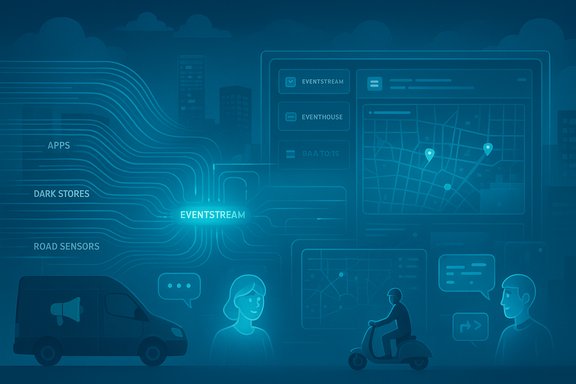
At the core of the redesign is a streaming ingestion layer that captures telemetry from multiple sources: app events, dark‑store inventory systems, rider GPS and status updates, traffic and weather feeds, and promotional code usage. These events are funneled into a low‑latency event store (an “Eventhouse” concept in modern fabrics) where queries and aggregations run in seconds rather than minutes.- Event ingestion picks up high‑cardinality data (per‑order, per‑rider) and preserves event order where required.
- Lightweight transformations enrich events with geospatial and routing metadata to make them actionable for routing and inventory decisions.
- The event store supports both fast operational dashboards and downstream persistence to the central data lake for historical analysis.
Real‑Time Dashboards and Data Activators
Swiggy replaced batch refresh dashboards with live operational views that update in seconds. Those views feed “Data Activators” — programmable rules and anomaly detectors that trigger alerts or automated corrective workflows. Practical examples deployed in production include:- Instant inventory flags to prevent customers ordering items that are out of stock at a dark store.
- Automated deactivation of promotional coupons when anomalous redemption rates suggest a leak or misuse.
- Heatmaps of incoming orders that trigger ad‑hoc rider reallocation to maintain delivery SLAs.
Generative AI chatbots for customer support and drivers
Generative AI models were integrated via managed model services to automate conversational flows:- Customer support bots that field routine queries like “Where is my order?” and socialise estimated delays without human intervention during peak volumes.
- A driver assistant (branded internally) that helps with onboarding, earnings visibility, route suggestions, and administrative queries — effectively shifting many repetitive interactions to automated channels.
Platform glue: Foundry, OneLake and model orchestration
The deployment uses a unified data fabric concept — a single logical lake/store where historical, analytical and streaming data can be correlated. This reduces the plumbing complexity typically present in multi‑tool ecosystems and shortens time‑to‑insight for product teams. The stack also leverages a managed AI “foundry” layer that provides model selection, deployment pipelines and governance controls to operationalize generative AI safely.Why this matters: tactical and strategic benefits
- Latency reduction: Shrinking an operational dashboard refresh from five–ten minutes to seconds materially reduces failed orders and customer frustration caused by stale inventory or routing data.
- Cost avoidance and fraud mitigation: Real‑time coupon‑fraud detection stops revenue leakage that can be hard to detect in batch analytics.
- Human augmentation at scale: Conversational assistants reduce contact center load and provide on‑demand help to delivery partners, improving throughput and partner satisfaction.
- Faster experimentation: A unified fabric and managed AI services accelerate product iterations — teams can build, test and deploy new routing or incentive experiments without heavy ETL cycles.
- Data‑driven partner insights: The same real‑time pipelines can create near‑instant partner reporting for restaurants and suppliers, unlocking commercial opportunities.
Technical anatomy: how Real‑Time Intelligence works in practice
Eventstream → Eventhouse → Activators → Dashboards
- Eventstream captures raw signals from mobile apps, dark‑store systems, rider devices, third‑party traffic feeds and payment systems.
- Eventhouse stores time‑series and event data in a schema optimized for rapid aggregation and ad‑hoc queries.
- Data Activators (real‑time rules engines) run anomaly detection logic and trigger actions, from disabling a coupon to reassigning riders to high‑demand zones.
- Real‑time dashboards and downstream workflows subscribe to the activator outputs or directly to the eventhouse, enabling both automated and human responses.
Model orchestration and conversational AI
- Managed model endpoints handle inference at scale for templated responses (order status) while higher‑complexity knowledge tasks (escalations, dispute resolution) can route to human agents with context.
- Model governance layers enforce rules on data used for model training and prompt construction, plus monitoring for drift and hallucination rates.
- Hybrid patterns are used: deterministic microservices for critical, safety‑sensitive actions (e.g., cancelling an order or issuing a refund) and generative models for human‑facing text generation and query summarization.
Strengths and notable engineering choices
- Unified data plane reduces integration friction. Having streaming, lake, and analytics in one cohesive fabric dramatically lowers engineering overhead and accelerates feature launches.
- Event‑first design aligns with business needs. For a delivery network, event timeliness directly maps to customer experience metrics; treating events as first‑class entities is the correct architecture.
- Combining rule‑based activators with ML yields robust detection. Starting with rule‑based abnormality detectors and layering ML improves early detection of coupon abuse without over‑reliance on opaque models.
- Generative AI is applied pragmatically. Using conversational AI primarily for routine query automation and partner assistance reduces friction and frees human agents to handle complex cases.
- Partner ecosystem adoption accelerates rollout. Working with platform integrators and certified partners shortened deployment time for real‑time connectors and edge integrations.
Risks, tradeoffs and unanswered questions
While the technical and operational benefits are clear, the move raises several strategic and operational risks that teams must manage proactively.Vendor lock‑in and portability
Relying heavily on a single cloud vendor’s unified stack can yield rapid benefits, but it increases exposure to pricing changes, proprietary APIs, and migration complexity. Rewriting event‑processing and model‑orchestration logic for another provider is non‑trivial. Companies should:- Design bounded interfaces and event contracts to isolate business logic from provider APIs.
- Maintain exportable event snapshots and mirrored data copies to minimize migration friction.
- Adopt multi‑cloud or hybrid strategies where regulatory or availability needs demand them.
Data sovereignty, privacy and compliance
Real‑time aggregation of user locations, purchase histories, and payment metadata creates a large compliance surface. The following areas deserve close attention:- Ensure operational logs and personal data used by models are handled according to local data‑protection requirements and recorded consents.
- Enforce fine‑grained access controls over OneLake or equivalent data stores to prevent overexposure of PII.
- Audit the data used to train or prompt generative models to detect and remove sensitive content.
Model safety and hallucination risk
Generative chatbots can deliver swift customer responses but also produce incorrect or misleading content. For delivery operations where misinformation can directly impact customer satisfaction:- Implement deterministic fallbacks for critical information (order ETA, payment status).
- Monitor model outputs for hallucinations and route ambiguous requests to human agents.
- Use prompt‑conditioning and retrieval‑augmented generation tied to the live event store to ground the model in factual context.
Operational resilience and single‑point failures
Centralized fabrics and event stores can become chokepoints in peak load scenarios. Teams should:- Build graceful degradation modes — for example, read‑only dashboards or cached inventory views for transient outages.
- Use circuit breakers and retries in ingestion paths to avoid cascading failures.
- Run chaos experiments to validate recovery and failover behaviors.
Cost control and efficiency
Streaming systems and large‑scale model inference are resource‑intensive. Without guardrails, cloud bill variability can explode. Recommended controls include:- Autoscaling policies tied to business KPIs rather than raw CPU usage.
- Tiered model architectures: cheap lightweight models for common queries and larger models reserved for complex tasks.
- Use of cached responses for frequently asked queries and rate‑limiting for bots to control inference costs.
Governance and third‑party risk
Using third‑party connectors for traffic, weather, or mapping introduces supply‑chain risk. Validate SLAs, data accuracy, and failure modes for each external feed before they are used in decision logic.Lessons for other delivery and logistics operators
Swiggy’s implementation provides a practical pattern for companies in similar domains.- Prioritize event timeliness for decisions that directly impact SLAs. Even a few minutes of lag can cascade into missed delivery windows and customer churn.
- Start with high‑value, low‑complexity use cases: coupon‑fraud detection, inventory updates for dark stores, and simple chatbots often deliver immediate ROI.
- Use a hybrid automation model: deterministic services for transactional actions, generative models for natural language and summary tasks.
- Invest in model governance and observability early — model performance and safety issues compound as automation grows.
- Treat data contracts as first‑class artifacts; stable schemas and versioning reduce downstream fragility.
Recommendations: how to build a production‑grade real‑time + AI delivery platform
- Define clear business KPIs tied to event freshness (e.g., acceptable inventory staleness, order‑to‑fulfilment SLA).
- Adopt an event contract strategy: versioned, documented, and backward‑compatible.
- Separate streaming compute from long‑term storage; design for both fast lookups and historical analysis.
- Implement layered detection — rule‑based alerts first, then ML detectors — to reduce false positives and speed time to value.
- Establish prompt‑and‑retrieval patterns to ground LLM outputs in the real‑time event store.
- Create human‑in‑the‑loop workflows for edge cases and model retraining signals.
- Build cost governance: inference budgets, cold/warm model tiers and budget alerts.
- Harden for outages with fallback UIs and degraded but safe operational modes.
Commercial and competitive landscape implications
Swiggy’s adoption of a managed, unified cloud fabric is more than a technical migration — it’s a strategic positioning play. Real‑time capabilities and generative AI help shift the competitive battleground from simple price and delivery to predictive resilience and partner enablement. Companies that can guarantee fresher operational state and faster resolution will capture higher lifetime value and better partner economics.At the same time, rivals with in‑house platforms or different cloud providers will watch two metrics closely: time‑to‑insight (how quickly analytics influence operations) and cost‑to‑serve (the marginal cost of an additional order). The winner in this space will likely be the company that scales operational reliability while keeping unit economics healthy.
What remains to be validated
Some operational figures cited in public briefings describe platform scale in orders, riders and monthly transacting users. These metrics are reported in company briefings and vendor case studies, but independent verification against audited filings or regulatory disclosures is limited in the public domain. Readers should treat headline counts as reported metrics from company and partner briefings, and exercise caution when modeling financial or margin impacts purely on those figures without access to detailed unit economics and audited results.Conclusion
Swiggy’s deployment of a modern event‑driven analytics fabric combined with generative AI demonstrates how a real‑time data architecture can materially improve delivery reliability, fraud detection and partner support at massive scale. The technical pattern — streaming ingestion, low‑latency event stores, rule‑based activators, and grounded generative AI — is a repeatable blueprint for any logistics or on‑demand business that needs to make decisions in seconds rather than minutes.The benefits are compelling: better customer experience, lower friction for delivery partners, and an operational platform that supports rapid experimentation. The tradeoffs are real too: vendor dependency, data governance complexity, model safety and cost management require disciplined engineering, governance and contingency planning.
For technology leaders in the delivery economy, the lesson is straightforward: real‑time is no longer optional — it’s a competitive requirement — and generative AI, when applied with guardrails, can scale human‑grade support across millions of interactions. The engineering challenge is to harvest that value without creating single points of failure or unmanaged risk. Achieving that balance is what separates a tactical pilot from a production‑grade, resilient platform that will carry a company’s operations for the next decade.
Source: NDTV Profit 'A Great Use Case': Microsoft CEO Lauds Swiggy For Utilising Its AI Platform
