

SymphonyAI’s new CINDE Merchandising Agents fold agentic AI directly into the weekly heartbeat of retail merchandising, promising to turn days‑long signal detection and manual analysis into near‑real‑time, role‑specific decisioning that aims to protect and grow margin at the store level.
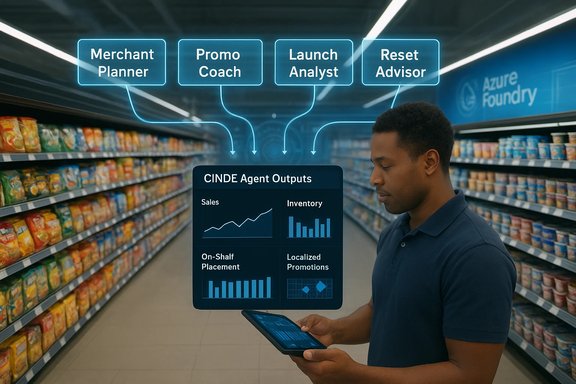
SymphonyAI has announced a next‑generation suite of CINDE Merchandising Agents—purpose‑built, role‑based AI agents that target four core retail merchandising workflows: weekly sales planning, promotional optimization, new‑item launches, and post‑reset evaluation. The packaged agents—Merchant Planner, Promo Coach, Launch Analyst, and Reset Advisor—are described as autonomous, context‑aware assistants that continuously analyze performance, explain causal drivers, and recommend prioritized actions aligned to the merchandising lifecycle.
This rollout is explicitly built on Microsoft’s Foundry platform and Azure infrastructure, marking another high‑profile pairing of domain‑trained enterprise AI with Microsoft’s agent and large‑model tooling. The offering was announced in retail industry channels ahead of NRF 2026 and is intended for live, production use rather than limited pilots.
The CINDE Merchandising Agents position themselves to collapse that latency by:
SymphonyAI emphasizes role‑based outputs (merchant language, prioritized tasks) rather than raw statistical diagnostics, which lowers the adoption barrier for store teams and category managers who need executable guidance more than model output.
SymphonyAI’s advantage rests on two claims:
Important room for scrutiny:
However, success is not guaranteed. Data quality, integration depth, governance, and human change management remain the dominant practical barriers. Retailers should validate vendor claims through carefully designed pilots, insist on explainability and audit trails, and quantify both uplift and execution rates before full deployment.
SymphonyAI’s announcement is not just another product launch; it signals a maturing category—agentic retail AI—where the intelligence is meant to act at the rhythm of merchandising, not merely report on it. Retailers that pair disciplined operations with these new agentic tools stand to recover margin faster and execute more consistently. Equally, those that underestimate the integration, governance, and change management requirements risk introducing brittle automation that can amplify errors.
Adoption will be won at the intersection of technology capability and operational rigor: the agents can surface the truth quickly, but merchants must still decide how—and how fast—to act.
Source: The AI Journal SymphonyAI Launches Next-Generation CINDE Merchandising Agents, Bringing Agentic AI Into Core Merchandising Decisions, Powered by Microsoft Foundry and Azure | The AI Journal
 Background
SymphonyAI has announced a next‑generation suite of CINDE Merchandising Agents—purpose‑built, role‑based AI agents that target four core retail merchandising workflows: weekly sales planning, promotional optimization, new‑item launches, and post‑reset evaluation. The packaged agents—Merchant Planner, Promo Coach, Launch Analyst, and Reset Advisor—are described as autonomous, context‑aware assistants that continuously analyze performance, explain causal drivers, and recommend prioritized actions aligned to the merchandising lifecycle.This rollout is explicitly built on Microsoft’s Foundry platform and Azure infrastructure, marking another high‑profile pairing of domain‑trained enterprise AI with Microsoft’s agent and large‑model tooling. The offering was announced in retail industry channels ahead of NRF 2026 and is intended for live, production use rather than limited pilots.
Why this matters now
Retail margin is fragile and earned or erased on a weekly cadence. Merchandising decisions—where products sit on shelf, how SKUs are promoted, whether a new item is priced, displayed, and replenished correctly—directly move profit. Historically, those decisions have depended on lagging reports, human cross‑tool analysis, and slow handoffs between planners, category managers, and store teams.The CINDE Merchandising Agents position themselves to collapse that latency by:
- Surfacing margin‑impacting signals within hours, not days.
- Explaining why metrics moved, not merely that they did.
- Recommending prioritized, merchant‑friendly next steps.
- Automating part of the action loop so fixes happen sooner and more consistently.
Overview of the CINDE Merchandising Agents
What each agent is built to do
- Merchant Planner
- Focus: weekly sales insights and margin opportunities.
- Role: acts like a merchant’s weekly analyst that monitors sales trajectories, inventory, and local anomalies.
- Promo Coach
- Focus: identifying causal drivers and optimizing promotional effectiveness.
- Role: detects when promotions are underperforming and recommends adjustments to price, placement, or promotional mix.
- Launch Analyst
- Focus: early signals of new item success and corrective measures.
- Role: spots weak early performance and suggests interventions (repositioning, localized promotions, or delist recommendations).
- Reset Advisor
- Focus: measuring post‑reset impact and advising next steps.
- Role: evaluates planogram and reset outcomes and spots execution gaps that erode expected lift.
How the agents operate in practice
The agents are described as continuously ingesting merchandising, sales, inventory, and execution data; applying domain‑aware reasoning; detecting causal relationships; and producing prioritized action lists for merchants. They are intended to be action‑oriented—not just alerts—and to interface with existing workflows such as weekly reviews, promo planning sessions, and store operations.SymphonyAI emphasizes role‑based outputs (merchant language, prioritized tasks) rather than raw statistical diagnostics, which lowers the adoption barrier for store teams and category managers who need executable guidance more than model output.
The technical foundation: Microsoft Foundry and Azure
Microsoft Foundry (the Foundry AI platform formerly marketed as Azure AI Studio and recently expanded under the Foundry name) supplies agent orchestration, the Model Context Protocol (MCP) integration layer, and managed model hosting that SymphonyAI leverages for CINDE agent execution. Foundry offers:- An Agent Service and tools for building multi‑step, tool‑enabled agents.
- MCP support to connect agents securely to enterprise systems and to extend tool invocations.
- Integrated model routing, observability, and governance capabilities for running agents at scale on Azure.
- A portfolio of model integration options (first‑party and third‑party models) and enterprise controls for security and data residency.
What SymphonyAI’s claims mean for merchants
Faster detection, clearer causality, and prioritized actions
Merchants traditionally rely on dashboards and human review to find problems. The CINDE Merchandising Agents promise to do three things differently:- Detect emerging issues early by continuously monitoring multi‑dimensional signals (sales, inventory, on‑shelf placement, competitor price).
- Explain causal drivers—helping merchants distinguish between price competition, placement changes, display execution, or assortment shifts.
- Prioritize actions that are most likely to recover margin, using merchant‑friendly language and store‑level specificity.
Aligning intelligence to merchant workflow
A critical design choice here is rhythm alignment: the agents map to the cadence merchants already use—weekly reviews, promo calendars, launch windows, and reset cycles. That reduces workflow friction and increases the likelihood of action. For retailers focused on execution rather than only insight, this is essential.Strengths and potential operational benefits
- Domain specialization: The agents are verticalized for merchandising, which should reduce the time to useful recommendations versus generic analytics or chatbot tools.
- Workflow fit: Role‑based outputs (merchant planner language, promo coach guidance) map directly to established human processes.
- Speed to action: Early detection and prioritized recommendations can close the loop quickly, preventing margin leakage during the weeks between analytics cycles.
- Enterprise-grade foundation: Built on Microsoft Foundry and Azure, the agents can tap into managed agent services, model routing, and governance controls—important for large, regulated retailers.
- Reduced cognitive load: By translating raw data into recommended actions, agents can free merchant time for judgement calls and execution.
Risks, limitations, and operational caveats
No AI system is a magic wand; CINDE Merchandising Agents bring both opportunity and risk. Major considerations include:- Data quality and integration: Agents are only as good as the data they can access. Many retailers run heterogeneous POS, inventory, and execution systems. Poor or inconsistent data feeds will reduce signal quality and produce incorrect recommendations.
- Grounding and hallucination risk: Agentic systems that reason across tools and data must be grounded. Without robust traceability and explainability, merchants may receive confident‑sounding but incorrect causal claims. Merchants must demand transparent explanations and audit trails for every recommendation.
- Operational dependency: Relying on automated recommendations can create an operational single point of failure if oversight and human review aren’t maintained. Merchants should treat agent outputs as decision support, not absolute directives, at least during early adoption.
- Security and privacy: Agent integration with store systems, planogram tools, and inventory APIs introduces a larger attack surface. Retailers must validate identity, access control, and monitoring across the agent stack.
- Change management and adoption: Even the best agent outputs will fail to create value without process changes. Retail organizations must rework weekly workflows, define acceptance criteria for agent recommendations, and train teams to interpret outputs and take action.
- Proven ROI vs. vendor claims: SymphonyAI positions these agents as margin multipliers and “return on intelligence.” Retailers should seek client case studies with verified, independently audited results and performance baselines before rolling agents into enterprise operations.
How retailers should validate vendor claims
To responsibly evaluate CINDE Merchandising Agents, retailers should take a structured approach:- Define baseline KPIs: Set clear measurement windows and control groups (stores, regions, SKUs) to measure before/after impacts.
- Run parallel pilots: Test agents in a controlled set of stores across different formats (urban vs. suburban, high‑velocity vs. low‑velocity) to measure robustness.
- Demand explainability: Require the vendor to provide rationale for every recommendation, show the data inputs and the chain of reasoning, and make explainability auditable.
- Check integration breadth: Verify the agent’s ability to access POS, DSD (direct store delivery), planogram tools, and pricing engines; ensure latency is within operational windows.
- Validate security posture: Review identity/pass‑through mechanisms, role‑based access, data residency, logging, and incident response with the vendor’s security team.
- Measure behavioral lift: Track not only sales improvement but execution rate—how often recommended actions are taken—and the time from recommendation to completion.
- Confirm economic math: Require a clear CAGR, margin restoration calculation, and payback period for agent deployment including total cost of ownership.
Implementation considerations
Data and system readiness
- Inventory accuracy and POS feeds must be near‑real‑time for weekly agents to be effective.
- Planogram and store execution data (photos, execution checks) are critical input signals that materially alter causal inference.
- Integration into promotion engines and price books is required to recommend and execute promo changes.
Human + AI operating model
Retailers should plan for a phased operating model:- Start with a decision‑support mode where agents recommend but humans decide.
- Move to semi‑automated workflows for low‑risk actions (e.g., adjusting shelf tags, localized price tags) after performance and safety checks pass.
- Consider automated execution only for highly predictable interventions and with strong rollback controls.
Governance and auditability
- Keep an immutable audit trail for every recommendation, the data that informed it, model versions used, and the person who accepted or rejected the recommendation.
- Implement guardrails for high‑impact decisions (pricing across geographies, large promotional reallocations) so that agent outputs cannot be executed without human sign‑off.
The competitive landscape: who else is doing agentic retail AI?
Agentic AI—multi‑step, tool‑enabled agents that operate across enterprise systems—has become a major focus across cloud and AI vendors. Microsoft Foundry, with its Agent Service and Model Context Protocol support, is a central platform for enterprise agents; other vendors are pushing similar agent competences into retail analytics.SymphonyAI’s advantage rests on two claims:
- Domain specialization in retail through CINDE and pre‑trained merchandising expertise.
- Deep integration with enterprise agent tooling (Microsoft Foundry) for governance, scale, and model ops.
- Vertical domain knowledge versus general platform flexibility.
- Proven field deployments and verified KPIs.
- Integration depth with their existing retail stack.
Real customers, measurable outcomes — caveats apply
The SymphonyAI materials cite client examples and assert measurable margin recovery in real store tests. These early examples are compelling but represent vendor‑provided case narratives that require independent validation. Retailers should ask vendors for anonymized, auditable results and, if practical, an independent third‑party measurement of claimed margin impact.Important room for scrutiny:
- How was the uplift attributed specifically to the agent (vs. other concurrent actions)?
- Were control groups used and randomized across stores?
- How durable are the gains (one‑week recovery vs. sustained improvement)?
Security, compliance, and model governance
SymphonyAI’s use of Microsoft Foundry and Azure provides enterprise tools for governance, but responsibility is shared. Retailers must ensure:- Proper tenant isolation and encryption for data at rest and in transit.
- Role‑based identity and least‑privilege access for agent actions that touch ERP, pricing engines, or planogram systems.
- Data residency and regulatory compliance in retail jurisdictions.
- Ongoing model monitoring to detect drift, degraded performance, or unsafe recommendations.
Practical examples of value capture
- Recovering SKU sales after execution errors: Detects when exposure or placement change reduces sales and recommends targeted fixes in affected stores.
- Promo optimization: Identifies promotions that are cannibalizing other SKUs and recommends alternative mechanics or localized splits to protect margin.
- Faster new‑item decisions: Signals early whether a new item will sustain velocity and suggests promotional or assortment changes to accelerate success or reduce loss.
- Post‑reset validation: Evaluates whether a reset produced the expected lift and highlights stores that failed to execute planograms correctly.
Where CINDE fits in a retailer’s AI roadmap
CINDE agents are best thought of as a layer in a broader retail AI and digital operations stack:- Foundational systems: POS, ERP, inventory management, promotion engines, planogram tools.
- Analytics layer: BI, forecasting, demand planning.
- Execution layer: Store ops, planogram deployment, in‑store teams.
- Agent layer: CINDE agents sit on top of these layers to synthesize signals into prioritized actions.
The verdict: promise tempered by real‑world complexity
SymphonyAI’s CINDE Merchandising Agents represent a clear step toward putting agentic AI into the day‑to‑day decisions that move retail margin. The combination of vertical expertise and Microsoft Foundry’s agent tooling is a natural technical fit. For retailers that have mature data pipelines, disciplined execution teams, and strong governance practices, the agents could shorten detection‑to‑action loops and recover material margin loss previously left to lagging reports.However, success is not guaranteed. Data quality, integration depth, governance, and human change management remain the dominant practical barriers. Retailers should validate vendor claims through carefully designed pilots, insist on explainability and audit trails, and quantify both uplift and execution rates before full deployment.
Practical checklist for retailers considering CINDE Merchandising Agents
- Ensure near‑real‑time POS and inventory feeds.
- Put planogram and execution data streams in place (image checks, audits).
- Define KPIs and control groups before pilot launch.
- Insist on transparent model explanations and recommend audit formats.
- Validate security posture, identity, and data residency with vendor.
- Pilot across varied store formats and SKU types to measure robustness.
- Plan human + AI operating model with phased automation and rollback controls.
SymphonyAI’s announcement is not just another product launch; it signals a maturing category—agentic retail AI—where the intelligence is meant to act at the rhythm of merchandising, not merely report on it. Retailers that pair disciplined operations with these new agentic tools stand to recover margin faster and execute more consistently. Equally, those that underestimate the integration, governance, and change management requirements risk introducing brittle automation that can amplify errors.
Adoption will be won at the intersection of technology capability and operational rigor: the agents can surface the truth quickly, but merchants must still decide how—and how fast—to act.
Source: The AI Journal SymphonyAI Launches Next-Generation CINDE Merchandising Agents, Bringing Agentic AI Into Core Merchandising Decisions, Powered by Microsoft Foundry and Azure | The AI Journal
