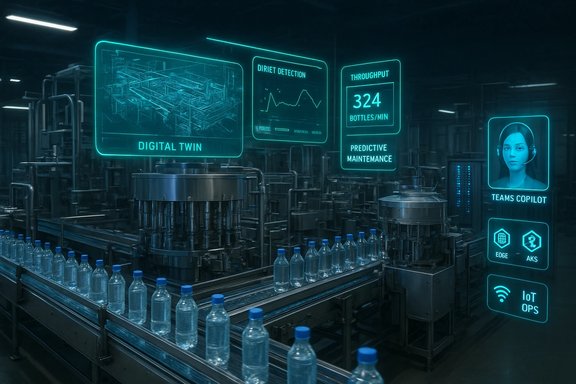
SymphonyAI’s announcement of eight new industrial AI applications tailored specifically for CPG food and beverage manufacturers signals a deliberate pivot from generic “manufacturing AI” to domain-specific solutions built for high-velocity, thermally complex, and changeover-heavy production environments. These apps—packaged under the IRIS Foundry/IRIS Forge umbrella and architected on Microsoft Azure technologies—target cleaning-cycle optimization (CIP/SIP), filling and seaming analytics, 3D digital twins, vision-based packaging quality, predictive maintenance, thermal process stability, intelligent material flow and robotics orchestration, and AR-enabled maintenance. The suite promises real-time, edge-capable intelligence designed to operate at line speed and to integrate into enterprise collaboration tools like Microsoft Teams and Copilot via modern agent interoperability patterns.
Food and beverage production is distinct from other manufacturing verticals. High-speed beverage lines can run hundreds of units per minute; thermal processes introduce time-dependent quality variability; CIP (clean-in-place) and SIP (sterilize-in-place) cycles are safety- and compliance-critical; and frequent SKU changeovers result in transient states that defeat models trained on long steady-state runs. Generic industrial AI platforms frequently underperform in this environment because they are tuned for slower, continuous-process industries or discrete-assembly scenarios where sampling cadence, thermal hysteresis, and hygienic design constraints are less severe.
SymphonyAI’s new offering positions IRIS Foundry and IRIS Forge as a domain-aware stack that pairs deep industrial ontologies and causal reasoning with Azure-native infrastructure (edge runtime, AKS, data lake storage, identity and secrets management). The marketing emphasizes line-speed inference, model governance and scale, and collaboration integration—arguments aimed at convincing F&B operators that these apps were built to understand the nuances of their workflows rather than retrofit generic analytics.
However, architecture alone is not enough. The success of line-speed AI depends on:
However, significant caveats apply. Any deployment that affects safety or food integrity must follow conservative, auditable validation procedures and maintain human oversight. Organizations should demand transparent pilot KPIs, an agreed-upon model governance framework, and exportable models/data to avoid lock-in. Finally, success rests not just on the software but on the operational partnership: process engineers, maintenance crews, IT/OT teams, and leadership alignment.
When approached methodically—starting with focused pilots, rigorous baselining, and progressive scaling—the combination of domain-aware AI and a robust cloud-edge architecture (like Azure) can shift food and beverage plants from reactive firefighting toward predictable, measurable operational performance. The objective should not be flashy claims but sustained improvement: fewer micro-stoppages, shorter changeovers, safer CIP cycles, and a measurable lift in throughput and yield that operations can trust and sustain.
Source: The AI Journal SymphonyAI Launches New Industrial AI Apps Purpose-Built for the CPG Food and Beverage Industry, Powered by Microsoft Azure | The AI Journal
 Background / Overview
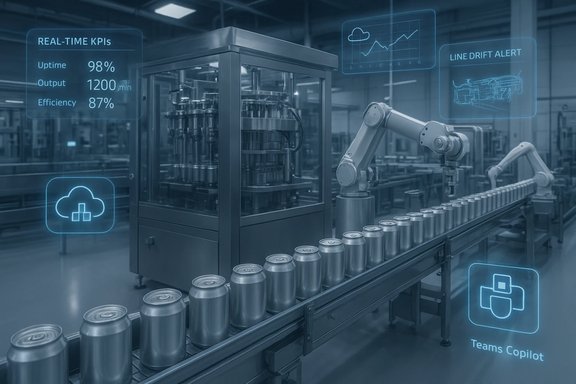
Food and beverage production is distinct from other manufacturing verticals. High-speed beverage lines can run hundreds of units per minute; thermal processes introduce time-dependent quality variability; CIP (clean-in-place) and SIP (sterilize-in-place) cycles are safety- and compliance-critical; and frequent SKU changeovers result in transient states that defeat models trained on long steady-state runs. Generic industrial AI platforms frequently underperform in this environment because they are tuned for slower, continuous-process industries or discrete-assembly scenarios where sampling cadence, thermal hysteresis, and hygienic design constraints are less severe.SymphonyAI’s new offering positions IRIS Foundry and IRIS Forge as a domain-aware stack that pairs deep industrial ontologies and causal reasoning with Azure-native infrastructure (edge runtime, AKS, data lake storage, identity and secrets management). The marketing emphasizes line-speed inference, model governance and scale, and collaboration integration—arguments aimed at convincing F&B operators that these apps were built to understand the nuances of their workflows rather than retrofit generic analytics.
What’s in the new suite: feature-by-feature breakdown
CIP / SIP Optimization
- What it does: Uses AI to optimize cleaning cycle durations, energy and chemical consumption, and scheduling to reduce overall downtime while improving repeatability and traceability.
- Why it matters: Cleaning cycles are necessary but non-value-adding from a throughput perspective. Small reductions or more consistent repeatability can materially increase available production time and decrease chemical spend.
- Strengths: Applying causal models and historical-cycle analytics can uncover over-conservative dwell times, detect incomplete rinses, and drive repeatability across shifts and sites.
- Risks & caveats: CIP/SIP interventions are safety- and regulation-sensitive. Any AI-driven reduction in time or chemical concentration requires rigorous validation, traceable audit logs, and approval by process engineers. Over-optimization without conservative guardrails risks noncompliance or compromised product safety.
AI-Optimized Filling, Seaming & Line Performance
- What it does: Real-time analytics for drift detection, micro-stoppages, changeover planning, and yield modeling specifically tuned for high-speed beverage and canning lines.
- Why it matters: Micro-stoppages and subtle parameter drift are the primary drivers of yield loss in high-speed lines; they’re hard to detect and often manifest minutes before major rejects.
- Strengths: Fast, line-level telemetry combined with domain-aware models (e.g., seamer torque signatures, fill-pressure patterns) can preempt a cascade of rejects or jams.
- Implementation note: Success depends on high-frequency data capture synchronized with product timestamps and accurate ground-truth labeling from quality systems.
Digital Twin & 3D Production Simulation
- What it does: Full 3D modeling of brewing, thermal processing, canning, packaging, and utilities for throughput simulation, layout validation, commissioning, and “what-if” planning.
- Why it matters: Digital twins accelerate commissioning, help validate new layouts, and let engineers evaluate throughput impacts of bottlenecks without taking lines offline.
- Strengths: When combined with live telemetry, a 3D twin can run near-real-time simulations to recommend setpoints or buffer allocations. Integration with GPU-accelerated simulation libraries can shorten simulation cycles from hours to minutes.
- Limitations: The fidelity of outcomes is only as good as the fidelity of the twin and the underlying physics models. Digital twins require careful calibration and ongoing maintenance, particularly after mechanical changes.
AI Vision for Packaging Quality & Seaming Integrity
- What it does: Advanced vision models to detect jams, underfill/overfill, label or print defects, can seam damage, and to predict imminent stoppages.
- Why it matters: Vision is the go-to sensor for visible defects; in F&B, fast and accurate vision systems directly protect brand safety and reduce recalls.
- Strengths: Modern computer vision and anomaly detection can spot micro-defects invisible to legacy rule-based systems, and predictive vision can send preemptive alerts.
- Risks: Lighting, occlusion, and product variability (e.g., shininess of cans) can degrade model performance. Robustness demands continuous retraining on new SKUs and systematic domain adaptation.
Predictive Maintenance for Beverage Assets
- What it does: Machine-health intelligence for fillers, seamers, packers, pumps, compressors, and conveyors, including remaining-useful-life (RUL) modeling and automated maintenance scheduling.
- Why it matters: Predictive maintenance reduces unplanned downtime and extends asset life when models can reliably forecast failures with sufficient lead time.
- Strengths: Combining vibration, current, temperature, and process context in a causal model improves the signal-to-noise ratio for failure prediction versus single-sensor approaches.
- Caution: RUL models must be validated across failure modes and regularly recalibrated. False positives create unnecessary maintenance work and erode trust; false negatives create production risk.
Thermal Process Stability & Beverage Quality Optimization
- What it does: AI-based control and stabilization for pasteurization, PU (pasteurization units) drift, carbonation, and ingredient dosing.
- Why it matters: Thermal processes and CO2 consistency directly affect shelf stability, regulatory compliance, and taste—areas where even small deviations can cause returns or brand damage.
- Strengths: Closed-loop models that combine process control algorithms with machine learning can reduce variability and adapt to fuel/temperature drift in real time.
- Regulatory note: Any AI-guided change to thermal cycles needs to retain full traceability and control rollback to validated setpoints; regulators and auditors typically require human oversight for safety-critical controls.
Intelligent Material Flow, Robotics & LGV-Driven Intralogistics
- What it does: Predictive orchestration of raw materials, packaging, pallets, and transport systems; optimizes AGV/LGV routing and buffer management across the plant.
- Why it matters: Congestion and mis-sequenced material arrival contribute to changeover delays and increased downtime. Smarter orchestration reduces starvation and blockage events.
- Strengths: Combining demand forecasting, AGV telemetry, and digital twin simulation enables proactive buffering and route optimization.
- Integration complexity: Requires mapping into PLCs, warehouse management systems (WMS), and robotic control planes—often an organizational as well as a technical project.
AR-Enabled Maintenance & Line Operations
- What it does: Operator-facing AR overlays for maintenance guidance, asset intelligence, alarms, runtime insights, and remote expert support.
- Why it matters: AR reduces mean time to repair (MTTR) by delivering procedural guidance and contextual data at the point of work.
- Strengths: Best applied where maintenance tasks are standardizable and guided instructions can be modeled; remote experts reduce travel and speed up repairs.
- Practical constraints: AR success depends on user training, headset ergonomics in wet/hazardous F&B environments, and clear change management to avoid operator distraction.
Built for production on Microsoft Azure: architecture & operational considerations
SymphonyAI’s new apps are explicitly presented as Azure-native. Key architectural components include:- Edge and low-latency processing using Azure IoT Operations and Azure Edge Runtime to keep critical decisions close to the source.
- Containerized application hosting and orchestration via Azure Kubernetes Service (AKS) for scale and high availability.
- Long-term data and analytics via Azure Data Lake and cloud analytics services to support cross-site learning and model retraining.
- Enterprise security and secrets management through Azure Active Directory (AAD) and Azure Key Vault.
- Agentic/assistant integration through Microsoft’s Model Context Protocol (MCP), enabling Copilot/Teams experiences that surface line intelligence in collaboration tools.
However, architecture alone is not enough. The success of line-speed AI depends on:
- Deterministic data pipelines with timestamp alignment between OT (PLCs, machine sensors) and IT systems.
- Tight model validation and drift detection to prevent model decay as SKUs, adhesives, and ambient conditions change.
- Fail-safe logic and human-in-the-loop controls for any recommendations that can alter safety- or compliance-critical setpoints.
Tactical benefits and claimed ROI — scrutinizing the numbers
Vendor materials highlight rapid deployment, enterprise scale, and measurable business outcomes—typical value propositions from vertical AI vendors. Past SymphonyAI marketing has used case-study-style claims such as reductions in downtime and improvements in retail profit or fraud detection metrics. These marketing claims can be powerful indicators of potential, but they require independent validation.- What’s realistic: Predictive maintenance can reduce unplanned downtime but results vary by asset class, existing maintenance maturity, and historical failure data quality. Vision-based quality inspection often reduces false rejects and increases throughput, but requires robust retraining and lighting controls.
- What to challenge: Any single-vendor claim of large, cross-plant percentages without independent third-party case studies should be treated as indicative, not definitive. ROI outcomes depend heavily on integration quality, data cleanliness, and operator adoption.
- Recommended approach: Insist on measurable pilot success criteria and transparent baseline measurement. Convert outcomes into short, medium, and long-term KPIs (e.g., MTTR reduction, yield uplift, changeover time reduction) and contractually tie milestones to value delivery where possible.
Integration and deployment realities
Deploying domain-specific AI in F&B requires more than software—successful programs combine data engineering, OT connectivity, process validation, and people change. Key considerations include:- Data readiness: Are historical logs, batch records, and vision data labelled and time-aligned? Many plants store data in fragmented historians or manual logs; preparing this data can be the largest time sink.
- OT/IT boundary: Network segmentation, firewall rules, and gateway architecture are critical. Edge components often require on-premise compute with strict security controls.
- Model governance: Continuous training pipelines, model lineage tracking, and drift monitoring should be mandatory. Compliance and food safety audits demand immutable logs and versioned model artifacts.
- User workflows: Insights must be delivered where decisions are made—on operator HMIs, in MES, or via Teams/Copilot queries—with clear actionability and rollback paths.
- Multi-site scale: Standardizing ontologies and schemas across sites reduces customization friction; IRIS Foundry’s emphasis on industrial ontology is aimed at addressing this need.
Operational risks and limitations
- Data quality and labeling: Garbage in, garbage out remains true. Vision models and RUL predictors require reliable ground-truth labels; otherwise they drift into producing false alarms.
- Overfitting to a single line or SKU: Models trained on a narrow dataset can fail when minor mechanical changes occur. Cross-validation across lines and controlled A/B testing are essential.
- Safety and regulatory exposure: Automated recommendations that touch CIP cycles, thermal controls, or packaging integrity must be human-reviewed and tightly controlled.
- Vendor lock-in: Heavy reliance on a single vendor for both domain ontology and cloud integration can complicate future migrations; architecture that supports exportable models, open standards, and vendor-agnostic connectors reduces that risk.
- Change management: Operator trust is a function of accuracy and predictability. Over-alerting and false positives erode adoption and can cause teams to ignore important warnings.
Best-practice playbook: piloting industrial AI in food & beverage
- Define a clear pilot hypothesis with measurable KPIs (e.g., reduce micro-stoppage rate by X% in 90 days).
- Start small and fast: Choose a single, high-impact line with good data quality and receptive operations leadership.
- Baseline thoroughly: Capture existing KPIs and failure modes for an apples-to-apples comparison.
- Secure data and network topology: Design edge compute and segregation approaches before instrumenting assets.
- Co-develop governance: Establish model validation, retraining cadence, and rollback procedures with process engineers.
- Run shadow-mode: Execute recommendations in parallel first to validate correctness without affecting production.
- Quantify value and scale: If KPIs are met, codify lessons learned, standardize configurations, and scale across lines with controlled templates.
- Invest in upskilling: Provide operators and maintenance teams with the context and training to interpret AI outputs and perform corrective actions.
Where SymphonyAI’s approach is strongest — and where caution is warranted
Strengths:- Domain specialization: Purpose-built models and ontologies for CPG F&B reduce the need for heavy custom configuration compared with horizontal tools.
- End-to-end stack: Offering from edge runtime and line-level models to enterprise copilot integration simplifies procurement and integration in some accounts.
- Azure alignment: Building on Azure’s edge, security, and Kubernetes ecosystem matches enterprise expectations for scale and governance.
- Validation burden: Any application that touches cleaning cycles, pasteurization, or aseptic controls creates regulatory and safety validation work not eliminated by AI.
- Organizational readiness: Technology alone will not deliver outcomes; operational discipline, data maturity, and process engineering involvement are mandatory for success.
- Marketing vs. reality: Large ROI percentages presented as vendor proof points should be validated in pilot contracts and third-party audits.
Final assessment: practical guidance for manufacturers and IT leaders
SymphonyAI’s new CPG-focused apps represent a meaningful evolution in industrial AI: the move from general-purpose analytics to verticalized, production-grade applications that speak the language of beverage and food operations. For manufacturers with multiple high-velocity lines, substantial historical telemetry, and a willingness to invest in operational validation and governance, these tools can accelerate defect detection, reduce downtime, and improve changeover planning.However, significant caveats apply. Any deployment that affects safety or food integrity must follow conservative, auditable validation procedures and maintain human oversight. Organizations should demand transparent pilot KPIs, an agreed-upon model governance framework, and exportable models/data to avoid lock-in. Finally, success rests not just on the software but on the operational partnership: process engineers, maintenance crews, IT/OT teams, and leadership alignment.
When approached methodically—starting with focused pilots, rigorous baselining, and progressive scaling—the combination of domain-aware AI and a robust cloud-edge architecture (like Azure) can shift food and beverage plants from reactive firefighting toward predictable, measurable operational performance. The objective should not be flashy claims but sustained improvement: fewer micro-stoppages, shorter changeovers, safer CIP cycles, and a measurable lift in throughput and yield that operations can trust and sustain.
Source: The AI Journal SymphonyAI Launches New Industrial AI Apps Purpose-Built for the CPG Food and Beverage Industry, Powered by Microsoft Azure | The AI Journal