

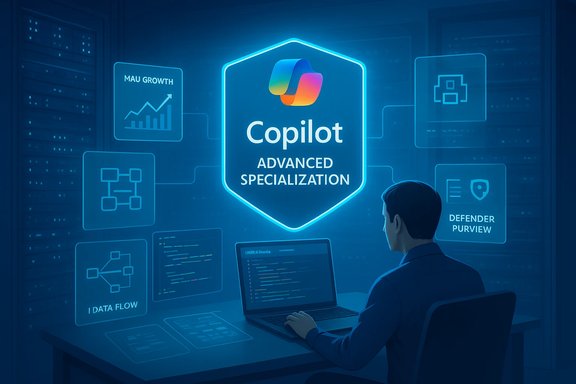
Synergy Technical’s announcement that it has earned the Microsoft Copilot Advanced Specialization marks a visible step in the fast‑moving effort to turn Copilot from a set of in‑app assistive features into an enterprise‑grade, governed automation and productivity platform — a credential that signals readiness to design, secure, deploy and extend Microsoft 365 Copilot, Copilot Chat and Copilot Studio at scale.
Microsoft’s Copilot program has expanded rapidly from draft‑assistants inside Word and Outlook to a broader platform that includes Copilot Chat, Copilot Studio, and agent‑based extensibility for automation and orchestration. Microsoft created the Copilot Advanced Specialization to give enterprise buyers an auditable partner signal: firms that can take Copilot projects through readiness, secure deployment, adoption, optimization and agent development. The program is a one‑year, renewable accreditation that sits on top of existing Microsoft Solutions Partner designations (Modern Work, Security or Business Applications). Synergy Technical’s public release emphasizes governance, measurable productivity gains, and the ability to extend Copilot via agent patterns and Copilot Studio — claims consistent with what Microsoft’s specialization is intended to validate. Rohana Meade, Synergy’s President & CEO, framed the achievement around secure deployments that align AI extensions to business and data strategies.
However, the real test is in the artifacts and references the partner can deliver. Press releases announce achievements; procurement artifacts convert achievements into contractual guarantees. Enterprise buyers should therefore request dated Partner Center proof, certification IDs for named consultants, telemetry extracts showing MAU growth and at least one agentic customer reference with measurable before/after KPIs. Without these, the specialization is a marketing claim.
At the same time, the badge is a beginning of procurement, not a substitute for robust due diligence. Buyers should insist on Partner Center evidence, named certification IDs, telemetry tied to MAU growth, agentic references with before/after KPIs, and hardened security and FinOps artifacts before approving production roll‑outs. When those artifacts are delivered and validated, a Copilot Advanced Specialization partner can materially accelerate an enterprise’s safe, scalable path from Copilot pilot to operational automation.
Source: The Herald-Times Synergy Technical Achieves Microsoft Copilot Advanced Specialization, Strengthening Leadership in Enterprise AI Adoption
 Background
Microsoft’s Copilot program has expanded rapidly from draft‑assistants inside Word and Outlook to a broader platform that includes Copilot Chat, Copilot Studio, and agent‑based extensibility for automation and orchestration. Microsoft created the Copilot Advanced Specialization to give enterprise buyers an auditable partner signal: firms that can take Copilot projects through readiness, secure deployment, adoption, optimization and agent development. The program is a one‑year, renewable accreditation that sits on top of existing Microsoft Solutions Partner designations (Modern Work, Security or Business Applications). Synergy Technical’s public release emphasizes governance, measurable productivity gains, and the ability to extend Copilot via agent patterns and Copilot Studio — claims consistent with what Microsoft’s specialization is intended to validate. Rohana Meade, Synergy’s President & CEO, framed the achievement around secure deployments that align AI extensions to business and data strategies.What the Microsoft Copilot Advanced Specialization actually requires
Microsoft’s published program criteria are explicit and operational — not symbolic. Key gates include:- Solutions Partner prerequisite: The partner must already hold a relevant Solutions Partner designation (Modern Work, Business Applications, and/or Security).
- Performance thresholds: A minimum of 1,000 net Monthly Active User (MAU) growth for Microsoft 365 Copilot over a trailing 12‑month period, and 5 net new Copilot customer tenants in the same trailing period, associated via allowed partner association types (CPOR, CSP Tier 1 / Tier 2).
- Skilling: Named, certified people mapped to role-based requirements — for example, multiple people with Microsoft 365 Enterprise Administrator Expert credentials and applied‑skills modules for security/compliance and Copilot Studio agent creation. Exact counts are specified on Microsoft’s Partner Center pages.
- Customer references: At least three customer references, including one agentic deployment that transformed a business process, plus other documentary evidence as required during auditing.
What Synergy Technical is claiming — a concise summary
Synergy Technical’s announcement states the firm has met the Copilot specialization gates and highlights four delivery areas:- Advisory services that map Copilot to business outcomes.
- Readiness and secure, compliant Copilot deployments.
- Adoption and change management programs to drive actual user value.
- Extending and customizing Copilot with agent‑based, extensibility‑first approaches using Copilot Studio.
Why this matters for enterprise IT leaders
- A practical procurement filter: The specialization reduces the short‑list problem. Procurement teams can reasonably narrow vendor selection to partners who have had their telemetry, certifications and references audited by Microsoft.
- A signal of governance capability: Because Copilot projects often require tenant configuration, data‑scoping and identity controls (Entra), a partner that passed the specialized audit should be able to present governance artifacts — DLP rules, Purview and Defender integration plans, and human‑in‑the‑loop gating for risky actions.
- An operational expectation, not a plug‑and‑play outcome: Copilot’s value rarely accrues without parallel work in change management, UX redesign and cost governance. Specialization indicates the partner understands that mix — but not that the partner can deliver guaranteed ROI without buyer engagement.
Technical snapshot: Copilot Studio, agents, identity and governance
Copilot Studio and agent patterns are central to the Advanced Specialization. Key technical facets enterprise teams should understand:- Agent identities (Entra Agent ID): Agents created in Copilot Studio are treated as directory objects. That enables lifecycle, conditional access and access‑review controls similar to service principals or user accounts — a critical guardrail for production agent deployments.
- Grounding sources and RAG patterns: Production agents are typically grounded in tenant data (SharePoint, Dataverse, Fabric, external APIs) to limit hallucinations. The architecture must define where inference occurs, how knowledge sources are indexed, and how prompt exposure to sensitive data is prevented.
- Agent runtime controls and quotas: Copilot Studio enforces message and throughput quotas per Dataverse environment and exposes agent‑level consumption controls (prepaid message packs, RPM/RPH quotas). These controls are part of how organizations cost, monitor and limit agent activity.
- Operational observability: Production deployments need telemetry for MAUs, unanswered‑question themes, credit consumption, prompt lineage and error metrics to maintain safety and measure value. Partners validated by the specialization should supply runbooks and dashboard artifacts demonstrating these capabilities.
Strengths demonstrated by partners who achieve this specialization
Partners that successfully earn and maintain the Copilot Advanced Specialization typically show a consistent set of strengths:- Documented, measurable adoption: Telemetry that links partner work to MAU growth and tenant adoption. Microsoft explicitly requires MAU and net customer growth thresholds.
- Bench depth and named certifications: Multiple certified practitioners mapped to role requirements (not just single‑expert claims). This reduces delivery risk that comes from a single point of failure.
- Governance artifacts and security integration: Practical DLP designs, Purview retention and Defender hooks, plus human‑in‑the‑loop gates for writebacks and sensitive changes.
- Agent engineering and lifecycle practices: Templates, MCP‑aware connectors, test harnesses and agent lifecycle plans that turn a PoC into sustainable production services.
Potential risks and blind spots buyers must watch
Earning the specialization raises expectations, but it does not eliminate real operational risks. Key caution points:- Badge is a snapshot, not a guarantee: The specialization is valid for one year and requires renewal. Partners can change staff, lose certifications, or have variable SLAs — so the badge should trigger targeted verification, not blind trust.
- Data residency and compliance complexity: For regulated industries (healthcare, finance, government) where data sovereignty and explainability are mandatory, agentic Copilot usage can create complex compliance questions that a partner must address concretely with architecture and contractual commitments.
- Hidden total cost of ownership (TCO): Production Copilot and agent runtimes introduce ongoing inference, Copilot Credits and Azure consumption costs. Partners must supply three‑year TCO models; otherwise, organizations can face sticker shock when scale is reached.
- Agent brittleness and maintenance: UI automation and computer‑use automations expand reach to legacy systems, but they are brittle. Maintenance and test automation costs can erode projected savings if not accounted for.
- Vendor lock‑in risk: Consolidating extensibility and agent logic into a partner’s IP without exportable artifacts or handover commitments can raise switching costs. Ensure contracts include exportable agent manifests, runbooks and knowledge transfer.
How to verify Synergy Technical’s claim (a practical procurement checklist)
The Copilot Advanced Specialization is meant to make verification easier — use it. Request and validate the following artifacts from Synergy Technical before contracting for production work:- Partner Center proof that the Copilot Advanced Specialization is active today, including award and expiry dates.
- A named, dated skills matrix listing each consultant, the exact certification or applied‑skills module they hold, and certification IDs you can cross‑check on Microsoft Learn.
- Telemetry extracts or dashboards showing MAU growth and the partner‑attributed net new Copilot customers for the trailing 12 months. Ask for the raw metrics used to qualify the specialization.
- At least three customer references, including one agentic production deployment; request before/after KPIs, a contactable reference and a short technical architecture doc for each.
- A security architecture diagram that maps data flows, where inference runs (tenant vs cloud), Purview/DLP integration points, Entra Agent ID usage, and Defender/SOC hooks.
- A three‑year TCO model that includes licensing, Copilot Credits, Azure inference costs and managed service fees — with sensitivity runs for higher adoption.
- Exportable deliverables and handover artifacts: agent manifests, code repositories, test harnesses, retraining plans and runbooks. Contractually require these to be delivered at acceptance.
Best practice implementation playbook (high level)
- Readiness & Discovery
- Run a focused Copilot Readiness workshop to identify 3–5 high‑value use cases and set KPIs (time saved, error reduction, MAU targets).
- Map sensitive data and define RAG boundaries and tenant access policies.
- Pilot & Agent Build
- Deploy a narrow-scope agent built in Copilot Studio with human‑in‑the‑loop approvals for all writebacks.
- Ground the agent on versioned corpora (Dataverse, SharePoint, Fabric) and instrument telemetry.
- Validate & Hardening
- Conduct red‑team testing for hallucination scenarios, prompt‑injection, and failure modes.
- Integrate DLP/Purview and Sentinel/Defender hooks; test incident playbooks.
- Scale & Operate
- Expand to role‑based copilots, enforce environment policies, schedule model refreshes and adopt FinOps practices for inference consumption.
- Move to an operational SLA for monitoring and incident handling, with documented responsibility for cost and telemetry.
Commercial and organizational implications
- Procurement leverage: The specialization shortens due diligence time when artifacts are provided, but buyers should still include acceptance criteria tied to measurable productivity or quality improvements.
- Change management investment: Expect to allocate budget and time for training, reinforcement and UX redesign. Technology alone rarely delivers adoption.
- FinOps readiness: Copilot and Copilot Studio agent workloads can shift cloud bill profiles. Require forecast scenarios and billing transparency from the partner.
- People and skills: A sustainable operating model requires internal skills; insist on knowledge transfer clauses and staged handovers so the buyer retains core competences over time.
Critical assessment of Synergy Technical’s announcement
Synergy Technical’s public claim aligns with Microsoft’s stated program intent and the capabilities the specialization is designed to validate: advisory, secure deployment, adoption and agent extensibility. As a signal, the specialization is useful for buyers who want to identify partners with demonstrable Copilot experience.However, the real test is in the artifacts and references the partner can deliver. Press releases announce achievements; procurement artifacts convert achievements into contractual guarantees. Enterprise buyers should therefore request dated Partner Center proof, certification IDs for named consultants, telemetry extracts showing MAU growth and at least one agentic customer reference with measurable before/after KPIs. Without these, the specialization is a marketing claim.
Quick checklist for Windows and Microsoft 365 administrators evaluating Synergy or any Copilot specialization partner
- Ask for Partner Center proof with award and expiry dates.
- Verify named consultants’ certification IDs on Microsoft Learn.
- Request a red‑team test summary and human‑in‑the‑loop policy for writebacks.
- Require a security architecture diagram mapping Purview and Sentinel integrations.
- Insist on an exportable agent manifest, runbooks and retraining plans.
- Get a three‑year TCO model with sensitivity cases for high adoption.
Conclusion
Synergy Technical’s Microsoft Copilot Advanced Specialization is a meaningful market signal: it indicates the firm passed Microsoft’s telemetry, skilling and customer‑evidence gates for Copilot delivery and agent extensibility. That credential should shorten vendor selection for organizations moving beyond experimentation into governed, measurable Copilot adoption.At the same time, the badge is a beginning of procurement, not a substitute for robust due diligence. Buyers should insist on Partner Center evidence, named certification IDs, telemetry tied to MAU growth, agentic references with before/after KPIs, and hardened security and FinOps artifacts before approving production roll‑outs. When those artifacts are delivered and validated, a Copilot Advanced Specialization partner can materially accelerate an enterprise’s safe, scalable path from Copilot pilot to operational automation.
Source: The Herald-Times Synergy Technical Achieves Microsoft Copilot Advanced Specialization, Strengthening Leadership in Enterprise AI Adoption
