

Synopsys’ new digital‑twin framework promises to shift high‑fidelity simulation from an offline engineering backlog into the operational tempo of the shop floor by combining GPU‑accelerated CFD, OpenUSD/Omniverse visualization, and cloud orchestration on Microsoft Azure — a capability demoed at Microsoft Ignite and validated in a production pilot with Krones AG, though headline runtime claims need careful auditing before they become procurement targets.
Manufacturing has long treated computational fluid dynamics (CFD) and physics‑based modeling as engineering tools used primarily during design validation. Those workflows are powerful but slow: meshing, solver runs, and post‑processing commonly take hours or days. The practical result is that simulation rarely contributes to on‑shift decisioning on production lines.
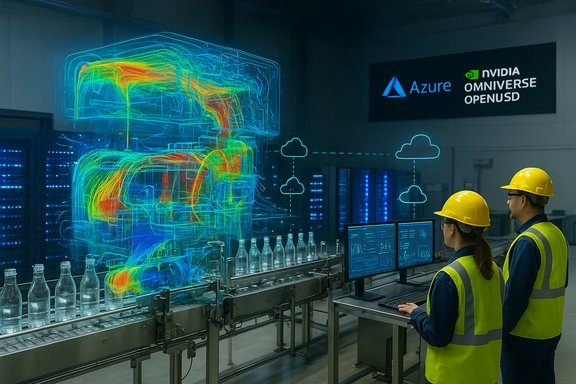
Synopsys’ framework aims to close that gap by delivering a cloud‑native, GPU‑accelerated digital twin that can run scenario sweeps for entire assembly lines — for example, bottle‑filling systems where bottle geometry, liquid viscosity, fill level, valve timing, and conveyor alignment interact in complex, multiphase flows. The platform stitches together Synopsys’ accelerated physics/orchestration layer, Ansys Fluent as the CFD backbone, NVIDIA Omniverse with OpenUSD for scene composition and visualization, and Microsoft Azure for elastic GPU compute and orchestration. The solution was demonstrated with Krones AG’s bottling and packaging lines.
Key architectural components:
Why the numbers can diverge:
Sectors that stand to benefit immediately include:
Manufacturers should proceed deliberately: run bounded pilots with auditable runbooks, quantify fidelity trade‑offs, model cloud run rates, and enforce governance and safety controls. When these guardrails are in place, the technology stack Synopsys showcased can reduce waste, shorten time‑to‑market for line changes, and create the technical foundation for genuinely smart, simulation‑driven factories.
Source: Bisinfotech Synopsys Unveils Digital Twin Framework for Manufacturing
 Background
Manufacturing has long treated computational fluid dynamics (CFD) and physics‑based modeling as engineering tools used primarily during design validation. Those workflows are powerful but slow: meshing, solver runs, and post‑processing commonly take hours or days. The practical result is that simulation rarely contributes to on‑shift decisioning on production lines.Synopsys’ framework aims to close that gap by delivering a cloud‑native, GPU‑accelerated digital twin that can run scenario sweeps for entire assembly lines — for example, bottle‑filling systems where bottle geometry, liquid viscosity, fill level, valve timing, and conveyor alignment interact in complex, multiphase flows. The platform stitches together Synopsys’ accelerated physics/orchestration layer, Ansys Fluent as the CFD backbone, NVIDIA Omniverse with OpenUSD for scene composition and visualization, and Microsoft Azure for elastic GPU compute and orchestration. The solution was demonstrated with Krones AG’s bottling and packaging lines.
What was demonstrated — a practical overview
The public demonstration included a fully parameterized digital twin of a bottling/filling assembly line that allowed multidisciplinary teams to run multiple “what‑if” scenarios without interrupting physical operations. Scenario sweeps showed how changes to bottle neck geometry, liquid viscosity, fill set‑points, and timing affected fill accuracy, spillage, and throughput. Results — both volumetric visualizations and numeric metrics (mass flow, pressures, turbulence indicators) — were streamed into an Omniverse scene so engineers and operators could compare outcomes side‑by‑side.Key architectural components:
- Solver layer: Ansys Fluent (GPU‑enabled) for multiphase and single‑phase CFD.
- Acceleration/orchestration: Synopsys’ accelerated physics layer to schedule multi‑GPU jobs and integrate solver outputs.
- Visualization/interoperability: NVIDIA Omniverse and OpenUSD as the canonical scene format and runtime.
- Cloud platform: Microsoft Azure (including Ansys Access on Azure) for elastic GPU clusters, orchestration, identity, and enterprise governance.
- Systems integrators: CADFEM and SoftServe for solver tuning, integration, and operator dashboards.
The performance headline — aspirational target vs. fielded reality
Public messaging around the demo includes an attention‑grabbing claim: a reduction in CFD runtimes “from 3–4 hours to less than 5 minutes.” That figure frames the announcement as a potential step‑change in latency for physics simulation. However, independent integrator and field materials tied to the Krones deployment report a different, more conservative operational number: roughly 30 minutes per simulation cycle after a two‑month tuning and integration effort. Both metrics appear in the public record and must be read together. The sub‑5‑minute number is presented as an optimized, lab‑condition capability; the ~30‑minute figure is the documented, fielded baseline.Why the numbers can diverge:
- Mesh density and cell count scale wall‑clock time non‑linearly; production‑grade multiphase meshes are far more expensive than reduced meshes used for rapid demos.
- Physics fidelity (free surface tracking, discrete particles, complex turbulence models) limits what solver kernels can be fully GPU‑accelerated.
- Extreme latency reductions frequently require surrogate or reduced‑order models (ROMs) or ML‑based emulators that trade some fidelity for speed. Those trade‑offs must be validated against an auditable baseline.
- Achieving minute‑scale performance typically demands high‑end multi‑GPU topologies (H100/A100/MI300‑class GPUs), very fast NVMe I/O, and careful orchestration to minimize container startup and data staging overhead.
Technical anatomy — how the stack delivers faster answers
Solver and GPU acceleration
Ansys Fluent provides the physics engine. Recent Fluent releases have hardened GPU pathways and multi‑GPU scaling that accelerate many CFD kernels. These GPU‑native solver paths are real and produce significant speedups in favorable cases, but performance remains case dependent — mesh resolution, multiphase physics, and solver formulation matter. Synopsys’ role is to provide an orchestration and acceleration layer that maximizes GPU utilization, minimizes overhead, and integrates solver outputs into pipelines for visualization and analytics.Interoperability and visualization with OpenUSD / Omniverse
Using OpenUSD as the canonical scene format lets CAD geometry, telemetry (PLC/MES data), and CFD overlays live in the same asset. NVIDIA Omniverse supplies the runtime for photoreal rendering and collaborative review, allowing non‑CAE stakeholders (operators, plant managers) to see fluid behaviors in context, not only as numeric tables. This lowers the cultural friction between engineering and operations and speeds cross‑discipline decision‑making.Cloud orchestration on Azure
Microsoft Azure provides elastic GPU instances, autoscaling, identity and governance controls, and commercial offerings like Ansys Access on Azure to simplify deployment. Cloud orchestration is critical to spin up the right GPU topology, schedule jobs across GPUs, and feed results back to dashboards. This cloud‑native model supports multi‑tenant governance and enterprise controls but introduces ongoing run‑rate costs that must be modeled.Real operational benefits — what’s believable now
When implemented with realistic fidelity and repeatable benchmarking, the framework produces tangible operational gains:- Faster engineering iterations: Reducing runtime from hours to tens of minutes (or minutes in extreme lab cases) multiplies how many parameter sweeps a team can run per shift, accelerating root‑cause analysis and change validation.
- Reduced waste and higher yield: Validated scenario sweeps can identify valve timing and fill settings that materially reduce overfills, spills, and downstream rework.
- Cross‑team collaboration: Visual, USD‑based twins let operators and engineers operate on the same dataset, improving speed and quality of decisions.
- Foundations for predictive and closed‑loop use cases: Once established, the twin can be extended to predictive maintenance, layout optimization, and operator training.
Risks, caveats, and procurement red flags
Adopting simulation‑driven digital twins at scale introduces new technical, financial, and governance risks that IT/OT teams must treat as material.- Headline performance claims require auditable runbooks. Vendors should supply an explicit runbook that documents GPU SKU, mesh size, solver flags, time steps, and any surrogate/ROM usage used to produce quoted numbers. Without that, “sub‑5‑minute” claims are marketing, not procurement guarantees.
- Fidelity trade‑offs: Faster runs may rely on simplified physics or surrogate models. If simulation outputs become the basis for operational changes, error bounds and confidence intervals must be explicit and validated. Fast but inaccurate suggestions can be worse than slow, accurate guidance.
- Cloud run‑rate economics: Minutes‑scale simulations run frequently translate to sustained GPU hours. Enterprises must model ongoing cloud spend (compute, storage, egress) versus on‑prem alternatives and negotiate committed discounts or caps.
- Security and IP governance: Detailed plant geometry, machine designs, and process models are sensitive. Ensure tenant isolation, encryption at rest and transit, identity‑based access, and clear contractual rules about ownership and data portability.
- Operational safety: Any automated control derived from simulation must pass safety interlocks, human sign‑off thresholds, and regulatory checks. Simulations should recommend changes; a human or certified control system must validate before actuating safety‑critical commands.
- Vendor lock‑in and portability risk: Deep integration with a single cloud or visualization runtime increases switching costs. Insist on scene and asset portability (exportable USD artifacts) so the digital twin remains an ownerable asset.
Practical evaluation checklist for pilots
For IT, OT, and manufacturing leaders considering a pilot, follow a disciplined approach:- Define a small, measurable pilot scope (one machine or one line) with clear KPIs: waste reduction, throughput delta, mean time to changeover.
- Require a vendor runbook that reproduces the performance claim on your topology, including GPU SKU, mesh sizes, and solver flags.
- Validate fidelity by running side‑by‑side comparisons: full‑fidelity Fluent runs, accelerated pipeline results, and any surrogate outputs, then quantify numerical differences and confidence intervals.
- Build a cost model for expected cadence (runs per shift/day), capturing compute, storage, integration, and licensing.
- Negotiate SLAs, cost caps, and IP terms—insist on USD/scene export and data ownership.
- Design governance and safety controls: explicit human sign‑off limits, rollback thresholds, and integration tests before any control actions are automated.
Broader industry implications
Synopsys’ framework and the Krones pilot are emblematic of a larger shift toward Industry 4.0 patterns: GPU‑first solvers, cloud HPC orchestration, and standardized scene formats (OpenUSD) converge to make simulation a continuous operational instrument rather than a point‑in‑time engineering activity. Several platform vendors and integrators are racing to deliver similar blueprints, but the differentiator will be repeatable, auditable performance at production fidelity and predictable run costs.Sectors that stand to benefit immediately include:
- Packaging and food & beverage (tight fill tolerances, high volumes).
- Pharmaceuticals (sterility, precise dosing).
- Chemicals and process industries (multiphase flow and mixing).
- Semiconductor equipment and module fabrication (thermal and flow control).
Strengths of the Synopsys approach
- Modular, best‑of‑breed architecture: By composing Ansys Fluent, Omniverse/OpenUSD, Azure, and Synopsys’ orchestration, the framework leverages mature components and avoids reinventing core solvers or visualization layers. This reduces development risk and accelerates integration.
- Interoperability via OpenUSD: Using a neutral scene format materially lowers integration friction across CAD, CAE, MES and operator tooling, enabling cross‑discipline collaboration.
- Real operational case evidence: The SoftServe/Krones field case documents a deliverable system with meaningful speedups (~30 minutes), proving the concept beyond lab demos.
- Cloud scalability and governance: Azure’s enterprise controls and Ansys Access offerings provide a practical path to production deployments with identity and policy integration.
Where caution is warranted
- Headline latency should be treated as an engineering target, not a guaranteed SLA, until vendors publish reproducible runbooks and third‑party audited benchmarks.
- Fidelity vs. speed trade‑offs must be contractualized. Enterprises should require explicit error budgets for any reduced‑order or surrogate models used in operational decisions.
- Total cost of ownership (TCO) can be non‑trivial for frequent, minutes‑scale runs; run‑rate cloud costs, storage, and license models must be carefully modeled and negotiated.
Conclusion — a pragmatic verdict for manufacturing IT leaders
Synopsys’ digital‑twin framework represents an important and credible step toward making high‑fidelity simulation operationally useful. The blend of GPU‑accelerated CFD, Omniverse/OpenUSD visualization, and Azure cloud orchestration is a pragmatic pattern that brings CAE into the operational loop. The Krones pilot shows the model works in the field and delivers meaningful operational improvements; however, the difference between marketing‑grade “under five minutes” claims and documented, fielded runtimes of roughly 30 minutes is material for procurement, operations, and safety planning.Manufacturers should proceed deliberately: run bounded pilots with auditable runbooks, quantify fidelity trade‑offs, model cloud run rates, and enforce governance and safety controls. When these guardrails are in place, the technology stack Synopsys showcased can reduce waste, shorten time‑to‑market for line changes, and create the technical foundation for genuinely smart, simulation‑driven factories.
Source: Bisinfotech Synopsys Unveils Digital Twin Framework for Manufacturing
