Tanium’s Autonomous IT platform has been named a Leader in IDC MarketScape’s vendor assessment for worldwide client endpoint management software focused on Windows device management for 2025–2026 — a recognition the company says underlines its push to unite endpoint management, exposure management and security operations under a single, AI-driven platform.
IDC MarketScape’s vendor assessment examines tools used by large organisations to manage Windows endpoints across desktops, servers and specialised devices. The 2025–2026 Worldwide Client Endpoint Management Software for Windows Device Management assessment (doc #US53002925, December 2025) evaluates vendors on a mix of qualitative and quantitative criteria — product and service capability, strategy, and market success factors — and places vendors on a comparative graphic intended to guide enterprise buyers. IDC’s analysis explicitly frames Windows as the dominant corporate OS and casts endpoint management as central to resilience and compliance across modern mixed-device estates. Tanium’s placement as a Leader in that IDC MarketScape round marks the company’s second Leader placement in this Windows-focused assessment. Tanium positions its offering as the Tanium Autonomous IT Platform, a single platform the company says brings together endpoint management, exposure (vulnerability) management and security operations for enterprises managing Windows devices — spanning Windows 10 and Windows 11 PCs, Windows Server and Windows IoT endpoints. IDC’s assessment highlights Tanium’s deep Microsoft ecosystem integrations and argues Tanium addresses gaps left by some native Microsoft tooling. This recognition arrives alongside Tanium’s public positioning in the new Gartner Magic Quadrant for Endpoint Management Tools (2026), where Tanium and several peers announced leadership placements as the market pivots toward autonomous endpoint management and AI-driven automation. The expanding vendor recognition from IDC and Gartner reflects the rapid redefinition of endpoint management: from manual, siloed toolchains to centralized, intelligence-driven platforms that promise speed, scale and automation.
Tanium’s IDC MarketScape recognition places the company near the center of the conversation about the future of Windows endpoint management. For enterprises wrestling with sprawling Windows estates and rising cyber risk, the verdict from IDC is a strong signal to evaluate autonomous platforms — but the practical journey from pilot to production will determine whether those platforms ultimately deliver the resilience and reduced operational complexity they promise.
Source: SecurityBrief New Zealand https://securitybrief.co.nz/story/tanium-named-leader-in-idc-report-on-windows-tools/
 Background / Overview
IDC MarketScape’s vendor assessment examines tools used by large organisations to manage Windows endpoints across desktops, servers and specialised devices. The 2025–2026 Worldwide Client Endpoint Management Software for Windows Device Management assessment (doc #US53002925, December 2025) evaluates vendors on a mix of qualitative and quantitative criteria — product and service capability, strategy, and market success factors — and places vendors on a comparative graphic intended to guide enterprise buyers. IDC’s analysis explicitly frames Windows as the dominant corporate OS and casts endpoint management as central to resilience and compliance across modern mixed-device estates. Tanium’s placement as a Leader in that IDC MarketScape round marks the company’s second Leader placement in this Windows-focused assessment. Tanium positions its offering as the Tanium Autonomous IT Platform, a single platform the company says brings together endpoint management, exposure (vulnerability) management and security operations for enterprises managing Windows devices — spanning Windows 10 and Windows 11 PCs, Windows Server and Windows IoT endpoints. IDC’s assessment highlights Tanium’s deep Microsoft ecosystem integrations and argues Tanium addresses gaps left by some native Microsoft tooling. This recognition arrives alongside Tanium’s public positioning in the new Gartner Magic Quadrant for Endpoint Management Tools (2026), where Tanium and several peers announced leadership placements as the market pivots toward autonomous endpoint management and AI-driven automation. The expanding vendor recognition from IDC and Gartner reflects the rapid redefinition of endpoint management: from manual, siloed toolchains to centralized, intelligence-driven platforms that promise speed, scale and automation. What IDC and Tanium are Saying — The Key Claims
Windows-first coverage and platform scope
IDC’s MarketScape highlights Tanium’s focus on enterprises with large Windows estates and cites Tanium’s support coverage across Windows 10/11, Windows Server and Windows IoT as core to the assessment. The report stresses Tanium’s ability to plug gaps in endpoint performance monitoring, compliance reporting and automation that may not be fully covered by native Microsoft tooling such as Intune or Configuration Manager. The IDC view is that a Windows-first, scale-oriented platform still has prominent utility even as device diversity grows.Autonomous IT and agentic AI features
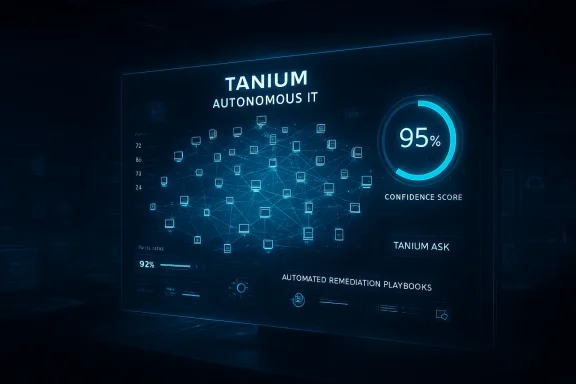
Tanium frames the MarketScape recognition as validation of the Autonomous IT model: consolidating tools, aligning IT and security operations, and automating routine workflows with AI and real-time telemetry. The company has publicised a raft of capabilities under that banner — notably Tanium Ask (Ask Agent), an agentic AI experience that can automate configuration, QA and remediation workflows from natural-language prompts; Tanium Confidence Score, a rollout-guidance metric designed to help progressive deployments; and Adaptive Actions, automation for patching and configuration at scale. Tanium has also expanded integrations — including a connector for Microsoft Intune and extensions for OT and mobile endpoints — positioning those as business-critical bridges between traditional Windows management and broader enterprise needs.Market positioning and competitive context
IDC’s commentary (via its research vice president) calls out Tanium’s “advanced automation and deep integration with Microsoft’s ecosystem — based on real-time endpoint intelligence,” and recommends Tanium as a candidate for organisations seeking operational resilience, security and consistent compliance at scale. At the same time, a growing list of vendors (from established players to emergent autonomous-focused startups) are being positioned in Gartner and IDC assessments as leaders or challengers — dramatizing how many suppliers are racing to deliver autonomous endpoint management capabilities.Why Tanium’s approach matters to Windows-focused enterprises
Real-time visibility at scale
A recurring advantage Tanium claims is real-time endpoint intelligence: the ability to query and act across millions of endpoints quickly, preserving granular telemetry for immediate investigation and remediation. For very large Windows estates — global retail, financial services, healthcare networks and government agencies — that speed of insight and action can materially reduce mean time to remediation and contain lateral risk propagation.Unified IT + Security workflows
Converging endpoint management with exposure management and security operations reduces handoffs between teams. Tanium’s message is that a single platform reduces tool sprawl, shortens investigation-to-remediation cycles and supports unified reporting for compliance and governance — practical outcomes that map directly to enterprise purchasing drivers.Microsoft ecosystem integration
Many enterprises standardise on Microsoft for identity, productivity, and device management. Tanium’s emphasis on deep Microsoft integrations (Intune connector, ConfigMgr complement) helps position the product as complementary rather than replacement technology — an attracktive narrative for organisations that want to extend Microsoft capabilities without rip-and-replace projects. IDC specifically called out Tanium filling areas not fully covered by Microsoft native tools.Technical and operational strengths
- Agent architecture and telemetry: Tanium’s agent-centric model is designed for comprehensive telemetry and actionability across patching, configuration and vulnerability remediation.
- Agentic AI workflows: Tanium Ask Agent offers a natural-language front end for query, QA and remediation — an approach that can lower the expertise barrier for routine operations while supporting human-in-the-loop control.
- Progressive rollout guidance: Confidence Score and progressive rings aim to reduce the blast radius of configuration changes by offering data-driven rollout plans.
- Automation at scale: Adaptive Actions and other orchestration features enable large-scale patching and policy enforcement with reduced manual overhead.
- Extended endpoint coverage: Statements from Tanium indicate growing support for OT and mobile endpoints, positioning the platform for heterogeneous estates beyond classic Windows PCs.
Critical analysis — strengths, blindspots and practical trade-offs
Notable strengths
- Operational speed and control: For organisations that must act quickly on threats across thousands to millions of endpoints, the promise of real-time interrogation and orchestration is compelling.
- Consolidation potential: Reducing the number of point tools can lower integration overhead and reduce latency between detection and response.
- Microsoft-native complement: For enterprises that standardise on Microsoft but need additional telemetry, enforcement or automation, a platform that bridges those gaps is useful.
- AI-driven ergonomics: Natural-language agentic workflows can accelerate routine tasks, shrink mean-time-to-knowledge and democratise platform use beyond elite specialists.
Important cautions and limitations
- Vendor consolidation vs. vendor concentration: Consolidating multiple functions into a single vendor reduces tool sprawl — but it increases dependency on that single supplier. Organisations should weigh the commercial and operational risks of deeper dependence on one platform, especially for critical functions like remediation and compliance tracking.
- Agent security and attack surface: Agent-based platforms necessarily run privileged telemetry and execution code on endpoints. That capability is powerful — and if misconfigured or compromised, it becomes a high-impact attack vector. Rigorous operational controls, just-in-time privilege models (such as Tanium’s Jump Gate concept), and careful segmentation are non-negotiable.
- AI agentic risk and predictability: Agentic AI can automate complex workflows, but it introduces new failure modes: model drift, inappropriate automation decisions, and the risk of over-reliance on suggested remediations. Human-in-the-loop controls, policy guardrails, and thorough staging are essential.
- Cost and licensing complexity: Consolidated platforms with broad functionality often carry a premium. Enterprises must validate total cost of ownership, licensing models (per endpoint, per seat, per feature) and any additional costs for cloud-hosted features, AI modules, or integrations.
- Mixed estate coverage: IDC’s assessment emphasises Windows device management; organisations with substantial macOS, Linux, mobile-first, or BYOD populations should verify the product’s depth across non-Windows endpoints and whether those features match the Windows parity or are functionally narrower.
- Integration reality with Microsoft stacks: While Tanium positions itself as complementary to Intune and Configuration Manager, real-world integration can be non-trivial. Buyers should validate specific workflows (e.g., co-managed update orchestration, compliance reporting reconciliation and identity integration) in pilot environments.
The competitive landscape — where Tanium sits
The endpoint management market’s shape has shifted rapidly in 2025–2026. Gartner’s inaugural Magic Quadrant for Endpoint Management Tools and IDC’s MarketScape updates show multiple vendors being named Leaders, Challengers, Visionaries and Niche players — indicating active competition and differing approaches to autonomy, AI, cross-platform coverage and cloud-native architectures. Some vendors emphasise autonomous endpoint management, others emphasise Apple-first management, and several focus on cloud-native, multi-OS coverage. This crowded field gives buyers choice but also complicates vendor selection because the trade-offs (speed vs. coverage, automation vs. human control, cost vs. consolidation) vary considerably across suppliers.Deployment considerations and practical guidance
Pre-deployment checklist
- Confirm supported OS and endpoint types in writing (Windows 10/11 versions, Windows Server SKUs, Windows IoT variants, OT and mobile coverage).
- Request details on the agent model: update cadence, memory/CPU footprint, communication architecture (peer-to-peer vs. cloud relay), and offline handling.
- Validate integration paths with Microsoft identity, Intune, Configuration Manager and Defender products.
- Insist on a security review of the agent: code signing, update pipeline, privilege boundary, and documented incident response plans for agent compromise.
- Define rollback and progressive rollout thresholds: how Confidence Score is calculated and what remediation/rollback paths exist in the event of failed rollouts.
Proof-of-concept (PoC) scope
- Deploy agents to a representative ring (mix of OS versions, locations, network profiles).
- Test real-time queries and inventory accuracy under typical load.
- Execute controlled Adaptive Actions (patching sequence, configuration rollback) and measure time-to-remediation and failure rates.
- Evaluate Ask Agent recommendations on non-critical workflows and validate human-in-the-loop controls.
- Perform red-team scenarios to validate agent hardening and Jump Gate just-in-time access controls.
Questions to demand from the vendor
- How is telemetry protected in transit and at rest, and what are the data residency options?
- How are Ask Agent’s models trained, where does model inference occur (cloud vs. on-prem), and what data is used for training?
- What SLA guarantees exist for platform availability and critical remediation actions?
- How does the platform interoperate with existing MCCM/Intune deployments in co-managed topologies?
- What mechanisms prevent runaway automation (cascading misconfigurations) and how do you ensure safe rollbacks?
Security and compliance implications
- Telemetry and privacy: Endpoint telemetry can contain sensitive user and business data. Compliance teams must map what telemetry is collected, where it flows, how long it is retained and whether it is subject to regulatory controls (GDPR, HIPAA, sector-specific rules).
- Audit and forensic readiness: Unified platforms can centralise audit trails, but buyers must verify immutability, retention windows and forensic export capabilities to satisfy regulatory and incident response needs.
- Zero Trust alignment: Features like just-in-time access, ephemeral credentialing and Jump Gate are positive signs — but they must be tested in real workflows to validate that privileged actions are constrained and fully auditable.
- Third-party integrations: Cross-tool automation (e.g., pushing remediation actions into an EDR or SIEM) must preserve chain-of-custody and not introduce new blind spots.
Business and financial considerations
- TCO calculus: Factor in license fees, potential reduction in headcount or contractor spend, integration and migration costs, and any savings from decommissioning legacy tools.
- Procurement timelines: Large-scale rollouts spanning tens of thousands of endpoints require procurement cycles that include legal review of data protection addenda, export control considerations for cross-border telemetry, and enterprise architecture sign-offs.
- Vendor health and roadmaps: With AI and autonomous capabilities rapidly evolving, enterprises should demand transparent product roadmaps, third-party audit commitments (for AI safety and telemetry handling), and explicit upgrade policies for critical features.
Where Tanium’s recognition fits into enterprise strategy
Tanium’s Leader placement in IDC MarketScape signals that the company’s Autonomous IT messaging and real-time platform capabilities resonate with IDC’s criteria for Windows device management at scale. For enterprises with large Windows footprints and a need to compress detection-to-remediation windows while consolidating tools, Tanium’s unified platform is a credible option — especially where Microsoft native tools do not meet all operational or compliance requirements. That said, the decision to adopt a broad, agentic, autonomous platform must be made with thorough PoCs, careful security validation and a clear roll-out plan that protects production systems from automation risk.Practical buying checklist (quick reference)
- Confirm Windows OS and Server SKUs supported and get written compatibility matrices.
- Validate Intune and Configuration Manager integration specifics.
- Verify the agent’s resource profile and impact on endpoint performance.
- Pilot Ask Agent on narrowly scoped workflows and test rollback/approval gates.
- Insist on architecture diagrams showing telemetry flows, storage, and residency.
- Review the vendor’s AI model governance and data usage policies.
- Map disaster recovery and incident response procedures with vendor support commitments.
- Request references from organisations with similar scale and regulatory constraints.
Closing analysis
IDC MarketScape’s Leader placement is meaningful validation for Tanium in a market that prizes speed, scale and integration with the Microsoft ecosystem. The company’s emphasis on Autonomous IT, real-time intelligence, and agentic AI tools like Tanium Ask targets the pain points of large Windows estates: visibility gaps, complex change management, and the need for fast, reliable remediation. However, the shift to autonomous, agent-driven platforms is not risk-free. Organisations must balance consolidation benefits against the concentration of control, AI-driven decision risks, agent security considerations, and cost implications. A disciplined procurement and deployment approach — with PoCs, staged rollouts, clear security guardrails and rigorous vendor questions — will be essential for turning the promise of real-time, autonomous endpoint management into safe, measurable business benefit.Tanium’s IDC MarketScape recognition places the company near the center of the conversation about the future of Windows endpoint management. For enterprises wrestling with sprawling Windows estates and rising cyber risk, the verdict from IDC is a strong signal to evaluate autonomous platforms — but the practical journey from pilot to production will determine whether those platforms ultimately deliver the resilience and reduced operational complexity they promise.
Source: SecurityBrief New Zealand https://securitybrief.co.nz/story/tanium-named-leader-in-idc-report-on-windows-tools/