
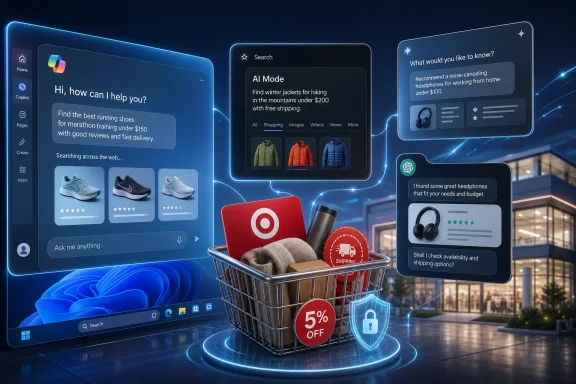
Target’s latest AI commerce push puts its assortment inside Google Search AI Mode, the Gemini app, Microsoft Copilot, and ChatGPT, letting shoppers browse and buy through conversational interfaces while keeping Target accounts, Circle benefits, promotions, and purchase decisions tied to the retailer. The company is not merely adding another digital sales channel. It is preparing for a version of shopping in which the storefront is no longer the starting point. For Windows users, IT teams, and anyone watching Microsoft’s consumer AI ambitions, the Target-Copilot tie-up is a useful early signal: the chatbot is becoming a checkout lane.
Retailers have spent two decades trying to pull shoppers into their own apps, websites, loyalty programs, and logged-in ecosystems. Target’s AI-commerce strategy accepts a more uncomfortable possibility: the next shopper may begin not at Target.com, but inside a general-purpose assistant that already knows the errand, the budget, the household, and the deadline.
That is why Target’s claim matters. The company says it is the first mass retailer with a presence across three major AI shopping surfaces: Google Search and Gemini, Microsoft Copilot, and OpenAI’s ChatGPT. Whether that “first” label holds up forever is less important than the strategy behind it. Target wants to make sure that when consumers outsource the first draft of a shopping trip to an AI assistant, Target’s catalog is not missing from the conversation.
This is a different kind of e-commerce expansion from launching a mobile app feature or redesigning a product page. The retailer is plugging itself into platforms it does not control. Search, chat, recommendation, identity, payment, and checkout are being rearranged around third-party AI systems, and Target is trying to remain the merchant of record even as the customer’s attention sits somewhere else.
That tension defines the whole move. Target wants the reach of Google, Microsoft, and OpenAI without surrendering its loyalty economics. It wants conversational discovery without becoming a commodity supplier behind someone else’s assistant. In plain retail terms, it wants the basket, the account relationship, and the data exhaust, even if the shopping trip starts in a chatbot.
For shoppers, the pitch is convenience. A person can ask Google Search AI Mode or Gemini for products by occasion, need, or use case, receive curated Target recommendations, and complete the purchase while still accessing account-linked perks. That means a request like “I need dorm room basics under $150” can become a guided basket rather than a page of blue links, sponsored tiles, and manual filtering.
For Google, this is the next logical extension of search. The company has long sat between consumer intent and merchant websites. AI Mode and Gemini give it a chance to move deeper into the transaction itself, turning search from an index of destinations into a place where the shopping trip happens.
That is a major shift for retailers. Traditional e-commerce optimization is built around landing pages, product detail pages, reviews, filters, cart design, and checkout conversion. In an AI-mediated model, some of that still matters, but the decisive moment may happen before a shopper ever sees the retailer’s interface. The assistant may decide which products are relevant, which bundles make sense, and which merchant earns the recommendation.
Target is not blind to that risk. Its messaging repeatedly emphasizes that shoppers remain in control, that AI “supports” their efforts, and that customers can link to Target Circle. Those details are not just consumer-comfort language. They are Target’s attempt to preserve consent, loyalty, and brand presence in a channel where the interface belongs to someone else.
Target says it is an early customer-loyalty launch partner for Microsoft Copilot Checkout through account linking. In practice, that means shoppers can browse, sign into Target accounts, and purchase inside the Copilot chat flow. Target Circle members can receive eligible discounts and free shipping, and Target Circle Card users can still receive the 5 percent savings that Target uses as one of its strongest loyalty hooks.
That account-linking detail is the real story. A generic chatbot checkout would be useful but shallow. A chatbot checkout connected to a retailer’s loyalty account is far more valuable, because it can carry forward pricing, shipping rules, saved preferences, and membership benefits. It also gives Target a reason to tell customers that buying through Copilot is not a second-class experience compared with buying through Target’s own app.
For Microsoft, this points to a broader monetization path for Copilot. The company has talked for years about making AI assistants useful enough to change habits. Shopping is one of the most obvious tests because it combines search, recommendation, identity, payment, and user trust in a single workflow. If Copilot can move from “answer engine” to “transaction assistant,” it becomes more than a productivity wrapper.
But this is also where IT pros should squint. Commerce inside an AI assistant raises familiar enterprise questions in a consumer wrapper: identity federation, account permissions, payment handling, auditability, phishing risk, data retention, and the boundary between recommendation and persuasion. Copilot Checkout may be a consumer shopping feature, but the underlying pattern is the same one Microsoft is pushing elsewhere: assistants that do not just answer, but act.
The company’s emphasis on “multi-item baskets” is important. Retailers do not merely want AI to sell a single replacement item. They want assistants to assemble trips. If a chatbot can move a customer from “I’m hosting a backyard birthday party” to plates, decorations, drinks, snacks, gifts, sunscreen, and pickup timing, it starts to mimic the role that store layout, endcaps, search filters, and recommendation modules used to play.
That is why conversational commerce has become attractive to large retailers. Human shoppers often think in missions, not SKUs. Traditional search boxes are poor at that. A customer types “birthday party,” and the retailer must guess whether that means balloons, cake mix, a gift, paper cups, or an outfit. A conversational agent can ask clarifying questions, infer context, and build a basket in a way ordinary site search rarely does well.
The danger is that the assistant becomes the brand the customer remembers. If the shopper says, “ChatGPT helped me plan the party,” Target risks becoming the fulfillment layer behind the experience. Target’s answer is to keep its benefits visible: Circle accounts, promotions, payment savings, pickup options, and curated assortment. It is trying to make the assistant a doorway, not the destination.
Retail loyalty programs have always been about more than discounts. They create identity, purchase history, personalization, frequency, and switching costs. In the AI-commerce era, they also become a negotiation tool with platforms. If Target can say that the best prices, shipping benefits, saved preferences, and card savings require account linking, it gives customers a reason to maintain a direct relationship even when they shop through Copilot or Gemini.
That account relationship also matters for personalization. Target says it wants to apply what it learns from AI retail partnerships to improve its own app and website, with more relevant recommendations, easier checkout, and more personalized benefits. That is the flywheel the company is trying to build: learn from conversational shopping behavior on third-party platforms, then bring those lessons back into owned channels.
The challenge is that platform data may not flow as freely as retailers would like. Google, Microsoft, and OpenAI all have their own incentives. They want to improve their assistants, own the user experience, and make their platforms indispensable to merchants. Target will want enough insight to improve merchandising and conversion without giving away the customer relationship.
This is where the next round of platform politics will happen. The first phase of e-commerce was about who owned the website visit. The second was about who owned the app install. The third may be about who owns the conversational session and its associated intent data.
That difference matters. When an AI assistant says, “Here are the best items for your camping trip,” many users will treat the output as curated guidance rather than advertising architecture. The assistant may be drawing from structured product feeds, merchant relationships, availability, price, delivery windows, reviews, user preferences, and commercial ranking systems. But to the shopper, it arrives as a helpful answer.
Target’s language tries to soften that concern by insisting that consumers direct interactions and control purchase decisions. That is true in the narrow sense: the shopper still chooses whether to buy. But the assistant can shape the choice set before the human sees it. In retail, controlling the shelf has always mattered. AI assistants create a new shelf, and its placement rules will be contested.
For Windows users, the analogy is familiar. Microsoft has already used Windows surfaces, Edge prompts, Bing integration, and Copilot placement to steer user behavior. A commerce-enabled Copilot adds another layer to that pattern. If the assistant is present across desktop, browser, and mobile contexts, it can become a persistent mediator between need and purchase.
None of this means AI shopping is inherently bad for consumers. A good assistant could reduce friction, compare options more clearly, prevent forgotten items, and make accessibility better for users who struggle with dense e-commerce interfaces. The question is not whether conversational shopping can be useful. It is whether the incentives behind the conversation remain legible.
What changes is their role in discovery. A growing share of early-stage shopping may move into assistants, especially for broad, fuzzy, or mission-based queries. That means the website becomes less of a universal starting point and more of a trusted account hub, service center, loyalty engine, and deep catalog environment.
This has practical consequences for digital teams. Product data quality becomes even more important. If AI assistants rely on structured attributes, availability, imagery, pricing, reviews, and fulfillment promises, sloppy catalog data will translate directly into invisibility or bad recommendations. Search engine optimization does not vanish; it mutates into something closer to agent optimization.
Checkout design also changes. Retailers spent years shaving milliseconds and fields from their own checkout flows. Now they must make sure account linking, promotions, payment credentials, tax, shipping, pickup, substitutions, and loyalty benefits work cleanly through third-party interfaces. The checkout is no longer just a page. It is a transaction service exposed to agents.
That is a serious engineering and governance problem. When something goes wrong, shoppers will not care whether the fault sits with Target, Google, Microsoft, OpenAI, a payment provider, or an account-linking handoff. They will blame the experience. Retailers entering AI commerce are accepting responsibility for workflows they only partially control.
Prompt injection, impersonation, malicious product listings, fake support flows, account-linking scams, and poisoned recommendations all become relevant. If shoppers grow accustomed to buying inside chat, attackers will try to mimic those flows. If assistants can summarize merchant offers, attackers will try to influence what the assistant sees. If loyalty accounts become valuable transaction tokens, phishing campaigns will adapt accordingly.
Microsoft, Google, OpenAI, payment processors, and retailers will all argue that they have guardrails. They probably do, and mature payment systems already have fraud detection, tokenization, and dispute mechanisms. But the history of consumer platforms suggests that new convenience layers always create new abuse patterns before norms and defenses catch up.
There is also a subtler privacy issue. A conversational shopping query can reveal far more than a keyword search. “I need supplies for my father after surgery,” “help me buy clothes after weight gain,” or “what do I need for a child with sensory issues” are commercially useful and personally sensitive. Retailers and AI platforms will need to be clear about how such intent is stored, used, and shared.
For administrators, the consumer version of this problem foreshadows enterprise questions. If AI agents can buy office supplies, book travel, procure software, or interact with vendors, organizations will need policies around spending authority, approval workflows, logging, and data leakage. Target’s announcement is about household shopping, but the pattern scales directly into business purchasing.
But standards in platform markets are never neutral terrain. The organization that defines the protocol, ships the dominant implementation, controls the default interface, or owns the user session still has leverage. Google’s role in UCP is especially significant because Google already sits at the center of search advertising, merchant listings, product discovery, maps, local intent, Android, Chrome, and Gmail.
Microsoft’s Copilot Checkout follows a different route, with PayPal and commerce partners involved in letting purchases happen without leaving the assistant. OpenAI has its own commerce efforts through ChatGPT and payment partnerships. These systems may converge technically, but they are also competing for the same prize: the right to sit between consumer intent and merchant fulfillment.
Target’s multi-platform approach is a hedge against that uncertainty. Rather than betting exclusively on one assistant, it is trying to be present wherever conversational shopping gains traction. That makes sense for a mass retailer, but it also shows that no one yet knows which AI surface will become the default shopping assistant.
The likely outcome is not one universal winner. It is a messy period in which Google dominates some discovery flows, ChatGPT owns open-ended planning, Copilot captures Microsoft ecosystem users, and retailer apps continue to matter for loyal customers. Target is preparing for that fragmented reality.
The change will not necessarily arrive as a dramatic Windows update. It may show up as a shopping answer in Edge, a Copilot prompt in search, a product comparison in the sidebar, or a checkout flow that feels like an extension of chat. That is how platform shifts often happen: not as a single revolution, but as repeated convenience nudges.
Microsoft has obvious reasons to pursue this. Search advertising was historically Google’s fortress. If AI assistants become the new front end for commercial intent, Microsoft has a chance to reopen a market that Bing never fully cracked. Copilot Checkout gives Microsoft a way to say that its assistant does not just find products; it closes the loop.
Users may welcome that if it works. The web is cluttered, product search is gamed, and many retail sites are overloaded with pop-ups, sponsored placements, and dark-pattern-adjacent urgency cues. A clean conversational checkout could feel like relief. The problem is that the same forces that made web shopping noisy will follow the money into AI results.
This is why transparency will matter. Users should know when products are sponsored, when rankings are influenced by commercial relationships, when a retailer’s loyalty account changes pricing, and when the assistant is optimizing for convenience rather than lowest total cost. A useful Copilot shopping experience must be more than frictionless. It must be trustworthy.
Consumer habits are stubborn. Many people already know to open Amazon for general shopping, Target for household goods, Walmart for price comparison, Google for broad research, and TikTok or Instagram for inspiration. AI assistants are trying to collapse those entry points into a single conversational layer. That is ambitious, and it is not guaranteed to work.
Target’s advantage is that it has many mission-driven categories where conversation can help. Grocery, home, apparel, beauty, baby, seasonal, back-to-school, and gifting all involve context. A shopper may not know the exact item name, but they know the event, constraint, or problem. That is precisely where chat interfaces can outperform keyword search.
The retailer’s risk is that conversational commerce may train customers to become less brand-loyal, not more. If a shopper asks an assistant for “the best value paper towels delivered today,” Target must compete inside a ranked answer against Walmart, Amazon, Costco, grocery chains, and marketplaces. Loyalty benefits may help, but the assistant’s comparison logic could make switching easier.
That is why Target is emphasizing its own differentiators: curation, design-forward products, Circle discounts, free shipping, card savings, pickup, and fulfillment options. It cannot merely expose a catalog. It has to teach the assistant why Target should be chosen.
The company’s approach is pragmatic. It is not abandoning its app or website. It is using third-party AI platforms as test beds for new forms of discovery and transaction. Then it plans to bring those lessons back into its own digital properties, where recommendations, checkout, and personalized benefits can be improved under Target’s control.
That loop is strategically sensible, but it depends on execution. If the experience feels fragmented, customers will retreat to familiar apps. If promotions fail to apply, account linking breaks, delivery promises are unclear, or returns become confusing, AI commerce will feel like a gimmick. Retail shopping is operationally unforgiving because convenience collapses the moment something goes wrong.
The bigger issue is trust. Consumers may tolerate a chatbot suggesting socks or shampoo. They may be more cautious when the assistant recommends medicine-adjacent products, baby gear, financial offers, or expensive electronics. Retailers and platforms will have to decide where conversational convenience ends and higher-friction confirmation begins.
Target’s move is therefore both aggressive and cautious. It wants to be early enough to learn, but not so early that it hands the customer relationship to someone else. Its language about shopper control is not accidental. It is the defensive line around the entire strategy.
The most concrete implications are already visible:
 Target Is Betting That the Storefront Is Becoming an API
Retailers have spent two decades trying to pull shoppers into their own apps, websites, loyalty programs, and logged-in ecosystems. Target’s AI-commerce strategy accepts a more uncomfortable possibility: the next shopper may begin not at Target.com, but inside a general-purpose assistant that already knows the errand, the budget, the household, and the deadline.That is why Target’s claim matters. The company says it is the first mass retailer with a presence across three major AI shopping surfaces: Google Search and Gemini, Microsoft Copilot, and OpenAI’s ChatGPT. Whether that “first” label holds up forever is less important than the strategy behind it. Target wants to make sure that when consumers outsource the first draft of a shopping trip to an AI assistant, Target’s catalog is not missing from the conversation.
This is a different kind of e-commerce expansion from launching a mobile app feature or redesigning a product page. The retailer is plugging itself into platforms it does not control. Search, chat, recommendation, identity, payment, and checkout are being rearranged around third-party AI systems, and Target is trying to remain the merchant of record even as the customer’s attention sits somewhere else.
That tension defines the whole move. Target wants the reach of Google, Microsoft, and OpenAI without surrendering its loyalty economics. It wants conversational discovery without becoming a commodity supplier behind someone else’s assistant. In plain retail terms, it wants the basket, the account relationship, and the data exhaust, even if the shopping trip starts in a chatbot.
Google Turns Product Search Into a Checkout Surface
The Google side of Target’s announcement is built around Universal Commerce Protocol, or UCP, an open standard for agentic commerce. The phrase is awkward, but the ambition is straightforward: let AI agents participate in the shopping journey from discovery through transaction instead of simply pointing users to a retailer’s website.For shoppers, the pitch is convenience. A person can ask Google Search AI Mode or Gemini for products by occasion, need, or use case, receive curated Target recommendations, and complete the purchase while still accessing account-linked perks. That means a request like “I need dorm room basics under $150” can become a guided basket rather than a page of blue links, sponsored tiles, and manual filtering.
For Google, this is the next logical extension of search. The company has long sat between consumer intent and merchant websites. AI Mode and Gemini give it a chance to move deeper into the transaction itself, turning search from an index of destinations into a place where the shopping trip happens.
That is a major shift for retailers. Traditional e-commerce optimization is built around landing pages, product detail pages, reviews, filters, cart design, and checkout conversion. In an AI-mediated model, some of that still matters, but the decisive moment may happen before a shopper ever sees the retailer’s interface. The assistant may decide which products are relevant, which bundles make sense, and which merchant earns the recommendation.
Target is not blind to that risk. Its messaging repeatedly emphasizes that shoppers remain in control, that AI “supports” their efforts, and that customers can link to Target Circle. Those details are not just consumer-comfort language. They are Target’s attempt to preserve consent, loyalty, and brand presence in a channel where the interface belongs to someone else.
Microsoft Copilot Checkout Makes the Windows Angle Hard to Ignore
The Microsoft piece is especially relevant to the Windows ecosystem because Copilot is not just another app. It is Microsoft’s chosen AI layer across Windows, Edge, Bing, Microsoft 365, and consumer web services. If Copilot Checkout becomes a durable commerce surface, it gives Microsoft a new way to convert everyday intent into transactions.Target says it is an early customer-loyalty launch partner for Microsoft Copilot Checkout through account linking. In practice, that means shoppers can browse, sign into Target accounts, and purchase inside the Copilot chat flow. Target Circle members can receive eligible discounts and free shipping, and Target Circle Card users can still receive the 5 percent savings that Target uses as one of its strongest loyalty hooks.
That account-linking detail is the real story. A generic chatbot checkout would be useful but shallow. A chatbot checkout connected to a retailer’s loyalty account is far more valuable, because it can carry forward pricing, shipping rules, saved preferences, and membership benefits. It also gives Target a reason to tell customers that buying through Copilot is not a second-class experience compared with buying through Target’s own app.
For Microsoft, this points to a broader monetization path for Copilot. The company has talked for years about making AI assistants useful enough to change habits. Shopping is one of the most obvious tests because it combines search, recommendation, identity, payment, and user trust in a single workflow. If Copilot can move from “answer engine” to “transaction assistant,” it becomes more than a productivity wrapper.
But this is also where IT pros should squint. Commerce inside an AI assistant raises familiar enterprise questions in a consumer wrapper: identity federation, account permissions, payment handling, auditability, phishing risk, data retention, and the boundary between recommendation and persuasion. Copilot Checkout may be a consumer shopping feature, but the underlying pattern is the same one Microsoft is pushing elsewhere: assistants that do not just answer, but act.
ChatGPT Gives Target Access to the New Front Door of Consumer Intent
Target’s OpenAI partnership fits the same pattern but carries a different cultural weight. ChatGPT has become the place many users go when they do not yet know exactly what they want. That makes it a potent environment for shopping discovery, especially for multi-item baskets such as holiday hosting, back-to-school supplies, baby registries, dorm move-ins, or pantry restocks.The company’s emphasis on “multi-item baskets” is important. Retailers do not merely want AI to sell a single replacement item. They want assistants to assemble trips. If a chatbot can move a customer from “I’m hosting a backyard birthday party” to plates, decorations, drinks, snacks, gifts, sunscreen, and pickup timing, it starts to mimic the role that store layout, endcaps, search filters, and recommendation modules used to play.
That is why conversational commerce has become attractive to large retailers. Human shoppers often think in missions, not SKUs. Traditional search boxes are poor at that. A customer types “birthday party,” and the retailer must guess whether that means balloons, cake mix, a gift, paper cups, or an outfit. A conversational agent can ask clarifying questions, infer context, and build a basket in a way ordinary site search rarely does well.
The danger is that the assistant becomes the brand the customer remembers. If the shopper says, “ChatGPT helped me plan the party,” Target risks becoming the fulfillment layer behind the experience. Target’s answer is to keep its benefits visible: Circle accounts, promotions, payment savings, pickup options, and curated assortment. It is trying to make the assistant a doorway, not the destination.
Loyalty Is the Anchor in a Platform-Controlled World
Target Circle is not a side feature in this strategy. It is the anchor. Once shopping moves into third-party AI platforms, loyalty accounts become the mechanism that keeps the retailer from disappearing into the background.Retail loyalty programs have always been about more than discounts. They create identity, purchase history, personalization, frequency, and switching costs. In the AI-commerce era, they also become a negotiation tool with platforms. If Target can say that the best prices, shipping benefits, saved preferences, and card savings require account linking, it gives customers a reason to maintain a direct relationship even when they shop through Copilot or Gemini.
That account relationship also matters for personalization. Target says it wants to apply what it learns from AI retail partnerships to improve its own app and website, with more relevant recommendations, easier checkout, and more personalized benefits. That is the flywheel the company is trying to build: learn from conversational shopping behavior on third-party platforms, then bring those lessons back into owned channels.
The challenge is that platform data may not flow as freely as retailers would like. Google, Microsoft, and OpenAI all have their own incentives. They want to improve their assistants, own the user experience, and make their platforms indispensable to merchants. Target will want enough insight to improve merchandising and conversion without giving away the customer relationship.
This is where the next round of platform politics will happen. The first phase of e-commerce was about who owned the website visit. The second was about who owned the app install. The third may be about who owns the conversational session and its associated intent data.
The AI Shopping Trip Is a Recommendation Engine With a Cash Register
The retail industry has used recommendation engines for years, but chatbot commerce changes their posture. A product carousel on a website is obviously a recommendation module. A conversational assistant feels more like advice.That difference matters. When an AI assistant says, “Here are the best items for your camping trip,” many users will treat the output as curated guidance rather than advertising architecture. The assistant may be drawing from structured product feeds, merchant relationships, availability, price, delivery windows, reviews, user preferences, and commercial ranking systems. But to the shopper, it arrives as a helpful answer.
Target’s language tries to soften that concern by insisting that consumers direct interactions and control purchase decisions. That is true in the narrow sense: the shopper still chooses whether to buy. But the assistant can shape the choice set before the human sees it. In retail, controlling the shelf has always mattered. AI assistants create a new shelf, and its placement rules will be contested.
For Windows users, the analogy is familiar. Microsoft has already used Windows surfaces, Edge prompts, Bing integration, and Copilot placement to steer user behavior. A commerce-enabled Copilot adds another layer to that pattern. If the assistant is present across desktop, browser, and mobile contexts, it can become a persistent mediator between need and purchase.
None of this means AI shopping is inherently bad for consumers. A good assistant could reduce friction, compare options more clearly, prevent forgotten items, and make accessibility better for users who struggle with dense e-commerce interfaces. The question is not whether conversational shopping can be useful. It is whether the incentives behind the conversation remain legible.
The Retail Website Will Not Die, But Its Job Will Change
It is tempting to frame this as the death of the retailer website. That overstates the case. Target’s app and site will remain essential for browsing, order management, pickup coordination, returns, promotions, pharmacy, registries, and high-intent shopping. Owned channels are not going away.What changes is their role in discovery. A growing share of early-stage shopping may move into assistants, especially for broad, fuzzy, or mission-based queries. That means the website becomes less of a universal starting point and more of a trusted account hub, service center, loyalty engine, and deep catalog environment.
This has practical consequences for digital teams. Product data quality becomes even more important. If AI assistants rely on structured attributes, availability, imagery, pricing, reviews, and fulfillment promises, sloppy catalog data will translate directly into invisibility or bad recommendations. Search engine optimization does not vanish; it mutates into something closer to agent optimization.
Checkout design also changes. Retailers spent years shaving milliseconds and fields from their own checkout flows. Now they must make sure account linking, promotions, payment credentials, tax, shipping, pickup, substitutions, and loyalty benefits work cleanly through third-party interfaces. The checkout is no longer just a page. It is a transaction service exposed to agents.
That is a serious engineering and governance problem. When something goes wrong, shoppers will not care whether the fault sits with Target, Google, Microsoft, OpenAI, a payment provider, or an account-linking handoff. They will blame the experience. Retailers entering AI commerce are accepting responsibility for workflows they only partially control.
The Security Story Is Bigger Than Stolen Passwords
Consumer AI commerce will inevitably attract fraud. Any system that combines identity, stored payment methods, promotions, shipping addresses, and conversational prompts creates a rich attack surface. The threat model is not limited to someone stealing a password and ordering a television.Prompt injection, impersonation, malicious product listings, fake support flows, account-linking scams, and poisoned recommendations all become relevant. If shoppers grow accustomed to buying inside chat, attackers will try to mimic those flows. If assistants can summarize merchant offers, attackers will try to influence what the assistant sees. If loyalty accounts become valuable transaction tokens, phishing campaigns will adapt accordingly.
Microsoft, Google, OpenAI, payment processors, and retailers will all argue that they have guardrails. They probably do, and mature payment systems already have fraud detection, tokenization, and dispute mechanisms. But the history of consumer platforms suggests that new convenience layers always create new abuse patterns before norms and defenses catch up.
There is also a subtler privacy issue. A conversational shopping query can reveal far more than a keyword search. “I need supplies for my father after surgery,” “help me buy clothes after weight gain,” or “what do I need for a child with sensory issues” are commercially useful and personally sensitive. Retailers and AI platforms will need to be clear about how such intent is stored, used, and shared.
For administrators, the consumer version of this problem foreshadows enterprise questions. If AI agents can buy office supplies, book travel, procure software, or interact with vendors, organizations will need policies around spending authority, approval workflows, logging, and data leakage. Target’s announcement is about household shopping, but the pattern scales directly into business purchasing.
The Standards Race Is Really a Power Struggle
Universal Commerce Protocol is being presented as an open standard, and that matters. Open standards can prevent a single platform from locking up the mechanics of AI shopping. They can make it easier for retailers, payment providers, and agents to interoperate. They can also help smaller merchants avoid building one-off integrations for every assistant.But standards in platform markets are never neutral terrain. The organization that defines the protocol, ships the dominant implementation, controls the default interface, or owns the user session still has leverage. Google’s role in UCP is especially significant because Google already sits at the center of search advertising, merchant listings, product discovery, maps, local intent, Android, Chrome, and Gmail.
Microsoft’s Copilot Checkout follows a different route, with PayPal and commerce partners involved in letting purchases happen without leaving the assistant. OpenAI has its own commerce efforts through ChatGPT and payment partnerships. These systems may converge technically, but they are also competing for the same prize: the right to sit between consumer intent and merchant fulfillment.
Target’s multi-platform approach is a hedge against that uncertainty. Rather than betting exclusively on one assistant, it is trying to be present wherever conversational shopping gains traction. That makes sense for a mass retailer, but it also shows that no one yet knows which AI surface will become the default shopping assistant.
The likely outcome is not one universal winner. It is a messy period in which Google dominates some discovery flows, ChatGPT owns open-ended planning, Copilot captures Microsoft ecosystem users, and retailer apps continue to matter for loyal customers. Target is preparing for that fragmented reality.
Windows Users Are Being Trained to Treat Copilot as a Transaction Layer
For the WindowsForum audience, the Copilot angle deserves special attention because Microsoft has spent the last several years normalizing Copilot as a system-level companion. It appears in Windows experiences, Microsoft 365 workflows, Edge, Bing, and mobile apps. Commerce is another step in turning that assistant from a feature into a behavioral layer.The change will not necessarily arrive as a dramatic Windows update. It may show up as a shopping answer in Edge, a Copilot prompt in search, a product comparison in the sidebar, or a checkout flow that feels like an extension of chat. That is how platform shifts often happen: not as a single revolution, but as repeated convenience nudges.
Microsoft has obvious reasons to pursue this. Search advertising was historically Google’s fortress. If AI assistants become the new front end for commercial intent, Microsoft has a chance to reopen a market that Bing never fully cracked. Copilot Checkout gives Microsoft a way to say that its assistant does not just find products; it closes the loop.
Users may welcome that if it works. The web is cluttered, product search is gamed, and many retail sites are overloaded with pop-ups, sponsored placements, and dark-pattern-adjacent urgency cues. A clean conversational checkout could feel like relief. The problem is that the same forces that made web shopping noisy will follow the money into AI results.
This is why transparency will matter. Users should know when products are sponsored, when rankings are influenced by commercial relationships, when a retailer’s loyalty account changes pricing, and when the assistant is optimizing for convenience rather than lowest total cost. A useful Copilot shopping experience must be more than frictionless. It must be trustworthy.
Target’s Real Experiment Is Behavioral, Not Technical
The obvious technical pieces of Target’s announcement are account linking, catalog integration, checkout, loyalty benefits, and conversational product discovery. Those are difficult, but they are not the most interesting part. The real experiment is whether shoppers will change where they begin.Consumer habits are stubborn. Many people already know to open Amazon for general shopping, Target for household goods, Walmart for price comparison, Google for broad research, and TikTok or Instagram for inspiration. AI assistants are trying to collapse those entry points into a single conversational layer. That is ambitious, and it is not guaranteed to work.
Target’s advantage is that it has many mission-driven categories where conversation can help. Grocery, home, apparel, beauty, baby, seasonal, back-to-school, and gifting all involve context. A shopper may not know the exact item name, but they know the event, constraint, or problem. That is precisely where chat interfaces can outperform keyword search.
The retailer’s risk is that conversational commerce may train customers to become less brand-loyal, not more. If a shopper asks an assistant for “the best value paper towels delivered today,” Target must compete inside a ranked answer against Walmart, Amazon, Costco, grocery chains, and marketplaces. Loyalty benefits may help, but the assistant’s comparison logic could make switching easier.
That is why Target is emphasizing its own differentiators: curation, design-forward products, Circle discounts, free shipping, card savings, pickup, and fulfillment options. It cannot merely expose a catalog. It has to teach the assistant why Target should be chosen.
The Checkout Button Is Moving, and Target Wants Its Name Beside It
Target’s announcement is not a declaration that AI shopping has already won. It is an acknowledgment that the checkout button is moving. Google wants it in Search and Gemini. Microsoft wants it in Copilot. OpenAI wants it in ChatGPT. Retailers must decide whether to resist that shift, join it, or risk being abstracted away.The company’s approach is pragmatic. It is not abandoning its app or website. It is using third-party AI platforms as test beds for new forms of discovery and transaction. Then it plans to bring those lessons back into its own digital properties, where recommendations, checkout, and personalized benefits can be improved under Target’s control.
That loop is strategically sensible, but it depends on execution. If the experience feels fragmented, customers will retreat to familiar apps. If promotions fail to apply, account linking breaks, delivery promises are unclear, or returns become confusing, AI commerce will feel like a gimmick. Retail shopping is operationally unforgiving because convenience collapses the moment something goes wrong.
The bigger issue is trust. Consumers may tolerate a chatbot suggesting socks or shampoo. They may be more cautious when the assistant recommends medicine-adjacent products, baby gear, financial offers, or expensive electronics. Retailers and platforms will have to decide where conversational convenience ends and higher-friction confirmation begins.
Target’s move is therefore both aggressive and cautious. It wants to be early enough to learn, but not so early that it hands the customer relationship to someone else. Its language about shopper control is not accidental. It is the defensive line around the entire strategy.
The New Shopping Aisle Has Three Gatekeepers
Target’s AI-commerce push is best understood as a map of the new retail gatekeepers. Google controls search-scale intent. Microsoft controls a growing AI layer across productivity and Windows-adjacent consumer experiences. OpenAI controls one of the most widely used general-purpose chat interfaces. Target is trying to occupy all three before consumer behavior hardens.The most concrete implications are already visible:
- Target is treating Google Search AI Mode, Gemini, Microsoft Copilot, and ChatGPT as commerce channels rather than mere marketing surfaces.
- Account linking is the mechanism that lets Target preserve Circle benefits, promotions, free shipping eligibility, and Circle Card savings inside third-party AI interfaces.
- Conversational commerce is especially suited to multi-item shopping missions, where the customer describes an occasion or problem instead of searching for individual SKUs.
- The strategic risk for Target is that AI assistants could own discovery while retailers are pushed into fulfillment and price competition.
- The practical risk for consumers is that convenience may arrive before transparency, security norms, and clear rules for sponsored or commercially influenced recommendations.
- The Windows-specific signal is that Copilot is being positioned not only as an assistant that answers questions, but as a transaction environment that can connect identity, shopping, and payment.
References
- Primary source: HomePage News
Published: 2026-06-18T17:31:08.315544
Target Details Third-Party AI Commerce Initiatives
AI-driven traffic to Target increased 2,000% in the first quarter compared to the 2025 period, the company said in an online post detailing how the operation is applying artificial intelligence, particularly in conversational commerce.www.homepagenews.com - Related coverage: corporate.target.com
Target Shopping Experiences in Conversational AI
Learn how Target is powering new shopping experiences with AI.corporate.target.com
- Related coverage: techcrunch.com
Google announces a new protocol to facilitate commerce using AI agents | TechCrunch
Google said that merchants can now offer discounts to users directly in AI mode results.techcrunch.com - Related coverage: business-standard.com
- Related coverage: grocerytradenews.com
Target launches AI shopping with Google Search and Gemini
Target is launching an AI-powered shopping experience with Google Search and the Gemini app, enabling direct purchases through conversational search.www.grocerytradenews.com - Related coverage: techwyse.com
Google AI Mode Checkout Launches With Universal Commerce Protocol
Google launches AI Mode Checkout, enabling in-search purchases via a new Universal Commerce Protocol, plus Business Agent and Direct Offers for retailers.www.techwyse.com
- Related coverage: axios.com
Target app to launch in ChatGPT in time for Black Friday holiday sales
Target will let shoppers buy products directly in ChatGPT, part of a new OpenAI partnership launching Black Friday week.www.axios.com
- Related coverage: pymnts.com
PYMNTS | Google Launches Agentic Commerce With Etsy and Wayfair
Google’s standard for connecting businesses and artificial intelligence (AI) agents is beginning to power checkout in the United States. www.pymnts.com
- Related coverage: androidcentral.com
How Google's new protocol transforms AI agents into shopping powerhouses | Android Central
Google has unveiled a new open standard called Universal Commerce Protocol that lets AI agents shop, check out, and handle payments for you.www.androidcentral.com - Related coverage: constellationr.com
Google launches agentic commerce tools, Universal Commerce Protocol, Gemini Enterprise for Customer Experience | Constellation Research
Google is making its play to lead agentic AI commerce across its units as it combines AI Mode commerce features and agents with a new end-to-end commerce protocol and Google Cloud's Gemini Enterprise for Customer Experience.www.constellationr.com
- Related coverage: tech.yahoo.com
Google announces a new protocol to facilitate commerce using AI agents
Google said that merchants can now offer discounts to users directly in AI mode results.tech.yahoo.com - Related coverage: eyemaginetech.com
