

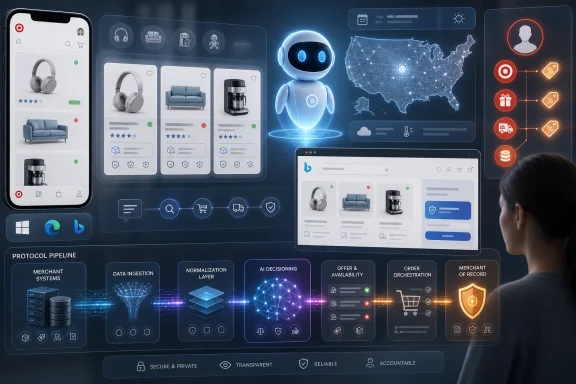
Microsoft Is Turning Product Feeds Into Agent Instructions
For two decades, the merchant feed has been one of the least glamorous artifacts in online retail. It is a spreadsheet-shaped confession: product names, prices, availability, images, shipping details, identifiers, policy metadata, and enough structured information for search engines and marketplaces to decide whether a listing deserves to appear.
UCP changes the status of that feed. In Microsoft’s framing, Universal Commerce Protocol support in Merchant Center gives businesses a way to provide structured data that Copilot can use when it reasons through shopping tasks. The point is not simply to list a boot, a toy, or a home appliance. The point is to make the merchant’s systems legible to an AI agent that is expected to answer a customer’s request, check whether the item exists, evaluate whether the terms are acceptable, and help complete the transaction.
That is why the announcement matters beyond advertising departments. A traditional search ad can send a user to a product page and let the retailer’s website do the rest. An agentic shopping experience needs to understand the checkout path, the return policy, the customer’s account benefits, the merchant’s role in the transaction, and the moment when inventory has disappeared. The feed becomes a negotiated interface between the retailer and the assistant.
Microsoft is not alone in this shift. Google announced its own Universal Commerce Protocol push in January 2026, positioning UCP as a standard for AI agents to work across discovery, checkout, and post-purchase support. That chronology is important because Microsoft’s April move is not the birth of agentic commerce. It is the moment Microsoft starts bringing the same pattern into its advertising and Copilot stack at wider U.S. scale.
The battle is therefore not over whether AI assistants will recommend products. They already do. The battle is over whose structured commerce layer becomes the path of least resistance when a consumer says, in plain language, “find me this thing, make sure it fits my preferences, and buy it if the terms are right.”
Target Shows Why Loyalty Is the First Real Test
Target’s involvement is the most revealing part of Microsoft’s announcement because loyalty programs are where AI shopping stops being a generic catalog query and becomes personal commerce. A shopper asking for a product does not only care about price. They care about free shipping, stored preferences, membership discounts, delivery windows, return convenience, and the quiet stack of benefits that retailers have spent years hiding inside account systems.
Target Circle is a useful test case because it represents a common retail ambition: keep the customer relationship even when the shopping interface moves elsewhere. If Copilot can link to a Target account and show account-specific benefits at checkout, Target gets to preserve some of the value of its loyalty program inside an AI surface it does not fully control. That is a subtle but important shift.
The old fear for retailers was that search engines would commoditize them into blue links and product tiles. The new fear is sharper: AI assistants could collapse entire stores into a single answer and treat merchants as interchangeable fulfillment endpoints. Loyalty integration is one defense against that future. It lets a retailer say, in effect, “this shopper is not just buying a toy; this shopper is a Target customer with a relationship, a history, and benefits that change the comparison.”
Microsoft’s demo, according to the reporting around the announcement, used a child’s toy purchase to contrast a more manual shopping process with a UCP-assisted flow. That example is deliberately ordinary. The promise of agentic commerce is not that it will make luxury purchases magical; it is that it will make repetitive, low-drama transactions feel less like errands.
But ordinary purchases are also where mistakes become dangerous at scale. If the assistant misunderstands inventory, misses a loyalty discount, fails to surface a better shipping option, or treats a substituted product as equivalent, the retailer—not the AI assistant—will still absorb much of the customer anger. Microsoft’s statement that the advertiser remains the merchant of record is therefore both reassuring and ominous. It preserves the retailer’s commercial role, but it also means the retailer keeps operational responsibility in a transaction increasingly mediated by someone else’s assistant.
Copilot Checkout Is Microsoft’s Bid to Keep the User in the Conversation
Microsoft says Copilot Checkout has expanded from desktop into mobile and involves more than 500,000 participating merchants. The number is doing obvious marketing work, but the mobile expansion is the more strategically important claim. Shopping is not a desktop ritual anymore; it is a phone-native behavior conducted in spare moments, often with incomplete attention and high expectations for saved credentials, delivery memory, and frictionless payment.
For Microsoft, this is a familiar platform problem in a new costume. Windows put Microsoft between users and applications. Bing put Microsoft between users and web pages, though never with Google’s dominance. Copilot is an attempt to sit between users and tasks. Commerce is one of the most lucrative tasks left to mediate.
The phrase agentic shopping can sound like conference-room vapor, but the workflow is concrete. A consumer asks for a waterproof dress boot in size 9 between $200 and $500. The assistant needs to parse the request, identify products, determine availability, compare merchants, handle payment constraints, and produce confirmation. Every step where the user does not open a retailer’s site is a step where the assistant gains power.
That does not mean websites vanish. It means the website becomes less central to the transaction for some categories of intent. Product pages may still serve as the canonical source of truth, the legal wrapper, the SEO landing page, and the destination for complex browsing. But for replenishment, simple comparison, and high-intent purchases, the assistant can become the store aisle.
Microsoft’s advantage is not that Copilot is universally beloved. It is that Copilot is being woven into Windows, Edge, Bing, Microsoft 365, and mobile apps as a persistent interface layer. If even a modest share of shopping intent moves through that layer, Merchant Center support for UCP becomes a practical on-ramp for retailers that do not want to be invisible to the assistant.
The Open Protocol Pitch Hides a Platform Power Grab
The industry loves the phrase “open protocol” because it suggests neutrality, interoperability, and relief from one-off integrations. In the abstract, that is a real benefit. Merchants do not want to build custom checkout logic for every assistant, every search engine, every model provider, every wallet, and every retail-media network.
UCP’s appeal is that it promises a common language. Product availability, purchase actions, return policies, account benefits, payment handoff, and order confirmation can be expressed in a way that agents understand. In theory, that reduces integration sprawl and gives merchants a better shot at participating across multiple AI surfaces.
But open protocols do not eliminate platform power. They often relocate it. RSS was open, but feed readers and social platforms still shaped distribution. The web is open, but search ranking determined winners and losers for a generation. UCP may standardize the pipe, while Microsoft, Google, and others compete to decide which products flow through it, in what order, with which disclosures, and under what commercial incentives.
That is where WindowsForum readers should be skeptical. Microsoft Advertising is not a charity for merchant interoperability. It is building the commerce substrate for Copilot, and it is doing so inside an advertising business that already monetizes visibility. The more shoppers trust Copilot to narrow choices, the more valuable placement, eligibility, and structured feed quality become.
There is a difference between an assistant finding the best answer and an advertising platform defining the eligible universe of answers. Microsoft’s public language emphasizes helpfulness, accurate structured product information, and faster transactions. Those goals are not fake. They are also perfectly compatible with a future in which merchants must optimize for agent visibility the way they once optimized for search ranking and marketplace placement.
Inventory Is Where the Magic Either Works or Breaks
The most practical detail in the announcement is that UCP can recognize when a product found online is out of stock at the merchant. That sounds mundane until you remember how often online shopping still fails at the boundary between promise and reality. Search results show unavailable items. Product pages lag behind store systems. Marketplace listings persist after inventory evaporates. Delivery estimates change at checkout.
For an AI assistant, stale inventory is not merely an inconvenience. It undermines the entire premise of delegation. If a user asks an agent to buy something, the agent cannot behave like a search engine that shrugs and sends the user to a dead end. It must either complete the task or explain why it cannot.
That raises the quality bar for merchant data. A retailer that publishes incomplete or stale structured data may still be present in a normal search experience, where the user can click around and recover. In an agentic flow, bad data may cause the assistant to skip the retailer, abandon the transaction, or recommend a competitor with cleaner signals.
This is the uncomfortable part for small and mid-sized merchants. UCP-style commerce may reduce the number of bespoke integrations, but it increases the pressure to maintain disciplined, machine-readable operations. Return policies, customer service paths, shipping costs, product variants, tax handling, and stock states become not only back-office details but ranking and eligibility signals.
For sysadmins and IT teams supporting retailers, the feed is no longer just a marketing artifact. It becomes production infrastructure. If the feed breaks, the store may not just lose ad performance; it may disappear from the assistant’s consideration set.
Windows Users Will See Shopping Become an Operating-System Feature
The Windows angle is not that Microsoft announced a new Windows feature on April 21. It is that Copilot’s commerce ambitions sit inside Microsoft’s broader project to make the assistant a front door for tasks across devices. When an assistant can search, compare, transact, and confirm, shopping becomes less like visiting a site and more like invoking a service.
That has implications for Windows users who already see Copilot appearing in system surfaces, Edge sidebars, Bing results, and Microsoft apps. The assistant that summarizes a document and explains a setting can also become the assistant that recommends a laptop sleeve, a replacement charger, or a software subscription. Microsoft does not need every user to start shopping in Copilot. It needs enough task traffic to make merchants treat Copilot as a serious channel.
The line between utility and advertising will be the pressure point. If Copilot produces a genuinely useful comparison and explains why one product fits the user’s constraints, users may tolerate commerce inside the assistant. If the experience feels like a conversational ad unit wearing a productivity costume, users will learn to route around it.
This is especially sensitive on Windows because Microsoft has already tested user patience with promotional surfaces, default-app nudges, Edge prompts, and Copilot placement. A commerce-capable assistant raises the stakes. The more the operating system becomes a launchpad for shopping, the more users will ask whether recommendations are based on their interests, merchant data quality, paid placement, or some blend Microsoft does not fully expose.
For administrators, the enterprise version of that concern is governance. Consumer shopping may seem outside the corporate perimeter, but Copilot surfaces do not respect the neat conceptual boundaries IT departments prefer. Organizations will need to decide which AI shopping features are acceptable on managed devices, how account linking should be handled, and whether commerce flows introduce data leakage or compliance concerns.
The Merchant of Record Still Carries the Messy Human Burden
Microsoft’s insistence that the advertiser remains the merchant of record is meant to calm retailers. It says Copilot is facilitating the transaction, not becoming the seller. The merchant keeps the customer relationship, the order, the fulfillment obligation, and presumably the legal responsibilities that come with selling the product.
That division is cleaner in a slide deck than in a customer support queue. If Copilot shows the wrong loyalty benefit, surfaces a confusing delivery promise, fails to make a return policy clear, or helps purchase an item the customer later says was not what they intended, who does the customer blame? The payment may run through a merchant system, but the decision path ran through an assistant.
This is the classic platform accountability problem. Platforms mediate attention and shape behavior while sellers handle much of the fallout. Marketplaces have dealt with this for years, but AI assistants add a layer of natural-language ambiguity. A product tile is static; a conversation can create the impression of advice.
The risk is not that AI shopping agents will hallucinate every transaction. The risk is that even a low error rate becomes expensive when applied to millions of mundane purchases. A mistaken recommendation for a children’s toy may be easy to return. A mistaken purchase involving medical equipment, car parts, software licenses, or regulated goods is a different matter.
Microsoft and its retail partners will therefore have to make consent, confirmation, and auditability boringly robust. The assistant should be able to show what the user asked for, what criteria it applied, what merchant data it relied on, and what the user approved. Agentic commerce cannot be built on vibes at checkout.
Google Forced the Tempo, Microsoft Is Choosing Distribution
Google’s January UCP announcement put a marker down: AI search and Gemini would not merely answer shopping questions; they would support native commerce flows. Microsoft’s April response is best understood as distribution strategy. Google has search scale and Android reach. Microsoft has Windows, Edge, Bing, Microsoft Advertising, and a Copilot brand it is pushing aggressively across work and consumer contexts.
The rivalry is not symmetrical. Google’s commercial DNA is search advertising. Microsoft’s is more mixed: enterprise software, cloud, operating systems, gaming, search, and ads. That mix gives Microsoft more surfaces but also more potential user suspicion. A Copilot shopping flow inside a browser may feel expected. A shopping nudge inside a productivity context may feel intrusive.
Target’s role highlights another distinction. Google’s January push came with a broad ecosystem message, including major retailers and payments players. Microsoft’s April framing emphasizes Merchant Center support, Copilot Checkout, and a specific loyalty integration. It is less about announcing the standard and more about showing how the standard can be operationalized inside Microsoft’s commerce stack.
That may be the smarter near-term play. Protocol announcements are abstractions. Loyalty benefits at checkout are tangible. A shopper may not know or care what UCP is, but they understand free shipping, exclusive discounts, and not having to re-enter account information.
The competitive question is whether retailers will treat UCP as a neutral baseline or whether implementations will fragment around the largest AI surfaces. If Google, Microsoft, and other agent platforms all support the same protocol but add their own feed requirements, ranking signals, checkout policies, and account-linking mechanics, merchants may still face the integration maze UCP was supposed to simplify.
Advertising Becomes the Tax on Delegated Intent
The deeper business model is not hard to see. Search advertising monetized expressed intent: a user typed a query, and advertisers paid to appear near the answer. Agentic commerce monetizes delegated intent: a user gives an assistant a task, and merchants compete to be selected by the system that completes it.
That is a more powerful position. In ordinary search, users often see multiple links and make their own messy choices. In an agentic flow, the assistant may narrow the field before the user sees it. The economic value of being in that narrowed set is enormous.
This is why structured data quality and advertising strategy will converge. Merchants will need to ask not only whether their products are eligible for Copilot shopping experiences, but how Copilot interprets their value. Is the return policy machine-readable? Are loyalty benefits visible? Are product variants clear? Are images and descriptions sufficient for an AI comparison? Is inventory fresh? Does the checkout path support the assistant’s handoff?
The answer to those questions will shape who wins. Large retailers have the engineering teams, feed-management vendors, and legal departments to adapt quickly. Smaller merchants may benefit from platform tools that abstract away the complexity, but they will also become more dependent on those tools.
The irony is that agentic commerce is being sold as friction reduction for consumers. For merchants, it may create a new optimization treadmill. First came SEO. Then marketplace optimization. Then retail media. Now comes agent optimization, where the audience is not just the human shopper but the model-mediated system acting on the shopper’s behalf.
The Privacy Trade Is Bigger Than a Checkout Shortcut
Account linking is convenient because it lets Copilot know that a shopper has Target Circle benefits. It is also sensitive because it connects identity, shopping intent, loyalty status, and assistant interaction in a single flow. That does not automatically mean something improper is happening. It does mean the privacy model needs to be more legible than a checkbox.
Consumers are used to linking accounts for streaming services, payment apps, and shopping portals. What is different here is the conversational layer. An assistant can infer intent from vague prompts, remember context depending on settings, and mediate decisions across merchants. The data involved is not just “this user bought this item.” It can include why the user wanted it, what constraints they gave, what alternatives were considered, and which benefits changed the outcome.
For Windows users, this intersects with the broader anxiety around AI personalization. Microsoft has to convince users that Copilot can be helpful without becoming an over-curious shopping broker. The company also has to convince merchants that data shared for transaction facilitation will not simply train a platform that later commoditizes them.
There is a security dimension as well. Agentic checkout depends on clear boundaries around authorization. An assistant can help find and prepare a transaction, but the moment of purchase must remain explicit. Payment credentials, shipping addresses, loyalty accounts, and order confirmations all become attractive targets if the ecosystem is poorly implemented.
The safest version of this future is one where agents are powerful but constrained. They can read structured merchant data, present choices, fill carts, and prepare checkout. They cannot quietly buy, substitute, upsell, or disclose account-linked benefits without user-visible consent. That may sound obvious. The history of online commerce suggests obvious guardrails often arrive only after the first wave of abuse.
The Old Web Storefront Is Becoming a Data Backend
Retailers once built websites as destinations. Then they built mobile apps as loyalty containers. Then they optimized product feeds for Google Shopping, marketplaces, social platforms, and retail media networks. UCP points to the next phase: the storefront becomes partly a backend for third-party agents.
That does not mean branding disappears. In fact, brand trust may become more important when the user sees fewer surfaces. If Copilot presents three options, recognizable retailers and strong loyalty benefits may stand out. But the beautiful product page, the carefully designed category flow, and the promotional homepage matter less when the assistant is doing the navigation.
This is uncomfortable for retailers that invested heavily in owned experiences. It is also inevitable. Consumers do not wake up wanting to admire checkout architecture. They want the right item, at the right price, delivered under acceptable terms. If an assistant can do that reliably, some share of traffic will bypass the traditional storefront.
The strategic response is not to reject agentic commerce. That would be like rejecting mobile search in 2012. The response is to make the merchant’s data, policies, identity, and loyalty value portable enough to survive outside its own website.
Microsoft’s Target example is therefore a preview of the negotiation ahead. Retailers will participate because the traffic may be too valuable to ignore. They will also push to preserve loyalty, customer data, and brand control. Platforms will promise facilitation while building the interface where purchase decisions increasingly happen.
The Real Winners Will Be the Merchants Whose Data Can Be Trusted
The immediate news is narrow: Microsoft Advertising added U.S. general availability for UCP-ready feeds in Merchant Center, expanded Copilot Checkout into mobile, and highlighted Target’s account-linking work for Target Circle. The larger lesson is that AI shopping will reward operational clarity as much as marketing creativity.
- Merchants should treat UCP-ready feeds as commerce infrastructure, not as a side project owned only by advertising teams.
- Loyalty programs will become more valuable when their benefits can surface inside AI-assisted checkout without breaking the merchant relationship.
- Inventory accuracy, return policies, shipping terms, and customer-service metadata will increasingly affect whether assistants recommend or skip a product.
- Windows and Edge users should expect Copilot commerce features to become more visible as Microsoft tries to turn assistant interactions into transactions.
- IT administrators will need policies for account linking, payment flows, and AI shopping features on managed devices before these tools become routine.
- The open-protocol story is real, but the platforms that control ranking, presentation, and checkout context will still hold enormous leverage.
Microsoft’s UCP expansion is not just a retail announcement; it is another step toward a web where the user’s first stop is an agent rather than a page, and where the winners are the merchants whose systems can explain themselves clearly to machines. The companies that adapt early will not merely make checkout faster. They will teach the next generation of AI interfaces how to see their products, their policies, and their customer relationships before a rival assistant quietly makes those choices for them.
References
- Microsoft Teams With Target, Expands 'UCP' For Loyalty 04/21/2026 MediaPost · 2026-05-20T19:50:07.895415
- about.ads.microsoft.com about.ads.microsoft.com