

Tata Electronics is investigating a cybersecurity incident after the extortion group World Leaks reportedly published more than 200,000 files, totaling over 630GB, that researchers say include Apple manufacturing records and Tesla engineering documents tied to products in both companies’ supply chains. The breach is not yet a confirmed catastrophe for Apple or Tesla customers, but it is already a warning about where modern technology risk actually lives. The most sensitive data in the hardware business is often not sitting inside Cupertino or Austin. It is scattered across factories, suppliers, testing labs, logistics partners, and the systems that connect them.
The headline number is easy to grasp: more than 200,000 files and hundreds of gigabytes of data allegedly taken from Tata Electronics. But the more important figure may be much smaller: 181 Apple-related files and folders reportedly identified by cybersecurity researcher Rajshekhar Rajaharia, plus Tesla-related manufacturing and assembly documents that researchers say appeared in searches of the leaked dataset.
That distinction matters because a giant data dump can be noisy, duplicated, stale, or padded with low-value material. The real risk comes from whether the exposed documents map out production processes, component requirements, quality thresholds, and internal coordination between a supplier and its customers. If the reports are accurate, this is not just another folder full of invoices and HR files.
Tata Electronics has confirmed that it detected a cybersecurity incident weeks ago and said it activated response protocols. The company also said its business operations remain unaffected, which is the kind of carefully bounded statement companies make when the factory floor is still moving but the forensic picture is incomplete.
That phrasing leaves room for the central uncertainty. A company can keep producing parts while still losing sensitive files. A supplier can avoid operational disruption while still exposing trade secrets, quality-control instructions, or confidential customer documents. In supply-chain security, “operations remain unaffected” is reassuring only up to a point.
The reported presence of folders labeled “com.apple.factorydata” and documents referencing material specifications is therefore more than embarrassing metadata. It suggests that the leaked cache may include the connective tissue of Apple’s manufacturing machine: the instructions, tolerances, inspections, and component expectations that turn a design into millions of consistent devices.
One reported document, described as a 52-page quality inspection standard for iPhone circuit board components, is exactly the kind of file that sounds boring until it leaks. Quality-control documentation can expose what a company considers acceptable variance, what defects it is watching for, and how tightly it manages suppliers. For competitors, counterfeiters, and attackers, that is not trivia.
Apple has spent decades building a supply chain that is both enormous and unusually disciplined. Its leverage comes not only from design but from being able to impose manufacturing discipline at scale. If supplier-side breaches start surfacing proprietary manufacturing documents, Apple’s security problem is no longer just endpoint hardening or developer account hygiene. It becomes a test of whether every node in its production network can protect information at Apple’s own standard.
That matters because automotive engineering is a long-tail business of components, revisions, supplier coordination, and manufacturing constraints. A single drawing may not reveal a car’s secret sauce, but collections of drawings, specifications, and assembly documents can reveal how a company builds, tests, and sources parts.
Tesla also lives in a particularly exposed competitive environment. It is not merely trying to protect conventional automotive know-how; it is competing with Chinese EV makers, legacy automakers, battery suppliers, software-defined vehicle platforms, and manufacturing specialists. Any credible leak of engineering and component documentation is therefore strategically awkward even if the files are not consumer-facing.
The reported confidentiality notices on some Tesla documents, describing the material as proprietary or trade secret information, do not prove authenticity on their own. Anyone can stamp a document. But if researchers have correctly linked real Tesla program material to a Tata supplier dataset, the incident becomes a case study in how supplier compromise can bypass the security perimeter of a high-profile brand.
This model is particularly effective against suppliers. A company like Tata Electronics may be the direct victim, but the reputational blast radius extends to Apple, Tesla, and anyone else whose documents are found in the dump. The attacker does not need to breach Apple if it can embarrass Apple through a manufacturing partner.
For years, ransomware’s most visible damage was operational disruption: hospitals turning away patients, city governments reverting to paper, manufacturers halting lines. The extortion economy has become subtler and in some ways nastier. The stolen-data model turns confidentiality into the hostage.
That is why this incident should not be measured only by downtime. Tata says operations were unaffected. Good. But if attackers obtained files that reveal production details, quality rules, component specifications, employee records, or customer-linked project data, the harm may unfold through legal review, customer audits, supplier remediation, and quiet redesigns rather than visible factory stoppages.
But users should not confuse “no customer data reported” with “no customer impact.” Supply-chain breaches can affect customers indirectly. They can expose how devices are assembled, how components are validated, where weaknesses might appear in production, or which suppliers and internal systems are involved in particular product lines.
For WindowsForum readers, the lesson is familiar from enterprise IT: the most painful breach is not always the one that steals a password database. Sometimes it is the one that gives an adversary enough institutional knowledge to plan the next attack. Manufacturing documents can become reconnaissance.
That is especially relevant in hardware. If attackers learn which components are used, how firmware-bearing parts are tested, or which quality checks are performed, they may be better positioned to target future suppliers, counterfeit parts, or development workflows. The leak itself may be the opening chapter, not the final act.
That mismatch is where attackers keep finding opportunity. A supplier often needs access to enough information to build or validate a product but may not have the same defensive depth as the brand whose logo appears on the box. The result is a security architecture that looks strong at the center and porous at the perimeter.
This is not just an Apple or Tesla problem. It is the normal shape of modern production. Software companies rely on libraries and cloud providers. Automakers rely on tiered suppliers. PC makers rely on ODMs, firmware vendors, driver developers, and component manufacturers. Even highly integrated companies are only as secure as the partners that receive sensitive data.
The practical consequence is uncomfortable: procurement is now security architecture. Vendor selection, contract language, data segmentation, access expiration, audit rights, encryption practices, and breach notification duties are no longer paperwork. They are the controls that determine whether a supplier breach becomes a contained incident or a multi-company disclosure event.
India’s rise as a manufacturing alternative to China is not just about labor costs or assembly capacity. It is also about whether global firms trust the ecosystem around those factories. That includes power, logistics, regulatory predictability, environmental compliance, and increasingly, data security.
A breach at a major supplier does not undo the case for India. China-based supply chains have had their own security, geopolitical, and operational risks for years. But it does show that manufacturing diversification does not automatically equal risk reduction. It can simply redistribute risk unless the security model travels with the production line.
For Tata, the stakes are especially high because it is trying to occupy a more central role in global electronics. The company does not merely need to reassure its customers that production continues. It needs to show that its data governance, supplier-facing systems, employee controls, and incident response are suitable for the kind of crown-jewel documentation that companies like Apple and Tesla must share to get products built.
Lock everything down too tightly and production slows. Share too broadly and a compromised account, workstation, or server can expose entire product programs. The security challenge is not to hoard information but to make access specific, temporary, monitored, and revocable.
That is where many companies still struggle. Manufacturing environments often combine modern cloud tools with legacy file shares, local engineering systems, shared workstations, third-party maintenance access, and industrial networks that were not built for today’s threat model. Add tight production deadlines and cross-company collaboration, and perfect least-privilege access becomes difficult to sustain.
The reported Tata leak is a reminder that data classification without enforcement is theater. A document stamped confidential is not protected merely because the footer says so. The real question is who could open it, where it was stored, whether access was logged, whether copies were controlled, and how quickly credentials or systems were isolated once suspicious activity appeared.
That uncertainty should not be used as a shield by affected companies. It should be used as a reason for precision. The public needs to know what categories of data were exposed, which customers were affected, whether personal information was included, and whether sensitive engineering files were current, obsolete, or already widely distributed among suppliers.
The temptation in incidents like this is for vendors to say as little as possible while investigators work. That instinct is understandable, especially when trade secrets and customer contracts are involved. But vague statements create a vacuum, and extortion groups are very good at filling vacuums.
The right disclosure posture is not panic and not denial. It is staged specificity: confirm the incident, define what is known, state what is not yet verified, explain whether operations or customer data are affected, and update the record as forensic work continues. Anything less leaves customers, partners, and employees guessing.
The immediate lesson is to stop treating third-party risk as a questionnaire exercise. Annual vendor attestations and checkboxes may satisfy procurement, but they do not answer the operational questions that matter during a breach. Where is shared data stored? Who can download it? How long do suppliers retain it? Are sensitive files watermarked per recipient? Can access be revoked quickly?
The second lesson is that data minimization is not a privacy slogan. It is a breach-containment strategy. If a supplier does not need historical engineering packages, old identity documents, or broad project folders, those files should not be sitting in reachable systems. Every unnecessary copy becomes future evidence on a leak site.
The third lesson is that incident response contracts should be written before the incident. When a supplier is breached, customers need notification timelines, forensic cooperation, log preservation, evidence handling, and communication rules. Those terms are much harder to negotiate while a ransomware group is publishing samples.
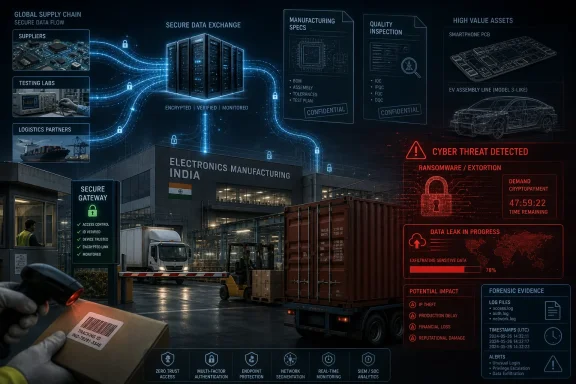 The Breach Is About Manufacturing Power, Not Just Stolen Files
The headline number is easy to grasp: more than 200,000 files and hundreds of gigabytes of data allegedly taken from Tata Electronics. But the more important figure may be much smaller: 181 Apple-related files and folders reportedly identified by cybersecurity researcher Rajshekhar Rajaharia, plus Tesla-related manufacturing and assembly documents that researchers say appeared in searches of the leaked dataset.That distinction matters because a giant data dump can be noisy, duplicated, stale, or padded with low-value material. The real risk comes from whether the exposed documents map out production processes, component requirements, quality thresholds, and internal coordination between a supplier and its customers. If the reports are accurate, this is not just another folder full of invoices and HR files.
Tata Electronics has confirmed that it detected a cybersecurity incident weeks ago and said it activated response protocols. The company also said its business operations remain unaffected, which is the kind of carefully bounded statement companies make when the factory floor is still moving but the forensic picture is incomplete.
That phrasing leaves room for the central uncertainty. A company can keep producing parts while still losing sensitive files. A supplier can avoid operational disruption while still exposing trade secrets, quality-control instructions, or confidential customer documents. In supply-chain security, “operations remain unaffected” is reassuring only up to a point.
Apple’s India Bet Now Has a Security Shadow
Tata Electronics is not a marginal Apple vendor. It has become a major part of Apple’s manufacturing expansion in India, including iPhone-related operations in Hosur and broader efforts to diversify production beyond China. That strategy has been driven by geopolitics, tariffs, resilience planning, and the obvious desire not to have one country serve as the hinge for the world’s most valuable consumer electronics franchise.The reported presence of folders labeled “com.apple.factorydata” and documents referencing material specifications is therefore more than embarrassing metadata. It suggests that the leaked cache may include the connective tissue of Apple’s manufacturing machine: the instructions, tolerances, inspections, and component expectations that turn a design into millions of consistent devices.
One reported document, described as a 52-page quality inspection standard for iPhone circuit board components, is exactly the kind of file that sounds boring until it leaks. Quality-control documentation can expose what a company considers acceptable variance, what defects it is watching for, and how tightly it manages suppliers. For competitors, counterfeiters, and attackers, that is not trivia.
Apple has spent decades building a supply chain that is both enormous and unusually disciplined. Its leverage comes not only from design but from being able to impose manufacturing discipline at scale. If supplier-side breaches start surfacing proprietary manufacturing documents, Apple’s security problem is no longer just endpoint hardening or developer account hygiene. It becomes a test of whether every node in its production network can protect information at Apple’s own standard.
Tesla’s Reported Files Point to Engineering Exposure
The Tesla material reportedly found in the leak appears different in character but similar in sensitivity. Researchers reportedly identified references to charge-port controller systems, assembly instructions, engineering drawings, component specifications, and files linked to Project Highland, the codename associated with the redesigned Model 3.That matters because automotive engineering is a long-tail business of components, revisions, supplier coordination, and manufacturing constraints. A single drawing may not reveal a car’s secret sauce, but collections of drawings, specifications, and assembly documents can reveal how a company builds, tests, and sources parts.
Tesla also lives in a particularly exposed competitive environment. It is not merely trying to protect conventional automotive know-how; it is competing with Chinese EV makers, legacy automakers, battery suppliers, software-defined vehicle platforms, and manufacturing specialists. Any credible leak of engineering and component documentation is therefore strategically awkward even if the files are not consumer-facing.
The reported confidentiality notices on some Tesla documents, describing the material as proprietary or trade secret information, do not prove authenticity on their own. Anyone can stamp a document. But if researchers have correctly linked real Tesla program material to a Tata supplier dataset, the incident becomes a case study in how supplier compromise can bypass the security perimeter of a high-profile brand.
World Leaks Shows the Ransomware Business Has Moved Beyond Ransomware
The group named in the reports, World Leaks, is described as an extortion actor rather than a traditional encrypt-and-demand ransomware crew. That reflects a broader shift in cybercrime. Attackers no longer need to shut down a factory to create leverage; they can steal files, publish samples, and let customers, regulators, journalists, and competitors do the pressure work.This model is particularly effective against suppliers. A company like Tata Electronics may be the direct victim, but the reputational blast radius extends to Apple, Tesla, and anyone else whose documents are found in the dump. The attacker does not need to breach Apple if it can embarrass Apple through a manufacturing partner.
For years, ransomware’s most visible damage was operational disruption: hospitals turning away patients, city governments reverting to paper, manufacturers halting lines. The extortion economy has become subtler and in some ways nastier. The stolen-data model turns confidentiality into the hostage.
That is why this incident should not be measured only by downtime. Tata says operations were unaffected. Good. But if attackers obtained files that reveal production details, quality rules, component specifications, employee records, or customer-linked project data, the harm may unfold through legal review, customer audits, supplier remediation, and quiet redesigns rather than visible factory stoppages.
The Customer Data Question Is Narrower Than the Business Risk
Based on the reports so far, there is no clear evidence that Apple or Tesla consumer customer data was exposed. That is an important distinction. A leak of manufacturing and engineering documents is not the same as a leak of iCloud accounts, Tesla owner profiles, payment data, or vehicle telemetry.But users should not confuse “no customer data reported” with “no customer impact.” Supply-chain breaches can affect customers indirectly. They can expose how devices are assembled, how components are validated, where weaknesses might appear in production, or which suppliers and internal systems are involved in particular product lines.
For WindowsForum readers, the lesson is familiar from enterprise IT: the most painful breach is not always the one that steals a password database. Sometimes it is the one that gives an adversary enough institutional knowledge to plan the next attack. Manufacturing documents can become reconnaissance.
That is especially relevant in hardware. If attackers learn which components are used, how firmware-bearing parts are tested, or which quality checks are performed, they may be better positioned to target future suppliers, counterfeit parts, or development workflows. The leak itself may be the opening chapter, not the final act.
Supply-Chain Security Keeps Failing at the Edges
Large technology companies have spent years hardening their central systems. They have security teams, bug bounty programs, identity controls, internal red teams, and incident response playbooks. Their suppliers, however, operate under a different mix of cost pressure, customer demands, industrial systems, local infrastructure, and uneven security maturity.That mismatch is where attackers keep finding opportunity. A supplier often needs access to enough information to build or validate a product but may not have the same defensive depth as the brand whose logo appears on the box. The result is a security architecture that looks strong at the center and porous at the perimeter.
This is not just an Apple or Tesla problem. It is the normal shape of modern production. Software companies rely on libraries and cloud providers. Automakers rely on tiered suppliers. PC makers rely on ODMs, firmware vendors, driver developers, and component manufacturers. Even highly integrated companies are only as secure as the partners that receive sensitive data.
The practical consequence is uncomfortable: procurement is now security architecture. Vendor selection, contract language, data segmentation, access expiration, audit rights, encryption practices, and breach notification duties are no longer paperwork. They are the controls that determine whether a supplier breach becomes a contained incident or a multi-company disclosure event.
India’s Manufacturing Moment Meets the Cybersecurity Test
The Tata incident lands at a sensitive moment for India’s electronics ambitions. Apple’s expansion in India has been watched as a sign of strategic diversification, with Tata playing a key role in the country’s emergence as a serious iPhone manufacturing hub. That makes the breach politically and commercially significant beyond the immediate companies involved.India’s rise as a manufacturing alternative to China is not just about labor costs or assembly capacity. It is also about whether global firms trust the ecosystem around those factories. That includes power, logistics, regulatory predictability, environmental compliance, and increasingly, data security.
A breach at a major supplier does not undo the case for India. China-based supply chains have had their own security, geopolitical, and operational risks for years. But it does show that manufacturing diversification does not automatically equal risk reduction. It can simply redistribute risk unless the security model travels with the production line.
For Tata, the stakes are especially high because it is trying to occupy a more central role in global electronics. The company does not merely need to reassure its customers that production continues. It needs to show that its data governance, supplier-facing systems, employee controls, and incident response are suitable for the kind of crown-jewel documentation that companies like Apple and Tesla must share to get products built.
The Hardest Files to Protect Are the Ones Factories Actually Need
There is a reason supplier breaches are so difficult to prevent. Manufacturing depends on information flow. Engineers need specifications. Quality teams need inspection documents. Line managers need assembly instructions. Vendors need purchase orders, material requirements, and revision histories.Lock everything down too tightly and production slows. Share too broadly and a compromised account, workstation, or server can expose entire product programs. The security challenge is not to hoard information but to make access specific, temporary, monitored, and revocable.
That is where many companies still struggle. Manufacturing environments often combine modern cloud tools with legacy file shares, local engineering systems, shared workstations, third-party maintenance access, and industrial networks that were not built for today’s threat model. Add tight production deadlines and cross-company collaboration, and perfect least-privilege access becomes difficult to sustain.
The reported Tata leak is a reminder that data classification without enforcement is theater. A document stamped confidential is not protected merely because the footer says so. The real question is who could open it, where it was stored, whether access was logged, whether copies were controlled, and how quickly credentials or systems were isolated once suspicious activity appeared.
Ransomware Reporting Still Rewards the Loudest Claim
There is another caution here: not every file in a criminal leak site should be treated as authenticated fact. Researchers have reportedly reviewed parts of the dataset, but the full scope and authenticity of every file remain unverified. Criminal groups have incentives to exaggerate, mislabel, recycle, or mix legitimate files with unrelated material.That uncertainty should not be used as a shield by affected companies. It should be used as a reason for precision. The public needs to know what categories of data were exposed, which customers were affected, whether personal information was included, and whether sensitive engineering files were current, obsolete, or already widely distributed among suppliers.
The temptation in incidents like this is for vendors to say as little as possible while investigators work. That instinct is understandable, especially when trade secrets and customer contracts are involved. But vague statements create a vacuum, and extortion groups are very good at filling vacuums.
The right disclosure posture is not panic and not denial. It is staged specificity: confirm the incident, define what is known, state what is not yet verified, explain whether operations or customer data are affected, and update the record as forensic work continues. Anything less leaves customers, partners, and employees guessing.
What IT Pros Should Read Between the Lines
For administrators and security teams, the Tata breach is not a distant manufacturing story. It is a mirror. Most organizations have their own version of this problem: a trusted vendor, a managed service provider, a design contractor, a payroll processor, a SaaS integration, or a support partner with access to material the core business would never publish.The immediate lesson is to stop treating third-party risk as a questionnaire exercise. Annual vendor attestations and checkboxes may satisfy procurement, but they do not answer the operational questions that matter during a breach. Where is shared data stored? Who can download it? How long do suppliers retain it? Are sensitive files watermarked per recipient? Can access be revoked quickly?
The second lesson is that data minimization is not a privacy slogan. It is a breach-containment strategy. If a supplier does not need historical engineering packages, old identity documents, or broad project folders, those files should not be sitting in reachable systems. Every unnecessary copy becomes future evidence on a leak site.
The third lesson is that incident response contracts should be written before the incident. When a supplier is breached, customers need notification timelines, forensic cooperation, log preservation, evidence handling, and communication rules. Those terms are much harder to negotiate while a ransomware group is publishing samples.
The Useful Lessons Are Already Visible
The full forensic story may take weeks or months, and some of it may never become public. Still, the reported facts are concrete enough for technology buyers, security teams, and manufacturing partners to act now. The point is not to assume the worst about Tata, Apple, or Tesla; it is to recognize the pattern before the next supplier’s name appears on a leak site.- Companies should assume that confidential manufacturing and engineering documents held by suppliers are high-value breach targets, not back-office paperwork.
- Security teams should review whether suppliers retain more sensitive files than they need for current production or support obligations.
- Vendor contracts should require fast breach notification, forensic cooperation, access-log preservation, and clear handling rules for customer-linked intellectual property.
- Manufacturers should treat file access, download behavior, and unusual archive creation as security events worth monitoring in near real time.
- Customers should wait for confirmed findings before assuming personal data exposure, but they should not dismiss supplier leaks simply because consumer account data has not been reported.
References
- Primary source: TechRepublic
Published: Tue, 23 Jun 2026 21:34:55 GMT
Tata Electronics Leak Exposes 200,000 Files, Including Apple and Tesla Documents
Tata Electronics is investigating a cyber incident after leaked files reportedly included manufacturing documents for Apple and Tesla.www.techrepublic.com
- Related coverage: mactech.com
Apple manufacturing partner Tata Electronics hit by a cyber breach - MacTech.com
Apple manufacturing partner Tata Electronics has confirmed it’s been hit by a “cybersecurity incident,” reports Reuters (a subscription is required to read the article). The attack was by a group known as World Leaks. Tata Electronics says that a “few weeks ago” it identified a cybersecurity inciwww.mactech.com
- Related coverage: business-standard.com
- Related coverage: ndtv.com
- Related coverage: thedailystar.net
Tata Electronics hack claims to leak Apple, Tesla data: report
A ransomware attack on Tata Electronics has reportedly led to the leak of confidential manufacturing documents belonging to Apple and Tesla.www.thedailystar.net - Related coverage: bsmedia.business-standard.com
