

Tech Mahindra’s chief executive Mohit Joshi told Business Today at Davos that the company sees a positive hiring outlook for 2026 while doubling down on company-wide AI training and provisioning of commercial AI tools — a posture that ties talent strategy, product partnerships and a three‑year turnaround playbook into a single corporate bet on an AI‑driven services rebound.
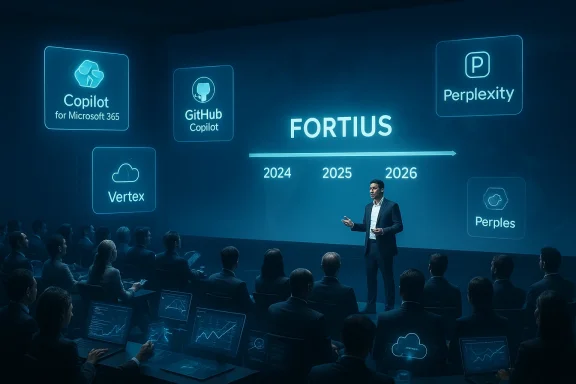
Tech Mahindra has spent the last 18 months reshaping its go‑to‑market and talent approach under a program management umbrella popularly referred to as Project Fortius. The stated goals are to improve structural mix, firm up margins and move the company higher up the value chain into AI, cloud, telecom modernization and engineering services. Executives and market coverage say the company is now executing a staged three‑year plan — a stabilization phase followed by the harvesting of gains — and that AI capability building is a central lever in that plan. Tech Mahindra also remains a very large employer: public communications and company statements place the workforce at roughly the mid‑hundreds of thousands globally, and management has publicly described a substantial internal upskilling push across that population. Those scale and reskilling numbers frame why the company’s statements about licensing Copilot, Perplexity and Gemini models matter beyond marketing — they are operational signals about tooling, governance and client delivery scale.
Source: Business Today Tech Mahindra’s Mohit Joshi Talks About Hiring Outlook | BT DAVOS 2026 - /wef-2026 BusinessToday
 Background
Tech Mahindra has spent the last 18 months reshaping its go‑to‑market and talent approach under a program management umbrella popularly referred to as Project Fortius. The stated goals are to improve structural mix, firm up margins and move the company higher up the value chain into AI, cloud, telecom modernization and engineering services. Executives and market coverage say the company is now executing a staged three‑year plan — a stabilization phase followed by the harvesting of gains — and that AI capability building is a central lever in that plan. Tech Mahindra also remains a very large employer: public communications and company statements place the workforce at roughly the mid‑hundreds of thousands globally, and management has publicly described a substantial internal upskilling push across that population. Those scale and reskilling numbers frame why the company’s statements about licensing Copilot, Perplexity and Gemini models matter beyond marketing — they are operational signals about tooling, governance and client delivery scale. What Mohit Joshi said at Davos: the short version
- The hiring outlook is positive for Tech Mahindra in 2026, with momentum expected in targeted verticals and geographies.
- The company has invested heavily in AI training and has moved to provide licensed access to a range of commercial AI tools to employees — specifically naming Microsoft Copilot, Perplexity for sales use‑cases, and Google’s Gemini 2.5 in enterprise form. Joshi framed this as both an internal productivity investment and a demonstration of the company’s ability to sell AI‑enabled services at scale.
- Joshi warned against unrealistic short‑term productivity claims for large enterprises, arguing that AI ROI depends on prior simplification, modernization and data framing — large companies are like cruise ships, not kayaks. He said single‑year, high‑double‑digit productivity leaps are generally a mirage for big organisations.
Overview: Where this fits in the industry landscape
The services industry is re‑tooling
The global IT services industry has transitioned from a vendor ecosystem focused on labour arbitrage to one where vendors are judged on their ability to deliver measurable AI‑driven outcomes. That shift is why partnerships with hyperscalers and the rollout of commercial AI assistants within employee populations are now front‑page corporate strategy items. Tech Mahindra’s public collaboration with Microsoft around Copilot for Microsoft 365 and GitHub Copilot and its more recent partnership to accelerate adoption of Google Cloud’s Gemini Enterprise are textbook examples of this pivot. These are not mere PR tie‑ups — they serve as both internal productivity investments and avenues to sell integrated AI solutions to clients.Talent is the choke point
A central constraint facing all large systems integrators is the mismatch between model‑centric excitement (LLMs, agents, foundation models) and enterprise readiness (data integration, security, governance, business process rewiring). That gap is why CEOs and CHROs are focusing on mandatory certifications, belt‑style skilling roadmaps and tool licensing: to create a consistently capable workforce that can both deploy and govern AI in client environments. Tech Mahindra’s internal training history and scale make its claims consequential for buyer confidence across Telco, BFSI, manufacturing and other verticals it serves.Hiring outlook — what “positive” looks like in practice
Where hiring will concentrate
Mohit Joshi framed the 2026 hiring outlook as selective and demand‑driven rather than a broad headcount binge. Expect the hiring focus to be:- Freshers and early career software engineers to optimize the cost pyramid and increase internal fulfilment rates.
- AI‑aware practitioners and engineers with cloud, data‑ops and MLOps skills.
- Domain specialists in telecom, BFSI, healthcare and manufacturing — verticals where Tech Mahindra claims differentiated process knowledge.
What this means for job seekers and clients
- For fresh graduates and early career talent, Tech Mahindra’s policy implies significant entry‑level intake and structured career tracks — particularly if Project Fortius continues to prioritize pyramid optimization.
- For enterprise clients, a workforce increasingly certified on commercial AI tools reduces implementation risk and shortens time‑to‑value for standardized use cases. However, client firms should still validate vendor governance and data residency controls case‑by‑case.
AI training and tooling: what Tech Mahindra is buying and why it matters
Microsoft Copilot and GitHub Copilot — mainstreaming copilots for knowledge work and devs
Tech Mahindra announced a formal collaboration with Microsoft to deploy Copilot for Microsoft 365 (targeting knowledge workers) and GitHub Copilot (targeting developers). Public statements from Tech Mahindra indicate an initial Copilot rollout for thousands of employees and GitHub Copilot for several thousand developers, positioning the firm as an early large‑scale adopter among global systems integrators. Internally, these tools aim to boost writer productivity, automate repetitive office tasks, and accelerate developer throughput — all necessary to lift utilisation and margins.Gemini Enterprise and Gemini 2.5 — moving toward agentic AI at enterprise scale
In December 2025 Tech Mahindra announced a strategic collaboration to accelerate enterprise adoption of Gemini Enterprise, leveraging Google’s Gemini 2.5 multimodal models. The stated objective is to create Agentic AI solutions — specialized, reasoning agents that integrate with data pipelines, BigQuery and Vertex AI — and to offer governance and guardrails suitable for regulated clients. That partnership gives Tech Mahindra a pathway to build advanced, enterprise‑grade agents for customers where reasoning across documents, code and multimodal inputs is required.Perplexity for sales teams — a sales‑enablement play
Mohit Joshi specifically referenced Perplexity licences for sales teams during the Davos interview. Perplexity markets enterprise products tailored for sales use cases — prospect research, competitive intelligence and CRM enrichment — and many commercial teams have adopted it as a fast research and briefing tool. However, independent confirmation that Tech Mahindra has purchased Perplexity Enterprise for its sales organisation outside of the Davos comment is limited in public filings; the broader industry trend of Perplexity in sales functions is well documented. That makes Joshi’s statement credible in context but — from a verification perspective — a point to watch for formal confirmation in corporate communications.Why licensing matters operationally
Licensing and managed deployment of these tools at scale signals three important shifts:- Governance becomes possible: enterprise licences typically offer controls for data retention, query logging and model selection that consumer accounts do not. This is essential for regulated clients.
- Costs are predictable: a licencing model lets Tech Mahindra plan seat‑based productivity gains and factor those into margin assumptions.
- Upskilling is tool‑driven: training tied to actual tool usage (Copilot workflows, Gemini agent design) is more likely to produce measurable improvements than abstract LLM theory courses.
The productivity mirage — why caution matters
Mohit Joshi’s “cruise ship” metaphor is an industry‑useful corrective: AI can rapidly deliver improvements to an individual’s personal productivity, but translating those gains to enterprise process outcomes requires prior work on systems, data and organisational design. Several empirical lessons should temper expectations:- Personal productivity lifts are quick, visible and easy to claim; enterprise outcome measures (cost, revenue, error rates, time‑to‑market) require integrated instrumentation and time to manifest.
- Many pilots fail to scale because data is fragmented, governed inconsistently, or not mapped to product/operational metrics. The result is pilot success but production failure.
- Vendor selection and model choice are not neutral — they influence vendor lock‑in, licensing cost profiles and integration effort. Enterprises should quantify these trade‑offs before standardization.
Strengths of Tech Mahindra’s approach
- Strategic hyperscaler partnerships: formal programs with Microsoft and Google Cloud give Tech Mahindra privileged access to tooling, training programs and co‑selling opportunities. That improves credibility in sales cycles for large enterprises seeking managed AI adopters.
- Scale of reskilling: public filings and reporting indicate a sustained program of AI skilling across the workforce, a necessary step to elevate baseline capability and internal fulfilment. Mandatory certification pathways (white/blue/brown/black belt style frameworks) suggest a methodical approach to capability stacking.
- Clear commercial narrative: Tech Mahindra links hiring, cost‑pyramid optimization and tool provisioning to its margin targets under Project Fortius, giving investors and clients a transparent line of sight on the “why” behind hiring announcements.
Risks and unanswered questions
1. Governance, compliance and data residency
Provisioning external models and copilot tools at enterprise scale introduces data flow and residency questions. The Gemini Enterprise announcements emphasise guardrails — but implementation details matter. Enterprises with sensitive data will need to verify vendor contracts, data processing terms, and whether models are hosted with on‑shore residency guarantees.2. Vendor and model lock‑in
Heavy licensing of Copilot, Perplexity and Gemini can accelerate value capture, but it can also create long‑term dependencies on specific model families and APIs. That creates commercial and technical switching costs at a time when model architectures and providers remain rapidly iterating.3. The skills gap in advanced AI roles
Large upskilling percentages are encouraging, yet advanced roles — prompt engineering at scale, data‑to‑AI platform engineering, agent orchestration and model safety engineering — remain scarce. Public numbers that show “X percent trained” often aggregate basic awareness and advanced practitioner counts, obscuring how many employees are truly production ready. Independent reporting suggests the industry still has a relatively small population of advanced GenAI practitioners compared to the total workforce. That talent scarcity could bottleneck deal delivery if demand ramps faster than practitioner supply.4. Financial and execution risk tied to Project Fortius
Project Fortius is explicit about margin targets and timeline. Execution delays, shorter‑than‑expected deal wins, or higher-than‑expected retooling costs could compress margins and push hiring plans into a more conservative posture. Market observers have noted both improved margins and the pressure to meet stretch targets, making delivery discipline critical.What customers and partners should look for when Tech Mahindra proposes AI solutions
- Clear SLAs and measurable KPIs tied to business outcomes rather than generic “productivity” claims. Contracts should include milestones for measurable metrics (time saved, error reduction, revenue uplift).
- Documented data handling and model governance policies, including log retention, fine‑tuning controls, and incident response.
- Evidence of productionized pilots migrating to repeatable, secure agent architectures (not one‑off notebooks). Gemini Enterprise and similar offerings are designed for this, but proof in deployment counts.
Short tactical checklist for enterprises evaluating Tech Mahindra’s hiring and AI posture
- Request evidence of tool rollouts: number of Copilot seats, how GitHub Copilot is embedded into CI/CD, and whether Perplexity or other tools are governed by enterprise workspace policies.
- Ask for a copy of the AI competency framework (white/blue/brown/black belts) and the percentage of employees at each level. That helps differentiate marketing from deep capability.
- Validate Gemini‑agent use cases with architecture diagrams showing BigQuery/Vertex integrations and guardrail enforcement.
- Include binding KPIs in supplier contracts that align with business outcomes and milestone payments tied to measured impact.
Long‑term strategic implications for the services market
- Standardization on hyperscaler stacks will accelerate; vendors that can demonstrate deep operational playbooks around Copilot‑style productivity, developer copilots and agent frameworks will have competitive advantage.
- Margin competition will shift from labour price to delivery velocity and IP‑driven outcomes — firms that can reduce client operating costs through agentic automation will win differentiated pricing power. Project Fortius explicitly targets this dynamic by balancing hiring, margin repair and product‑led services.
- Talent pyramids will reshape: freshers and junior engineers will remain important for cost optimization, but the real scarcity and premium will be for advanced AI engineers, safety specialists and data‑to‑AI platform architects. Firms that invest early in these scarce roles will command higher multiple in the medium term.
Final analysis: measured optimism with guardrails
Tech Mahindra’s Davos message — optimistic hiring outlook, broad licensing of AI tools and focus on enterprise‑grade agents — is credible in the context of the company’s recent partnerships and its Project Fortius roadmap. The combination of Microsoft Copilot scale‑outs and a formal Gemini Enterprise partnership gives Tech Mahindra a dual‑hyperscaler playbook that can appeal to a wide set of enterprise buyers. However, three cautions are essential for readers parsing these developments:- When leadership points to licenced tool rollouts, treat those as necessary enablers — not proof of outcome. The hard work is mapping those tools to revenue‑grade processes and embedding governance around data and model use.
- Public statements about Perplexity use in sales teams are consistent with the broader market trend, but direct, independent confirmation of Tech Mahindra’s Perplexity seat counts beyond the Davos remark is limited in public filings. Mark such claims as management statements pending formal confirmation.
- Project Fortius sets ambitious margin and structural targets; meeting them requires sustained deal momentum and disciplined cost execution. Any slowdown in sales or unexpected retooling costs could slow hiring or alter the pyramid strategy.
Conclusion
Mohit Joshi’s Davos briefing distilled a practical, risk‑aware version of what many IT services CEOs are now saying: AI adoption will drive opportunity, but only if it is backed by scaleable tooling, disciplined governance and deep skilling across a firm’s delivery organisation. Tech Mahindra has chosen a path that combines hyperscaler partnerships, internally provisioned copilots and a hiring posture that favours selective growth in strategic areas. That blend is defensible and consistent with the company’s public turnaround roadmap, but the difference between promise and performance will show up in the next set of quarters — in deal conversions, margin movements and the company’s ability to convert personal productivity gains into repeatable, measurable business outcomes.Source: Business Today Tech Mahindra’s Mohit Joshi Talks About Hiring Outlook | BT DAVOS 2026 - /wef-2026 BusinessToday
