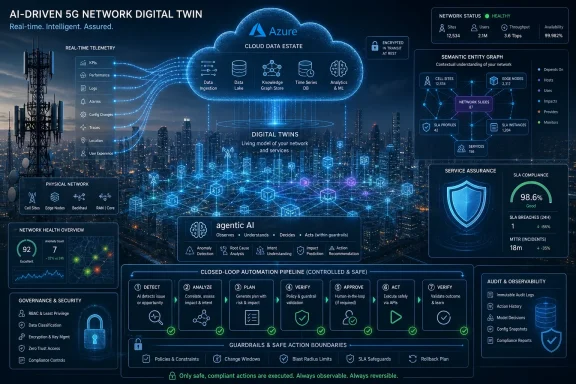
Tech Mahindra and Microsoft announced on June 30, 2026, a collaboration to showcase an AI-powered 5G Network Digital Twin for telecom operators, while Tech Mahindra’s next quarterly earnings checkpoint is expected in mid-July as investors measure progress toward its FY27 margin targets. The two items belong in the same story because one sells the future and the other audits the present. For Tech Mahindra, the promise is that AI can move its telecom franchise beyond labor-heavy services into higher-value platforms. The risk is that the market has heard enough AI adjectives; it now wants proof in revenue, margins, and deal conversion.
Tech Mahindra has always had a more natural claim to telecom credibility than many Indian IT services peers. Its heritage, client base, and operating vocabulary are deeply tied to communications service providers, network modernization, and the messy economics of carrier infrastructure. That is why the Microsoft collaboration is not merely another “AI partnership” announcement dropped into a crowded news cycle.
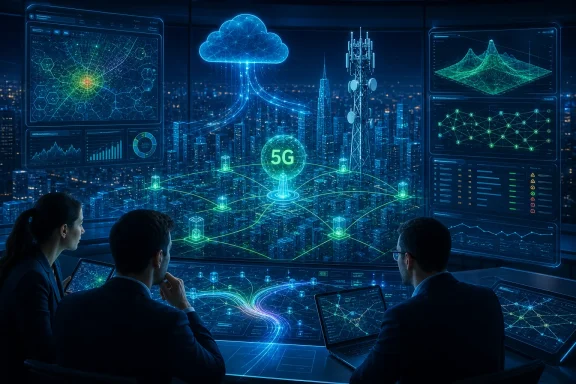
The proposed 5G Network Digital Twin is meant to create a live, intelligent model of telecom infrastructure, allowing operators to simulate changes, detect issues earlier, and optimize complex network environments before failures become customer-visible events. In plain terms, it is a virtual control room for networks that are becoming too distributed, too software-defined, and too expensive to manage by instinct.
Microsoft’s role matters because telecom digital twins need more than consulting decks. They need cloud scale, data fabric, model governance, AI tooling, and integration paths into existing operational systems. Azure, Azure AI Foundry, Microsoft Fabric, and related services give Tech Mahindra a platform story that can travel across carriers instead of being rebuilt from scratch for each deployment.
That is the optimistic reading. The harder reading is that digital twins have existed in industrial technology conversations for years, and telecom has been slower to turn them into repeatable economics. The carrier boardroom does not buy a digital twin because it sounds futuristic; it buys one if it reduces truck rolls, cuts energy use, improves uptime, accelerates rollout, or helps monetize 5G services that have so far underwhelmed investors.
That leaves operators searching for savings, automation, and enterprise services. A network digital twin fits neatly into that pressure because it reframes AI as operational leverage rather than novelty. If a carrier can model network load, predict degradation, plan capacity, and test configuration changes virtually, it can avoid some of the most expensive mistakes in live infrastructure.
This is also where Tech Mahindra’s pitch becomes more interesting than a generic AI services announcement. Telecom networks are full of domain-specific data relationships: topology, spectrum behavior, routing dependencies, device classes, service-level commitments, energy consumption, and legacy system constraints. A useful twin cannot be a pretty dashboard sitting on stale data; it has to understand the operational grammar of the network.
The Microsoft connection helps with the industrialization problem, but it does not erase it. Data quality remains the graveyard of many AI modernization projects. If the underlying inventory is incomplete, if OSS and BSS systems disagree, if edge telemetry is inconsistent, or if field data is trapped in old workflows, the twin becomes an expensive mirror with cracks in it.
The phrase non-linear growth gets abused in IT services, but it captures the ambition here. Traditional outsourcing grows by adding people, managing utilization, and squeezing delivery efficiency. Platform-led AI offerings promise a different equation: reusable assets, higher-value consulting, annuity-like modernization work, and potentially better pricing power.
That does not mean Tech Mahindra suddenly becomes a software company. The real business is still likely to include integration, customization, migration, managed services, and change management. But the wrapper matters because a packaged telecom AI solution can shift the conversation from “how many engineers can you supply?” to “what measurable network outcome can you deliver?”
The distinction is important for margins. If the Microsoft-backed offering becomes a serious client door-opener, Tech Mahindra can attach advisory, integration, data engineering, and managed AI operations work around it. If it remains a showcase item, it will be useful for branding but less meaningful for earnings.
For Microsoft, the appeal is obvious. Telecom workloads are complex, data-rich, and strategically important, but operators are cautious buyers. A systems integrator with telecom credibility can help Microsoft translate Azure capabilities into carrier-specific deployments rather than generic cloud consumption.
For Tech Mahindra, Azure is not only a technology base. It is a distribution channel, a credibility layer, and a procurement accelerant. Many large enterprises and carriers already have Microsoft commercial relationships, security reviews, and cloud commitments. Building on that foundation can reduce friction compared with asking a telecom client to adopt a wholly unfamiliar stack.
The partnership also reflects a broader pattern in enterprise AI. Hyperscalers provide the compute, model tooling, governance layer, and marketplace gravity; services firms provide industry context, integration labor, and customer-specific delivery. The winners will be the firms that make that combination feel like a product rather than a science project.
Tech Mahindra has been judged heavily on its margin improvement plan. Management has repeatedly pointed toward a 15 percent EBIT margin ambition for FY27, and the market has treated that target as a test of credibility. A telecom AI partnership may improve sentiment, but it cannot substitute for operating progress.
Investors will watch whether revenue growth is stabilizing, whether deal wins are translating into execution, and whether the company can protect margins while investing in AI talent and platforms. The tension is obvious: the firm needs to spend to build higher-value offerings, but it also needs to prove that those investments are not delaying margin recovery.
That is why the July result matters. If margins improve and deal commentary is constructive, the Microsoft announcement looks like part of a disciplined repositioning. If margins disappoint or telecom remains weak, the same announcement risks being read as narrative cover for a slower turnaround.
Microsoft has also worked with other telecom technology players, and carriers rarely want to be locked into a single integrator’s worldview. A large operator may use one vendor for cloud, another for radio access network modernization, another for observability, and another for managed services. Tech Mahindra has to prove it can orchestrate across that landscape, not merely appear in it.
The competitive challenge is partly technical and partly commercial. A digital twin must work across hybrid networks, vendor-diverse equipment, legacy systems, and regulatory environments. It must also produce a business case that survives procurement scrutiny, cybersecurity review, and the CFO’s impatience with AI pilots.
There is also the question of ownership. Who owns the model? Who owns the operational recommendations? Who is accountable if an AI-assisted network change causes an outage? Telecom operators are conservative for a reason, and the closer AI gets to production network decisions, the more governance becomes a buying criterion rather than a footnote.
The connection to Windows and Microsoft’s broader enterprise estate is indirect but meaningful. As private 5G, edge computing, AI PCs, Intune-managed endpoints, and cloud-managed operations converge, Microsoft wants to be the control plane for more than desktops and productivity software. Telecom modernization becomes another layer in the same strategic map.
A smarter carrier network also matters to enterprises deploying always-connected PCs, field devices, industrial IoT, and branch connectivity. The more networks can self-optimize and recover, the more viable those distributed Windows and edge workloads become. But that benefit depends on carrier adoption, not merely vendor announcements.
This is why the Tech Mahindra deal should be read as part of Microsoft’s ongoing attempt to extend cloud governance into physical infrastructure. The company does not need to own the cell tower to influence how the network is modeled, monitored, and optimized. It needs partners that can bring the industry-specific machinery into Azure’s orbit.
That transition creates opportunity for Tech Mahindra because integration is the hard part. Carriers have fragmented data estates, strict uptime requirements, security obligations, and an understandable fear of changes that look elegant in a lab but brittle in production. A network digital twin is valuable precisely because it lets operators test and reason before acting.
But the phrase also creates expectations that vendors may struggle to meet. A digital twin that only visualizes assets is not enough. A model that predicts trouble but cannot integrate with workflows is not enough. An AI assistant that explains alarms but cannot improve resolution time is not enough.
The market will eventually separate demos from durable tools. The useful systems will be those that close the loop between telemetry, simulation, recommendation, approval, execution, and learning. The rest will become conference-stage theater.
Tech Mahindra’s challenge is to make AI investment look like leverage rather than cost inflation. That means reusable frameworks, delivery automation, better offshore mix, disciplined contracting, and solutions that do not require bespoke reinvention every time. The Microsoft platform relationship can help, but only if Tech Mahindra standardizes enough of the offering to scale.
This is where the company’s FY27 margin ambition becomes a useful forcing function. The target pushes management to prove that AI is not just a growth slogan but an operating model. Investors will be less impressed by the number of partnerships than by evidence that the business mix is changing.
The danger is familiar across Indian IT services. Every company wants to move “up the value chain,” but clients often still negotiate like buyers of labor. Tech Mahindra’s telecom twin strategy is credible because it is domain-specific; it becomes compelling only if clients pay for outcomes rather than headcount.
The weaker argument is urgency. Carriers are cautious capital allocators, and many are still digesting previous 5G investments. They may like the digital twin concept but phase deployments slowly, starting with pilots in specific geographies, network domains, or enterprise use cases.
That adoption curve matters for Tech Mahindra’s financial story. A promising solution can take several quarters to become a meaningful revenue contributor. It can take even longer to show up in margin mix, especially if early work involves customization and proof-of-concept delivery.
The most realistic near-term benefit may therefore be sales positioning. The Microsoft collaboration gives Tech Mahindra something concrete to discuss with telecom clients who are under pressure to modernize operations. It may open doors, shape pipeline, and improve the quality of conversations before it materially changes the income statement.
Still, specificity does not eliminate execution risk. The company must integrate Microsoft’s cloud and AI stack with the messy reality of carrier networks, prove reliability, manage security concerns, and persuade budget-conscious telecom operators that the return is near enough to fund. That is a lot of work hiding behind one polished partnership announcement.
The next earnings update will not answer whether the 5G digital twin succeeds. It can, however, show whether Tech Mahindra has enough operational momentum to invest in this strategy without losing investor patience. The margin trajectory, deal wins, telecom commentary, and AI pipeline will matter more than headline enthusiasm.
For now, the announcement is best understood as a strategic marker. Tech Mahindra is telling the market that its telecom future will be built around AI-enabled operations, not merely network services. Microsoft is telling the market that Azure wants to sit inside the next generation of telecom control systems.
That makes the market reaction difficult to handicap. A bullish investor can argue that the Microsoft collaboration strengthens Tech Mahindra’s claim to high-value telecom transformation work. A skeptical investor can argue that the announcement does not yet quantify revenue, contract value, deployment scale, or margin contribution.
Both views can be true. Partnerships often matter before they show up in numbers, but markets eventually tire of stories that do not become numbers. Tech Mahindra has bought itself attention; now it has to convert that attention into evidence.
The most important thing is not whether the phrase “5G Network Digital Twin” survives the next branding cycle. It is whether carriers begin treating AI simulation and predictive operations as essential infrastructure. If they do, Tech Mahindra has positioned itself in the right corridor.
 Microsoft Gives Tech Mahindra a More Ambitious Telecom Story
Tech Mahindra has always had a more natural claim to telecom credibility than many Indian IT services peers. Its heritage, client base, and operating vocabulary are deeply tied to communications service providers, network modernization, and the messy economics of carrier infrastructure. That is why the Microsoft collaboration is not merely another “AI partnership” announcement dropped into a crowded news cycle.The proposed 5G Network Digital Twin is meant to create a live, intelligent model of telecom infrastructure, allowing operators to simulate changes, detect issues earlier, and optimize complex network environments before failures become customer-visible events. In plain terms, it is a virtual control room for networks that are becoming too distributed, too software-defined, and too expensive to manage by instinct.
Microsoft’s role matters because telecom digital twins need more than consulting decks. They need cloud scale, data fabric, model governance, AI tooling, and integration paths into existing operational systems. Azure, Azure AI Foundry, Microsoft Fabric, and related services give Tech Mahindra a platform story that can travel across carriers instead of being rebuilt from scratch for each deployment.
That is the optimistic reading. The harder reading is that digital twins have existed in industrial technology conversations for years, and telecom has been slower to turn them into repeatable economics. The carrier boardroom does not buy a digital twin because it sounds futuristic; it buys one if it reduces truck rolls, cuts energy use, improves uptime, accelerates rollout, or helps monetize 5G services that have so far underwhelmed investors.
The Digital Twin Pitch Is Really a Cost-Cutting Pitch
The telecom industry’s 5G problem is not that the technology failed. It is that the business case has been harder to extract than the marketing promised. Operators spent heavily on spectrum, radio access networks, core modernization, and edge experiments, only to discover that consumers did not suddenly volunteer to pay materially more for faster mobile broadband.That leaves operators searching for savings, automation, and enterprise services. A network digital twin fits neatly into that pressure because it reframes AI as operational leverage rather than novelty. If a carrier can model network load, predict degradation, plan capacity, and test configuration changes virtually, it can avoid some of the most expensive mistakes in live infrastructure.
This is also where Tech Mahindra’s pitch becomes more interesting than a generic AI services announcement. Telecom networks are full of domain-specific data relationships: topology, spectrum behavior, routing dependencies, device classes, service-level commitments, energy consumption, and legacy system constraints. A useful twin cannot be a pretty dashboard sitting on stale data; it has to understand the operational grammar of the network.
The Microsoft connection helps with the industrialization problem, but it does not erase it. Data quality remains the graveyard of many AI modernization projects. If the underlying inventory is incomplete, if OSS and BSS systems disagree, if edge telemetry is inconsistent, or if field data is trapped in old workflows, the twin becomes an expensive mirror with cracks in it.
Tech Mahindra Is Trying to Escape the Services Multiple
For investors, the strategic subtext is straightforward: Tech Mahindra wants the market to see it as more than a traditional IT services outsourcer. The company has been pushing a broader AI portfolio, including Project Indus and verticalized AI efforts, while management has emphasized disciplined execution and margin recovery. The Microsoft telecom tie-up gives that message a sharper enterprise shape.The phrase non-linear growth gets abused in IT services, but it captures the ambition here. Traditional outsourcing grows by adding people, managing utilization, and squeezing delivery efficiency. Platform-led AI offerings promise a different equation: reusable assets, higher-value consulting, annuity-like modernization work, and potentially better pricing power.
That does not mean Tech Mahindra suddenly becomes a software company. The real business is still likely to include integration, customization, migration, managed services, and change management. But the wrapper matters because a packaged telecom AI solution can shift the conversation from “how many engineers can you supply?” to “what measurable network outcome can you deliver?”
The distinction is important for margins. If the Microsoft-backed offering becomes a serious client door-opener, Tech Mahindra can attach advisory, integration, data engineering, and managed AI operations work around it. If it remains a showcase item, it will be useful for branding but less meaningful for earnings.
Azure Is the Distribution Channel as Much as the Technology
Microsoft’s telecom strategy has evolved from selling cloud infrastructure into carriers toward embedding itself into the operational logic of communications networks. The company has spent years courting operators with Azure for Operators, edge computing concepts, private 5G partnerships, and AI-driven network management narratives. Tech Mahindra now plugs into that broader ambition.For Microsoft, the appeal is obvious. Telecom workloads are complex, data-rich, and strategically important, but operators are cautious buyers. A systems integrator with telecom credibility can help Microsoft translate Azure capabilities into carrier-specific deployments rather than generic cloud consumption.
For Tech Mahindra, Azure is not only a technology base. It is a distribution channel, a credibility layer, and a procurement accelerant. Many large enterprises and carriers already have Microsoft commercial relationships, security reviews, and cloud commitments. Building on that foundation can reduce friction compared with asking a telecom client to adopt a wholly unfamiliar stack.
The partnership also reflects a broader pattern in enterprise AI. Hyperscalers provide the compute, model tooling, governance layer, and marketplace gravity; services firms provide industry context, integration labor, and customer-specific delivery. The winners will be the firms that make that combination feel like a product rather than a science project.
The July Earnings Test Will Be Less Forgiving Than the Press Release
The timing is awkward in the way market timing often is. A new Microsoft collaboration gives Tech Mahindra a future-facing story at almost the same moment investors are waiting for the next quarterly numbers. That makes the Q1 FY27 update more than a routine earnings event.Tech Mahindra has been judged heavily on its margin improvement plan. Management has repeatedly pointed toward a 15 percent EBIT margin ambition for FY27, and the market has treated that target as a test of credibility. A telecom AI partnership may improve sentiment, but it cannot substitute for operating progress.
Investors will watch whether revenue growth is stabilizing, whether deal wins are translating into execution, and whether the company can protect margins while investing in AI talent and platforms. The tension is obvious: the firm needs to spend to build higher-value offerings, but it also needs to prove that those investments are not delaying margin recovery.
That is why the July result matters. If margins improve and deal commentary is constructive, the Microsoft announcement looks like part of a disciplined repositioning. If margins disappoint or telecom remains weak, the same announcement risks being read as narrative cover for a slower turnaround.
Telecom Expertise Is an Advantage, but Not a Moat by Itself
Tech Mahindra’s telecom depth gives it a seat at the table, but it does not guarantee it owns the table. The same opportunity is attracting hyperscalers, network equipment vendors, consulting firms, OSS specialists, AI infrastructure providers, and niche digital twin startups. Everyone sees the same carrier pain points.Microsoft has also worked with other telecom technology players, and carriers rarely want to be locked into a single integrator’s worldview. A large operator may use one vendor for cloud, another for radio access network modernization, another for observability, and another for managed services. Tech Mahindra has to prove it can orchestrate across that landscape, not merely appear in it.
The competitive challenge is partly technical and partly commercial. A digital twin must work across hybrid networks, vendor-diverse equipment, legacy systems, and regulatory environments. It must also produce a business case that survives procurement scrutiny, cybersecurity review, and the CFO’s impatience with AI pilots.
There is also the question of ownership. Who owns the model? Who owns the operational recommendations? Who is accountable if an AI-assisted network change causes an outage? Telecom operators are conservative for a reason, and the closer AI gets to production network decisions, the more governance becomes a buying criterion rather than a footnote.
The Windows Angle Is Enterprise Infrastructure, Not Consumer Glamour
For WindowsForum readers, the most interesting part of this story is not whether a consumer sees a faster phone signal tomorrow. They will not. The impact sits deeper in the enterprise infrastructure stack, where Microsoft is trying to make Azure and AI services unavoidable in the management of networks, devices, and distributed operations.The connection to Windows and Microsoft’s broader enterprise estate is indirect but meaningful. As private 5G, edge computing, AI PCs, Intune-managed endpoints, and cloud-managed operations converge, Microsoft wants to be the control plane for more than desktops and productivity software. Telecom modernization becomes another layer in the same strategic map.
A smarter carrier network also matters to enterprises deploying always-connected PCs, field devices, industrial IoT, and branch connectivity. The more networks can self-optimize and recover, the more viable those distributed Windows and edge workloads become. But that benefit depends on carrier adoption, not merely vendor announcements.
This is why the Tech Mahindra deal should be read as part of Microsoft’s ongoing attempt to extend cloud governance into physical infrastructure. The company does not need to own the cell tower to influence how the network is modeled, monitored, and optimized. It needs partners that can bring the industry-specific machinery into Azure’s orbit.
AI-Native Networking Is Still Mostly a Destination
The industry phrase AI-native networking sounds decisive, but the present reality is transitional. Most operators are not replacing their network operations with autonomous AI systems overnight. They are layering analytics, automation, and predictive models onto environments built over decades.That transition creates opportunity for Tech Mahindra because integration is the hard part. Carriers have fragmented data estates, strict uptime requirements, security obligations, and an understandable fear of changes that look elegant in a lab but brittle in production. A network digital twin is valuable precisely because it lets operators test and reason before acting.
But the phrase also creates expectations that vendors may struggle to meet. A digital twin that only visualizes assets is not enough. A model that predicts trouble but cannot integrate with workflows is not enough. An AI assistant that explains alarms but cannot improve resolution time is not enough.
The market will eventually separate demos from durable tools. The useful systems will be those that close the loop between telemetry, simulation, recommendation, approval, execution, and learning. The rest will become conference-stage theater.
The Margin Story Has to Survive the AI Hiring Cycle
One underappreciated risk in AI services is that building capability can pressure margins before it improves them. Skilled AI architects, data engineers, cloud specialists, security professionals, and telecom domain experts are not cheap. If every services firm races to staff the same capabilities, wage pressure can dilute the very margin expansion investors expect.Tech Mahindra’s challenge is to make AI investment look like leverage rather than cost inflation. That means reusable frameworks, delivery automation, better offshore mix, disciplined contracting, and solutions that do not require bespoke reinvention every time. The Microsoft platform relationship can help, but only if Tech Mahindra standardizes enough of the offering to scale.
This is where the company’s FY27 margin ambition becomes a useful forcing function. The target pushes management to prove that AI is not just a growth slogan but an operating model. Investors will be less impressed by the number of partnerships than by evidence that the business mix is changing.
The danger is familiar across Indian IT services. Every company wants to move “up the value chain,” but clients often still negotiate like buyers of labor. Tech Mahindra’s telecom twin strategy is credible because it is domain-specific; it becomes compelling only if clients pay for outcomes rather than headcount.
Carriers Need Better Tools, but They Also Need a Reason to Buy Now
The best argument for Tech Mahindra and Microsoft is that telecom operators face a real operational squeeze. Network complexity is rising, energy costs remain material, customer tolerance for outages is low, and 5G monetization has been slower than expected. AI-assisted simulation and proactive operations speak directly to those pressures.The weaker argument is urgency. Carriers are cautious capital allocators, and many are still digesting previous 5G investments. They may like the digital twin concept but phase deployments slowly, starting with pilots in specific geographies, network domains, or enterprise use cases.
That adoption curve matters for Tech Mahindra’s financial story. A promising solution can take several quarters to become a meaningful revenue contributor. It can take even longer to show up in margin mix, especially if early work involves customization and proof-of-concept delivery.
The most realistic near-term benefit may therefore be sales positioning. The Microsoft collaboration gives Tech Mahindra something concrete to discuss with telecom clients who are under pressure to modernize operations. It may open doors, shape pipeline, and improve the quality of conversations before it materially changes the income statement.
The Signal Inside the Noise
The cleanest read is that Tech Mahindra is making the right kind of AI bet: vertical, operational, and tied to a client pain point with measurable economics. This is far more persuasive than a generic generative AI announcement promising productivity miracles across every industry. Telecom network modernization is specific enough to matter.Still, specificity does not eliminate execution risk. The company must integrate Microsoft’s cloud and AI stack with the messy reality of carrier networks, prove reliability, manage security concerns, and persuade budget-conscious telecom operators that the return is near enough to fund. That is a lot of work hiding behind one polished partnership announcement.
The next earnings update will not answer whether the 5G digital twin succeeds. It can, however, show whether Tech Mahindra has enough operational momentum to invest in this strategy without losing investor patience. The margin trajectory, deal wins, telecom commentary, and AI pipeline will matter more than headline enthusiasm.
For now, the announcement is best understood as a strategic marker. Tech Mahindra is telling the market that its telecom future will be built around AI-enabled operations, not merely network services. Microsoft is telling the market that Azure wants to sit inside the next generation of telecom control systems.
The July 16 Clock Turns a Technology Story Into an Execution Story
The next few weeks will compress two narratives into one. On one side is the long-term case for AI-driven network digital twins, where Tech Mahindra can use Microsoft’s platform depth to modernize telecom operations. On the other side is the near-term question of whether Tech Mahindra’s turnaround math is actually working.That makes the market reaction difficult to handicap. A bullish investor can argue that the Microsoft collaboration strengthens Tech Mahindra’s claim to high-value telecom transformation work. A skeptical investor can argue that the announcement does not yet quantify revenue, contract value, deployment scale, or margin contribution.
Both views can be true. Partnerships often matter before they show up in numbers, but markets eventually tire of stories that do not become numbers. Tech Mahindra has bought itself attention; now it has to convert that attention into evidence.
The most important thing is not whether the phrase “5G Network Digital Twin” survives the next branding cycle. It is whether carriers begin treating AI simulation and predictive operations as essential infrastructure. If they do, Tech Mahindra has positioned itself in the right corridor.
The Numbers Will Decide Whether the Twin Has Teeth
The partnership gives Tech Mahindra a sharper telecom AI narrative, but the July earnings window will determine how much patience investors extend while that narrative matures. The most concrete points are also the least glamorous.- Tech Mahindra and Microsoft are collaborating on an AI-powered 5G Network Digital Twin intended to help telecom operators simulate, optimize, and manage complex networks.
- The strategic value lies in reducing operational cost and improving network reliability, not in adding another AI label to an existing services brochure.
- Microsoft gives the offering cloud, data, and AI infrastructure credibility, while Tech Mahindra brings telecom domain knowledge and systems integration experience.
- The near-term financial test remains Tech Mahindra’s progress toward its FY27 margin goals, especially as AI investments can raise talent and delivery costs before they scale.
- Carrier adoption is likely to be gradual because telecom operators must validate security, data quality, integration reliability, and return on investment before broad deployment.
- The announcement is most meaningful if it improves deal quality and repeatability, rather than remaining a showcase partnership with limited measurable contribution.
References
- Primary source: sahi.com
Published: Tue, 30 Jun 2026 13:54:02 GMT
Tech Mahindra Partners With Microsoft For 5G AI; Q1 Results Scheduled For July 16
Tech Mahindra is doubling down on its 'Scale at Speed' strategy by leveraging Microsoft Azure for 5G network modernization, while investors eye July 16 forwww.sahi.com - Related coverage: mahindra.com
Tech Mahindra Collaborates with Microsoft to Launch Ontology-Driven Agentic AI Platform to Accelerate Telecom and Data Mesh Transformation
Tech Mahindra Collaborates with Microsoft to Launch Ontology-Driven Agentic AI Platform to Accelerate Telecom and Data Mesh Transformationwww.mahindra.com - Related coverage: prnewswire.com
Tech Mahindra Partners with Microsoft to Advance Telecom Modernization with AI-Driven 5G Network Digital Twin
/PRNewswire/ -- Tech Mahindra (NSE: TECHM), a leading global provider of technology consulting and digital solutions to enterprises across industries,... www.prnewswire.com
- Official source: marketplace.microsoft.com
Telecom Digital Twins: Network Language Model for Diagnostic and Resolution
<p>Tech Mahindra's Telecom digital twin, powered by Nvidia and Azure, offers AI-driven 3D modeling and real-time analytics for telecom infrastructure, network planning, and operations</p>marketplace.microsoft.com
- Related coverage: techtrendske.co.ke
Tech Mahindra, Microsoft Launch AI Network Digital Twin - TechTrendsKE
Tech Mahindra and Microsoft unveil an AI-powered Network Digital Twin platform to help telecom operators automate networks and accelerate 5G services.techtrendske.co.ke - Related coverage: techmahindra.com
Tech Mahindra Integrates IndusQ LLM with Qualcomm AI Hub to Drive Enterprise AI Innovation
Tech Mahindra is the only GSI to achieve the integrationwww.techmahindra.com
- Related coverage: livemint.com
Tech Mahindra Q1 Results: From profit, margin to deal TCV— 5 key highlights | Stock Market News
Tech Mahindra Q1 Results: Tech Mahindra reported a 34% increase in Q1FY26 consolidated profit, reaching ₹1,140.6 crore, up from ₹851.5 crore YoY. Revenue rose 2.7% YoY to ₹13,351.2 crore compared to ₹13,005.5 crore in the same quarter last year. www.livemint.com
- Related coverage: devdiscourse.com
Tech Mahindra and Microsoft Forge AI-Powered 5G Network Revolution | Business
Tech Mahindra partners with Microsoft to launch an AI-driven digital twin solution aimed at revolutionizing telecom network modernization. This collaboration will enable service providers to enhance 5G capabilities, shift from traditional network simulations to cutting-edge cloud technology, and...www.devdiscourse.com - Official source: microsoft.com
TM Forum DTW Ignite 2026: From strategy to execution in the AI era of telecom | The Microsoft Cloud Blog
TM Forum DTW Ignite 2026 showcases telecom AI at scale—delivering trusted, measurable outcomes across networks, data, and operations. Learn more.www.microsoft.com - Related coverage: windowsforum.com
Tech Mahindra and Microsoft Build an AI 5G Network Digital Twin for Operators | Windows Forum
Tech Mahindra said on June 30, 2026, that it has partnered with Microsoft to advance telecom modernization through an AI-driven 5G Network Digital Twin...windowsforum.com - Related coverage: windowscentral.com
Microsoft and Ericsson team up to improve 5G Windows laptops | Windows Central
Fewer headaches for IT teams and more reliable 5G experiences for end users are heading our way.www.windowscentral.com - Related coverage: insights.techmahindra.com
- Related coverage: images.assettype.com
- Related coverage: moneycontrol.com
Tech Mahindra Q1 Results: Net profit jumps 34% on-year, tops Rs 1,140 crore on low expenditure
Deal wins have increased by 44% on a last twelve months basis, says TechM CEO Mohit Joshiwww.moneycontrol.com - Related coverage: univest.in
Tech Mahindra Q1 Results FY27: Uniresearch Predictions and Analys
Tech Mahindra Q1 Results FY27: Uniresearch projects Q1 FY27 Revenue Rs 14,192 Cr and PAT Rs 1,340 Cr (40-analyst consensus). Q4 FY26 actuals inside.univest.in - Related coverage: informistmedia.com
Informist Media - Analyst Concall: Macro weak but Tech Mahindra says retaining FY27 margin aim
; Tech Mahindra Ltd. remains committed to meeting its earnings before interest and tax margin target of 15% for the financial year 2026-27 (Apr-Mar),informistmedia.com