

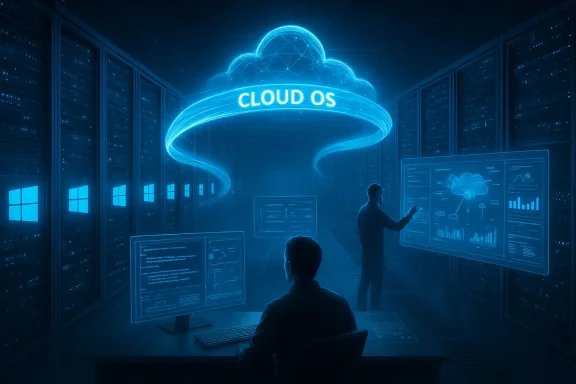
Microsoft opened TechEd North America 2012 in Orlando with a clear message: the company was no longer merely tolerating the cloud — it intended to own the platform narrative. Satya Nadella used the keynote to place Windows at the center of that strategy by dubbing it the Cloud OS, while Microsoft pushed a combined story around Windows Server 2012, Windows Azure, System Center and new management tools that promised a unified path for enterprises moving toward hybrid and public-cloud models. The keynote framed the company’s ambitions in practical terms — infrastructure features, automation hooks, and customer case studies — and signaled a shift in Microsoft’s posture from cautious to aggressively cloud-first.
TechEd North America 2012 was the 20th edition of Microsoft’s flagship technical conference for IT professionals and developers, attracting roughly 10,000 attendees to the Orlando Convention Center. The event showcased the company’s server, virtualization and cloud portfolio at a pivotal moment: enterprises were wrestling with virtualization scale-outs, hybrid-cloud design and developer expectations for cloud-native platforms. Microsoft’s message centered on making Windows and its platform tools the default path for enterprises to modernize datacenters and adopt cloud architectures.
But the path to that promise required — and still requires — disciplined planning. Organizations must balance the operational benefits of cloud scale and elasticity against migration costs, governance complexity and the need to retool teams. For IT leaders, the takeaway is practical: the technical building blocks were present, but successful adoption depends on process, automation and realistic pilots.
TechEd 2012 planted a flag: Microsoft intended to be the enterprise’s cloud partner. The company followed through in subsequent years; the seeds planted in Orlando — automation, hybrid portability, and an integrated platform story — were foundational to the cloud era that followed.
TechEd 2012 was an operational manifesto more than a product launch: Microsoft aimed to show enterprises how to run services at Internet scale while keeping the operational controls IT expects. The clarity of that message — and the practical demos that accompanied it — made Orlando an important milestone in the evolution of enterprise cloud computing.
Source: eWeek Microsoft's TechEd 2012 Focuses on Windows Server 2012, Cloud, Tools - Enterprise Applications - News & Reviews - eWeek.com
 Background
TechEd North America 2012 was the 20th edition of Microsoft’s flagship technical conference for IT professionals and developers, attracting roughly 10,000 attendees to the Orlando Convention Center. The event showcased the company’s server, virtualization and cloud portfolio at a pivotal moment: enterprises were wrestling with virtualization scale-outs, hybrid-cloud design and developer expectations for cloud-native platforms. Microsoft’s message centered on making Windows and its platform tools the default path for enterprises to modernize datacenters and adopt cloud architectures.Why TechEd 2012 mattered
- It was one of the first major public forums where Microsoft laid out the integrated Windows/Azure vision post‑Windows Server 2012 preview.
- The company moved beyond product demos to show migration stories — customers running production workloads on Azure and integrating on‑premises datacenters with cloud services.
- The keynote emphasized operational realities: scale, availability, automation and shared resources — not just feature checklists.
The Cloud OS thesis: what Microsoft announced and why it matters
Satya Nadella’s central narrative was deceptively simple: treat Windows not just as an OS, but as the fabric that spans private datacenters, service providers and Microsoft’s public cloud. He described a “Cloud OS” that provides consistent identity, virtualization, management and development experience across environments. That framing was strategic: it reframes Azure not as a separate play, but as a natural extension of Windows Server and System Center.Core elements of the Cloud OS message
- Consistency across environments — identity and management models that work on-premises and in Azure.
- Portability — virtual machine portability was emphasized as a key requirement to reduce lock‑in and enable hybrid movement.
- Programmatic automation — everything exposed through PowerShell and APIs to enable operational automation at scale.
- Platform completeness — compute, storage, networking and data services (including SQL Server and SQL Azure) together provide the application platform.
The modern data center, redefined
A recurring phrase in the keynote was the “modern data center.” Microsoft boiled that concept down to four operational attributes: scalability, availability, shared resources and automation. These aren’t just checklist items — they shape architectural decisions about virtualization, networking and storage, and they informed the product roadmap presented throughout the conference.What those four attributes mean in practice
- Scalability: design for both vertical scale (large-memory, multi-core VMs) and horizontal scale (stateless front ends, many small instances).
- Availability: support multi-fault-domain placement, failover and redundancy across tiers — availability sets and mirrored SQL pairs were practical examples shown onstage.
- Shared resources: build multi‑tenant‑capable resource pools that can be carved up for departments or customers.
- Automation: expose every management surface via PowerShell, APIs or System Center so operators can script, orchestrate and measure at scale.
Product highlights and technical specifics
Below are the technical threads that ran through the keynote and breakout demos — the tangible product capabilities that supported Microsoft’s Cloud OS vision.Windows Server 2012: scale, virtualization and automation
Microsoft positioned Windows Server 2012 as the OS engineered for cloud-scale virtualization. Demonstrations emphasized:- Support for workloads requiring dozens of cores and hundreds of gigabytes of RAM.
- A large set of PowerShell cmdlets (thousands) intended to make automation first-class.
- Storage enhancements (including improvements to resiliency and deduplication approaches), revamped Hyper‑V capabilities and new management hooks for large clustered deployments.
Windows Azure: infrastructure as a service and data center without boundaries
Microsoft used TechEd to showcase Windows Azure as both a platform and a set of operational controls:- The Azure portal demos (designed in Metro UI) showed simplified VM creation, website provisioning and integrated monitoring.
- Infrastructure as a Service (IaaS) portability was a headline: the idea that VMs and VHDs could move between on‑premise App Controller deployments and Azure was presented as a differentiator for hybrid cloud scenarios.
- Azure’s availability set model, storage resilience and automated deployment pipelines were shown as mechanisms to realize the “data center without boundaries” idea.
Application platform and development: Visual Studio and Azure app platform
Scott Guthrie’s segment focused on developer productivity and how Visual Studio and Azure together simplified building and deploying modern, mobile-aware web applications. Microsoft illustrated:- Integrated tooling for mobile web applications and quick deployment to Azure websites.
- Continuous integration / continuous deployment (CI/CD) hooks with TFS online and Azure deployments.
- Developer-focused telemetry and diagnostics surfaced in the portal to bridge dev and ops.
Device & endpoint management: Windows Intune and people-centric management
Device management was another pillar. Microsoft previewed the next release of Windows Intune, promising expanded mobile device management and people-centric access control — an early recognition that modern apps are consumed across diverse devices and users, and must be managed accordingly. Intune’s integration with System Center and Azure aimed to give enterprises integrated control over policy, deployment and updates.Customer stories and real-world validation
Product announcements are only persuasive when paired with customer evidence. Microsoft used two primary customer narratives to validate its claims.Aflac: elasticity and enterprise web workloads on Azure
Aflac’s CIO, Mike Boyle, described running their SharePoint-based public site and SQL Server-backed services in Azure VMs to gain agility during enrollment cycles and to deliver consistent performance through geographically dispersed datacenters. The demo showed a multi-tier application — front ends, mirrored SQL servers, domain controllers — running as an Azure cloud service, illustrating how traditional enterprise architectures could be adapted to a public cloud model. This example was used to show Azure as a plausible platform for mission-critical, customer-facing services.Tribune Company (and others): hybrid scenarios and peak load elasticity
Microsoft also referenced media customers using the hybrid model — placing variable components in Azure while keeping core systems under on‑prem control. These examples underscored the operational benefit of being able to add capacity on demand for unpredictable workloads, a common requirement for media, retail and public-sector applications.Critical analysis: strengths, risks and enterprise implications
TechEd 2012 was, in many ways, Microsoft’s formal pivot from on‑premise-first to cloud‑and‑on‑prem hybrid first for enterprise IT. The narrative was coherent and the demos were practical, but the strategy carried both clear strengths and notable risks.Strengths
- Integrated vision: Microsoft’s biggest asset was its vertical reach — OS, hypervisor, management suite, development tools and public cloud. That integration reduces friction for organizations already invested in Windows ecosystems.
- Operational focus: Emphasizing automation, PowerShell and System Center addressed the true pain point of cloud: operational complexity at scale. The decision to expose management surfaces programmatically was a necessary step for enterprise adoption.
- Hybrid reality: By focusing on portability and hybrid scenarios, Microsoft avoided the “all‑or‑nothing” cloud narrative. This increases Azure’s appeal to organizations that need phased migrations.
Risks and cautionary points
- Maturity of IaaS in 2012: Azure’s IaaS capabilities were newly announced; enterprises evaluating production migration had to weigh the risk that some features and operational practices were still maturing. Early adopters would shoulder substantial operational and integration overhead. This is important context for IT teams considering production moves.
- Perception of lock‑in: Despite Microsoft’s portability messaging, migration and lifecycle management across heterogeneous stacks (Windows, Linux, various middleware) remain complex. The Cloud OS pitch mitigates lock‑in concerns but does not eliminate migration costs and platform dependencies. Enterprises should plan for data egress, networking, and operational toolchain portability.
- Security and compliance complexity: Moving customer-facing and regulated workloads to a public cloud introduces non‑trivial compliance and security work. Microsoft emphasized platform controls, but the burden of architecture, encryption, identity and audit remains on customers and integrators.
- Operational skill retooling: The push to automation and programmatic management demands new skills for IT teams. PowerShell proficiency, API-driven orchestration and cloud cost control practices were not yet universal in 2012, meaning many organizations faced a nontrivial people and process transition.
How to read Microsoft’s intent
Viewed strategically, TechEd 2012 was an admission that the future of enterprise computing would be cloud-dominant and that Microsoft intended to be the enterprise’s primary cloud partner. The emphasis on operational controls and hybrid portability shows a pragmatic approach: Microsoft was selling manageability and continuity more than raw novelty. For organizations with heavy Windows investments, that message was compelling; for organizations with polyglot stacks or deep non‑Windows commitment, the shift was less persuasive.Practical guidance for IT leaders (what to audit, what to pilot)
If you were an IT leader in 2012 — or planning a later hybrid adoption based on the same principles — TechEd’s announcements suggested a set of practical steps to get started.- Inventory and classify workloads: decide which applications are suitable for IaaS VMs, which require platform services, and which must remain on‑prem for regulatory reasons.
- Build automation-first runbooks: start small with PowerShell scripts and System Center runbooks that codify deployment, backup and scaling. Automation reduces operational drift.
- Pilot with stateless or bursty workloads: public web front ends, dev/test environments and seasonal workloads are lower-risk pilots to validate Azure connectivity and failover behavior.
- Validate data strategies: ensure SQL Server/SQL Azure designs include clear RPO/RTO targets, data encryption and backup portability. Consider network performance and VPN topology in real tests.
- Invest in skills: ensure your ops and dev teams have PowerShell, Azure portal, networking and security competency before broad migrations.
The Big Picture: TechEd 2012 in hindsight
TechEd 2012 represented a turning point: Microsoft publicly aligned Windows Server, System Center and Azure into a single narrative for enterprise cloud adoption. The "Cloud OS" motif foreshadowed a multi-year effort that would see Azure mature into a dominant hyperscale platform and Microsoft evolve its product cadence to emphasize cloud-first development and operations. The company’s focus on operational control and hybrid flexibility positioned it differently from early cloud competitors that pushed all‑in public cloud migration. For enterprise buyers, Microsoft’s message was pragmatic: modernize at your pace, but plan for cloud-era operational models.Lasting implications
- The emphasis on automation and API-first management laid groundwork for later orchestration and IaC (infrastructure as code) patterns in Microsoft’s tooling ecosystem.
- Hybrid patterns validated at TechEd became a cornerstone of enterprise cloud adoption strategies for industries with regulatory constraints.
- Customer stories highlighted that mission-critical workloads could run on Azure early on — proof points that supported the platform’s enterprise credibility over the next decade.
Final verdict: practical optimism with guarded discipline
TechEd 2012 was a persuasive showing by Microsoft: it combined product depth, developer tooling and customer examples into a credible enterprise cloud story. The Cloud OS framing remains one of the clearest articulations of Microsoft’s hybrid-first strategy: use Windows and familiar management tooling as the bridge between traditional datacenters and public cloud capabilities.But the path to that promise required — and still requires — disciplined planning. Organizations must balance the operational benefits of cloud scale and elasticity against migration costs, governance complexity and the need to retool teams. For IT leaders, the takeaway is practical: the technical building blocks were present, but successful adoption depends on process, automation and realistic pilots.
TechEd 2012 planted a flag: Microsoft intended to be the enterprise’s cloud partner. The company followed through in subsequent years; the seeds planted in Orlando — automation, hybrid portability, and an integrated platform story — were foundational to the cloud era that followed.
Appendix: quick reference — key phrases and announcements to remember
- Cloud OS — Windows as the operating fabric across private, service provider and public clouds.
- Windows Server 2012 — targeted at cloud-scale virtualization, large-memory workloads and broad PowerShell automation.
- Windows Azure IaaS & Portal — VM portability, availability sets, and a Metro‑style portal to manage cloud resources.
- Windows Intune — people-centric device and endpoint management with expanded mobile device management features.
- Customer proofs — Aflac and Tribune demonstrated Azure-hosted multi-tier enterprise workloads in real sessions.
TechEd 2012 was an operational manifesto more than a product launch: Microsoft aimed to show enterprises how to run services at Internet scale while keeping the operational controls IT expects. The clarity of that message — and the practical demos that accompanied it — made Orlando an important milestone in the evolution of enterprise cloud computing.
Source: eWeek Microsoft's TechEd 2012 Focuses on Windows Server 2012, Cloud, Tools - Enterprise Applications - News & Reviews - eWeek.com
