Teramind AI Governance: Behavior-Based Oversight for Enterprise AI Use

  • Thread Author
Teramind’s new product announcement marks a deliberate attempt to stitch enterprise-grade governance around the very behaviors that make modern AI useful — prompts, responses, and autonomous actions — and to do so across the entire spectrum of tools employees now use, from sanctioned copilots to the sprawling “shadow AI” ecosystem.

A futuristic control room with a holographic AI dashboard and analysts at computer stations.Background​

The pace at which generative AI and agentic systems have entered everyday workflows has left many security and compliance teams scrambling. Workforce surveys and vendor research over the last 18 months show a consistent pattern: employee adoption of unsanctioned AI tools is widespread, experimentation with autonomous agents is accelerating, and governance frameworks are struggling to keep up. That gap — between rapid operational adoption and lagging oversight — is exactly the problem Teramind says its new offering, Teramind AI Governance, aims to close.
Teramind positions the product as a behavioral oversight layer that requires no new enterprise infrastructure and can capture evidence of AI use immediately: prompt/response logging, screen recordings with OCR, transcripts of agent activity, and behavioral detection of shadow AI based on execution patterns rather than signatures. The vendor pitches this as the first platform to provide a single-pane view across mainstream LLMs and copilots, plus the unsanctioned tools employees bring to the job.
To understand why vendors and customers are talking about this now, three industry realities matter:
  • Worker access to AI expanded rapidly in 2025, driving broader enterprise exposure.
  • A growing minority of organizations have moved from pilots into scaled, agentic deployments.
  • Security teams report an uptick in incidents where sensitive data is exposed via AI interactions, raising questions about breach costs, compliance, and auditability.
These trends combine to make AI governance a top-priority security and compliance problem in 2026.

What Teramind says it delivers​

Teramind’s announcement emphasizes a few headline capabilities that are worth summarizing before we analyze their implications:
  • Comprehensive prompt and response logging: recording the prompts employees send to LLMs and the responses those models return.
  • Visual evidence capture (screen recording + OCR): capturing what actually appears on an employee’s screen — useful for web-based, browser-only, or native app interactions where API hooks are unavailable.
  • Transcripts of autonomous agent activity: logging an agent's planning, sub-tasks, and execution steps when it operates across systems.
  • Behavioral detection of shadow AI: identifying unauthorized AI use by how a tool behaves (execution patterns) rather than relying solely on static signatures or allow/block lists.
  • Automatic enforcement of existing security policies: applying data loss prevention (DLP), access controls, and compliance rules directly against AI-driven activity.
  • Out-of-the-box alignment with compliance regimes: claims to produce continuous audit trails across SOX, HIPAA, CMMC, FedRAMP, SOC 2, ISO 27001, and the EU AI Act.
Teramind also frames governance as an enabler, not a breaker: the company’s messaging repeatedly stresses that the answer is “governed AI” rather than prohibiting AI use outright.

Why enterprises are hunting for this kind of solution​

Several converging forces have made an AI governance product a commercially practical and operationally urgent idea:
  • The rise of shadow AI: Large numbers of employees — from developers to executives — routinely use third-party AI services for work tasks. Organizations report that unauthorized AI usage is common, and security vendors have documented significant volumes of sensitive data being pasted into public LLMs.
  • Agentic systems: Autonomous or agentic AI can rapidly execute multi-step actions; a misconfigured or malicious agent can multiply impact far faster than a single manual user action.
  • Compliance and audit pressure: Regulators and auditors are increasingly focused on how AI is used in regulated workflows. The EU AI Act and sectoral rules (HIPAA, FedRAMP, etc.) push for traceability and risk controls around automated decision-making and data flows.
  • Incident cost pressures: Early research and vendor analyses suggest that when sensitive data is exfiltrated via AI prompts or agent workflows, breach remediation costs can be materially higher, particularly where audit trails are missing.
  • User demand vs. IT control: A classic adoption paradox — employees adopt tools that increase productivity if IT does not provide acceptable alternatives, and governance that simply blocks access often drives users deeper into shadow tooling.
Taken together, these forces have created both the appetite and the justifications for products that can provide detailed, behavioral visibility into AI use — and then act on it.

How this product fits into the security stack​

Teramind’s positioning is that AI governance is an extension of existing workforce monitoring, DLP, and insider-risk tooling. In practice, organizations will likely look to integrate an AI governance layer in several related places:
  • Endpoint monitoring and DLP: capture copy/paste, file uploads, and the content of screen sessions that show sensitive information being shared with AI tools.
  • Network filters and CASB: block or throttle calls to unapproved public AI APIs at the gateway; conversely, tag and allow sanctioned API usage for auditing.
  • SIEM/SOAR: send AI-related logs and alerts into centralized security operations for correlation and automated response.
  • Identity and access management: attach policy decisions to user identity and roles to enforce fine-grained controls.
  • Model and platform governance: integrate with vendor contracts, model risk assessments, and procurement to ensure sanctioned AI services meet data-handling requirements.
The practical value to security teams is straightforward: without logging and context around AI interactions, incident response and forensic timelines become extremely costly and slow. Auditability — who prompted what and what the model did — matters both for compliance and for building trust in deployments.

Strengths and notable innovations​

Teramind’s announcement highlights a number of pragmatic design choices that address real-world enforcement problems:
  • Behavioral detection approach: Detecting shadow AI by execution patterns rather than signatures addresses evasion tactics (renamed binaries, custom wrappers) and the proliferation of new models and endpoints. This is a meaningful practical improvement over static allowlists alone.
  • Prompt-level evidence capture: Storing prompts and model responses gives teams the ability to reconstruct exactly what data left the environment and what answers were returned — crucial for regulatory investigations and breach analysis.
  • Transcripts of agent activity: Capturing multi-step agent plans and their actions introduces accountability into what would otherwise be opaque automation. This is especially valuable as organizations move from pilots to actual production agentic workflows.
  • No new infrastructure claim: Minimizing deployment friction is a strong commercial play; security teams are more willing to trial tools that don’t require rip-and-replace of existing stacks.
  • Policy enforcement across compliance frameworks: Packaging reporting and audit trails for a long list of standards (SOX, HIPAA, CMMC, FedRAMP, SOC 2, ISO 27001, EU AI Act) adds immediate value for regulated industries that must demonstrate continuous controls.
These features combine to deliver what many enterprises say they need: evidence-based governance rather than speculative detection.

Risks, limitations, and unanswered questions​

No product can be a silver bullet; the announcement raises several technical, legal, and organizational questions that buyers must weigh carefully.

Technical and operational limitations​

  • Encrypted and ephemeral agents: Agents that execute entirely on-premise models or within encrypted channels (e.g., private API credentials, self-hosted LLMs running in containers) may be harder to detect and log without deeper integration. Behavioral detection can help, but it’s not a guarantee.
  • API-only interactions: When employees or agents interact with AI via backend API keys rather than through an observable UI, capturing the full prompt/response chain may require intercepting API traffic or integrating with the sanctioned platform’s telemetry APIs.
  • Scale and noise: Recording prompts, screen captures, and agent transcripts across thousands of endpoints will create huge volumes of data. Without careful signal tuning, security teams risk being overwhelmed by false positives or benign activity logs.
  • Accuracy of behavioral models: Behavioral detection systems must be trained and tuned; they can generate false positives (legitimate automation flagged) and false negatives (novel evasion). Vendors typically require time and data to reach acceptable maturity.
  • Tamper resistance: Agents or users with admin privileges might be able to disable endpoint recording or obfuscate activity, complicating enforcement unless the governance layer is tightly integrated with endpoint management and hardened against tampering.

Legal, privacy, and workforce implications​

  • Employee privacy and labor law: Continuous screen recording and prompt logging raise legitimate privacy concerns. In some jurisdictions, recording employees without notice or consent can trigger legal and collective bargaining issues. Even where allowed, heavy-handed monitoring can erode trust and morale.
  • Data sovereignty and regulatory boundaries: For companies operating across jurisdictions, storing prompts and responses that contain regulated data (PII, PHI) may create additional compliance obligations, especially under stringent privacy laws.
  • Evidence handling and retention: Captured prompts and responses are potentially highly sensitive artifacts. Policies for retention, access control, encryption-at-rest, and lawful disclosure processes need to be robust and auditable.
  • Overreach and chilling effects: Aggressive monitoring can discourage legitimate use of AI tools provided to improve productivity, unless governance is paired with enablement and sanctioned alternatives.

Claims that require careful verification​

The announcement cites specific numbers from Teramind’s internal research (e.g., “more than 80% of workers use unapproved AI tools,” “one-third have shared proprietary data with unsanctioned platforms,” “49% hide AI use from IT”) and asserts a concrete per-incident cost for AI-associated breaches (more than $650,000). Those points are consistent with broader independent vendor surveys that report widespread shadow AI use and elevated breach impact, but the exact figures should be treated as company-reported or vendor-specific unless cross-checked against independent, peer-reviewed data sets. Buyers should ask for underlying methodologies before relying on headline percentages for risk modeling.

Competitive and market context​

Teramind is not alone in recognizing a governance gap at the intersection of AI, automation, and enterprise security. Several adjacent players and service providers are already offering policy-as-code, agent orchestration governance, or integrations that seek to codify risk controls into agent workflows.
  • Large systems integrators and service providers are packaging policy-as-code for agentic workflows, enabling automated enforcement of organizational rules within agents.
  • Established security vendors are enhancing DLP, CASB, and UEBA (user and entity behavior analytics) capabilities to better detect shadow AI and model-based exfiltration patterns.
  • Cloud and platform providers have introduced audit tooling and logging features for their own model services, making it easier for enterprise customers to get telemetry from sanctioned services.
This means organizations evaluating Teramind should consider not only feature parity but also integration breadth: does the governance layer plug cleanly into existing DLP, SIEM, IAM, and cloud provider telemetry? Is there a path to consolidate AI governance into the broader security operations lifecycle?

Adoption guidance: how to approach AI governance in practice​

For security leaders and CIOs wrestling with shadow AI and agentic rollouts, a measured approach balances control and productivity:
  • Start with data classification and policy: Identify the data types that must never leave controlled environments (e.g., PHI, regulated financial data, secrets). Translate those into machine-enforceable rules before deploying technical controls.
  • Offer sanctioned alternatives: Employees often use unsanctioned AI because sanctioned tools don’t meet needs. Provide approved copilots and connectors that meet security requirements and make compliance the path of least resistance.
  • Instrument and observe first: Deploy visibility features to map the problem space — what tools are people using, how often, and where sensitive data is exposed — before sweeping enforcement actions.
  • Phase enforcement: Move from detection to soft enforcement (alerts, education) to hard enforcement (blocking, quarantining) to avoid shutting down legitimate productivity gains.
  • Integrate into incident response: Ensure L1/L2 SOC playbooks include AI-related artifacts (prompts, transcripts) so that investigations have the right context.
  • Protect the captured data: Treat recorded prompts and transcripts as highly sensitive logs. Enforce strict access controls, encryption, and retention policies.
  • Engage legal, HR, and privacy early: Agree on acceptable monitoring terms, consent frameworks, and labor considerations. Where appropriate, negotiate changes with employee representatives.
  • Measure outcomes: Track the net business impact — breach reductions, reduction in shadow AI incidents, developer productivity when using sanctioned tools, and business units’ satisfaction.

Practical checklist for evaluating an AI governance vendor​

When vetting solutions like Teramind AI Governance, security and compliance teams should ask vendors to demonstrate:
  • Exact telemetry sources and limitations (what is captured, what can’t be captured).
  • How prompt and response data is stored, protected, and purged.
  • Integration points with DLP, SIEM, SOAR, CASB, and cloud provider logs.
  • Behavioral detection model performance metrics (false positive / false negative rates) and tuning requirements.
  • Support for self-hosted/private LLM telemetry and how API-only agent interactions are audited.
  • Policy enforcement modes (audit-only, quarantine, block) and how they can be scoped by role and data classification.
  • Compliance reporting templates aligned to specific frameworks (SOC 2, HIPAA, EU AI Act clauses).
  • Administrative controls and tamper resistance for endpoint agents.
  • Privacy, retention, and data residency features.
  • Pricing model for large-scale capture (e.g., cost per GB of recorded content or per endpoint).
A strong vendor will be able to demonstrate real-world deployments and clearly explain where gaps remain.

Longer-term implications for governance and operations​

If tools like Teramind’s take hold, they may accelerate several structural shifts inside organizations:
  • Policy as code for AI: More organizations will embed governance directly into agent workflows and model interfaces so policies are enforced at runtime rather than as an afterthought.
  • AI Bills of Materials: Companies will start to catalog models, datasets, and dependencies the way they manage software supply chains.
  • Agent attestation and identity: Agents will be given identities and certificates that bind them to policies and responsibilities, making it easier to audit actions to a machine identity.
  • Convergence of DLP + MRM + UEBA: Data loss prevention, model risk management, and behavioral analytics will become tightly integrated disciplines rather than siloed functions.
  • Standards and regulation: As governance practices mature, industry standards and regulation (national AI acts, sectoral rules) will likely codify minimum auditability and logging requirements for agentic operations.
These shifts are positive for large-scale, responsible AI adoption — but they also shift operational burden onto a new operational plane that combines software engineering, security operations, and model governance.

Conclusion​

Teramind’s AI Governance announcement is a timely product move into a space many organizations describe as a pain point: the need for forensic-grade visibility and enforceable control over the flood of AI tools and the agentic systems emerging in production. Its emphasis on behavioral detection, prompt-level evidence, and agent transcripts addresses concrete gaps that existing DLP and endpoint tools have struggled to cover.
That said, the work of governance is as much organizational as it is technical. Continuous screen recording and prompt capture come with privacy, legal, and cultural trade-offs that security teams must manage deliberately. Technical limits — encrypted API traffic, self-hosted models, high-volume telemetry — mean no single product will entirely eliminate risk. The right approach starts with clear data-first policies, sanctioned tools that meet user needs, and phased enforcement that balances productivity and protection.
For enterprises moving from experiment to scale with agentic AI, an evidence-driven governance layer is not optional; it is a pragmatic guardrail. Products that combine visibility, policy-as-code, and operational integrations will be valuable building blocks — but success depends on integrating them into a broader program of classification, training, legal alignment, and continuous improvement. In short: governance can enable AI safely, but only when it is part of a wider strategy that recognizes both the promise and the pitfalls of agentic systems.

Source: Business Wire https://www.businesswire.com/news/h...vernance-Platform-for-the-Agentic-Enterprise/

 

Teramind’s new AI Governance platform pushes the enterprise debate from “should we use AI?” to “how will we control it?” and arrives at a moment when unsanctioned AI use — what security teams call shadow AI — is no longer hypothetical but a measurable, enterprise-scale risk.

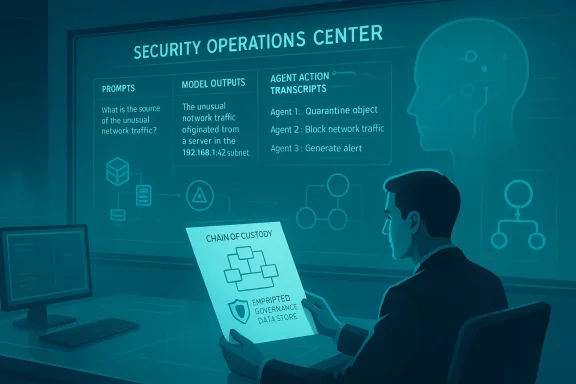
A security analyst reviews a chain-of-custody document in a Security Operations Center.Background​

AI adoption in business has accelerated from experimentation into broad workplace usage, and with that shift has come new vectors for data leakage, compliance failures, and insider risk. Vendors and consultancies report that employee access to AI tools jumped sharply in 2025, and a growing share of organisations are piloting or scaling agentic systems — autonomous agents that chain model calls and commands across multiple environments. Against this backdrop, Teramind has launched Teramind AI Governance, a platform designed to monitor prompts and model outputs, detect and record agentic activity, and apply existing security policies to both approved and unapproved AI tools.
Teramind frames the problem as a governance gap rather than an absence of AI capability: employees will use generative AI whether IT approves it or not, and autonomous agents compound the risk by executing multi-step workflows at machine speed. The vendor’s announcement highlights three headline concerns from its internal research: widespread use of unapproved AI, frequent sharing of proprietary data with unsanctioned services, and active concealment of AI use from IT teams. Teramind also warns that agentic systems compress the window for detection and response because they can run hundreds of commands in seconds.
This launch is part of a broader market trend: security and compliance teams increasingly demand visibility into the “AI layer” — where prompts, model outputs, and agent actions live — and vendors are racing to offer telemetry, policy enforcement, and audit trails that line up with regulated standards.

What Teramind AI Governance claims to do​

Teramind’s product messaging focuses on four core capabilities designed to collapse the visibility and enforcement gap around AI:
  • Prompt and response capture: Log prompts sent to models and the responses returned, producing a searchable record of what was asked and what the model produced.
  • Agentic activity transcripts: Record multi-step actions performed by autonomous agents, including commands executed, files modified, and connections made.
  • Visual evidence via screen recording and OCR: Use on-device screen capture and optical character recognition to create visual proof of what users and agents displayed or accessed on endpoints.
  • Behavioral detection of shadow AI: Identify unsanctioned AI tools by execution patterns and behavioral fingerprints rather than relying solely on static signatures.
Teramind positions these features as immediately actionable: the vendor says the platform integrates with existing endpoints and security tooling, requires no additional “new” infrastructure, and can enforce pre-existing policies (block, alert, quarantine) against both users and agents.

Technical verification: what’s plausible and what needs scrutiny​

Teramind’s approach — combining endpoint telemetry, screen capture, OCR, and behavior-based detection — maps to established capabilities in user activity monitoring and data loss prevention (DLP). Several technical points are important to verify in any procurement or risk review:
  • Screen recording + OCR is an established technique: Endpoint agents that capture frames and run OCR to extract on-screen text are widely used by advanced DLP and user monitoring products. This delivers visibility into text rendered in browser windows, desktop apps, or even documents that don’t expose machine-readable text.
  • Prompt capture depends on telemetry sources: Prompt-and-response logging is straightforward when tools are browser-based (capturable via screen text and keystroke metadata), and when APIs or sanctioned integrations exist. Capturing prompts sent through native or encrypted channels (for example, certain desktop apps, API keys, or embedded model SDKs) is harder and often requires endpoint-level agents or API-side logging.
  • Behavioral fingerprinting is effective but needs maintenance: Detecting unnamed or renamed AI tools by behavioral patterns (e.g., bursty automated keystrokes, predictable network flows, repeated API call patterns) is a robust detection strategy — but it requires continuous tuning and red‑teaming to avoid evasion and minimize false positives.
  • Agent transcripts need reliable provenance: Recording an agent’s actions is useful only if the system preserves tamper-evident chains of custody and timestamps. For audit and forensic uses, organisations must validate how the platform signs, timestamps, and stores these transcripts.
  • Scaling telemetry at enterprise scale is nontrivial: Agentic systems can generate bursts of high-volume activity. Collecting full-screen recordings, OCR outputs, and transcripts at scale imposes storage, processing, and retention costs that need explicit planning.
  • Security of the governance data store is critical: A central repository of prompts, responses, and screenshots contains the very secrets organisations are trying to protect. That store must be encrypted, access-controlled, and subject to strict data minimisation and retention policies.
Teramind’s product documentation and support pages confirm that the company already offers screen recording, OCR, and endpoint agent telemetry in its broader product suite. The vendor’s new AI governance pages extend those capabilities to label and treat AI interactions as first-class audit objects.

Market context and independent signals​

Teramind’s launch arrived in a market where leading consultancies and industry reports have documented a rapid rise in AI access and experimentation inside enterprises. Surveys and research have reported significant year‑over‑year expansion in worker access to AI tools and a meaningful share of organisations experimenting with or rolling out agentic systems. That environment explains growing demand for governance layers that can deliver audit trails, policy enforcement, and integrations into existing security stacks.
At the same time, multiple vendors and systems integrators are adding agent-aware controls, policy-as-code for agents, and integrations between model providers and enterprise logging infrastructure. Large cloud and platform providers have begun exposing richer telemetry for model usage, and security vendors are extending DLP and behavioral analytics to account for model-based exfiltration.
Teramind’s claim that “this isn’t a technology gap — it’s a governance gap” echoes a common industry diagnosis: enterprises are not lacking model capability but are lagging on policy, oversight, and tooling that ties AI activity back into compliance and incident response workflows.

Strengths: where Teramind’s approach looks strong​

  • Extends existing telemetry to the AI layer: Enterprises that already use endpoint agents and DLP tools will find value in a solution that elevates prompts, responses, and agent actions to the same level as file transfers and email telemetry.
  • Behavior-first detection reduces signature dependence: Using behavioral fingerprints to find hidden or renamed AI tools addresses a core evasion tactic of shadow tools — renaming or repackaging. Behavioral detection can surface suspicious automation even when a tool masks itself.
  • Auditability for regulated environments: Generating continuous audit trails aligned with compliance frameworks (e.g., SOC 2, ISO 27001, HIPAA, FedRAMP, EU AI Act) meets a pressing need for organisations in regulated sectors that must demonstrate oversight of AI use.
  • Rapid time-to-value for endpoint-centric deployments: If an organisation already has a Teramind agent or similar endpoint fleet, delivering visibility without a separate proxy layer or gateway can simplify deployment and reduce immediate infrastructure friction.
  • Focus on developer workflows and agentic speed: Developer environments and automated agents are obvious blind spots: logging terminal sessions, build pipelines, and multi-step agents helps close gaps where sensitive code and credentials flow quickly.

Risks, caveats, and unanswered questions​

Teramind’s announcement raises several legitimate concerns that buyers should evaluate before deployment. Many of these are common to any vendor offering deep endpoint visibility.
  • Vendor-sourced statistics require independent validation: Headline numbers about employee behavior or per‑incident costs often come from vendor research and can reflect customers or samples that skew high. Treat company-reported percentages and dollar-cost estimates as signaling risk, not definitive benchmarks.
  • Privacy and employment law exposure: Continuous screen recording, OCR, and detailed prompt logs can run afoul of local privacy laws, union rules, and employment jurisdictions. Deployments across multi-jurisdiction workforces require careful legal review and transparent policy communication to avoid litigation or regulatory scrutiny.
  • The governance data is a high-value target: Logs of prompts and model outputs are sensitive. If attackers gain access to that central store, they inherit a trove of secrets. Organisations must apply least-privilege, robust encryption-at-rest, immutable auditing, and segmented access to governance data.
  • False positives and alert fatigue: Behavior-based detection can trigger on legitimate automation or productivity tools. Security teams must tune rules and create feedback loops to prevent overload and missed signals.
  • Operational overhead and cost: Capturing full-screen video, OCR outputs, and agent transcripts at enterprise scale creates storage and processing demands. Buyers should model retention windows, indexing costs, and potential impacts on endpoint performance.
  • Legal admissibility of captured evidence: Screen captures and prompt logs are valuable in investigations, but their admissibility in audits or legal proceedings depends on chain-of-custody controls and tamper-evidence mechanisms. Verify how the platform preserves provenance.
  • False sense of completeness: No endpoint-centric tool can see everything. Agents running purely in cloud sandboxes, server-side model calls with no endpoint signals, or encrypted pipelines can remain blind spots unless the governance layer also integrates with API, cloud, and service logs.
  • Ethical and cultural costs: Intensive monitoring can erode trust and hamper collaboration. Overly broad capture can chill reasonable uses of AI for productivity, so policy calibration must balance risk reduction with employee autonomy.

Practical guidance for security, compliance, and procurement teams​

If your organisation is evaluating Teramind AI Governance or any comparable AI governance product, approach procurement and deployment in three phases: PREPARE, INTEGRATE, and OPERATE.

PREPARE: baseline and policy first​

  • Inventory current AI use:
  • Map sanctioned tools (Copilot, Gemini, ChatGPT, Claude Code) and known internal agents.
  • Identify high-risk functions (legal, product, engineering, finance) that access sensitive IP.
  • Define acceptable‑use policies:
  • Create a clear list of approved AI services, data classes that may never be shared, and a process for requesting new tools.
  • Align policies with HR, legal, and privacy teams.
  • Assess legal constraints:
  • Review jurisdictional privacy laws, employee consent requirements, and union or contractual clauses that might limit monitoring.
  • Establish a data-retention and minimization policy:
  • Decide how long prompts, screen captures, and transcripts are retained and when they are deleted or archived.

INTEGRATE: technical and procedural controls​

  • Validate telemetry coverage:
  • Proof-of-concept (PoC) must show the platform captures prompts and agent actions across browsers, terminals, and common IDEs used by developers.
  • Secure the governance data store:
  • Require encryption-at-rest, strong RBAC, hardening of APIs, and audit logs for access to governance data.
  • Integrate with security stack:
  • Forward AI governance alerts and logs to your SIEM/SOAR, DLP, and case management systems to ensure response consistency.
  • Define enforcement semantics:
  • Configure policy responses (alert only, block, quarantine) and test in staged environments before broad enforcement.
  • Plan for scale:
  • Model storage, compute, and network impacts; set retention rules and archiving thresholds.

OPERATE: monitoring, auditing, and culture​

  • Tune detection models:
  • Use feedback loops between security analysts and SOC teams to reduce false positives and continuously refine behavioral fingerprints.
  • Run red-team scenarios:
  • Simulate agentic exfiltration, renamed tool evasion, and developer copy/paste misuse to validate detections and response playbooks.
  • Protect the governance traces:
  • Treat prompt repositories with the same controls as other sensitive logs: segmented access, multi-factor admin login, and periodic audits.
  • Communicate and train:
  • Make AI governance visible to employees: explain what is monitored, why, and how to request exceptions. Provide safe channels to request sanctioned AI tooling.
  • Measure outcomes:
  • Track reduction in shadow-AI incidents, number of policy violations, mean time to detect and respond, and business impact metrics tied to approved AI usage.

Compliance and regulatory considerations​

Enterprises deploying AI governance solutions should align their design to relevant regulatory regimes. Two priorities stand out:
  • Accountability and audit readiness: Regulations like the EU AI Act emphasise documentation, oversight, and accountability for high‑risk AI uses. A governance platform that captures prompts, outputs, and agent actions can help satisfy documentation and traceability obligations, provided the evidence is preserved with appropriate chain-of-custody safeguards.
  • Sector-specific rules: Healthcare and financial services face sectoral controls (HIPAA, SOX, FedRAMP, CMMC, SOC 2, ISO 27001, etc.) that demand strict access controls and evidence of process adherence. Verify that the platform’s audit artifacts and retention settings map to specific compliance requirements and that legal teams have reviewed data flows and retention policies.
A critical point: collecting and storing prompt/response archives can itself create compliance obligations — particularly if logs contain personal data or sensitive customer information. Data minimisation, selective capture rules, and on‑the‑fly redaction should be part of any deployment plan.

Where governance products like Teramind fit in a layered security architecture​

AI governance platforms are not a standalone cure. They are a policy and telemetry layer that must integrate across a broader risk architecture:
  • Endpoint agents and DLP capture user and device-level activity.
  • Network and cloud logs provide service-side visibility for API calls and model usage.
  • Identity and access management (IAM) ensure least-privilege and control model access keys.
  • SIEM/SOAR and SOC processes enable correlation, alerting, and automated response.
  • Legal, HR, and compliance workflows provide governance mechanisms for exceptions and disciplinary processes.
When combined, these layers create a credible defence-in-depth posture for the AI era: prevent risky flows, detect unsanctioned behaviour, and enable rapid containment while preserving evidence for forensics and audits.

The procurement checklist: questions to ask vendors​

When evaluating Teramind AI Governance or rivals, buyers should insist on clear answers to these practical questions:
  • What exact telemetry sources do you use to capture prompts and agent actions (browser frames, keystroke metadata, API hooks, terminal logging)?
  • How do you ensure the tamper-evident chain of custody for captured transcripts and recordings?
  • How are prompt/response artifacts stored, encrypted, and access-controlled? Can we host the data in our own cloud tenancy?
  • What controls exist to redact or exclude personal data from captured records?
  • How does behavioral detection distinguish legitimate automation from malicious agentic activity? What are expected false-positive rates?
  • What is the performance impact of your endpoint agent on developer tools and build pipelines?
  • How do you handle cross-jurisdiction deployments and employee notice/consent requirements?
  • Can the platform integrate with our SIEM, SOAR, DLP, and ticketing systems? Which connectors are available out of the box?
  • What logging retention options and export formats do you support for audit and legal needs?
  • How do you support third-party attestations (SOC 2, ISO 27001) and audit requests from regulators?
Answers to these questions will surface architectural trade-offs and help procurement teams compare vendors on deployability, total cost of ownership, and long-term fit.

Strategic implications for security and leadership​

AI governance is part technical control, part organisational change. Security leaders should treat governance tooling as an enabler for safe adoption rather than a retroactive policing device. Two strategic themes matter:
  • Governance as accelerator: Effective oversight removes blockers to adoption by giving legal, compliance, and business leaders the visibility they need to say “yes” to AI in controlled ways. With the right guardrails, sanctioned AI can drive productivity without exposing the business.
  • Governance as a cultural intervention: Heavy-handed surveillance will breed concealment and workarounds. Pairing governance tooling with transparent policies, easy approval paths for new tools, and training creates a less adversarial environment where employees see governance as protection rather than punishment.
For boards and C‑suite leaders, the calculation should centre on measured scale: how to capture the productivity upside of generative AI while reducing the risk of regulatory fines, intellectual property leakage, and reputational harm. Governance tooling is a component of that balance — not a substitute for thoughtful process and leadership.

Conclusion​

Teramind AI Governance is a clear response to an urgent, visible problem: enterprises need a practical way to see and police the AI interactions that increasingly touch sensitive data and automated workflows. The platform’s emphasis on prompt and response capture, agent transcripts, behavioral detection, and audit trails addresses real gaps that traditional DLP and network controls struggle to close.
But vendor claims — especially headline statistics and damage-estimate figures — should be treated as company-reported signals and validated against independent benchmarks before they become the basis for corporate risk models. More importantly, organisations must design deployments that protect the governance artifacts themselves, respect privacy and employment law, and integrate tightly with existing incident response and compliance processes.
Ultimately, the governance imperative is organisational, not purely technical. Tools like Teramind can illuminate the AI layer, enforce rules, and generate the audit trails regulators increasingly expect. Their value, though, rests on how security, legal, HR, and business teams use that visibility to build safe, auditable, and productive AI practices — otherwise, governance risks becoming a high‑visibility log repository with few controls to keep its secrets safe.

Source: IT Brief UK https://itbrief.co.uk/story/teramind-launches-ai-governance-to-tackle-shadow-ai/
 

Back
Top