

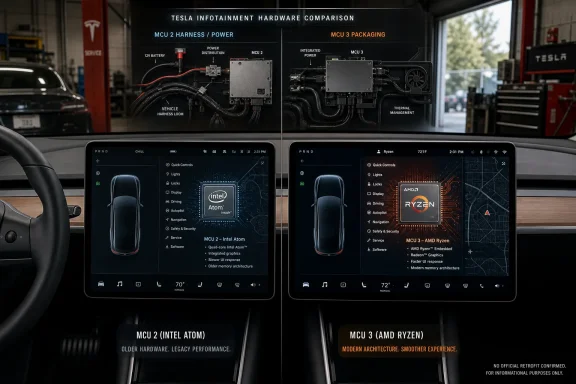
Tesla owners with Intel-based MCU 2 infotainment computers are unlikely to receive a straightforward retrofit to the newer AMD Ryzen-based MCU 3 hardware, after teardown comments from Tesla hacker “greentheonly” pointed to different power, harness, and physical-unit designs in newer Model Y vehicles. That is not an official Tesla verdict, and it should not be treated as one. But it is exactly the sort of unofficial finding that tends to harden into reality in the Tesla ecosystem, where hardware changes often arrive silently and support boundaries are discovered after the fact.
The bigger story is not simply that one computer may not plug into another car. It is that Tesla’s rolling-hardware strategy, once sold as a kind of software-defined superpower, keeps colliding with the brute physicality of wiring looms, thermal envelopes, display controllers, and service economics. MCU 2 owners may not be losing Autopilot or Full Self-Driving capability here, but they may be watching the infotainment side of their cars age into a permanent feature divide.
Tesla has spent more than a decade training customers to think of the car as an updatable device. That framing is not wrong. Over-the-air software updates have meaningfully changed Tesla vehicles after purchase, adding entertainment apps, interface redesigns, driver-assistance refinements, charging behavior changes, and the occasional feature nobody asked for but everyone discussed for a week.
But the phrase software-defined vehicle can become misleading when it suggests that hardware generations are merely temporary inconveniences. The center screen in a Tesla is not an iPad glued to a dashboard. It is the user-facing control plane for climate, media, navigation, charging settings, vehicle configuration, cameras, connectivity, and a widening range of creature comforts that owners encounter every time they drive.
That means infotainment hardware ages differently from an engine control module hidden under a hood. A slow screen is not an abstract benchmark problem. It is a daily reminder that the car’s interface is becoming older, less responsive, and potentially excluded from whatever Tesla decides the modern experience should be.
The reported MCU 2-to-MCU 3 retrofit obstacle matters because it challenges a comfortable assumption among many owners: that if Tesla upgraded MCU 1 cars to MCU 2, it would eventually do the same for MCU 2 cars. The first upgrade created a precedent. The second generation may expose the limit of that precedent.
The company eventually offered an official infotainment upgrade for eligible older Model S and Model X vehicles, priced around the same psychological zone as a high-end laptop. That upgrade moved owners to MCU 2-class hardware and gave them access to a faster interface and newer media features. It was not cheap, but it was at least a clear answer: pay the money, get the newer experience.
That history made MCU 2 owners more optimistic than they otherwise might have been. If Tesla could replace an old Nvidia-based unit with an Intel-based one in legacy vehicles, why not replace an Intel-based unit with an AMD-based one in newer vehicles? To a consumer, the pattern looks obvious.
Automotive electronics rarely reward that kind of pattern-matching. The MCU 1-to-MCU 2 upgrade was designed around a specific set of legacy vehicles, service procedures, parts, and customer pain points. MCU 3 is not necessarily an interchangeable successor module for every Intel car. It may be a product of a broader platform update that changed power delivery, packaging, cooling assumptions, board layout, display integration, or harness design in ways that make a retrofit technically possible only in the sense that anything is possible with enough money and a patient engineer.
The distinction between “possible” and “commercially supportable” is everything. Tesla does not merely have to make one hacker’s bench experiment work. It has to stock parts, train service centers, validate safety interactions, support warranty claims, handle regional configurations, and decide whether the revenue justifies the complexity. A retrofit can die long before it reaches the edge of electrical possibility.
That is not surprising. The Intel Atom chips used in MCU 2 were a dramatic improvement over MCU 1 when they arrived, but they were never magic. They were low-power embedded processors deployed in a car environment where longevity matters more than spec-sheet glory. The AMD Ryzen generation brought a much larger performance jump, and in some configurations paired CPU improvements with significantly stronger graphics capability.
Tesla’s challenge is that it rarely markets these changes with the ceremony that traditional automakers attach to model-year refreshes. Hardware simply appears. One month a car may ship with Intel; another may ship with AMD. One owner gets a faster infotainment computer because of production timing, while another, who paid a similar price days or weeks earlier, gets the outgoing hardware.
That approach is efficient for Tesla but emotionally corrosive for customers. In consumer electronics, buyers expect annual or semiannual generational boundaries. In cars, they expect model years, trim changes, and disclosed equipment differences. Tesla’s rolling changes blur those categories, creating a used-market scavenger hunt where shoppers learn to inspect “Additional Vehicle Information” screens like sysadmins checking firmware revisions on secondhand servers.
For WindowsForum readers, the analogy is familiar. Nobody wants to discover after purchase that two machines with the same retail name have different CPUs, different wireless chipsets, different firmware features, and different upgrade ceilings. Tesla has brought that PC-industry variability into a product that costs as much as a house deposit.
A modern vehicle infotainment unit is not just a motherboard. It sits inside a network of power rails, CAN and LIN bus connections, Ethernet links, antennas, amplifiers, USB ports, cellular modems, GPS, camera feeds, displays, and sometimes region-specific communication hardware. Even when two generations perform the same visible job, the behind-the-dashboard reality can change enough to make a drop-in replacement impractical.
Thickness matters too. A computer module that fits one mounting envelope may not fit another without interfering with brackets, ducts, shielding, crash-related structures, or thermal paths. That sounds trivial until a manufacturer has to guarantee that thousands of installations will survive vibration, heat, cold, moisture, service variation, and years of owner use.
Power is another quiet constraint. A Ryzen-based infotainment computer may demand different power characteristics than an Intel Atom unit, especially under heavier graphics or media loads. Even if the average consumption is acceptable, peak loads, heat dissipation, sleep behavior, wake behavior, and low-voltage battery interactions all have to be validated. Tesla’s later move away from traditional 12-volt lead-acid batteries in some vehicles further complicates assumptions across production eras.
This is where the dream of a modular Tesla starts to look more limited. The company can update software at internet speed, but it cannot update harnesses over Wi-Fi. Once a physical architecture leaves the factory, every retrofit becomes a negotiation with the manufacturing decisions embedded in that car.
That distinction is worth stating clearly because Tesla discussions often collapse every computer in the vehicle into one vague idea of “the brain.” The MCU is the cabin and interface brain. The driver-assistance computer is a different system. An MCU 2 car does not become less capable of basic driving or charging because it lacks Ryzen.
But consumer perception does not divide the car so neatly. Owners experience the car through the touchscreen, and Tesla has leaned so heavily into the touchscreen that infotainment performance feels like vehicle performance. A laggy browser or sluggish app launch can make an otherwise mechanically excellent EV feel old.
The problem will deepen if Tesla continues to build new features around AMD-class performance. Entertainment apps are one obvious dividing line, but they are not the only one. Voice assistants, richer maps, heavier UI effects, local media processing, browser-based services, and in-car AI features can all become places where Tesla quietly says, in effect, “AMD required.”
The risk for MCU 2 owners is not a sudden cliff. It is a slow narrowing of the future. The car still works, but each software release has to choose whether Intel remains a first-class target, a compatibility target, or a legacy target.
That strategy has benefits. Tesla can incorporate supply-chain improvements, cost reductions, and component upgrades without waiting for a formal redesign. In a fast-moving EV market, that flexibility is a competitive weapon. It lets Tesla adapt faster than automakers tied to rigid model-year cycles and dealership inventory choreography.
But buyers pay the price in uncertainty. Two Model Ys from adjacent production windows can differ in processor, battery chemistry, suspension tuning, sensors, interior details, or low-voltage systems. Enthusiasts may enjoy decoding those differences. Ordinary owners are less amused when the decoding happens after delivery.
The MCU 2-to-MCU 3 question is a perfect example. The hardware split emerged not as a carefully explained customer-facing migration, but as a discovery process led by teardown photos, owner reports, vehicle information screens, and community sleuthing. That is exciting if you treat cars as rolling developer kits. It is maddening if you treat them as long-lived household assets.
For used buyers, this creates a practical due-diligence burden. “Model year” is no longer enough. Build month may not be enough. The only reliable answer may be the car’s own information screen, the service history, and sometimes the specific factory and production window. That is normal in the PC world. It remains awkward in the car world.
The absence of confirmation does not mean a retrofit is secretly coming. It also does not mean it is impossible in every conceivable configuration. Tesla has multiple vehicle lines, multiple production eras, and regional differences. A retrofit that is impossible or impractical for one Model Y build may not map perfectly to every Model 3, Model S, or Model X variant.
Still, the direction of travel seems unfavorable for owners hoping for a universal MCU 3 upgrade. If the unit has different connectors, different power requirements, and a different physical envelope, Tesla would need to create something closer to a conversion kit than a replacement part. That kit would need adapters, validation, installation procedures, and long-term support.
The economics are not obvious. A paid upgrade might attract enthusiasts, but many owners would balk at a price that reflected true labor and parts complexity. Tesla would then be left supporting a niche retrofit for aging cars while simultaneously optimizing new production around newer architectures.
That is why official silence can be interpreted as a policy posture. Companies do not always say “no” when the practical answer is no. Sometimes they simply let the installed base age out of the question.
MCU 2 is in that uncomfortable middle zone. It is not ancient like MCU 1 was by the time Tesla offered upgrades, but it is no longer modern. It is good enough for core tasks, yet increasingly disadvantaged for the services Tesla wants to showcase.
The Windows analogy also explains why backward support becomes expensive. Microsoft, Intel, AMD, OEMs, and driver vendors all understand that keeping older hardware viable requires compromises. Features get held back. Interfaces get simplified. Security patches continue longer than performance optimization. Eventually, a company draws a line and calls the older machines unsupported for the newest experience.
Tesla’s difference is that the computer is embedded in a vehicle with a much longer expected service life than a laptop. A 2020 or 2021 car is not old in automotive terms. If its infotainment system already feels like a legacy target in 2026, that is a serious mismatch between consumer-electronics cadence and vehicle ownership reality.
This is the central tension of the software-defined car. The software industry normalizes fast obsolescence. The auto industry sells durability. Tesla is trying to profit from both cultures, and owners are discovering that the bill comes due in the dashboard.
The MCU discussion is less safety-critical but more visible in daily use. Autopilot hardware debates can become abstract for owners who do not use advanced driver-assistance features frequently. Infotainment performance is immediate. You notice it when the car wakes, when the map redraws, when a camera view appears, when a streaming app loads, and when the UI hesitates under your finger.
This visibility gives MCU 2 owners a different kind of grievance. They are not necessarily arguing that the car cannot perform its advertised driving functions. They are arguing that the premium digital experience Tesla sold as central to the vehicle is aging unevenly, and that later buyers received a materially better foundation without a clear upgrade path.
That complaint is not unique to Tesla. The entire auto industry is moving toward centralized computing, app ecosystems, subscription services, and cockpit experiences that depend on chip generations. Tesla is simply ahead of the pain curve because it adopted the model earlier and more aggressively.
If there is a lesson for legacy automakers, it is not that they should avoid software-defined vehicles. It is that they should define the support contract before customers discover it by teardown.
The distinction is especially important for vehicles built around the transition period in late 2021 and early 2022. Depending on market, factory, model, and timing, otherwise similar cars may not have the same infotainment hardware. In the used market, the difference can affect perceived value, responsiveness, and access to some newer software experiences.
Owners should also separate frustration from risk. An Intel MCU 2 car is not automatically a bad purchase. It may be perfectly adequate for someone who values range, charging network access, driving dynamics, and basic Tesla functionality more than streaming performance or the newest UI flourishes. But it should be priced and evaluated as an Intel-equipped vehicle, not as a mystery box that might someday become AMD.
That means buyers should ask sharper questions and sellers should answer them plainly. “Does it have Ryzen?” has become the Tesla equivalent of “How much RAM?” or “Is this the Apple silicon model?” It is not trivia anymore. It is part of the machine’s long-term support profile.
That is not betrayal in the simple sense. No company can make every new feature run forever on every old processor. Even generous support policies cannot repeal hardware limits. But Tesla’s minimalist communication style makes every boundary feel like it was discovered rather than disclosed.
A more mature Tesla would treat hardware transitions as part of the customer contract. It would publish clear support matrices for major compute generations, explain which features are expected to remain supported, and identify which capabilities are hardware-limited. That would reduce speculation and help buyers make informed decisions.
The company may resist that because clarity has costs. Once Tesla publishes a boundary, it owns the backlash. Ambiguity preserves flexibility. It also shifts the burden of understanding onto owners, forums, hackers, service advisors, and third-party trackers.
That bargain works when the enthusiast community is excited by discovery. It works less well when the discovery is that a relatively recent car may not have a viable path to the latest cabin computer.
Tesla’s lead in software integration makes this more visible, but not unique. Mercedes, BMW, Hyundai, GM, Ford, Rivian, Lucid, and others are all building cars whose feature roadmaps depend on onboard compute. The industry will need norms for how long cockpit computers are supported, whether upgrades are possible, and how clearly buyers are told about midstream hardware changes.
Tesla could still surprise everyone with a limited retrofit, a revised service part, or a future compatibility program. But if the physical differences are as substantial as reported, owners should not plan their purchase or ownership strategy around that outcome. Hope is not a support policy.
The harder truth is that MCU 2 may become Tesla’s first large-scale lesson in modern-but-not-modern-enough vehicle computing. MCU 1 was obviously old by the time it became a problem. MCU 2 is recent enough that owners expected more runway. That makes the line feel harsher.
The bigger story is not simply that one computer may not plug into another car. It is that Tesla’s rolling-hardware strategy, once sold as a kind of software-defined superpower, keeps colliding with the brute physicality of wiring looms, thermal envelopes, display controllers, and service economics. MCU 2 owners may not be losing Autopilot or Full Self-Driving capability here, but they may be watching the infotainment side of their cars age into a permanent feature divide.
 Tesla’s Software Car Still Has a Hardware Wall
Tesla has spent more than a decade training customers to think of the car as an updatable device. That framing is not wrong. Over-the-air software updates have meaningfully changed Tesla vehicles after purchase, adding entertainment apps, interface redesigns, driver-assistance refinements, charging behavior changes, and the occasional feature nobody asked for but everyone discussed for a week.But the phrase software-defined vehicle can become misleading when it suggests that hardware generations are merely temporary inconveniences. The center screen in a Tesla is not an iPad glued to a dashboard. It is the user-facing control plane for climate, media, navigation, charging settings, vehicle configuration, cameras, connectivity, and a widening range of creature comforts that owners encounter every time they drive.
That means infotainment hardware ages differently from an engine control module hidden under a hood. A slow screen is not an abstract benchmark problem. It is a daily reminder that the car’s interface is becoming older, less responsive, and potentially excluded from whatever Tesla decides the modern experience should be.
The reported MCU 2-to-MCU 3 retrofit obstacle matters because it challenges a comfortable assumption among many owners: that if Tesla upgraded MCU 1 cars to MCU 2, it would eventually do the same for MCU 2 cars. The first upgrade created a precedent. The second generation may expose the limit of that precedent.
The MCU 1 Upgrade Created Expectations Tesla May Not Want to Meet Twice
Tesla’s MCU 1 era was messy enough that an upgrade path became almost inevitable. Early Model S and Model X vehicles used Nvidia Tegra-based infotainment hardware that, over time, became painfully slow and notably constrained. Tesla’s newer entertainment features, including video streaming and expanded arcade capability, simply did not fit well inside that older computing envelope.The company eventually offered an official infotainment upgrade for eligible older Model S and Model X vehicles, priced around the same psychological zone as a high-end laptop. That upgrade moved owners to MCU 2-class hardware and gave them access to a faster interface and newer media features. It was not cheap, but it was at least a clear answer: pay the money, get the newer experience.
That history made MCU 2 owners more optimistic than they otherwise might have been. If Tesla could replace an old Nvidia-based unit with an Intel-based one in legacy vehicles, why not replace an Intel-based unit with an AMD-based one in newer vehicles? To a consumer, the pattern looks obvious.
Automotive electronics rarely reward that kind of pattern-matching. The MCU 1-to-MCU 2 upgrade was designed around a specific set of legacy vehicles, service procedures, parts, and customer pain points. MCU 3 is not necessarily an interchangeable successor module for every Intel car. It may be a product of a broader platform update that changed power delivery, packaging, cooling assumptions, board layout, display integration, or harness design in ways that make a retrofit technically possible only in the sense that anything is possible with enough money and a patient engineer.
The distinction between “possible” and “commercially supportable” is everything. Tesla does not merely have to make one hacker’s bench experiment work. It has to stock parts, train service centers, validate safety interactions, support warranty claims, handle regional configurations, and decide whether the revenue justifies the complexity. A retrofit can die long before it reaches the edge of electrical possibility.
Ryzen Changed the Cabin Experience More Than Tesla Wanted to Admit
When Tesla began shipping AMD Ryzen-based infotainment systems, first visibly in refreshed Model S and Model X vehicles and then in Model 3 and Model Y production, the change was not subtle. Owners noticed faster wake times, smoother browser performance, better responsiveness in video apps, and a more modern feel in the UI. The upgrade was most obvious in the same places where Intel Atom-based MCU 2 units had begun to show their limits: web rendering, media-heavy interfaces, app switching, and animation.That is not surprising. The Intel Atom chips used in MCU 2 were a dramatic improvement over MCU 1 when they arrived, but they were never magic. They were low-power embedded processors deployed in a car environment where longevity matters more than spec-sheet glory. The AMD Ryzen generation brought a much larger performance jump, and in some configurations paired CPU improvements with significantly stronger graphics capability.
Tesla’s challenge is that it rarely markets these changes with the ceremony that traditional automakers attach to model-year refreshes. Hardware simply appears. One month a car may ship with Intel; another may ship with AMD. One owner gets a faster infotainment computer because of production timing, while another, who paid a similar price days or weeks earlier, gets the outgoing hardware.
That approach is efficient for Tesla but emotionally corrosive for customers. In consumer electronics, buyers expect annual or semiannual generational boundaries. In cars, they expect model years, trim changes, and disclosed equipment differences. Tesla’s rolling changes blur those categories, creating a used-market scavenger hunt where shoppers learn to inspect “Additional Vehicle Information” screens like sysadmins checking firmware revisions on secondhand servers.
For WindowsForum readers, the analogy is familiar. Nobody wants to discover after purchase that two machines with the same retail name have different CPUs, different wireless chipsets, different firmware features, and different upgrade ceilings. Tesla has brought that PC-industry variability into a product that costs as much as a house deposit.
The Harness Is the Part of the Story Software People Forget
Greentheonly’s reported observation about different power and harness arrangements is important precisely because it is boring. It shifts the discussion away from chip envy and toward the unglamorous physical systems that make an automotive computer serviceable. In a car, the connector is destiny.A modern vehicle infotainment unit is not just a motherboard. It sits inside a network of power rails, CAN and LIN bus connections, Ethernet links, antennas, amplifiers, USB ports, cellular modems, GPS, camera feeds, displays, and sometimes region-specific communication hardware. Even when two generations perform the same visible job, the behind-the-dashboard reality can change enough to make a drop-in replacement impractical.
Thickness matters too. A computer module that fits one mounting envelope may not fit another without interfering with brackets, ducts, shielding, crash-related structures, or thermal paths. That sounds trivial until a manufacturer has to guarantee that thousands of installations will survive vibration, heat, cold, moisture, service variation, and years of owner use.
Power is another quiet constraint. A Ryzen-based infotainment computer may demand different power characteristics than an Intel Atom unit, especially under heavier graphics or media loads. Even if the average consumption is acceptable, peak loads, heat dissipation, sleep behavior, wake behavior, and low-voltage battery interactions all have to be validated. Tesla’s later move away from traditional 12-volt lead-acid batteries in some vehicles further complicates assumptions across production eras.
This is where the dream of a modular Tesla starts to look more limited. The company can update software at internet speed, but it cannot update harnesses over Wi-Fi. Once a physical architecture leaves the factory, every retrofit becomes a negotiation with the manufacturing decisions embedded in that car.
MCU 2 Is Not Obsolete, but It Is No Longer the Center of Gravity
It would be wrong to describe Intel-based MCU 2 cars as unusable or abandoned. For many owners, the interface remains functional, navigation works, media plays, climate controls respond, and the car continues receiving software updates. The main driving systems are also separate from the media computer in a way that matters: Autopilot and Full Self-Driving hardware are not determined by whether the infotainment processor is Intel Atom or AMD Ryzen.That distinction is worth stating clearly because Tesla discussions often collapse every computer in the vehicle into one vague idea of “the brain.” The MCU is the cabin and interface brain. The driver-assistance computer is a different system. An MCU 2 car does not become less capable of basic driving or charging because it lacks Ryzen.
But consumer perception does not divide the car so neatly. Owners experience the car through the touchscreen, and Tesla has leaned so heavily into the touchscreen that infotainment performance feels like vehicle performance. A laggy browser or sluggish app launch can make an otherwise mechanically excellent EV feel old.
The problem will deepen if Tesla continues to build new features around AMD-class performance. Entertainment apps are one obvious dividing line, but they are not the only one. Voice assistants, richer maps, heavier UI effects, local media processing, browser-based services, and in-car AI features can all become places where Tesla quietly says, in effect, “AMD required.”
The risk for MCU 2 owners is not a sudden cliff. It is a slow narrowing of the future. The car still works, but each software release has to choose whether Intel remains a first-class target, a compatibility target, or a legacy target.
Tesla’s Rolling Upgrades Create Winners, Losers, and Confused Buyers
Traditional automakers often frustrate customers by moving too slowly. Tesla frustrates them by moving at odd angles. A buyer can receive a vehicle in one quarter and then watch a materially improved version ship in the next, sometimes without a clear trim-name change or public transition date.That strategy has benefits. Tesla can incorporate supply-chain improvements, cost reductions, and component upgrades without waiting for a formal redesign. In a fast-moving EV market, that flexibility is a competitive weapon. It lets Tesla adapt faster than automakers tied to rigid model-year cycles and dealership inventory choreography.
But buyers pay the price in uncertainty. Two Model Ys from adjacent production windows can differ in processor, battery chemistry, suspension tuning, sensors, interior details, or low-voltage systems. Enthusiasts may enjoy decoding those differences. Ordinary owners are less amused when the decoding happens after delivery.
The MCU 2-to-MCU 3 question is a perfect example. The hardware split emerged not as a carefully explained customer-facing migration, but as a discovery process led by teardown photos, owner reports, vehicle information screens, and community sleuthing. That is exciting if you treat cars as rolling developer kits. It is maddening if you treat them as long-lived household assets.
For used buyers, this creates a practical due-diligence burden. “Model year” is no longer enough. Build month may not be enough. The only reliable answer may be the car’s own information screen, the service history, and sometimes the specific factory and production window. That is normal in the PC world. It remains awkward in the car world.
The Upgrade Question Is Really a Support Policy Question
Tesla could settle much of the anxiety with a simple public statement: Intel MCU 2 vehicles will or will not receive an official AMD retrofit. If not, Tesla could explain whether the limitation is physical, economic, safety-related, or simply not on the roadmap. The company’s reluctance to communicate that way is part of why unofficial technical findings carry so much weight.The absence of confirmation does not mean a retrofit is secretly coming. It also does not mean it is impossible in every conceivable configuration. Tesla has multiple vehicle lines, multiple production eras, and regional differences. A retrofit that is impossible or impractical for one Model Y build may not map perfectly to every Model 3, Model S, or Model X variant.
Still, the direction of travel seems unfavorable for owners hoping for a universal MCU 3 upgrade. If the unit has different connectors, different power requirements, and a different physical envelope, Tesla would need to create something closer to a conversion kit than a replacement part. That kit would need adapters, validation, installation procedures, and long-term support.
The economics are not obvious. A paid upgrade might attract enthusiasts, but many owners would balk at a price that reflected true labor and parts complexity. Tesla would then be left supporting a niche retrofit for aging cars while simultaneously optimizing new production around newer architectures.
That is why official silence can be interpreted as a policy posture. Companies do not always say “no” when the practical answer is no. Sometimes they simply let the installed base age out of the question.
The PC Analogy Cuts Both Ways
Tesla’s infotainment evolution looks familiar to anyone who has lived through Windows hardware cycles. A machine that felt fast on Windows 10 can feel marginal under heavier web apps, high-resolution video, modern browser engines, and background services. The operating system still runs, but the experience diverges from newer hardware in ways that are hard to capture on a spec sheet.MCU 2 is in that uncomfortable middle zone. It is not ancient like MCU 1 was by the time Tesla offered upgrades, but it is no longer modern. It is good enough for core tasks, yet increasingly disadvantaged for the services Tesla wants to showcase.
The Windows analogy also explains why backward support becomes expensive. Microsoft, Intel, AMD, OEMs, and driver vendors all understand that keeping older hardware viable requires compromises. Features get held back. Interfaces get simplified. Security patches continue longer than performance optimization. Eventually, a company draws a line and calls the older machines unsupported for the newest experience.
Tesla’s difference is that the computer is embedded in a vehicle with a much longer expected service life than a laptop. A 2020 or 2021 car is not old in automotive terms. If its infotainment system already feels like a legacy target in 2026, that is a serious mismatch between consumer-electronics cadence and vehicle ownership reality.
This is the central tension of the software-defined car. The software industry normalizes fast obsolescence. The auto industry sells durability. Tesla is trying to profit from both cultures, and owners are discovering that the bill comes due in the dashboard.
Full Self-Driving Is a Separate Fight, but the Pattern Is Familiar
Tesla veterans will recognize the broader pattern from Autopilot and Full Self-Driving hardware upgrades. Tesla has repeatedly changed the compute hardware used for driver-assistance features, sometimes offering retrofits to customers who bought certain packages and sometimes drawing lines around eligibility. The promise of future capability has often depended on later hardware clarification.The MCU discussion is less safety-critical but more visible in daily use. Autopilot hardware debates can become abstract for owners who do not use advanced driver-assistance features frequently. Infotainment performance is immediate. You notice it when the car wakes, when the map redraws, when a camera view appears, when a streaming app loads, and when the UI hesitates under your finger.
This visibility gives MCU 2 owners a different kind of grievance. They are not necessarily arguing that the car cannot perform its advertised driving functions. They are arguing that the premium digital experience Tesla sold as central to the vehicle is aging unevenly, and that later buyers received a materially better foundation without a clear upgrade path.
That complaint is not unique to Tesla. The entire auto industry is moving toward centralized computing, app ecosystems, subscription services, and cockpit experiences that depend on chip generations. Tesla is simply ahead of the pain curve because it adopted the model earlier and more aggressively.
If there is a lesson for legacy automakers, it is not that they should avoid software-defined vehicles. It is that they should define the support contract before customers discover it by teardown.
Owners Should Check the Computer, Not the Badge
For current Tesla owners and used buyers, the practical advice is straightforward: verify the infotainment processor in the vehicle itself. Tesla’s menus can show whether the car has Intel Atom or AMD Ryzen hardware. That detail matters more than a casual listing description, a seller’s memory, or a broad model-year assumption.The distinction is especially important for vehicles built around the transition period in late 2021 and early 2022. Depending on market, factory, model, and timing, otherwise similar cars may not have the same infotainment hardware. In the used market, the difference can affect perceived value, responsiveness, and access to some newer software experiences.
Owners should also separate frustration from risk. An Intel MCU 2 car is not automatically a bad purchase. It may be perfectly adequate for someone who values range, charging network access, driving dynamics, and basic Tesla functionality more than streaming performance or the newest UI flourishes. But it should be priced and evaluated as an Intel-equipped vehicle, not as a mystery box that might someday become AMD.
That means buyers should ask sharper questions and sellers should answer them plainly. “Does it have Ryzen?” has become the Tesla equivalent of “How much RAM?” or “Is this the Apple silicon model?” It is not trivia anymore. It is part of the machine’s long-term support profile.
The Real Cost Is Trust in the Upgrade Story
The emotional sting in the MCU 3 retrofit rumor comes from the way Tesla has cultivated upgrade optimism. Owners have been encouraged, implicitly and explicitly, to believe that the vehicle improves over time. Many Tesla cars do improve over time. But improvement is unevenly distributed, and hardware generations eventually become gates.That is not betrayal in the simple sense. No company can make every new feature run forever on every old processor. Even generous support policies cannot repeal hardware limits. But Tesla’s minimalist communication style makes every boundary feel like it was discovered rather than disclosed.
A more mature Tesla would treat hardware transitions as part of the customer contract. It would publish clear support matrices for major compute generations, explain which features are expected to remain supported, and identify which capabilities are hardware-limited. That would reduce speculation and help buyers make informed decisions.
The company may resist that because clarity has costs. Once Tesla publishes a boundary, it owns the backlash. Ambiguity preserves flexibility. It also shifts the burden of understanding onto owners, forums, hackers, service advisors, and third-party trackers.
That bargain works when the enthusiast community is excited by discovery. It works less well when the discovery is that a relatively recent car may not have a viable path to the latest cabin computer.
The Ryzen Divide Is Now Part of Tesla Ownership Math
The most useful way to read the MCU 2-to-MCU 3 story is not as a final verdict on a single retrofit, but as a warning about the next decade of connected cars. Vehicles are becoming platforms, but platforms have hardware floors. Once software becomes a selling point, processor generations become depreciation factors.Tesla’s lead in software integration makes this more visible, but not unique. Mercedes, BMW, Hyundai, GM, Ford, Rivian, Lucid, and others are all building cars whose feature roadmaps depend on onboard compute. The industry will need norms for how long cockpit computers are supported, whether upgrades are possible, and how clearly buyers are told about midstream hardware changes.
Tesla could still surprise everyone with a limited retrofit, a revised service part, or a future compatibility program. But if the physical differences are as substantial as reported, owners should not plan their purchase or ownership strategy around that outcome. Hope is not a support policy.
The harder truth is that MCU 2 may become Tesla’s first large-scale lesson in modern-but-not-modern-enough vehicle computing. MCU 1 was obviously old by the time it became a problem. MCU 2 is recent enough that owners expected more runway. That makes the line feel harsher.
The Dashboard Upgrade Dream Meets the Service Bay
The practical picture is narrower, and less romantic, than the software-defined-car story suggests.- Intel-based MCU 2 vehicles remain usable, but owners should not assume they will receive an official AMD Ryzen MCU 3 retrofit.
- The reported differences in harnessing, power, and physical packaging make a simple drop-in replacement unlikely.
- Autopilot and Full Self-Driving hardware are separate from the infotainment computer, so the MCU split does not automatically change driver-assistance capability.
- Used Tesla buyers should verify the infotainment processor from the vehicle’s own software screen rather than relying on model year alone.
- Tesla’s rolling hardware changes make the car better over time as a product line, but not always better over time for every individual owner.
- The long-term issue is not one missing upgrade, but the absence of a clear public support contract for major cockpit-computer generations.
References
- Primary source: Not a Tesla App
Published: 2026-06-27T14:10:11.658536
Loading…
www.notateslaapp.com - Related coverage: tomshardware.com
Tesla’s Potent AMD Ryzen Upgrade Arrives Stateside for Model 3, Model Y | Tom's Hardware
The new AMD Ryzen chip absolutely smokes the old Intel Atom chip.www.tomshardware.com - Related coverage: tesla.com
Loading…
www.tesla.com - Related coverage: notebookcheck.net
Loading…
www.notebookcheck.net - Related coverage: factually.co
Loading…
factually.co - Related coverage: go-parts.com
Tesla Model 3 & Y Ryzen MCU3 Failure: Diagnosing a Black Screen and Replacement Guide (2017-2023) | Go-Parts.com
This guide covers the common failures of the AMD Ryzen-based infotainment computer (MCU3) in the Tesla Model 3 and Model Y, including the critical programming required after replacement.www.go-parts.com