
Tesla appears to be preparing a U.S. launch of the larger Model Y L, with reports pointing to Gigafactory Texas production beginning around September 2026 and sales before year-end, after the six-seat crossover found early success in China and other right-hand-drive markets. The move would not be just another trim-line expansion. It would be Tesla’s attempt to patch a self-inflicted hole in its lineup at the exact moment the company is asking buyers to believe it can become both a carmaker and an autonomy platform.
The Model Y L is easy to describe and harder to categorize. It is not a true Model X replacement, not a full-size SUV, and not the long-rumored Tesla van that families, fleet operators, and ride-hailing optimists have imagined for years. But in practical terms, it may be the most important conventional vehicle Tesla could bring to the United States right now: a stretched, three-row family EV built on the company’s best-selling nameplate, arriving after the Model X has left the stage.
For years, Tesla could get away with an awkward gap in its lineup because the market gap was obscured by demand. The Model Y was efficient, quick, software-forward, and broadly sized for the American suburb. The Model X, meanwhile, existed as the premium oddball: expensive, dramatic, and increasingly detached from the center of Tesla’s volume strategy.
That balance no longer works. Once the Model S and Model X were discontinued, Tesla effectively walked away from the vehicle that gave larger families a reason to stay inside the brand without compromising too severely on passenger space. The seven-seat Model Y can technically carry seven people, but the third row has always been a conditional promise: useful for children, occasional trips, and short distances, not a comfortable long-term answer for households that actually need six usable seats.
That matters because the American SUV market does not reward technical eligibility; it rewards lived usefulness. Parents do not ask whether a car can legally be configured with three rows. They ask whether a teenager can sit in the back without folding into a punctuation mark, whether child seats can coexist with school bags, and whether a road trip will turn every charging stop into a grievance hearing.
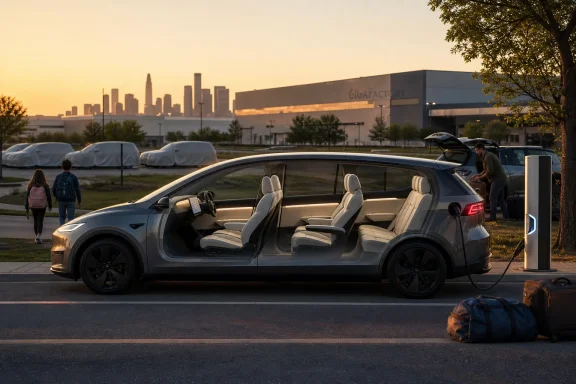
The Model Y L is Tesla’s answer to that very ordinary, very powerful consumer reality. It stretches the standard Model Y by roughly seven inches, lengthens the wheelbase by about six inches, raises the roofline, and creates enough interior volume for a 2+2+2 cabin with second-row captain’s chairs. The numbers are not revolutionary, but the packaging shift is meaningful: the vehicle becomes less of a compact crossover with emergency seating and more of a plausible family hauler.
It gave Tesla a large-vehicle flagship. It gave buyers who wanted the Tesla ecosystem but needed more room somewhere to go. It also signaled that Tesla was not merely a compact-EV company with a truck experiment attached.
Discontinuing the Model X alongside the Model S may make industrial sense if Tesla truly wants to reallocate Fremont capacity toward Optimus, autonomy hardware, or other future-facing bets. But the showroom consequence is blunt: buyers looking for a roomy Tesla passenger vehicle are left with the Model Y, the Cybertruck, or nothing. The Cybertruck is not a minivan substitute, no matter how much cultural energy surrounds it.
That makes the Model Y L feel less like opportunism and more like triage. Tesla can tell investors that autonomy will reshape vehicle ownership; it can tell fans that robotaxis are the real product; it can tell critics that the old luxury models had become sentimental artifacts. But the family deciding what to buy this fall still needs a car, not a thesis.
The larger Model Y would give Tesla a lower-risk way to restore some of that lost utility without reviving the Model X or launching a clean-sheet full-size SUV. It also lets Tesla do what Tesla prefers to do operationally: stretch an existing platform, reuse manufacturing knowledge, and chase scale through simplification rather than proliferation.
The quick success of the Model Y L in China appears to have changed the conversation. A vehicle that may have started as a regional adaptation now looks like a global pressure valve for Tesla’s most obvious product shortfall. Australia and India reportedly fall under the Shanghai supply umbrella, while the United States would require domestic production because China-built Teslas would be politically, economically, and tariff-wise untenable for the American market.
That is where Gigafactory Texas enters the story. If recent reporting is accurate, Tesla is preparing to build the Model Y L in the U.S. rather than import it. That would keep the vehicle aligned with Tesla’s North American manufacturing footprint and avoid the geopolitical baggage attached to Chinese-made EVs entering the U.S. at volume.
It would also be a quiet admission that Tesla’s global product strategy is becoming more regional than its branding suggests. The company likes to sell the idea of a unified, software-defined fleet, but bodies, seats, crash rules, incentives, and buyer habits remain stubbornly local. A China-born Model Y L built in Texas would be a very Tesla solution to that tension: global idea, local factory, minimal ceremony.
That is not glamorous, but it is how mature automakers defend market share. Toyota does not treat every family-hauler update as a philosophical event. Hyundai and Kia have built recent momentum in part by understanding that buyers want thoughtful packaging as much as software ambition. Rivian’s upcoming smaller vehicles, Kia’s EV9, Hyundai’s Ioniq family, and legacy automakers’ increasingly competent electric crossovers all pressure Tesla in ways that cannot be answered by acceleration times alone.
Tesla’s greatest manufacturing strength has always been iteration at scale. The Model 3 became more compelling through cost reduction, simplification, and refinement. The Model Y succeeded because it translated the Model 3 formula into the world’s favorite body style. A larger Model Y follows the same logic: not a moonshot, but a mass-market adjustment.
That is why the U.S. Model Y L would be a revealing product. If Tesla prices it sensibly, it could fill the space between the regular Model Y and the departed Model X while giving the company a much-needed family-oriented story. If Tesla prices it too high, trims it too narrowly, or treats it as a boutique variant, it risks becoming another example of the company understanding demand but misreading the mainstream buyer.
The line is thin. A six-seat Model Y L that lands near the upper end of Model Y pricing could be a hit. A six-seat Model Y L that drifts into luxury-SUV money without luxury-SUV comfort could become an expensive footnote.
The problem is that buyers cannot put a prediction in the driveway. Even if Tesla’s self-driving systems continue to improve, the transition from advanced driver assistance to broadly deployed, regulator-approved, commercially reliable autonomy remains uneven and jurisdiction-dependent. A family buying a vehicle in 2026 is buying for school runs, vacations, commutes, medical appointments, weekend sports, and aging parents — not for a hypothetical transportation network that may or may not arrive on their street during the ownership period.
This is where Tesla’s rhetoric can work against its product planning. The company’s software ambition is real, and its installed fleet gives it advantages that traditional automakers envy. But physical constraints remain physical. A third row is either usable or it is not. A child seat either fits cleanly or it does not. A six-passenger cabin either reduces daily friction or merely checks a configurator box.
The Model Y L implicitly concedes that autonomy does not eliminate the family car. It may change how that car is driven, dispatched, insured, financed, or shared, but it does not make knees shorter or luggage smaller. Tesla’s challenge is to embrace that truth without making it sound like a retreat from the future.
In fact, a larger Model Y could strengthen Tesla’s autonomy story if the company frames it correctly. A six-seat, comfortable crossover is a better candidate for shared family mobility, premium ride-hailing, and group transport than a cramped third-row compact. If Tesla believes cars will become more utilized over time, then space and comfort become more important, not less.
The Model Y’s dominance came partly from hitting the sweet spot before competitors caught up. It was not just an EV; it was the right kind of EV at the right size and price. But as the EV market broadens, buyers are less willing to bend their lives around limited choices. They can cross-shop more electric crossovers, more plug-in hybrids, and more efficient gasoline SUVs than they could five years ago.
That is particularly true for families. A buyer who needs a third row may admire Tesla’s charging network, software interface, and efficiency, but still choose a larger rival if the cabin does not work. The EV purchase is no longer a binary decision between Tesla and compromise. In 2026, the compromise can just as easily be staying with a hybrid or buying a non-Tesla EV that gives up some software polish in exchange for more usable space.
A Model Y L would give Tesla a stronger argument in that fight. It would not need to beat every three-row SUV on maximum cargo volume or towing capacity. It would need to be sufficiently roomy, efficient, familiar, and well-priced enough to prevent current Tesla owners from leaving the brand when their families outgrow the standard Model Y.
That retention point is critical. The first wave of Model 3 and Model Y owners has aged into different household needs. Some have kids. Some have teenagers. Some have parents to transport. Some simply want more comfort without moving to a pickup. If Tesla cannot offer those buyers a natural next step, another automaker will.
Texas already carries symbolic and operational weight for Tesla. It is the home of the Cybertruck, a major Model Y site, and a centerpiece of the company’s American manufacturing narrative. Adding the Model Y L there would let Tesla position the vehicle not as an import adaptation but as a U.S.-built extension of its most successful platform.
That matters for politics as well as logistics. The U.S. EV market is tangled in domestic-content rules, tariff disputes, tax-credit eligibility, battery sourcing, and election-cycle industrial policy. A China-made Model Y L would be a nonstarter for many practical reasons. A Texas-built Model Y L is a cleaner story, even if some components remain globally sourced.
The timing also matters. A September production start, if accurate, would put Tesla on an aggressive clock for sales before the end of 2026. That would suggest the company either has done much of the engineering groundwork already or intends to launch with a relatively narrow configuration set. Tesla often prefers the latter: fewer variants, fewer choices, faster ramp.
That can work if the chosen configuration matches demand. A six-seat long-range version with captain’s chairs, strong range, and a price that does not wander into luxury-brand territory would be easy to understand. A confusing mix of expensive options, limited colors, or delayed trims would blunt the point of the vehicle before it reaches customers.
For Tesla, that is a particularly useful choice. The standard Model Y already offers a seven-seat option, so the Model Y L needs to differentiate itself through experience rather than raw seat count. Six comfortable-ish seats are more persuasive than seven theoretical ones.
There is a trade-off, of course. A longer wheelbase and taller body usually mean more mass, a larger turning circle, and some efficiency penalty. Cargo space behind the third row may still be modest, because physics has not been repealed. Anyone expecting a Tahoe-sized Tesla from a stretched Model Y will be disappointed.
But the likely customer is not necessarily shopping full-size SUVs. The likely customer is a current or would-be Model Y buyer who wants more rear-seat usability without moving to a truck, a luxury EV, or a different brand. For that buyer, the Model Y L does not need to be enormous. It needs to be enough.
That word may define the vehicle’s commercial fate. Enough legroom. Enough third-row access. Enough range. Enough cargo. Enough price discipline. Tesla has often won by being spectacular in a few dimensions and acceptable in others; the Model Y L would need to win by being balanced.
Tesla still has advantages. Its charging ecosystem remains a powerful draw. Its software interface is familiar and fast. Its efficiency, over-the-air update culture, and brand recognition continue to matter. But those advantages do not automatically solve segment mismatch.
The company also faces a reputational complication. Tesla buyers once tolerated product gaps because the brand felt far ahead. Today, some buyers are more skeptical of long promises, especially around autonomy timelines, service experience, repair costs, and quality consistency. A practical product like the Model Y L could help reset the conversation from ideology back to utility.
That reset would be healthy. Tesla discourse too often swings between messianic confidence and total dismissal. The actual company is more interesting than either caricature: a manufacturer with extraordinary strengths, avoidable blind spots, and a tendency to let the future crowd out the present. The Model Y L is a present-tense product, and that is precisely why it matters.
It also suggests that Tesla understands, at least at the product level, that not every problem is solved by neural networks. Sometimes the winning move is a longer wheelbase.
If Tesla prices the Model Y L too close to the old Model X’s psychological territory, it will invite comparisons it cannot win. Buyers will ask why a stretched Model Y costs luxury-SUV money when it lacks the presence, space, materials, or cachet of more expensive rivals. They will also cross-shop aggressively against three-row EVs and hybrids that offer more conventional comfort.
If Tesla prices it close enough to the Model Y to feel like a rational upgrade, the story changes. Suddenly it becomes the obvious answer for households that like Tesla but need room. It becomes a way to keep customers inside the ecosystem. It becomes a family-car wedge at a time when Tesla needs more than autonomy headlines to sustain growth.
The company’s history cuts both ways. Tesla has used price cuts ruthlessly when demand required it, sometimes damaging resale values and angering recent buyers. It has also been willing to charge heavily for trims and features when it believes the brand can support the margin. The Model Y L will test which Tesla shows up.
The smartest play would be restraint. A vehicle designed to solve a practical problem should not be priced like a vanity object. Families are not allergic to paying more for space, but they are unforgiving when the value equation feels cynical.
Rear climate control matters more when passengers are spread across three rows. Seat-folding logic matters more when cargo and humans trade places daily. Camera views, parking assistance, and turning-radius compensation matter more when a familiar crossover grows several inches longer. The vehicle will be judged not only by whether it has more space, but by whether Tesla’s minimalist interface makes that space easy to manage.
This is where Tesla can still surprise competitors. Traditional automakers often understand physical packaging but stumble over software cohesion. Tesla can take a stretched vehicle and make it feel digitally integrated rather than merely enlarged. If it adds thoughtful family-oriented software features, the Model Y L could feel more complete than its dimensions imply.
But Tesla can also over-minimalize. Families do not always want hidden controls, screen-only interactions, or interface cleverness when children are melting down in row three. A family SUV is a stress test for design ideology because it is used under stress. What feels elegant on a solo commute can feel maddening in a school pickup line.
That tension is not unique to Tesla, but Tesla amplifies it. The Model Y L will show whether the company can adapt its design language to a more demanding use case without admitting that some old-fashioned controls and conveniences exist for a reason.
The honest answer may be both. Tesla can pursue autonomy and robotics while still needing to maintain a compelling vehicle lineup. In fact, it must. The robotaxi future, if it arrives, will not be financed by vibes; it will be financed by selling products, generating cash, and keeping customers loyal long enough for the next platform shift.
That is why the Model Y L could matter more than its modest sheet-metal changes suggest. It would show Tesla responding to a grounded market signal. Not a meme, not a concept, not an investor-day silhouette, but a specific consumer complaint: the current Model Y is not roomy enough, and the Model X is gone.
Tesla has sometimes behaved as if demand should reorganize itself around the company’s roadmap. The Model Y L would be a rare example of the roadmap bending back toward demand. For a maturing automaker, that is not weakness. It is discipline.
The most concrete implications are simple enough to state plainly:
Tesla’s next act may still be defined by autonomy, robots, and software, but the Model Y L is a reminder that revolutions have to fit real bodies, real families, and real garages. If Tesla brings the stretched crossover to the United States before the end of 2026, it will not be admitting defeat in the race toward the future. It will be admitting something more useful: the future still needs a usable third row.
The Model Y L is easy to describe and harder to categorize. It is not a true Model X replacement, not a full-size SUV, and not the long-rumored Tesla van that families, fleet operators, and ride-hailing optimists have imagined for years. But in practical terms, it may be the most important conventional vehicle Tesla could bring to the United States right now: a stretched, three-row family EV built on the company’s best-selling nameplate, arriving after the Model X has left the stage.
 Tesla’s Family-Car Problem Has Finally Outgrown the Model Y
For years, Tesla could get away with an awkward gap in its lineup because the market gap was obscured by demand. The Model Y was efficient, quick, software-forward, and broadly sized for the American suburb. The Model X, meanwhile, existed as the premium oddball: expensive, dramatic, and increasingly detached from the center of Tesla’s volume strategy.That balance no longer works. Once the Model S and Model X were discontinued, Tesla effectively walked away from the vehicle that gave larger families a reason to stay inside the brand without compromising too severely on passenger space. The seven-seat Model Y can technically carry seven people, but the third row has always been a conditional promise: useful for children, occasional trips, and short distances, not a comfortable long-term answer for households that actually need six usable seats.
That matters because the American SUV market does not reward technical eligibility; it rewards lived usefulness. Parents do not ask whether a car can legally be configured with three rows. They ask whether a teenager can sit in the back without folding into a punctuation mark, whether child seats can coexist with school bags, and whether a road trip will turn every charging stop into a grievance hearing.
The Model Y L is Tesla’s answer to that very ordinary, very powerful consumer reality. It stretches the standard Model Y by roughly seven inches, lengthens the wheelbase by about six inches, raises the roofline, and creates enough interior volume for a 2+2+2 cabin with second-row captain’s chairs. The numbers are not revolutionary, but the packaging shift is meaningful: the vehicle becomes less of a compact crossover with emergency seating and more of a plausible family hauler.
The Model X Exit Turned a Niche Product Into a Strategic Hole
The Model X was never Tesla’s mainstream family SUV. It was too expensive, too visually polarizing, and too bound up in the engineering theater of falcon-wing doors to become the obvious electric alternative to a Honda Pilot, Toyota Grand Highlander, Hyundai Palisade, or Kia EV9. But it served a purpose that is now more obvious in its absence.It gave Tesla a large-vehicle flagship. It gave buyers who wanted the Tesla ecosystem but needed more room somewhere to go. It also signaled that Tesla was not merely a compact-EV company with a truck experiment attached.
Discontinuing the Model X alongside the Model S may make industrial sense if Tesla truly wants to reallocate Fremont capacity toward Optimus, autonomy hardware, or other future-facing bets. But the showroom consequence is blunt: buyers looking for a roomy Tesla passenger vehicle are left with the Model Y, the Cybertruck, or nothing. The Cybertruck is not a minivan substitute, no matter how much cultural energy surrounds it.
That makes the Model Y L feel less like opportunism and more like triage. Tesla can tell investors that autonomy will reshape vehicle ownership; it can tell fans that robotaxis are the real product; it can tell critics that the old luxury models had become sentimental artifacts. But the family deciding what to buy this fall still needs a car, not a thesis.
The larger Model Y would give Tesla a lower-risk way to restore some of that lost utility without reviving the Model X or launching a clean-sheet full-size SUV. It also lets Tesla do what Tesla prefers to do operationally: stretch an existing platform, reuse manufacturing knowledge, and chase scale through simplification rather than proliferation.
China Showed Tesla the Demand Was Real
The Model Y L’s reported path to America begins in China, where Tesla introduced the stretched version as a localized answer to a market that takes rear-seat space seriously. Chinese buyers have long placed a premium on second-row comfort, chauffeur-friendly layouts, and long-wheelbase variants, even in segments where Western markets might prioritize cargo numbers or towing. In that context, a roomier Model Y was not an indulgence; it was a competitive necessity.The quick success of the Model Y L in China appears to have changed the conversation. A vehicle that may have started as a regional adaptation now looks like a global pressure valve for Tesla’s most obvious product shortfall. Australia and India reportedly fall under the Shanghai supply umbrella, while the United States would require domestic production because China-built Teslas would be politically, economically, and tariff-wise untenable for the American market.
That is where Gigafactory Texas enters the story. If recent reporting is accurate, Tesla is preparing to build the Model Y L in the U.S. rather than import it. That would keep the vehicle aligned with Tesla’s North American manufacturing footprint and avoid the geopolitical baggage attached to Chinese-made EVs entering the U.S. at volume.
It would also be a quiet admission that Tesla’s global product strategy is becoming more regional than its branding suggests. The company likes to sell the idea of a unified, software-defined fleet, but bodies, seats, crash rules, incentives, and buyer habits remain stubbornly local. A China-born Model Y L built in Texas would be a very Tesla solution to that tension: global idea, local factory, minimal ceremony.
A Stretch Is Not a Reinvention, and That Is the Point
The most important thing about the Model Y L may be that it is not radical. It does not ask Tesla to invent a new body style, open an entirely new segment, or bet everything on a difficult-to-manufacture flagship. It asks the company to take the vehicle it already builds better than anything else and make it more useful.That is not glamorous, but it is how mature automakers defend market share. Toyota does not treat every family-hauler update as a philosophical event. Hyundai and Kia have built recent momentum in part by understanding that buyers want thoughtful packaging as much as software ambition. Rivian’s upcoming smaller vehicles, Kia’s EV9, Hyundai’s Ioniq family, and legacy automakers’ increasingly competent electric crossovers all pressure Tesla in ways that cannot be answered by acceleration times alone.
Tesla’s greatest manufacturing strength has always been iteration at scale. The Model 3 became more compelling through cost reduction, simplification, and refinement. The Model Y succeeded because it translated the Model 3 formula into the world’s favorite body style. A larger Model Y follows the same logic: not a moonshot, but a mass-market adjustment.
That is why the U.S. Model Y L would be a revealing product. If Tesla prices it sensibly, it could fill the space between the regular Model Y and the departed Model X while giving the company a much-needed family-oriented story. If Tesla prices it too high, trims it too narrowly, or treats it as a boutique variant, it risks becoming another example of the company understanding demand but misreading the mainstream buyer.
The line is thin. A six-seat Model Y L that lands near the upper end of Model Y pricing could be a hit. A six-seat Model Y L that drifts into luxury-SUV money without luxury-SUV comfort could become an expensive footnote.
Autonomy Does Not Cancel the Need for Legroom
Elon Musk’s reported hesitation around bringing the Model Y L to the United States fits a broader Tesla pattern. If full self-driving, robotaxis, and automated fleet utilization are always just around the corner, then today’s conventional vehicle-planning decisions can look temporary, even provincial. Why build a larger family SUV if autonomy is about to change how people use cars?The problem is that buyers cannot put a prediction in the driveway. Even if Tesla’s self-driving systems continue to improve, the transition from advanced driver assistance to broadly deployed, regulator-approved, commercially reliable autonomy remains uneven and jurisdiction-dependent. A family buying a vehicle in 2026 is buying for school runs, vacations, commutes, medical appointments, weekend sports, and aging parents — not for a hypothetical transportation network that may or may not arrive on their street during the ownership period.
This is where Tesla’s rhetoric can work against its product planning. The company’s software ambition is real, and its installed fleet gives it advantages that traditional automakers envy. But physical constraints remain physical. A third row is either usable or it is not. A child seat either fits cleanly or it does not. A six-passenger cabin either reduces daily friction or merely checks a configurator box.
The Model Y L implicitly concedes that autonomy does not eliminate the family car. It may change how that car is driven, dispatched, insured, financed, or shared, but it does not make knees shorter or luggage smaller. Tesla’s challenge is to embrace that truth without making it sound like a retreat from the future.
In fact, a larger Model Y could strengthen Tesla’s autonomy story if the company frames it correctly. A six-seat, comfortable crossover is a better candidate for shared family mobility, premium ride-hailing, and group transport than a cramped third-row compact. If Tesla believes cars will become more utilized over time, then space and comfort become more important, not less.
The U.S. Market Wants Electric SUVs, but It Wants Familiar Ones
Tesla helped teach the American market that EVs could be desirable. Now the American market is teaching Tesla that desirability alone does not flatten every segment. Buyers still sort vehicles by size, seating, price, brand trust, service access, insurance cost, and whether the thing can survive a week of ordinary chaos.The Model Y’s dominance came partly from hitting the sweet spot before competitors caught up. It was not just an EV; it was the right kind of EV at the right size and price. But as the EV market broadens, buyers are less willing to bend their lives around limited choices. They can cross-shop more electric crossovers, more plug-in hybrids, and more efficient gasoline SUVs than they could five years ago.
That is particularly true for families. A buyer who needs a third row may admire Tesla’s charging network, software interface, and efficiency, but still choose a larger rival if the cabin does not work. The EV purchase is no longer a binary decision between Tesla and compromise. In 2026, the compromise can just as easily be staying with a hybrid or buying a non-Tesla EV that gives up some software polish in exchange for more usable space.
A Model Y L would give Tesla a stronger argument in that fight. It would not need to beat every three-row SUV on maximum cargo volume or towing capacity. It would need to be sufficiently roomy, efficient, familiar, and well-priced enough to prevent current Tesla owners from leaving the brand when their families outgrow the standard Model Y.
That retention point is critical. The first wave of Model 3 and Model Y owners has aged into different household needs. Some have kids. Some have teenagers. Some have parents to transport. Some simply want more comfort without moving to a pickup. If Tesla cannot offer those buyers a natural next step, another automaker will.
Texas Production Would Be the Real Launch Signal
Spotted, covered vehicles are interesting, but factory allocation is the tell. Tesla prototypes and engineering vehicles can circulate for many reasons: validation, benchmarking, homologation, software testing, or internal evaluation. Production planning at Gigafactory Texas would be a stronger sign that the Model Y L is moving from possibility to product.Texas already carries symbolic and operational weight for Tesla. It is the home of the Cybertruck, a major Model Y site, and a centerpiece of the company’s American manufacturing narrative. Adding the Model Y L there would let Tesla position the vehicle not as an import adaptation but as a U.S.-built extension of its most successful platform.
That matters for politics as well as logistics. The U.S. EV market is tangled in domestic-content rules, tariff disputes, tax-credit eligibility, battery sourcing, and election-cycle industrial policy. A China-made Model Y L would be a nonstarter for many practical reasons. A Texas-built Model Y L is a cleaner story, even if some components remain globally sourced.
The timing also matters. A September production start, if accurate, would put Tesla on an aggressive clock for sales before the end of 2026. That would suggest the company either has done much of the engineering groundwork already or intends to launch with a relatively narrow configuration set. Tesla often prefers the latter: fewer variants, fewer choices, faster ramp.
That can work if the chosen configuration matches demand. A six-seat long-range version with captain’s chairs, strong range, and a price that does not wander into luxury-brand territory would be easy to understand. A confusing mix of expensive options, limited colors, or delayed trims would blunt the point of the vehicle before it reaches customers.
The Six-Seat Layout Is a Bet on Comfort Over Spec-Sheet Theater
The Model Y L’s reported 2+2+2 layout is more significant than it looks. Many three-row SUVs chase seven- or eight-passenger bragging rights, but captain’s chairs often make a vehicle feel more usable in daily life. They ease access to the third row, reduce sibling warfare, and make the second row feel less like a bench and more like a place adults can tolerate.For Tesla, that is a particularly useful choice. The standard Model Y already offers a seven-seat option, so the Model Y L needs to differentiate itself through experience rather than raw seat count. Six comfortable-ish seats are more persuasive than seven theoretical ones.
There is a trade-off, of course. A longer wheelbase and taller body usually mean more mass, a larger turning circle, and some efficiency penalty. Cargo space behind the third row may still be modest, because physics has not been repealed. Anyone expecting a Tahoe-sized Tesla from a stretched Model Y will be disappointed.
But the likely customer is not necessarily shopping full-size SUVs. The likely customer is a current or would-be Model Y buyer who wants more rear-seat usability without moving to a truck, a luxury EV, or a different brand. For that buyer, the Model Y L does not need to be enormous. It needs to be enough.
That word may define the vehicle’s commercial fate. Enough legroom. Enough third-row access. Enough range. Enough cargo. Enough price discipline. Tesla has often won by being spectacular in a few dimensions and acceptable in others; the Model Y L would need to win by being balanced.
The Competitive Threat Is No Longer Theoretical
Tesla’s larger-family problem would be less urgent if the rest of the industry were still fumbling basic EV execution. That is not the market Tesla faces now. The Kia EV9 has shown that a genuinely family-sized electric SUV can be coherent, attractive, and attainable enough to change expectations. Hyundai’s broader EV lineup keeps improving. Rivian is building brand equity around adventure-oriented utility. Legacy automakers may move slowly, but they have decades of experience building vehicles for households rather than enthusiasts.Tesla still has advantages. Its charging ecosystem remains a powerful draw. Its software interface is familiar and fast. Its efficiency, over-the-air update culture, and brand recognition continue to matter. But those advantages do not automatically solve segment mismatch.
The company also faces a reputational complication. Tesla buyers once tolerated product gaps because the brand felt far ahead. Today, some buyers are more skeptical of long promises, especially around autonomy timelines, service experience, repair costs, and quality consistency. A practical product like the Model Y L could help reset the conversation from ideology back to utility.
That reset would be healthy. Tesla discourse too often swings between messianic confidence and total dismissal. The actual company is more interesting than either caricature: a manufacturer with extraordinary strengths, avoidable blind spots, and a tendency to let the future crowd out the present. The Model Y L is a present-tense product, and that is precisely why it matters.
It also suggests that Tesla understands, at least at the product level, that not every problem is solved by neural networks. Sometimes the winning move is a longer wheelbase.
Pricing Will Decide Whether This Is a Family SUV or a Margin Exercise
Tesla has one enormous lever left to pull: price. The Model Y L could be positioned as a premium family upgrade, a high-margin niche variant, or a volume-oriented bridge between the standard Model Y and the rest of the SUV market. Those are not the same strategy.If Tesla prices the Model Y L too close to the old Model X’s psychological territory, it will invite comparisons it cannot win. Buyers will ask why a stretched Model Y costs luxury-SUV money when it lacks the presence, space, materials, or cachet of more expensive rivals. They will also cross-shop aggressively against three-row EVs and hybrids that offer more conventional comfort.
If Tesla prices it close enough to the Model Y to feel like a rational upgrade, the story changes. Suddenly it becomes the obvious answer for households that like Tesla but need room. It becomes a way to keep customers inside the ecosystem. It becomes a family-car wedge at a time when Tesla needs more than autonomy headlines to sustain growth.
The company’s history cuts both ways. Tesla has used price cuts ruthlessly when demand required it, sometimes damaging resale values and angering recent buyers. It has also been willing to charge heavily for trims and features when it believes the brand can support the margin. The Model Y L will test which Tesla shows up.
The smartest play would be restraint. A vehicle designed to solve a practical problem should not be priced like a vanity object. Families are not allergic to paying more for space, but they are unforgiving when the value equation feels cynical.
The Model Y L Would Also Test Tesla’s Software-First Identity
A stretched Model Y seems like a hardware story, but Tesla’s software identity will shape how buyers perceive it. Range estimates, route planning, cabin controls, driver-assistance features, entertainment, climate behavior, and seat usability all combine into the ownership experience. In a larger family vehicle, small software choices become household politics.Rear climate control matters more when passengers are spread across three rows. Seat-folding logic matters more when cargo and humans trade places daily. Camera views, parking assistance, and turning-radius compensation matter more when a familiar crossover grows several inches longer. The vehicle will be judged not only by whether it has more space, but by whether Tesla’s minimalist interface makes that space easy to manage.
This is where Tesla can still surprise competitors. Traditional automakers often understand physical packaging but stumble over software cohesion. Tesla can take a stretched vehicle and make it feel digitally integrated rather than merely enlarged. If it adds thoughtful family-oriented software features, the Model Y L could feel more complete than its dimensions imply.
But Tesla can also over-minimalize. Families do not always want hidden controls, screen-only interactions, or interface cleverness when children are melting down in row three. A family SUV is a stress test for design ideology because it is used under stress. What feels elegant on a solo commute can feel maddening in a school pickup line.
That tension is not unique to Tesla, but Tesla amplifies it. The Model Y L will show whether the company can adapt its design language to a more demanding use case without admitting that some old-fashioned controls and conveniences exist for a reason.
The Bigger Tesla Story Is About Attention
The Model Y L rumor lands at a moment when Tesla’s attention is split across cars, robotics, AI, charging, energy storage, and the political gravitational field around its CEO. That makes even a straightforward vehicle decision feel like a referendum on corporate focus. Is Tesla still interested in building the cars its customers are asking for, or is it treating the vehicle business mostly as a bridge to something else?The honest answer may be both. Tesla can pursue autonomy and robotics while still needing to maintain a compelling vehicle lineup. In fact, it must. The robotaxi future, if it arrives, will not be financed by vibes; it will be financed by selling products, generating cash, and keeping customers loyal long enough for the next platform shift.
That is why the Model Y L could matter more than its modest sheet-metal changes suggest. It would show Tesla responding to a grounded market signal. Not a meme, not a concept, not an investor-day silhouette, but a specific consumer complaint: the current Model Y is not roomy enough, and the Model X is gone.
Tesla has sometimes behaved as if demand should reorganize itself around the company’s roadmap. The Model Y L would be a rare example of the roadmap bending back toward demand. For a maturing automaker, that is not weakness. It is discipline.
The Longer Model Y Carries a Short List of Hard Truths
If the U.S. launch happens on the reported timeline, the Model Y L will arrive as both a product and a message. It will tell buyers that Tesla has not abandoned ordinary car-market needs. It will tell competitors that Tesla can still move quickly when a gap becomes too obvious to ignore. And it will tell investors that the company’s automotive business still requires care, even as autonomy dominates the narrative.The most concrete implications are simple enough to state plainly:
- The Model Y L would give Tesla a practical replacement for some Model X use cases without reviving the Model X itself.
- U.S. production at Gigafactory Texas would be essential to making the vehicle politically and commercially viable in the American market.
- The six-seat layout would prioritize real passenger comfort over the standard Model Y’s more compromised seven-seat configuration.
- Pricing will determine whether the Model Y L becomes a mainstream family upgrade or a narrow premium variant.
- The vehicle’s success will depend less on novelty than on whether Tesla can deliver space, range, comfort, and value in one coherent package.
- A larger Model Y would not weaken Tesla’s autonomy story; it would make that story more credible by acknowledging how people actually use vehicles today.
Tesla’s next act may still be defined by autonomy, robots, and software, but the Model Y L is a reminder that revolutions have to fit real bodies, real families, and real garages. If Tesla brings the stretched crossover to the United States before the end of 2026, it will not be admitting defeat in the race toward the future. It will be admitting something more useful: the future still needs a usable third row.
References
- Primary source: Teslarati
Published: 2026-06-26T13:42:19.565172
Loading…
www.teslarati.com - Related coverage: cars.com
Loading…
www.cars.com - Related coverage: techcrunch.com
Loading…
techcrunch.com - Related coverage: autoblog.com
Loading…
www.autoblog.com - Related coverage: paultan.org
Loading…
paultan.org - Related coverage: kbb.com
Loading…
www.kbb.com
- Related coverage: teslaoracle.com
Loading…
www.teslaoracle.com - Related coverage: caranddriver.com
Loading…
www.caranddriver.com - Related coverage: axios.com
Loading…
www.axios.com - Related coverage: carsdirect.com
Loading…
www.carsdirect.com - Related coverage: automotivefly.com
Loading…
automotivefly.com - Related coverage: notebookcheck.net
Loading…
www.notebookcheck.net - Related coverage: techradar.com
Loading…
www.techradar.com - Related coverage: tomsguide.com
Loading…
www.tomsguide.com - Related coverage: theatlantic.com
Loading…
www.theatlantic.com - Related coverage: americansupercars.com
Loading…
americansupercars.com