

Tesla has now placed the Tesla Semi on its Full Self-Driving roadmap, marking the company’s clearest confirmation yet that its driver-assistance software is intended to move from passenger cars into the highly regulated world of Class 8 freight. The announcement is significant not because a driverless Tesla truck is suddenly imminent, but because it establishes the Semi as a future FSD platform—and makes clear that Tesla sees heavy-duty logistics as part of its broader autonomy strategy.
During Tesla’s second-quarter earnings call, Elon Musk said the company expects to have self-driving “working” on the Semi around the end of 2026 or in early 2027. He immediately qualified that prediction by emphasizing Tesla’s current priorities: improving FSD in the high-volume Model 3 and Model Y fleet, while also advancing the Cybercab program.
That caution matters. Tesla is not promising an unsupervised, driverless Semi release by a defined date. It is instead signaling that the truck’s production hardware and software architecture have been designed with future FSD capability in mind—and that a Tesla Semi FSD rollout is expected to follow once production capacity and the underlying autonomy stack are mature enough.
For Windows users, fleet managers, IT professionals, and technology watchers, the development is an important reminder that Tesla’s autonomy story is no longer limited to a dashboard interface in a consumer EV. The Semi will turn FSD into a commercial platform problem involving fleet telematics, software updates, safety monitoring, regulatory compliance, route planning, charging logistics, and cybersecurity.
The wording around this news deserves careful attention. Tesla is not launching a separate “Tesla Semi app” or a standalone freight-driving service that commercial fleets can simply download. FSD on the Tesla Semi is expected to be vehicle software, delivered through Tesla’s established over-the-air update model and integrated with the truck’s onboard sensors, cameras, compute hardware, controls, and driver-monitoring systems.
That distinction is critical because the Tesla Semi is not merely a larger Model Y with a trailer attached. A Class 8 tractor operates under different physics, different operating rules, different maintenance requirements, and dramatically higher consequences when something goes wrong.
A consumer vehicle’s driver-assistance system must contend with parking lots, intersections, pedestrians, city traffic, and highway merges. A heavy truck system must also account for:
The company’s near-term language also points toward a supervised driver-assistance model, rather than a fully autonomous freight service. That means an appropriately licensed driver would remain responsible for monitoring the truck, taking control when required, and complying with all commercial driving rules.
The refreshed production Semi is now offered in two primary configurations:
The Long Range model is the more obvious candidate for long-haul autonomy development. A 500-mile operational target creates room for regional and interstate freight routes that can potentially fit within planned charging windows, driver shifts, and depot-based fleet operations.
Yet the Standard Range model could be equally important in the early stages. Controlled regional freight operations—such as distribution-center runs, port drayage, factory-to-warehouse routes, and recurring retail deliveries—are often more predictable than coast-to-coast trucking. They may provide a more manageable operating environment for supervised automation.
Tesla’s Semi also carries a large array of exterior cameras, alongside an in-cabin camera intended to support driver monitoring and safety systems. Cameras are already central to Tesla’s philosophy across its passenger vehicle lineup, where the company has increasingly relied on vision-based perception rather than a more sensor-diverse approach built around lidar and high-definition mapping.
The Semi’s autonomy ambitions therefore do not appear to require a complete reinvention of Tesla’s technical direction. Instead, the company is attempting to adapt its existing AI, camera processing, neural-network training, and over-the-air software infrastructure to a much larger vehicle category.
The more revealing part of the statement was the reason for the delay. Tesla does not want Semi autonomy work to distract from improving the safety and generalization of FSD in the Model 3, Model Y, and Cybercab programs.
That tells the market several things.
First, Tesla appears to believe that the core FSD software stack can be extended to the Semi, rather than requiring an entirely separate autonomous-driving program. The Semi is likely expected to benefit from improvements in Tesla’s perception models, path planning, real-world video training, occupancy networks, and fleet-learning infrastructure.
Second, the Semi remains a lower-volume product compared with Tesla’s consumer vehicles. The Model 3 and Model Y provide far more driving data, more software test coverage, and greater financial leverage for each major autonomy improvement.
Third, Tesla is tying Semi FSD progress to manufacturing readiness. The company is still scaling its Nevada Semi operation, and the timing of a major software feature may depend on the number of production vehicles active in customer fleets. A small pilot fleet can generate valuable data, but broad validation requires extensive exposure across weather conditions, road types, cargo loads, geographies, and driving styles.
That makes early 2027 the more credible interpretation for a meaningful customer-facing Semi FSD deployment. Tesla could demonstrate limited functionality or begin narrow internal testing earlier, but a wider rollout would require much more than a public demonstration.
Ground-truthing matters because an autonomous system needs more than confidence. It needs a repeatable way to test whether its interpretation of the environment matches what is actually happening.
For a Semi, that can involve scenarios such as:
The heavy-duty truck creates a uniquely valuable test platform because it exposes the software to different camera heights, different blind zones, different vehicle dynamics, and different road interactions. A system trained only on consumer vehicles cannot automatically be assumed to understand how a loaded tractor-trailer behaves.
Tesla will need to prove that its approach works not just when the truck is cruising in a clearly marked lane, but during the uncomfortable edge cases that define commercial driving: construction detours, bad weather, mixed traffic, unusual trailer behavior, damaged lane markings, and unpredictable human drivers.
This is not the same as a driverless truck.
Under the widely used SAE framework, systems that combine steering and acceleration or braking support while requiring continual human supervision are considered Level 2 driver-support systems. The driver is still driving from a legal and operational standpoint, even if their hands are not constantly turning the wheel or their foot is not applying pedal pressure.
For commercial freight, that distinction has serious consequences.
A driver using supervised automation would still need to:
The best case for a supervised Semi system is not that it eliminates the driver. It is that it makes a professional driver more effective on repetitive highway work, reduces workload during long stretches of controlled-access travel, and provides additional layers of safety support.
That could be valuable even if the driver remains in the cab for the entire journey.
A 4,000-pound passenger vehicle and an 80,000-pound combination vehicle do not present comparable risk profiles. Braking distances rise, kinetic energy rises, blind spots expand, and a small mistake can produce a much larger incident.
Tesla has emphasized its continuing work toward what Musk described as “march of nines” safety—an industry shorthand for pushing reliability toward increasingly high levels. That ambition is understandable, but it is also the point where claims require the most scrutiny.
FSD has faced ongoing safety attention from regulators, including investigations involving alleged traffic-law violations while the system was engaged in Tesla passenger vehicles. The existence of such scrutiny does not predetermine the outcome of any investigation, nor does it prove that a Semi implementation would perform the same way. It does reinforce that Tesla must establish a convincing safety record before extending its technology into commercial freight.
The primary risk is not simply whether Semi FSD can stay in a lane. Modern driver-assistance systems are already capable of useful lane centering and adaptive cruise control. The harder question is whether the software can recognize when it is uncertain, hand control back early enough, and behave predictably when road conditions become ambiguous.
A commercial trucking system must be judged on its failure behavior as much as its success behavior.
High-volume Semi manufacturing would give Tesla several advantages:
The company’s decision to avoid making Semi FSD the immediate priority may actually be prudent. Freight customers do not need another ambitious feature announcement as much as they need reliable trucks, predictable range, charging access, parts availability, repair capacity, and stable operating costs.
If Tesla can establish those fundamentals while gradually adding supervised automation, the Semi could develop into a more credible commercial product than if FSD becomes the headline before the underlying fleet ecosystem is ready.
Long-haul freight is full of small efficiency losses: uneven pacing, delayed reactions to traffic, unnecessary braking, inefficient lane choices, driver fatigue, and variation between operators. A well-designed supervised system could smooth out parts of the driving task, helping maintain safer following distances and more consistent speed control.
For an electric truck, efficiency is particularly important. Energy use directly influences route viability, charging stops, delivery timing, and fleet economics. A system that drives more predictably could potentially help protect range and reduce avoidable energy waste.
Tesla’s stated Semi efficiency target of roughly 1.7 kWh per mile provides a useful baseline, but actual freight operations will vary widely. Cargo weight, weather, terrain, speed, traffic, auxiliary loads, and driving style can all change real-world consumption.
A future FSD system could potentially support fleet operations by improving:
The trucking industry’s labor challenge is not solely about the number of people with commercial driver’s licenses. It also involves retention, pay structures, home time, working conditions, training, detention at customer facilities, health demands, and the uneven attractiveness of over-the-road work.
A supervised Tesla Semi does not remove the need for drivers. In fact, its first deployments may increase the need for skilled drivers who can work comfortably with advanced automation, understand system limitations, and intervene decisively when conditions require human judgment.
The longer-term scenario is different. If Tesla eventually reaches a genuinely unsupervised, limited-domain automated driving capability, the technology could shift human labor toward more complex work:
For now, the driver shortage narrative should be viewed as a strategic future possibility—not an immediate operational outcome of Tesla Semi FSD.
Tesla’s software-defined truck model could increase the importance of integration between vehicle data and corporate IT systems.
A large Semi fleet equipped with advanced driver-assistance features could generate information on:
Fleet operators will want clear answers on:
The company must prove that the Semi hardware can support FSD reliably in commercial service. It must prove that its vision-based approach can manage heavy-truck edge cases. It must show that professional drivers can understand the system’s limits without overtrusting it. It must satisfy fleet customers who need uptime, serviceability, and transparent data.
It must also navigate a regulatory environment where the rules for automated commercial vehicles remain complex. Supervised systems can operate within existing driver-centered frameworks more easily than truly driverless systems, but the regulatory burden becomes far more difficult once a company attempts to remove the human operator from the cab.
The strongest near-term outcome would be a carefully scoped Semi FSD Supervised release focused on highway assistance, robust driver monitoring, conservative operational limits, and fleet pilots with measurable safety reporting.
The weakest outcome would be an overambitious promise that confuses commercial customers about what the truck can actually do.
Tesla’s track record shows that it can move quickly when hardware, software, and manufacturing align. It also shows that autonomy timelines should be treated as targets rather than guarantees. The Tesla Semi FSD announcement should therefore be viewed as a strategic confirmation, not a finished product announcement.
For now, the central facts are clear: Tesla expects Semi self-driving capability to arrive around late 2026 or early 2027, the company is actively validating Semi-specific autonomy hardware and software, and any initial deployment is far more likely to be supervised driver assistance than a driverless trucking revolution.
That is still a major development. If Tesla can combine dependable Semi production, high-power charging, disciplined FSD validation, robust driver monitoring, and fleet-ready software support, it could make the Class 8 truck one of the most important connected vehicle platforms in commercial transportation.
During Tesla’s second-quarter earnings call, Elon Musk said the company expects to have self-driving “working” on the Semi around the end of 2026 or in early 2027. He immediately qualified that prediction by emphasizing Tesla’s current priorities: improving FSD in the high-volume Model 3 and Model Y fleet, while also advancing the Cybercab program.
That caution matters. Tesla is not promising an unsupervised, driverless Semi release by a defined date. It is instead signaling that the truck’s production hardware and software architecture have been designed with future FSD capability in mind—and that a Tesla Semi FSD rollout is expected to follow once production capacity and the underlying autonomy stack are mature enough.
For Windows users, fleet managers, IT professionals, and technology watchers, the development is an important reminder that Tesla’s autonomy story is no longer limited to a dashboard interface in a consumer EV. The Semi will turn FSD into a commercial platform problem involving fleet telematics, software updates, safety monitoring, regulatory compliance, route planning, charging logistics, and cybersecurity.
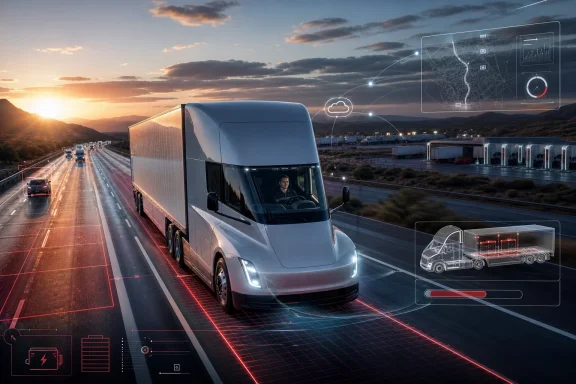 Tesla Semi FSD Is a Product Roadmap, Not a New App
The wording around this news deserves careful attention. Tesla is not launching a separate “Tesla Semi app” or a standalone freight-driving service that commercial fleets can simply download. FSD on the Tesla Semi is expected to be vehicle software, delivered through Tesla’s established over-the-air update model and integrated with the truck’s onboard sensors, cameras, compute hardware, controls, and driver-monitoring systems.That distinction is critical because the Tesla Semi is not merely a larger Model Y with a trailer attached. A Class 8 tractor operates under different physics, different operating rules, different maintenance requirements, and dramatically higher consequences when something goes wrong.
A consumer vehicle’s driver-assistance system must contend with parking lots, intersections, pedestrians, city traffic, and highway merges. A heavy truck system must also account for:
- Trailer length and articulation
- Gross combination weight
- Extended stopping distances
- Cargo stability
- Brake temperature and air-brake behavior
- Wide turns and off-tracking
- Steep grades
- Crosswinds
- Work zones
- Freight terminals and loading docks
- Commercial driver hours-of-service rules
- State and federal commercial vehicle regulations
The company’s near-term language also points toward a supervised driver-assistance model, rather than a fully autonomous freight service. That means an appropriately licensed driver would remain responsible for monitoring the truck, taking control when required, and complying with all commercial driving rules.
Background: Why the Tesla Semi Is a Natural FSD Candidate
Tesla’s Semi has long been presented as more than an electric substitute for a diesel tractor. From its central seating position and camera-heavy exterior to its high-voltage architecture and connected software platform, the truck has been positioned as a digitally native commercial vehicle.The refreshed production Semi is now offered in two primary configurations:
- Standard Range, rated at approximately 325 miles
- Long Range, rated at approximately 500 miles
The Long Range model is the more obvious candidate for long-haul autonomy development. A 500-mile operational target creates room for regional and interstate freight routes that can potentially fit within planned charging windows, driver shifts, and depot-based fleet operations.
Yet the Standard Range model could be equally important in the early stages. Controlled regional freight operations—such as distribution-center runs, port drayage, factory-to-warehouse routes, and recurring retail deliveries—are often more predictable than coast-to-coast trucking. They may provide a more manageable operating environment for supervised automation.
Tesla’s Semi also carries a large array of exterior cameras, alongside an in-cabin camera intended to support driver monitoring and safety systems. Cameras are already central to Tesla’s philosophy across its passenger vehicle lineup, where the company has increasingly relied on vision-based perception rather than a more sensor-diverse approach built around lidar and high-definition mapping.
The Semi’s autonomy ambitions therefore do not appear to require a complete reinvention of Tesla’s technical direction. Instead, the company is attempting to adapt its existing AI, camera processing, neural-network training, and over-the-air software infrastructure to a much larger vehicle category.
The Timing: Late 2026 Is Possible, but Early 2027 Looks More Realistic
Musk’s forecast leaves Tesla considerable room. “Around the end” of 2026 or “early” 2027 is not a launch commitment, a fleet availability date, or a promise that customer trucks will immediately receive FSD.The more revealing part of the statement was the reason for the delay. Tesla does not want Semi autonomy work to distract from improving the safety and generalization of FSD in the Model 3, Model Y, and Cybercab programs.
That tells the market several things.
First, Tesla appears to believe that the core FSD software stack can be extended to the Semi, rather than requiring an entirely separate autonomous-driving program. The Semi is likely expected to benefit from improvements in Tesla’s perception models, path planning, real-world video training, occupancy networks, and fleet-learning infrastructure.
Second, the Semi remains a lower-volume product compared with Tesla’s consumer vehicles. The Model 3 and Model Y provide far more driving data, more software test coverage, and greater financial leverage for each major autonomy improvement.
Third, Tesla is tying Semi FSD progress to manufacturing readiness. The company is still scaling its Nevada Semi operation, and the timing of a major software feature may depend on the number of production vehicles active in customer fleets. A small pilot fleet can generate valuable data, but broad validation requires extensive exposure across weather conditions, road types, cargo loads, geographies, and driving styles.
That makes early 2027 the more credible interpretation for a meaningful customer-facing Semi FSD deployment. Tesla could demonstrate limited functionality or begin narrow internal testing earlier, but a wider rollout would require much more than a public demonstration.
Ground-Truth Testing Signals That Development Is Underway
The confirmation follows recent sightings of Tesla Semi trucks operating with external measurement and validation equipment. These test rigs are commonly associated with ground-truth data collection, where engineers use additional sensors and recording systems to compare a vehicle’s perception output with highly detailed real-world observations.Ground-truthing matters because an autonomous system needs more than confidence. It needs a repeatable way to test whether its interpretation of the environment matches what is actually happening.
For a Semi, that can involve scenarios such as:
- Identifying passenger vehicles hidden by trailer blind spots
- Recognizing lane closures that narrow a truck’s available corridor
- Determining whether a lead vehicle is accelerating or braking on an uphill grade
- Tracking cut-ins from smaller vehicles
- Estimating the path of merging traffic near freight hubs
- Interpreting construction workers, flaggers, cones, and temporary signs
- Detecting obstacles that may be harmless for a car but hazardous for a tractor-trailer
- Managing trailer swing during turns
- Responding safely to abrupt traffic changes while hauling tens of thousands of pounds
The heavy-duty truck creates a uniquely valuable test platform because it exposes the software to different camera heights, different blind zones, different vehicle dynamics, and different road interactions. A system trained only on consumer vehicles cannot automatically be assumed to understand how a loaded tractor-trailer behaves.
Tesla will need to prove that its approach works not just when the truck is cruising in a clearly marked lane, but during the uncomfortable edge cases that define commercial driving: construction detours, bad weather, mixed traffic, unusual trailer behavior, damaged lane markings, and unpredictable human drivers.
What FSD Supervised Would Actually Mean in a Tesla Semi
Tesla’s most plausible first step is FSD Supervised functionality for the Semi. In practical terms, that would mean the truck can assist with steering, speed control, lane positioning, traffic navigation, and selected driving decisions while a professional driver remains fully responsible.This is not the same as a driverless truck.
Under the widely used SAE framework, systems that combine steering and acceleration or braking support while requiring continual human supervision are considered Level 2 driver-support systems. The driver is still driving from a legal and operational standpoint, even if their hands are not constantly turning the wheel or their foot is not applying pedal pressure.
For commercial freight, that distinction has serious consequences.
A driver using supervised automation would still need to:
- Hold the appropriate commercial driving credentials.
- Remain alert and ready to intervene.
- Follow hours-of-service limits.
- Conduct vehicle inspections.
- Manage cargo-related responsibilities.
- Respond to roadside enforcement stops.
- Handle loading docks, terminals, and operational handoffs.
- Take control in conditions outside the system’s reliable operating envelope.
The best case for a supervised Semi system is not that it eliminates the driver. It is that it makes a professional driver more effective on repetitive highway work, reduces workload during long stretches of controlled-access travel, and provides additional layers of safety support.
That could be valuable even if the driver remains in the cab for the entire journey.
The Safety Case Is More Demanding Than in Passenger Cars
Tesla’s FSD branding has always created a tension between marketing shorthand and the technical meaning of “self-driving.” The Semi makes that tension harder to ignore.A 4,000-pound passenger vehicle and an 80,000-pound combination vehicle do not present comparable risk profiles. Braking distances rise, kinetic energy rises, blind spots expand, and a small mistake can produce a much larger incident.
Tesla has emphasized its continuing work toward what Musk described as “march of nines” safety—an industry shorthand for pushing reliability toward increasingly high levels. That ambition is understandable, but it is also the point where claims require the most scrutiny.
FSD has faced ongoing safety attention from regulators, including investigations involving alleged traffic-law violations while the system was engaged in Tesla passenger vehicles. The existence of such scrutiny does not predetermine the outcome of any investigation, nor does it prove that a Semi implementation would perform the same way. It does reinforce that Tesla must establish a convincing safety record before extending its technology into commercial freight.
The primary risk is not simply whether Semi FSD can stay in a lane. Modern driver-assistance systems are already capable of useful lane centering and adaptive cruise control. The harder question is whether the software can recognize when it is uncertain, hand control back early enough, and behave predictably when road conditions become ambiguous.
A commercial trucking system must be judged on its failure behavior as much as its success behavior.
The critical safety questions
Before Tesla Semi FSD can become a broad fleet tool, operators and regulators will need credible answers to several questions:- How does the system perform with a fully loaded trailer versus an empty trailer?
- Can it reliably account for trailer length, axle configuration, and cargo weight?
- How does it handle snow, heavy rain, fog, glare, debris, and faded lane markings?
- What is the fallback procedure if the system disengages on a busy highway?
- How are emergency vehicles, work zones, and police-directed traffic handled?
- Can it safely judge gaps for lane changes with a long trailer?
- What happens during camera obstruction or sensor degradation?
- How does the system interact with a human driver who may be fatigued or slow to respond?
- What data does Tesla provide to fleet customers following an incident or near miss?
- How quickly can safety-related software changes be validated and deployed?
Manufacturing Scale Will Matter as Much as Software Progress
Tesla’s Nevada Semi factory is central to the company’s plan. The truck cannot become a serious autonomy platform if only a small number of early units exist in controlled customer pilots.High-volume Semi manufacturing would give Tesla several advantages:
- A growing fleet to collect real-world operating data
- More standardized hardware across customer vehicles
- Greater leverage for over-the-air software deployment
- Increased purchasing confidence among large fleets
- More pressure to expand high-power charging infrastructure
- A clearer business case for Semi-specific service and support networks
The company’s decision to avoid making Semi FSD the immediate priority may actually be prudent. Freight customers do not need another ambitious feature announcement as much as they need reliable trucks, predictable range, charging access, parts availability, repair capacity, and stable operating costs.
If Tesla can establish those fundamentals while gradually adding supervised automation, the Semi could develop into a more credible commercial product than if FSD becomes the headline before the underlying fleet ecosystem is ready.
Freight Efficiency Could Be the Real Prize
The most immediate value of Tesla Semi FSD may not be fully autonomous driving. It may be operational consistency.Long-haul freight is full of small efficiency losses: uneven pacing, delayed reactions to traffic, unnecessary braking, inefficient lane choices, driver fatigue, and variation between operators. A well-designed supervised system could smooth out parts of the driving task, helping maintain safer following distances and more consistent speed control.
For an electric truck, efficiency is particularly important. Energy use directly influences route viability, charging stops, delivery timing, and fleet economics. A system that drives more predictably could potentially help protect range and reduce avoidable energy waste.
Tesla’s stated Semi efficiency target of roughly 1.7 kWh per mile provides a useful baseline, but actual freight operations will vary widely. Cargo weight, weather, terrain, speed, traffic, auxiliary loads, and driving style can all change real-world consumption.
A future FSD system could potentially support fleet operations by improving:
- Cruise efficiency on long highway routes
- Predictable regenerative braking behavior
- Speed consistency across a fleet
- Safer response to stop-and-go traffic
- Driver workload during monotonous segments
- Data collection for route optimization
- Maintenance forecasting based on vehicle usage patterns
The Driver Shortage Argument Needs Nuance
Tesla has argued that increasingly capable autonomy could help address truck driver shortages. That argument has merit in the long term, but it is often framed too simply.The trucking industry’s labor challenge is not solely about the number of people with commercial driver’s licenses. It also involves retention, pay structures, home time, working conditions, training, detention at customer facilities, health demands, and the uneven attractiveness of over-the-road work.
A supervised Tesla Semi does not remove the need for drivers. In fact, its first deployments may increase the need for skilled drivers who can work comfortably with advanced automation, understand system limitations, and intervene decisively when conditions require human judgment.
The longer-term scenario is different. If Tesla eventually reaches a genuinely unsupervised, limited-domain automated driving capability, the technology could shift human labor toward more complex work:
- Terminal operations
- Urban pickup and delivery
- Loading and unloading oversight
- Freight-yard management
- Remote assistance
- Exception handling
- Fleet safety supervision
- Maintenance and inspection
For now, the driver shortage narrative should be viewed as a strategic future possibility—not an immediate operational outcome of Tesla Semi FSD.
Windows, Fleet Software, and the Commercial IT Implications
The Semi’s autonomy roadmap also has implications far beyond the driver’s seat. Commercial fleets run on data, and most fleet organizations rely on a broad mix of Windows PCs, cloud platforms, enterprise resource planning systems, maintenance software, dispatch tools, warehouse systems, and mobile devices.Tesla’s software-defined truck model could increase the importance of integration between vehicle data and corporate IT systems.
A large Semi fleet equipped with advanced driver-assistance features could generate information on:
- Route completion
- Energy consumption
- Charging status
- Driver alerts
- Safety events
- Vehicle diagnostics
- Tire and brake conditions
- Predictive maintenance
- Software versions
- Camera and sensor health
- Operating environment trends
Security will be non-negotiable
As Tesla expands FSD into commercial vehicles, cybersecurity becomes even more important. A connected truck can receive software updates, transmit operational data, and become part of a fleet-wide management ecosystem. That creates a larger attack surface than a traditional mechanically focused tractor.Fleet operators will want clear answers on:
- Update authorization and rollback processes
- Account access controls
- Multi-factor authentication
- Audit logs
- Data retention
- Incident reporting
- Remote diagnostic permissions
- Third-party integration security
- Vehicle-to-cloud encryption
- Response plans for connectivity outages
What Tesla Still Has to Prove
Tesla’s confirmation is meaningful, but it is only the beginning of a larger test.The company must prove that the Semi hardware can support FSD reliably in commercial service. It must prove that its vision-based approach can manage heavy-truck edge cases. It must show that professional drivers can understand the system’s limits without overtrusting it. It must satisfy fleet customers who need uptime, serviceability, and transparent data.
It must also navigate a regulatory environment where the rules for automated commercial vehicles remain complex. Supervised systems can operate within existing driver-centered frameworks more easily than truly driverless systems, but the regulatory burden becomes far more difficult once a company attempts to remove the human operator from the cab.
The strongest near-term outcome would be a carefully scoped Semi FSD Supervised release focused on highway assistance, robust driver monitoring, conservative operational limits, and fleet pilots with measurable safety reporting.
The weakest outcome would be an overambitious promise that confuses commercial customers about what the truck can actually do.
Tesla’s track record shows that it can move quickly when hardware, software, and manufacturing align. It also shows that autonomy timelines should be treated as targets rather than guarantees. The Tesla Semi FSD announcement should therefore be viewed as a strategic confirmation, not a finished product announcement.
The Bottom Line
Tesla’s plan to bring FSD to the Tesla Semi is one of the company’s most consequential autonomy moves because it shifts the conversation from personal transportation to freight infrastructure. The Semi could eventually become a rolling software platform for energy management, safety assistance, fleet telemetry, and automated highway driving.For now, the central facts are clear: Tesla expects Semi self-driving capability to arrive around late 2026 or early 2027, the company is actively validating Semi-specific autonomy hardware and software, and any initial deployment is far more likely to be supervised driver assistance than a driverless trucking revolution.
That is still a major development. If Tesla can combine dependable Semi production, high-power charging, disciplined FSD validation, robust driver monitoring, and fleet-ready software support, it could make the Class 8 truck one of the most important connected vehicle platforms in commercial transportation.
References
- Primary source: Not a Tesla App
Published: 2026-07-23T19:33:00+00:00
Loading…
www.notateslaapp.com - Related coverage: tesla.com
Loading…
www.tesla.com - Related coverage: basenor.com
Loading…
www.basenor.com - Related coverage: teslaoracle.com
Loading…
www.teslaoracle.com - Related coverage: electrek.co
Loading…
electrek.co - Related coverage: techradar.com
The first Tesla Semi finally rolls off the production line — 7 years after Elon Musk unveiled the long-haul EVs | TechRadar
Better late than neverwww.techradar.com