

Jeff Kaplan — the public face behind Overwatch’s early design and long-time Blizzard director — has returned to the spotlight with a strikingly different ambition: a multiplayer, action-survival first-person shooter set in a mythical Gold Rush–era Island of California called The Legend of California, developed at his new studio Kintsugiyama and slated for Early Access on PC later this year under Dreamhaven’s publishing banner. (steamdb.info)
Kintsugiyama — the studio presenting the game — operates with a focused identity: build and ship a single, high-ambition product from a small, tightly curated team. The studio’s public pages position The Legend of California as their flagship project and provide a press kit and contacts for media, indicating a conventional developer/publisher setup and an emphasis on controlled messaging around the launch. (kintsugiyama.com)
Players should be excited but pragmatic: wishlist and sign up for playtests if you want to get an early look and influence development, but temper expectations around immediate polish and long-term persistence guarantees. Watch for early guidance on monetization, anti-cheat, and post-launch server commitments; those factors will ultimately determine whether The Legend of California becomes a durable frontier or another promising project sidelined by the heavy costs of modern live-service gaming. (steamdb.info)
Source: Wccftech The Legend of California Is a Multiplayer Action Survival FPS Set in the Gold Rush Era and Designed by the Creator of Overwatch
 Background
From Overwatch to a frontier survival FPS
Jeff Kaplan’s name is inseparable from Overwatch’s launch-era identity; he served as a high-profile director at Blizzard until his departure in April 2021. His exit marked the end of nearly two decades at Blizzard and the beginning of a quieter, independent chapter that now sees him steering an ambitious survival-FPS project rather than the hero-shooter spectacle he helped define.Kintsugiyama — the studio presenting the game — operates with a focused identity: build and ship a single, high-ambition product from a small, tightly curated team. The studio’s public pages position The Legend of California as their flagship project and provide a press kit and contacts for media, indicating a conventional developer/publisher setup and an emphasis on controlled messaging around the launch. (kintsugiyama.com)
Dreamhaven’s role and context
Publishing duties are being handled by Dreamhaven, the Irvine-based company founded by Blizzard co-founder Mike Morhaime and partners. Dreamhaven’s role as publisher brings industry gravitas and institutional experience to Kintsugiyama’s debut; however, Dreamhaven itself has faced headwinds in 2025 with restructuring and staff reductions that highlight the fragile economics of mid-tier publishing. That context matters because persistent multiplayer games rely on long-term publisher support for servers, marketing, and ongoing development.Overview: What The Legend of California Promises
Setting and scope
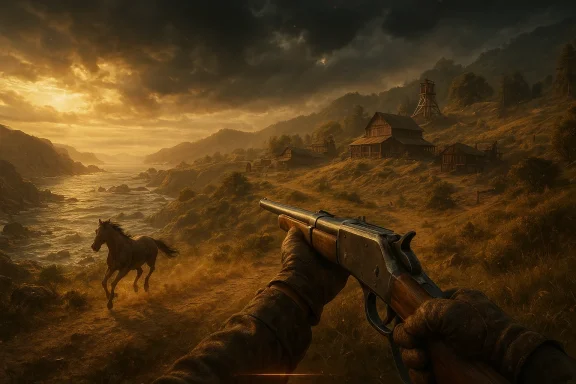
The Legend of California places players on a mythical Island of California during a stylized Gold Rush era. Promises on official storefront material emphasize:- An expansive, ever-changing open world inspired by Gold Rush–era California and filled with distinct biomes and iconic landmarks.
- Persistent multiplayer servers where players can go solo or form a “company” of up to four players to share resources, buildings, and progress.
- A mix of PvE and optional PvP: hunting wildlife, raiding hostile encampments, and assaulting enemy strongholds for rewards.
- Robust gathering, crafting, and base-building systems — ranches, mines, stables, crafting stations are specifically called out — supporting progressive player economies and home-base development.
Core gameplay pillars
From developer messaging and storefront descriptions the game’s pillars can be summarized as:- Exploration — emergent discovery across varied biomes and hidden secrets.
- Combat — first-person shooting with a stated emphasis on precision; encounters include wildlife, PvE camps, and optional PvP.
- Crafting and base building — resource gathering that feeds into ranching, mining, and station-based unlocking of advanced gear.
- Persistence and legacy — servers hold player progress and structures, enabling long-term play and reputational systems.
Technical detail: system requirements and platforms
Minimum and recommended specs
The Legend of California already lists minimum and recommended PC specifications on its storefront entries. The key specs are:- Minimum: Windows 10/11 (64-bit); Intel Core i7-10700K / AMD Ryzen 7 3700X; 16 GB RAM; NVIDIA GeForce RTX 2060 SUPER (8GB) or AMD Radeon RX 6600 (8GB); DirectX 12; 50 GB (SSD required).
- Recommended: Windows 10/11 (64-bit); Intel Core i7-12700K / AMD Ryzen 7 5700X; 32 GB RAM; NVIDIA GeForce RTX 3080 (10GB) or AMD Radeon RX 6800 (10GB); DirectX 12; 50 GB (SSD required).
Platforms and release window
At present, the project is confirmed for Windows PC with an Early Access launch planned for 2026; storefront blurbs and SteamDB list the game as prerelease and coming to Early Access in 2026, with private playtests already enabled. There is no public confirmation of console releases at announcement time. A recent podcast appearance and promotional materials indicate alpha or playtest phases in March, signaling an iterative roll-out leading to broader Early Access later in the year. (steamdb.info)Why Jeff Kaplan matters here — creative strengths
Design pedigree and player-first instincts
Jeff Kaplan’s career — notably his public-facing role on Overwatch’s development and community communication — means two things matter for The Legend of California:- Design craft: Kaplan has experience shipping multiplayer systems and balancing combat and progression at scale. That background is valuable for an FPS that aims to marry shooting skill with survival mechanics. Expect emphasis on responsive guns, readable combat feedback, and deliberate progression loops rather than purely grind-first survival staples.
- Community empathy: Kaplan’s high-profile relationship with player communities (the “Papa Jeff” era) suggests the new studio may keep community channels open and iterate transparently in early access. That can be a major asset for a live service–adjacent game that will need constant tuning. His public interviews also highlight a design-led motivation rather than a pure monetization-first approach.
Tactical advantages for Kintsugiyama
A small, experienced leadership team can move faster and iterate cleaner. Kaplan’s name is a marketing vector in itself — attracting talent, press, and early wishlists. With Dreamhaven on publishing, Kintsugiyama gains a launch partner that understands AAA operations, at least in theory. These are important elements for an indie project with high technical and live-service expectations. (kintsugiyama.com)Risks, blind spots, and hard questions
1) Genre crowding and differentiation
The open-world survival genre is saturated. Titles that combine base-building, resource loops, PvE threats, and PvP competition have to earn each of those systems through either novel interactions or exceptional polish. Kaplan’s pedigree helps, but pedigree alone does not guarantee the kind of systems-level innovation needed to make a survival FPS stand out long-term. The game’s marketing leans on a Gold Rush theme and “mythical island” framing as its differentiator; that thematic coat of paint will matter only if it meaningfully alters core gameplay loops.2) Persistent servers and fiscal sustainability
Persistent multiplayer servers are expensive. Dreamhaven’s recent cost-control measures and reported layoffs in 2025 underscore the reality that even well-funded boutique publishers face tight margins. Long-term server, matchmaking, anti-cheat, and content support commitments are expensive — and essential. If The Legend of California gains traction, Dreamhaven will need to commit ongoing resources; if it does not, server shutdowns or feature cuts could reduce the game’s long-term value to players. That’s a publisher-and-platform risk independent of creative quality.3) Early Access pitfalls
Early Access can be a double-edged sword. It allows iterative refinement but it also exposes the product to first-impression risks: poor optimization, broken features, or spine-weak balancing can scar a game’s community before it matures. The listed system requirements suggest a heavy technical bar; if widespread performance issues occur on launch, player sentiment could sour quickly. The presence of playtests on Steam does indicate the team intends to iterate, but the market’s patience for problematic early-access launches is limited. (steamdb.info)4) PvP governance, griefing, and moderation
Optional PvP is attractive on paper but introduces social friction: griefing, exploitation of player-built assets, and toxic behavior can destroy emergent economies. Robust reporting, server rulesets, active moderation, and well-designed grief-protection mechanics are non-negotiable if Kintsugiyama wants retention-driven economies and the safety of cooperative play. Achieving that requires organizational capacity (moderation teams, tools) often underestimated by small studios. No public roadmap yet clarifies how the team will staff and fund these operational roles. (steamdb.info)5) Historical sensitivity and portrayal
Setting a game in the Gold Rush era raises non-trivial historical and cultural questions. The Gold Rush period was catastrophic for many Indigenous communities, and it shaped patterns of displacement, violence, and unequal wealth. A mythicized “Island of California” gives designers leeway, but narrative and environmental design choices should still be conscious about representation, appropriation, and the ethical implications of the era. There is currently no public detail on how the game handles these themes. That absence is a red flag for players attentive to historical accuracy and representation. (This is a cautionary observation rather than a claim about the game’s content.)How The Legend of California fits alongside major genre touchstones
Benchmarks and analogues
Several successful and instructive comparisons give practical context for what Kaplan’s team is attempting:- Rust — a harsh, player-driven survival sandbox with strong PvP and social emergent systems. Rust demonstrates how PvP economies can thrive but also how toxic dynamics discourage some player segments.
- Red Dead Redemption 2 (and its online component) — the Western aesthetic and horseback traversal evoke RDR’s themes, but Rockstar’s single-player-narrative and AAA resources are a different proposition.
- Valheim / Subnautica — both represent survival with strong exploration and crafting hooks; Valheim’s focus on cooperative discovery and Subnautica’s environmental storytelling show alternate pathways to player engagement.
- Escape from Tarkov — high-stakes PvP-looter-shooter mechanics reveal how tension and loot economies can drive retention — while also generating steep new-player barriers.
Practical implications for players and PC owners
Hardware planning
The recommended specs suggest serious GPU and memory headroom. Players on mid-range or older GPUs should assume they’ll have to tune settings aggressively or risk sub-60 FPS experiences, especially in high-density settlements or when advanced rendering features are enabled. The explicit SSD requirement signals heavy streaming; long HDD load times and pop-in would likely be present without an SSD. If you plan to play at launch, ensure you meet or exceed recommended specs for the smoothest Early Access experience.Playtests, wishlist, and Early Access etiquette
Kintsugiyama has enabled playtests and the game is on Steam wishlists with a playtest indicator, which is the right approach for iterative design. If you join early playtests:- Treat Early Access as a work-in-progress and avoid immediate judgments based on preliminary builds.
- Provide focused, reproducible feedback — the most useful input teams receive is bug reports with reproduction steps, hardware specs, and logs.
- Expect balance shifts and occasional server downtime; playtests are often for stress-testing backend systems. (steamdb.info)
Monetization and business model — what to watch for
There is no public, detailed monetization breakdown at announcement, which is standard for a pre-Early Access reveal. Still, given the game’s live-server design, possible models include:- Upfront purchase for Early Access with optional cosmetic microtransactions.
- Seasonal content passes or expansions.
- Premium DLC or companion expansion packs.
Operational concerns: servers, anti-cheat, and post-launch support
Anti-cheat and competitive integrity
Any FPS with persistent economies and PvP must plan for anti-cheat, fair matchmaking, and rapid exploit mitigation. The engineering demands are non-trivial; smaller studios often lean on third-party anti-cheat solutions, which can cause community friction depending on implementation. Transparency about anti-cheat approaches and a clear, visible ban/enforcement process will be important for player confidence. The storefront and developer materials do not yet specify anti-cheat technologies. (steamdb.info)Server scaling and persistence design
Persistence is a selling point but a technical and fiscal liability. The choices the team makes around world instancing, persistence scope (do all structures persist forever? are there decay systems?), and backup/rollback processes will determine how durable player investment feels. Given Dreamhaven’s recent restructuring, the level of continuous post-launch investment remains an open and material question.What success looks like — and failure modes to avoid
Success indicators
- A clear, differentiated gameplay loop that leverages the Gold Rush setting beyond visuals (environmental storytelling, unique biome systems, and faction interplay).
- Polished first-person combat that rewards skill while integrating survival mechanics in a balanced way.
- Strong early community stewardship — daily updates on bug-fixes, roadmap clarity, and substantial engagement during Early Access phases.
- Sustainable monetization that funds servers and content without undermining the gameplay loop.
Failure modes
- Launching Early Access with serious performance or stability issues, especially given high recommended specs.
- Allowing PvP griefing or unmoderated behavior to erode cooperative player bases.
- Overreaching with server persistence without committed funding for long-term upkeep — leading to server-side feature cuts or sunset.
- Using monetization that fragments gameplay fairness or accelerates the grind for paying players.
Final verdict: cautious optimism with clear caveats
The Legend of California is an ambitious pivot for Jeff Kaplan and Kintsugiyama: it trades hero-driven, character-first design for a survival-driven, place-and-progression experience rooted in a stylized historical milieu. That pivot is creatively intriguing. Kaplan’s track record in shipping memorable multiplayer experiences, combined with Dreamhaven’s publishing muscle, places the project in a position to surprise — but the commercial and operational realities of running a persistent multiplayer survival title are unforgiving.Players should be excited but pragmatic: wishlist and sign up for playtests if you want to get an early look and influence development, but temper expectations around immediate polish and long-term persistence guarantees. Watch for early guidance on monetization, anti-cheat, and post-launch server commitments; those factors will ultimately determine whether The Legend of California becomes a durable frontier or another promising project sidelined by the heavy costs of modern live-service gaming. (steamdb.info)
Quick reference: what to watch next
- Early Access launch window and exact dates from Kintsugiyama or Steam announcements (the game is listed for Early Access in 2026 now).
- Playtest notes and patch cadence during alpha/beta phases; active iteration is a positive sign.
- Clear statements on monetization — cosmetic vs. gameplay-affecting purchases.
- Technical observables: recommended system requirements performance, anti-cheat stack, and server persistence mechanics.
- Dreamhaven’s publishing posture and whether it provides long-term operational guarantees for persistent servers. (steamdb.info)
Source: Wccftech The Legend of California Is a Multiplayer Action Survival FPS Set in the Gold Rush Era and Designed by the Creator of Overwatch
