

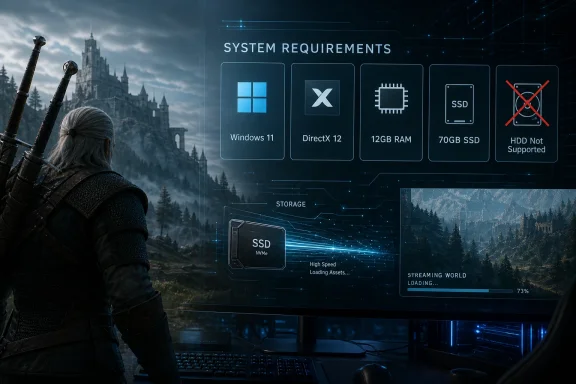
CD Projekt Red says The Witcher 3: Wild Hunt will require Windows 11, DirectX 12, 12GB of RAM, and 70GB of SSD storage on PC when its new paid expansion, Songs of the Past, launches in 2027 for PC, PlayStation 5, and Xbox Series X|S. That is a remarkable line to draw under a game that began life in 2015 as a last-generation open-world RPG designed to run on mechanical drives and Windows 7-era assumptions. The company is not selling this as a visual reboot, which makes the move feel less like a graphics milestone and more like a platform cutover. For Windows users, the message is blunt: the future of even old games is increasingly being written around Windows 11 and solid-state storage.
The strange thing about this announcement is not that a new Witcher 3 expansion exists. CD Projekt has spent years proving that its biggest worlds can have long commercial tails, and Geralt remains one of the most bankable characters in modern RPGs. The strange thing is that Songs of the Past arrives with a PC requirements shift that feels more like a new game launch than a late-life add-on.
The headline requirements are not outrageous by contemporary gaming standards. A Ryzen 5 2600 or Core i5-8400, a GeForce GTX 1660 or Radeon RX 5500 XT-class card, and 12GB of RAM are not enthusiast hardware in 2026. Many midrange PCs have cleared that bar for years.
But requirements are not judged only by how expensive they look on a spreadsheet. They are judged by who they exclude. In this case, the exclusion zone is obvious: Windows 10 machines, older PCs that cannot officially move to Windows 11, and systems still relying on hard drives for large game libraries.
That matters because The Witcher 3 is not merely another item in a Steam backlog. It is one of the defining PC RPGs of the last decade, a game whose install base sprawls across old desktops, living-room PCs, laptops, and upgraded machines that may have gained a better GPU without ever replacing the motherboard. A late expansion to that kind of game inherits an older audience by design.
CD Projekt is therefore making a bet about the shape of its active audience. It appears to believe that the players who will buy a premium expansion in 2027 are already on SSDs, already on current-generation consoles, or already inside the Windows 11 tent. That may be commercially rational. It is still a meaningful break with the idea that a game’s original PC footprint should remain the baseline for its future content.
Game studios do not want to certify new content against operating systems their platform vendor has already moved beyond. They also do not want to spend engineering time chasing driver, middleware, overlay, launcher, and anti-tamper bugs on a retired OS. The closer a release gets to 2027, the easier it becomes for publishers to argue that Windows 10 is no longer a viable baseline.
The problem is that Windows 10 retirement is not just a software update story. Windows 11’s official requirements have always carried a hardware implication: TPM support, Secure Boot, and CPU eligibility left some perfectly functional older machines outside Microsoft’s preferred upgrade path. For a desktop built around a pre-2018 platform, the practical route to Windows 11 may be a motherboard and processor replacement, not a Tuesday-night update.
That is why this requirement will sting differently from a GPU bump. A graphics card requirement says, “Your game may not run well.” An operating system requirement says, “Your platform is no longer welcome.” For users who bought The Witcher 3 years ago and kept a stable Windows 10 gaming PC around precisely because it still worked, the distinction is not academic.
There is also a trust dimension. PC gaming has traditionally sold itself on backward compatibility, ownership continuity, and the ability to carry a library across hardware generations. Every time a major game draws a hard OS line, that promise becomes more conditional. The library survives, but the supported version narrows.
That is not a wild assumption in 2027. Modern consoles have normalized SSD-first design, and PC developers increasingly build around faster storage because it reduces the compromises that once shaped open-world streaming. Texture pop-in, traversal bottlenecks, disguised loading corridors, duplicated assets, and conservative world layouts all have roots in storage limits.
Still, The Witcher 3 is not a brand-new Unreal Engine 5 showcase being built from scratch for current hardware. It is an expansion to a 2015 RPG whose original world streamed from hard drives because it had to. Asking for an SSD without announcing a corresponding visual overhaul creates a messaging gap that CD Projekt will have to fill.
The charitable reading is that Songs of the Past may push the old engine in ways that are less visible in screenshots than they are in play. More dense environments, fewer loading seams, larger streaming cells, and more aggressive asset reuse can all demand faster storage without looking like a ray-tracing demo. The less charitable reading is that dropping HDD support simplifies testing and support more than it transforms the player experience.
Both can be true. Developers are allowed to simplify support matrices, especially for an expansion arriving twelve years after the base game. But players are also allowed to ask what they receive in exchange for the new floor. When a publisher says “SSD required,” many PC users now hear “current-gen design.” If the delivered expansion feels like a conventional quest pack, the requirement will be judged harshly.
That makes the hard drive exclusion more prominent. If the graphics floor had jumped to an RTX-class card, the story would be simple: a major rendering upgrade needs modern hardware. Instead, the requirements imply that the company is less worried about shader throughput than about platform consistency.
That distinction matters to PC enthusiasts because it changes the upgrade logic. A player with an older but still decent GPU may be technically close to the new minimums while still blocked by Windows 10 or storage. Another player may have an SSD but a Windows 11-ineligible CPU platform. The expensive part of compliance may not be the part that improves frame rate.
It also raises an uncomfortable question about what minimum requirements are supposed to communicate. In the old model, they were a performance warning. In the new model, they are increasingly a support boundary. The hardware might be capable of limping through, but the developer is choosing not to validate it.
For administrators and technically minded users, that is a familiar pattern. Enterprise software vendors routinely narrow support to reduce unknowns, even when older configurations might function. PC gamers, however, have historically expected more flexibility. The Witcher 3 change is a reminder that big-budget games are adopting enterprise-style lifecycle discipline, one compatibility table at a time.
A rollback is not the same as support. It is a museum door. You can keep the old version, but you are stepping out of the forward-moving branch of the game.
That distinction becomes more important if future patches, mod compatibility updates, bug fixes, or launcher-level changes follow the new requirements. The community may end up with two Witcher 3 realities: the living 2027 branch with Songs of the Past, and the preserved legacy branch for players who cannot or will not upgrade. For a single-player RPG, that split is manageable. For a mod-heavy classic, it can still be disruptive.
The platform split is sharper for players on storefronts without robust version rollback. Steam and GOG have long been friendlier to preservation-minded PC users because they provide more practical control over builds. If Epic Games Store users lack an equivalent rollback path for this case, the same purchase can become meaningfully different depending on where it was made.
That is one of the under-discussed consequences of modern PC gaming. We talk about “PC” as though it is one platform, but the real user experience is mediated by launchers, depots, branch policies, offline installers, cloud saves, and entitlement rules. A system requirement change is not just a hardware story. It is a storefront story.
It also gives Songs of the Past a certain narrative credibility. This does not look like a random outsourcing arrangement bolted onto a beloved game for brand extraction. It looks like CD Projekt trying to use a trusted regional partner to extend the life of its most enduring RPG while the next mainline Witcher project moves elsewhere.
But credibility is not immunity. A third expansion for The Witcher 3 arrives under enormous expectations because Hearts of Stone and Blood and Wine were not throwaway DLCs. They helped define what premium RPG expansions could be: substantial, sharply written, and worth treating almost like standalone games.
That legacy cuts both ways. If Songs of the Past is rich enough, the new requirements may be seen as the cost of revisiting Geralt properly in 2027. If it feels slight, the requirements will look like an exclusionary footnote attached to nostalgia. CD Projekt does not merely have to justify the price; it has to justify the platform break.
The company has not yet disclosed pricing or full story details, and more information is expected later. That leaves room for the picture to improve. It also leaves room for suspicion, especially among players who have learned to read system requirements as part marketing, part engineering, and part support policy.
That makes CD Projekt’s decision a useful signal. If even a long-lived 2015 game can move its active branch to Windows 11 and SSD-only storage, then similar moves from other publishers will become easier to defend. The precedent will not be that every old game must do this. The precedent will be that major new content can reset the contract.
This is where Microsoft’s hardware policy and game publishers’ support economics start to reinforce each other. Microsoft ends mainstream support for Windows 10. GPU vendors tune drivers and tooling for newer stacks. Middleware vendors prioritize current platforms. Studios follow the support trail. Users experience the result as an upgrade requirement that appears to come from a game, even though it is really the endpoint of several industry decisions.
There is nothing conspiratorial about that. It is how platforms age. But for users, the practical effect is the same: a working PC becomes “legacy” not because it fails, but because the ecosystem stops wanting to test against it.
That is especially relevant for households and hobbyists who maintain older gaming rigs. A machine that remains excellent for esports, indie games, older AAA titles, media playback, and general use may be locked out of new content for reasons that have little to do with raw capability. The PC does not become useless. It becomes increasingly segmented.
Modern platform requirements are less forgiving. DirectX versions, CPU instruction sets, storage expectations, driver models, kernel protections, anti-cheat systems, and OS support windows are harder gates than the old “turn the settings down” culture. They make development cleaner, but they make ownership feel less open-ended.
The SSD transition is a good example. For years, SSDs were a quality-of-life upgrade. They made Windows boot faster and games load more quickly, but most titles still tolerated hard drives. Then current-generation consoles made fast storage part of the design baseline, and the PC version of that shift has been uneven but unmistakable.
Windows 11 is following a similar path. At first, it was optional for many gamers. Then it became the default on new systems. Now it is becoming the supported minimum for some forward-looking releases and updates. The transition is gradual until, for a particular game or tool, it suddenly is not.
This is not necessarily bad for the medium. Developers can do more when they stop designing around the slowest widely installed hardware. Security improves when unsupported operating systems fade out of the active matrix. Support teams can spend less time triaging bugs caused by ancient drivers and unpredictable storage stalls. The industry does gain something.
But the cost is borne unevenly. Enthusiasts who upgrade often barely notice. Budget users, preservationists, students, rural players with older family PCs, and those who deliberately avoid Windows 11 notice immediately. A requirement that looks modest in a gaming hardware survey can still be a wall for the people on the wrong side of it.
The risk is that the affected users are not random edge cases. They are often the very players who kept old games alive, modded them, replayed them, recommended them, and bought complete editions years after launch. A late expansion trades heavily on that loyalty. Excluding part of that audience is commercially defensible, but emotionally awkward.
The no-exceptions posture also changes how the expansion will be discussed before anyone plays it. Instead of the first conversation being about Geralt’s return, the setting, or how the new story connects to the next Witcher era, a large slice of the PC audience is debating operating systems and storage. That is not ideal marketing for a fantasy RPG.
CD Projekt can reduce the backlash with clarity. It should explain whether the requirement applies to the base game after a future update or only to the new content branch. It should document rollback options by storefront. It should be explicit about whether existing owners can remain on older builds without forced disruption. Most of all, it should show what the SSD assumption enables in the expansion itself.
Players are more accepting of higher requirements when they can see the trade. They are less accepting when the requirement looks like a quiet support-policy cleanup wrapped around a paid product.
The storage part is the easier fix for many desktops. SATA SSDs remain cheap, and even older systems can often gain a dramatic improvement from replacing a hard drive. If the rest of the machine is Windows 11-ready, the SSD mandate may be more annoying than devastating.
The OS part is harder. Users on unsupported CPUs face the familiar choice: stay on Windows 10 and legacy game branches, attempt unsupported Windows 11 installation paths, or rebuild around a supported platform. For a single expansion, that may be an unreasonable upgrade trigger. For users already seeing other software leave Windows 10 behind, The Witcher 3 may simply become one more item on a growing list.
There is also a preservation-minded path: freeze the current build where possible, back up saves, and avoid assuming that every storefront will treat version control equally. GOG’s offline-installer heritage and Steam’s branch system have practical value here. Launcher choice becomes part of a long-term ownership strategy.
This is where the PC’s flexibility still matters. The new requirements may close one door, but users are not powerless. They can choose when to upgrade, where to buy, which build to preserve, and whether a 2027 expansion is worth reorganizing a machine around.
 CD Projekt Turns a 2015 Classic Into a 2027 Compatibility Test
The strange thing about this announcement is not that a new Witcher 3 expansion exists. CD Projekt has spent years proving that its biggest worlds can have long commercial tails, and Geralt remains one of the most bankable characters in modern RPGs. The strange thing is that Songs of the Past arrives with a PC requirements shift that feels more like a new game launch than a late-life add-on.The headline requirements are not outrageous by contemporary gaming standards. A Ryzen 5 2600 or Core i5-8400, a GeForce GTX 1660 or Radeon RX 5500 XT-class card, and 12GB of RAM are not enthusiast hardware in 2026. Many midrange PCs have cleared that bar for years.
But requirements are not judged only by how expensive they look on a spreadsheet. They are judged by who they exclude. In this case, the exclusion zone is obvious: Windows 10 machines, older PCs that cannot officially move to Windows 11, and systems still relying on hard drives for large game libraries.
That matters because The Witcher 3 is not merely another item in a Steam backlog. It is one of the defining PC RPGs of the last decade, a game whose install base sprawls across old desktops, living-room PCs, laptops, and upgraded machines that may have gained a better GPU without ever replacing the motherboard. A late expansion to that kind of game inherits an older audience by design.
CD Projekt is therefore making a bet about the shape of its active audience. It appears to believe that the players who will buy a premium expansion in 2027 are already on SSDs, already on current-generation consoles, or already inside the Windows 11 tent. That may be commercially rational. It is still a meaningful break with the idea that a game’s original PC footprint should remain the baseline for its future content.
Windows 10’s Retirement Becomes a Gaming Cutoff
The Windows 11 requirement is the more politically charged part of the change because it turns Microsoft’s lifecycle calendar into a game-access rule. Windows 10 reached the end of standard support on October 14, 2025, and CD Projekt is explicitly aligning its PC support posture with that reality. In security terms, that is not an unreasonable position.Game studios do not want to certify new content against operating systems their platform vendor has already moved beyond. They also do not want to spend engineering time chasing driver, middleware, overlay, launcher, and anti-tamper bugs on a retired OS. The closer a release gets to 2027, the easier it becomes for publishers to argue that Windows 10 is no longer a viable baseline.
The problem is that Windows 10 retirement is not just a software update story. Windows 11’s official requirements have always carried a hardware implication: TPM support, Secure Boot, and CPU eligibility left some perfectly functional older machines outside Microsoft’s preferred upgrade path. For a desktop built around a pre-2018 platform, the practical route to Windows 11 may be a motherboard and processor replacement, not a Tuesday-night update.
That is why this requirement will sting differently from a GPU bump. A graphics card requirement says, “Your game may not run well.” An operating system requirement says, “Your platform is no longer welcome.” For users who bought The Witcher 3 years ago and kept a stable Windows 10 gaming PC around precisely because it still worked, the distinction is not academic.
There is also a trust dimension. PC gaming has traditionally sold itself on backward compatibility, ownership continuity, and the ability to carry a library across hardware generations. Every time a major game draws a hard OS line, that promise becomes more conditional. The library survives, but the supported version narrows.
The SSD Mandate Is the Real No-Exceptions Moment
If Windows 11 is the political requirement, the SSD mandate is the architectural one. CD Projekt’s stated framing is asset streaming rather than visual fidelity. In plain English, the expansion is being designed around the assumption that the game can pull world data from storage quickly and predictably enough that a hard drive is no longer an acceptable minimum.That is not a wild assumption in 2027. Modern consoles have normalized SSD-first design, and PC developers increasingly build around faster storage because it reduces the compromises that once shaped open-world streaming. Texture pop-in, traversal bottlenecks, disguised loading corridors, duplicated assets, and conservative world layouts all have roots in storage limits.
Still, The Witcher 3 is not a brand-new Unreal Engine 5 showcase being built from scratch for current hardware. It is an expansion to a 2015 RPG whose original world streamed from hard drives because it had to. Asking for an SSD without announcing a corresponding visual overhaul creates a messaging gap that CD Projekt will have to fill.
The charitable reading is that Songs of the Past may push the old engine in ways that are less visible in screenshots than they are in play. More dense environments, fewer loading seams, larger streaming cells, and more aggressive asset reuse can all demand faster storage without looking like a ray-tracing demo. The less charitable reading is that dropping HDD support simplifies testing and support more than it transforms the player experience.
Both can be true. Developers are allowed to simplify support matrices, especially for an expansion arriving twelve years after the base game. But players are also allowed to ask what they receive in exchange for the new floor. When a publisher says “SSD required,” many PC users now hear “current-gen design.” If the delivered expansion feels like a conventional quest pack, the requirement will be judged harshly.
The Modest GPU Bar Makes the Storage Decision Louder
The GPU requirement is telling precisely because it is not extreme. A GTX 1660 or RX 5500 XT is not the sort of minimum that screams generational reset. It suggests CD Projekt is not trying to make The Witcher 3 into a path-traced spectacle that leaves older midrange PCs behind.That makes the hard drive exclusion more prominent. If the graphics floor had jumped to an RTX-class card, the story would be simple: a major rendering upgrade needs modern hardware. Instead, the requirements imply that the company is less worried about shader throughput than about platform consistency.
That distinction matters to PC enthusiasts because it changes the upgrade logic. A player with an older but still decent GPU may be technically close to the new minimums while still blocked by Windows 10 or storage. Another player may have an SSD but a Windows 11-ineligible CPU platform. The expensive part of compliance may not be the part that improves frame rate.
It also raises an uncomfortable question about what minimum requirements are supposed to communicate. In the old model, they were a performance warning. In the new model, they are increasingly a support boundary. The hardware might be capable of limping through, but the developer is choosing not to validate it.
For administrators and technically minded users, that is a familiar pattern. Enterprise software vendors routinely narrow support to reduce unknowns, even when older configurations might function. PC gamers, however, have historically expected more flexibility. The Witcher 3 change is a reminder that big-budget games are adopting enterprise-style lifecycle discipline, one compatibility table at a time.
The Fallback Exists, But It Splits the PC Audience
There is a safety valve for some players: previous game versions on Steam and GOG can typically be preserved through branch or rollback mechanisms. If CD Projekt keeps that path available, Windows 10 and HDD users may be able to continue playing the existing build indefinitely. That softens the blow, but it does not erase it.A rollback is not the same as support. It is a museum door. You can keep the old version, but you are stepping out of the forward-moving branch of the game.
That distinction becomes more important if future patches, mod compatibility updates, bug fixes, or launcher-level changes follow the new requirements. The community may end up with two Witcher 3 realities: the living 2027 branch with Songs of the Past, and the preserved legacy branch for players who cannot or will not upgrade. For a single-player RPG, that split is manageable. For a mod-heavy classic, it can still be disruptive.
The platform split is sharper for players on storefronts without robust version rollback. Steam and GOG have long been friendlier to preservation-minded PC users because they provide more practical control over builds. If Epic Games Store users lack an equivalent rollback path for this case, the same purchase can become meaningfully different depending on where it was made.
That is one of the under-discussed consequences of modern PC gaming. We talk about “PC” as though it is one platform, but the real user experience is mediated by launchers, depots, branch policies, offline installers, cloud saves, and entitlement rules. A system requirement change is not just a hardware story. It is a storefront story.
Fool’s Theory Gives the Expansion Credibility, Not Immunity
The involvement of Fool’s Theory is a smart move. The Polish studio has Witcher veterans in its orbit and is already working on the remake of the original Witcher. For CD Projekt, that makes it a natural partner for a project designed to return to Geralt without pulling the core studio fully away from newer priorities.It also gives Songs of the Past a certain narrative credibility. This does not look like a random outsourcing arrangement bolted onto a beloved game for brand extraction. It looks like CD Projekt trying to use a trusted regional partner to extend the life of its most enduring RPG while the next mainline Witcher project moves elsewhere.
But credibility is not immunity. A third expansion for The Witcher 3 arrives under enormous expectations because Hearts of Stone and Blood and Wine were not throwaway DLCs. They helped define what premium RPG expansions could be: substantial, sharply written, and worth treating almost like standalone games.
That legacy cuts both ways. If Songs of the Past is rich enough, the new requirements may be seen as the cost of revisiting Geralt properly in 2027. If it feels slight, the requirements will look like an exclusionary footnote attached to nostalgia. CD Projekt does not merely have to justify the price; it has to justify the platform break.
The company has not yet disclosed pricing or full story details, and more information is expected later. That leaves room for the picture to improve. It also leaves room for suspicion, especially among players who have learned to read system requirements as part marketing, part engineering, and part support policy.
A Late Expansion Becomes a Windows 11 Adoption Signal
For WindowsForum readers, the broader implication is more interesting than the fate of a single RPG. The Witcher 3 is the kind of legacy blockbuster that reveals where the PC market is actually moving because it straddles generations. It launched in an era when hard drives were normal, Windows 10 was new, and the PlayStation 4 and Xbox One defined console baselines. Its 2027 expansion belongs to a world of SSD consoles, Windows 11, and OS security requirements that publishers increasingly do not want to fight.That makes CD Projekt’s decision a useful signal. If even a long-lived 2015 game can move its active branch to Windows 11 and SSD-only storage, then similar moves from other publishers will become easier to defend. The precedent will not be that every old game must do this. The precedent will be that major new content can reset the contract.
This is where Microsoft’s hardware policy and game publishers’ support economics start to reinforce each other. Microsoft ends mainstream support for Windows 10. GPU vendors tune drivers and tooling for newer stacks. Middleware vendors prioritize current platforms. Studios follow the support trail. Users experience the result as an upgrade requirement that appears to come from a game, even though it is really the endpoint of several industry decisions.
There is nothing conspiratorial about that. It is how platforms age. But for users, the practical effect is the same: a working PC becomes “legacy” not because it fails, but because the ecosystem stops wanting to test against it.
That is especially relevant for households and hobbyists who maintain older gaming rigs. A machine that remains excellent for esports, indie games, older AAA titles, media playback, and general use may be locked out of new content for reasons that have little to do with raw capability. The PC does not become useless. It becomes increasingly segmented.
The Old PC Gaming Bargain Is Being Rewritten
The old bargain of PC gaming was messy but generous. You could often run a game below spec, hack a configuration file, tolerate stutter, reduce textures, or accept long loading times. The machine might complain, but it rarely refused on principle.Modern platform requirements are less forgiving. DirectX versions, CPU instruction sets, storage expectations, driver models, kernel protections, anti-cheat systems, and OS support windows are harder gates than the old “turn the settings down” culture. They make development cleaner, but they make ownership feel less open-ended.
The SSD transition is a good example. For years, SSDs were a quality-of-life upgrade. They made Windows boot faster and games load more quickly, but most titles still tolerated hard drives. Then current-generation consoles made fast storage part of the design baseline, and the PC version of that shift has been uneven but unmistakable.
Windows 11 is following a similar path. At first, it was optional for many gamers. Then it became the default on new systems. Now it is becoming the supported minimum for some forward-looking releases and updates. The transition is gradual until, for a particular game or tool, it suddenly is not.
This is not necessarily bad for the medium. Developers can do more when they stop designing around the slowest widely installed hardware. Security improves when unsupported operating systems fade out of the active matrix. Support teams can spend less time triaging bugs caused by ancient drivers and unpredictable storage stalls. The industry does gain something.
But the cost is borne unevenly. Enthusiasts who upgrade often barely notice. Budget users, preservationists, students, rural players with older family PCs, and those who deliberately avoid Windows 11 notice immediately. A requirement that looks modest in a gaming hardware survey can still be a wall for the people on the wrong side of it.
CD Projekt Is Selling Confidence, But Also Forcing a Choice
There is an unmistakable confidence in this move. CD Projekt is effectively saying that the audience for a 2027 Witcher 3 expansion is modern enough to absorb a stricter baseline. Given SSD adoption and the age of Windows 10, the company may be right.The risk is that the affected users are not random edge cases. They are often the very players who kept old games alive, modded them, replayed them, recommended them, and bought complete editions years after launch. A late expansion trades heavily on that loyalty. Excluding part of that audience is commercially defensible, but emotionally awkward.
The no-exceptions posture also changes how the expansion will be discussed before anyone plays it. Instead of the first conversation being about Geralt’s return, the setting, or how the new story connects to the next Witcher era, a large slice of the PC audience is debating operating systems and storage. That is not ideal marketing for a fantasy RPG.
CD Projekt can reduce the backlash with clarity. It should explain whether the requirement applies to the base game after a future update or only to the new content branch. It should document rollback options by storefront. It should be explicit about whether existing owners can remain on older builds without forced disruption. Most of all, it should show what the SSD assumption enables in the expansion itself.
Players are more accepting of higher requirements when they can see the trade. They are less accepting when the requirement looks like a quiet support-policy cleanup wrapped around a paid product.
The Practical Advice Is Less Romantic Than the Return to Geralt
For users planning ahead, the safest interpretation is simple: treat Songs of the Past as a current-generation PC release that happens to attach to an old game. If your machine cannot officially run Windows 11 and does not have an SSD large enough for the install, assume you are outside the supported path. Waiting for a last-minute exception is not a strategy.The storage part is the easier fix for many desktops. SATA SSDs remain cheap, and even older systems can often gain a dramatic improvement from replacing a hard drive. If the rest of the machine is Windows 11-ready, the SSD mandate may be more annoying than devastating.
The OS part is harder. Users on unsupported CPUs face the familiar choice: stay on Windows 10 and legacy game branches, attempt unsupported Windows 11 installation paths, or rebuild around a supported platform. For a single expansion, that may be an unreasonable upgrade trigger. For users already seeing other software leave Windows 10 behind, The Witcher 3 may simply become one more item on a growing list.
There is also a preservation-minded path: freeze the current build where possible, back up saves, and avoid assuming that every storefront will treat version control equally. GOG’s offline-installer heritage and Steam’s branch system have practical value here. Launcher choice becomes part of a long-term ownership strategy.
This is where the PC’s flexibility still matters. The new requirements may close one door, but users are not powerless. They can choose when to upgrade, where to buy, which build to preserve, and whether a 2027 expansion is worth reorganizing a machine around.
Geralt’s Next Contract Comes With Fine Print
The important details are concrete enough that players should not treat this as ordinary pre-release noise. CD Projekt’s requirements sketch a real boundary around the 2027 expansion, and that boundary runs through two of the biggest transition points in modern Windows gaming: operating system support and storage architecture.- Songs of the Past is being positioned as a new paid expansion for The Witcher 3 in 2027, not a simple compatibility patch.
- Windows 11 is the new PC operating system floor, which leaves Windows 10 users outside the supported path after Microsoft’s standard support window has ended.
- SSD storage is required, which makes hard drives unsuitable even if the rest of the PC meets the CPU, GPU, and memory targets.
- The CPU and GPU requirements are moderate enough that the Windows 11 and SSD rules will be the real blockers for many older systems.
- Steam and GOG rollback options may preserve access to older builds, but that is not the same as receiving the new expansion on legacy hardware.
- CD Projekt still needs to show what the new storage and platform assumptions buy players inside the actual expansion.
References
- Primary source: gagadget.com
Published: 2026-05-27T16:20:10.250414
Loading…
gagadget.com - Related coverage: gamespot.com

The Witcher 3 Is Getting New DLC Nearly 12 Years After Launch
The Witcher 3 developer CD Projekt Red has announced the new Songs of the Past expansion for the game, which comes 11 years after its second expansion, Blood and Wine. Co-developed with Fool’s Theory–a studio that includes several Witcher 3 veterans and previously released The Thaumaturge in... www.gamespot.com
- Related coverage: gameinformer.com
Loading…
gameinformer.com - Related coverage: pushsquare.com
Loading…
www.pushsquare.com - Related coverage: gamesradar.com
Loading…
www.gamesradar.com - Related coverage: notebookcheck.com
Loading…
www.notebookcheck.com
- Related coverage: altchar.com
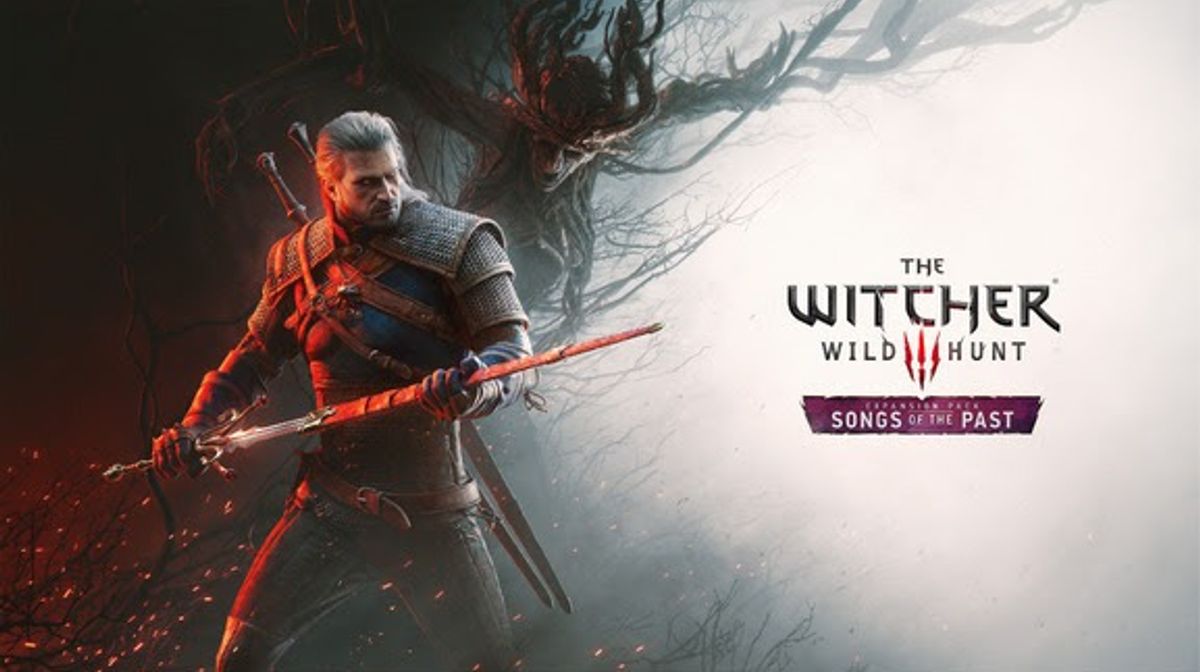
CD Projekt Red announces Songs of the Past, a brand new Witcher 3 expansion | AltChar
CD Projekt Red has officially announced Songs of the Past, a third expansion for The Witcher 3: Wild Hunt, co-developed with Fool's Theory and launching in 2027.www.altchar.com
- Related coverage: nintendolife.com
Loading…
www.nintendolife.com - Related coverage: 9to5toys.com
Loading…
9to5toys.com - Related coverage: techspot.com
Loading…
www.techspot.com - Related coverage: dungen.ru
Loading…
dungen.ru - Related coverage: respawn.outlookindia.com

Witcher 3 'Songs of the Past': CD Projekt Confirms Third Expansion for 2027 | Outlook Respawn
CD Projekt has confirmed "Songs of the Past," a third expansion for The Witcher 3: Wild Hunt, co-developed with Fool's Theory and due in 2027. respawn.outlookindia.com
- Related coverage: pcgameshardware.de

The Witcher 3: Dritter DLC "Songs of the Past" mit Releasetermin offiziell angekündigt
CD Projekt kündigt überraschend einen dritten DLC für The Witcher 3 an: "Songs of the Past" soll 2027 erscheinen und Geralt in den Mittelpunkt rücken.www.pcgameshardware.de
- Related coverage: as.com

Es oficial: CD Projekt anuncia Songs of the Past, la nueva expansión de The Witcher 3: Wild Hunt
Geralt volverá en 2027 con Songs of the Past, la nueva expansión de The Witcher 3 co-desarrollada por Fool’s Theory.as.com
- Related coverage: techradar.com
Loading…
www.techradar.com - Related coverage: pcgamer.com
Loading…
www.pcgamer.com - Related coverage: aftonbladet.se
Loading…
www.aftonbladet.se