

CD Projekt Red announced on May 27, 2026, that The Witcher 3: Wild Hunt will receive a third expansion, Songs of the Past, in 2027 for PC, PlayStation 5, and Xbox Series X|S, alongside sharply higher minimum PC requirements that move the game to Windows 11, DirectX 12, and SSD storage. The story is not just that Geralt is being pulled out of retirement. It is that one of PC gaming’s great long-tail success stories is finally drawing a hard technical line under the hardware and operating systems that carried it for more than a decade. For Windows users, especially those who treat old games as permanent fixtures in their library, this is a small but telling preview of what the post-Windows 10 gaming landscape is going to feel like.
The immediate headline is irresistible: The Witcher 3 is getting new paid narrative content roughly twelve years after its original 2015 launch and more than a decade after Blood and Wine seemed to close the book on Geralt’s story. CD Projekt Red says Songs of the Past will return players to Geralt of Rivia for a new adventure, co-developed with Fool’s Theory, the Polish studio already entrusted with the remake of the first Witcher game. More details are promised for late summer 2026, which gives the announcement the shape of a teaser rather than a full reveal.
But the PC requirement change is the part that will matter most to WindowsForum readers. According to the reported updated minimums, The Witcher 3 will require Windows 11 64-bit, DirectX 12, 12GB of RAM, 70GB of SSD storage, 6GB of VRAM, and hardware in the range of a Ryzen 5 2600 or Core i5-8400 paired with a GeForce GTX 1660 or Radeon RX 5500 XT. That is no longer “old laptop with a discrete GPU” territory. It is a floor built around the late-2010s mainstream gaming PC.
This is a dramatic shift because The Witcher 3 has long occupied a special place in the PC library: old enough to be cheap and widely owned, modern enough to still look handsome, scalable enough to run on a broad sweep of hardware, and culturally important enough to keep returning to. The 2022 next-gen update raised expectations, added ray tracing and visual improvements, and created some performance controversy, but it did not fundamentally reclassify the game as current-generation-only. Songs of the Past appears to do exactly that.
There is a blunt logic to CD Projekt Red’s move. If a studio is going to ship new content in 2027 for a game still carrying active commercial weight, it has to test, support, and patch against a manageable target. Windows 10 will be out of standard support by then, mechanical hard drives are a disastrous baseline for open-world streaming, and DirectX 11 is increasingly the compatibility path rather than the development path. The company is not merely adding an expansion. It is deciding which version of PC gaming history it wants to keep maintaining.
Still, it is worth separating three things that often get collapsed into one outrage cycle. First, there is the playable version users already own. Second, there is the future updated version of the game that CD Projekt Red intends to support. Third, there is the new expansion, which will be designed and QA-tested against the new floor. The practical details of whether legacy builds remain selectable on storefronts will matter enormously, and they are precisely the kind of detail publishers often under-communicate at announcement time.
The Windows 11 requirement is not surprising in isolation. Microsoft ended standard support for Windows 10 on October 14, 2025, and the PC games industry has been slowly aligning its official support matrices around that fact. Studios can and often do support older operating systems beyond Microsoft’s dates, but doing so comes with cost: driver weirdness, security assumptions, QA time, crash triage, and a growing mismatch between what modern middleware expects and what legacy systems provide.
For CD Projekt Red, the timing is convenient. A 2027 expansion gives the company a plausible reason to recut the game’s support baseline without making it look like a purely administrative decision. “We need to ensure smooth performance and compatibility going forward” is the kind of corporate phrasing that sounds bloodless, but in this case it is probably accurate. The game is no longer just a static artifact; it is becoming an active product again.
That distinction matters because PC gaming’s promise has always been a little mythic. We like to say that our libraries are forever, that backward compatibility is the platform’s secret weapon, that old games remain alive through modders, wrappers, community patches, and brute-force hardware. All of that is still true. But a live commercial game with new paid content is governed less by preservation romance than by support economics.
Open-world games are not just big folders of textures and meshes. They are constant data logistics problems. As the player rides through forests, cities, swamps, interiors, and combat spaces, the engine has to feed assets into memory fast enough to avoid visible hitches, missing geometry, texture pop-in, and loading stalls. A hard drive can still store the bits, but storage is not merely archival in a modern game; it is part of the performance pipeline.
The current-generation consoles normalized this reality. PlayStation 5 and Xbox Series X|S were designed around fast solid-state storage, and once developers target those systems as the floor, PC requirements inevitably follow. The PC has more variety, more knobs, and more potential brute force, but it cannot indefinitely pretend that a 5400 rpm laptop drive and an NVMe SSD are simply different-sized buckets.
For The Witcher 3, an SSD requirement may feel odd because the original game was built for the PlayStation 4 and Xbox One era, when slow storage was assumed. But Songs of the Past is not being built in 2015. Even if it uses the same underlying world, even if it does not transform the engine into something unrecognizable, CD Projekt Red and Fool’s Theory are developing against player expectations shaped by a different decade of hardware.
There is also a simple QA angle. Supporting hard drives does not just mean tolerating longer loading screens. It means testing for streaming stalls, save/load behavior, traversal edge cases, and inconsistent performance across a device category that varies wildly by age, fragmentation, cache behavior, and laptop power profile. At some point, the correct technical decision is to stop pretending the lowest common denominator is still common enough to deserve the denominator.
Making DirectX 12 the minimum changes that bargain. It tells players that the compatibility path is no longer the real path. This does not necessarily mean every player will be forced into ray tracing or heavy visual modes, but it does mean the renderer, driver expectations, and toolchain assumptions are moving forward.
For developers, DirectX 12 offers lower-level control and better alignment with modern graphics architectures, but it also pushes more responsibility onto the game. That is part of why DX12 implementations can vary so dramatically in quality. A good DX12 renderer can scale well and make sophisticated use of modern GPUs. A poor one can expose players to shader stutter, CPU bottlenecks, and driver-specific headaches that DX11’s older abstraction layer sometimes papered over.
The new minimum GPU class is therefore important. A GTX 1660 is not exotic in 2026 terms, but it is a substantial leap from the old GTX 660-era minimum that defined the original PC release. The Radeon RX 5500 XT 8GB target, similarly, points to a world where 6GB or more of VRAM is no longer a luxury line item. The game that once ran on early-2010s midrange cards is being re-anchored around hardware from the end of that decade.
This is not CD Projekt Red demanding the bleeding edge. It is more interesting than that. The new floor is a declaration that mainstream now means something different. The PC that counts as modest in 2027 is not the PC that counted as modest in 2015, and the industry is becoming less willing to keep both definitions alive inside one supported build.
This is especially sensitive for games distributed through auto-updating platforms. A boxed PC game from 2002 might be a compatibility headache, but it is at least inert. A modern digital game can be reshaped, patched, delisted, recompiled, or made dependent on launcher behavior years after purchase. The convenience of live updates carries the quiet cost of mutability.
That is why the handling of legacy branches matters. If CD Projekt Red preserves an older Windows 10/DX11-compatible branch through Steam betas, GOG installers, or a clearly labeled classic build, much of the practical harm is reduced. Players who want the new expansion can upgrade. Players who want the game as it existed can stay put. The platform then behaves more like a library and less like a conveyor belt.
GOG gives CD Projekt Red a particular responsibility here. The company’s storefront has long traded on the language of preservation, offline installers, and user control. If any publisher understands the cultural value of keeping older PC builds accessible, it should be CD Projekt. The irony of a beloved old game becoming harder to run on older systems would be sharper under the same corporate roof as a store that built its reputation on exactly the opposite promise.
The harder case is Steam, where most players probably own and launch the game. Steam’s branch system can preserve old builds, but it requires publisher intent and clear communication. If the requirement change simply arrives as an update and the legacy path is obscure or absent, the backlash will not be about DirectX documentation. It will be about trust.
Games are among the most visible cuts because they sit at the intersection of drivers, anti-cheat systems, GPU APIs, launchers, storefronts, and hardware telemetry. A productivity app can often remain useful on an old OS with fewer moving parts. A major game has to survive a much more chaotic stack. Once GPU driver support and middleware support start narrowing, the game publisher becomes the customer-facing messenger for decisions made across the ecosystem.
That does not mean every Windows 10 gamer needs to panic. Many titles will continue to work, and older games with stable builds may remain perfectly playable for a long time. But the direction is clear: new releases, new expansions, and new “enhanced” versions will increasingly treat Windows 11 as the default Windows PC target. The weird transitional era, where Windows 10 and Windows 11 are both listed as equals, is ending.
The hardware eligibility issue makes this more fraught than past Windows transitions. Some perfectly functional gaming PCs cannot officially move to Windows 11 because of TPM, CPU generation, or platform requirements. For users on those machines, “upgrade to Windows 11” may actually mean replace a motherboard, CPU, or entire system. A game requirement sheet becomes a proxy notice that the rest of the PC industry has moved past them.
This is why Microsoft’s Windows 11 push has always had a gaming dimension. DirectStorage, Auto HDR, newer scheduler work, security baselines, and console-adjacent platform messaging were all part of the sales pitch. But the real migration pressure rarely arrives as a Microsoft ad. It arrives when a game you care about stops listing your OS.
Fool’s Theory’s involvement is a sensible hedge. The studio includes developers with prior Witcher experience, and its work on The Thaumaturge showed an interest in morally textured narrative design rather than generic open-world content. CD Projekt Red keeping creative oversight while sharing development with a trusted Polish partner sounds like a way to expand capacity without handing the crown jewels to a random support house.
But nostalgia is a volatile currency. Players may say they want more Geralt, but they also want the memory of Geralt protected. A perfunctory expansion would cheapen the ending. A technically rough expansion would revive the exact concerns CD Projekt Red has worked so hard to bury. A brilliant expansion, by contrast, could serve as a bridge between the old trilogy and the next era of The Witcher franchise.
The technical requirements are part of that trust equation. If CD Projekt Red is asking players to accept a higher floor, the payoff needs to be visible in stability, loading behavior, asset quality, world density, and polish. “We dropped Windows 10 and hard drives so the new content runs better” is a defensible argument only if the new content actually runs better. Otherwise, the requirement change becomes another example of PC players losing compatibility without gaining confidence.
This is particularly important because The Witcher 3 already has a complicated technical legacy. The next-gen update was generous, ambitious, and uneven. Many players loved the visual improvements, while others stuck to older modes or wrestled with performance. CD Projekt Red does not get to assume that “newer technical baseline” automatically reads as “better experience.” It has to prove it.
That has changed. Requirement sheets now signal who a publisher imagines its PC audience to be. They tell laptop users whether they are still invited, tell Windows holdouts whether they are still worth supporting, and tell desktop owners whether their once-excellent rig has aged into the margins. The move from HDD to SSD and Windows 10 to Windows 11 is not just technical housekeeping. It is a declaration of the new normal.
This is why the reaction will be sharper than the numbers alone justify. A Ryzen 5 2600, Core i5-8400, GTX 1660, or RX 5500 XT is hardly extravagant by 2026 standards. Many active PC gamers already exceed those specs. SSDs are cheap, RAM is plentiful, and Windows 11 is widely available on supported systems. From one angle, CD Projekt Red is merely stating the obvious.
From another angle, The Witcher 3 is not an obvious place to state it. This is not a brand-new Unreal Engine 5 showcase. It is a 2015 RPG that many users bought specifically because it scaled across generations of hardware. Its identity as a PC game is partly tied to that breadth. Raising the floor so dramatically makes sense for the expansion, but it also alters the symbolic contract around the base game.
The best version of this transition would be additive. The new branch becomes the living, supported, expansion-ready version. The old branch remains accessible for preservation, mod compatibility, and older hardware. Players understand the split and choose accordingly. That would honor both sides of PC gaming: progress and continuity.
The worst version would be muddled. Requirements change, patches arrive, mods break, Windows 10 users discover the problem only after an update, and the publisher spends weeks clarifying what should have been clear on day one. That would turn a celebratory announcement into another case study in how not to manage an aging live product.
The question is not simply whether mods break. Mods often break after major updates, and communities often repair them. The question is whether the new branch changes assumptions deeply enough to fragment the mod scene between legacy and current versions. If Windows 10/DX11-era builds remain popular for compatibility, while Songs of the Past requires the new branch, mod authors may have to decide which audience they serve.
That is not inherently bad. Some of the healthiest PC modding communities are built around explicit versioning and stable legacy targets. But it requires tooling, documentation, and time. A publisher that benefits from mod-driven longevity should treat mod compatibility as part of its communications plan, not as an afterthought for Discord archaeology.
The Witcher 3’s modding scene also intersects with performance. Many users install mods to reduce friction, improve visuals, or modernize the interface on machines that are not top-end. If the official baseline rises, some players may lean harder on community fixes to keep older setups viable. Others may abandon mods temporarily to keep the new expansion stable. Either way, the community will absorb work created by a corporate technical decision.
CD Projekt Red has generally been more mod-friendly than many large publishers, and that gives it an opportunity here. Clear branching, advance documentation, and honest communication about rendering or scripting changes would go a long way. PC players are often forgiving when they are treated like adults. They are far less forgiving when they feel surprised by avoidable breakage.
Once last-generation consoles are out of the picture, slow storage and weaker CPUs stop being design anchors. Developers can assume faster decompression, better memory behavior, and a more modern I/O profile. The PC equivalent does not map perfectly to consoles, but the philosophy does: stop treating 2013 hardware assumptions as a constraint on 2027 content.
This is the point that often gets lost in PC requirement debates. Minimum specs are not just about whether the game could technically be made to run on something weaker. With enough settings, hacks, and compromises, many games can be pushed below their official floors. The question is what experience the developer is willing to certify, support, and troubleshoot.
The Xbox Series S complicates this, as it often does. If a game runs on Series S, some PC users reasonably ask why it cannot support older desktop GPUs or lower-memory machines. The answer is that consoles are fixed platforms with predictable storage, memory, OS, drivers, and certification paths. A weaker-but-fixed console can be easier to optimize for than a chaotic PC landscape with old Windows installs and unknown drive behavior.
That is not a moral judgment; it is an engineering reality. The PC’s openness is its greatest strength and its most expensive support burden. Raising minimum requirements is one way publishers convert chaos into a narrower problem they can actually solve.
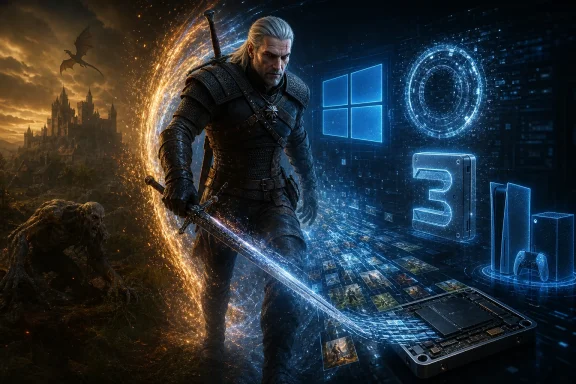 Geralt Returns, But Not to the Same PC Era
The immediate headline is irresistible: The Witcher 3 is getting new paid narrative content roughly twelve years after its original 2015 launch and more than a decade after Blood and Wine seemed to close the book on Geralt’s story. CD Projekt Red says Songs of the Past will return players to Geralt of Rivia for a new adventure, co-developed with Fool’s Theory, the Polish studio already entrusted with the remake of the first Witcher game. More details are promised for late summer 2026, which gives the announcement the shape of a teaser rather than a full reveal.But the PC requirement change is the part that will matter most to WindowsForum readers. According to the reported updated minimums, The Witcher 3 will require Windows 11 64-bit, DirectX 12, 12GB of RAM, 70GB of SSD storage, 6GB of VRAM, and hardware in the range of a Ryzen 5 2600 or Core i5-8400 paired with a GeForce GTX 1660 or Radeon RX 5500 XT. That is no longer “old laptop with a discrete GPU” territory. It is a floor built around the late-2010s mainstream gaming PC.
This is a dramatic shift because The Witcher 3 has long occupied a special place in the PC library: old enough to be cheap and widely owned, modern enough to still look handsome, scalable enough to run on a broad sweep of hardware, and culturally important enough to keep returning to. The 2022 next-gen update raised expectations, added ray tracing and visual improvements, and created some performance controversy, but it did not fundamentally reclassify the game as current-generation-only. Songs of the Past appears to do exactly that.
There is a blunt logic to CD Projekt Red’s move. If a studio is going to ship new content in 2027 for a game still carrying active commercial weight, it has to test, support, and patch against a manageable target. Windows 10 will be out of standard support by then, mechanical hard drives are a disastrous baseline for open-world streaming, and DirectX 11 is increasingly the compatibility path rather than the development path. The company is not merely adding an expansion. It is deciding which version of PC gaming history it wants to keep maintaining.
The Windows 11 Requirement Is a Support Decision Wearing a Gaming Hat
The most provocative phrase in the Eurogamer and IGN framing is that the new requirements will “force” PC players to use Windows 11. For a portion of the audience, that is exactly how it will feel. A game bought in 2015, updated over the years, and perhaps installed on a Windows 10 machine in a Steam or GOG library may now have a future branch of support that leaves that OS behind.Still, it is worth separating three things that often get collapsed into one outrage cycle. First, there is the playable version users already own. Second, there is the future updated version of the game that CD Projekt Red intends to support. Third, there is the new expansion, which will be designed and QA-tested against the new floor. The practical details of whether legacy builds remain selectable on storefronts will matter enormously, and they are precisely the kind of detail publishers often under-communicate at announcement time.
The Windows 11 requirement is not surprising in isolation. Microsoft ended standard support for Windows 10 on October 14, 2025, and the PC games industry has been slowly aligning its official support matrices around that fact. Studios can and often do support older operating systems beyond Microsoft’s dates, but doing so comes with cost: driver weirdness, security assumptions, QA time, crash triage, and a growing mismatch between what modern middleware expects and what legacy systems provide.
For CD Projekt Red, the timing is convenient. A 2027 expansion gives the company a plausible reason to recut the game’s support baseline without making it look like a purely administrative decision. “We need to ensure smooth performance and compatibility going forward” is the kind of corporate phrasing that sounds bloodless, but in this case it is probably accurate. The game is no longer just a static artifact; it is becoming an active product again.
That distinction matters because PC gaming’s promise has always been a little mythic. We like to say that our libraries are forever, that backward compatibility is the platform’s secret weapon, that old games remain alive through modders, wrappers, community patches, and brute-force hardware. All of that is still true. But a live commercial game with new paid content is governed less by preservation romance than by support economics.
The SSD Mandate Is the More Honest Requirement
If the Windows 11 line will draw the loudest complaints, the SSD requirement may be the more meaningful technical change. Mechanical hard drives have been dying as a gaming baseline for years, but many PC requirement sheets treated SSDs as recommendations long after the design assumptions had moved on. A minimum spec that explicitly says SSD is a minimum spec that admits how modern streaming works.Open-world games are not just big folders of textures and meshes. They are constant data logistics problems. As the player rides through forests, cities, swamps, interiors, and combat spaces, the engine has to feed assets into memory fast enough to avoid visible hitches, missing geometry, texture pop-in, and loading stalls. A hard drive can still store the bits, but storage is not merely archival in a modern game; it is part of the performance pipeline.
The current-generation consoles normalized this reality. PlayStation 5 and Xbox Series X|S were designed around fast solid-state storage, and once developers target those systems as the floor, PC requirements inevitably follow. The PC has more variety, more knobs, and more potential brute force, but it cannot indefinitely pretend that a 5400 rpm laptop drive and an NVMe SSD are simply different-sized buckets.
For The Witcher 3, an SSD requirement may feel odd because the original game was built for the PlayStation 4 and Xbox One era, when slow storage was assumed. But Songs of the Past is not being built in 2015. Even if it uses the same underlying world, even if it does not transform the engine into something unrecognizable, CD Projekt Red and Fool’s Theory are developing against player expectations shaped by a different decade of hardware.
There is also a simple QA angle. Supporting hard drives does not just mean tolerating longer loading screens. It means testing for streaming stalls, save/load behavior, traversal edge cases, and inconsistent performance across a device category that varies wildly by age, fragmentation, cache behavior, and laptop power profile. At some point, the correct technical decision is to stop pretending the lowest common denominator is still common enough to deserve the denominator.
DirectX 12 Becomes the Baseline, Not the Bonus Path
DirectX 12 has had an uneven reputation among PC gamers, and The Witcher 3 itself contributed to that ambiguity after its next-gen update. The DX12 version enabled the newest visual features, including ray tracing, but it also became a source of performance complaints for players who found the DX11 path smoother on their machines. For years, the practical PC advice around many games has been: try DX12 if you need the features, fall back to DX11 if you want stability.Making DirectX 12 the minimum changes that bargain. It tells players that the compatibility path is no longer the real path. This does not necessarily mean every player will be forced into ray tracing or heavy visual modes, but it does mean the renderer, driver expectations, and toolchain assumptions are moving forward.
For developers, DirectX 12 offers lower-level control and better alignment with modern graphics architectures, but it also pushes more responsibility onto the game. That is part of why DX12 implementations can vary so dramatically in quality. A good DX12 renderer can scale well and make sophisticated use of modern GPUs. A poor one can expose players to shader stutter, CPU bottlenecks, and driver-specific headaches that DX11’s older abstraction layer sometimes papered over.
The new minimum GPU class is therefore important. A GTX 1660 is not exotic in 2026 terms, but it is a substantial leap from the old GTX 660-era minimum that defined the original PC release. The Radeon RX 5500 XT 8GB target, similarly, points to a world where 6GB or more of VRAM is no longer a luxury line item. The game that once ran on early-2010s midrange cards is being re-anchored around hardware from the end of that decade.
This is not CD Projekt Red demanding the bleeding edge. It is more interesting than that. The new floor is a declaration that mainstream now means something different. The PC that counts as modest in 2027 is not the PC that counted as modest in 2015, and the industry is becoming less willing to keep both definitions alive inside one supported build.
The Strange Politics of Updating a Game People Already Bought
The emotional problem with changing requirements for an old game is not that the technical argument is weak. It is that ownership expectations are strong. Players do not think of a purchased game as a service contract governed by future platform matrices. They think of it as their game, and when a future update changes what “their game” requires, even for understandable reasons, it can feel like a boundary has been crossed.This is especially sensitive for games distributed through auto-updating platforms. A boxed PC game from 2002 might be a compatibility headache, but it is at least inert. A modern digital game can be reshaped, patched, delisted, recompiled, or made dependent on launcher behavior years after purchase. The convenience of live updates carries the quiet cost of mutability.
That is why the handling of legacy branches matters. If CD Projekt Red preserves an older Windows 10/DX11-compatible branch through Steam betas, GOG installers, or a clearly labeled classic build, much of the practical harm is reduced. Players who want the new expansion can upgrade. Players who want the game as it existed can stay put. The platform then behaves more like a library and less like a conveyor belt.
GOG gives CD Projekt Red a particular responsibility here. The company’s storefront has long traded on the language of preservation, offline installers, and user control. If any publisher understands the cultural value of keeping older PC builds accessible, it should be CD Projekt. The irony of a beloved old game becoming harder to run on older systems would be sharper under the same corporate roof as a store that built its reputation on exactly the opposite promise.
The harder case is Steam, where most players probably own and launch the game. Steam’s branch system can preserve old builds, but it requires publisher intent and clear communication. If the requirement change simply arrives as an update and the legacy path is obscure or absent, the backlash will not be about DirectX documentation. It will be about trust.
Windows 10’s Afterlife Will Be Full of These Cuts
For WindowsForum readers, this story fits into a broader pattern. Windows 10 did not stop running on October 14, 2025, and millions of machines will continue using it for years. But “still runs” and “still supported by current software” are different states. The post-support period is when users discover, product by product, which vendors are willing to carry the old OS and which are ready to move on.Games are among the most visible cuts because they sit at the intersection of drivers, anti-cheat systems, GPU APIs, launchers, storefronts, and hardware telemetry. A productivity app can often remain useful on an old OS with fewer moving parts. A major game has to survive a much more chaotic stack. Once GPU driver support and middleware support start narrowing, the game publisher becomes the customer-facing messenger for decisions made across the ecosystem.
That does not mean every Windows 10 gamer needs to panic. Many titles will continue to work, and older games with stable builds may remain perfectly playable for a long time. But the direction is clear: new releases, new expansions, and new “enhanced” versions will increasingly treat Windows 11 as the default Windows PC target. The weird transitional era, where Windows 10 and Windows 11 are both listed as equals, is ending.
The hardware eligibility issue makes this more fraught than past Windows transitions. Some perfectly functional gaming PCs cannot officially move to Windows 11 because of TPM, CPU generation, or platform requirements. For users on those machines, “upgrade to Windows 11” may actually mean replace a motherboard, CPU, or entire system. A game requirement sheet becomes a proxy notice that the rest of the PC industry has moved past them.
This is why Microsoft’s Windows 11 push has always had a gaming dimension. DirectStorage, Auto HDR, newer scheduler work, security baselines, and console-adjacent platform messaging were all part of the sales pitch. But the real migration pressure rarely arrives as a Microsoft ad. It arrives when a game you care about stops listing your OS.
CD Projekt Red Is Rebuilding Trust While Spending Nostalgia
The expansion itself is also strategically interesting. CD Projekt Red has spent the years since Cyberpunk 2077’s disastrous launch trying to rebuild credibility, first through patches and the excellent Phantom Liberty, then through a more cautious communications posture. Returning to The Witcher 3 is both safe and risky. It is safe because the game remains the company’s most reliable goodwill engine. It is risky because Blood and Wine is widely remembered as one of the best farewells in modern RPGs.Fool’s Theory’s involvement is a sensible hedge. The studio includes developers with prior Witcher experience, and its work on The Thaumaturge showed an interest in morally textured narrative design rather than generic open-world content. CD Projekt Red keeping creative oversight while sharing development with a trusted Polish partner sounds like a way to expand capacity without handing the crown jewels to a random support house.
But nostalgia is a volatile currency. Players may say they want more Geralt, but they also want the memory of Geralt protected. A perfunctory expansion would cheapen the ending. A technically rough expansion would revive the exact concerns CD Projekt Red has worked so hard to bury. A brilliant expansion, by contrast, could serve as a bridge between the old trilogy and the next era of The Witcher franchise.
The technical requirements are part of that trust equation. If CD Projekt Red is asking players to accept a higher floor, the payoff needs to be visible in stability, loading behavior, asset quality, world density, and polish. “We dropped Windows 10 and hard drives so the new content runs better” is a defensible argument only if the new content actually runs better. Otherwise, the requirement change becomes another example of PC players losing compatibility without gaining confidence.
This is particularly important because The Witcher 3 already has a complicated technical legacy. The next-gen update was generous, ambitious, and uneven. Many players loved the visual improvements, while others stuck to older modes or wrestled with performance. CD Projekt Red does not get to assume that “newer technical baseline” automatically reads as “better experience.” It has to prove it.
The PC Minimum Spec Is Becoming a Cultural Statement
Minimum requirements used to be treated as dull buying guidance. Could your machine launch the game? Would it hit the lowest settings? Did you have enough disk space? They were a practical checklist, not a cultural artifact.That has changed. Requirement sheets now signal who a publisher imagines its PC audience to be. They tell laptop users whether they are still invited, tell Windows holdouts whether they are still worth supporting, and tell desktop owners whether their once-excellent rig has aged into the margins. The move from HDD to SSD and Windows 10 to Windows 11 is not just technical housekeeping. It is a declaration of the new normal.
This is why the reaction will be sharper than the numbers alone justify. A Ryzen 5 2600, Core i5-8400, GTX 1660, or RX 5500 XT is hardly extravagant by 2026 standards. Many active PC gamers already exceed those specs. SSDs are cheap, RAM is plentiful, and Windows 11 is widely available on supported systems. From one angle, CD Projekt Red is merely stating the obvious.
From another angle, The Witcher 3 is not an obvious place to state it. This is not a brand-new Unreal Engine 5 showcase. It is a 2015 RPG that many users bought specifically because it scaled across generations of hardware. Its identity as a PC game is partly tied to that breadth. Raising the floor so dramatically makes sense for the expansion, but it also alters the symbolic contract around the base game.
The best version of this transition would be additive. The new branch becomes the living, supported, expansion-ready version. The old branch remains accessible for preservation, mod compatibility, and older hardware. Players understand the split and choose accordingly. That would honor both sides of PC gaming: progress and continuity.
The worst version would be muddled. Requirements change, patches arrive, mods break, Windows 10 users discover the problem only after an update, and the publisher spends weeks clarifying what should have been clear on day one. That would turn a celebratory announcement into another case study in how not to manage an aging live product.
Modders May Feel the Ground Move Under Their Feet
No discussion of The Witcher 3 on PC is complete without mods. For many players, the game’s long life has been sustained not only by official patches but by texture packs, lighting tweaks, quality-of-life changes, gameplay rebalances, bug fixes, UI improvements, and script-heavy overhauls. A major technical baseline change can ripple through that ecosystem in ways that do not show up on a storefront requirement sheet.The question is not simply whether mods break. Mods often break after major updates, and communities often repair them. The question is whether the new branch changes assumptions deeply enough to fragment the mod scene between legacy and current versions. If Windows 10/DX11-era builds remain popular for compatibility, while Songs of the Past requires the new branch, mod authors may have to decide which audience they serve.
That is not inherently bad. Some of the healthiest PC modding communities are built around explicit versioning and stable legacy targets. But it requires tooling, documentation, and time. A publisher that benefits from mod-driven longevity should treat mod compatibility as part of its communications plan, not as an afterthought for Discord archaeology.
The Witcher 3’s modding scene also intersects with performance. Many users install mods to reduce friction, improve visuals, or modernize the interface on machines that are not top-end. If the official baseline rises, some players may lean harder on community fixes to keep older setups viable. Others may abandon mods temporarily to keep the new expansion stable. Either way, the community will absorb work created by a corporate technical decision.
CD Projekt Red has generally been more mod-friendly than many large publishers, and that gives it an opportunity here. Clear branching, advance documentation, and honest communication about rendering or scripting changes would go a long way. PC players are often forgiving when they are treated like adults. They are far less forgiving when they feel surprised by avoidable breakage.
The Console Versions Explain the PC Cutoff
The platform list also tells a story. Songs of the Past is coming to PlayStation 5, Xbox Series X|S, and PC. It is not being positioned as a PlayStation 4 or Xbox One expansion. That alone explains much of the new PC floor.Once last-generation consoles are out of the picture, slow storage and weaker CPUs stop being design anchors. Developers can assume faster decompression, better memory behavior, and a more modern I/O profile. The PC equivalent does not map perfectly to consoles, but the philosophy does: stop treating 2013 hardware assumptions as a constraint on 2027 content.
This is the point that often gets lost in PC requirement debates. Minimum specs are not just about whether the game could technically be made to run on something weaker. With enough settings, hacks, and compromises, many games can be pushed below their official floors. The question is what experience the developer is willing to certify, support, and troubleshoot.
The Xbox Series S complicates this, as it often does. If a game runs on Series S, some PC users reasonably ask why it cannot support older desktop GPUs or lower-memory machines. The answer is that consoles are fixed platforms with predictable storage, memory, OS, drivers, and certification paths. A weaker-but-fixed console can be easier to optimize for than a chaotic PC landscape with old Windows installs and unknown drive behavior.
That is not a moral judgment; it is an engineering reality. The PC’s openness is its greatest strength and its most expensive support burden. Raising minimum requirements is one way publishers convert chaos into a narrower problem they can actually solve.
The Line CD Projekt Red Has Drawn for Geralt’s Second Afterlife
The practical message for PC players is not complicated, but it deserves to be stated without panic or sugarcoating. The Witcher 3 is entering a new support era, and the machines that could comfortably claim membership in the old era may not qualify for the new one. If CD Projekt Red manages the transition well, this will be an annoyance for some and a non-event for many. If it manages it badly, it will become a preventable fight over ownership, preservation, and Windows 11.- Players who want Songs of the Past on PC should plan around Windows 11 64-bit, DirectX 12, SSD storage, 12GB of RAM, and a substantially newer CPU/GPU floor than the original 2015 release required.
- Windows 10 users may still be able to play existing versions depending on branch availability, but the future supported version is being aligned with Microsoft’s post-Windows 10 ecosystem.
- The SSD requirement is not cosmetic; it reflects modern open-world streaming assumptions and the end of hard drives as a credible baseline for current-generation development.
- CD Projekt Red needs to communicate clearly about legacy builds, storefront behavior, and mod compatibility before the update lands.
- The expansion’s technical ambition must justify the raised floor, because PC players will not accept lost compatibility on faith alone.
- This announcement is a preview of the broader 2026–2027 PC transition, where beloved older games with new content increasingly become Windows 11-era products.
References
- Primary source: Eurogamer
Published: Wed, 27 May 2026 10:56:56 GMT

The Witcher 3 minimum PC requirements rise significantly ahead of new expansion, forcing you to use Windows 11 and an SSD
CD Projekt Red has decided it's time to bring The Witcher 3: Wild Hunt wholesale into the modern era, ahead of a brand new expansion arriving next year. www.eurogamer.net
- Independent coverage: IGN
Published: Wed, 27 May 2026 10:08:53 GMT

CD Projekt Just Updated The Witcher 3 Minimum Requirements Ahead of the Songs of the Past DLC Expansion — Here's What Changed
CD Projekt has signalled changes to The Witcher 3: Wild Hunt minimum requirements ahead of the release of the just-announced third expansion, Songs of the Past.www.ign.com
- Related coverage: press.cdprojektred.com

The Witcher 3: Wild Hunt - Songs of the Past Announced - CD PROJEKT RED Press Center
press.cdprojektred.com
- Related coverage: gamespot.com

The Witcher 3 Is Getting New DLC Nearly 12 Years After Launch
The Witcher 3 developer CD Projekt Red has announced the new Songs of the Past expansion for the game, which comes 11 years after its second expansion, Blood and Wine. Co-developed with Fool’s Theory–a studio that includes several Witcher 3 veterans and previously released The Thaumaturge in... www.gamespot.com
- Related coverage: support.cdprojektred.com
Системные требования игры Ведьмак 3: Дикая Охота — The Witcher 3: Wild Hunt | Техническая поддержка — CD PROJEKT RED
Добро пожаловать на страницу технической поддержки! Здесь вы можете получить помощь по нашим играм и ответы на часто задаваемые вопросы. support.cdprojektred.com
- Related coverage: techradar.com
'Medallion's humming' — CD Projekt Red officially announces the Songs of the Past, the third expansion for The Witcher 3: Wild Hunt, launching in 2027
The Witcher 3: Wild Hunt's third expansion, Songs of the Past, has been announced for 2027.www.techradar.com
- Related coverage: en.gamegpu.com
- Related coverage: pcgamer.com
- Related coverage: pcgamesn.com

The Witcher 3 system requirements
While the minimum and recommended specs haven't changed in 2025, the next-gen update for The Witcher 3 demands a more modern graphics card. www.pcgamesn.com
- Related coverage: tweakers.net
The Witcher 3 krijgt twaalf jaar na release nieuwe dlc: Songs of the Past
CD Projekt RED brengt in 2027 een nieuwe dlc uit voor The Witcher 3: Wild Hunt. Daarmee krijgt de game twaalf jaar na release ineens nieuwe content. De dlc komt alleen beschikbaar voor de pc-, PS5- en XBOX Series X- en S-versies van de game.tweakers.net
- Related coverage: as.com

Es oficial: CD Projekt anuncia Songs of the Past, la nueva expansión de The Witcher 3: Wild Hunt
Geralt volverá en 2027 con Songs of the Past, la nueva expansión de The Witcher 3 co-desarrollada por Fool’s Theory.as.com