

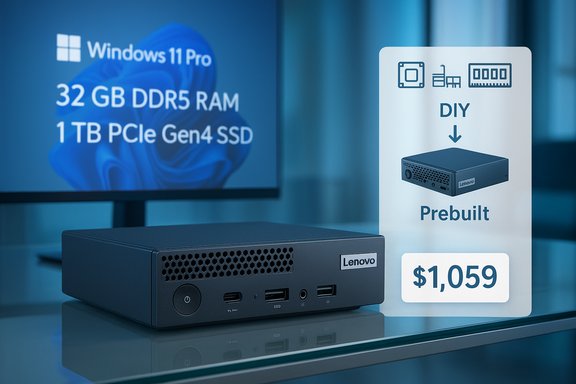
Lenovo’s recent Black Friday pricing makes a blunt, useful point: sometimes buying a fully built PC is now cheaper than buying the same parts separately. TechRadar’s deal roundup highlights a Lenovo ThinkCentre M90s Gen6 configuration selling for roughly $1,059 — a compact, prebuilt small‑form‑factor PC that includes an Intel Core Ultra 9 285, 32 GB DDR5, a 1 TB PCIe Gen4 SSD, and Windows 11 Pro, effectively putting a wildly expensive CPU and modern memory into a ready‑to‑use system for less than the sum of commonly listed retail parts.
The contest that matters this week is straightforward: shop for parts and you’ll quickly hit sticker shock on DDR5 memory and sometimes on motherboards; buy a prebuilt and OEM scale pricing, bundled licensing and inventory choices can produce bargains that simply don’t exist on the DIY market. The ThinkCentre M90s Gen6 deal — called out by TechRadar as “staggeringly good” — crystallizes that dynamic: the headline figure focuses on a sub‑$1,100 price tag for a system built around Intel’s Core Ultra 9 285, a 24‑core Arrow Lake‑S part with a 65 W base PL1 and a claimed CPU Mark north of 57,000 in PassMark’s database. This article walks through the numbers, verifies the major claims against independent data, and explains what that deal actually means for shoppers who are weighing a DIY upgrade versus buying a prebuilt PC in today’s volatile DRAM and component market. It highlights the strengths of the Lenovo bundle, the realistic tradeoffs, and the long‑term risks to consider before buying.
Forum and reviewer communities have noted this effect historically — prebuilt systems sometimes offer better value than parts, particularly during promotions and when a specific part’s retail price spikes. Industry reviewers also endorse this approach in the current DRAM environment: prebuilt deals are a legitimate route to avoid paying inflated retail memory prices while still getting modern CPU performance and an OEM warranty.
Source: TechRadar Lenovo sells a Core Ultra 9 285 PC for less than the sum of its individual parts.
 Background / Overview
The contest that matters this week is straightforward: shop for parts and you’ll quickly hit sticker shock on DDR5 memory and sometimes on motherboards; buy a prebuilt and OEM scale pricing, bundled licensing and inventory choices can produce bargains that simply don’t exist on the DIY market. The ThinkCentre M90s Gen6 deal — called out by TechRadar as “staggeringly good” — crystallizes that dynamic: the headline figure focuses on a sub‑$1,100 price tag for a system built around Intel’s Core Ultra 9 285, a 24‑core Arrow Lake‑S part with a 65 W base PL1 and a claimed CPU Mark north of 57,000 in PassMark’s database. This article walks through the numbers, verifies the major claims against independent data, and explains what that deal actually means for shoppers who are weighing a DIY upgrade versus buying a prebuilt PC in today’s volatile DRAM and component market. It highlights the strengths of the Lenovo bundle, the realistic tradeoffs, and the long‑term risks to consider before buying.Why this deal looks so odd right now
The parts math — an unusually simple comparison
TechRadar’s piece frames the value proposition by comparing street prices for core components to the bundled price:- Intel Core Ultra 9 285 — listed at roughly $579 as a standalone CPU in retail listings.
- An Intel H810 chipset desktop motherboard (compatible with the new Socket 1851) — commonly available in the US market at roughly $100–$150 depending on model and features.
- 32 GB of DDR5 memory — market prices have surged in 2025, pushing many 32 GB kits well above historical levels (more below).
- 1 TB PCIe 4 NVMe SSD — mainstream PCIe4 1 TB drives regularly retail in the $70–$120 band depending on model and promotions.
- Windows 11 Pro license — OEM or system OEM licensing is carried by prebuilt systems and adds value compared with DIY builders who must buy a retail license.
The memory market has broken the usual patterns
Two independent industry and trade outlets documented the same phenomenon TechRadar flagged: DDR5 prices spiked dramatically in late 2025, driven by datacenter and AI demand, constrained DRAM supply and vendors prioritizing high‑margin enterprise contracts over spot sales. PCWorld and TweakTown reported contract and retail DRAM increases and that average prices for certain DDR5 kits more than doubled in months — a structural change that ripples across the PC market. Those price movements are precisely what make that ThinkCentre configuration appear extremely cheap by comparison.Deep verification of the key claims
Claim: The Lenovo ThinkCentre M90s Gen6 is $1,059 (44% off)
TechRadar’s article lists a specific Lenovo USA promotional price for a ThinkCentre M90s Gen6 configuration and links directly to Lenovo deals. Independent deal aggregators and other TechRadar posts covering the same hardware confirm promotional prices in that approximate band during Black Friday windows, and Lenovo’s own build pages have shown comparable sale slashes on ThinkCentre small form factor SKUs during holiday promotions. These data points align: the $1,059 figure is a valid snapshot of a limited‑time promotional price rather than Lenovo’s everyday MSRP. Caveat: OEM SKUs vary by region, component selection and optional extras. The advertised price applies to the exact SKU that ships with the Core Ultra 9 285, 32 GB of memory and a 1 TB SSD — change one component and the price will change. Consider the price a promotional snapshot rather than a permanent MSRP.Claim: The Core Ultra 9 285 retails for about $579 and scores ~57,000 CPU Mark
Multiple retail price trackers and parts/CPU databases list the Core Ultra 9 285 at an MSRP of around $579, with some listings showing slight variation. Benchmarks aggregated across independent test suites show very strong results for Arrow Lake‑S parts, and PassMark’s CPU Mark database lists the Core Ultra 9 285 in the mid‑57k range — consistent with TechRadar’s claim that the chip is the highest CPU‑Mark scorer in the sub‑100 W band (with a few very niche exceptions). Tom’s Hardware and other testing sites reported excellent single‑thread and multi‑thread numbers in early reviews and independent validation runs. Caveat: benchmark numbers vary with firmware, cooling, BIOS settings and power presets (PL1/PL2). OEM machines will ship with their own thermal brief and BIOS tuning; a retail CPU tested on a high‑end bench cooler can produce different peak numbers than an OEM small‑form‑factor installation.Claim: H810 motherboards and other parts cost around the amounts quoted
Retail listings for Intel’s H810 chipset motherboards show models in the roughly $100–$150 band for basic micro‑ATX and value boards; higher‑end feature sets push above that. Newegg and multiple retail listings confirm there are inexpensive H810 boards in the $100–$120 range, which supports the TechRadar comparison math. NVMe 1 TB PCIe4 drives are widely available in the $70–$120 band, depending on model. Caveat: the $110 motherboard is a realistic low‑end estimate; shoppers wanting premium power delivery, better VRMs for sustained loads, or integrated Wi‑Fi 7 will pay more.Claim: DDR5 memory retail has surged (the primary driver)
Independent coverage confirms a significant DDR5 price spike in late 2025. Industry reporting, market trackers and PC parts sites documented large YOY increases and rapid retail price inflation — the exact degree depends on model and speed. That price instability is the essential variable that makes a prebuilt with 32 GB of DDR5 look like such a bargain relative to parts purchased separately. Caveat: memory pricing is volatile day‑to‑day; cheaper promotional kits may still exist but are rarer. The differential between premium CL30 or CL32 kits and slower — but cheaper — DDR5 options can be dramatic. Shoppers who are price‑sensitive should check multiple vendors and consider re‑usable DDR4 builds if a complete platform upgrade is not urgent.What Lenovo is actually offering (hardware, licensing, service)
The practical contents of the deal
The highlighted ThinkCentre M90s Gen6 SKU is a small form factor desktop that typically includes:- Intel Core Ultra 9 285 (24 core Arrow Lake‑S)
- 32 GB DDR5 (installed)
- 1 TB PCIe Gen4 NVMe SSD
- Windows 11 Pro (OEM installed and activated)
- A chassis, 260 W PSU for the small form factor model (desktop SFF variant can ship with a 310 W PSU), a DVD writer in some SKUs, keyboard, mouse and a one‑year on‑site warranty option.
Hidden value factors for prebuilt systems
- Windows 11 Pro license: OEM licensing and pre‑activation is included, which for many buyers removes the incremental $100+ cost of acquiring a retail Pro license.
- Warranty and on‑site service: Business‑class systems carry better onsite warranty options than typical DIY builds (where SLA and parts RMA are buyer’s responsibility).
- System integration: thermals, BIOS tuning, firmware drivers and tested hardware combinations that save time for IT and reduce compatibility headaches.
Critical analysis — strengths and who should buy
Strengths of the deal
- Exceptional CPU value: Owning a Core Ultra 9 285 inside a sub‑$1,100 prebuilt is rare. For multithreaded productivity tasks, heavy multitasking, and many creative workloads, the chip’s efficiency and thread throughput are a powerful match. PassMark positioning supports this.
- Immediate usability: Preinstalled Windows 11 Pro, peripherals and warranty make it a low‑friction purchase for small offices and professionals.
- OEM pricing arbitrage: Lenovo’s buying scale and inventory strategy lets them bundle costly parts (memory, CPU) into systems, shielding buyers from retail memory spikes.
Who benefits most
- Small business owners and IT buyers who value warranty and predictable deployment timelines.
- Pros and creators who want high CPU throughput for video editing, compiling, or multitasking without a full tower footprint.
- Buyers who do not want to shop for fluctuating retail memory prices and prefer a single purchase with support and warranty.
Risks, tradeoffs and things to verify before buying
1. Upgradeability and long‑term costs
Small form factor systems are convenient but can limit upgrade paths. Check the chassis form factor, available slots and PSU headroom if you plan to add a larger discrete GPU or multiple M.2 drives later. The SFF M90s ships with a 260 W PSU in the tiny chassis; the larger tower option includes a 310 W PSU for roughly $10 more in some promotions — that’s an important consideration for future GPU upgrades.2. Memory speed, timing and expandability
The installed 32 GB DDR5 module(s) likely match an OEM SKU optimized for balance of capacity and cost, but Lenovo may use slower JEDEC‑timed DIMMs rather than the fastest XMP/EXPO‑tuned kits. If you rely on high memory bandwidth (certain rendering, simulation or heavy dataset workloads), verify the installed kit speed and whether Lenovo supports user upgrades and dual‑channel/populated DIMM configurations. Given the DRAM squeeze, buying extra memory at retail right now could be expensive.3. BIOS/firmware tuning and throttling in SFF chassis
Power and thermal limits inside a small SFF case can influence sustained performance. The Core Ultra 9 285 is a 65 W PL1 part that can hit higher short‑term PL2 power states; sustained heavy loads might lead to thermal management kicking in earlier than on a tower with beefier cooling. Independent reviews and power‑tuned benchmarks show Arrow Lake parts scale with cooling and power headroom, so know what workload profile you’ll run and decide accordingly.4. Promotional nature of the price
This price is a snapshot tied to seasonal promotions. If you miss the deal you may never see that exact configuration at that price again — especially while memory volatility persists. For enterprises or buyers who want multiple systems, confirm volume pricing or negotiate with vendor reps.Buying strategy and practical recommendations
Quick checklist before you click “buy”
- Confirm the exact SKU and spec sheet on Lenovo’s product page — specifically the memory speed, SSD model and warranty terms.
- Decide if SFF trades off thermal headroom you might need; consider the slightly higher‑priced desktop/tower variant if you plan GPU upgrades.
- If you plan to expand memory later, check the number of DIMM slots and the maximum supported capacity for the motherboard/BIOS.
- Compare the bundled warranty and on‑site service against the cost of self‑supporting a DIY build. Warranty and on‑site service are nontrivial for business buyers.
When a DIY build still makes sense
- You need a full‑blown ATX tower with heavy GPU upgrades and custom cooling.
- You already own a motherboard/platform and only need to swap CPU or memory (and are willing to tolerate current memory price volatility).
- You want to choose premium memory (very fast CL30, CL32 kits) for latency‑sensitive workloads and can source it at a reasonable price.
The broader market signal: why OEMs will occasionally win the price game
There’s a market dynamic here worthy of attention: when a single component (memory) becomes scarce or strategically prioritized by vendors, OEMs with large purchase contracts and preexisting channel relationships often absorb those shocks and redistribute them across systems. That creates temporary bargains for system buyers, especially in holiday windows where OEMs want to clear inventory or push specific SKUs.Forum and reviewer communities have noted this effect historically — prebuilt systems sometimes offer better value than parts, particularly during promotions and when a specific part’s retail price spikes. Industry reviewers also endorse this approach in the current DRAM environment: prebuilt deals are a legitimate route to avoid paying inflated retail memory prices while still getting modern CPU performance and an OEM warranty.
Final verdict — who should act, and how
- For small businesses, power users and pros who want a ready‑to‑use machine with a best‑in‑class, efficient multithreaded CPU and minimal deployment friction, this Lenovo ThinkCentre M90s Gen6 configuration at the promotional price is an excellent buy. The OEM warranty, Windows Pro license and included peripherals add practical, real‑world value that the raw parts comparison can understate.
- For DIY builders who prize maximum internal expandability, the SFF chassis and limited PSU headroom are legitimate constraints. If you want to build a high‑end gaming station with a top GPU, a tower with a larger PSU may be the smarter long‑term choice — even if the initial price looks higher.
- If your decision hinges on RAM capacity or a memory‑heavy workload, weigh the current market: DDR5 spot prices are volatile and high. If you can wait and are willing to watch the market, there may be brief windows for better deals; but if you need a production‑ready system now and want to avoid memory sticker shock, the prebuilt path is defensible.
Closing perspective
This Lenovo Black Friday snapshot is more than a single bargain — it’s a market lesson. When commodity shifts (like a DRAM shortage) distort retail pricing, value shifts to integrated solutions: OEMs, with scale and bundled licensing, can occasionally deliver components at prices consumers can’t recreate by shopping parts alone. Buyers who weigh total cost of ownership, warranty support and deployment speed against a volatile parts market will often find surprises in prebuilt systems this season. Keep a clear head about what you need, verify the exact Lenovo SKU and warranty terms, and treat the promotion as a time‑sensitive opportunity rather than a permanent market floor.Source: TechRadar Lenovo sells a Core Ultra 9 285 PC for less than the sum of its individual parts.
