

Microsoft’s new guidance on threat modeling for AI applications arrives at a moment when enterprises are scrambling to put generative and agentic systems into production — and it does something important: it forces security teams to stop treating AI as “just another component” and start modeling the behavioral risks that only emerge when models act on interpreted intent. (microsoft.com)
Generative AI and agentic systems have remade the attack surface of modern software. Where traditional threat modeling dealt with deterministic execution paths, fixed APIs, and clear boundaries between data and instructions, modern AI collapses those distinctions: language, images, and audio can be both content and executable intent. Microsoft’s Security team lays this out plainly, arguing that threat modeling for AI must be adapted to the technology’s inherent nondeterminism, instruction‑following bias, and the way models expand system capabilities through tools and memory. (microsoft.com)
This feature explains what that adaptation looks like in practice: how to think about assets (not just attacks), how to model misuse and accidents, what architectural controls matter, and how detection and response strategies must change when models are probabilistic and can take action. I cross‑check Microsoft’s recommendations with independent frameworks — notably NIST’s AI Risk Management Framework, OWASP’s LLM Top 10, and MITRE’s ATLAS — and with recent academic and operational research on prompt injection and adversarial model attacks to give you a practical, evidence‑based playbook.
Why this matters: academic work and operational incidents show that many high‑impact incidents begin when a seemingly benign feature (document ingestion, web scraping, or plugin execution) implicitly mixes attacker‑controlled content into the model’s context, allowing instruction injection or data exfiltration. If you can’t tolerate the consequence, don’t build the feature that exposes it.
Key architectural mitigations:
Essential observability components:
Adopt the asset‑centric, lifecycle approach Microsoft recommends, invest in prompt‑aware architecture and observability, and treat prompt injection and agentic misuse as structural risks that require continuous engineering and policy attention. In practice, that means mapping inputs, setting explicit “never‑do” boundaries, instrumenting detection and response, and being willing to not ship features that can’t be defended. Doing so is the fastest path to deploying AI that is both useful and resilient — and to preserving the trust your users will need to keep using it. (microsoft.com)
Source: Microsoft Threat modeling AI applications | Microsoft Security Blog
 Background / Overview
Generative AI and agentic systems have remade the attack surface of modern software. Where traditional threat modeling dealt with deterministic execution paths, fixed APIs, and clear boundaries between data and instructions, modern AI collapses those distinctions: language, images, and audio can be both content and executable intent. Microsoft’s Security team lays this out plainly, arguing that threat modeling for AI must be adapted to the technology’s inherent nondeterminism, instruction‑following bias, and the way models expand system capabilities through tools and memory. (microsoft.com)This feature explains what that adaptation looks like in practice: how to think about assets (not just attacks), how to model misuse and accidents, what architectural controls matter, and how detection and response strategies must change when models are probabilistic and can take action. I cross‑check Microsoft’s recommendations with independent frameworks — notably NIST’s AI Risk Management Framework, OWASP’s LLM Top 10, and MITRE’s ATLAS — and with recent academic and operational research on prompt injection and adversarial model attacks to give you a practical, evidence‑based playbook.
Why AI changes threat modeling
AI isn’t “slowly different” — it’s structurally different in three ways that matter for security and safety.- Nondeterminism. A single prompt can produce different outputs across runs. That means threat modeling must reason about ranges of behavior, including rare but high‑impact failures, not single predictable execution paths. Microsoft emphasizes this shift from deterministic failures to probabilistic distributions of outcomes. (microsoft.com)
- Instruction‑following bias. Modern models are trained to be helpful and compliant. That optimization makes them unusually receptive to manipulative or adversarial text (prompt injection) and more likely to follow attacker‑crafted instructions embedded in otherwise normal content. OWASP places prompt injection at the top of its LLM Top 10 for precisely this reason.
- System expansion through tools and memory. Agentic models can call APIs, persist state, execute workflows, and chain actions across systems. Small misinterpretations can cascade into privileged operations, data leaks, or automated harmful effects. Microsoft highlights the risk of unchecked tool use and privilege escalation as central to AI threat models. (microsoft.com)
Start with assets, not attacks
A foundational lesson from Microsoft and other frameworks is to model what you’re protecting before enumerating how it might be attacked. In AI systems, assets go beyond the usual database or credentials:- User safety — systems that offer advice (medical, legal, operational) can cause real‑world harm if outputs are incorrect, biased, or persuasive.
- User trust and reputation — a single high‑profile hallucination or sensitive disclosure can permanently erode adoption.
- Privacy and confidentiality — models and retrieval systems can leak embeddings, context windows, or cached secrets.
- Instruction integrity — system prompts, tunings, and contextual signals must be protected because they effectively encode how the model acts.
- Action integrity — any downstream actions (API calls, code execution, file edits) invoked by agents are assets that must be constrained.
Why this matters: academic work and operational incidents show that many high‑impact incidents begin when a seemingly benign feature (document ingestion, web scraping, or plugin execution) implicitly mixes attacker‑controlled content into the model’s context, allowing instruction injection or data exfiltration. If you can’t tolerate the consequence, don’t build the feature that exposes it.
Understand the system you’re actually building
Threat modeling succeeds only when it reflects reality, not optimistic design docs. For AI systems, that means mapping precise data flows and trust boundaries:- How are prompts assembled (system prompt, user message, retrieved context, memory)?
- Which external data sources feed retrievals, and which are treated as trusted vs untrusted?
- What tooling can the model call (APIs, shell, databases), and with what privileges?
- Where is human approval required, and how is it enforced or audited?
- How are outputs validated, sanitized, and redacted before leaving the system?
Practical mapping exercise
- Diagram the full pipeline from user input to model output and downstream actions.
- Label each external data source with a trust level and a validation requirement.
- Annotate each tool or API the model can call with the minimal privilege needed.
- Identify human‑in‑the‑loop checkpoints for irreversible or high‑impact actions.
Model misuse and accidents: adversaries are not the only problem
AI threat modeling must plan for both malicious attacks and accidental, high‑impact misuse.- Adversarial threats: crafted prompts to extract secrets, coerce agents to misuse tools, or chain actions that escalate privilege. OWASP’s Top 10 outlines many of these vectors (prompt injection, sensitive information disclosure, plugin vulnerabilities, supply chain risks).
- Accidental misuse: confident hallucinations mistaken for facts, outputs used outside of validated contexts, or users over‑relying on suggestions. Microsoft stresses that human‑centered harms — loss of trust, reinforcement of bias, overreliance — are first‑class concerns in AI threat models. (microsoft.com)
Use impact to determine priority, and likelihood to shape response
Classic risk = impact × likelihood practices mislead in highly scaled, probabilistic systems. Microsoft recommends separating prioritization and response:- Impact drives priority. High‑severity risks (safety, large‑scale data exfiltration, systemic misinformation) require attention even if currently rare.
- Likelihood shapes response. Frequent issues demand automated, scalable controls; rare but catastrophic events need defined escalation and emergency playbooks.
Design mitigations into the architecture
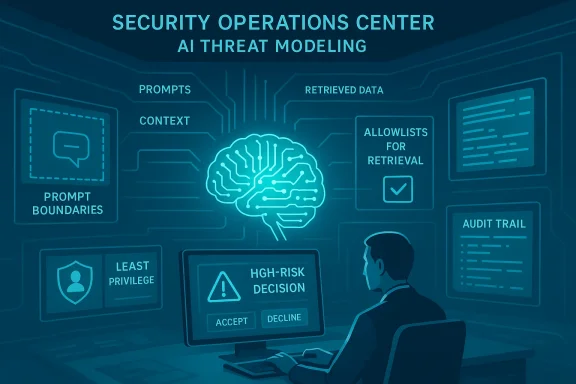
Because AI behavior emerges from interactions among models, data, tools, and users, mitigations that treat the model as a passive component will fail. Microsoft and independent best practices converge on architectural mitigations that constrain failure rather than attempting to perfect model behavior.Key architectural mitigations:
- Prompt boundaries and strict separation of instructions and untrusted content. Encode or otherwise mark untrusted data so that the model cannot easily mistake it for a system instruction. Consider signed, canonical prompts or structural wrappers. (microsoft.com)
- Least privilege for tool access. Agents should request explicit, minimal privileges to perform actions; a policy mediator should authorize tool calls and enforce RBAC. MITRE ATLAS and recent operational guidance emphasize enforcement at the mediator layer.
- Allowlists for retrieval and external calls. Only allow retrieval from known, vetted corpora for sensitive contexts; treat external web content as untrusted by default. (microsoft.com)
- Human‑in‑the‑loop (HITL) for high‑risk decisions. Require explicit human confirmation for irreversible or privacy‑sensitive outputs or actions. Log approvals for auditability. (microsoft.com)
- Validation and redaction. Sanitize model outputs before they reach downstream systems or users; block or redact sensitive data and validate that action proposals match policy constraints.
Detection, observability, and response
Prevention will fail — the design of detection and response determines whether failures become incidents or catastrophes.Essential observability components:
- Logging of prompts and context (with privacy protections): capture the exact prompt assembly used to generate outputs for forensic analysis.
- Attribution and audit trails: tie every API call, tool invocation, and state change to a model instance, user, or agent and to the retrieval source that influenced the prompt.
- Signals for untrusted influence: flag when outputs relied heavily on unvetted external data or when retrievals include content with known risk patterns.
- Behavioral anomaly detection: identify model outputs or action sequences that deviate from historical norms (e.g., unusual tool chaining, repeated access to sensitive data).
- Automated containment for common abuse (rate limits, revoke API keys, disable agent features).
- Human escalation for ambiguous or high‑impact incidents.
- Post‑incident reviews that feed learned failure modes back into training, prompt design, and architectural controls.
Threat modeling at scale: process and playbook
Microsoft recommends treating threat modeling as an ongoing, cross‑functional discipline. Here’s a practical playbook teams can adopt immediately.- Map where untrusted data enters your system. Treat every ingestion point as a security boundary.
- Enumerate assets (safety, trust, confidentiality, instruction integrity, action integrity).
- For each asset, enumerate plausible failure modes (adversarial and accidental).
- For each failure mode, assign impact (high/med/low) and design a response pattern (automated, human review, feature disable).
- Design architectural mitigations (prompt boundaries, least privilege, allowlists, HITL).
- Implement observability: prompt logging, retrieval provenance, action attribution.
- Build detection rules and run red‑teams focused on prompt injection, poisoning, and plugin misuse.
- Maintain a continuous feedback loop: use incidents and red‑team results to update the threat model and controls.
Evidence and independent validation
A few independent sources and findings validate the urgency in Microsoft’s guidance:- OWASP LLM Top 10 catalogues the dominant attack types facing generative systems, putting prompt injection and sensitive information disclosure at the top of priority lists for developers. That taxonomy is now widely used by commercial and open‑source tooling to target mitigations and testing.
- NIST AI RMF provides a voluntary, risk‑based structure for operationalizing trustworthy AI across development and deployment — reinforcing the need to manage data quality, transparency, and governance alongside technical security. NIST’s framework aligns with the asset‑centric, lifecycle approach Microsoft recommends.
- MITRE ATLAS offers a living knowledge base of adversarial tactics and techniques for AI. The ATLAS project catalogs real red‑team case studies and maps them to detection and mitigation patterns, giving threat modelers concrete adversary playbooks to test against.
- Research on prompt injection and testing tools confirms that many models remain vulnerable to crafted instructions and that systematic fuzzing and red‑teaming can uncover exploitation techniques across architectures. Recent papers show high success rates for injection attacks in many testbeds, underscoring why treating these threats as structural (not just implementation bugs) is realistic.
Notable strengths of Microsoft’s guidance
- Practical asset focus. Microsoft forces teams to think beyond “can an attacker exfiltrate data?” to “what must this system never do?” This asset‑centric approach surfaces business and ethical constraints that technical lists miss. (microsoft.com)
- Architectural emphasis. The guidance prioritizes architectural controls that limit blast radius (prompt boundaries, least privilege, explicit mediators) over brittle attempts to make models perfect — a pragmatic stance grounded in both research and field experience. (microsoft.com)
- Lifecycle orientation. By tying threat modeling into design, deployment, monitoring, and response, the guidance aligns with NIST’s RMF and with operational red‑teaming practice, making it implementable in real organizations.
Risks, gaps, and caveats
While Microsoft’s guidance is strong, a few important caveats and gaps remain:- Residual risk remains unavoidable. Independent experts — including the UK’s NCSC — warn that prompt injection may never be fully mitigated in the same way we mitigated SQL injection, because models lack an intrinsic separation between data and instructions. Teams must accept residual risk and design around it. Treat the NCSC’s assessment as a policy posture: reduce impact, don’t assume elimination.
- Operational complexity and tooling maturity. Implementing fine‑grained mediators, signed prompts, and robust retrieval allowlists is nontrivial. Tooling is emerging but inconsistent; MITRE ATLAS and OWASP help, but many organizations will need to invest in custom engineering to reach an acceptable risk profile.
- Data governance and fairness challenges. Microsoft calls out data quality and uneven behavior across languages and cultures. Mitigating these requires investments in diverse training data, evaluation at scale, and governance processes that go beyond typical security budgets. NIST’s RMF highlights this as well. (microsoft.com)
- Emerging attack vectors. Research continues to uncover new classes of semantic attacks (LLM‑to‑LLM prompt infection, multi‑agent chaining) that can evade current defenses. Threat models must be revisited frequently to incorporate research findings.
A pragmatic checklist for teams today
- Map where any external data influences prompts — treat each as a security boundary.
- Enumerate and document assets (safety, trust, privacy, instruction integrity, action integrity).
- For each asset, list failure modes and design a concrete response (automated block, human review, feature disable).
- Enforce least privilege on any model‑triggered action; mediate tool access through an auditable policy layer.
- Treat model output as untrusted content; sanitize, redact, and validate before any downstream execution.
- Log the full prompt context (with privacy controls) and the retrieval provenance for every high‑risk query.
- Build detection rules focused on semantic anomalies (unexpected tool chaining, unusual retrieval patterns).
- Run continuous red‑teams and use automated fuzzing for prompt injection tests — integrate findings back into the model pipeline.
- If a use case cannot tolerate residual risk even after controls, do not deploy the model for that use case.
Conclusion
Threat modeling for AI is no longer a security checkbox — it’s a design discipline that must run across product, engineering, and governance. Microsoft’s guidance is a timely, pragmatic blueprint: treat nondeterminism and instruction bias as architectural realities, model assets like trust and action integrity, and design layered defenses that limit blast radius rather than promising impossible perfection. Independent frameworks from NIST, OWASP, and MITRE — and a growing body of red‑team research — back this approach and provide concrete tools and taxonomies for teams to operationalize it. (microsoft.com)Adopt the asset‑centric, lifecycle approach Microsoft recommends, invest in prompt‑aware architecture and observability, and treat prompt injection and agentic misuse as structural risks that require continuous engineering and policy attention. In practice, that means mapping inputs, setting explicit “never‑do” boundaries, instrumenting detection and response, and being willing to not ship features that can’t be defended. Doing so is the fastest path to deploying AI that is both useful and resilient — and to preserving the trust your users will need to keep using it. (microsoft.com)
Source: Microsoft Threat modeling AI applications | Microsoft Security Blog
